change time GMC SIERRA 2007 Owner's Guide
[x] Cancel search | Manufacturer: GMC, Model Year: 2007, Model line: SIERRA, Model: GMC SIERRA 2007Pages: 680, PDF Size: 3.42 MB
Page 504 of 680
Your dealer has GM-trained service people who
will perform this work using genuine GM parts and
reset the system. It is also important to check
your oil regularly and keep it at the proper level.
If the system is ever reset accidentally, you
must change your oil at 3,000 miles (5 000 km)
since your last oil change. Remember to reset the
oil life system whenever the oil is changed.
How to Reset the Engine Oil Life
System
The Engine Oil Life System calculates when to
change your engine oil and lter based on vehicle
use. Anytime your oil is changed, reset the
system so it can calculate when the next oil
change is required. If a situation occurs where you
change your oil prior to a CHANGE ENGINE
OIL SOON message coming on, reset the system.Always reset the engine oil life to 100% after
every oil change. It will not reset itself. To reset
the Engine Oil Life System, do the following:
1. Display the OIL LIFE REMAINING on the DIC.
If your vehicle does not have DIC buttons, the
vehicle must be in PARK (P) to access this
display. SeeDIC Operation and Displays (With
DIC Buttons) on page 268orDIC Operation
and Displays (Without DIC Buttons) on
page 275.
2. Press and hold the SET/RESET button on
the DIC, or the trip odometer reset stem if
your vehicle does not have DIC buttons,
for more than ve seconds. The oil life will
change to 100%.
If the CHANGE ENGINE OIL SOON message
comes back on when you start your vehicle, the
Engine Oil Life System has not reset. Repeat
the procedure.
504
Page 531 of 680
Brake Pedal Travel
See your dealer/retailer if the brake pedal does
not return to normal height, or if there is a
rapid increase in pedal travel. This could be a sign
that brake service might be required.
Brake Adjustment
Every time you make a brake stop, the brakes
adjust for wear.
Replacing Brake System Parts
The braking system on a vehicle is complex. Its
many parts have to be of top quality and work well
together if the vehicle is to have really good
braking. Your vehicle was designed and tested
with top-quality brake parts. When you replace
parts of the braking system — for example, when
the brake linings wear down and you need
new ones put in — be sure you get new approved
replacement parts. If you do not, the brakesmight not work properly. For example, if someone
puts in brake linings that are wrong for your
vehicle, the balance between the front and rear
brakes can change — for the worse. The braking
performance you have come to expect can
change in many other ways if someone puts in the
wrong replacement brake parts.
Battery
Your vehicle has a maintenance free battery.
When it is time for a new battery, get one that has
the replacement number shown on the original
battery’s label. We recommend an ACDelco
®
replacement battery. SeeEngine Compartment
Overview on page 498for battery location.
Warning:Battery posts, terminals, and related
accessories contain lead and lead compounds,
chemicals known to the State of California
to cause cancer and reproductive harm. Wash
hands after handling.
531
Page 565 of 680
Federal Communications Commission
(FCC) and Industry and Science
Canada
The Tire Pressure Monitor System (TPMS)
operates on a radio frequency and complies with
Part 15 of the FCC Rules. Operation is subject
to the following two conditions:
1. This device may not cause harmful
interference.
2. This device must accept any interference
received, including interference that may
cause undesired operation.
The Tire Pressure Monitor System (TPMS)
operates on a radio frequency and complies
with RSS-210 of Industry and Science Canada.
Operation is subject to the following
two conditions:
1. This device may not cause interference.
2. This device must accept any interference
received, including interference that may
cause undesired operation of the device.
Changes or modications to this system by other
than an authorized service facility could void
authorization to use this equipment.
Tire Inspection and Rotation
Tires should be rotated every 5,000 to 8,000 miles
(8 000 to 13 000 km).
Any time you notice unusual wear, rotate your
tires as soon as possible and check wheel
alignment. Also check for damaged tires or wheels.
SeeWhen It Is Time for New Tires on page 568
andWheel Replacement on page 573for
more information.
Make sure the spare tire is stored securely. Push,
pull, and then try to rotate or turn the tire. If it
moves, use the wheel wrench/hoist shaft to tighten
the cable. SeeChanging a Flat Tire on page 576.
If your vehicle has dual rear wheels, also see
Dual Tire Operation on page 560.
The purpose of regular rotation is to achieve more
uniform wear for all tires on the vehicle. The
rst rotation is the most important. SeeScheduled
Maintenance (Gasoline Engine) on page 623.
565
Page 567 of 680
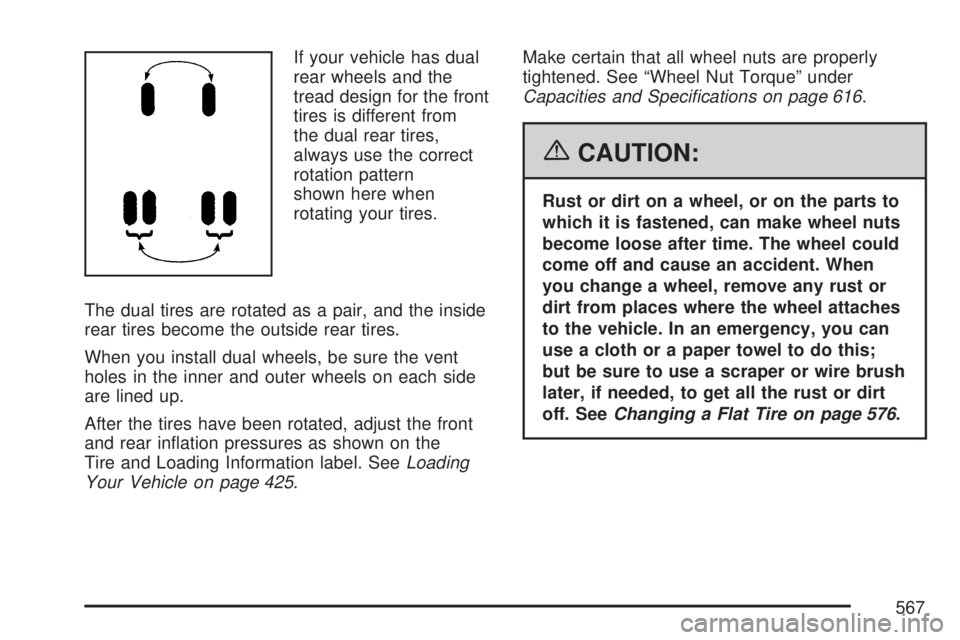
If your vehicle has dual
rear wheels and the
tread design for the front
tires is different from
the dual rear tires,
always use the correct
rotation pattern
shown here when
rotating your tires.
The dual tires are rotated as a pair, and the inside
rear tires become the outside rear tires.
When you install dual wheels, be sure the vent
holes in the inner and outer wheels on each side
are lined up.
After the tires have been rotated, adjust the front
and rear ination pressures as shown on the
Tire and Loading Information label. SeeLoading
Your Vehicle on page 425.Make certain that all wheel nuts are properly
tightened. See “Wheel Nut Torque” under
Capacities and Specications on page 616.
{CAUTION:
Rust or dirt on a wheel, or on the parts to
which it is fastened, can make wheel nuts
become loose after time. The wheel could
come off and cause an accident. When
you change a wheel, remove any rust or
dirt from places where the wheel attaches
to the vehicle. In an emergency, you can
use a cloth or a paper towel to do this;
but be sure to use a scraper or wire brush
later, if needed, to get all the rust or dirt
off. SeeChanging a Flat Tire on page 576.
567
Page 623 of 680
If you want to purchase service information, see
Service Publications Ordering Information on
page 663.
Owner Checks and Services on page 631tells you
what should be checked, when to check it, and
what you can easily do to help keep your vehicle in
good condition.
The proper replacement parts, uids, and
lubricants to use are listed inRecommended
Fluids and Lubricants on page 635andNormal
Maintenance Replacement Parts on page 638.
When your vehicle is serviced, make sure these
are used. All parts should be replaced and all
necessary repairs done before you or anyone else
drives the vehicle. We recommend the use of
genuine GM parts.Scheduled Maintenance
(Gasoline Engine)
This maintenance section applies to vehicles with
a gasoline engine. If your vehicle has a diesel
engine, see the maintenance schedule section in
the DURAMAX
®Diesel Engine Supplement.
When the CHANGE ENGINE OIL SOON message
comes on, it means that service is required for your
vehicle. Have your vehicle serviced as soon as
possible within the next 600 miles (1 000 km). It is
possible that, if you are driving under the best
conditions, the engine oil life system may not
indicate that vehicle service is necessary for over a
year. However, your engine oil and lter must be
changed at least once a year and at this time the
system must be reset. Your GM Goodwrench
®
dealer has GM-trained service technicians who will
perform this work using genuine GM parts and reset
the system.
623
Page 653 of 680
GMC and General Motors of Canada Limited
reserve the right to limit services or reimbursement
to an owner or driver when, in their sole
discretion, the claims become excessive in
frequency or type of occurrence.
Roadside Assistance is not part of or included in
the coverage provided by the New Vehicle Limited
Warranty. GMC and General Motors of Canada
reserve the right to make any changes or
discontinue the Roadside Assistance program at
any time without notication.
Towing and Road Service Exclusions
Specically excluded from Roadside Assistance
coverage are towing or services for vehicles
operated on a non-public roadway or highway,
nes, impound towing caused by a violation
of local, Municipal, State, Provincial, or Federal
law, and mounting, dismounting or changing
of snow tires, chains, or other traction devices.
Courtesy Transportation
To enhance your ownership experience, we and
our participating dealers/retailers are proud to offer
Courtesy Transportation, a customer support
program for new vehicles.
For warranty repairs during the Bumper-to-Bumper
(U.S.) or Base Warranty Coverage period
(Canada), provided by the New Vehicle Limited
Warranty, interim transportation may be available
under the Courtesy Transportation program.
Several courtesy transportation options are
available to assist in reducing your inconvenience
when warranty repairs are required.
Courtesy Transportation is not a part of the New
Vehicle Limited Warranty and is available only
at participating dealers/retailers. A separate
booklet entitled “Warranty and Owner Assistance
Information” furnished with each new vehicle
provides detailed warranty coverage information.
653
Page 655 of 680
In addition, for U.S. customers, should you arrange
transportation through a friend or relative, limited
reimbursement for reasonable fuel expenses may
be available. Claim amounts should reect actual
costs and be supported by original receipts.
Courtesy Rental Vehicle
Your dealer/retailer may arrange to provide you
with a courtesy rental vehicle or reimburse you for
a rental vehicle that you obtain if your vehicle is
kept for an overnight warranty repair. Rental
reimbursement will be limited and must be
supported by original receipts. This requires that
you sign and complete a rental agreement
and meet state/provincial, local, and rental vehicle
provider requirements. Requirements vary and
may include minimum age requirements, insurance
coverage, credit card, etc. You are responsible
for fuel usage charges and may also be
responsible for taxes, levies, usage fees,
excessive mileage, or rental usage beyond the
completion of the repair.
Generally it is not possible to provide a like-vehicle
as a courtesy rental.
Additional Program Information
All program options, such as shuttle service, may
not be available at every dealer/retailer. Please
contact your dealer/retailer for specic information
about availability. All Courtesy Transportation
arrangements will be administered by appropriate
dealer/retailer personnel.
General Motors reserves the right to unilaterally
modify, change or discontinue Courtesy
Transportation at any time and to resolve all
questions of claim eligibility pursuant to the terms
and conditions described herein at its sole
discretion.
655
Page 664 of 680
Owner Information
Owner publications are written specically for
owners and intended to provide basic operational
information about the vehicle. The owner
manual includes the Maintenance Schedule for
all models.
In-Portfolio: Includes a Portfolio, Owner Manual,
and Warranty Booklet.
RETAIL SELL PRICE: $35.00 US
+ Processing Fee
Without Portfolio: Owner Manual only.
RETAIL SELL PRICE: $25.00 US
+ Processing Fee
Current and Past Model Order Forms
Technical Service Bulletins and Manuals are
available for current and past model GM vehicles.
To request an order form, specify year and
model name of the vehicle.
ORDER TOLL FREE: 1-800-551-4123
Monday-Friday 8:00 AM - 6:00 PM
Eastern Time
For Credit Card Orders Only
(VISA-MasterCard-Discover), visit Helm, Inc. on
the World Wide Web at: www.helminc.com
Or you can write to:
Helm, Incorporated
P.O. Box 07130
Detroit, MI 48207
Prices are subject to change without notice and
without incurring obligation. Allow ample time
for delivery.
Note to Canadian Customers: All listed prices are
quoted in U.S. funds. Canadian residents are
to make checks payable in U.S. funds.
664
Page 671 of 680
Gage (cont.)
Tachometer.............................................. 248
Voltmeter Gage........................................ 255
Garage Door Opener................................... 185
Gasoline
Octane..................................................... 489
Specications........................................... 489
Glove Box................................................... 196
GM Mobility Reimbursement Program.......... 649
H
Hazard Warning Flashers............................ 211
Head Restraints............................................ 18
Headlamps.................................................. 544
Bulb Replacement.................................... 543
Daytime Running Lamps.......................... 222
Flash-to-Pass........................................... 214
Halogen Bulbs......................................... 544
High/Low Beam Changer......................... 214
On Reminder........................................... 222
Pickup Box Identication and Fender
Marker Lamps...................................... 546
Heated Seats................................................ 12
Heater................................................234, 237
Heater......................................................... 238Highbeam On Light..................................... 265
Highway Hypnosis....................................... 415
Hill and Mountain Roads............................. 416
Hood
Checking Things Under............................ 496
Release................................................... 497
Horn............................................................ 211
How to Use This Manual................................ 4
How to Wear Safety Belts Properly............... 27
I
Ignition Positions......................................... 133
Infants and Young Children, Restraints.......... 48
Ination - Tire Pressure............................... 559
Instrument Panel
Overview.........................................206, 209
Storage Area............................................ 197
Instrument Panel (I/P)
Brightness................................................ 225
Cluster..................................................... 247
J
Jump Starting.............................................. 532
671
Page 679 of 680
Tires (cont.)
If a Tire Goes Flat................................... 576
Ination - Tire Pressure............................ 559
Inspection and Rotation............................ 565
Installing the Spare Tire........................... 582
Pressure Monitor System......................... 561
Removing the Flat Tire............................. 582
Removing the Spare Tire and Tools......... 578
Secondary Latch System......................... 589
Spare Tire................................................ 596
Storing a Flat or Spare Tire and Tools..... 592
Tire Sidewall Labeling.............................. 551
Tire Terminology and Denitions............... 556
Uniform Tire Quality Grading.................... 571
Wheel Alignment and Tire Balance........... 572
Wheel Replacement................................. 573
When It Is Time for New Tires................. 568
Tow/Haul Mode........................................... 144
Tow/Haul Mode Light................................... 266
Towing
Recreational Vehicle................................. 439
Towing a Trailer....................................... 445
Your Vehicle............................................. 439
Traction
StabiliTrak
®System................................. 381Trailer
Recommendations.................................... 482
Transmission
Fluid, Automatic....................................... 508
Transmission Operation, Automatic.............. 138
Trip Odometer............................................. 248
Truck-Camper Loading Information.............. 436
Turn and Lane-Change Signals................... 213
Turn Signal/Multifunction Lever.................... 212
U
Ultrasonic Rear Parking Assist (URPA)........ 228
Understanding Radio Reception................... 369
Uniform Tire Quality Grading....................... 571
Universal Home Remote System................. 185
Operation........................................185, 189
System Identication................................ 184
V
Vehicle
Control..................................................... 378
Damage Warnings....................................... 5
Loading.................................................... 425
Symbols...................................................... 5
679