wheel torque GMC SIERRA 2008 User Guide
[x] Cancel search | Manufacturer: GMC, Model Year: 2008, Model line: SIERRA, Model: GMC SIERRA 2008Pages: 578, PDF Size: 6.47 MB
Page 496 of 578
{CAUTION:
Incorrect or improperly tightened wheel nuts
can cause the wheel to come loose and even
come off. This could lead to a crash. If you
have to replace them, be sure to get new
original equipment wheel nuts. Stop
somewhere as soon as you can and have the
nuts tightened with a torque wrench to the
proper torque specication. SeeCapacities
and Specifications on page 5-130for wheel nut
torque specication.
Notice:Improperly tightened wheel nuts can lead
to brake pulsation and rotor damage. To avoid
expensive brake repairs, evenly tighten the wheel
nuts in the proper sequence and to the proper
torque specication. SeeCapacities and
Specifications on page 5-130for the wheel nut
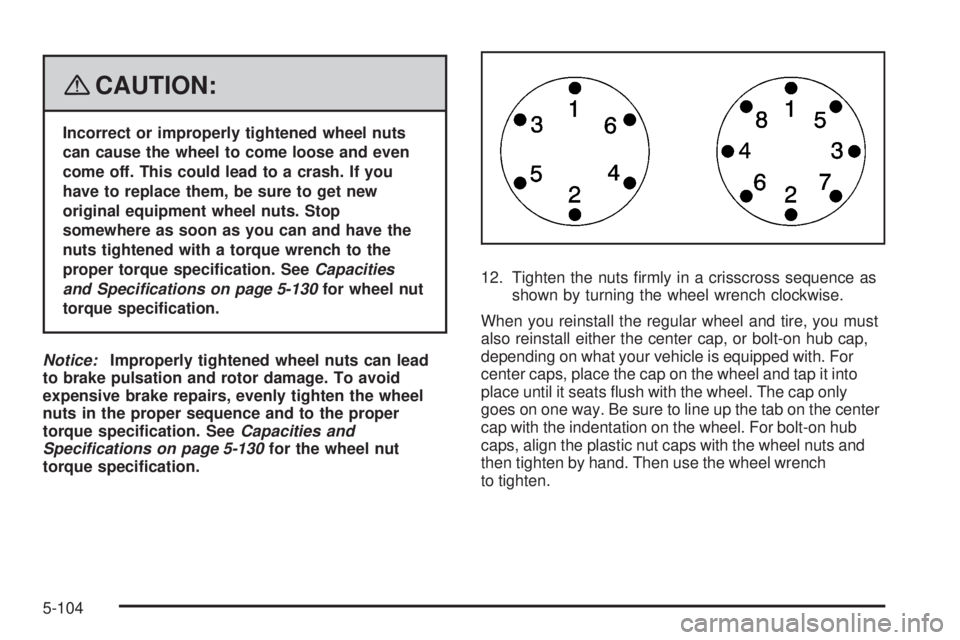
torque specication.12. Tighten the nuts rmly in a crisscross sequence as
shown by turning the wheel wrench clockwise.
When you reinstall the regular wheel and tire, you must
also reinstall either the center cap, or bolt-on hub cap,
depending on what your vehicle is equipped with. For
center caps, place the cap on the wheel and tap it into
place until it seats ush with the wheel. The cap only
goes on one way. Be sure to line up the tab on the center
cap with the indentation on the wheel. For bolt-on hub
caps, align the plastic nut caps with the wheel nuts and
then tighten by hand. Then use the wheel wrench
to tighten.
5-104
Page 523 of 578
ApplicationCapacities
English Metric
2500 Series Standard Box 26.0 gal 98.0 L
2500 Series and 3500 Series Long Box 34.0 gal 128.7 L
3500 Series Chassis Cab 50.0 gal 189.0 L
3500 Chassis Cab – Front Tank 27.0 gal 102.0 L
3500 Chassis Cab – Rear Tank 23.0 gal (if equipped) 87.0 L
Transmission Fluid (Pan Removal and Filter Replacement)
Auto 4-Speed Transmission 4L60-E Electronic
Transmission5.0 qt 4.7 L
Auto 4-Speed Transmission 4L70-E Super Duty
Transmission5.0 qt 4.7 L
Auto 6-Speed Transmission 6L80-E 6.0 qt 5.7 L
Auto 6-Speed Transmission 6L90-E 6.3 qt 6.0 L
Auto 6-Speed Transmission Allison 7.4 qt 7.0 L
Transfer Case Fluid 1.6 qt 1.5 L
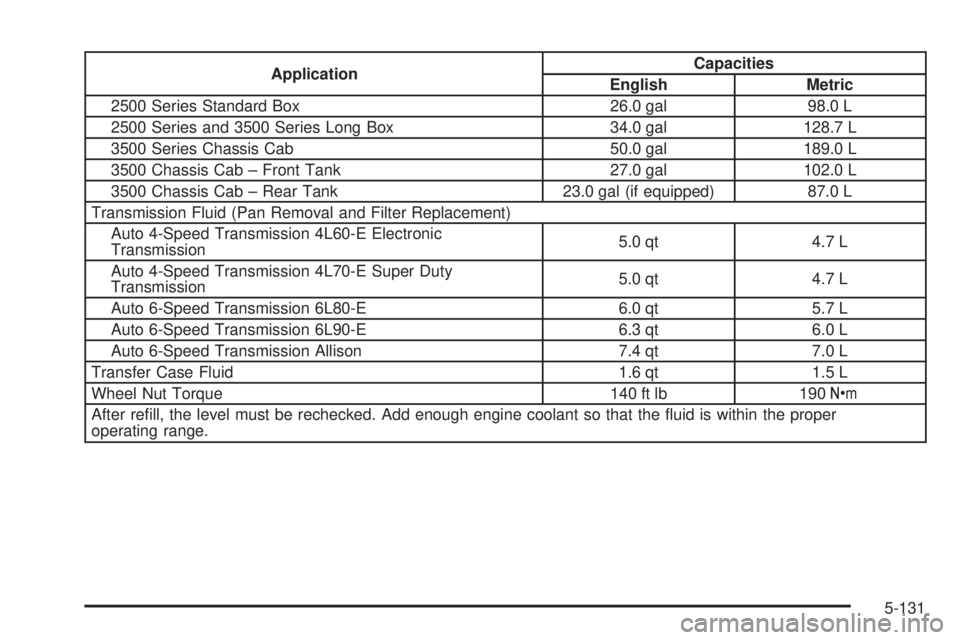
Wheel Nut Torque 140 ft lb 190Y
After rell, the level must be rechecked. Add enough engine coolant so that the uid is within the proper
operating range.
5-131
Page 535 of 578
(l)Extreme Duty Service: Change transfer case fluid if
the vehicle is mainly driven off-road in four-wheel
drive, or is used for heavy trailer towing. Farming,
mining, forestry, and Department of Natural Resources
(DNR) vehicles meet this definition.
(m)During any maintenance, if a power washer is used
to clean mud and dirt from the underbody, care should be
taken to not directly spray the transfer case output seals.
High pressure water can overcome the seals and
contaminate the transfer case fluid. Contaminated fluid
will decrease the life of the transfer case and should be
replaced.
(n)Vehicles with diesel engine or with GVWR above
10,000 lbs (4 536 kg) only: Inspect shields for damage or
looseness. Adjust or replace as required. This is a
Noise Emission Control Service. Applicable to vehicles
sold in the United States and recommended for
vehicles sold in Canada.
(p)If you drive regularly under dusty conditions, inspect
the filter or change indicator (if equipped) at each
engine oil change.
(q)Visually inspect belt for fraying, excessive cracks, or
obvious damage. Replace belt if necessary.Owner Checks and Services
These owner checks and services should be performed
at the intervals specied to help ensure the safety,
dependability, and emission control performance of your
vehicle. Your dealer/retailer can assist you with these
checks and services.
Be sure any necessary repairs are completed at once.
Whenever any uids or lubricants are added to your
vehicle, make sure they are the proper ones, as shown
inRecommended Fluids and Lubricants on page 6-15.
At the First 100, 1,000 and 6,000
Miles (160, 1 600 and 10 000 km)
For vehicles with dual wheels, check dual wheel
nut torque. For proper torque, seeCapacities and
Specifications on page 5-130.
At Each Fuel Fill
It is important to perform these underhood checks at
each fuel fill.
6-11