lock GMC SIERRA 2010 Owner's Manual
[x] Cancel search | Manufacturer: GMC, Model Year: 2010, Model line: SIERRA, Model: GMC SIERRA 2010Pages: 630, PDF Size: 4.65 MB
Page 525 of 630

The TPMS sensor matching process is outlined below:1. Set the parking brake.
2. Turn the ignition switch to ON/RUN with the engine off.
3. Press the Remote Keyless Entry (RKE) transmitter's LOCK and UNLOCK buttons at the
same time for approximately five seconds. The
horn sounds twice to signal the receiver is in
relearn mode and TIRE LEARNING ACTIVE
message displays on the DIC screen.
If your vehicle does not have RKE, press the
Driver Information Center (DIC) vehicle information
button until the PRESS
VTO RELEARN TIRE
POSITIONS message displays. The horn sounds
twice to signal the receiver is in relearn mode and
TIRE LEARNING ACTIVE message displays on
the DIC screen.
If your vehicle does not have RKE or DIC buttons,
press the trip odometer reset stem located on the
instrument panel cluster until the PRESS
VTO
RELEARN TIRE POSITIONS message displays.
The horn sounds twice to signal the receiver is in
relearn mode and TIRE LEARNING ACTIVE
message displays on the DIC screen.
4. Start with the driver side front tire. 5. Remove the valve cap from the valve cap stem.
Activate the TPMS sensor by increasing or
decreasing the tire's air pressure for five seconds,
or until a horn chirp sounds. The horn chirp, which
may take up to 30 seconds to sound, confirms that
the sensor identification code has been matched to
this tire and wheel position.
6. Proceed to the passenger side front tire, and repeat the procedure in Step 5.
7. Proceed to the passenger side rear tire, and repeat the procedure in Step 5.
8. Proceed to the driver side rear tire, and repeat the procedure in Step 5. The horn sounds two times to
indicate the sensor identification code has been
matched to the driver side rear tire, and that the
TPMS sensor matching process is no longer
active. The TIRE LEARNING ACTIVE message on
the DIC display screen goes off.
9. Turn the ignition switch to LOCK/OFF.
10. Set all four tires to the recommended air pressure level as indicated on the Tire and Loading
Information label.
11. Put the valve caps back on the valve stems.
6-79
Page 531 of 630
Different Size Tires and Wheels
If you add wheels or tires that are a different size than
your original equipment wheels and tires, this could
affect the way your vehicle performs, including its
braking, ride and handling characteristics, stability, and
resistance to rollover. Additionally, if your vehicle has
electronic systems such as anti‐lock brakes, rollover
airbags, traction control, and electronic stability control,
the performance of these systems can be affected.
{WARNING:
If you add different sized wheels, your vehicle
may not provide an acceptable level of
performance and safety if tires not recommended
for those wheels are selected. You may increase
the chance that you will crash and suffer serious
injury. Only use GM specific wheel and tire
systems developed for your vehicle, and have
them properly installed by a GM certified
technician.
See Buying New Tires
on page 6‑83andAccessories
and Modificationson page 6‑4for additional
information.
Uniform Tire Quality Grading
Quality grades can be found where applicable on
the tire sidewall between tread shoulder and
maximum section width. For example:
Treadwear 200 Traction AA
Temperature A
The following information relates to the system
developed by the United States National
Highway Traffic Safety Administration (NHTSA),
which grades tires by treadwear, traction, and
temperature performance. This applies only to
vehicles sold in the United States. The grades are
molded on the sidewalls of most passenger car
tires. The Uniform Tire Quality Grading (UTQG)
system does not apply to deep tread, winter-type
snow tires, space-saver, or temporary use
spare tires, tires with nominal rim diameters of
10 to 12 inches (25 to 30 cm), or to some
limited-production tires.
6-85
Page 537 of 630
WARNING: (Continued)
3. If you have a four-wheel-drive vehicle, be surethe transfer case is in a drive gear –not in
N (Neutral).
4. Turn off the engine and do not restart while the vehicle is raised.
5. Do not allow passengers to remain in the vehicle.
To be even more certain the vehicle will not move,
put blocks at the front and rear of the tire farthest
away from the one being changed. That would be
the tire on the other side, at the opposite end of
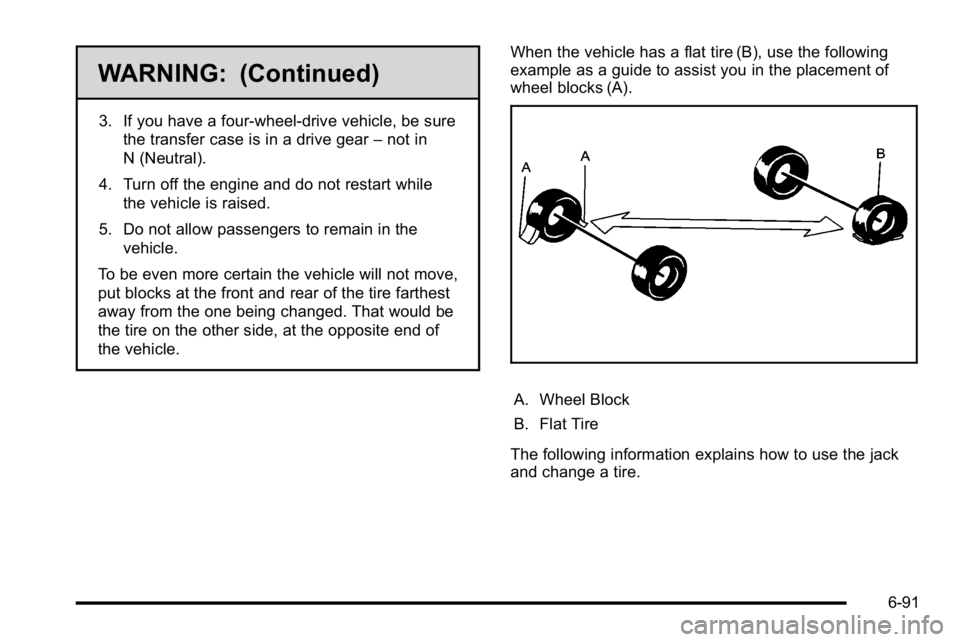
the vehicle. When the vehicle has a flat tire (B), use the following
example as a guide to assist you in the placement of
wheel blocks (A).
A. Wheel Block
B. Flat Tire
The following information explains how to use the jack
and change a tire.
6-91
Page 538 of 630
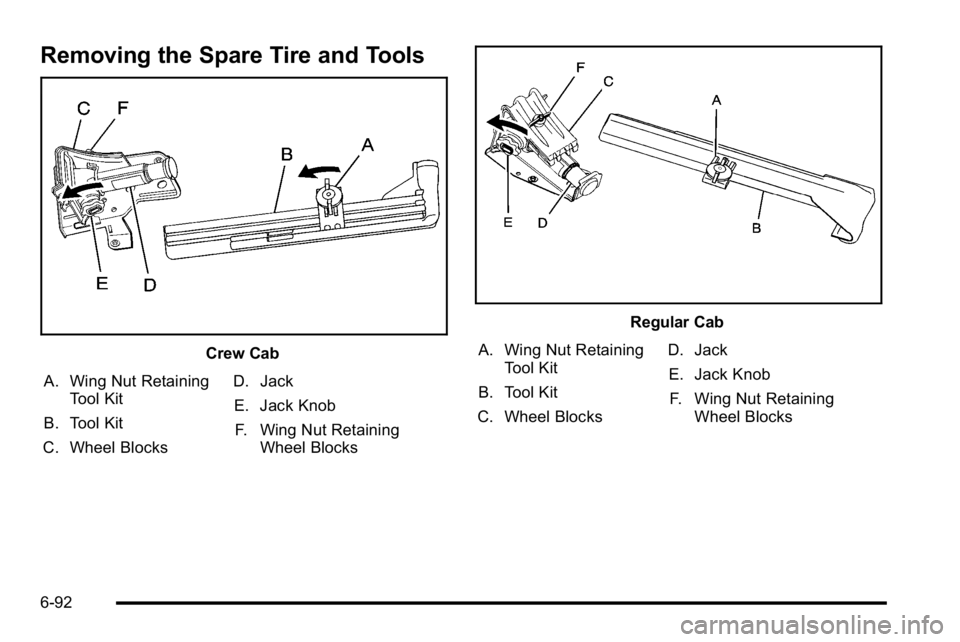
Removing the Spare Tire and Tools
Crew Cab
A. Wing Nut Retaining Tool Kit
B. Tool Kit
C. Wheel Blocks D. Jack
E. Jack Knob F. Wing Nut Retaining Wheel Blocks
Regular Cab
A. Wing Nut Retaining Tool Kit
B. Tool Kit
C. Wheel Blocks D. Jack
E. Jack Knob F. Wing Nut Retaining Wheel Blocks
6-92
Page 539 of 630
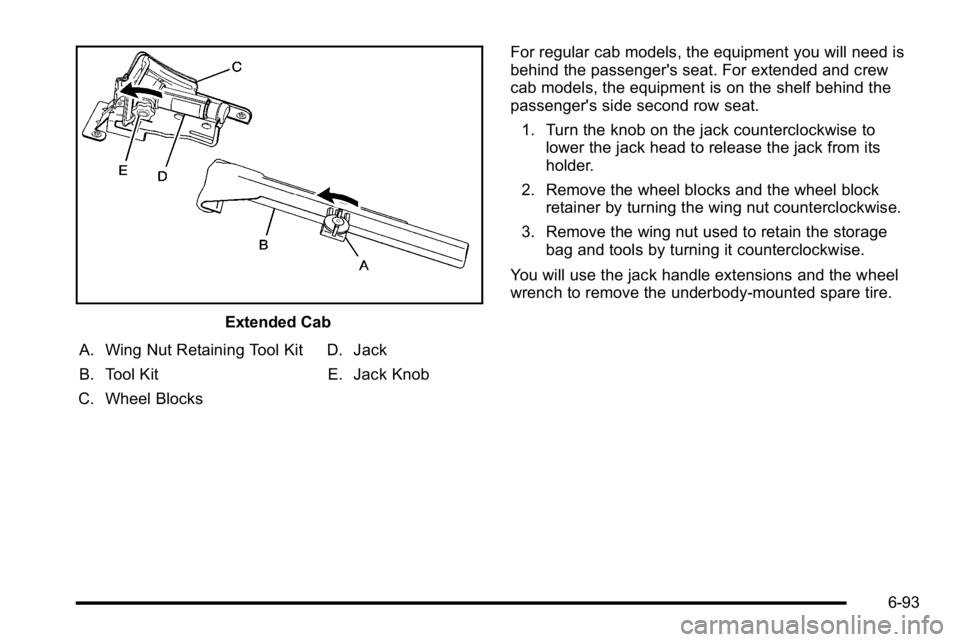
Extended Cab
A. Wing Nut Retaining Tool Kit
B. Tool Kit
C. Wheel Blocks D. Jack
E. Jack Knob For regular cab models, the equipment you will need is
behind the passenger's seat. For extended and crew
cab models, the equipment is on the shelf behind the
passenger's side second row seat.
1. Turn the knob on the jack counterclockwise to lower the jack head to release the jack from its
holder.
2. Remove the wheel blocks and the wheel block retainer by turning the wing nut counterclockwise.
3. Remove the wing nut used to retain the storage bag and tools by turning it counterclockwise.
You will use the jack handle extensions and the wheel
wrench to remove the underbody-mounted spare tire.
6-93
Page 540 of 630

A. Spare Tire(Valve Stem
Pointed Down)
B. Hoist Assembly
C. Hoist Cable
D. Tire/Wheel Retainer
E. Hoist Shaft F. Hoist End of
Extension Tool
G. Hoist Shaft Access Hole
H. Wheel Wrench
I. Jack Handle Extensions
J. Spare Tire Lock (If equipped) 1. Open the spare tire lock cover on the bumper and
use the ignition key to remove the spare tire
lock (J). To remove the spare tire lock, insert the
ignition key turn and pull straight out.
2. Assemble the wheel wrench (H) and the two jack
handle extensions (I) as shown.
6-94
Page 541 of 630
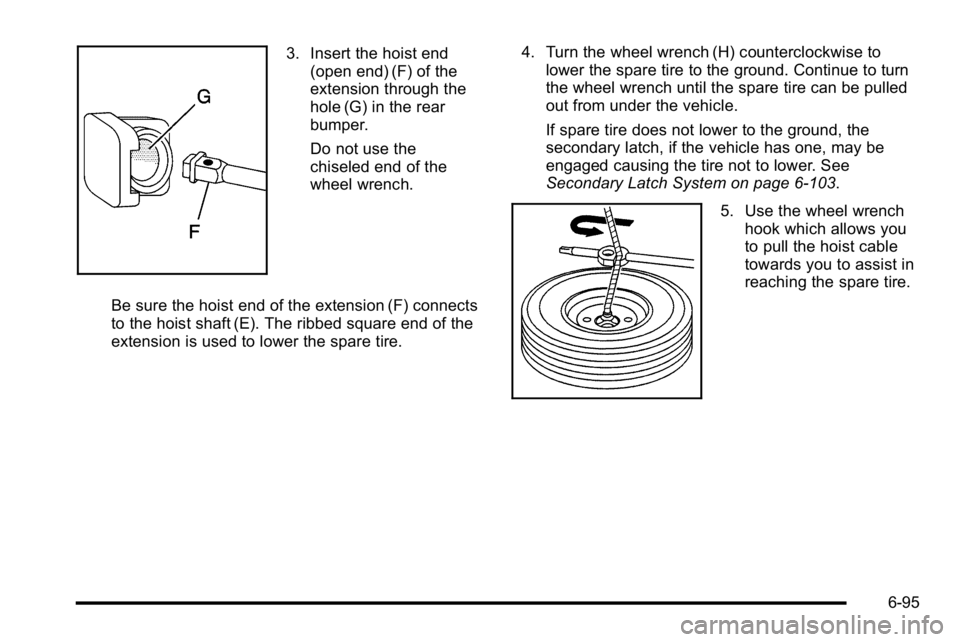
3. Insert the hoist end(open end) (F) of the
extension through the
hole (G) in the rear
bumper.
Do not use the
chiseled end of the
wheel wrench.
Be sure the hoist end of the extension (F) connects
to the hoist shaft (E). The ribbed square end of the
extension is used to lower the spare tire. 4. Turn the wheel wrench (H) counterclockwise to
lower the spare tire to the ground. Continue to turn
the wheel wrench until the spare tire can be pulled
out from under the vehicle.
If spare tire does not lower to the ground, the
secondary latch, if the vehicle has one, may be
engaged causing the tire not to lower. See
Secondary Latch System on page 6‑103.
5. Use the wheel wrench
hook which allows you
to pull the hoist cable
towards you to assist in
reaching the spare tire.
6-95
Page 543 of 630
Removing the Flat Tire and Installing
the Spare Tire
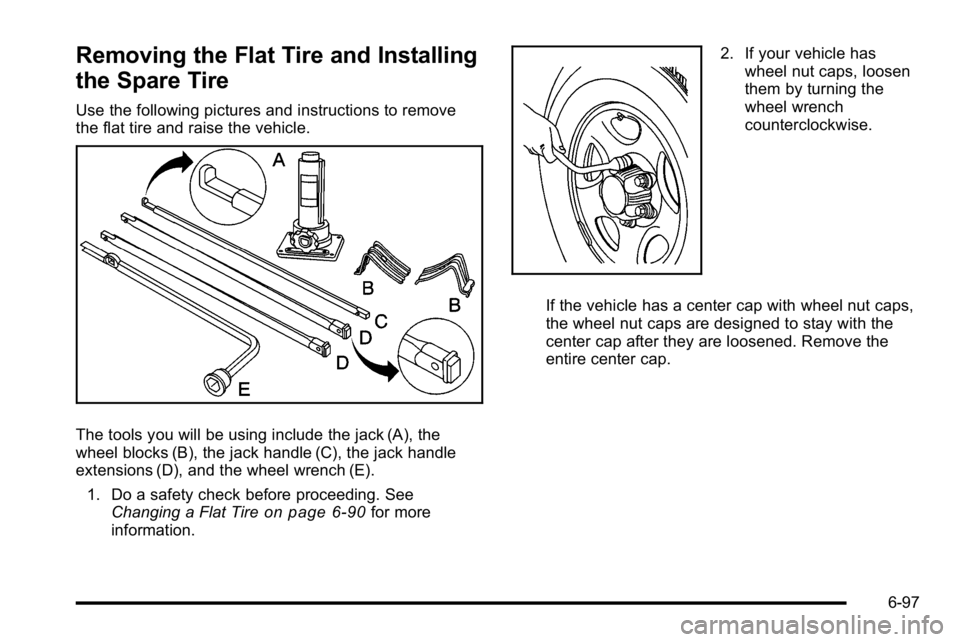
Use the following pictures and instructions to remove
the flat tire and raise the vehicle.
The tools you will be using include the jack (A), the
wheel blocks (B), the jack handle (C), the jack handle
extensions (D), and the wheel wrench (E).1. Do a safety check before proceeding. See Changing a Flat Tire
on page 6‑90for more
information.
2. If your vehicle has wheel nut caps, loosen
them by turning the
wheel wrench
counterclockwise.
If the vehicle has a center cap with wheel nut caps,
the wheel nut caps are designed to stay with the
center cap after they are loosened. Remove the
entire center cap.
6-97
Page 544 of 630
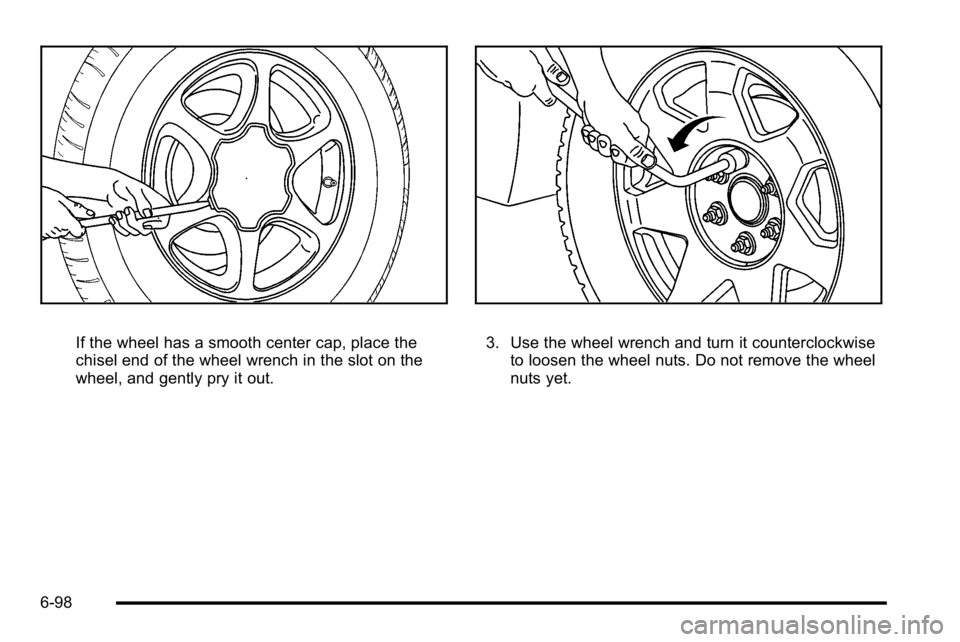
If the wheel has a smooth center cap, place the
chisel end of the wheel wrench in the slot on the
wheel, and gently pry it out.3. Use the wheel wrench and turn it counterclockwiseto loosen the wheel nuts. Do not remove the wheel
nuts yet.
6-98
Page 546 of 630
Make sure that the jack head is positioned so that
the rear axle is resting securely between the
grooves that are on the jack head.
{WARNING:
Getting under a vehicle when it is jacked up is
dangerous. If the vehicle slips off the jack, you
could be badly injured or killed. Never get under a
vehicle when it is supported only by a jack.
{WARNING:
Raising your vehicle with the jack improperly
positioned can damage the vehicle and even
make the vehicle fall. To help avoid personal
injury and vehicle damage, be sure to fit the
jack lift head into the proper location before
raising the vehicle.
6. Turn the wheel wrench clockwise to raise the vehicle. Raise the vehicle far enough off the
ground so there is enough room for the spare tire
to fit under the wheel well.
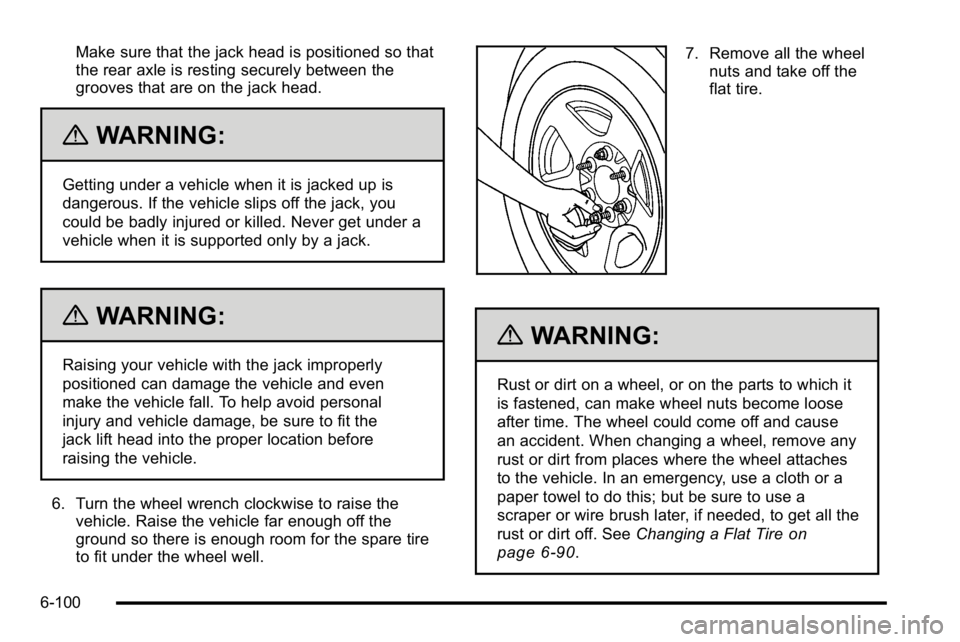
7. Remove all the wheelnuts and take off the
flat tire.
{WARNING:
Rust or dirt on a wheel, or on the parts to which it
is fastened, can make wheel nuts become loose
after time. The wheel could come off and cause
an accident. When changing a wheel, remove any
rust or dirt from places where the wheel attaches
to the vehicle. In an emergency, use a cloth or a
paper towel to do this; but be sure to use a
scraper or wire brush later, if needed, to get all the
rust or dirt off. See Changing a Flat Tire
on
page 6‑90
.
6-100