wheel GMC SIERRA 2014 Owners Manual
[x] Cancel search | Manufacturer: GMC, Model Year: 2014, Model line: SIERRA, Model: GMC SIERRA 2014Pages: 544, PDF Size: 13.79 MB
Page 334 of 544
Black plate (64,1)GMC Sierra Owner Manual (GMNA-Localizing-U.S./Canada/Mexico-
5853626) - 2014 - CRC - 6/6/14
9-64 Driving and Operating
Disconnecting the Rear Vision
Camera (RVC)
The RVC must be disconnected if
the tailgate needs to be removed.
The RVC is disconnected by
removing the connector from the
electrical junction block mounted on
the left side of the cross member of
the vehicle frame. After
disconnecting, the cap mounted
next to the camera connector must
be relocated so that the open
terminals on the junction block are
covered.
Assistance Systems for
Driving
If equipped, when driving the
vehicle, Forward Collision Alert
(FCA) and Lane Departure Warning
(LDW) can help to avoid a crash or
reduce crash damage.
Forward Collision Alert
(FCA) System
If equipped, the FCA system may
help to avoid or reduce the harm
caused by front-end crashes. When
approaching a vehicle ahead too
quickly, FCA provides a red flashing
alert on the windshield and rapidly
beeps or pulses the driver seat.
FCA also lights an amber visual
alert if following another vehicle
much too closely.
FCA detects vehicles within a
distance of approximately 60 m
(197 ft) and operates at speeds
above 40 km/h (25 mph).
{Warning
FCA is a warning system and
does not apply the brakes. When
approaching a slower-moving or
stopped vehicle ahead too rapidly,
or when following a vehicle too
closely, FCA may not provide a(Continued)
Warning (Continued)
warning with enough time to help
avoid a crash. FCA does not warn
of pedestrians, animals, signs,
guardrails, bridges, construction
barrels, or other objects. Be ready
to take action and apply the
brakes. For more information, see
Defensive Driving on page 9-3.
FCA can be disabled with the FCA
steering wheel control.
Detecting the Vehicle Ahead
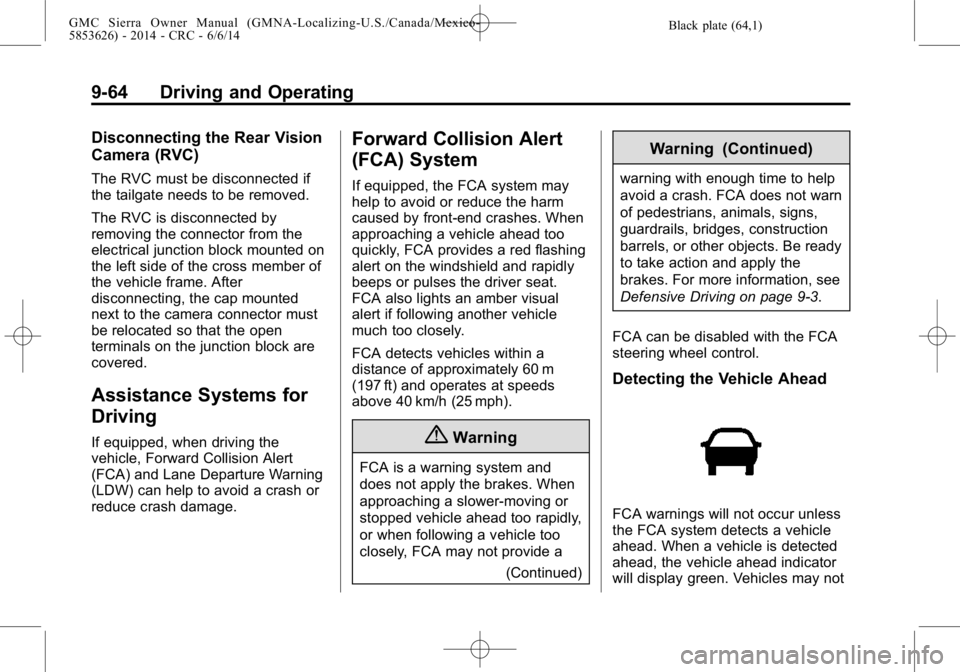
FCA warnings will not occur unless
the FCA system detects a vehicle
ahead. When a vehicle is detected
ahead, the vehicle ahead indicator
will display green. Vehicles may not
Page 336 of 544
Black plate (66,1)GMC Sierra Owner Manual (GMNA-Localizing-U.S./Canada/Mexico-
5853626) - 2014 - CRC - 6/6/14
9-66 Driving and Operating
Selecting the Alert Timing
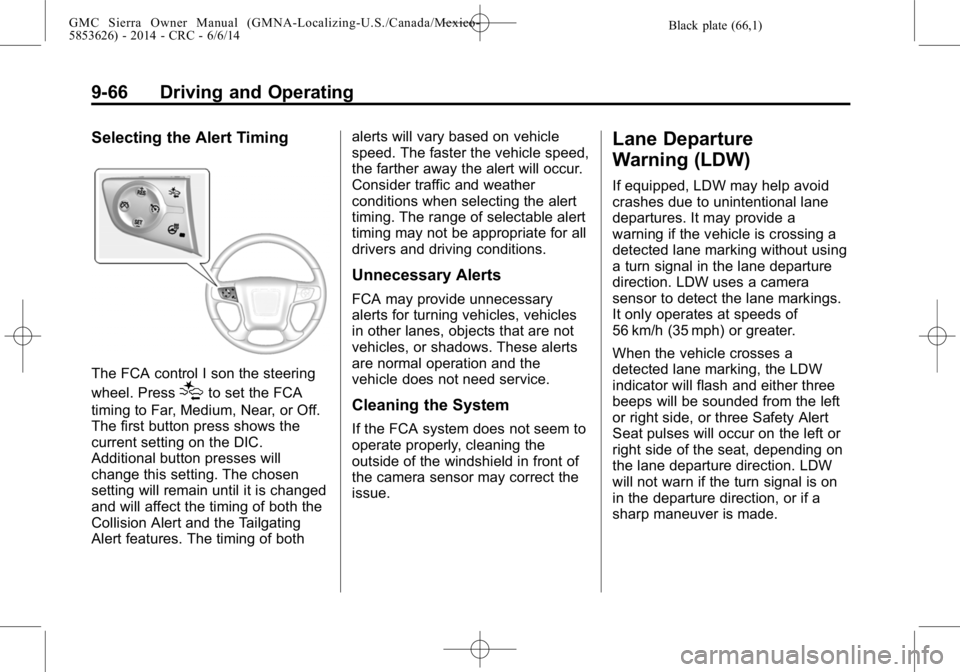
The FCA control I son the steering
wheel. Press
[to set the FCA
timing to Far, Medium, Near, or Off.
The first button press shows the
current setting on the DIC.
Additional button presses will
change this setting. The chosen
setting will remain until it is changed
and will affect the timing of both the
Collision Alert and the Tailgating
Alert features. The timing of both alerts will vary based on vehicle
speed. The faster the vehicle speed,
the farther away the alert will occur.
Consider traffic and weather
conditions when selecting the alert
timing. The range of selectable alert
timing may not be appropriate for all
drivers and driving conditions.
Unnecessary Alerts
FCA may provide unnecessary
alerts for turning vehicles, vehicles
in other lanes, objects that are not
vehicles, or shadows. These alerts
are normal operation and the
vehicle does not need service.
Cleaning the System
If the FCA system does not seem to
operate properly, cleaning the
outside of the windshield in front of
the camera sensor may correct the
issue.
Lane Departure
Warning (LDW)
If equipped, LDW may help avoid
crashes due to unintentional lane
departures. It may provide a
warning if the vehicle is crossing a
detected lane marking without using
a turn signal in the lane departure
direction. LDW uses a camera
sensor to detect the lane markings.
It only operates at speeds of
56 km/h (35 mph) or greater.
When the vehicle crosses a
detected lane marking, the LDW
indicator will flash and either three
beeps will be sounded from the left
or right side, or three Safety Alert
Seat pulses will occur on the left or
right side of the seat, depending on
the lane departure direction. LDW
will not warn if the turn signal is on
in the departure direction, or if a
sharp maneuver is made.
Page 345 of 544
Black plate (75,1)GMC Sierra Owner Manual (GMNA-Localizing-U.S./Canada/Mexico-
5853626) - 2014 - CRC - 6/6/14
Driving and Operating 9-75
Before starting, check all trailer hitch
parts and attachments, safety
chains, electrical connectors, lamps,
tires, and mirrors. If the trailer has
electric brakes, start the
combination moving and then apply
the trailer brake controller by hand
to be sure the brakes work.
During the trip, check occasionally
to be sure that the load is secure
and the lamps and any trailer
brakes still work.
Following Distance
Stay at least twice as far behind the
vehicle ahead as you would when
driving the vehicle without a trailer.
This can help to avoid heavy
braking and sudden turns.
Passing
More passing distance is needed
when towing a trailer. The
combination will not accelerate as
quickly and is longer so it is
necessary to go much farther
beyond the passed vehicle before
returning to the lane.
Backing Up
Hold the bottom of the steering
wheel with one hand. To move the
trailer to the left, move that hand to
the left. To move the trailer to the
right, move your hand to the right.
Always back up slowly and,
if possible, have someone
guide you.
Making Turns
{Caution
Making very sharp turns while
trailering could cause the trailer to
come in contact with the vehicle.
The vehicle could be damaged.
Avoid making very sharp turns
while trailering.
When turning with a trailer, make
wider turns than normal. Do this so
the trailer will not strike soft
shoulders, curbs, road signs, trees,
or other objects. Avoid jerky or
sudden maneuvers. Signal well in
advance. If the trailer turn signal bulbs burn
out, the arrows on the instrument
cluster will still flash for turns. It is
important to check occasionally to
be sure the trailer bulbs are still
working.
Driving on Grades
Reduce speed and shift to a lower
gear
before starting down a long or
steep downgrade. If the
transmission is not shifted down, the
brakes might get hot and no longer
work well.
Vehicles can tow in D (Drive). Shift
the transmission to a lower gear if
the transmission shifts too often
under heavy loads and/or hilly
conditions.
The Tow/Haul Mode may be used if
the transmission shifts too often.
See Tow/Haul Mode on page 9-38.
When towing at high altitude on
steep uphill grades, consider the
following: Engine coolant will boil at
a lower temperature than at normal
altitudes. If the engine is turned off
Page 346 of 544
Black plate (76,1)GMC Sierra Owner Manual (GMNA-Localizing-U.S./Canada/Mexico-
5853626) - 2014 - CRC - 6/6/14
9-76 Driving and Operating
immediately after towing at high
altitude on steep uphill grades, the
vehicle may show signs similar to
engine overheating. To avoid this,
let the engine run while parked,
preferably on level ground, with the
transmission in P (Park) for a few
minutes before turning the engine
off. If the overheat warning comes
on, seeEngine Overheating on
page 10-23.
Parking on Hills
{Warning
Parking the vehicle on a hill with
the trailer attached can be
dangerous. If something goes
wrong, the rig could start to move.
People can be injured, and both
the vehicle and the trailer can be
damaged. When possible, always
park the rig on a flat surface. If parking the rig on a hill:
1. Press the brake pedal, but do
not shift into P (Park) yet. Turn
the wheels into the curb if facing
downhill or into traffic if facing
uphill.
2. Have someone place chocks under the trailer wheels.
3. When the wheel chocks are in place, release the regular brakes
until the chocks absorb the load.
4. Reapply the brake pedal. Then apply the parking brake and shift
into P (Park).
5. Release the brake pedal.
Leaving After Parking on a Hill
1. Apply and hold the brake pedal.
2. Start the engine.
3. Shift into a gear.
4. Release the parking brake. 5. Let up on the brake pedal.
6. Drive slowly until the trailer is
clear of the chocks.
7. Stop and have someone pick up and store the chocks.
Maintenance when Trailer
Towing
The vehicle needs service more
often when pulling a trailer. See
Maintenance Schedule on
page 11-3. Things that are
especially important in trailer
operation are automatic
transmission fluid, engine oil, axle
lubricant, belts, cooling system, and
brake system. It is a good idea to
inspect these before and during
the trip.
Check periodically to see that all
hitch nuts and bolts are tight.
Page 348 of 544
Black plate (78,1)GMC Sierra Owner Manual (GMNA-Localizing-U.S./Canada/Mexico-
5853626) - 2014 - CRC - 6/6/14
9-78 Driving and Operating
Weight of the Trailer
How heavy can a trailer safely be?
It depends on how the rig is used.
Speed, altitude, road grades,
outside temperature, and how much
the vehicle is used to pull a trailer
are all important. It can depend on
any special equipment on the
vehicle, and the amount of tongue
weight the vehicle can carry. See
“Weight of the Trailer Tongue”later
in this section for more information.
Trailer weight rating (TWR) is
calculated assuming the tow vehicle
has only the driver but all required
trailering equipment. Weight of
additional optional equipment,
passengers, and cargo in the tow
vehicle must be subtracted from the
trailer weight rating. For kingpin weight and trailer
tongue weight information, see
“Weight of the Trailer Tongue”
later
in this section.
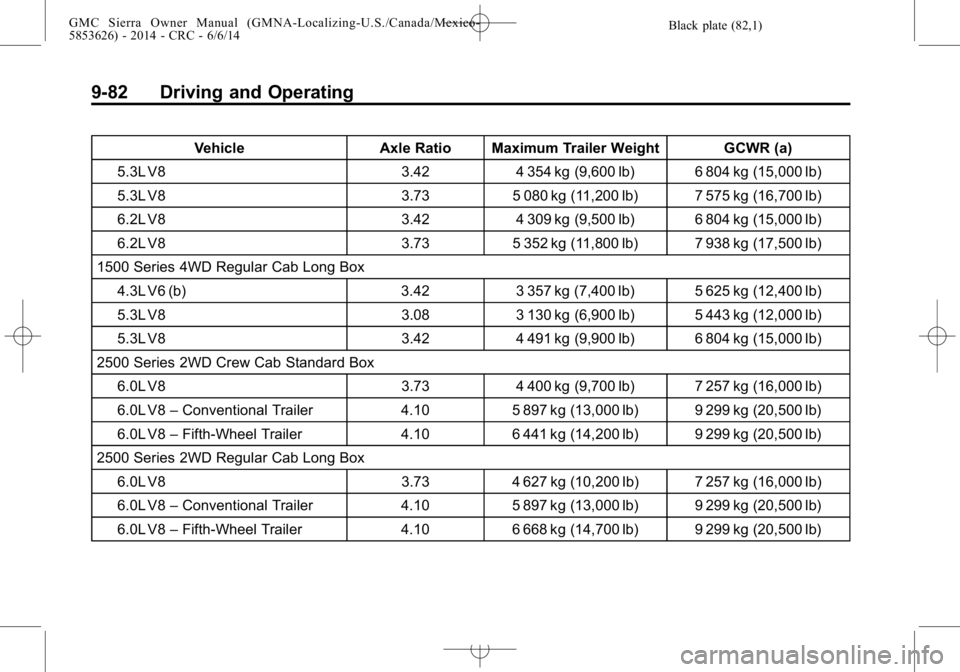
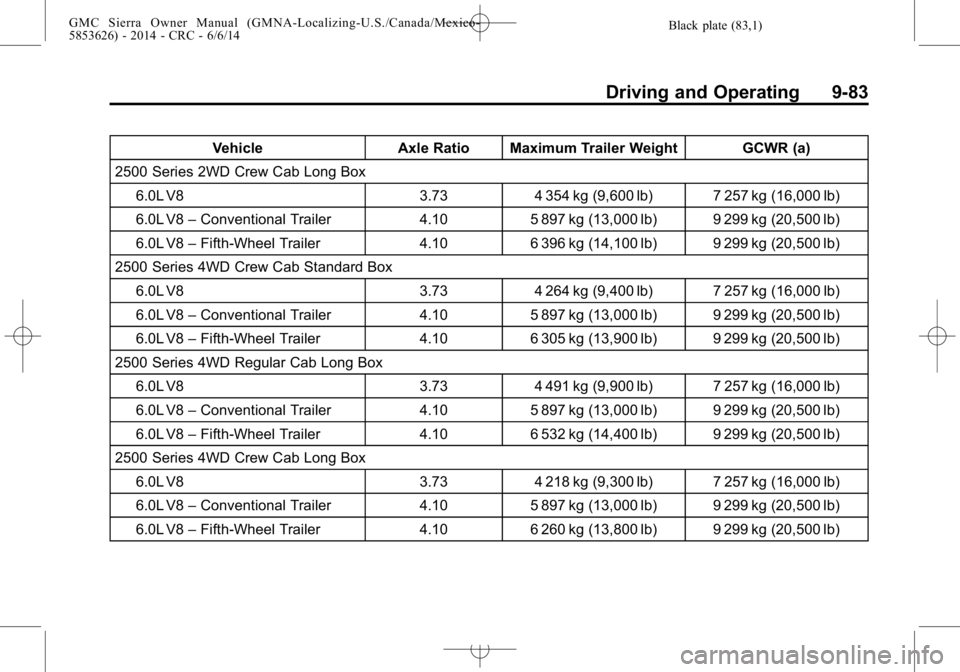
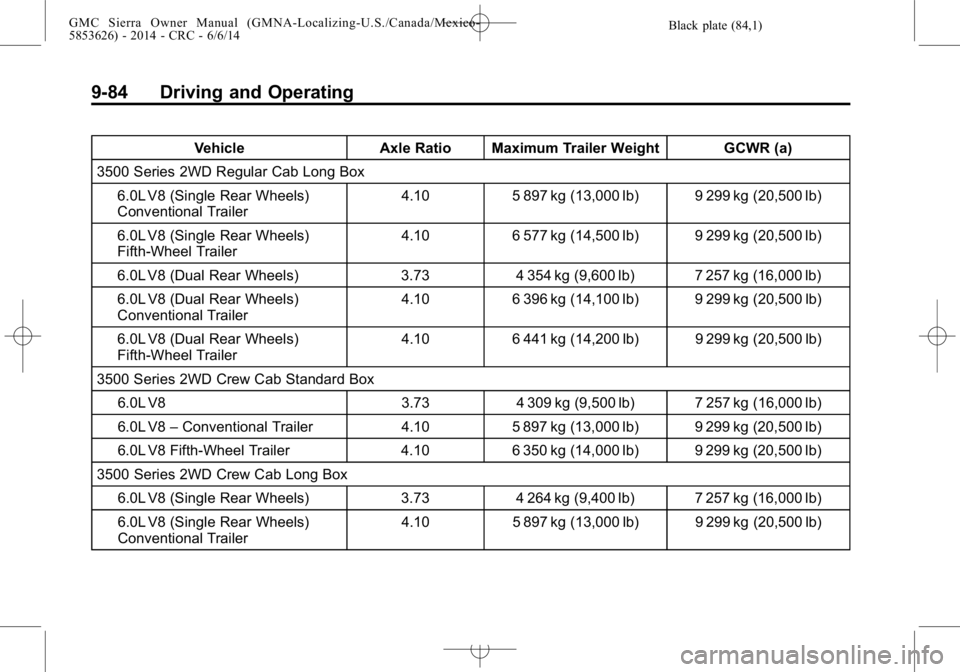
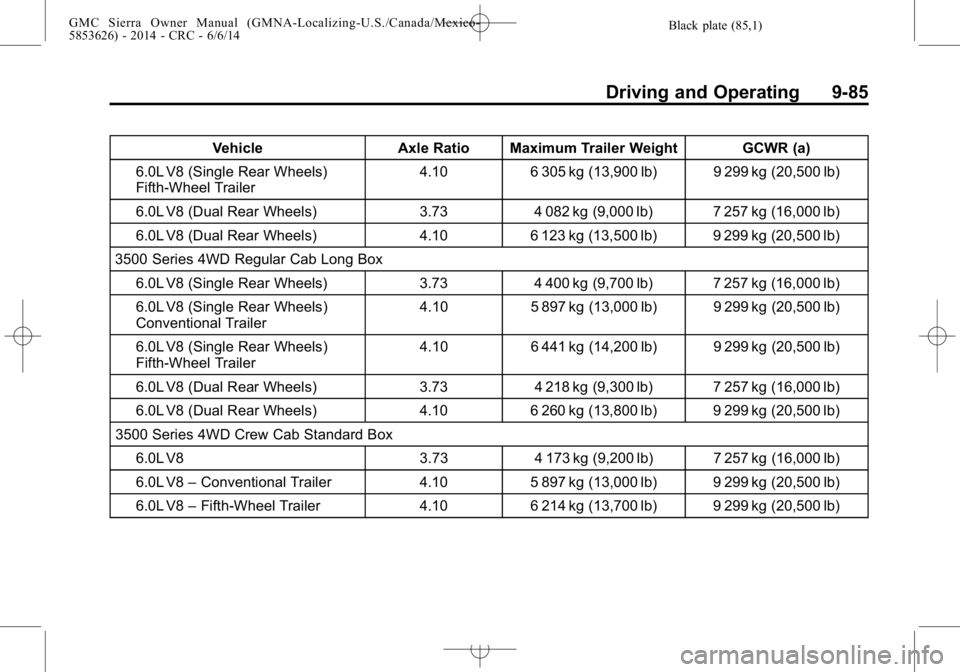
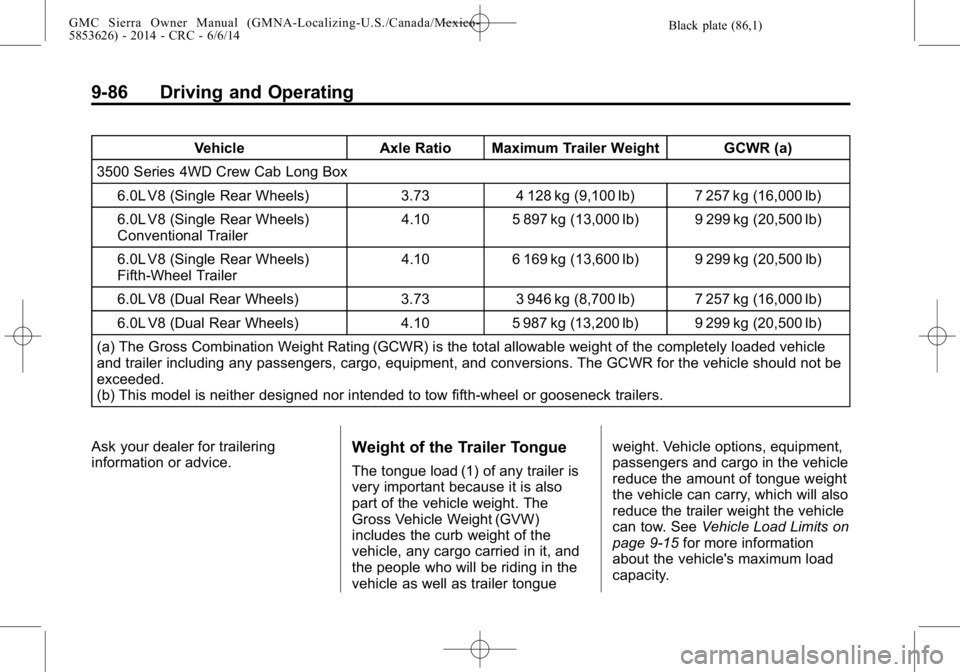
Use the following chart to determine
how much the vehicle can weigh,
based upon the vehicle model and
options.
Weights listed apply for
conventional trailers and fifth-wheel
trailers unless otherwise noted.
Page 352 of 544
Black plate (82,1)GMC Sierra Owner Manual (GMNA-Localizing-U.S./Canada/Mexico-
5853626) - 2014 - CRC - 6/6/14
9-82 Driving and Operating
VehicleAxle Ratio Maximum Trailer Weight GCWR (a)
5.3L V8 3.424 354 kg (9,600 lb) 6 804 kg (15,000 lb)
5.3L V8 3.735 080 kg (11,200 lb) 7 575 kg (16,700 lb)
6.2L V8 3.424 309 kg (9,500 lb) 6 804 kg (15,000 lb)
6.2L V8 3.735 352 kg (11,800 lb) 7 938 kg (17,500 lb)
1500 Series 4WD Regular Cab Long Box
4.3L V6 (b) 3.423 357 kg (7,400 lb) 5 625 kg (12,400 lb)
5.3L V8 3.083 130 kg (6,900 lb) 5 443 kg (12,000 lb)
5.3L V8 3.424 491 kg (9,900 lb) 6 804 kg (15,000 lb)
2500 Series 2WD Crew Cab Standard Box
6.0L V8 3.734 400 kg (9,700 lb) 7 257 kg (16,000 lb)
6.0L V8 –Conventional Trailer 4.105 897 kg (13,000 lb) 9 299 kg (20,500 lb)
6.0L V8 –Fifth-Wheel Trailer 4.106 441 kg (14,200 lb) 9 299 kg (20,500 lb)
2500 Series 2WD Regular Cab Long Box
6.0L V8 3.734 627 kg (10,200 lb) 7 257 kg (16,000 lb)
6.0L V8 –Conventional Trailer 4.105 897 kg (13,000 lb) 9 299 kg (20,500 lb)
6.0L V8 –Fifth-Wheel Trailer 4.106 668 kg (14,700 lb) 9 299 kg (20,500 lb)
Page 353 of 544
Black plate (83,1)GMC Sierra Owner Manual (GMNA-Localizing-U.S./Canada/Mexico-
5853626) - 2014 - CRC - 6/6/14
Driving and Operating 9-83
VehicleAxle Ratio Maximum Trailer Weight GCWR (a)
2500 Series 2WD Crew Cab Long Box 6.0L V8 3.734 354 kg (9,600 lb) 7 257 kg (16,000 lb)
6.0L V8 –Conventional Trailer 4.105 897 kg (13,000 lb) 9 299 kg (20,500 lb)
6.0L V8 –Fifth-Wheel Trailer 4.106 396 kg (14,100 lb) 9 299 kg (20,500 lb)
2500 Series 4WD Crew Cab Standard Box
6.0L V8 3.734 264 kg (9,400 lb) 7 257 kg (16,000 lb)
6.0L V8 –Conventional Trailer 4.105 897 kg (13,000 lb) 9 299 kg (20,500 lb)
6.0L V8 –Fifth-Wheel Trailer 4.106 305 kg (13,900 lb) 9 299 kg (20,500 lb)
2500 Series 4WD Regular Cab Long Box
6.0L V8 3.734 491 kg (9,900 lb) 7 257 kg (16,000 lb)
6.0L V8 –Conventional Trailer 4.105 897 kg (13,000 lb) 9 299 kg (20,500 lb)
6.0L V8 –Fifth-Wheel Trailer 4.106 532 kg (14,400 lb) 9 299 kg (20,500 lb)
2500 Series 4WD Crew Cab Long Box
6.0L V8 3.734 218 kg (9,300 lb) 7 257 kg (16,000 lb)
6.0L V8 –Conventional Trailer 4.105 897 kg (13,000 lb) 9 299 kg (20,500 lb)
6.0L V8 –Fifth-Wheel Trailer 4.106 260 kg (13,800 lb) 9 299 kg (20,500 lb)
Page 354 of 544
Black plate (84,1)GMC Sierra Owner Manual (GMNA-Localizing-U.S./Canada/Mexico-
5853626) - 2014 - CRC - 6/6/14
9-84 Driving and Operating
VehicleAxle Ratio Maximum Trailer Weight GCWR (a)
3500 Series 2WD Regular Cab Long Box 6.0L V8 (Single Rear Wheels)
Conventional Trailer 4.10
5 897 kg (13,000 lb) 9 299 kg (20,500 lb)
6.0L V8 (Single Rear Wheels)
Fifth-Wheel Trailer 4.10
6 577 kg (14,500 lb) 9 299 kg (20,500 lb)
6.0L V8 (Dual Rear Wheels) 3.734 354 kg (9,600 lb) 7 257 kg (16,000 lb)
6.0L V8 (Dual Rear Wheels)
Conventional Trailer 4.10
6 396 kg (14,100 lb) 9 299 kg (20,500 lb)
6.0L V8 (Dual Rear Wheels)
Fifth-Wheel Trailer 4.10
6 441 kg (14,200 lb) 9 299 kg (20,500 lb)
3500 Series 2WD Crew Cab Standard Box 6.0L V8 3.734 309 kg (9,500 lb) 7 257 kg (16,000 lb)
6.0L V8 –Conventional Trailer 4.105 897 kg (13,000 lb) 9 299 kg (20,500 lb)
6.0L V8 Fifth-Wheel Trailer 4.106 350 kg (14,000 lb) 9 299 kg (20,500 lb)
3500 Series 2WD Crew Cab Long Box 6.0L V8 (Single Rear Wheels) 3.734 264 kg (9,400 lb) 7 257 kg (16,000 lb)
6.0L V8 (Single Rear Wheels)
Conventional Trailer 4.10
5 897 kg (13,000 lb) 9 299 kg (20,500 lb)
Page 355 of 544
Black plate (85,1)GMC Sierra Owner Manual (GMNA-Localizing-U.S./Canada/Mexico-
5853626) - 2014 - CRC - 6/6/14
Driving and Operating 9-85
VehicleAxle Ratio Maximum Trailer Weight GCWR (a)
6.0L V8 (Single Rear Wheels)
Fifth-Wheel Trailer 4.10
6 305 kg (13,900 lb) 9 299 kg (20,500 lb)
6.0L V8 (Dual Rear Wheels) 3.734 082 kg (9,000 lb) 7 257 kg (16,000 lb)
6.0L V8 (Dual Rear Wheels) 4.106 123 kg (13,500 lb) 9 299 kg (20,500 lb)
3500 Series 4WD Regular Cab Long Box
6.0L V8 (Single Rear Wheels) 3.734 400 kg (9,700 lb) 7 257 kg (16,000 lb)
6.0L V8 (Single Rear Wheels)
Conventional Trailer 4.10
5 897 kg (13,000 lb) 9 299 kg (20,500 lb)
6.0L V8 (Single Rear Wheels)
Fifth-Wheel Trailer 4.10
6 441 kg (14,200 lb) 9 299 kg (20,500 lb)
6.0L V8 (Dual Rear Wheels) 3.734 218 kg (9,300 lb) 7 257 kg (16,000 lb)
6.0L V8 (Dual Rear Wheels) 4.106 260 kg (13,800 lb) 9 299 kg (20,500 lb)
3500 Series 4WD Crew Cab Standard Box
6.0L V8 3.734 173 kg (9,200 lb) 7 257 kg (16,000 lb)
6.0L V8 –Conventional Trailer 4.105 897 kg (13,000 lb) 9 299 kg (20,500 lb)
6.0L V8 –Fifth-Wheel Trailer 4.106 214 kg (13,700 lb) 9 299 kg (20,500 lb)
Page 356 of 544
Black plate (86,1)GMC Sierra Owner Manual (GMNA-Localizing-U.S./Canada/Mexico-
5853626) - 2014 - CRC - 6/6/14
9-86 Driving and Operating
VehicleAxle Ratio Maximum Trailer Weight GCWR (a)
3500 Series 4WD Crew Cab Long Box 6.0L V8 (Single Rear Wheels) 3.734 128 kg (9,100 lb) 7 257 kg (16,000 lb)
6.0L V8 (Single Rear Wheels)
Conventional Trailer 4.10
5 897 kg (13,000 lb) 9 299 kg (20,500 lb)
6.0L V8 (Single Rear Wheels)
Fifth-Wheel Trailer 4.10
6 169 kg (13,600 lb) 9 299 kg (20,500 lb)
6.0L V8 (Dual Rear Wheels) 3.733 946 kg (8,700 lb) 7 257 kg (16,000 lb)
6.0L V8 (Dual Rear Wheels) 4.105 987 kg (13,200 lb) 9 299 kg (20,500 lb)
(a) The Gross Combination Weight Rating (GCWR) is the total allowable weight of the completely loaded vehicle
and trailer including any passengers, cargo, equipment, and conversions. The GCWR for the vehicle should not be
exceeded.
(b) This model is neither designed nor intended to tow fifth-wheel or gooseneck trailers.
Ask your dealer for trailering
information or advice.
Weight of the Trailer Tongue
The tongue load (1) of any trailer is
very important because it is also
part of the vehicle weight. The
Gross Vehicle Weight (GVW)
includes the curb weight of the
vehicle, any cargo carried in it, and
the people who will be riding in the
vehicle as well as trailer tongue weight. Vehicle options, equipment,
passengers and cargo in the vehicle
reduce the amount of tongue weight
the vehicle can carry, which will also
reduce the trailer weight the vehicle
can tow. See
Vehicle Load Limits on
page 9-15 for more information
about the vehicle's maximum load
capacity.