seats GMC SIERRA CLASSIC 2007 User Guide
[x] Cancel search | Manufacturer: GMC, Model Year: 2007, Model line: SIERRA CLASSIC, Model: GMC SIERRA CLASSIC 2007Pages: 674, PDF Size: 3.5 MB
Page 16 of 674
To return the seatback to an upright position, do
the following:
1. Lift the lever fully without applying pressure to
the seatback and the seatback will return to
the upright position.
2. Push and pull on the seatback to make sure it
is locked.Power Reclining Seatbacks
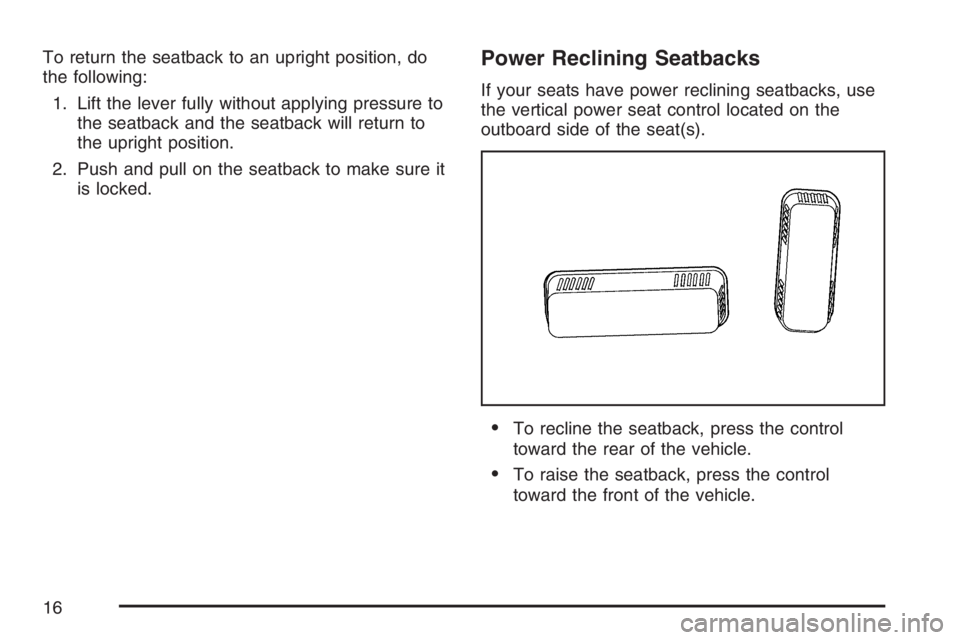
If your seats have power reclining seatbacks, use
the vertical power seat control located on the
outboard side of the seat(s).
To recline the seatback, press the control
toward the rear of the vehicle.
To raise the seatback, press the control
toward the front of the vehicle.
16
Page 18 of 674
Head Restraints
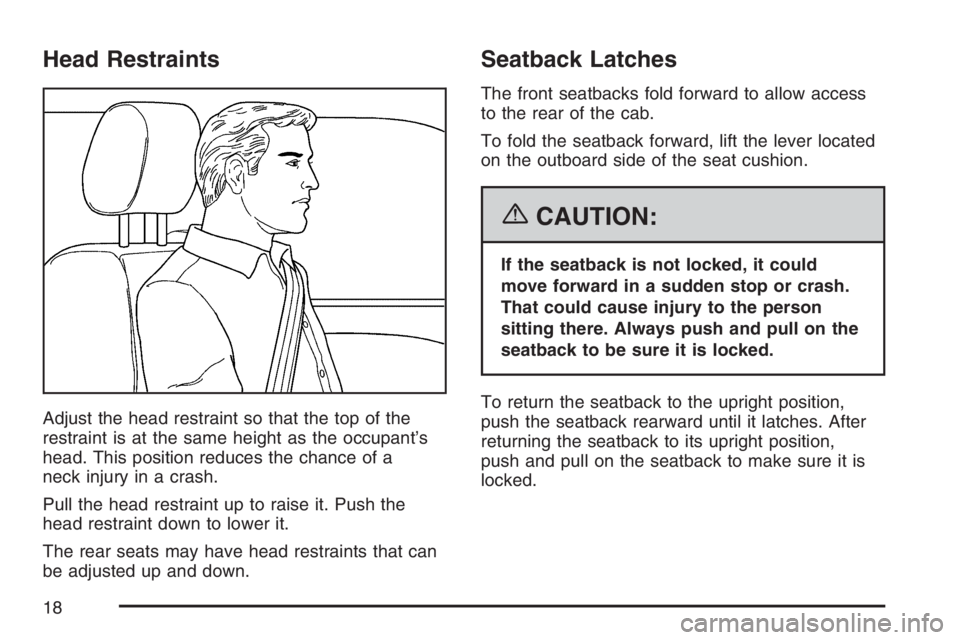
Adjust the head restraint so that the top of the
restraint is at the same height as the occupant’s
head. This position reduces the chance of a
neck injury in a crash.
Pull the head restraint up to raise it. Push the
head restraint down to lower it.
The rear seats may have head restraints that can
be adjusted up and down.
Seatback Latches
The front seatbacks fold forward to allow access
to the rear of the cab.
To fold the seatback forward, lift the lever located
on the outboard side of the seat cushion.
{CAUTION:
If the seatback is not locked, it could
move forward in a sudden stop or crash.
That could cause injury to the person
sitting there. Always push and pull on the
seatback to be sure it is locked.
To return the seatback to the upright position,
push the seatback rearward until it latches. After
returning the seatback to its upright position,
push and pull on the seatback to make sure it is
locked.
18
Page 19 of 674
Rear Seats
Rear Seat Operation (Extended Cab)
Folding the Rear Seat
The rear seat in the extended cab can be folded
up to provide more cargo space.
To fold the seat up, do the following:
Notice:Folding a rear seat with the safety
belts still fastened may cause damage to the
seat or the safety belts. Always unbuckle
the safety belts and return them to their normal
stowed position before folding a rear seat.
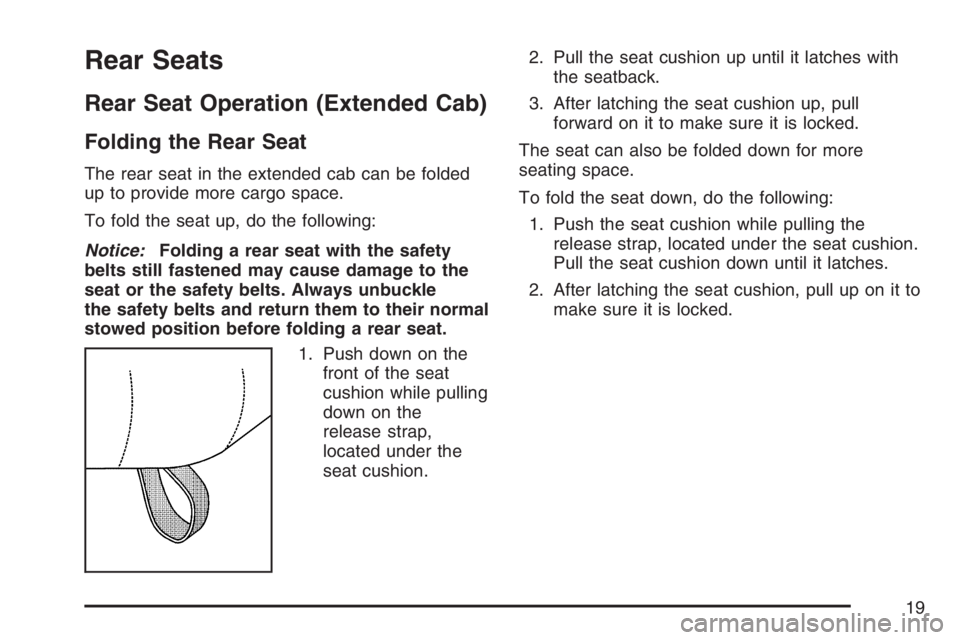
1. Push down on the
front of the seat
cushion while pulling
down on the
release strap,
located under the
seat cushion.2. Pull the seat cushion up until it latches with
the seatback.
3. After latching the seat cushion up, pull
forward on it to make sure it is locked.
The seat can also be folded down for more
seating space.
To fold the seat down, do the following:
1. Push the seat cushion while pulling the
release strap, located under the seat cushion.
Pull the seat cushion down until it latches.
2. After latching the seat cushion, pull up on it to
make sure it is locked.
19
Page 22 of 674
Safety Belts
Safety Belts: They Are for Everyone
This part of the manual tells you how to use
safety belts properly. It also tells you some things
you should not do with safety belts.
{CAUTION:
Do not let anyone ride where he or she
cannot wear a safety belt properly. If you
are in a crash and you are not wearing a
safety belt, your injuries can be much
worse. You can hit things inside the
vehicle or be ejected from it. You can be
seriously injured or killed. In the same
crash, you might not be, if you are
buckled up. Always fasten your safety
belt, and check that your passengers’
belts are fastened properly too.
{CAUTION:
It is extremely dangerous to ride in a
cargo area, inside or outside of a vehicle.
In a collision, people riding in these areas
are more likely to be seriously injured or
killed. Do not allow people to ride in any
area of your vehicle that is not equipped
with seats and safety belts. Be sure
everyone in your vehicle is in a seat and
using a safety belt properly.
22
Page 27 of 674
Q:If I am a good driver, and I never drive far
from home, why should I wear safety belts?
A:You may be an excellent driver, but if you are
in an accident — even one that is not your
fault — you and your passengers can be hurt.
Being a good driver does not protect you
from things beyond your control, such as bad
drivers.
Most accidents occur within 25 miles (40 km)
of home. And the greatest number of
serious injuries and deaths occur at speeds of
less than 40 mph (65 km/h).
Safety belts are for everyone.
How to Wear Safety Belts Properly
This part is only for people of adult size.
Be aware that there are special things to know
about safety belts and children. And there
are different rules for smaller children and babies.
If a child will be riding in your vehicle, see
Older Children on page 44orInfants and Young
Children on page 47. Follow those rules for
everyone’s protection.
First, you will want to know which restraint
systems your vehicle has.
We will start with the driver position.
Driver Position
Lap-Shoulder Belt
The driver has a lap-shoulder belt. Here is how to
wear it properly.
1. Close and lock the door.
2. Adjust the seat so you can sit up straight. To
see how, see “Seats” in the Index.
27
Page 41 of 674
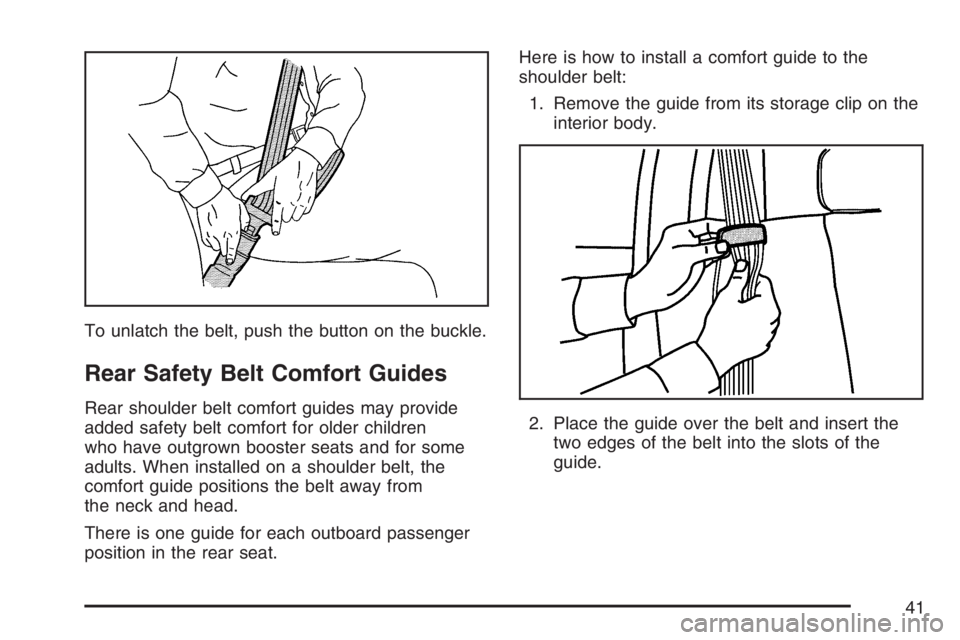
To unlatch the belt, push the button on the buckle.
Rear Safety Belt Comfort Guides
Rear shoulder belt comfort guides may provide
added safety belt comfort for older children
who have outgrown booster seats and for some
adults. When installed on a shoulder belt, the
comfort guide positions the belt away from
the neck and head.
There is one guide for each outboard passenger
position in the rear seat.Here is how to install a comfort guide to the
shoulder belt:
1. Remove the guide from its storage clip on the
interior body.
2. Place the guide over the belt and insert the
two edges of the belt into the slots of the
guide.
41
Page 43 of 674
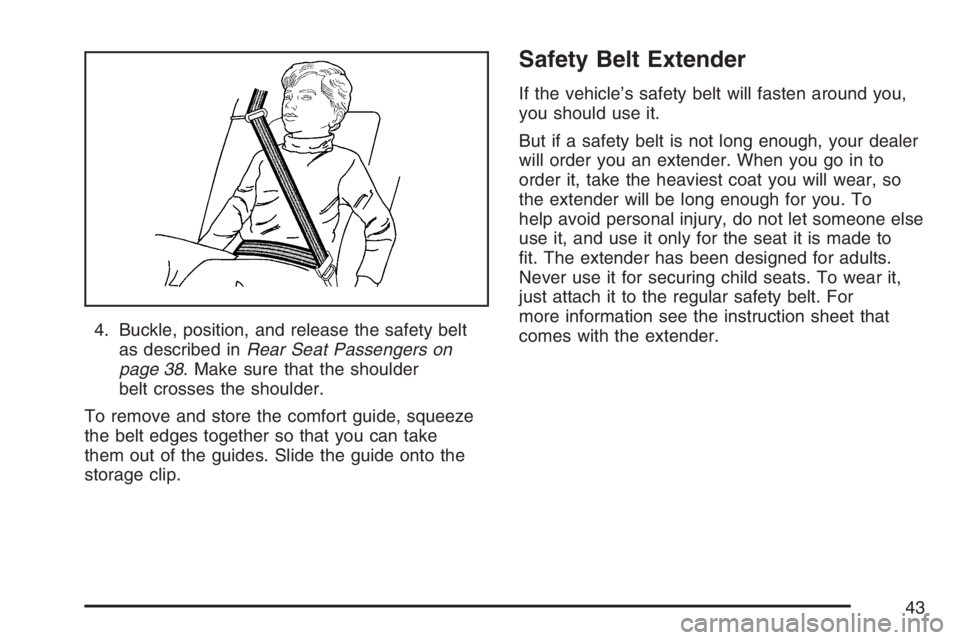
4. Buckle, position, and release the safety belt
as described inRear Seat Passengers on
page 38. Make sure that the shoulder
belt crosses the shoulder.
To remove and store the comfort guide, squeeze
the belt edges together so that you can take
them out of the guides. Slide the guide onto the
storage clip.
Safety Belt Extender
If the vehicle’s safety belt will fasten around you,
you should use it.
But if a safety belt is not long enough, your dealer
will order you an extender. When you go in to
order it, take the heaviest coat you will wear, so
the extender will be long enough for you. To
help avoid personal injury, do not let someone else
use it, and use it only for the seat it is made to
t. The extender has been designed for adults.
Never use it for securing child seats. To wear it,
just attach it to the regular safety belt. For
more information see the instruction sheet that
comes with the extender.
43
Page 44 of 674
Child Restraints
Older Children
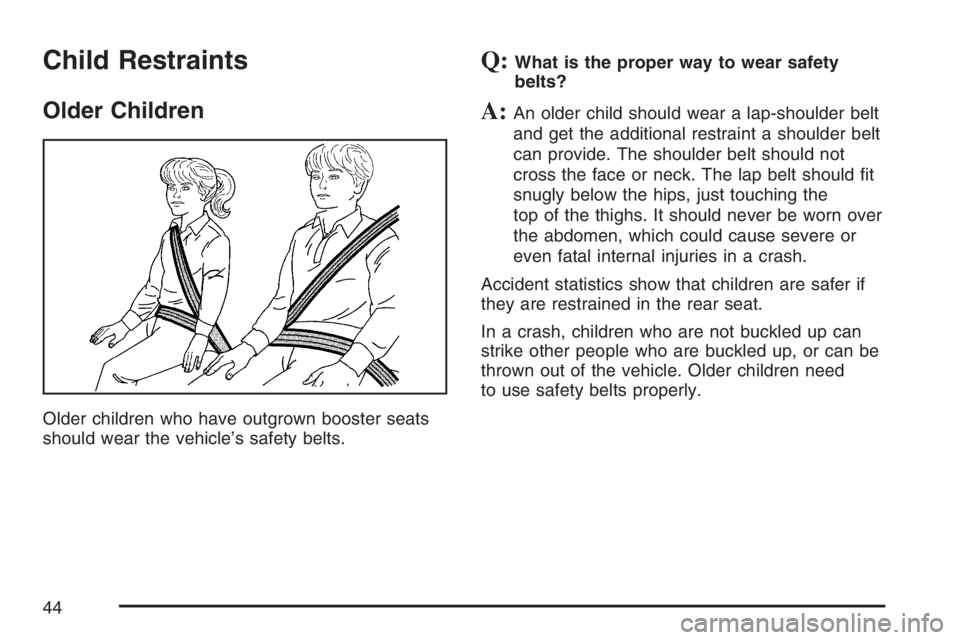
Older children who have outgrown booster seats
should wear the vehicle’s safety belts.
Q:What is the proper way to wear safety
belts?
A:An older child should wear a lap-shoulder belt
and get the additional restraint a shoulder belt
can provide. The shoulder belt should not
cross the face or neck. The lap belt should t
snugly below the hips, just touching the
top of the thighs. It should never be worn over
the abdomen, which could cause severe or
even fatal internal injuries in a crash.
Accident statistics show that children are safer if
they are restrained in the rear seat.
In a crash, children who are not buckled up can
strike other people who are buckled up, or can be
thrown out of the vehicle. Older children need
to use safety belts properly.
44
Page 53 of 674
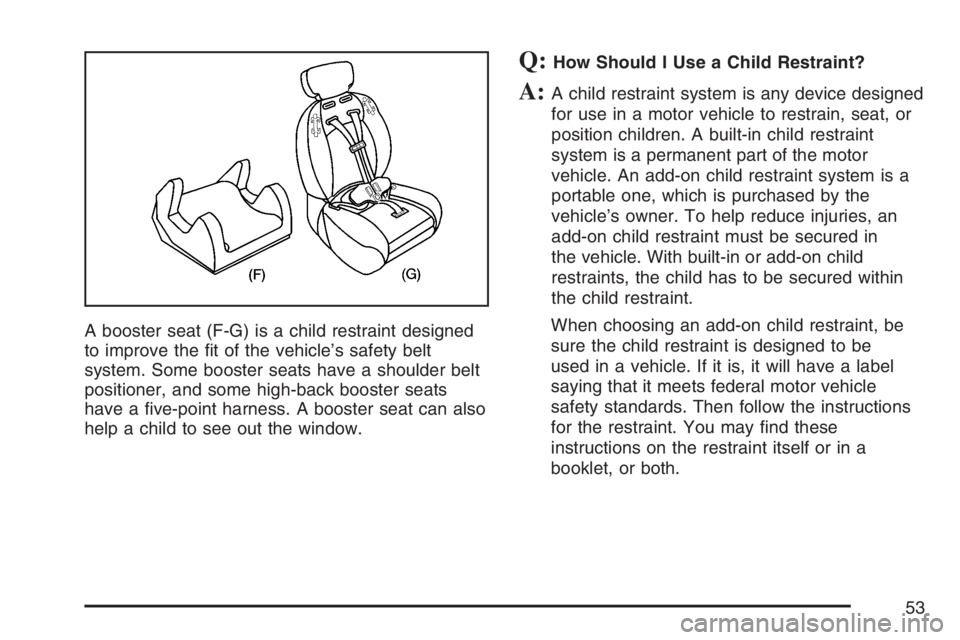
A booster seat (F-G) is a child restraint designed
to improve the t of the vehicle’s safety belt
system. Some booster seats have a shoulder belt
positioner, and some high-back booster seats
have a ve-point harness. A booster seat can also
help a child to see out the window.
Q:How Should I Use a Child Restraint?
A:A child restraint system is any device designed
for use in a motor vehicle to restrain, seat, or
position children. A built-in child restraint
system is a permanent part of the motor
vehicle. An add-on child restraint system is a
portable one, which is purchased by the
vehicle’s owner. To help reduce injuries, an
add-on child restraint must be secured in
the vehicle. With built-in or add-on child
restraints, the child has to be secured within
the child restraint.
When choosing an add-on child restraint, be
sure the child restraint is designed to be
used in a vehicle. If it is, it will have a label
saying that it meets federal motor vehicle
safety standards. Then follow the instructions
for the restraint. You may nd these
instructions on the restraint itself or in a
booklet, or both.
53
Page 54 of 674
Securing an Add-on Child Restraint in
the Vehicle
{CAUTION:
A child can be seriously injured or killed
in a crash if the child restraint is not
properly secured in the vehicle. Make sure
the child restraint is properly installed in
the vehicle using the vehicle’s safety belt
or LATCH system, following the
instructions that came with that restraint,
and also the instructions in this manual.
To help reduce the chance of injury, the child
restraint must be secured in the vehicle. Child
restraint systems must be secured in vehicle seats
by lap belts or the lap belt portion of a lap-shoulder
belt, or by the LATCH system. SeeLower
Anchors and Tethers for Children (LATCH) on
page 58for more information. A child can
be endangered in a crash if the child restraint is
not properly secured in the vehicle.When securing an add-on child restraint, refer to
the instructions that come with the restraint which
may be on the restraint itself or in a booklet, or both,
and to this manual. The child restraint instructions
are important, so if they are not available, obtain a
replacement copy from the manufacturer.
Keep in mind that an unsecured child restraint can
move around in a collision or sudden stop and
injure people in the vehicle. Be sure to properly
secure any child restraint in your vehicle — even
when no child is in it.
Securing the Child Within the Child
Restraint
There are several systems for securing the child
within the child restraint. One system, the
three-point harness, has straps that come down
over each of the infant’s shoulders and buckle
together at the crotch. The ve-point harness
system has two shoulder straps, two hip straps, and
a crotch strap. A shield may take the place of hip
straps. A T-shaped shield has shoulder straps that
are attached to a at pad which rests low against
the child’s body. A shelf- or armrest-type shield has
straps that are attached to a wide, shelf-like shield
that swings up or to the side.
54