seats GMC SIERRA CLASSIC 2007 Owner's Guide
[x] Cancel search | Manufacturer: GMC, Model Year: 2007, Model line: SIERRA CLASSIC, Model: GMC SIERRA CLASSIC 2007Pages: 674, PDF Size: 3.5 MB
Page 202 of 674
Reprogramming a Single Universal
Home Remote Button
To program a device to Universal Home Remote
using a Universal Home Remote button
previously trained, follow these steps:
1. Press and hold the desired Universal Home
Remote button. Do not release the button.
2. The indicator light will begin to ash after
20 seconds. While still holding the Universal
Home Remote button, proceed with Step
2 under “Programming Universal Home
Remote” shown earlier in this section.
For additional information on Universal Home
Remote, seeCustomer Assistance Offices
on page 642.
Storage Areas
Glove Box
Open the glove box by pulling the bottom of the
handle upward.
Cupholder(s)
Your vehicle may have cupholders located in the
front console, or in the fold-down armrest.
Front Storage Area
Your vehicle may have a center armrest storage
compartment in the front bench seat.
To open it, fold down the armrest and press the
latch handle located at the front of the armrest.
Center Console Storage Area
Your vehicle may have a console compartment
between the bucket seats.
To open it, press the button located on the right
side of the front of the lid.
Your console may have a cupholder that swings
down for the rear seat passengers to use. The front
cupholder pulls out and swivels 180° to provide
clearance between tall beverage containers and the
manual transmission shift lever.
202
Page 243 of 674
Rear Window Defogger
If your vehicle has this feature, the rear window
defogger uses a warming grid to remove fog from
the rear window.
If your vehicle has a sliding rear window, you will
not have a rear window defogger.
<(Rear):Press this button to turn the rear
window defogger on or off. An indicator light in the
button will come on to let you know that the rear
window defogger is activated. This button will also
activate the heated mirrors, if the vehicle has them.
The rear window defogger will automatically turn
off several minutes after the button is pressed.
Pressing the button while the defogger is running
can also turn off the defogger.
W(Mirror):If your vehicle does not have a rear
defogger and has heated mirrors, your vehicle
will have this button to activate them.
Notice:Do not use a razor blade or sharp
object to clear the inside rear window. Do not
adhere anything to the defogger grid lines
in the rear glass. These actions may damage
the rear defogger. Repairs would not be
covered by your warranty.
Outlet Adjustment
Use the air outlets located in the center and on the
side of your instrument panel to direct the airow.
Operation Tips
Keep the hood and front air inlets free of ice,
snow, or any other obstruction (such as
leaves). The heater and defroster will work
better, reducing the chance of fogging
the inside of your windows.
When you enter a vehicle in cold weather, set
the fan speed to maximum airow for a few
moments before driving. This helps clear
the intake ducts of snow and moisture, and
reduces the chance of fogging the inside
of your window.
Keep the air path under the front seats clear
of objects. This helps air to circulate
throughout your vehicle.
Adding outside equipment to the front of your
vehicle, such as hood-air deectors, may
affect the performance of the heating and air
conditioning system. Check with your
dealer before adding equipment to the outside
of your vehicle.
243
Page 414 of 674
If you put things inside your vehicle — like
suitcases, tools, packages, or anything
else — they go as fast as the vehicle goes.
If you have to stop or turn quickly, or if there
is a crash, they will keep going.
{CAUTION:
Things you put inside your vehicle can
strike and injure people in a sudden stop
or turn, or in a crash.
Put things in the cargo area of your
vehicle. Try to spread the weight
evenly.
Never stack heavier things, like
suitcases, inside the vehicle so that
some of them are above the tops of
the seats.
CAUTION: (Continued)
CAUTION: (Continued)
Do not leave an unsecured child
restraint in your vehicle.
When you carry something inside the
vehicle, secure it whenever you can.
Do not leave a seat folded down
unless you need to.
There is also important loading information for
off-road driving in this manual. See “Loading Your
Vehicle for Off-Road Driving“ underOff-Road
Driving on page 372.
414
Page 548 of 674
(C) Aspect Ratio:A two-digit number that
indicates the tire height-to-width measurements.
For example, if the tire size aspect ratio is 75, as
shown in item C of the light truck (LT-Metric) tire
illustration, it would mean that the tire’s sidewall is
75 percent as high as it is wide.
(D) Construction Code:A letter code is used to
indicate the type of ply construction in the tire.
The letter R means radial ply construction;
the letter D means diagonal or bias ply
construction; and the letter B means belted-bias
ply construction.
(E) Rim Diameter:Diameter of the wheel in
inches.
(F) Service Description:The service description
indicates the load range and speed rating of a
tire. The load index can range from 1 to 279.
Speed ratings range from A to Z.Tire Terminology and Denitions
Air Pressure:The amount of air inside the tire
pressing outward on each square inch of the
tire. Air pressure is expressed in pounds
per square inch (psi) or kilopascal (kPa).
Accessory Weight:This means the combined
weight of optional accessories. Some examples of
optional accessories are, automatic transmission/
transaxle, power steering, power brakes, power
windows, power seats, and air conditioning.
Aspect Ratio:The relationship of a tire’s height
to its width.
Belt:A rubber coated layer of cords that is
located between the plies and the tread. Cords
may be made from steel or other reinforcing
materials.
Bead:The tire bead contains steel wires wrapped
by steel cords that hold the tire onto the rim.
Bias Ply Tire:A pneumatic tire in which the plies
are laid at alternate angles less than 90 degrees
to the centerline of the tread.
548
Page 568 of 674
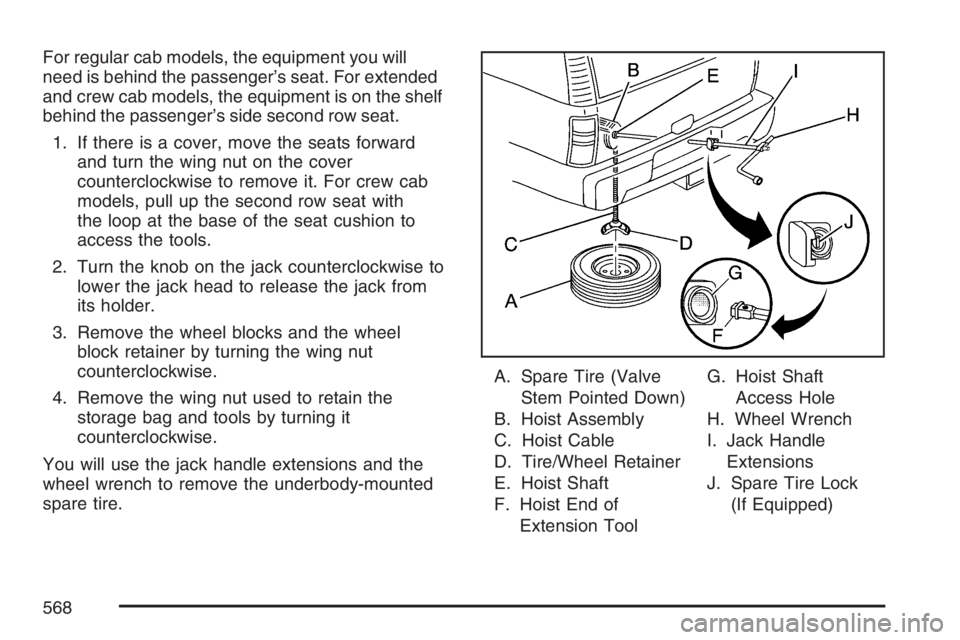
For regular cab models, the equipment you will
need is behind the passenger’s seat. For extended
and crew cab models, the equipment is on the shelf
behind the passenger’s side second row seat.
1. If there is a cover, move the seats forward
and turn the wing nut on the cover
counterclockwise to remove it. For crew cab
models, pull up the second row seat with
the loop at the base of the seat cushion to
access the tools.
2. Turn the knob on the jack counterclockwise to
lower the jack head to release the jack from
its holder.
3. Remove the wheel blocks and the wheel
block retainer by turning the wing nut
counterclockwise.
4. Remove the wing nut used to retain the
storage bag and tools by turning it
counterclockwise.
You will use the jack handle extensions and the
wheel wrench to remove the underbody-mounted
spare tire.A. Spare Tire (Valve
Stem Pointed Down)
B. Hoist Assembly
C. Hoist Cable
D. Tire/Wheel Retainer
E. Hoist Shaft
F. Hoist End of
Extension ToolG. Hoist Shaft
Access Hole
H. Wheel Wrench
I. Jack Handle
Extensions
J. Spare Tire Lock
(If Equipped)
568
Page 579 of 674

{CAUTION:
Incorrect wheel nuts or improperly
tightened wheel nuts can cause the wheel
to come loose and even come off. This
could lead to an accident. Be sure to use
the correct wheel nuts. If you have to
replace them, be sure to get new GM
original equipment wheel nuts. Stop
somewhere as soon as you can and have
the nuts tightened with a torque wrench to
the proper torque specication. See
Capacities and Specifications on page 609
for wheel nut torque specication.
Notice:Improperly tightened wheel nuts can
lead to brake pulsation and rotor damage.
To avoid expensive brake repairs, evenly
tighten the wheel nuts in the proper sequence
and to the proper torque specication. See
Capacities and Specifications on page 609for
the wheel nut torque specication.12. Tighten the nuts rmly in a crisscross
sequence as shown by turning the wheel
wrench clockwise.
When you reinstall the regular wheel and tire, you
must also reinstall either the center cap, or
bolt-on hub cap, depending on what your vehicle
is equipped with. For center caps, place the
cap on the wheel and tap it into place until it seats
ush with the wheel. The cap only goes on one
way. Be sure to line up the tab on the center cap
with the indentation on the wheel. For bolt-on
hub caps, align the plastic nut caps with the wheel
nuts and then tighten by hand. Then use the
wheel wrench to tighten.
579
Page 601 of 674
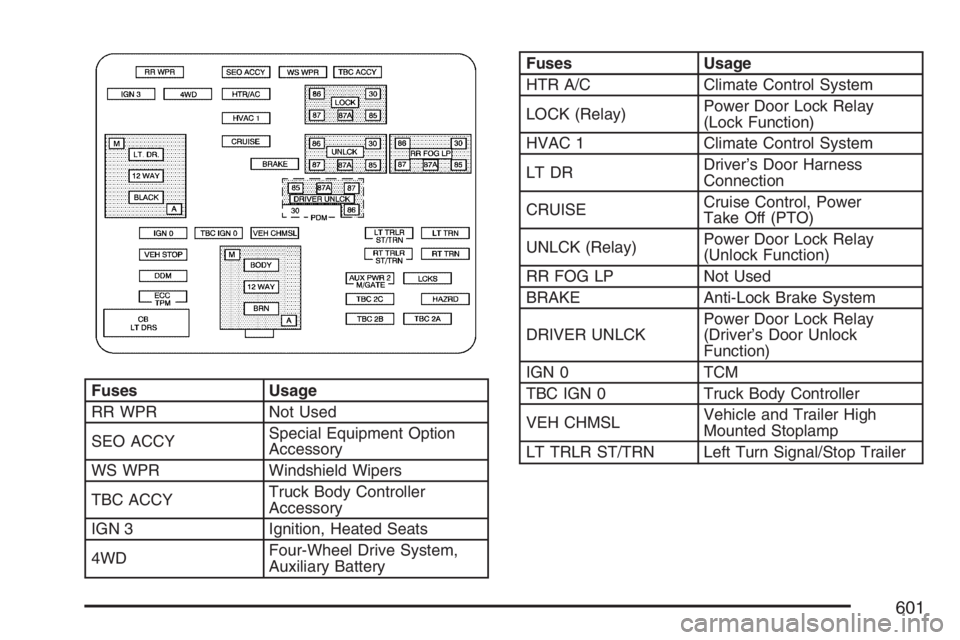
Fuses Usage
RR WPR Not Used
SEO ACCYSpecial Equipment Option
Accessory
WS WPR Windshield Wipers
TBC ACCYTruck Body Controller
Accessory
IGN 3 Ignition, Heated Seats
4WDFour-Wheel Drive System,
Auxiliary Battery
Fuses Usage
HTR A/C Climate Control System
LOCK (Relay)Power Door Lock Relay
(Lock Function)
HVAC 1 Climate Control System
LT DRDriver’s Door Harness
Connection
CRUISECruise Control, Power
Take Off (PTO)
UNLCK (Relay)Power Door Lock Relay
(Unlock Function)
RR FOG LP Not Used
BRAKE Anti-Lock Brake System
DRIVER UNLCKPower Door Lock Relay
(Driver’s Door Unlock
Function)
IGN 0 TCM
TBC IGN 0 Truck Body Controller
VEH CHMSLVehicle and Trailer High
Mounted Stoplamp
LT TRLR ST/TRN Left Turn Signal/Stop Trailer
601
Page 605 of 674
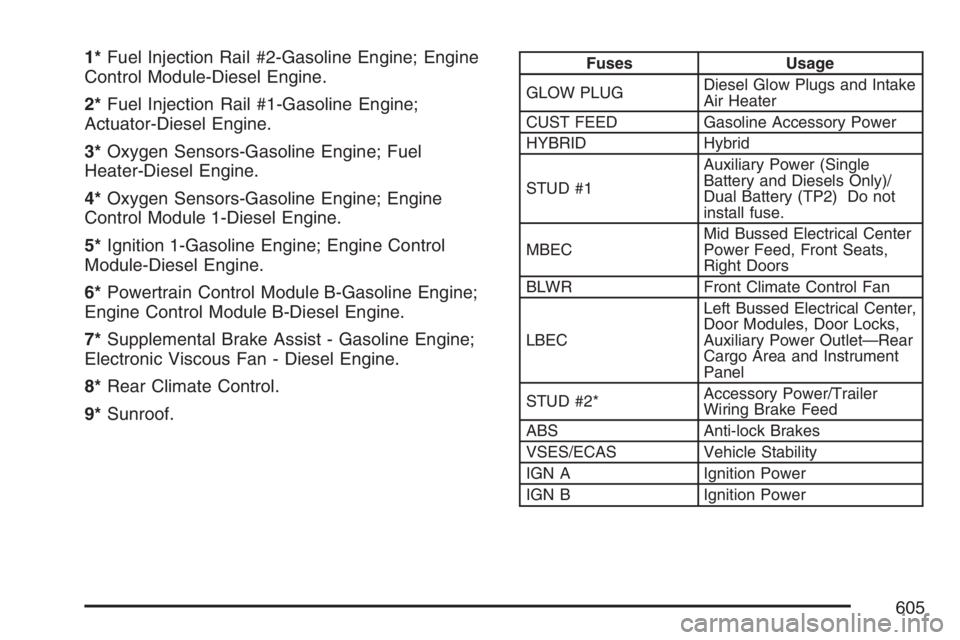
1*Fuel Injection Rail #2-Gasoline Engine; Engine
Control Module-Diesel Engine.
2*Fuel Injection Rail #1-Gasoline Engine;
Actuator-Diesel Engine.
3*Oxygen Sensors-Gasoline Engine; Fuel
Heater-Diesel Engine.
4*Oxygen Sensors-Gasoline Engine; Engine
Control Module 1-Diesel Engine.
5*Ignition 1-Gasoline Engine; Engine Control
Module-Diesel Engine.
6*Powertrain Control Module B-Gasoline Engine;
Engine Control Module B-Diesel Engine.
7*Supplemental Brake Assist - Gasoline Engine;
Electronic Viscous Fan - Diesel Engine.
8*Rear Climate Control.
9*Sunroof.Fuses Usage
GLOW PLUGDiesel Glow Plugs and Intake
Air Heater
CUST FEED Gasoline Accessory Power
HYBRID Hybrid
STUD #1Auxiliary Power (Single
Battery and Diesels Only)/
Dual Battery (TP2) Do not
install fuse.
MBECMid Bussed Electrical Center
Power Feed, Front Seats,
Right Doors
BLWR Front Climate Control Fan
LBECLeft Bussed Electrical Center,
Door Modules, Door Locks,
Auxiliary Power Outlet—Rear
Cargo Area and Instrument
Panel
STUD #2*Accessory Power/Trailer
Wiring Brake Feed
ABS Anti-lock Brakes
VSES/ECAS Vehicle Stability
IGN A Ignition Power
IGN B Ignition Power
605
Page 607 of 674
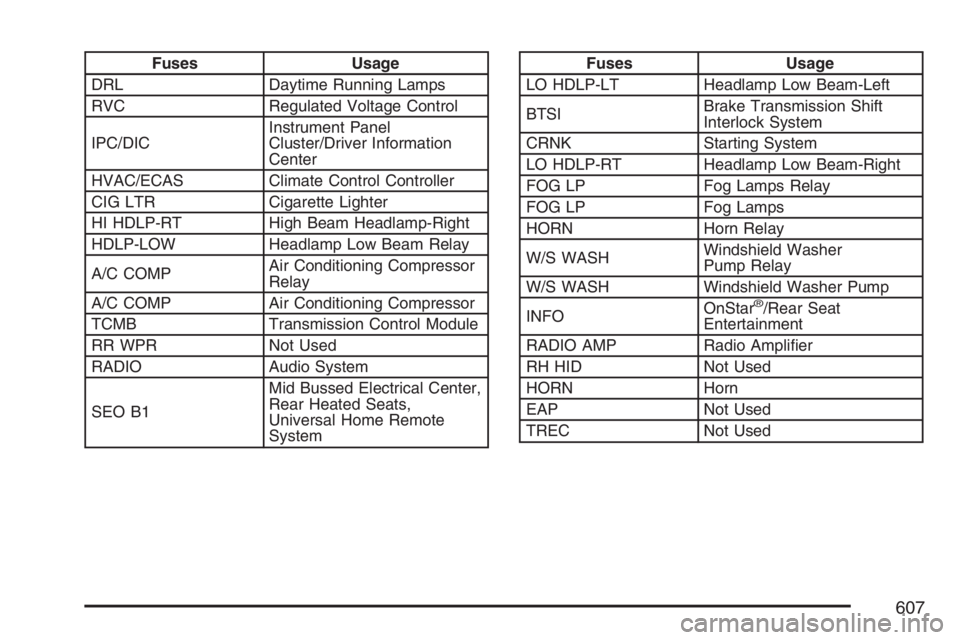
Fuses Usage
DRL Daytime Running Lamps
RVC Regulated Voltage Control
IPC/DICInstrument Panel
Cluster/Driver Information
Center
HVAC/ECAS Climate Control Controller
CIG LTR Cigarette Lighter
HI HDLP-RT High Beam Headlamp-Right
HDLP-LOW Headlamp Low Beam Relay
A/C COMPAir Conditioning Compressor
Relay
A/C COMP Air Conditioning Compressor
TCMB Transmission Control Module
RR WPR Not Used
RADIO Audio System
SEO B1Mid Bussed Electrical Center,
Rear Heated Seats,
Universal Home Remote
SystemFuses Usage
LO HDLP-LT Headlamp Low Beam-Left
BTSIBrake Transmission Shift
Interlock System
CRNK Starting System
LO HDLP-RT Headlamp Low Beam-Right
FOG LP Fog Lamps Relay
FOG LP Fog Lamps
HORN Horn Relay
W/S WASHWindshield Washer
Pump Relay
W/S WASH Windshield Washer Pump
INFOOnStar
®/Rear Seat
Entertainment
RADIO AMP Radio Amplier
RH HID Not Used
HORN Horn
EAP Not Used
TREC Not Used
607
Page 631 of 674
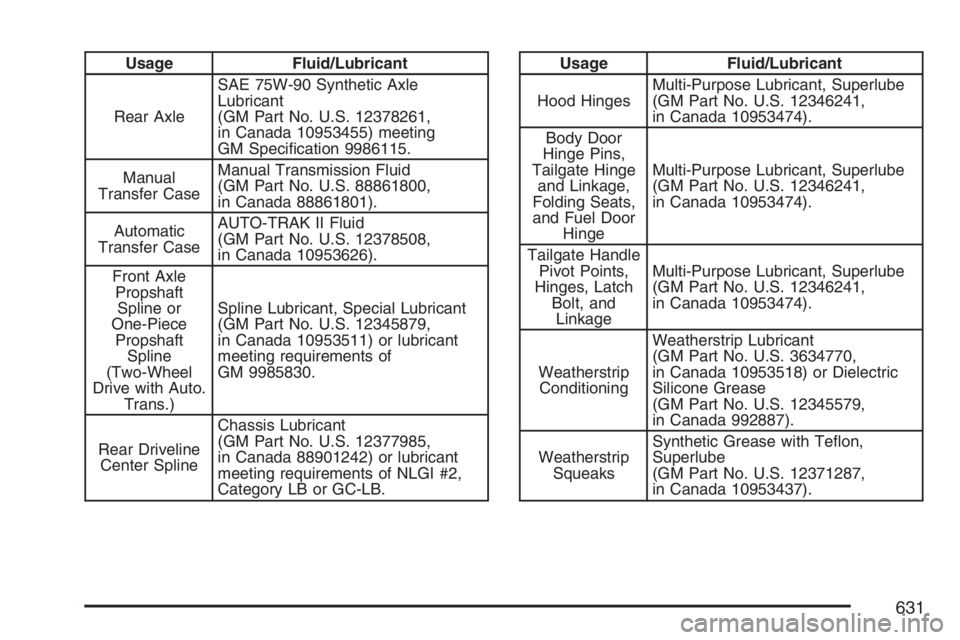
Usage Fluid/Lubricant
Rear AxleSAE 75W-90 Synthetic Axle
Lubricant
(GM Part No. U.S. 12378261,
in Canada 10953455) meeting
GM Specication 9986115.
Manual
Transfer CaseManual Transmission Fluid
(GM Part No. U.S. 88861800,
in Canada 88861801).
Automatic
Transfer CaseAUTO-TRAK II Fluid
(GM Part No. U.S. 12378508,
in Canada 10953626).
Front Axle
Propshaft
Spline or
One-Piece
Propshaft
Spline
(Two-Wheel
Drive with Auto.
Trans.)Spline Lubricant, Special Lubricant
(GM Part No. U.S. 12345879,
in Canada 10953511) or lubricant
meeting requirements of
GM 9985830.
Rear Driveline
Center SplineChassis Lubricant
(GM Part No. U.S. 12377985,
in Canada 88901242) or lubricant
meeting requirements of NLGI #2,
Category LB or GC-LB.Usage Fluid/Lubricant
Hood HingesMulti-Purpose Lubricant, Superlube
(GM Part No. U.S. 12346241,
in Canada 10953474).
Body Door
Hinge Pins,
Tailgate Hinge
and Linkage,
Folding Seats,
and Fuel Door
HingeMulti-Purpose Lubricant, Superlube
(GM Part No. U.S. 12346241,
in Canada 10953474).
Tailgate Handle
Pivot Points,
Hinges, Latch
Bolt, and
LinkageMulti-Purpose Lubricant, Superlube
(GM Part No. U.S. 12346241,
in Canada 10953474).
Weatherstrip
ConditioningWeatherstrip Lubricant
(GM Part No. U.S. 3634770,
in Canada 10953518) or Dielectric
Silicone Grease
(GM Part No. U.S. 12345579,
in Canada 992887).
Weatherstrip
SqueaksSynthetic Grease with Teon,
Superlube
(GM Part No. U.S. 12371287,
in Canada 10953437).
631