tow GMC SIERRA CLASSIC 2007 Owner's Manual
[x] Cancel search | Manufacturer: GMC, Model Year: 2007, Model line: SIERRA CLASSIC, Model: GMC SIERRA CLASSIC 2007Pages: 674, PDF Size: 3.5 MB
Page 147 of 674
Tow/Haul Mode
If your vehicle has an automatic transmission, it
may have a Tow/Haul mode. If your vehicle has an
Allison Transmission
®see “Tow/Haul Mode
(Allison Transmission®) following. Tow/Haul mode
adjusts the transmission shift pattern to reduce
shift cycling, providing increased performance,
vehicle control, and transmission cooling
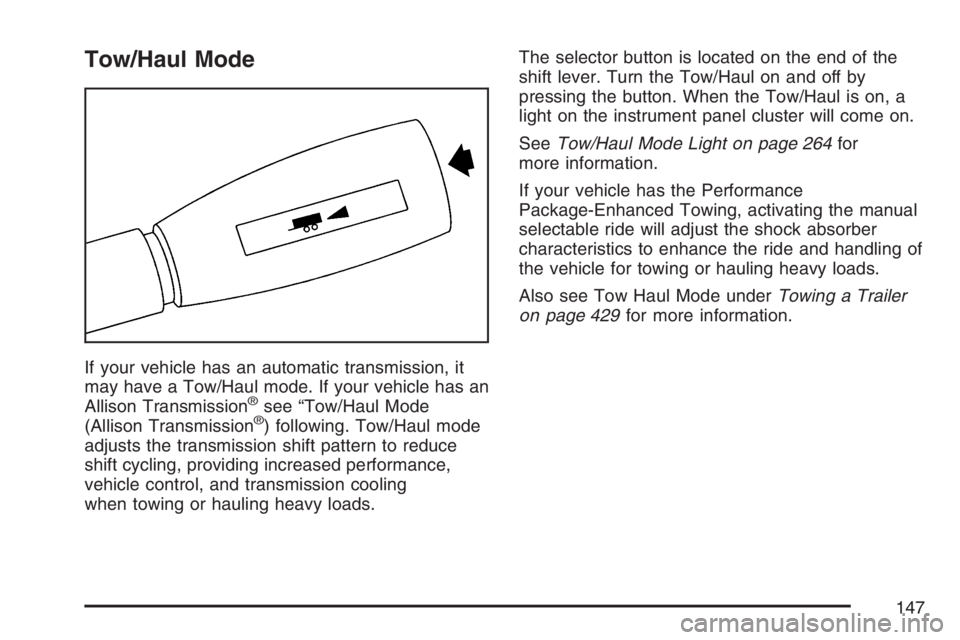
when towing or hauling heavy loads.The selector button is located on the end of the
shift lever. Turn the Tow/Haul on and off by
pressing the button. When the Tow/Haul is on, a
light on the instrument panel cluster will come on.
SeeTow/Haul Mode Light on page 264for
more information.
If your vehicle has the Performance
Package-Enhanced Towing, activating the manual
selectable ride will adjust the shock absorber
characteristics to enhance the ride and handling of
the vehicle for towing or hauling heavy loads.
Also see Tow Haul Mode underTowing a Trailer
on page 429for more information.
147
Page 148 of 674
Tow/Haul Mode (Allison
Transmission®)
If your vehicle has an Allison Transmission®,it
may have a Tow/Haul mode. Tow/Haul mode
adjusts the transmission shift pattern to reduce
shift cycling, providing increased performance,
vehicle control, and transmission cooling
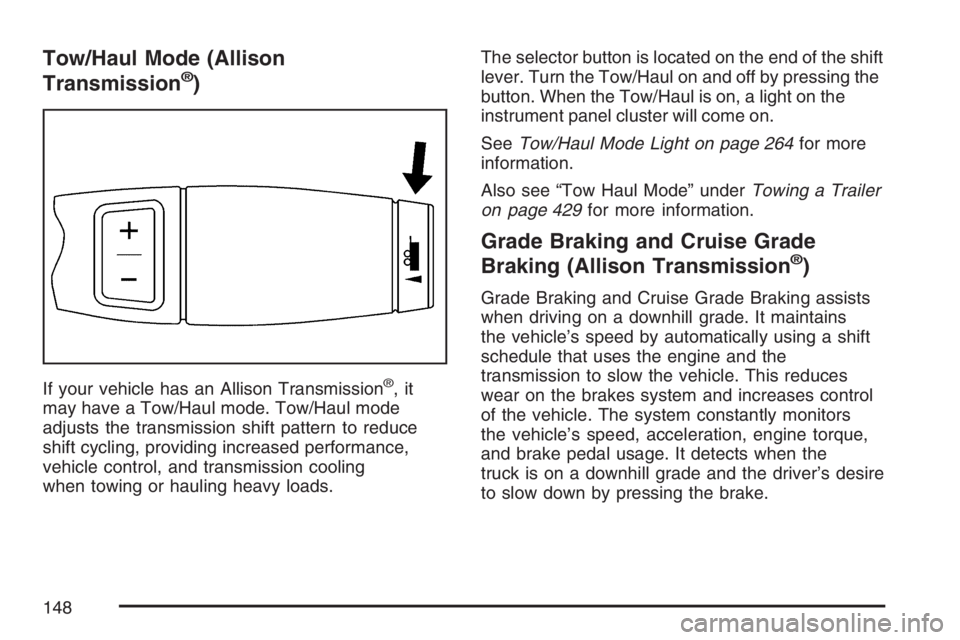
when towing or hauling heavy loads.The selector button is located on the end of the shift
lever. Turn the Tow/Haul on and off by pressing the
button. When the Tow/Haul is on, a light on the
instrument panel cluster will come on.
SeeTow/Haul Mode Light on page 264for more
information.
Also see “Tow Haul Mode” underTowing a Trailer
on page 429for more information.
Grade Braking and Cruise Grade
Braking (Allison Transmission®)
Grade Braking and Cruise Grade Braking assists
when driving on a downhill grade. It maintains
the vehicle’s speed by automatically using a shift
schedule that uses the engine and the
transmission to slow the vehicle. This reduces
wear on the brakes system and increases control
of the vehicle. The system constantly monitors
the vehicle’s speed, acceleration, engine torque,
and brake pedal usage. It detects when the
truck is on a downhill grade and the driver’s desire
to slow down by pressing the brake.
148
Page 149 of 674
Cruise Grade Braking is available on the 6.6L
DURAMAX®diesel engine. Cruise Grade Braking
monitors a vehicle’s cruise state, engine torque,
acceleration, vehicle speed, and the cruise set
speed. Using this information, it detects when the
truck is accelerating on a downhill grade and will
automatically downshift to slow the vehicle if it
exceeds the cruise set speed by a certain amount.
SeeCruise Control on page 217for more
information.
The Tow/Haul mode and Grade Braking shift
modes can be activated by pressing the button on
the end of the shift control stalk. If your vehicle
has the DURAMAX
®diesel Engine or the
8.1L VORTEC™ gasoline engine, Grade Braking
is only available while the Tow/Haul Mode is
selected. While in the Range Selection Mode,
Grade Braking is deactivated allowing the driver to
select a desired range of gears.
SeeAutomatic Transmission Operation on
page 140for more information.
Also seeTowing a Trailer on page 429for more
information.
Manual Transmission Operation
Five-Speed
(VORTEC™ 6.0L V8 Engine)
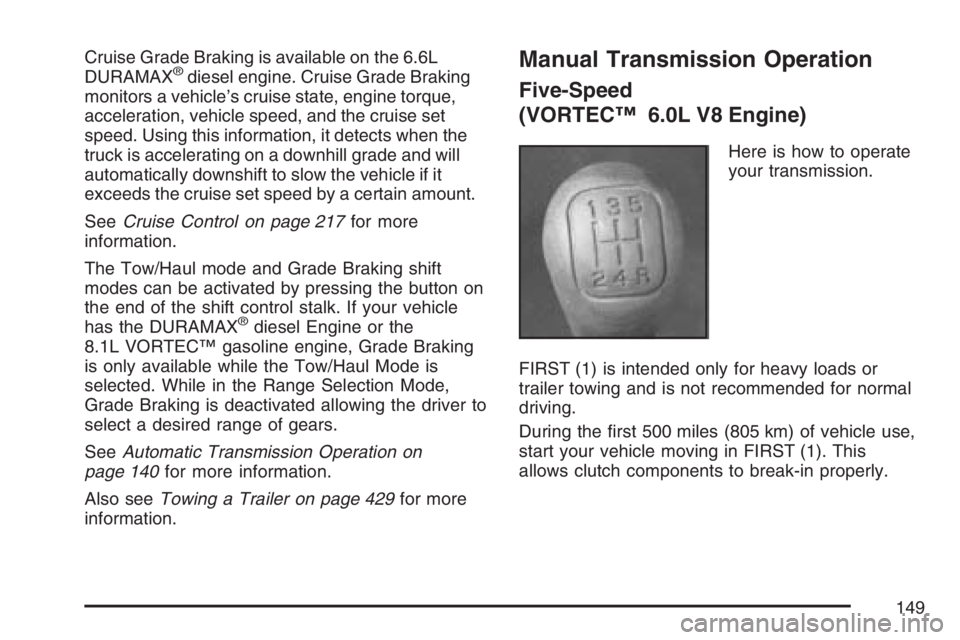
Here is how to operate
your transmission.
FIRST (1) is intended only for heavy loads or
trailer towing and is not recommended for normal
driving.
During the rst 500 miles (805 km) of vehicle use,
start your vehicle moving in FIRST (1). This
allows clutch components to break-in properly.
149
Page 154 of 674
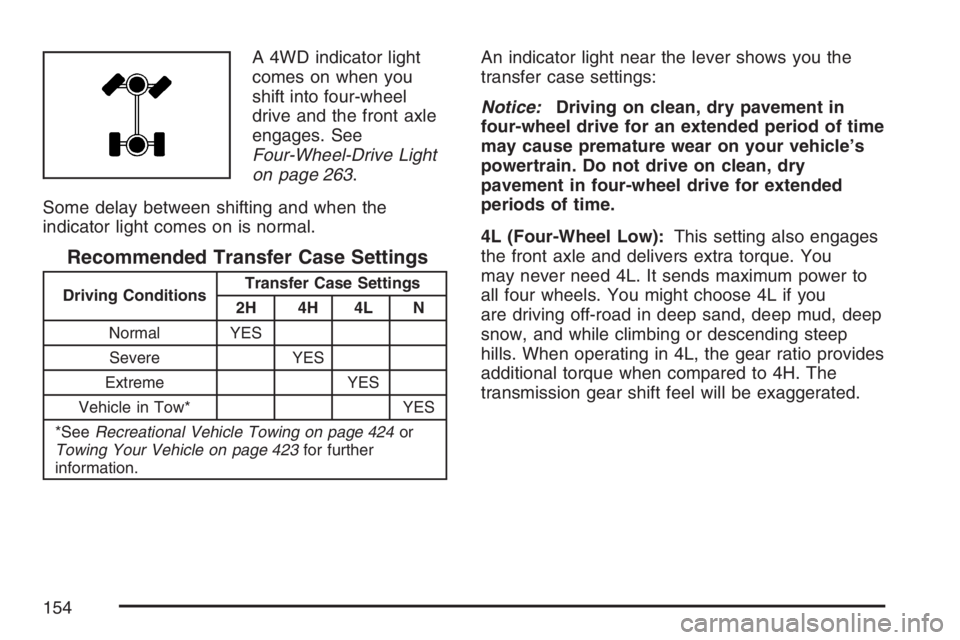
A 4WD indicator light
comes on when you
shift into four-wheel
drive and the front axle
engages. See
Four-Wheel-Drive Light
on page 263.
Some delay between shifting and when the
indicator light comes on is normal.
Recommended Transfer Case Settings
Driving ConditionsTransfer Case Settings
2H 4H 4L N
Normal YES
Severe YES
Extreme YES
Vehicle in Tow* YES
*SeeRecreational Vehicle Towing on page 424or
Towing Your Vehicle on page 423for further
information.
An indicator light near the lever shows you the
transfer case settings:
Notice:Driving on clean, dry pavement in
four-wheel drive for an extended period of time
may cause premature wear on your vehicle’s
powertrain. Do not drive on clean, dry
pavement in four-wheel drive for extended
periods of time.
4L (Four-Wheel Low):This setting also engages
the front axle and delivers extra torque. You
may never need 4L. It sends maximum power to
all four wheels. You might choose 4L if you
are driving off-road in deep sand, deep mud, deep
snow, and while climbing or descending steep
hills. When operating in 4L, the gear ratio provides
additional torque when compared to 4H. The
transmission gear shift feel will be exaggerated.
154
Page 155 of 674
{CAUTION:
Shifting the transfer case to NEUTRAL
can cause your vehicle to roll even if the
transmission is in PARK (P), or if you
have a manual transmission, even if you
are in gear. You or someone else could be
seriously injured. Be sure to set the
parking brake before placing the transfer
case in NEUTRAL. SeeParking Brake on
page 169.
N (Neutral):Shift to this setting only when your
vehicle needs to be towed. SeeRecreational
Vehicle Towing on page 424orTowing Your
Vehicle on page 423.2H (Two-Wheel Drive High):This setting is used
for driving in most street and highway situations.
The front axle is not engaged in two-wheel
drive. This setting also provides the best fuel
economy.
4H (Four-Wheel Drive High):Use this setting
when you need extra traction, such as on snowy or
icy roads or in most off-road situations. This
setting also engages the front axle to help drive
your vehicle. This is the best setting to use
when plowing snow.
You can shift from 2H to 4H or 4H to 2H while the
vehicle is moving. The front axle will engage
faster if you take your foot off of the accelerator
for a couple of seconds after you shift. In
extremely cold weather, it may be necessary to
stop or slow the vehicle to shift into 4H.
155
Page 158 of 674
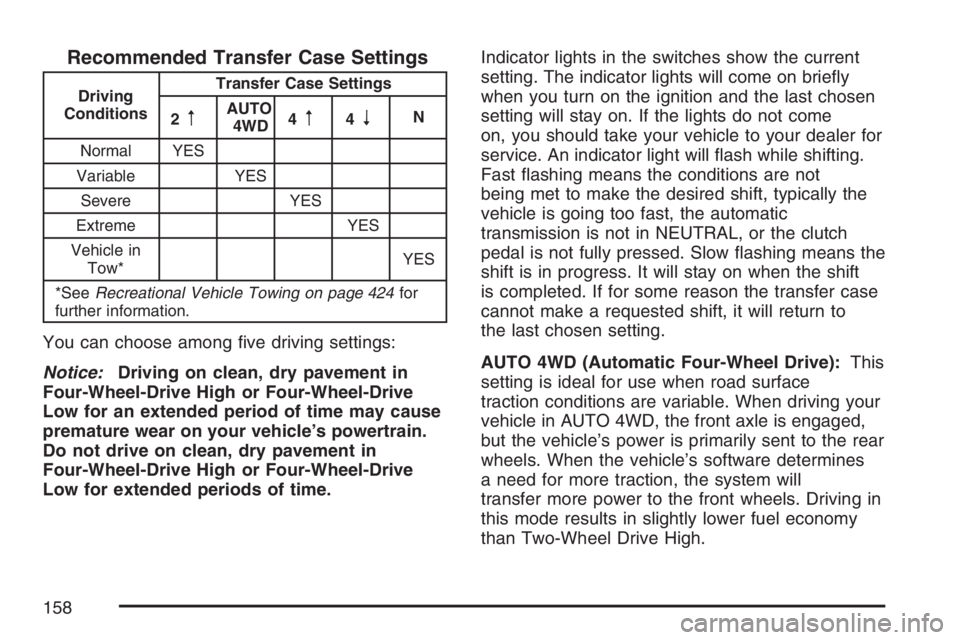
Recommended Transfer Case Settings
Driving
ConditionsTransfer Case Settings
2
mAUTO
4WD4m4nN
Normal YES
Variable YES
Severe YES
Extreme YES
Vehicle in
Tow*YES
*SeeRecreational Vehicle Towing on page 424for
further information.
You can choose among ve driving settings:
Notice:Driving on clean, dry pavement in
Four-Wheel-Drive High or Four-Wheel-Drive
Low for an extended period of time may cause
premature wear on your vehicle’s powertrain.
Do not drive on clean, dry pavement in
Four-Wheel-Drive High or Four-Wheel-Drive
Low for extended periods of time.Indicator lights in the switches show the current
setting. The indicator lights will come on briey
when you turn on the ignition and the last chosen
setting will stay on. If the lights do not come
on, you should take your vehicle to your dealer for
service. An indicator light will ash while shifting.
Fast ashing means the conditions are not
being met to make the desired shift, typically the
vehicle is going too fast, the automatic
transmission is not in NEUTRAL, or the clutch
pedal is not fully pressed. Slow ashing means the
shift is in progress. It will stay on when the shift
is completed. If for some reason the transfer case
cannot make a requested shift, it will return to
the last chosen setting.
AUTO 4WD (Automatic Four-Wheel Drive):This
setting is ideal for use when road surface
traction conditions are variable. When driving your
vehicle in AUTO 4WD, the front axle is engaged,
but the vehicle’s power is primarily sent to the rear
wheels. When the vehicle’s software determines
a need for more traction, the system will
transfer more power to the front wheels. Driving in
this mode results in slightly lower fuel economy
than Two-Wheel Drive High.
158
Page 159 of 674
2m(Two-Wheel Drive High):This setting is
used for driving in most street and highway
situations. Your front axle is not engaged in
two-wheel drive. This setting also provides the best
fuel economy.
{CAUTION:
Shifting the transfer case to NEUTRAL
can cause your vehicle to roll even if the
transmission is in PARK (P). You or
someone else could be seriously injured.
Be sure to set the parking brake before
placing the transfer case in NEUTRAL.
SeeParking Brake on page 169.
N (NEUTRAL):Shift the vehicle’s transfer case to
N (NEUTRAL) only when towing your vehicle.
SeeRecreational Vehicle Towing on page 424or
Towing Your Vehicle on page 423for more
information.4
m(Four-Wheel Drive High):Use this setting
when you need extra traction, such a on snowy
or icy roads or in most off-road situations.
This setting also engages your front axle to help
drive the vehicle. This is the best setting to
use when plowing snow.
4
n(Four-Wheel Drive Low):This setting also
engages the front axle and delivers extra
torque. You may never need Four-Wheel Drive
Low. It sends maximum power to all four wheels.
You might choose Four-Wheel Drive Low if
you are driving off-road in deep sand, deep mud,
deep snow, and while climbing or descending
steep hills. When operating in Four-Wheel Drive
Low, the gear ratio provides additional torque
when compared to Four-Wheel Drive High. The
transmission gear shift feel will be exaggerated.
If the SERVICE 4WD message stays on the Driver
Information Center (DIC), you should take your
vehicle to your dealer for service. SeeDIC
Warnings and Messages on page 270for further
information.
159
Page 164 of 674
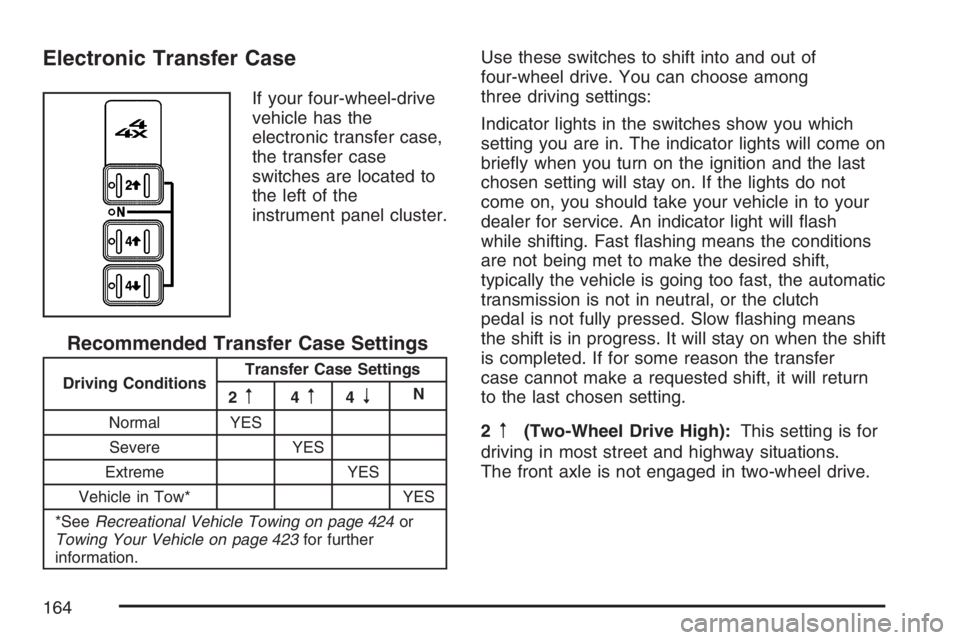
Electronic Transfer Case
If your four-wheel-drive
vehicle has the
electronic transfer case,
the transfer case
switches are located to
the left of the
instrument panel cluster.
Recommended Transfer Case Settings
Driving ConditionsTransfer Case Settings
2m4m4nN
Normal YES
Severe YES
Extreme YES
Vehicle in Tow* YES
*SeeRecreational Vehicle Towing on page 424or
Towing Your Vehicle on page 423for further
information.
Use these switches to shift into and out of
four-wheel drive. You can choose among
three driving settings:
Indicator lights in the switches show you which
setting you are in. The indicator lights will come on
briey when you turn on the ignition and the last
chosen setting will stay on. If the lights do not
come on, you should take your vehicle in to your
dealer for service. An indicator light will ash
while shifting. Fast ashing means the conditions
are not being met to make the desired shift,
typically the vehicle is going too fast, the automatic
transmission is not in neutral, or the clutch
pedal is not fully pressed. Slow ashing means
the shift is in progress. It will stay on when the shift
is completed. If for some reason the transfer
case cannot make a requested shift, it will return
to the last chosen setting.
2
m(Two-Wheel Drive High):This setting is for
driving in most street and highway situations.
The front axle is not engaged in two-wheel drive.
164
Page 165 of 674
{CAUTION:
Shifting the transfer case to NEUTRAL
can cause your vehicle to roll even if the
transmission is in PARK (P). You or
someone else could be seriously injured.
Be sure to set the parking brake before
placing the transfer case in NEUTRAL.
SeeParking Brake on page 169.
(N) NEUTRAL:Shift the vehicle’s transfer case to
NEUTRAL only when towing your vehicle. See
Recreational Vehicle Towing on page 424or
Towing Your Vehicle on page 423for more
information.
4
m(Four-Wheel Drive High):This setting
engages the front axle to help drive your vehicle.
Use Four-Wheel Drive High when you need
extra traction, such as on snowy or icy roads, or in
most off-road situations.4
n(Four-Wheel Drive Low):This setting also
engages your front axle to give you extra
traction. You may never need Four-Wheel Drive
Low. It sends the maximum power to all four
wheels. You might choose Four-Wheel Drive Low
if you were driving off-road in sand, mud or
deep snow and while climbing or descending steep
hills. When operating in Four-Wheel Drive Low,
the gear ratio provides additional torque when
compared to Four-Wheel Drive High. The
transmission gear shift feel will be exaggerated.
Shifting from Two-Wheel Drive High
to Four-Wheel Drive High
Press and release the Four-Wheel Drive High
switch. This can be done at any speed. The front
axle will lock automatically with some delay.
Shifting from Four-Wheel Drive High to
Two-Wheel Drive High
Press and release the Two-Wheel Drive High
switch. This can be done at any speed. The front
axle will unlock automatically with some delay.
165
Page 169 of 674
6. You may start the engine and shift the
transmission to the desired position.
Excessively shifting the transfer case into or
out of the different modes may cause the
transfer case to enter the shift protection
mode. This mode protects the transfer case
from possible damage and only allows
the transfer case to respond to one shift per
10 seconds. The transfer case may stay in this
mode for up to three minutes.
7. After the transfer case has shifted out of
NEUTRAL the red light will go out.
Parking Brake
To set the parking brake, hold the regular brake
pedal down with your right foot. Push down
the parking brake pedal with your left foot.
A chime will activate and the warning light will
ash when the parking brake is applied and
the vehicle is moving at least 3 mph (5 km/h) for
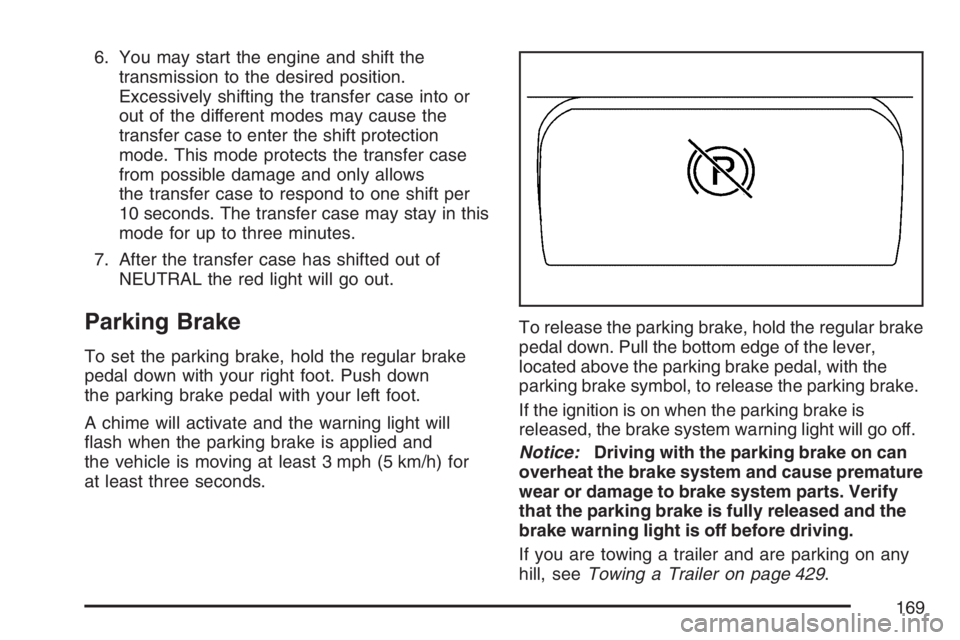
at least three seconds.To release the parking brake, hold the regular brake
pedal down. Pull the bottom edge of the lever,
located above the parking brake pedal, with the
parking brake symbol, to release the parking brake.
If the ignition is on when the parking brake is
released, the brake system warning light will go off.
Notice:Driving with the parking brake on can
overheat the brake system and cause premature
wear or damage to brake system parts. Verify
that the parking brake is fully released and the
brake warning light is off before driving.
If you are towing a trailer and are parking on any
hill, seeTowing a Trailer on page 429.
169