engine GMC SIERRA DENALI 2003 Owners Manual
[x] Cancel search | Manufacturer: GMC, Model Year: 2003, Model line: SIERRA DENALI, Model: GMC SIERRA DENALI 2003Pages: 428, PDF Size: 20.35 MB
Page 314 of 428
Using a match near a battery can cause battery
gas to explode. People have been hurt doing
this, and some have been blinded. Use a
flashlight if you need more light.
Be sure the battery has enough water.
You don’t need to add water to the ACDelco@
battery installed in your new vehicle. But
if
a battery has filler caps, be sure the right
amount of fluid is there. If
it is low, add water
to take care of that first. If you don’t, explosive
gas could be present.
Battery fluid contains acid that can burn you.
Don’t get
it on you. If you accidentally get it in
your eyes or on your skin, flush the place with
water and get medical help immediately.
I
Fans or other moving engine parts can injure
you badly. Keep your hands away from moving
parts once the engine is running.
I
5. Check that the jumper cables don’t have loose or
missing insulation. If they do, you could get a
shock. The vehicles could be damaged too.
Before you connect the cables, here are some
basic things you should know. Positive
(+) will go to
positive
(+) or a remote positive (+) terminal if the
vehicle has one. Negative
(-) will go to a heavy,
unpainted metal engine part or a remote
negative
(-) terminal if the vehicle has one.
Don’t connect positive
(+) to negative (-) or you’ll
get a short that would damage the battery and
maybe other parts too. And don’t connect the
negative
(-) cable to the negative (-) terminal on
the dead battery because this can cause sparks.
5-45
Page 316 of 428
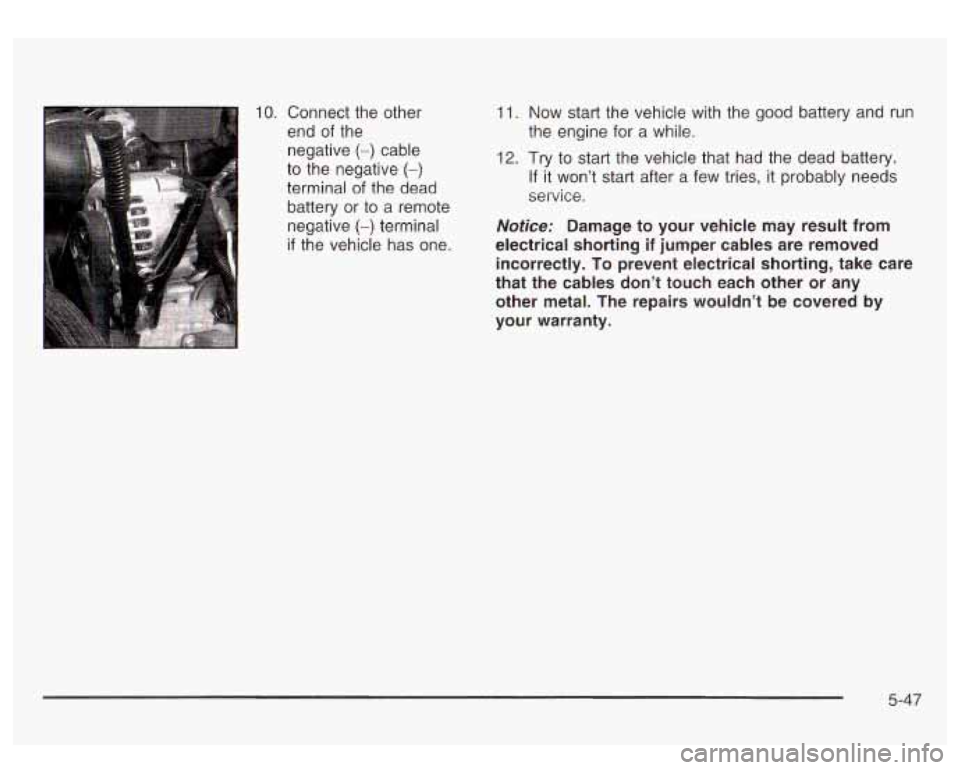
I 10. Connect the other
end of the
negative
(-) cable
to the negative
(-)
terminal of the dead
battery or to a remote
negative
(-) terminal
if the vehicle has one.
11. Now start the vehicle with the good battery and run
the engine for a while.
12. Try to start the vehicle that had the dead battery.
If it won’t start after a few tries, it probably needs
service.
Notice: Damage to your vehicle may result from
electrical shorting if jumper cables are removed
incorrectly.
To prevent electrical shorting, take care
that the cables don’t touch each other or any
other metal. The repairs wouldn’t be covered by
your warranty.
5-47
Page 317 of 428
A 8
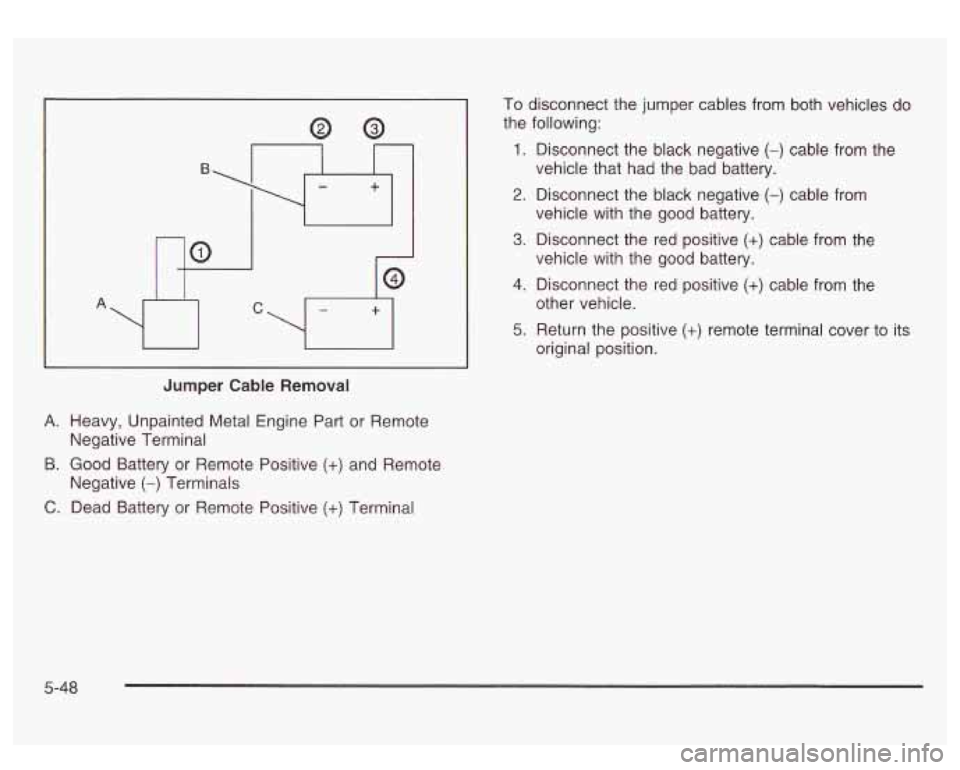
Jumper Cable Removal
A. Heavy, Unpainted Metal Engine Part or Remote
9. Good Battery or Remote Positive (+) and Remote
C. Dead Battery or Remote Positive (+) Terminal
Negative Terminal
Negative
(-) Terminals To
disconnect the jumper cables from both vehicles do
the following:
1. Disconnect the black negative (-) cable from the
2. Disconnect the black negative (-) cable from
3. Disconnect the red positive (+) cable from the
vehicle that
had the bad battery.
vehicle with the good battery.
vehicle with the good battery.
4. Disconnect the red positive (+) cable from the
other vehicle.
5. Return the positive (+) remote terminal cover to its
original position.
5-48
Page 338 of 428
A rear blowout, particularly on a curve, acts much like a Changing a Flat Tire
skid and may require the same correction you’d use
in a skid. In any rear blowout, remove your foot from the
If a tire goes flat, avoid further tire and wheel damage
accelerator pedal. Get the vehicle under control by by driving slowly
to a level place. Turn on your
steering
the way you want the vehicle to go. it may be hazard warning flashers.
very bumpy and noisy, but you can still steer. Gently
brake
to a stop - well off the road if possible.
If a tire goes flat, the next part shows how
to use your
jacking equipment to change a flat tire safely.
C..-nging a tire can cause
an injury. The
vehicle can slip
off the jack and roll over you
or other people. You and they could be badly
injured. Find a level place to change your tire.
To help prevent the vehicle from moving:
1. Set the parking brake firmly.
2. Put the shift lever in PARK (P).
3. Turn off the engine.
4. Put the wheel blocks at the front and rear
of the tire farthest away from the one
being changed. That
would be the tire on
the other side of the vehicle, at the
opposite end.
5-69
Page 363 of 428
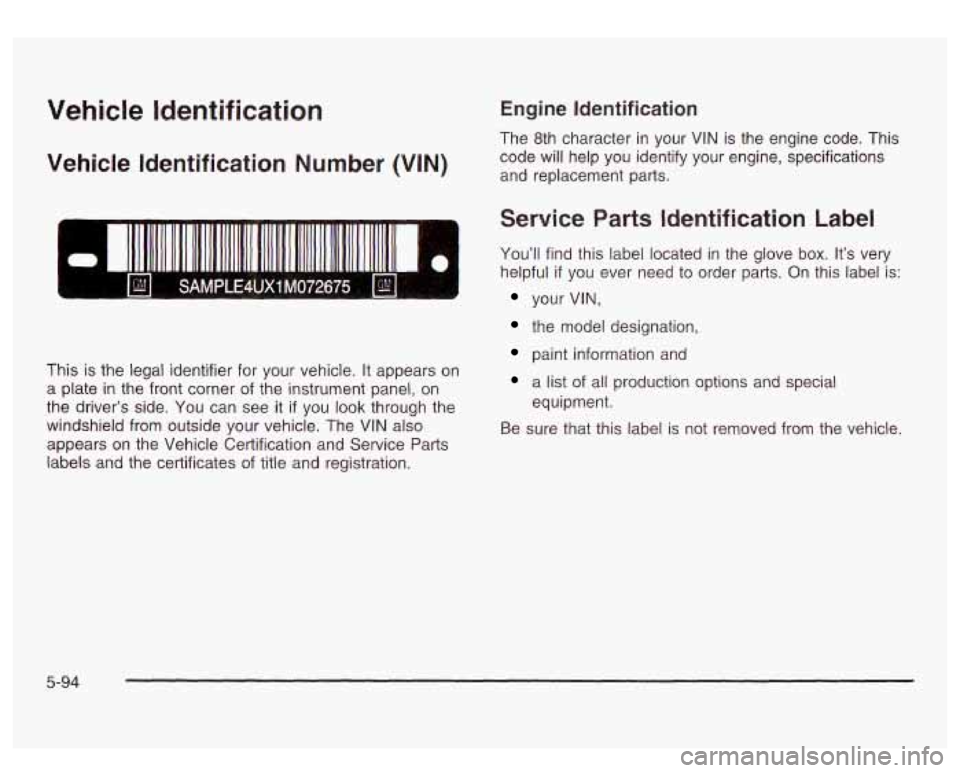
Vehicle Identification
Vehicle Identification Number (VIN)
SAMPLE4UX1 M072675
This is the legal identifier for your vehicle. It appears on
a plate in the front corner of the instrument panel, on
the driver’s side. You can see it
if you look through the
windshield from outside your vehicle. The VIN also
appears on the Vehicle Certification and Service Parts
labels and the certificates of title and registration.
Engine Identification
The 8th character in your VIN is the engine code. This
code will help you identify your engine, specifications
and replacement parts.
Service Parts Identification Label
You’ll find this label located in the glove box. It’s very
helpful
if you ever need to order parts. On this label is:
your VIN,
the model designation,
paint information and
a list of all production options and special
equipment.
Be sure that this label is not removed from the vehicle.
5-94
Page 368 of 428
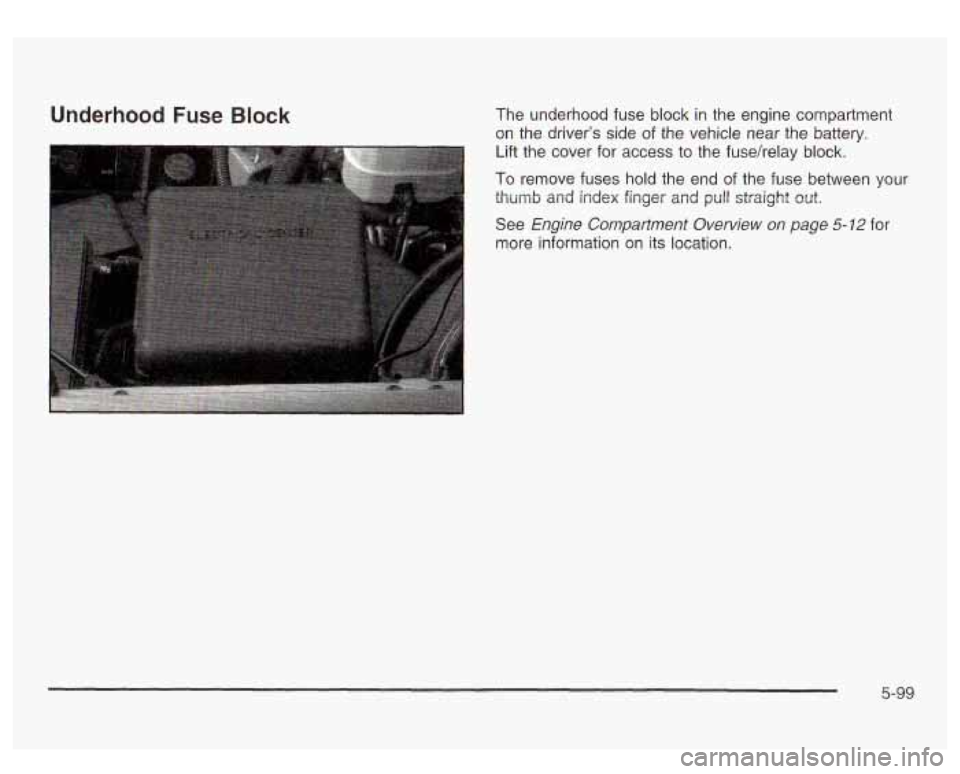
Underhood Fuse Block The underhood fuse block in the engine compartment
on the driver's side of the vehicle near the battery.
Lift the cover for access to the fusehelay block.
To remove fuses hold the end of the fuse between your
thumb and
index finger and pull straight out.
See
Engine Compartment Overview on page 5-12 for
more information on its location.
5-99
Page 369 of 428
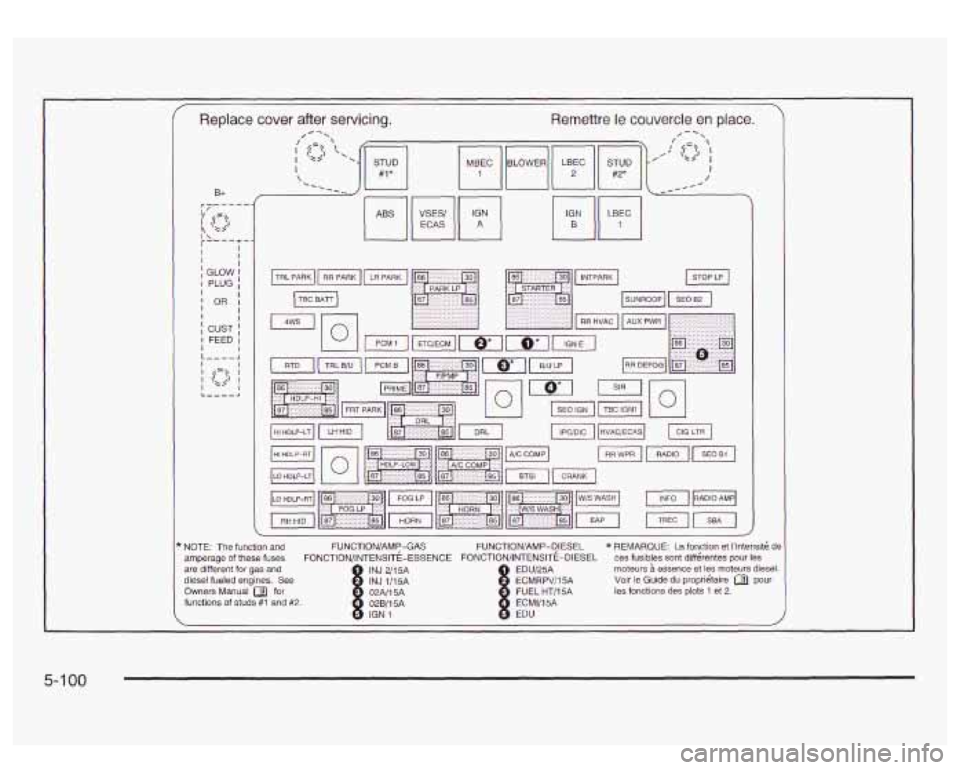
Replace cover after servicing. Remettre le couvercle en place.
I ? i I I I I I
I
I I I
I
I I I L I 1 I I L
B+
GLOW I PLUG
OR I
I CUST I FEED I I -_--l
NOTE: The function and FUNCTION/AMy-GAS
amperage of these fuses FONCTION/INTENSIT!-ESSENCE FONCTIONIINTENSITE-DIESEL ces fusibles sont diffbrentes pour les
FUNCTION/AMP-QlESEL * REMARQUE: La fonction
et I'intensitk de
are different for gas and INJ 2/15A EDU/25A moteurs essence et les rnoteurs diesel.
diesel fueled engines. See
Owners Manual for
functions
of studs #I and #2. ECMV15A f
tCMRPV/I5A
FUEL HT/15A Voir le Guide du propri6taire a pour
les fonctions des plots 1 et 2.
5- 1 00
Page 370 of 428
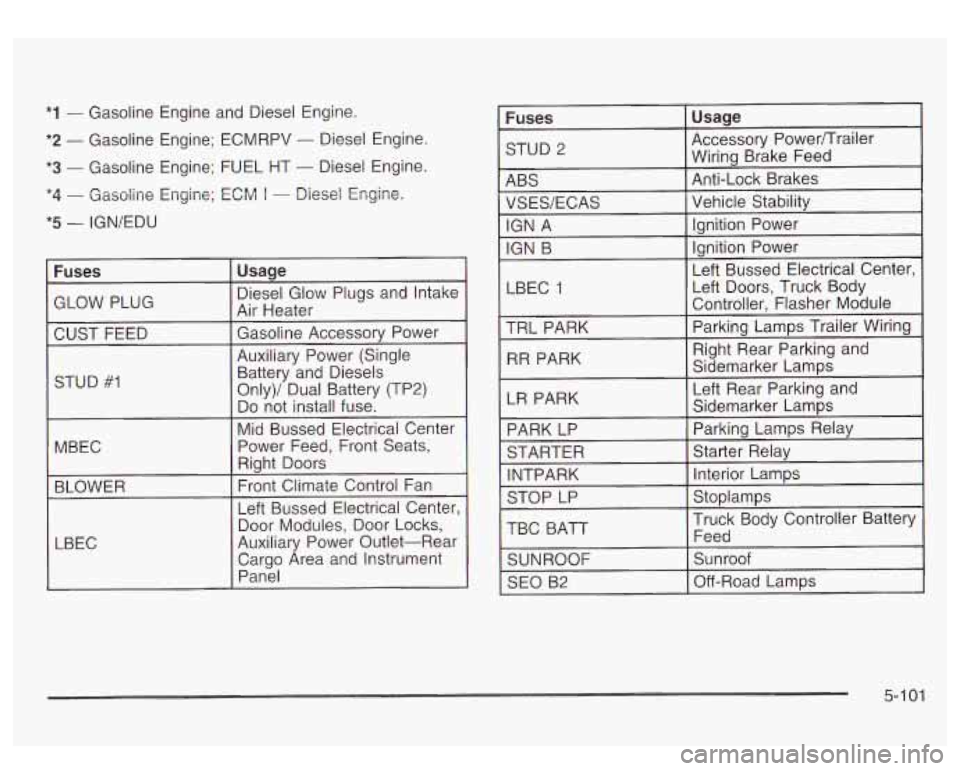
*I - Gasoline Engine and Diesel Engine.
*2 - Gasoline Engine; ECMRPV - Diesel Engine.
*3 - Gasoline Engine; FUEL HT - Diesel Engine.
*4 - Gasoline Engine; ECM f - Diesel Engine.
*5 - IGN/EDU
r Fuses
GLOW PLUG
CUST FEED
STUD
#I
MBEC
BLOWER
LBEC Only)/ Dual Battery
(TP2)
Do not install fuse.
Mid Bussed Electrical Center
Power Feed, Front Seats,
Riaht Doors TRL
PARK Parking Lamps Trailer Wiring
RR PARK Right
Rear Parking and
Sidemarker LamDs
TBC BATT Truck Body
Controller Battery
I Feed
5-1 01
Page 373 of 428
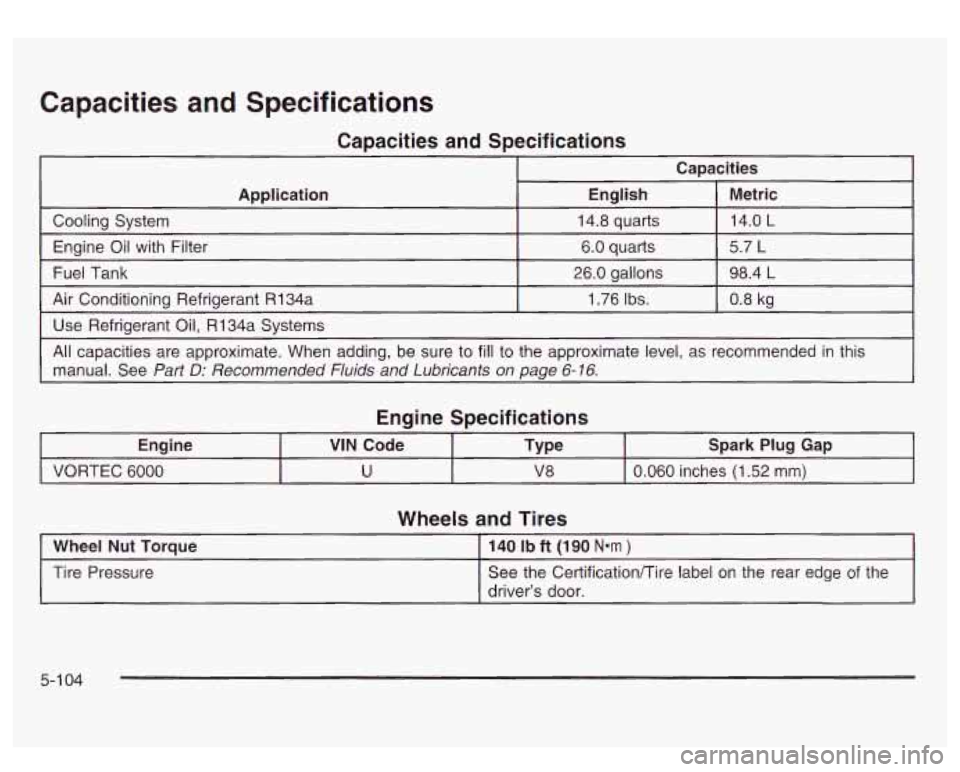
Capacities and Specifications
Capacities and Specifications
Capacities
Application
All capacities are approximate. When adding, be sure to
fill to the approximate level, as recommended in this
Use
Refrigerant Oil, R134a Systems 0.8
kg
1.76 Ibs.
Air Conditioning Refrigerant R134a 98.4
L 26.0 gallons
Fuel
Tank 5.7
L 6.0 quarts
Engine Oil
with Filter 14.0
L 14.8 quarts
Cooling
System Metric
English
manual. See
Part D: Recommended Fluids and Lubricants on page 6-16.
Engine Specifications
Engine Spark Plug Gap
Type
VIN Code
VORTEC 6000
0.060 inches (1.52 mm) V8
U
Wheels and Tires
Wheel Nut Torque
See the CertificationKire label on the rear edge of the
Tire
Pressure 140 Ib ft (190 N*m )
driver’s door.
5-1 04
Page 376 of 428
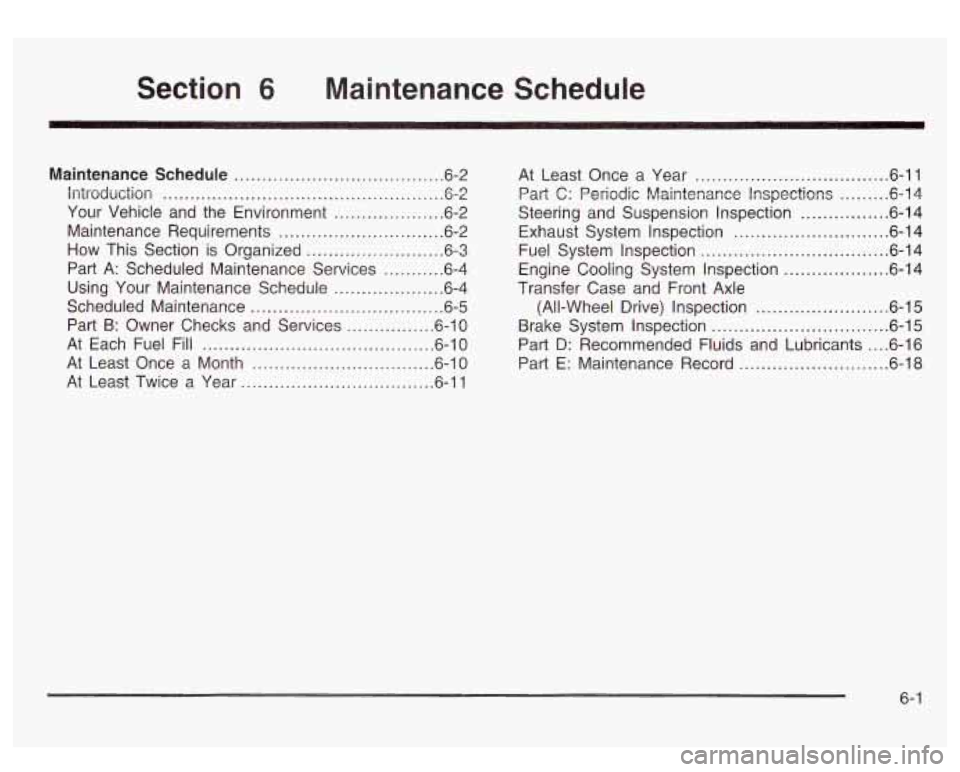
Section 6 Maintenance Schedule
Maintenance Schedule ...................................... 6.2
introduction
................................................... 6.2
Your Vehicle and the Environment
.................... 6-2
Maintenance Requirements
.............................. 6-2
How This Section is Organized
......................... 6-3
Part A: Scheduled Maintenance Services
........... 6-4
Using Your Maintenance Schedule
.................... 6-4
Scheduled Maintenance
................................... 6-5
Part
B: Owner Checks and Services ................ 6-10
At Each Fuel Fill
.......................................... 6-10
At Least Once a Month
................ ......... 6-10
At Least Twice a Year
............................... 6-11 At Least
Once a Year
................................... 6-11
Part
C: Periodic Maintenance Inspections ......... 6.14
Steering and Suspension Inspection
................ 6.14
Exhaust System inspection
............................ 6-14
Fuel System Inspection
.................................. 6.14
Engine Cooling System inspection
................... 6.14
(All-Wheel Drive) Inspection
........................ 6.15
Brake System Inspection
................................ 6.15
Part
D: Recommended Fluids and Lubricants .... 6-16
Part E: Maintenance Record
........................... 6.18
Transfer Case and
Front Axle
6- 1