transmission GMC SIERRA DENALI 2003 User Guide
[x] Cancel search | Manufacturer: GMC, Model Year: 2003, Model line: SIERRA DENALI, Model: GMC SIERRA DENALI 2003Pages: 428, PDF Size: 20.35 MB
Page 161 of 428
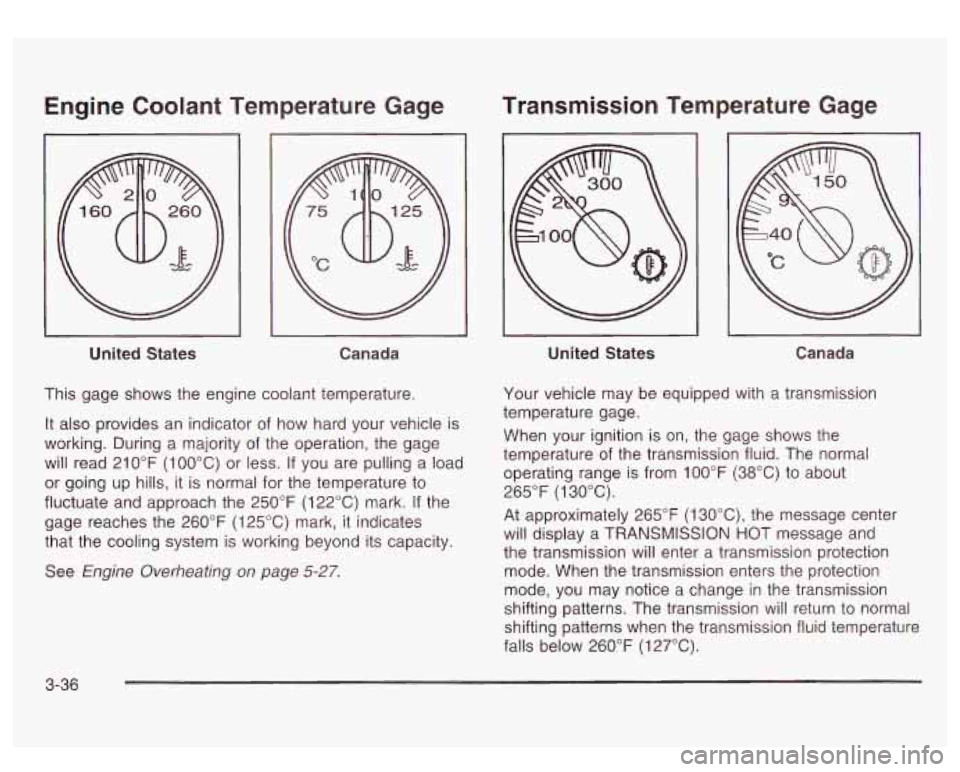
Engine Coolant Temperature Gage Transmission Temperature Gage
I I
United States
Canada
This gage shows the engine coolant temperature.
It also provides an indicator of how hard your vehicle is
working. During a majority
of the operation, the gage
will read 210°F
(1 00°C) or less. If you are pulling a load
or going up hills, it is normal for the temperature to
fluctuate and approach the 250°F (122°C) mark.
If the
gage reaches the 260°F
(1 25°C) mark, it indicates
that the cooling system is working beyond its capacity.
See
Engine Overheating on page 5-27.
United States Canada
Your vehicle may be equipped with a transmission
temperature gage.
When your ignition is on, the gage shows the
temperature of the transmission fluid. The normal
operating range is from 100°F (38°C)
to about
265°F
(1 30°C).
At approximately 265°F (13O"C), the message center
will display
a TRANSMISSION HOT message and
the transmission will enter
a transmission protection
mode. When the transmission enters the protection
mode, you may notice a change in the transmission
shifting patterns. The transmission will return to normal
shifting patterns when the transmission fluid temperature
falls below 260°F
(1 27°C).
3-36
Page 162 of 428
See Driver Information Center (DIC) on page 3-43 for
further information.
If the transmission fluid reaches temperatures of
approximately 275°F
(1 35°C) or greater, the Driver
Information Center wiil display a
TRANS HOT IDLE
ENG warning message. Pull the vehicle off the roadway
when it
is safe to do so. Set the parking brake, place
the transmission in PARK
(P) and allow the engine
to idle until the transmission temperature falls below
260°F (1 27°C). If the transmission continues to operate
above
265°F (13O"C), contact your nearest dealer or
the
GM Roadside Assistance Center. See Roadside
Assistance Program
on page 7-5.
Notices If you keep driving your vehicle with the
transmission temperature gage above the normal
operating range, you can damage the transmission.
This could lead to costly repairs that may not be
covered under your warranty. The
following situations can cause the transmission to
operate at higher temperatures:
0 Towing a trailer
0 Hot outside air temperatures
0 Hauling a large or heavy load
0 Low transmission fluid level
High transmission fluid level
0 Restricted air flow to the radiator and the auxiliary
transmission oil cooler
(if equipped).
A temporary solution to hotter transmission operating
temperatures may be to let the transmission cool down.
If the transmission is operated at higher temperatures
on a frequent basis, see
Scheduled Maintenance
on page
6-5 for the proper transmission maintenance
intervals.
3-37
Page 163 of 428
Malfunction Indicator Lamp
Check Engine Light
Your vehicle is equipped
with a computer which
monitors operation of the
fuel, ignition and emission
control systems.
I I
This system is called OBD I1 (On-Board
Diagnostics-Second Generation) and is intended to
assure that emissions are at acceptable levels for the
life of the vehicle, helping to produce a cleaner
environment. The Check Engine light comes on to
indicate that there is a problem and service is required.
Malfunctions often will be indicated by the system
before any problem is apparent. This may prevent more
serious damage to your vehicle. This system is also
designed to assist your service technician in correctly
diagnosing any malfunction.
Notice: If you keep driving your vehicle with this
light on, after a while, your emission controls
may not work as well, your fuel economy may not
be as good and your engine may not
run as
smoothly. This could lead to costly repairs that may not be covered by your warranty.
Notice: Modifications made to the engine,
transmission, exhaust, intake or fuel system of your
vehicle or the replacement of the original tires
with other than those of the same Tire Performance
Criteria (TPC) can affect your vehicle’s emission
controls and may cause this light to come on.
Modifications to these systems could lead to costly
repairs not covered by your warranty. This may
also result in a failure to
pass a required Emission
Inspection/Maintenance test.
This light should come on, as a check to show you it is
working, when the ignition is on and the engine is
not running. If the light doesn’t come on, have it
repaired. This light will also come on during a
malfunction in one of two ways:
Light Flashing - A misfire condition has been
detected.
A misfire increases vehicle emissions
and may damage the emission control system on
your vehicle. Dealer or qualified service center
diagnosis and service may be required.
Light On Steady - An emission control system
malfunction has been detected on your vehicle.
Dealer or qualified service center diagnosis
and service may be required.
3-38
Page 184 of 428
TRANSMISSION HOT
If the transmission fluid temperature becomes high, the
message center will display this message.
When the transmission enters the protection mode, you
may notice a change in the transmission shifting
patterns. When the transmission fluid temperature
returns to normal, the display will turn
off and the
transmission shifting patterns will return
to normal.
Nofice: If you keep driving your vehicle with the
transmission
TRANS FLUID HOT message
displayed, you can damage the transmission.
This
could lead to costly repairs that may not be covered
under your warranty. The
following situations can cause the transmission to
operate at higher temperatures:
Towing a trailer
Hot outside air temperatures
0 Hauling a large or heavy load
Low transmission fluid level
High transmission fluid level
transmission oil cooler.
0 Restricted air flow to the radiator and the auxiliary
A temporary solution to hotter transmission operating
temperatures may be to let the transmission
cool down.
If the transmission is operated at higher temperatures
on a frequent basis, see
Scheduled Maintenance
on page 6-5 for the proper transmission maintenance
intervals.
3-59
Page 188 of 428
XMTM Radio Satellite Service (USA Only): XMTM is a
continental
U.S. based satellite radio service that
offers 100 coast to coast channels including music,
news, sports, talk and children’s programming. XMTM
provides digital quality audio and text information,
including song title and artist name. A service fee is
required in order to receive the XMTM service. For more
information, contact XMTM at www.xmradio.com or
call 1 -800-852-XMXM
(9696).
Digital Audio Broadcast (DAB) (Canada Only): DAB
is a Canadian land-based radio service that offers
digital quality audio and text information including song
title, artist name, traffic, weather, emergency
announcements and more. Digital Audio Broadcast
transmission services are currently available
in Toronto,
Montreal, Vancouver, Ottawa, and Windsor. In fringe
areas signals may be interrupted by buildings, trees and
other obstructions. Additional services will be added
in the future. For current DAB coverage and other
information consult the GM Canada website at
www.gmcanada.com, your dealer or call
1-800-263-3777.
Playing the Radio
PWR (Power): Press this knob to turn the system on
and off.
VOL (Volume): Turn this knob to increase or to
decrease volume.
AUTO VOL (Automatic Volume): Your audio system
monitors the noise inside your vehicle. To use automatic
volume, press the AUTO VOL button until AVOL
ON
appears on the display. Then, automatic volume
will automatically adjust the volume of your radio
so that
it always sounds the same to you. To turn the
automatic volume off, press the AUTO VOL button until
AVOL
OFF appears on the display.
3-63
Page 220 of 428
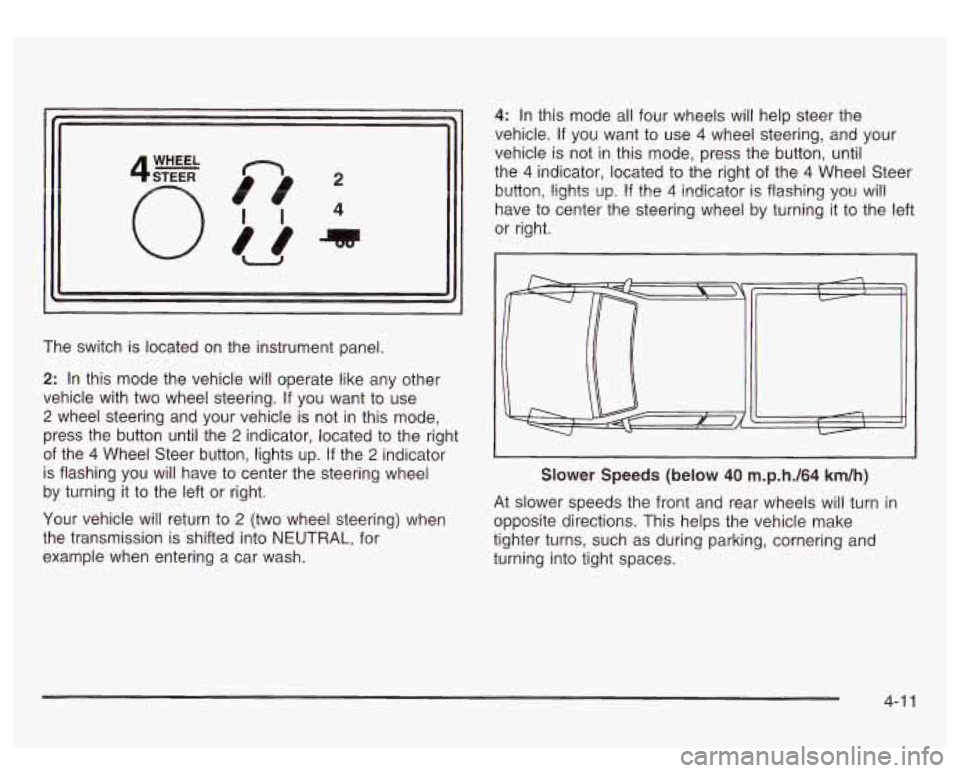
The switch is located on the instrument panel.
2: In this mode the vehicle will operate like any other
vehicle with two wheel steering. If you want to use
2 wheel steering and your vehicle is not in this mode,
press the button until the
2 indicator, located to the right
of the
4 Wheel Steer button, lights up. If the 2 indicator
is flashing you will have to center the steering wheel
by turning it
to the left or right.
Your vehicle will return to
2 (two wheel steering) when
the transmission is shifted into NEUTRAL, for
example when entering a car wash.
4: In this mode all four wheels will help steer the
vehicle.
If you want to use 4 wheel steering, and your
vehicle is not in this mode, press the button, until
the
4 indicator, located to the right of the 4 Wheel Steer
button, lights up.
If the 4 indicator is flashing you will
have to center the steering wheel by turning it to the left
or right.
I
I
Slower Speeds (below 40 m.p.h./64 km/h)
At slower speeds the front and rear wheels will turn in
opposite directions. This helps the vehicle make
tighter turns, such as during parking, cornering and
turning into tight spaces.
1
4-1 1
Page 232 of 428
Q: What should I do if my vehicle stalls, or is
A: if this happens, there are some things you should
about to stall, and
I can’t
make it up the hill?
e
9
e
do and there are some things you must not do.
First, here’s what you should do:
Push the brake pedal to stop the vehicle and keep
if from rolling backwards. Also, apply the parking
brake.
If your engine is still running, shift the transmission
to REVERSE (R), release the parking brake, and
slowly back down the hill as straight as possible in
REVERSE (R).
As you are backing down the hill, put your left hand
on the steering wheel at the
12 o’clock position.
This way, you’ll be able to tell
if your wheels
are straight and maneuver as you back down. It’s
best that you back down the hill with our wheels
straight rather than in the left or tight direction.
Turning the wheel too far to the left
or right
will increase the possibility of a rollover. Here are
some things you
must not do if you stall, or
are about to stall, when going up a
hill.
9 Never attempt to prevent a stall by shifting into
NEUTRAL
(N) to “rev-up” the engine and regain
forward momentum. This won’t work. Your vehicle
will roll backwards very quickly and you could
go out of control.
Instead, apply the regular brake to stop the vehicle.
Then apply the parking brake. Shift to
REVERSE (R), release the parking brake, and
slowly back straight down.
9 Never attempt to turn around if you are about to
stall when going up a hill. If the hill is steep
enough to stall your vehicle, it’s steep enough to
cause you to roll over
if you turn around. If you can’t
make it up the hill, you must back straight down
the hill.
4-23
Page 233 of 428
Q: Suppose, after stalling, I try to back down the hill
A: Set the parking brake, put your transmission in
PARK (P) and turn
off the engine. Leave the
vehicle and go get some help. Exit
on the uphill
side and stay clear of the path the vehicle would
take
if it rolled downhill.
and decide
I just can’t
do it. What should I do?
Driving Downhill
When off-roading takes you downhill, you’ll want to
consider a number of things:
How steep is the downhill? Will I be able to maintain
vehicle control?
What’s the surface like? Smooth? Rough? Slippery?
Hard-packed dirt? Gravel?
0 Are there hidden surface obstacles? Ruts? Logs?
What’s at the bottom of the hill? Is there a hidden
Boulders?
creek bank or even a river bottom with large
rocks?
If you decide you can go down a hill safely, then try to
keep your vehicle headed straight down, and use a
low gear. This way, engine drag can help your brakes
and they won’t hate to do all the work. Descend slowly,
keeping your vehicle under control at all times. Heavy
braking when going down a
h can
cause your brakes to overheat and fade. This
could cause
loss of control and a serious
accident. Apply the brakes lightly when
descending a hill and use
a low gear to keep
vehicle speed under control.
Q: Are there some things I should not do when
A: Yes! These are important because if you ignore
driving
down a hill?
0
them you could lose control and have a serious
accident.
When driving downhill, avoid turns that take you
across the incline
of the hill. A hill that’s not too
steep to drive down may be too steep to drive
across. You could roll over
if you don’t drive straight
down.
Never go downhill with the transmission in
NEUTRAL (N).
This is called “free-wheeling.” Your brakes will have
to do all the work and could overheat and fade.
4-24
Page 246 of 428
If you drive regularly in steep country, or if you’re
planning to visit there, here are some tips that can make
your trips safer and more enjoyable. See
Operating
Your All-Wheel-Drive Vehicle
Off Paved Roads on
page
4-16 for information about driving off-road.
Keep your vehicle in good shape. Check all fluid
levels and also the brakes, tires, cooling system
and transmission. These parts can work hard
on mountain roads.
Know how to go down hills. The most important
thing to know is this: let your engine do some of
the slowing down. Shift to a lower gear when you go
down a steep or long hill.
If you don’t I R down, your -____ 3s COL- ge-
so hot that they wouldn’t work well. You would
then have poor braking or even none going
down a hill. You could crash. Shift down to let
your engine assist your brakes on a steep downhill slope. Coasting
UVwnlll..
..I NEUTRAL (N) G. .... h the
ignition
off is dangerous. Your brakes will have
to do all the work
of slowing down. They could
get
so hot that they wouldn’t work well. You
would then have poor braking or even none
going down a
hill. You could crash. Always
have your engine running and your vehicle in
gear when you go downhill.
Know how to go uphill. You may want to shift down to
a lower gear. The lower gears help cool your engine
and transmission, and you can climb the hill better.
roads in hills or mountains. Don’t swing wide or cut
across the center of the road. Drive at speeds that let
you stay in your own lane.
As you go over the top of a hill, be alert. There could
be something in your lane, like a stalled car or an
accident.
You may see highway signs on mountains that warn
of special problems. Examples are long grades,
passing or no-passing zones, a falling rocks area or
winding roads. Be alert to these and take appropriate
action.
Stay in your own lane when driving on two-lane
4-37
Page 251 of 428
If You Are Stuck: In Sand, Mud, Ice
or Snow
in order to free your vehicle when it is stuck, you will
need to spin the wheels, but you don’t want to spin your
wheels too fast. The method known as “rocking” can
help you aet out when you’re stuck, but you must
use cauti
.
If you let your tires spin at high speed, they
can explode, and you or others could be
injured.
And, the transmission or other parts of
the vehicle can overheat. That could cause an
CAUTION: (Continued) engine compartment fire or other
damage.
When you’re stuck, spin the wheels as little as
possible. Don’t spin the wheels above
25 mph
(55 km/h) as shown on the speedometer.
Nofice: Spinning your wheels can destroy parts of
your vehicle as well as the tires. If you spin the
wheels too fast while shifting your transmission back and forth, you can destroy your transmission.
For information about using tire chains on your
vehicle, see
Tire Chains on page 5-68.
4-42