check engine GMC SIERRA DENALI 2003 Owner's Manual
[x] Cancel search | Manufacturer: GMC, Model Year: 2003, Model line: SIERRA DENALI, Model: GMC SIERRA DENALI 2003Pages: 428, PDF Size: 20.35 MB
Page 275 of 428
California Fuel
If your vehicle is certified to meet California Emission
Standards (see the underhood emission control label),
it is designed to operate on fuels that meet California
specifications. If this fuel is not available
in states
adopting California emissions standards, your vehicle
will operate satisfactorily on fuels meeting federal
specifications, but emission control system performance
may be affected. The malfunction indicator lamp may
turn on (see
Malfunction lndicator Lamp on page 3-38 )
and your vehicle may fail a smog-check test. If this
occurs, return
to your authorized GM dealer for
diagnosis. If it is determined that the condition is caused
by the type of fuel used, repairs may not be covered
by your warranty.
Additives
To provide cleaner air, all gasolines in the United States
are now required to contain additives that will help
prevent engine and fuel system deposits from forming,
allowing your emission control system to work properly.
You should not have
to add anything to your fuel. Gasolines containing
oxygenates, such as ethers and
ethanol, and reformulated gasolines may be available in
your area to contribute
to clean air. General Motors
recommends that you use these gasolines, particularly
if
they comply with the specifications described earlier.
Notice: Your vehicle was not designed for fuel
that contains methanol. Don’t use fuel containing
methanol.
It can corrode metal parts in your
fuel system and also damage the plastic and rubber
parts. That damage wouldn’t be covered under
your warranty.
Some gasolines that are not reformulated for low
emissions may contain an octane-enhancing additive
called methylcyclopentadienyl manganese tricarbonyl
(MMT); ask the attendant where you buy gasoline
whether the fuel contains MMT. General Motors does
not recommend the use of such gasolines. Fuels
containing MMT can reduce the life of spark plugs and
the performance of the emission control system may
be affected. The malfunction indicator lamp may turn on.
If this occurs, return to your authorized GM dealer
for service.
5-6
Page 279 of 428
Checking Things Under
1-eH
od
Things ti.-- burn c2.. get on hot engine parts
and start a fire. These include liquids like fuel,
oil, coolant, brake fluid, windshield washer and
other fluids, and plastic or rubber. You or
others could be burned. Be careful not to drop or spill things that will burn onto a hot engine.
Hood Release
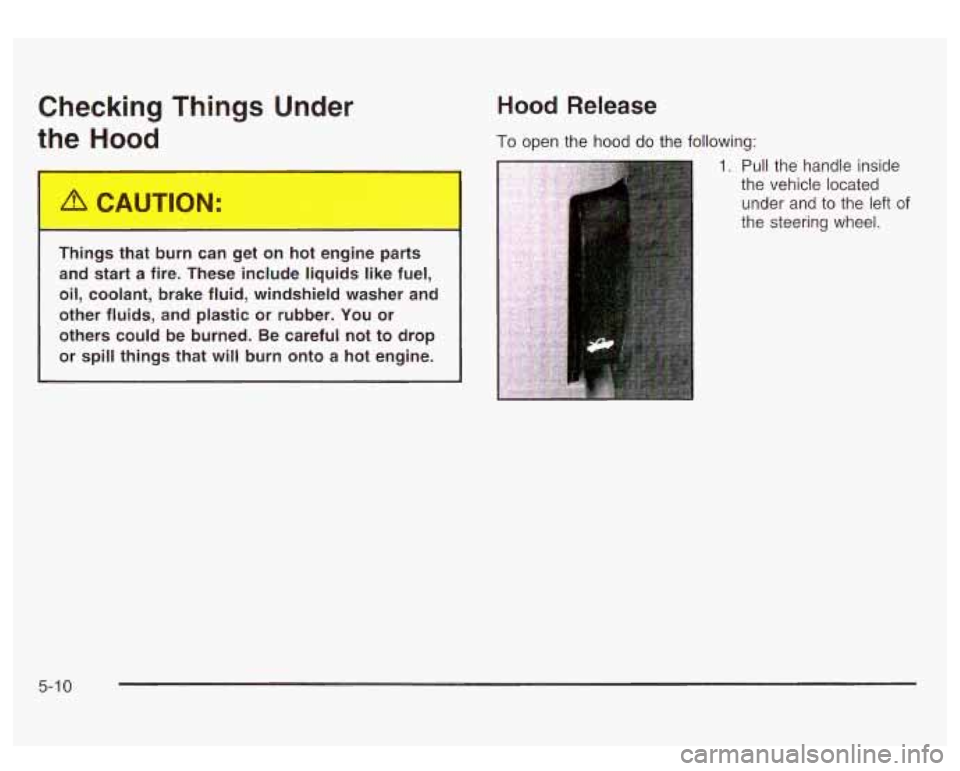
To open the hood do the following:
1. Pull the handle inside
the vehicle located
under and to the left
of
the steering wheel.
5-1 0
Page 282 of 428
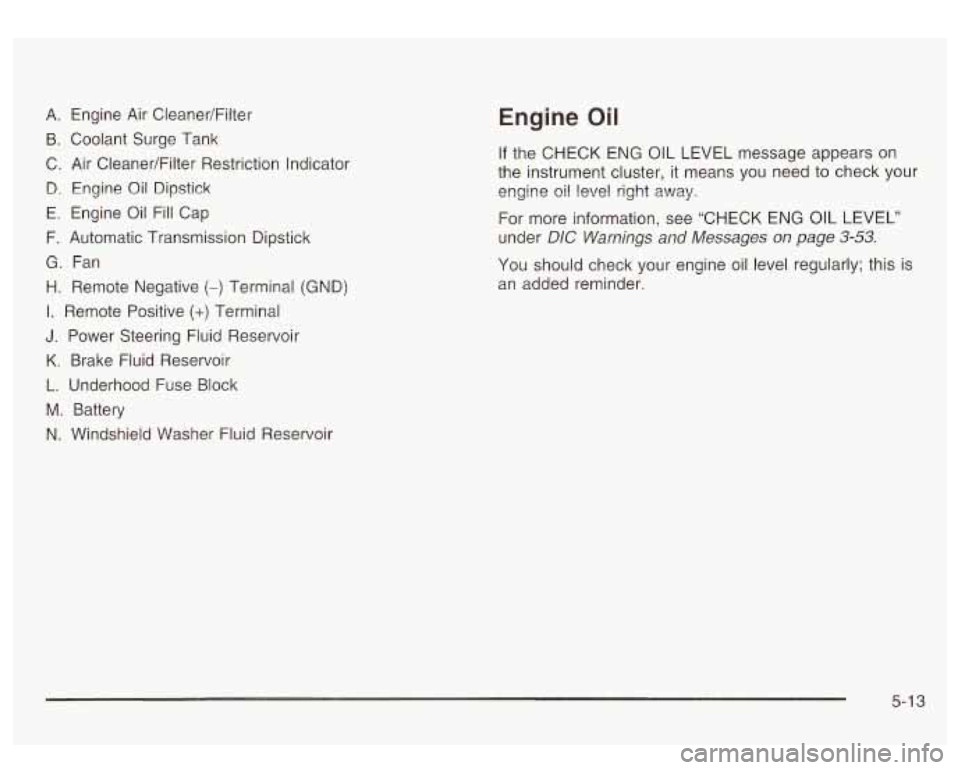
A. Engine Air CleanedFilter
B. Coolant Surge Tank
C. Air CleanerlFilter Restriction Indicator
B. Engine Oil Dipstick
E. Engine Oil Fill Cap
F. Automatic Transmission Dipstick
G. Fan
H. Remote Negative
(-) Terminal (GND)
I. Remote Positive (+) Terminal
J. Power Steering Fluid Reservoir
K. Brake Fluid Reservoir
L. Underhood Fuse Block
M. Battery
N. Windshield Washer Fluid Reservoir
Engine Oil
If the CHECK ENG OIL LEVEL message appears on
the instrument cluster, it means you need to check your
engine
oil level right away.
For more information, see “CHECK ENG
OIL LEVEL”
under
DIC Warnings and Messages on page 3-53.
You should check your engine oil level regularly; this is
an added reminder.
5-1 3
Page 283 of 428
Checking Engine Oil
It’s a good idea to check your engine oil every time you
get fuel. In order to get an accurate reading, the oil
must be warm and the vehicle must be on level ground.
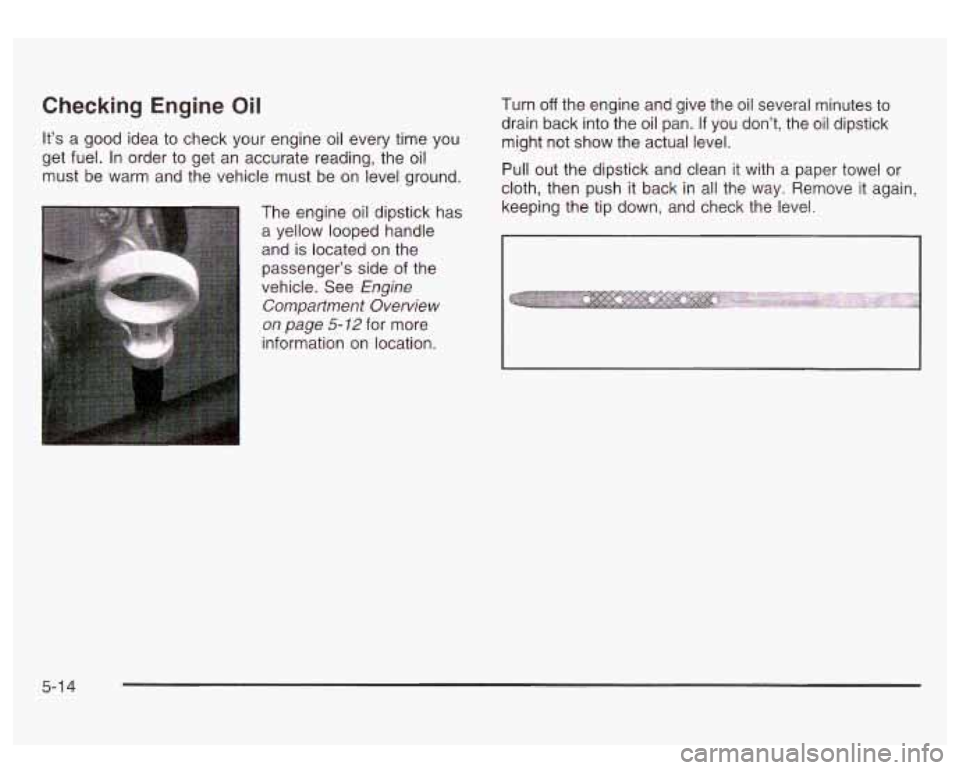
The engine oil dipstick has
a yellow looped handle
and is located on the
passenger’s side of the
vehicle. See
Engine
Compartment
Overview
on page 5- 12 for more
information on location. Turn
off the
engine and give the oil several minutes to
drain back into the oil pan.
If you don’t, the oil dipstick
might not show the actual level.
Pull out the dipstick and clean it with a paper towel or
cloth, then push it back in all the way. Remove it again,
keeping the tip down, and check the level.
5-1 4
Page 286 of 428
As in the chart shown previously, SAE 5W-30 is the
only viscosity grade recommended for your vehicle.
You should look for and use only oils which have the
API Starburst symbol and which are also identified
as SAE 5W-30. If you cannot find such SAE 5W-30 oils,
you can use an SAE IOW-30 oil which has the API
Starburst symbol,
if it's going to be 0°F (-18°C)
or above. Do not use other viscosity grade oils, such as
SAE 1OW-40 or SAE 20W-50 under any conditions.
Notice: Use only engine oil with the American
Petroleum Institute Certified For Gasoline Engines
starburst symbol. Failure to use the recommended
oil can result in engine damage not covered by
your warranty.
GM Goodwrench@ oil meets all the requirements for
your vehicle.
If you are in an area of extreme cold, where the
temperature falls below -20°F
(-29"C), it is
recommended that you use either an SAE 5W-30
synthetic oil or an SAE OW-30 oil. Both will provide
easier cold starting and better protection for your engine
at extremely
low temperatures.
Engine Oil Additives
Don't add anything to your oil. The recommended oils
with the starburst symbol are all you will need for
good performance and engine protection.
When to Change Engine Oil
(GM Oil Life SystemTM)
Your vehicle has a computer system that lets you know
when to change the engine
oil and filter. This is based on
engine revolutions and engine temperature, and not on
mileage. Based on driving conditions, the mileage
at which an oil change will be indicated can vary
considerably. For the oil life system to work properly,
you must reset the system every time the oil is changed.
When the system has calculated that oil life has been
diminished, it will indicate that an oil change is necessary.
A CHANGE ENGINE
OIL SOON message will come on.
Change your oil as soon as possible within the next two
times you stop for fuel. It is possible that,
if you are driving
under the best conditions, the oil life system may not
indicate that an oil change is necessary for over a year.
However, your engine oil and filter must be changed at
least once a year and at this time the system must be
reset. It is also important to check your oil regularly and
keep it at the proper level.
If the system is ever reset accidentally, you must
change your oil at 3,000 miles (5
000 km) since your
last oil change. Remember to reset the oil life system
whenever the oil is changed.
5-1 7
Page 288 of 428
Engine Air Cleaner/Filter
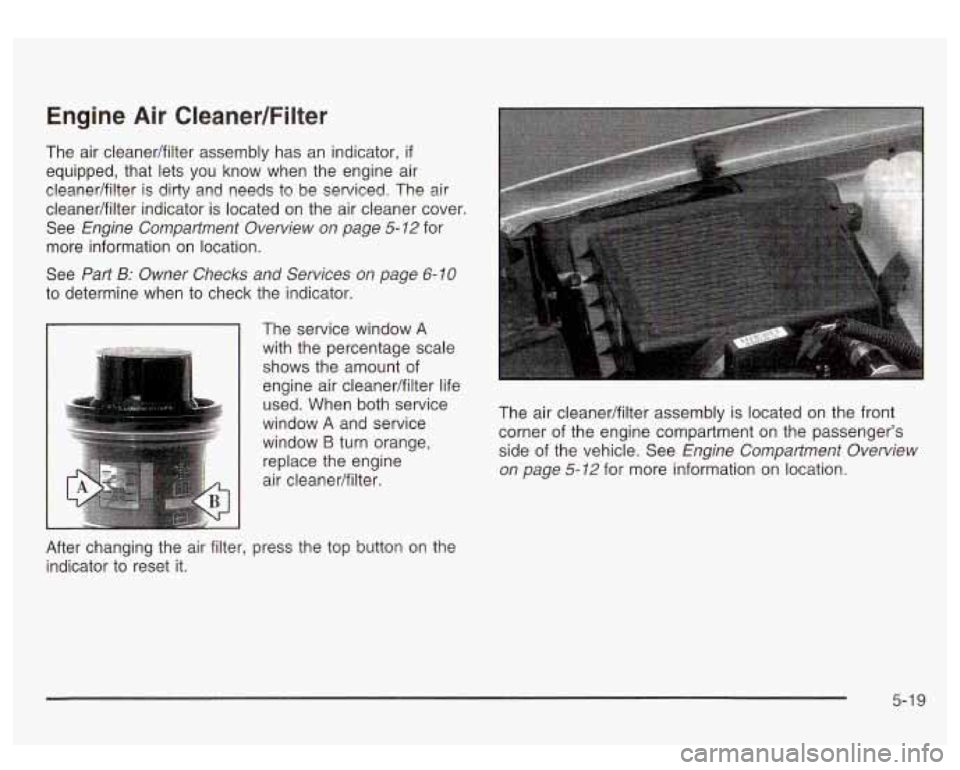
The air cleanedfilter assembly has an indicator, if
equipped, that lets you know when the engine air
cleanedfilter is dirty and needs to be serviced. The air
cleanedfilter indicator is located on the air cleaner cover.
See
Engine Compartment Overview on page 5-12 for
more information on location.
See
Part B: Owner Checks and Services on page 6-10
to determine when to check the indicator.
- The service window A
with the percentage scale
shows the amount of
engine air cleanedfilter life
used. When both service
window
A and service
window
B turn orange,
replace the engine
air cleaner/filter.
lfter changing the air filter, press the top button on the
ndicator to reset it. The air
cleanedfilter assembly is located on the front
corner of the engine compartment on the passenger’s
side of the vehicle. See Engine Compartment Overview
on page 5-12
for more information on location.
5-1 9
Page 289 of 428
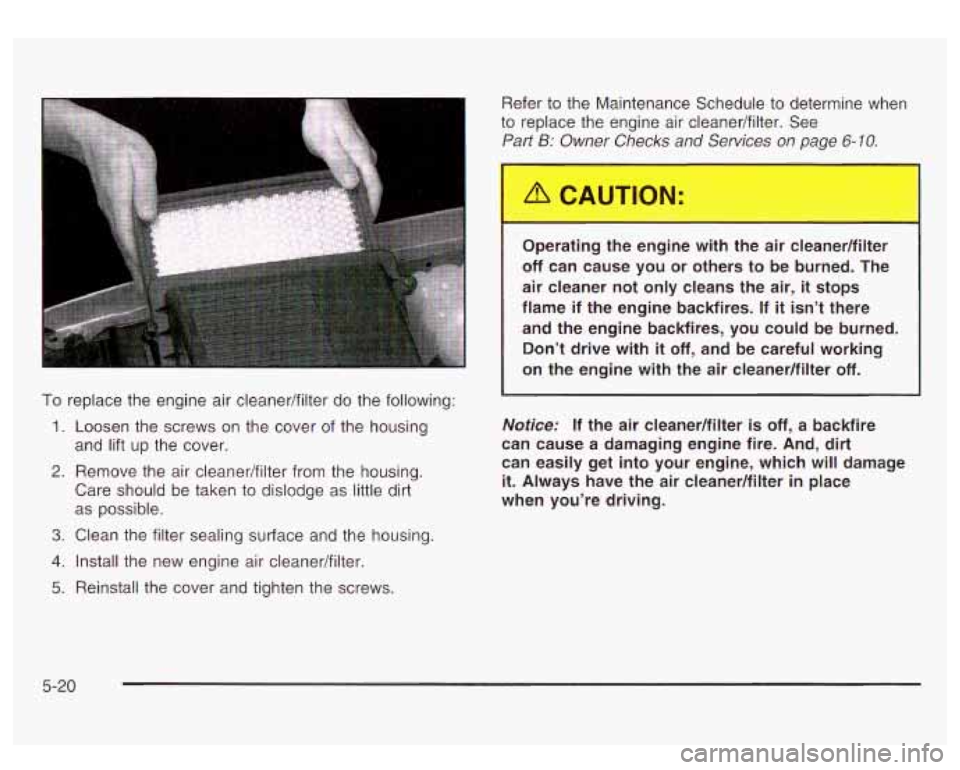
To replace the engine air cleaner/filter do the following:
1. Loosen the screws on the cover of the housing
and lift up the cover.
2. Remove the air cleaner/filter from the housing.
Care should be taken
to dislodge as little dirt
as possible.
3. Clean the filter sealing surface and the housing.
4. Install the new engine air cleanedfilter.
5. Reinstall the cover and tighten the screws. Refer
to the Maintenance Schedule to determine when
to replace the engine air cleaner/filter. See
Part B: Owner Checks and Services on page 6-10.
Operating the engine with the air cleanedfilter
off can cause you or others to be burned. The
air cleaner not only cleans the air,
it stops
flame
if the engine backfires. If it isn’t there
and the engine backfires, you could be burned. Don’t drive with
it off, and be careful working
on the engine with the air cleaner/filter
off.
Notice: If the air cleaner/filter is off, a backfire
can cause a damaging engine fire. And, dirt
can easily get into your engine, which will damage
it. Always have the air cleanedfilter in place
when you’re driving.
5-20
Page 290 of 428
Automatic Transmission Fluid
When to Check and Change
A good time to check your automatic transmission fluid
level
is when the engine oil is changed.
Change both the fluid and filter every
50,000 miles
(83
000 km) if the vehicle is mainly driven under one or
more
of these conditions:
In heavy city traffic where the outside temperature
regularly reaches 90°F (32°C) or higher.
In hilly or mountainous terrain.
When doing frequent trailer towing.
Uses such as found in taxi, police or delivery
If you do not use your vehicle under any of these
conditions, change the fluid and filter every
100,000 miles (1 66 000 km).
See
Part A: Scheduled Maintenance Services on
page
6-4.
service.
How to Check
Because this operation can be a little difficult, you may
choose to have this done at the dealership service
department.
If you do it yourself, be sure to follow all the instructions
here, or you could get a false reading on the dipstick.
Notice: Too much or too little fluid can damage
your transmission. Too much can mean that some
of the fluid could come out and fall on hot engine
part
or exhaust system parts, starting a fire.
Too little fluid could cause the transmission to overheat. Be sure to get an accurate reading if you
check your transmission fluid.
Wait at least
30 minutes before checking the
transmission fluid level
if you have been driving:
0 When outside temperatures are above 90°F (32°C).
At high speed for quite a while.
In heavy traffic - especially in hot weather.
While pulling a trailer.
To get the right reading, the fluid should be at normal
operating temperature, which is 180°F
to 200°F
(82°C to 93°C).
5-2
1
Page 291 of 428
Get the vehicle warmed up by driving about 15 miles
(24 km) when outside temperatures are above
50°F
(1 OOC). If it's colder than 50°F (lO°C), drive the
vehicle
in THIRD (3) until the engine temperature
gage moves and then remains steady for 10 minutes.
A cold fluid check can be made after the vehicle has been
sitting for eight hours or more with the engine
off, but this
is used only as a reference. Let the engine run at idle for
five minutes
if outside temperatures are 50°F (1 0°C) or
more.
If it's colder than 50°F (1 OOC), you may have to idle
the engine longer. Should the fluid level be low during this
cold check, you
must check the fluid hot before adding
fluid. Checking the fluid hot will give you a more accurate
reading of the fluid level.
Checking the Fluid Level
Prepare your vehicle as follows:
Park your vehicle on a level place. Keep the engine
running.
With the parking brake applied, place the shift lever
in PARK (P).
With your foot on the brake pedal, move the shift
lever through each gear range, pausing for about
three seconds in each range. Then, position the shift
lever in PARK
(P).
Let the engine run at idle for three minutes or more. Then, without
shutting
off the engine, follow these steps:
The red transmission dipstick handle is located at the
rear of the engine compartment, on the passenger's
side. See
Engine Compartment Overview on page 5-12
for further information on location.
1. Flip the handle up and then pull out the dipstick
and wipe it with a clean rag or paper towel.
3. Push it back in all the way, wait three seconds and
then pull it back out again.
5-22
Page 294 of 428
What to Use
Use a mixture of one-half dean, drinkable water and
one-half
DEX-COOL@ coolant which won’t damage
aluminum parts.
If you use this coolant mixture,
vou don’t need
to add anvthing else.
I
Addir - mi- -)lain water to lr cooling s- tem
can be dangerous. Plain water, or some other
liquid such as alcohol, can boil before the
proper coolant mixture will. Your vehicle’s
coolant warning system
is set for the proper
coolant mixture.
With plain water or the wrong
mixture, your engine could get too hot
but you
wouldn’t get the overheat warning. Your engine could catch fire and you or others could be burned. Use a
50/50 mixture of clean, drinkable
water and
DEX-COOL@ coolant.
Notice: If you use an improper coolant mixture,
your engine could overheat and be badly damaged.
The repair cost wouldn’t be covered by your
warranty. Too much water
in the mixture can freeze
and crack the engine, radiator, heater core
and
other parts.
If you have to add coolant more than four times a year,
have your dealer check your cooling system.
Notice: If you use the proper coolant, you don’t
have to add extra inhibitors or additives which claim
to improve the system. These can be harmful.
5-25