stop start GMC SIERRA DENALI 2003 Owner's Manual
[x] Cancel search | Manufacturer: GMC, Model Year: 2003, Model line: SIERRA DENALI, Model: GMC SIERRA DENALI 2003Pages: 428, PDF Size: 20.35 MB
Page 235 of 428
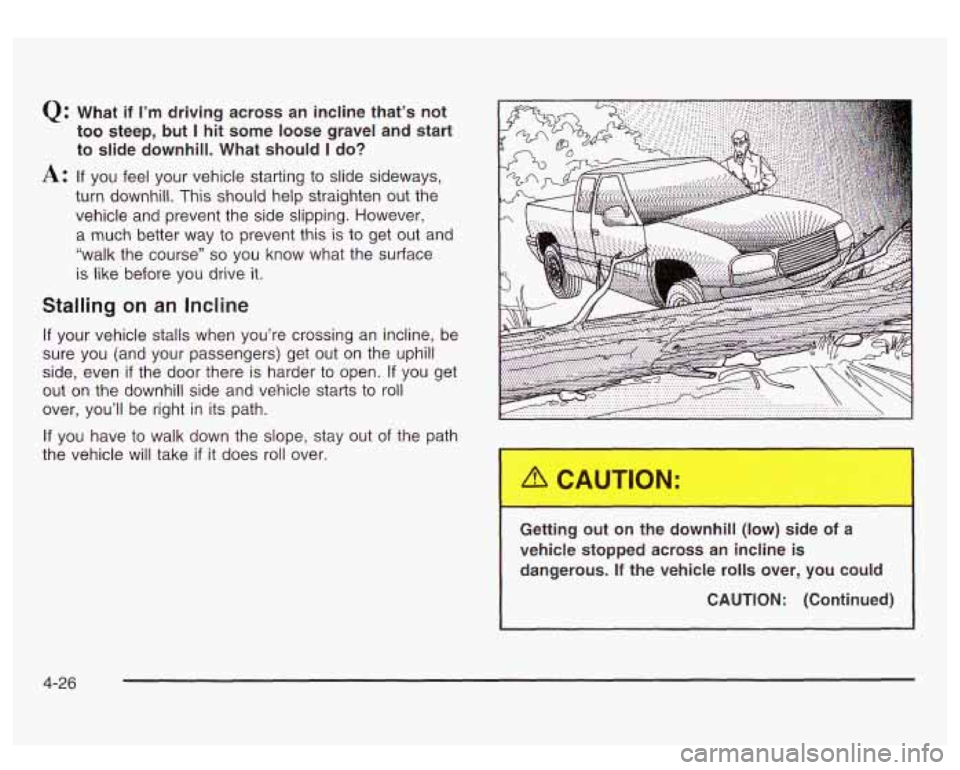
Q: What if I’m driving across an incline that’s not
too steep, but
I hit some loose gravel and start
to slide downhill. What should
I do?
A: If you feel your vehicle starting to slide sideways,
turn downhill. This should help straighten out the
vehicle and prevent the side slipping. However,
a much better way to prevent this is to get out and
“walk the course’’
so you know what the surface
is like before you drive
it.
Stalling on an Incline
If your vehicle stalls when you’re crossing an incline, be
sure you (and your passengers) get out on the uphill
side, even
if the door there is harder to open. If you get
out on the downhill side and vehicle starts to roll
over, you’ll be right in its path.
If you have to walk down the slope, stay out of the path
the vehicle will take
if it does roll over.
bd
Getting out on the downhill (low) side of a
vehicle stopped across an incline
is
dangerous. If the vehicle rolls over, you could
CAUTION: (Continued)
I
4-26
Page 237 of 428
If the water isn’t too deep, drive slowly through it. At
faster speeds, water splashes on your ignition system
and your vehicle can stall. Stalling can also occur
if you
get your tailpipe under water. And, as long as your
tailpipe is under water, you’ll never be able to start your
engine. When you go through water, remember that
when your brakes get wet, it may take you longer
+- stop.
,,jving thr,,gh rushing water can be
dangerous. Deep water can sweep your vehicle
downstream and you and your passengers
could drown. If it’s only shallow water, it can
still wash away the ground from under your
tires, and you could lose traction and roll the
water.
~ vehicle over. Don’t drive through rushing
I
After Off-Road Driving
Remove any brush or debris that has collected on the
underbody, chassis or under the hood. These
accumulations can be a fire hazard.
After operation
in mud or sand, have the brake linings
cleaned and checked. These substances can cause
glazing and uneven braking. Check the body structure,
steering, suspension, wheels, tires and exhaust
system for damage. Also, check the fuel lines and
cooling system for any leakage.
Your vehicle will require more frequent service due
to
off-road use. Refer to the Maintenance Schedule
for additional information.
See
Driving in Rain and on Wet Roads on page 4-30 for
more information on driving through water.
4-28
Page 239 of 428
Keep your windshield and all the glass on your vehicle
clean
- inside and out. Glare at night is made much
worse by dirt on the glass. Even the inside of the glass
can build up a film caused by dust. Dirty glass makes
lights dazzle and flash more than clean glass would,
making the pupils of your eyes contract repeatedly.
Remember that your headlamps light up far less of a
roadway when you are in a turn or curve. Keep
your eyes moving; that way, it’s easier to pick out dimly
lighted objects. Just
as your headlamps should be
checked regularly for proper aim,
so should your eyes
be examined regularly. Some drivers suffer from
night blindness
- the inability to see in dim light - and
aren’t even aware of
it.
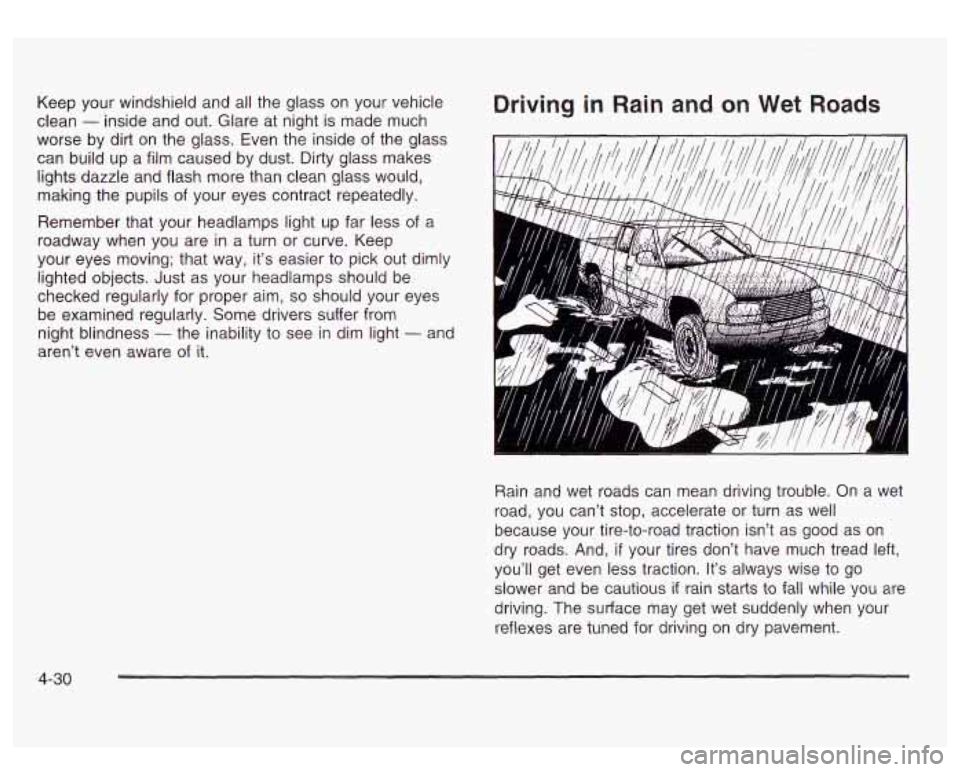
Driving in Rain and on Wet Roads
Rain and wet roads can mean driving trouble. On a wet
road, you can’t stop, accelerate or turn as well
because your tire-to-road traction isn’t as good as on
dry roads. And, if your tires don’t have much tread left,
you’ll get even less traction. It’s always wise to go
slower
and be cautious if rain starts to fall while you are
driving. The surface may get wet suddenly when your
reflexes are tuned for driving on dry pavement.
4-30
Page 240 of 428
The heavier the rain, the harder it is to see. Even if your
windshield wiper blades are in good shape, a heavy
rain can make it harder to see road signs and
traffic signals, pavement markings, the edge of the road
and even people walking.
It's wise to keep your wiping equipment in good shape
and keep your windshield washer tank filled with
washer fluid. Replace your windshield wiper inserts
when they show signs of streaking or missing areas on
the windshield, or when strips of rubber start to
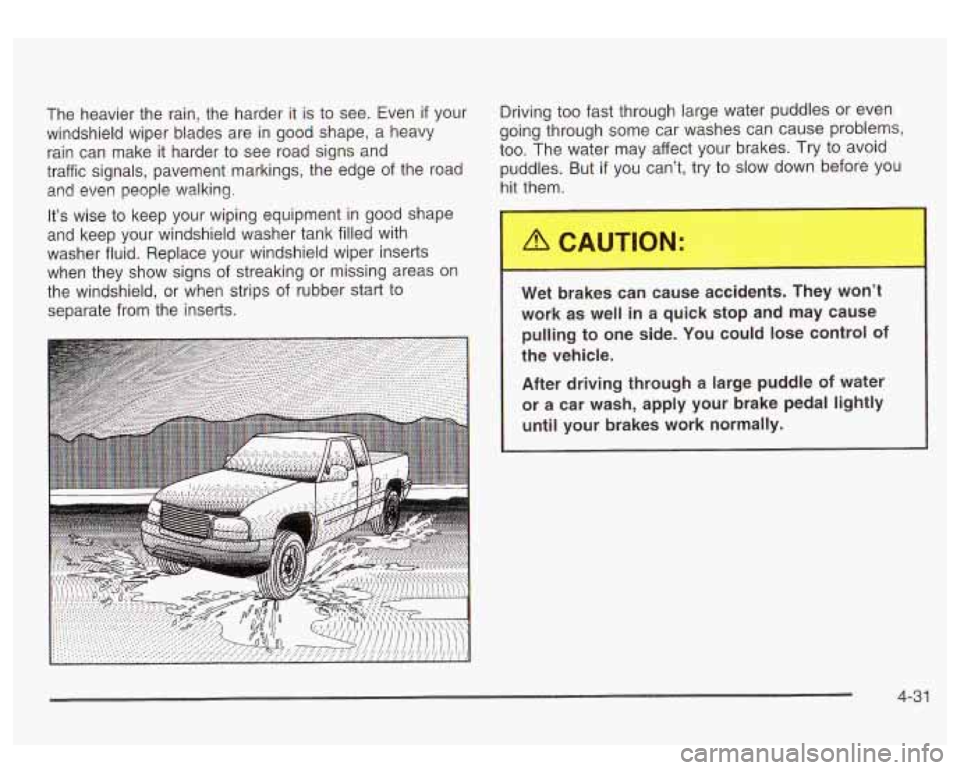
separate from the inserts. Driving too fast through large
water puddles or even
going through some car washes can cause problems,
too. The water may affect your brakes. Try to avoid
puddles. But
if you can't, try to slow down before you
hit them.
Wet brakes
4 1 cause accidents. They won't
work as well in a quick stop and may cause
pulling
to one side. You could lose control of
the vehicle.
After driving through a large puddle of water
or a car wash, apply your brake pedal lightly
until your brakes work normally.
4-3 1
Page 244 of 428
Once you are moving on the freeway, make certain you
allow a reasonable following distance. Expect to
move slightly slower at night.
When you want
to leave the freeway, move to the
proper lane well in advance.
If you miss your exit, do
not, under any circumstances, stop and back up. Drive
on to the next exit.
The exit ramp can be curved, sometimes quite sharply.
The exit speed is usually posted.
Reduce your speed according to your speedometer, not
to your sense of motion. After driving for any distance
at higher speeds, you may tend
to think you are
going slower than you actually are.
Before Leaving on a Long Trip
Make sure you’re ready. Try to be well rested. If you
must start when you’re not fresh
- such as after a day’s
work
- don’t plan to make too many miles that first
part of the journey. Wear comfortable clothing and shoes
you can easily drive in.
Is your vehicle ready for a long trip? If you keep it
serviced and maintained, it’s ready to go. If it needs
service, have it done before starting out.
Of course,
you’ll find experienced and able service experts
in dealerships all across North America. They’ll be
ready and willing to help
if you need it.
Here are some things you can check before a trip:
e
e e
e
e
e
e
Windshield Washer Fluid: Is the reservior full? Are
all windows clean inside and outside?
Wiper Blades: Are they in good shape?
Fuel, Engine Oil, Other Fluids: Have you checked
all levels?
Lamps: Are they all working? Are the lenses clean?
Tires: They are vitally important to a safe,
trouble-free trip.
Is the tread good enough for
long-distance driving? Are the tires all inflated to the
recommended pressure?
Weather Forecasts: What’s the weather outlook
along your route? Should you delay your trip a
short time to avoid a major storm system?
Maps: Do you have up-to-date maps?
4-35
Page 268 of 428
When You Are Ready to Leave After
Parking on a
Hill
1. Apply your regular brakes and hold the pedal down
while you:
0 start your engine,
shift into a gear, and
0 release the parking brake.
2. Let up on the brake pedal.
3. Drive slowly until the trailer is clear of the chocks.
4. Stop and have someone pick up and store the
chocks.
Maintenance When Trailer Towing
Your vehicle will need service more often when you’re
pulling a trailer. See the Maintenance Schedule for more
on this. Things that are especially important in trailer
operation are automatic transmission fluid (don’t overfill),
engine
oil, axle lubricant, belt, cooling system and
brake system. Each of these is covered in this manual,
and the Index will help you find them quickly. If
you’re trailering, it’s a good idea to review these sections
before you start your trip.
Check periodically to see that all hitch nuts and bolts
are tight.
4-59
Page 270 of 428
Section 5 Service and Appearance Care
Service ............................................................ 5.3
Doing Your Own Service Work
......................... 5-4
Adding Equipment to the Outside
of Your Vehicle
........................................... 5-4
Fuel
................................................................ 5.5
Gasoline Octane
............................................ 5.5
Gasoline Specifications
.................................... 5.5
California Fuel
............................................... 5.6
Additives
....................................................... 5.6
Fuels in Foreign Countries
................. ....... 5.7
Filling Your Tank
......................................... 5-7
Filling a Portable Fuel Container
.................... 5-9
the Hood
............................................. 5.10
Hood Release
........................................ ,.5-10
Engine Compartment Overview
....................... 5.12
Checking
Things Under
Engine Oil
................................................... 5.13
Engine Air Cleaner/Filter
................................ 5.19
Engine Coolant
............................................. 5.24
Engine Overheating
....................................... 5.27
Cooling System
............................................ 5.30
Automatic
Transmission Fluid
........................ -5-21
Coolant Surge Tank Pressure Cap
.................. 5-27 Engine
Fan Noise
......................................... 5.36
Power Steering Fluid
..................................... 5.37
Windshield Washer Fluid
................................ 5-38
Brakes
........................................................ 5.39
Battery
........................................................ 5.42
Jump Starting
............................................... 5.43
All-Wheel Drive
......................... .............. 5-49
Rear Axle
....................................................... 5-50
Front Axle
...................................................... 5-51
Bulb Replacement
.......................................... 5-52
Halogen Bulbs
.............................................. 5-52
Headlamps
................................................. -5-52
Roof Marker Lamps
...................................... 5-54
Cargo Lamp
............................................. 5-56
Taillamps
..................................................... 5-58
Replacement Bulbs
....................................... 5-59
Front
Turn Signal, Sidemarker
and Daytime
Running Lamps
......................................... 5-53
Center High-Mounted Stoplamp (CHMSL) and
Pickup
Box Identification and Fender Marker
Lamps
..................................................... 5-58
Windshield Wiper Blade Replacement
.............. 5-60
5-
1
Page 286 of 428
As in the chart shown previously, SAE 5W-30 is the
only viscosity grade recommended for your vehicle.
You should look for and use only oils which have the
API Starburst symbol and which are also identified
as SAE 5W-30. If you cannot find such SAE 5W-30 oils,
you can use an SAE IOW-30 oil which has the API
Starburst symbol,
if it's going to be 0°F (-18°C)
or above. Do not use other viscosity grade oils, such as
SAE 1OW-40 or SAE 20W-50 under any conditions.
Notice: Use only engine oil with the American
Petroleum Institute Certified For Gasoline Engines
starburst symbol. Failure to use the recommended
oil can result in engine damage not covered by
your warranty.
GM Goodwrench@ oil meets all the requirements for
your vehicle.
If you are in an area of extreme cold, where the
temperature falls below -20°F
(-29"C), it is
recommended that you use either an SAE 5W-30
synthetic oil or an SAE OW-30 oil. Both will provide
easier cold starting and better protection for your engine
at extremely
low temperatures.
Engine Oil Additives
Don't add anything to your oil. The recommended oils
with the starburst symbol are all you will need for
good performance and engine protection.
When to Change Engine Oil
(GM Oil Life SystemTM)
Your vehicle has a computer system that lets you know
when to change the engine
oil and filter. This is based on
engine revolutions and engine temperature, and not on
mileage. Based on driving conditions, the mileage
at which an oil change will be indicated can vary
considerably. For the oil life system to work properly,
you must reset the system every time the oil is changed.
When the system has calculated that oil life has been
diminished, it will indicate that an oil change is necessary.
A CHANGE ENGINE
OIL SOON message will come on.
Change your oil as soon as possible within the next two
times you stop for fuel. It is possible that,
if you are driving
under the best conditions, the oil life system may not
indicate that an oil change is necessary for over a year.
However, your engine oil and filter must be changed at
least once a year and at this time the system must be
reset. It is also important to check your oil regularly and
keep it at the proper level.
If the system is ever reset accidentally, you must
change your oil at 3,000 miles (5
000 km) since your
last oil change. Remember to reset the oil life system
whenever the oil is changed.
5-1 7