belt GMC SIERRA DENALI 2003 Repair Manual
[x] Cancel search | Manufacturer: GMC, Model Year: 2003, Model line: SIERRA DENALI, Model: GMC SIERRA DENALI 2003Pages: 428, PDF Size: 20.35 MB
Page 333 of 428
When It Is Time for New Tires
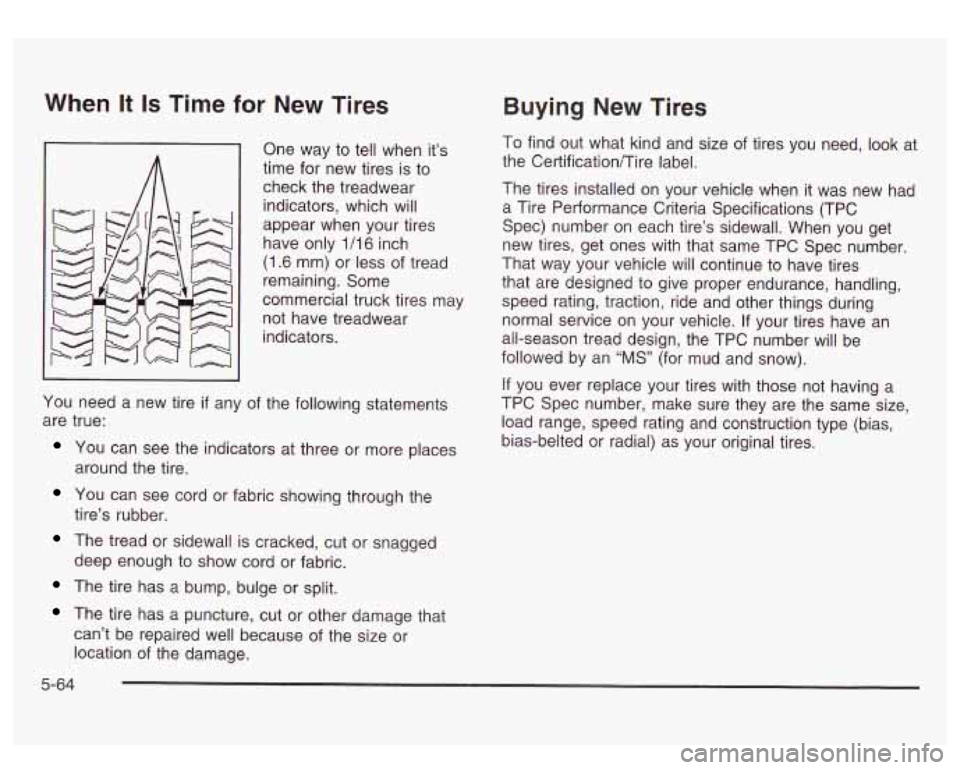
One way to tell when it’s
time for new tires is to
check the treadwear
indicators, which will
appear when your tires
have only 1/16 inch
(1.6 mm) or less of tread
remaining. Some
commercial truck tires may
not have treadwear
indicators.
You need a new tire
if any of the following statements
are true:
You can see the indicators at three or more places
You can see cord or fabric showing through the
The tread or sidewall is cracked, cut or snagged
The tire has a bump, bulge or split.
around
the tire.
tire’s rubber.
deep enough to show cord or fabric.
Buying New Tires
To find out what kind and size of tires you need, look at
the Certificationflire label.
The tires installed on your vehicle when it was new had
a Tire Performance Criteria Specifications (TPC
Spec) number on each tire’s sidewall. When you get
new tires, get ones with that same TPC Spec number.
That way your vehicle will continue to have tires
that are designed to give proper endurance, handling,
speed rating, traction, ride and other things during
normal service on your vehicle.
If your tires have an
all-season tread design, the TPC number will be
followed by an
“MS” (for mud and snow).
If you ever replace your tires with those not having a
TPC Spec number, make sure they are the same size,
load range, speed rating and construction type (bias,
bias-belted or radial) as your original tires.
The tire has a puncture, cut or other damage that
can’t be repaired well because of the size or
location of the damage.
5-64
Page 334 of 428
Mixing tires could cause you to lose control
while driving.
If you mix tires of different sizes
or types (radial and bias-belted tires), the
vehicle may not handle properly, and you
could have a crash. Using tires of different
sizes may also cause damage to your vehicle.
Be sure to use
the same size and type tires on
all wheels.
If your vehicle has 17 inch road
tires (those originally installed on your vehicle)
it is all right to drive with the 16 inch spare tire
that came with your vehicle. When new, your
vehicle included a spare tire and wheel assembly with
the same overall diameter as
your vehicle’s road tires and wheels. Because
this spare tire was developed for use on your vehicle,
it will not affect vehicle handling or
cause damage to your vehicle.
If yo^ Jse bias-ply tires on y--. ,chicle, the
wheel rim flanges could develop cracks after
many miles
of driving. A tire and/or wheel
could fail suddenly, causing a crash. Use only radial-ply tires with the wheels on your vehicle.
Uniform Tire Quality Grading
Quality grades can be found where applicable on the
tire sidewall between tread shoulder and maximum
section width. For example:
Treadwear 200 Traction AA Temperature A
The following information relates to the system
developed by the United States National Highway
Traffic Safety Administration, which grades tires by
treadwear, traction and temperature performance. (This
applies only to vehicles sold
in the United States.)
The grades are molded on the sidewalls of most
passenger car tires. The Uniform Tire Quality Grading
system does not apply to deep tread, winter-type
snow tires, space-saver or temporary use spare tires,
tires with nominal rim diameters
of 10 to 12 inches
(25 to
30 cm), or to some limited-production tires.
5-65
Page 357 of 428
Glass Surfaces Weatherstrips
Glass should be cleaned often. GM Glass Cleaner or a
liquid household glass cleaner will remove normal
tobacco smoke and dust films on interior glass. See
GM
Vehicle Care/Appearance Materials on page
5-92.
Notice: Don’t use abrasive cleaners on glass,
because they may cause scratches. Avoid placing
decals on
the inside rear window, since they
may have to be scraped
off later. If abrasive cleaners
are used on the inside of the rear window, an
electric defogger element may be damaged. Any
temporary license should not be attached across the defogger grid.
Care of Safety Belts
Ke belts clean and dry.
Do not bleach or dye safety belts. If you do, it
may severely weaken them. In a crash, they
might not be able to provide adequate
protection. Clean safety belts only with mild
soap and lukewarm water.
I
Silicone grease on weatherstrips will make them last
longer, seal better, and not stick or squeak. Apply
silicone grease with a clean cloth at least every six
months. During very cold, damp weather more frequent
application may be required. See
Part D: Recommended
Fluids and Lubricants on page
6-16.
Cleaning the Outside of Your
Vehicle
The paint finish on your vehicle provides beauty, depth
of color, gloss retention and durability.
Washing Your Vehicle
The best way to preserve your vehicle’s finish is to keep
it clean by washing it often with lukewarm or cold
water.
Don’t wash your vehicle in the direct rays of the sun.
Use a car washing soap. Don’t use strong soaps
or chemical detergents. Be sure to rinse the vehicle
well, removing all soap residue completely. You can get
GM-approved cleaning products from your dealer.
5-88
Page 384 of 428
90,000 Miles (150 000 km)
0 Check readfront axle fluid level and add fluid as
needed. Check constant velocity joints and axle seals
for leaking.
0 Replace fuel filter. An Emission Control Service. (See
Footnote
t.)
0 Replace engine air cleaner filter. An Emission
Control Service.
0 Rotate tires. See Tire Inspection and Rotation on
page 5-62
for proper rotation pattern and additional
information.
(See footnote +.)
97,500 Miles (162 500 km)
c[I Check readfront axle fluid level and add fluid as
needed. Check constant velocity joints and axle seals
for leaking.
page 5-62 for proper rotation pattern and additional
information.
(See footnote +.)
0 Rotate tires. See Tire Inspection and Rotation on
100,000 Miles (166 000 km)
0 Inspect spark plug wires. An Emission Control
0 Replace spark plugs. An Emission Control Service.
Service.
0 Change automatic
transmission fluid and filter if the
vehicle
is mainly driven under one or more of these
conditions:
- In heavy city traffic where the outside
temperature regularly reaches
90°F (32°C) or
higher.
- In hilly or mountainous terrain.
- When doing frequent trailer towing.
- Uses such as found in taxi, police or delivery
service.
0 If you haven’t used your vehicle under severe service
conditions listed previously and, therefore, haven’t
changed your automatic transmission fluid, change
both the fluid and filter.
0 Inspect Positive Crankcase Ventilation (PCV) valve.
An Emission Control Service.
150,000 Miles (240 000 km)
0 Drain, flush and refill cooling system (or every
60 months since last service, whichever occurs first).
See
Engine Coolant on page 5-24 for what to use.
Inspect hoses. Clean radiator, condenser, pressure
cap and neck. Pressure test the cooling system
and pressure cap.
An Emission Control Service.
0 Inspect engine accessory drive belt. An Emission
Control Service.
6-9
Page 386 of 428

At Least Twice a Year
Restraint System Check
Make sure the safety belt reminder light and all your
belts, buckles, latch plates, retractors and anchorages
are working properly. Look for any other loose or
damaged safety belt system parts.
If you see anything
that might keep a safety belt system from doing its
job, have it repaired. Have any torn or frayed safety belts
replaced.
Also look for any opened or broken air bag coverings,
and have them repaired or replaced. (The air bag
system does not need regular maintenance.)
Wiper Blade Check
Inspect wiper blades for wear or cracking. Replace
blade inserts that appear worn or damaged or that
streak or miss areas of the windshield.
Also see
Cleaning the Outside of Your Vehicle on page 5-88.
Spare Tire Check
At least twice a year, after the monthly inflation check of
the spare tire determines that the spare is inflated to
the correct tire inflation pressure, make sure that
the spare tire is stored securely. Push, pull, and then try
to rotate or turn the tire. If it moves, use the wheel
wrenchhatchet to tighten the cable. See
Changing a Flat
Tire on page 5-69.
Weatherstrip
Silicone grease on
longer, seal better,
Lubrication
weatherstrips will make them last
and not stick or squeak. Apply
silicone grease with a clean cloth. During very -cold,
damp weather more frequent application may be
required. See
Part D: Recommended Fluids and
lubricants on page
6- 16.
Automatic Transmission Check
Check the transmission fluid level; add if needed. See
Automatic Transmission Fluid on page 5-27. A fluid loss
may indicate a problem. Check the system and repair
if needed.
At Least Once a Year
Key Lock Cylinders Service
Lubricate the key lock cylinders with the lubricant
specified in Part D.
Body Lubrication Service
Lubricate all body door hinges, hood latch assembly,
secondary latch, pivots, spring anchor, release
pawl, tailgate hinge, tailgate linkage, tailgate handle
pivot points, latch bolt, fuel door hinge, locks and folding
seat hardware. Part
D tells you what to use. More
frequent lubrication may be required when exposed to a
corrosive environment.
6-1 1
Page 409 of 428
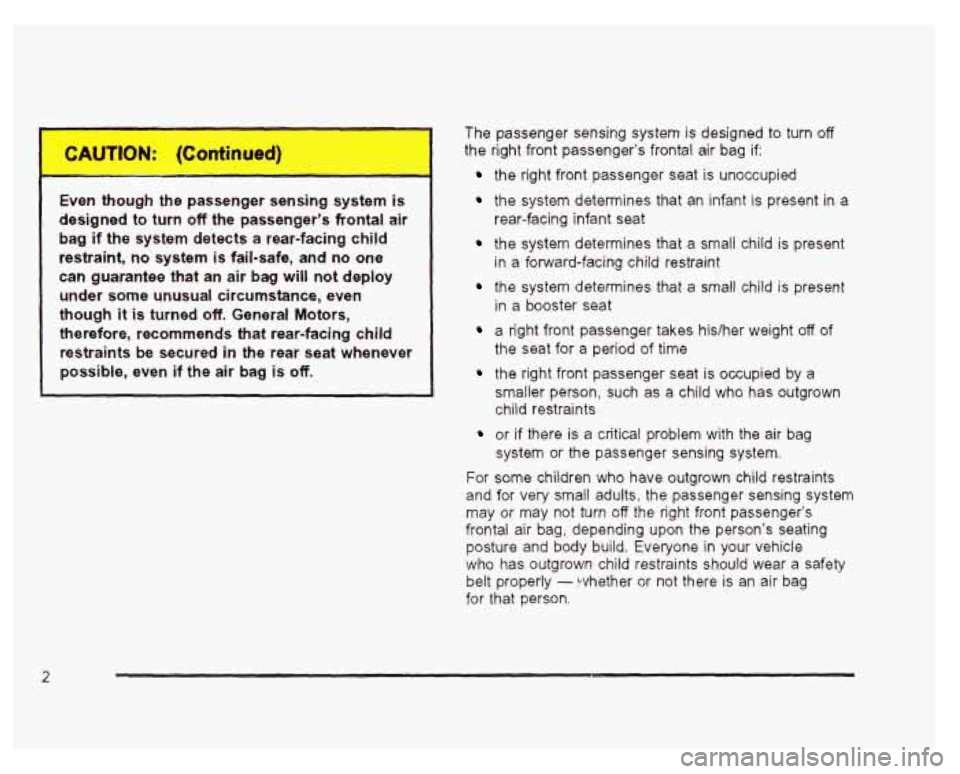
Even though the passenger sensing system is
designed to turn
off the passenger’s frontal air
bag if
the system detects a rear-facing child
restraint, no system
is fail-safe, and no one
can guarantee that an air bag will not deploy
under some unusual circumstance, even
though it
is turned off. General Motors,
therefore, recommends that rear-facing child
restraints be secured
in the rear seat whenever
~ possible, even if the air bag is off.
The passenger sensing system is designed to turn off
the right front passenger’s frontal air bag if:
the right front passenger seat is unoccupied
the system determines that an infant is present in a
the system determines that a small child is present
rear-facing infant seat
in a forward-facing child restraint
the system determines that a small child is present
in
a booster seat
a right front passenger takes hislher weight off of
the seat for a period of time
the right front passenger seat is occupied by a
smaller person, such as a child
who has outgrown
child restraints
or if there is a critical problem with the air bag
system or the passenger sensing system.
For
some children who have outgrown child restraints
and for
very small adults, the passenger sensing system
may
or may not turn off the right front passenger’s
frontal air bag, depending upon the person’s seating
posture and body build. Everyone in your vehicle
who has outgrown child restraints should wear
a safety
belt properly
- whether or not there is an air bag
for that person.
2
Page 410 of 428
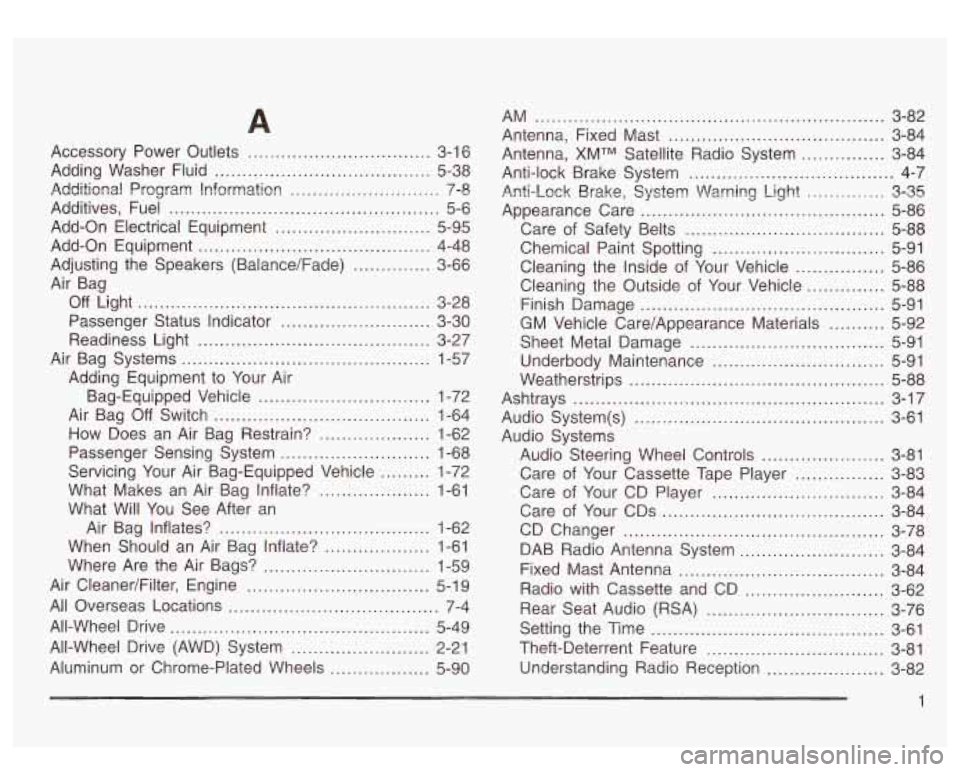
Accessory Power Outlets ................................. 3-16
Adding Washer Fluid
....................................... 5-38
Additional Program Information
........................... 7-8
Additives, Fuel ................................................. 5-6
Add-on Electrical Equipment
............................ 5-95
Add-on Equipment .......................................... 4-48
Off Light ..................................................... 3-28
Passenger Status Indicator
........................... 3-30
Readiness Light
.......................................... 3-27
Air Bag Systems
............................................. 1-57
Bag-Equipped Vehicle
............................... 1-72
Passenger Sensing System
........................... 1-68
Adjusting the Speakers
(Balance/Fade)
.............. 3-66
Air Bag
Adding Equipment to Your Air
Air Bag
Off Switch ....................................... 1-64
How Does an Air Bag Restrain?
.................... 1-62
Servicing Your Air Bag-Equipped Vehicle
......... 1-72
What Makes an
Air Bag inflate? .................... 1-61
What Will You See After an
Air Bag Inflates?
...................................... 1-62
When Should an Air Bag Inflate?
................... 1-61
Where Are the Air Bags?
.............................. 1-59
Air Cleaner/FiIter, Engine
................................. 5-1 9
All Overseas Locations ...................................... 7-4
All-Wheel Drive
............................................... 5-49
All-Wheel Drive (AWD) System
......................... 2-21
Aluminum or Chrome-Plated Wheels
.................. 5-90
AM ............................................................ 3-82
Antenna, Fixed Mast
....................................... 3-84
Anti-lock Brake System
..................................... 4-7
Appearance Care
............................................ 5-86
Care of Safety Belts
.................................... 5-88
Antenna,
XMTM Satellite
Radio System ............... 3-84
Anti-Lock Brake, System Warning
Light .............. 3-35
Chemical Paint Spotting
............................... 5-91
Cleaning the Inside of Your Vehicle
................ 5-86
Cleaning the Outside of Your Vehicle
.............. 5-88
Finish Damage
............................................ 5-91
GM Vehicle Care/Appearance Materials .......... 5-92
Sheet Metal Damage
................................... 5-91
Underbody Maintenance
............................... 5-91
Weatherstrips
.............................................. 5-88
Ashtrays
........................................................ 3-17
Audio System(s)
............................................. 3-61
Audio Systems
Audio Steering Wheel Controls
...................... 3-81
Care of Your Cassette Tape Player
................ 3-83
Care of Your CD Player
............................... 3-84
Care of Your CDs
........................................ 3-84
CD Changer
............................................... 3-78
DAB Radio Antenna System
.......................... 3-84
Fixed Mast Antenna
..................................... 3-84
Radio with Cassette and CD
......................... 3-62
Rear Seat Audio (RSA)
................................ 3-76
Setting the Time
.......................................... 3-61
Theft-Deterrent Feature
................................ 3-81
Understanding Radio Reception
..................... 3-82
1
Page 411 of 428
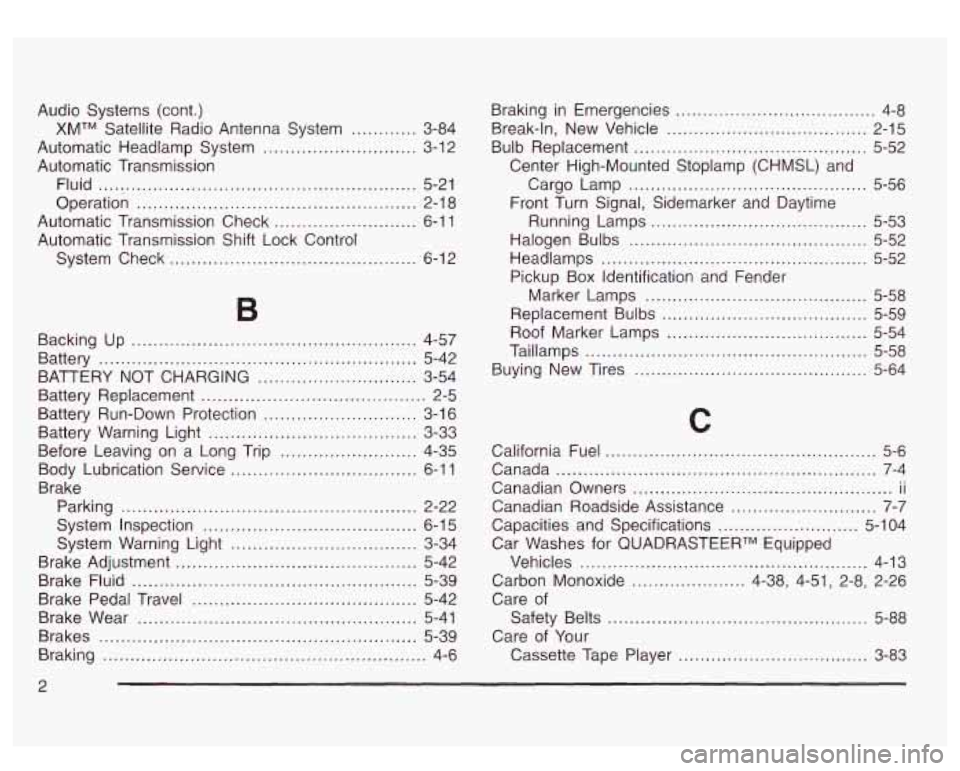
Audio Systems (cont.)
XMTM Satellite Radio Antenna System ............ 3-84
Automatic Headlamp System
............................ 3-1 2
Operation ................................................... 2-1 8
System Check
......................................... 6-12
Automatic
Transmission
Fluid
.......................................................... 5-21
Automatic Transmission Check
.......................... 6-1 1
Automatic Transmission Shift Lock Control
B
Backing Up .................................................... 4-57
Battery
.......................................................... 5-42
Battery Replacement
......................................... 2-5
Battery Run-Down Protection ............................ 3-1 6
BATTERY NOT CHARGING
............................. 3-54
Battery Warning Light
...................................... 3-33
Before Leaving on a Long Trip
......................... 4-35
Body Lubrication Service
.................................. 6-1 1
Brake Parking
...................................................... 2-22
System Inspection
....................................... 6-1 5
System Warning Light .................................. 3-34
Brake Adjustment
............................................ 5-42
Brake Fluid
.................................................... 5-39
Brake Pedal Travel
......................................... 5-42
Brake Wear
.................................... ....... 5-41
Brakes
.......................................................... 5-39
Braking ........................................................... 4-6 Braking
in Emergencies
..................................... 4-8
Break-In, New Vehicle
..................................... 2-15
Bulb Replacement
........................................... 5-52
Center High-Mounted Stoplamp (CHMSL) and
Cargo Lamp
............................................ 5-56
Front Turn Signal, Sidemarker and Daytime
Running Lamps
........................................ 5-53
Halogen Bulbs
............................................ 5-52
Headlamps
................................................. 5-52
Pickup Box Identification and Fender
Marker Lamps
......................................... 5-58
Replacement Bulbs
...................................... 5-59
Roof Marker Lamps
..................................... 5-54
Buying New Tires
........................................... 5-64
Taillamps
.................................................... 5-58
C
California Fuel .................................................. 5-6
Canada
........................................................... 7-4
Canadian Owners
................................................ ii
Canadian Roadside Assistance ........................... 7-7
Capacities and Specifications
.......................... 5-1 04
Car Washes for QUADRASTEERTM Equipped Vehicles
..................................................... 4-13
Carbon Monoxide
..................... 4-38, 4-51, 2-8, 2-26
Care of
Safety Belts
................................ ..... 5-88
Care
of Your
Cassette Tape Player
................................... 3-83
2
Page 412 of 428
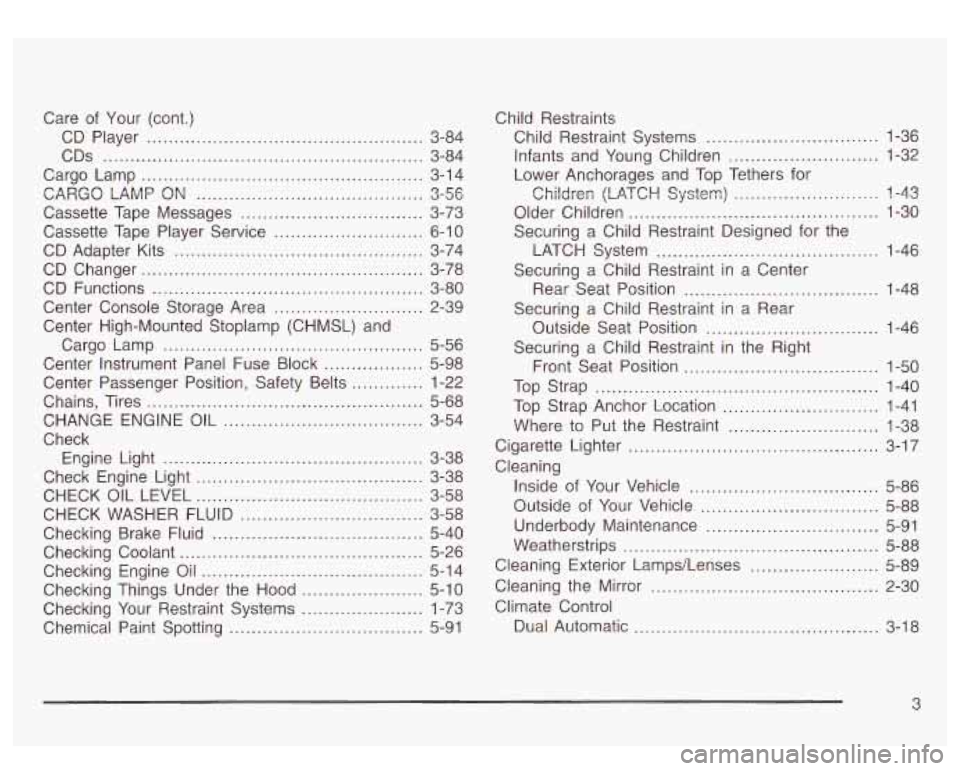
Care of Your (cont.)
CD Player
................................ ... 3-84
CDS
.......................................................... 3-84
Cargo Lamp
............................. ... 3-14
CARGO LAMP
ON ....................... ... 3-56
Cassette Tape Messages
................................. 3-73
Cassette Tape Player Service
........................... 6-10
CD Adapter Kits
............................................. 3-74
CD Changer
................................................... 3-78
CD Functions
................................................. 3-80
Center Console Storage Area
........................... 2-39
Center High-Mounted Stoplamp (CHMSL) and
Center Instrument Panel Fuse Block
.................. 5-98
Center Passenger Position, Safety Belts
............. 1-22
Chains, Tires .................................................. 5-68
Check Cargo Lamp
............................................... 5-56
CHANGE ENGINE OIL .................................... 3-54
Engine Light
.................................... ... 3-38
Check Engine Light
.......................... ... 3-38
CHECK OIL LEVEL
..................................... 3-58
CHECK WASHER FLUID
................................. 3-58
Checking Brake Fluid
...................................... 5-40
Checking Coolant ............................................ 5-26
Checking Engine Oil
........................................ 5-14
Checking Things Under the Hood
...................... 5-10
Checking Your Restraint Systems ...................... 1-73
Chemical Paint Spotting
................................... 5-91 Child Restraints
Child Restraint Systems
............................... 1-36
Infants and Young Children
........................... 1-32
Lower Anchorages and Top Tethers for
Children
(LATCH System) .......................... 1-43
Older Children ............................................. 1-30
Securing a Child Restraint Designed for the
Securing a Child Restraint in a Center
Securing a Child Restraint in a Rear
Securing a Child Restraint in the Right
LATCH System
........................................ 1-46
Rear Seat Position
................................... 1-48
Outside Seat Position
............................ 1-46
Front Seat Position
................................... 1-50
Top Strap ................................................... 1-40
Top Strap Anchor Location
............................ 1-41
Cigarette Lighter
............................................. 3-17
Where
to Put the Restraint
........................... 1-38
Cleaning Inside of Your Vehicle
.................................. 5-86
Outside
of Your Vehicle ................................ 5-88
Underbody Maintenance
............................... 5-91
Weatherstrips
.............................................. 5-88
Cleaning Exterior Lamps/Lenses
....................... 5-89
Cleaning the Mirror
......................................... 2-30
Climate Control Dual Automatic
..... . 3-18
Page 413 of 428
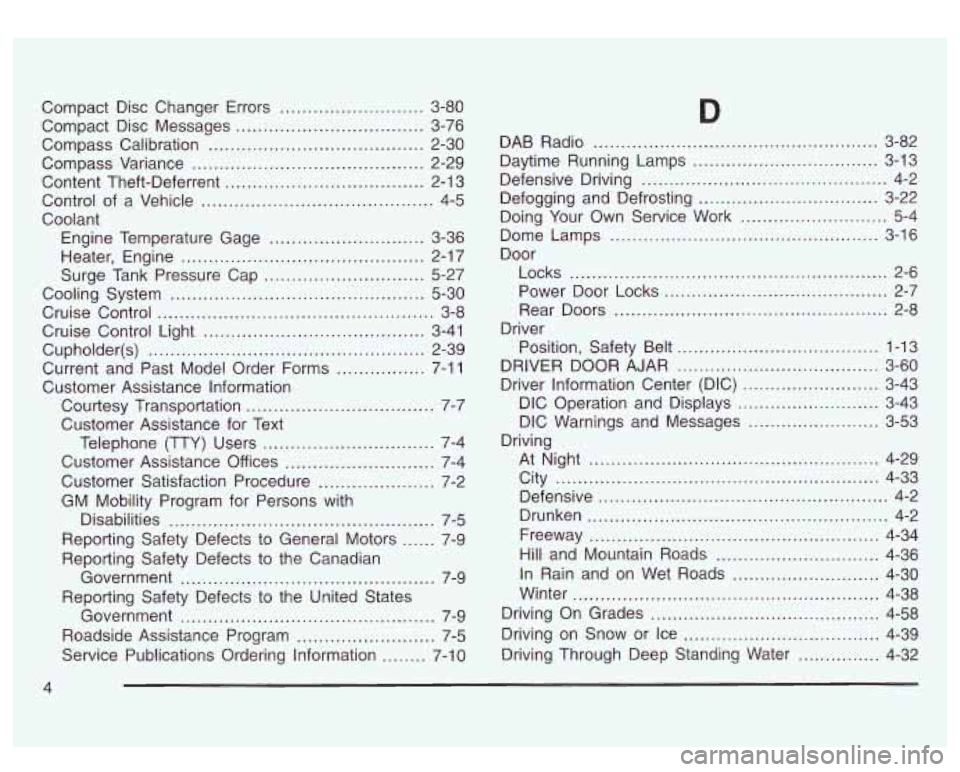
Compact Disc Changer Errors .......................... 3-80
Compact Disc Messages
.................................. 3-76
Compass Calibration
....................................... 2-30
Compass Variance
.......................................... 2-29
Content Theft-Deferrent
.................................... 2-1 3
Control of a Vehicle
.......................................... 4-5
Coolant
Engine Temperature Gage
............................ 3-36
Heater, Engine
............................................ 2-17
Surge Tank Pressure Cap
............................. 5-27
Cooling System
.............................................. 5-30
Cruise Control
.................................................. 3-8
Cruise Control Light
........................................ 3-41
Cupholder(s)
............................................... 2-39
Current and Past Model Order Forms
..... .... 7-11
Customer Assistance Information
Courtesy Transportation
.................................. 7-7
Customer Assistance for Text
Telephone (TTY) Users
............................... 7-4
Customer Assistance
Off ices ........................... 7-4
Customer Satisfaction Procedure
..................... 7-2
GM Mobility Program for Persons with
Disabilities
................................................ 7-5
Reporting Safety Defects to General Motors ...... 7-9
Reporting Safety Defects to the Canadian
Government
.............................................. 7-9
Reporting Safety Defects to the United States
Government
.............................................. 7-9
Roadside Assistance Program
......................... 7-5
Service Publications Ordering Information
........ 7-1 0
D
DAB Radio .................................................... 3-82
Defensive Driving
............................................. 4-2
Defogging and Defrosting
................................. 3-22
Doing Your Own Service Work
........................... 5-4
Dome Lamps
................................................. 3-16
Door
Daytime Running Lamps
.................................. 3-13
Locks
.......................................................... 2-6
Power Door Locks
......................................... 2-7
Rear Doors
.................................................. 2-8
Position, Safety Belt
..................................... 1-13
Driver Information Center (DIC)
......................... 3-43
Driver
DRIVER DOOR AJAR
..................................... 3-60
DIC Operation and Displays
.......................... 3-43
DIC Warnings and Messages
........................ 3-53
Driving At Night
..................................................... 4-29
City
........................................................... 4-33
Defensive
..................................................... 4-2
Drunken
....................................................... 4-2
Freeway
..................................................... 4-34
Hill and Mountain Roads
.............................. 4-36
In Rain and on Wet Roads
........................... 4-30
Winter
........................................................ 4-38
Driving On Grades
.......................................... 4-58
Driving on Snow or Ice
.................................... 4-39
Driving Through Deep Standing Water
............... 4-32
4