horn GMC SONOMA 2004 Owner's Manual
[x] Cancel search | Manufacturer: GMC, Model Year: 2004, Model line: SONOMA, Model: GMC SONOMA 2004Pages: 412, PDF Size: 4.16 MB
Page 65 of 412
Remote Keyless Entry System
Operation
If your vehicle has this feature, you can lock and
unlock your doors from about 3 feet (1 m) up to 30 feet
(9 m away using the remote keyless entry transmitter
supplied with your vehicle.
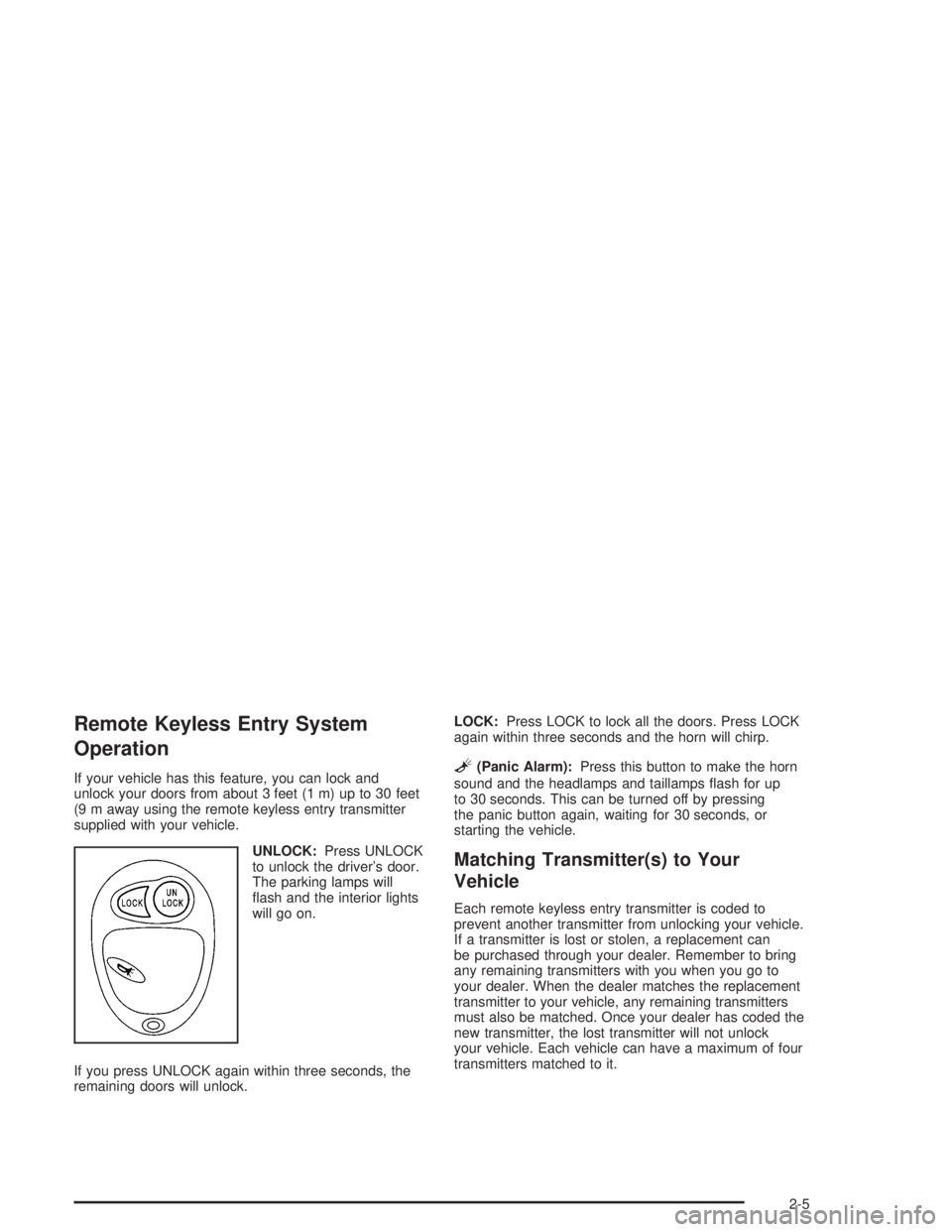
UNLOCK:Press UNLOCK
to unlock the driver’s door.
The parking lamps will
flash and the interior lights
will go on.
If you press UNLOCK again within three seconds, the
remaining doors will unlock.LOCK:Press LOCK to lock all the doors. Press LOCK
again within three seconds and the horn will chirp.L(Panic Alarm):Press this button to make the horn
sound and the headlamps and taillamps flash for up
to 30 seconds. This can be turned off by pressing
the panic button again, waiting for 30 seconds, or
starting the vehicle.
Matching Transmitter(s) to Your
Vehicle
Each remote keyless entry transmitter is coded to
prevent another transmitter from unlocking your vehicle.
If a transmitter is lost or stolen, a replacement can
be purchased through your dealer. Remember to bring
any remaining transmitters with you when you go to
your dealer. When the dealer matches the replacement
transmitter to your vehicle, any remaining transmitters
must also be matched. Once your dealer has coded the
new transmitter, the lost transmitter will not unlock
your vehicle. Each vehicle can have a maximum of four
transmitters matched to it.
2-5
Page 75 of 412
3. Close all doors. The SECURITY light should go off
after approximately 30 seconds. The alarm is not
armed until the SECURITY light goes off.
If a door is opened without the key or the remote
keyless entry transmitter, the alarm will go off. Your
vehicle’s headlamps will flash and the horn will sound for
110 seconds, then will turn off to save the battery
power.
Remember, the theft-deterrent system won’t activate if
you lock the doors with a key or use the manual
door lock. It activates only if you use a power door lock
switch with the door open, or with the remote keyless
entry transmitter. You should also remember that
you can start your vehicle with the correct ignition key if
the alarm has been set off.
Here’s how to avoid setting off the alarm by accident:
•If you don’t want to activate the theft-deterrent
system, the vehicle should be locked with the door
keyafterthe doors are closed.
•Always unlock a door with a key, or use the remote
keyless entry transmitter. Unlocking a door any
other way will set off the alarm.
If you set off the alarm by accident, unlock any door
with the key. You can also turn off the alarm by pressing
UNLOCK on the remote keyless entry transmitter.
The alarm won’t stop if you try to unlock a door any
other way.
Testing the Alarm
The alarm can be tested by following these steps:
1. From inside the vehicle, lower the driver’s window
and open the driver’s door.
2. Activate the system by locking the doors with the
power door lock switch while the door is open, or
with the remote keyless entry transmitter.
3. Get out of the vehicle, close the door and wait for
the SECURITY light to go out.
4. Then reach in through the window, unlock the door
with the manual door lock and open the door. This
should set off the alarm.
If the alarm does not sound when it should but the
vehicle’s headlamps flash, check to see if the horn
works. The horn fuse may be blown. To replace
the fuse, seeFuses and Circuit Breakers on page 5-95.
If the alarm does not sound or the vehicle’s headlamps
do not flash, the vehicle should be serviced by an
authorized service center.
2-15
Page 105 of 412
Instrument Panel Overview...............................3-2
Hazard Warning Flashers................................3-4
Other Warning Devices...................................3-5
Horn.............................................................3-5
Tilt Wheel.....................................................3-5
Turn Signal/Multifunction Lever.........................3-6
Exterior Lamps.............................................3-11
Interior Lamps..............................................3-15
Accessory Power Outlets...............................3-16
Ashtrays and Cigarette Lighter........................3-17
Climate Controls............................................3-18
Climate Control System.................................3-18
Outlet Adjustment.........................................3-20
Warning Lights, Gages and Indicators.............3-21
Instrument Panel Cluster................................3-22
Speedometer and Odometer...........................3-24
Trip Odometer..............................................3-24
Tachometer.................................................3-24
Safety Belt Reminder Light.............................3-24
Air Bag Readiness Light................................3-25
Charging System Light..................................3-26
Voltmeter Gage............................................3-26
Brake System Warning Light..........................3-27
Anti-Lock Brake System Warning Light.............3-28
Engine Coolant Temperature Gage..................3-28Malfunction Indicator Lamp.............................3-29
Oil Pressure Gage........................................3-32
Security Light...............................................3-33
Service Four-Wheel Drive Warning Light..........3-33
Check Gages Warning Light...........................3-34
Fuel Gage...................................................3-34
Low Fuel Warning Light.................................3-35
Audio System(s).............................................3-35
Setting the Time for Radios without Radio
Data Systems (RDS)..................................3-35
Setting the Time for Radios with Radio
Data Systems (RDS)..................................3-36
AM-FM Radio...............................................3-36
Radio with CD..............................................3-39
Radio with Cassette and CD..........................3-49
Radio with Six-Disc CD.................................3-59
Theft-Deterrent Feature (Non-RDS Radios).......3-73
Theft-Deterrent Feature (RDS Radios).............3-73
Understanding Radio Reception......................3-74
Care of Your Cassette Tape Player.................3-74
Care of Your CDs.........................................3-75
Care of Your CD Player................................3-76
Fixed Mast Antenna......................................3-76
XM™ Satellite Radio Antenna System
(48 Contiguous US States).........................3-76
Section 3 Instrument Panel
3-1
Page 107 of 412
The main components of your vehicle’s instrument panel are the following:
A. Air Outlets. SeeOutlet Adjustment on page 3-20for
more information.
B. Instrument Panel Cluster. SeeInstrument Panel
Cluster on page 3-22for more information.
C. Electronic Transfer Case Switch. See “Transfer
Case” underFour-Wheel Drive on page 5-46
for more information.
D. Lamp Controls. SeeExterior Lamps on page 3-11
for more information.
E. Fog Lamp Button. See “Fog Lamps” underExterior
Lamps on page 3-11for more information.
F. Brake Release. SeeParking Brake on page 2-25for
more information.
G. Turn Signal/Multifunction Lever. SeeTurn
Signal/Multifunction Lever on page 3-6for more
information.H. Horn. SeeHorn on page 3-5for more information.
I. Ashtray. SeeAshtrays and Cigarette Lighter on
page 3-17for more information.
J. Climate Controls. SeeClimate Control System on
page 3-18for more information.
K. Accessory Power Outlets. SeeAccessory Power
Outlets on page 3-16for more information.
L. Heated Outside Rearview Mirror Button (If
Equipped). SeeOutside Heated Mirrors on
page 2-32for more information.
M. Audio System. SeeAudio System(s) on page 3-35
for more information.
N. Glove Box. SeeGlove Box on page 2-33for more
information.
3-3
Page 109 of 412
Other Warning Devices
If you carry reflective triangles, you can set one up at
the side of the road about 300 feet (100 m) behind your
vehicle.
Horn
To sound the horn, press the horn symbol on the
steering wheel pad.
Tilt Wheel
A tilt wheel allows you to adjust the steering wheel
before you drive. If you have the tilt steering wheel, you
can raise it to the highest level to allow more room
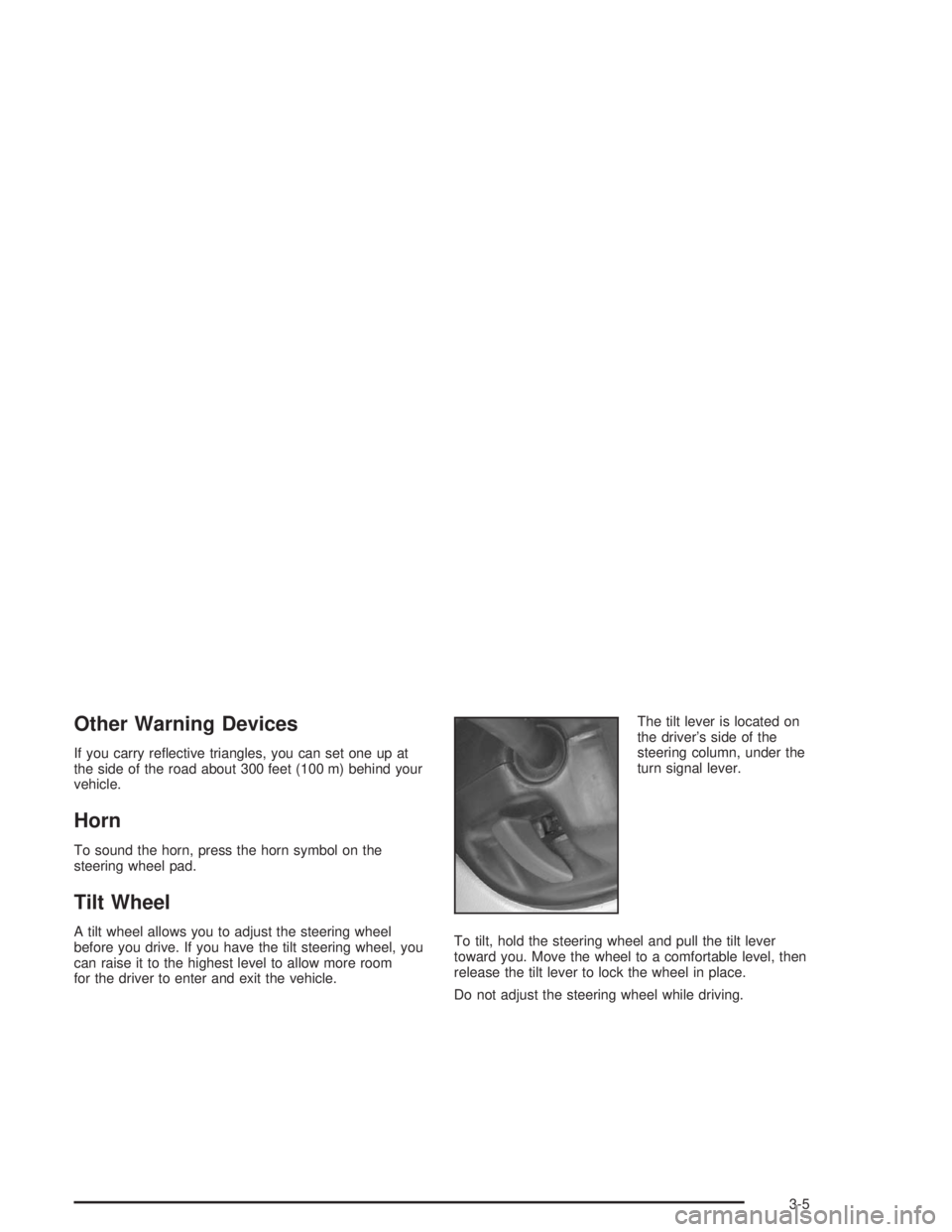
for the driver to enter and exit the vehicle.The tilt lever is located on
the driver’s side of the
steering column, under the
turn signal lever.
To tilt, hold the steering wheel and pull the tilt lever
toward you. Move the wheel to a comfortable level, then
release the tilt lever to lock the wheel in place.
Do not adjust the steering wheel while driving.
3-5
Page 199 of 412
Driving Uphill
Once you decide you can safely drive up the hill, you
need to take some special steps.
•Use a low gear and get a firm grip on the steering
wheel.
•Get a smooth start up the hill and try to maintain
your speed. Do not use more power than you
need, because you do not want your wheels to start
spinning or sliding.
•Try to drive straight up the hill if at all possible. If
the path twists and turns, you might want to find
another route.
{CAUTION:
Turning or driving across steep hills can be
dangerous. You could lose traction, slide
sideways, and possibly roll over. You could be
seriously injured or killed. When driving up
hills, always try to go straight up.
•Ease up on your speed as you approach the top of
the hill.
•Attach a flag to the vehicle to make you more
visible to approaching traffic on trails or hills.
•Sound the horn as you approach the top of the hill
to let opposing traffic know you are there.
•Use your headlamps even during the day. They
make you more visible to oncoming traffic.
{CAUTION:
Driving to the top (crest) of a hill at full speed
can cause an accident. There could be a
drop-off, embankment, cliff, or even another
vehicle. You could be seriously injured or
killed. As you near the top of a hill, slow down
and stay alert.
4-19
Page 343 of 412
Fuse Usage
LT TRN Left Turn Signal Rear
RT TRN Right Turn Signal Rear
RR PRK Right Rear Parking Lamps
TRL PRK Trailer Park Lamps
LTHDLP Left Headlamp
RTHDLP Right Headlamp
FRPRK Front Parking Lamps
INT BAT Instrument Panel Fuse Block Feed
ENG I Engine Sensors/Solenoids, MAF,
CAM, PURGE, VENT
ECM B Engine Control Module, Fuel Pump
Module, Oil Pressure
ABS Anti-Lock Brake System
ECM I Engine Control Module Injectors
F/PUMP Fuel Pump
DRL Daytime Running Lamps
A/C Air Conditioning
HORN HornFuse Usage
W/W PMP Not Used
HORN Horn
BTSI Automatic Transmission Shift Lock
Control System
B/U LP Back Up Lamps
IGN B Column Feed,Ignition 2, 3, 4
STARTER Starter
RAP Retained Accessory Power
LD LEV Not Used
OXYSEN Oxygen Sensor
IGN E Engine
MIR/LKS Mirrors, Door Locks
FOG LP Fog Lamps
IGN A Starting and Charging Ignition 1
STUD #2 Accessory Feeds, Electric Brake
PARKLP Parking Lamps
LR PRK Left Rear Parking Lamps
5-99
Page 403 of 412
Gasoline
Octane........................................................ 5-4
Specifications............................................... 5-5
Getting Familiar with Off-Road Driving................4-16
Glove Box.....................................................2-33
GM Mobility Program for Persons with
Disabilities.................................................... 7-5
H
Hazard Warning Flashers................................... 3-4
Head Restraints............................................... 1-6
Headlamp High/Low-Beam Changer.................... 3-7
Headlamps....................................................5-49
Bulb Replacement.......................................5-48
Electrical System.........................................5-95
Halogen Bulbs............................................5-48
One-Piece Front Turn Signal Lamps...............5-51
Two-Piece Front Turn Signal Lamps...............5-51
Heated Seats................................................... 1-4
Highway Hypnosis...........................................4-35
Hill and Mountain Roads..................................4-36
Hitches..........................................................4-59
Hood
Checking Things Under................................5-10
Release.....................................................5-10
Horn............................................................... 3-5
How to Add Automatic
Transmission Fluid.......................................5-22How to Add Coolant to the Coolant
Recovery Tank............................................5-30
How to Add Coolant to the Radiator..................5-32
How to Check................................................5-67
How to Check Lubricant..........................5-46, 5-47
How to Check Power Steering Fluid..................5-36
How to Check the Automatic
Transmission Fluid.......................................5-20
How to Inspect the Engine Air Cleaner/Filter.......5-18
How to Use This Manual...................................... ii
How to Wear Safety Belts Properly...................1-13
Hydroplaning..................................................4-31
I
If No Steam Is Coming From Your Engine..........5-27
If Steam Is Coming From Your Engine...............5-26
If the Light Is Flashing.....................................3-30
If the Light Is On Steady.................................3-30
If You Are Caught in a Blizzard.........................4-40
If You Are Stuck in Sand, Mud, Ice or Snow.......4-42
If You Do Decide To Pull A Trailer.....................4-56
Ignition Positions.............................................2-17
Ignition Transmission Lock Check......................6-28
Infants and Young Children, Restraints...............1-29
Inflation - Tire Pressure...................................5-67
Inspection
Brake System.............................................6-31
Engine Cooling System................................6-30
7