Panel GMC YUKON 2006 Repair Manual
[x] Cancel search | Manufacturer: GMC, Model Year: 2006, Model line: YUKON, Model: GMC YUKON 2006Pages: 540, PDF Size: 3.14 MB
Page 351 of 540
Q:What is total vehicle reserve capacity?
A:This is the difference between your GVWR and
the weight of your vehicle with full fuel and
passengers. It is the amount of weight you can
add to your vehicle before reaching your GVWR.
Keep in mind that reserve capacity numbers
are intended as a guide when selecting the amount
of equipment or cargo your vehicle can carry.
If you are unsure of your vehicle’s front, rear, or
total weight, go to a weigh station and weigh your
vehicle. Your dealer can also help you with this.
The total vehicle reserve capacity for your
vehicle can be found in the lower right corner of
the Certication/Tire label as shown previously.
See your dealer for additional advice and information
about using a snow plow on your vehicle. Also,
seeLoading Your Vehicle on page 4-46.
Emergency Roof Lamp Provisions
Vehicles with the RPO VYU snow plow prep package
also have an emergency roof lamp provision package,
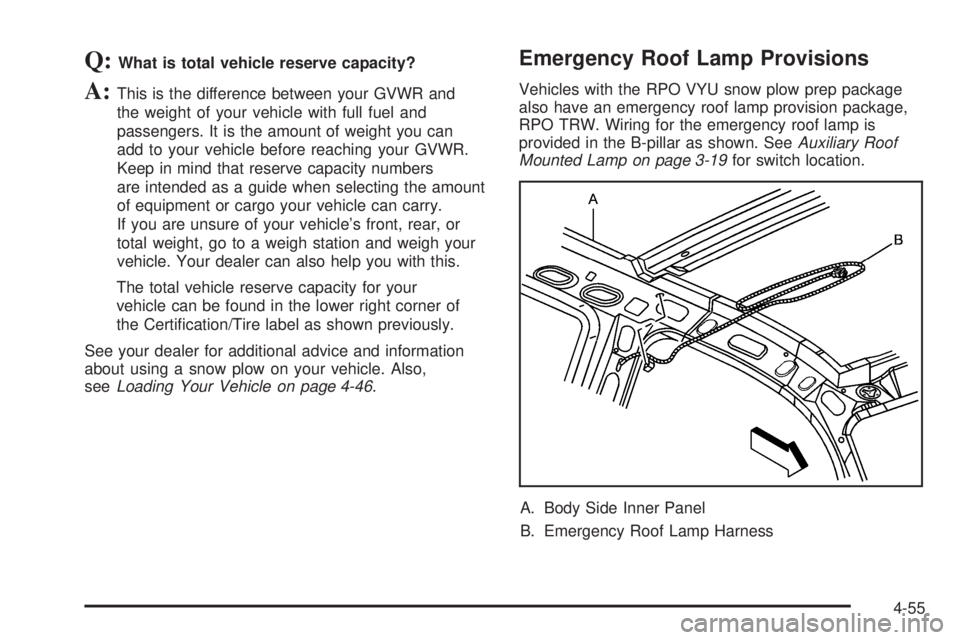
RPO TRW. Wiring for the emergency roof lamp is
provided in the B-pillar as shown. SeeAuxiliary Roof
Mounted Lamp on page 3-19for switch location.
A. Body Side Inner Panel
B. Emergency Roof Lamp Harness
4-55
Page 358 of 540
Your vehicle may be equipped with a button at the
end of the shift lever which, when pressed, enables
tow/haul. Your vehicle may be equipped with Autoride
®
which further improves your vehicle’s ride while
towing. SeeAutoride®on page 4-60for more
information. When the button is pressed, a light on
the instrument panel will illuminate to indicate that
Tow/Haul has been selected. Tow/Haul may be turned
off by pressing the button again, at which time the
indicator light on the instrument panel will turn off.
The vehicle will automatically turn off Tow/Haul every
time it is started.
Tow/Haul is designed to be most effective when the
vehicle and trailer combined weight is at least 75 percent
of the vehicle’s Gross Combined Weight Rating
(GCWR). See Weight of the Trailer later in this section.
Tow/Haul is most useful under the following driving
conditions:
When pulling a heavy trailer or a large or heavy
load through rolling terrain.
When pulling a heavy trailer or a large or heavy
load in stop and go traffic.
When pulling a heavy trailer or a large or heavy
load in busy parking lots where improved low
speed control of the vehicle is desired.Operating the vehicle in tow/haul when lightly loaded or
with no trailer at all will not cause damage. However,
there is no benet to the selection of Tow/Haul when the
vehicle is unloaded. Such a selection when unloaded
may result in unpleasant engine and transmission driving
characteristics and reduced fuel economy. Tow/Haul
is recommended only when pulling a heavy trailer or a
large or heavy load.
Weight of the Trailer
How heavy can a trailer safely be?
It depends on how you plan to use your rig. For
example, speed, altitude, road grades, outside
temperature and how much your vehicle is used to pull
a trailer are all important. It can also depend on any
special equipment that you have on your vehicle,
and the amount of tongue weight the vehicle can carry.
See “Weight of the Trailer Tongue” later in this
section for more information.
Maximum trailer weight is calculated assuming only the
driver is in the tow vehicle and it has all the required
trailering equipment. The weight of additional optional
equipment, passengers and cargo in the tow vehicle
must be subtracted from the maximum trailer weight.
4-62
Page 367 of 540
Following Distance
Stay at least twice as far behind the vehicle ahead as
you would when driving your vehicle without a trailer.
This can help you avoid situations that require
heavy braking and sudden turns.
Passing
You’ll need more passing distance up ahead when
you’re towing a trailer. And, because you’re a good
deal longer, you’ll need to go much farther beyond
the passed vehicle before you can return to your lane.
Backing Up
Hold the bottom of the steering wheel with one hand.
Then, to move the trailer to the left, just move that hand
to the left. To move the trailer to the right, move your
hand to the right. Always back up slowly and, if possible,
have someone guide you.
Making Turns
Notice:Making very sharp turns while trailering
could cause the trailer to come in contact with
the vehicle. Your vehicle could be damaged.
Avoid making very sharp turns while trailering.
When you’re turning with a trailer, make wider turns
than normal. Do this so your trailer won’t strike
soft shoulders, curbs, road signs, trees or other objects.
Avoid jerky or sudden maneuvers. Signal well in
advance.
Turn Signals When Towing a Trailer
The arrows on your instrument panel will ash whenever
you signal a turn or lane change. Properly hooked up,
the trailer lamps will also ash, telling other drivers
you’re about to turn, change lanes or stop.
When towing a trailer, the arrows on your instrument
panel will ash for turns even if the bulbs on the
trailer are burned out. Thus, you may think drivers
behind you are seeing your signal when they are not.
It’s important to check occasionally to be sure the
trailer bulbs are still working.
4-71
Page 376 of 540
Tire Pressure Monitor System.........................5-64
Tire Inspection and Rotation...........................5-68
When It Is Time for New Tires.......................5-69
Buying New Tires.........................................5-70
Different Size Tires and Wheels......................5-71
Uniform Tire Quality Grading..........................5-72
Wheel Alignment and Tire Balance..................5-73
Wheel Replacement......................................5-73
Tire Chains..................................................5-74
If a Tire Goes Flat........................................5-75
Changing a Flat Tire.....................................5-76
Removing the Spare Tire and Tools................5-78
Removing the Flat Tire and Installing
the Spare Tire..........................................5-81
Secondary Latch System...............................5-88
Storing a Flat or Spare Tire and Tools............5-92
Spare Tire...................................................5-95
Appearance Care............................................5-96
Cleaning the Inside of Your Vehicle.................5-96
Fabric/Carpet...............................................5-98
Leather.......................................................5-98
Instrument Panel, Vinyl, and Other Plastic
Surfaces..................................................5-99
Care of Safety Belts......................................5-99
Weatherstrips...............................................5-99Washing Your Vehicle..................................5-100
Cleaning Exterior Lamps/Lenses....................5-100
Finish Care................................................5-100
Windshield, Backglass, and Wiper Blades.......5-101
Aluminum or Chrome-Plated Wheels..............5-102
Tires.........................................................5-103
Sheet Metal Damage...................................5-103
Finish Damage...........................................5-103
Underbody Maintenance...............................5-103
Chemical Paint Spotting...............................5-103
Vehicle Care/Appearance Materials................5-104
Vehicle Identication.....................................5-105
Vehicle Identication Number (VIN)................5-105
Service Parts Identication Label...................5-105
Electrical System..........................................5-106
Add-On Electrical Equipment.........................5-106
Windshield Wiper Fuses...............................5-106
Power Windows and Other Power Options......5-106
Fuses and Circuit Breakers..........................5-106
Instrument Panel Fuse Block........................5-107
Center Instrument Panel Fuse Block..............5-108
Underhood Fuse Block................................5-109
Capacities and Specications........................5-114
Section 5 Service and Appearance Care
5-2
Page 378 of 540

Doing Your Own Service Work
{CAUTION:
You can be injured and your vehicle could be
damaged if you try to do service work on a
vehicle without knowing enough about it.
Be sure you have sufficient knowledge,
experience, the proper replacement parts,
and tools before you attempt any vehicle
maintenance task.
Be sure to use the proper nuts, bolts,
and other fasteners. English and metric
fasteners can be easily confused. If you
use the wrong fasteners, parts can later
break or fall off. You could be hurt.
If you want to do some of your own service work, you will
want to use the proper service manual. It tells you much
more about how to service your vehicle than this manual
can. To order the proper service manual, seeService
Publications Ordering Information on page 7-15.
Your vehicle has an airbag system. Before attempting
to do your own service work, seeServicing Your
Airbag-Equipped Vehicle on page 1-86.You should keep a record with all parts receipts and list
the mileage and the date of any service work you
perform. SeeMaintenance Record on page 6-17.
Adding Equipment to the Outside
of Your Vehicle
Things you might add to the outside of your vehicle
can affect the airow around it. This may cause
wind noise and affect windshield washer performance.
Check with your dealer before adding equipment to
the outside of your vehicle.
Fuel
The 8th digit of your vehicle identication number (VIN)
shows the code letter or number that identies your
engine. You will nd the VIN at the top left of the
instrument panel. SeeVehicle Identication Number
(VIN) on page 5-105.
If your vehicle has the 5.3L V8 engine (Code Z), you
may use either regular unleaded gasoline or ethanol
fuel containing up to 85% ethanol (E85); also see
Fuel E85 (85% Ethanol) on page 5-6. In all other
engines, use only regular unleaded gasoline.
5-4
Page 380 of 540

To help keep fuel injectors and intake valves clean,
or if your vehicle experiences problems due to
dirty injectors or valves, look for gasoline that is
advertised as TOP TIER Detergent Gasoline. Also,
your GM dealer has additives that will help correct
and prevent most deposit-related problems.
Gasolines containing oxygenates, such as ethers and
ethanol, and reformulated gasolines may be available in
your area. General Motors recommends that you use
these gasolines if they comply with the specications
described earlier. However, E85 (85% ethanol)
and other fuels containing more than 10% ethanol
must not be used in vehicles that were not designed
for those fuels.
Notice:Your vehicle was not designed for fuel
that contains methanol. Do not use fuel containing
methanol. It can corrode metal parts in your fuel
system and also damage the plastic and rubber
parts. That damage would not be covered under
your warranty.
Some gasolines that are not reformulated for low
emissions may contain an octane-enhancing additive
called methylcyclopentadienyl manganese tricarbonyl
(MMT); ask the attendant where you buy gasoline
whether the fuel contains MMT. General Motors
recommends against the use of such gasolines.Fuels containing MMT can reduce the life of spark plugs
and the performance of the emission control system
may be affected. The malfunction indicator lamp
may turn on. If this occurs, return to your authorized
GM dealer for service.
Fuel E85 (85% Ethanol)
The 8th digit of your vehicle identication number (VIN)
shows the code letter or number that identies your
engine. You will nd the VIN at the top left of the
instrument panel. SeeVehicle Identication Number
(VIN) on page 5-105.
If your vehicle has the 5.3L V8 engine (VIN Code Z
only), you may use either regular unleaded gasoline
or ethanol fuel containing up to 85% ethanol (E85);
also seeFuel on page 5-4. In all other engines, including
the 5.3L V8 (VIN Code T), use only regular unleaded
gasoline.
Only vehicles that have the 5.3L V8 engine (VIN Code Z)
may use 85% ethanol fuel (E85). General Motors
encourages the use of E85 in vehicles that are designed
to use it. The ethanol in E85 is a “renewable” fuel,
meaning it is made from renewable sources such as
corn and other crops.
5-6
Page 402 of 540
Engine Overheating
You will nd a coolant temperature gage on your
vehicle’s instrument panel. SeeEngine Coolant
Temperature Gage on page 3-43.
In addition, you will nd an ENGINE OVERHEATED,
and a REDUCED ENGINE POWER message in
the Driver Information Center (DIC) on the instrument
panel. SeeDIC Warnings and Messages on page 3-56.
If Steam Is Coming From
Your Engine
{CAUTION:
Steam from an overheated engine can burn
you badly, even if you just open the hood.
Stay away from the engine if you see or hear
steam coming from it. Just turn it off and get
everyone away from the vehicle until it cools
down. Wait until there is no sign of steam or
coolant before you open the hood.
CAUTION: (Continued)
CAUTION: (Continued)
If you keep driving when your engine is
overheated, the liquids in it can catch re.
You or others could be badly burned. Stop
your engine if it overheats, and get out of
the vehicle until the engine is cool.
SeeOverheated Engine Protection Operating
Mode on page 5-30for information on driving
to a safe place in an emergency.
Notice:If your engine catches re because you
keep driving with no coolant, your vehicle can
be badly damaged. The costly repairs would not be
covered by your warranty. SeeOverheated Engine
Protection Operating Mode on page 5-30for
information on driving to a safe place in an
emergency.
5-28
Page 438 of 540

How to Check
Use a good quality pocket-type gage to check tire
pressure. You cannot tell if your tires are properly
inated simply by looking at them. Radial tires may
look properly inated even when they’re underinated.
Check the tire’s ination pressure when the tires
are cold. Cold means your vehicle has been sitting
for at least three hours or driven no more than
1 mile (1.6 km).
Remove the valve cap from the tire valve stem. Press
the tire gage rmly onto the valve to get a pressure
measurement. If the cold tire ination pressure matches
the recommended pressure on the Tire and Loading
Information label, no further adjustment is necessary.
If the ination pressure is low, add air until you reach
the recommended amount.
If you overll the tire, release air by pushing on the
metal stem in the center of the tire valve. Recheck
the tire pressure with the tire gage.
Be sure to put the valve caps back on the valve
stems. They help prevent leaks by keeping out dirt
and moisture.
Tire Pressure Monitor System
The Tire Pressure Monitor System (TPMS) uses radio
and sensor technology to check tire pressure levels.
If your vehicle has this feature, sensors are mounted on
each tire and wheel assembly, except the spare tire.
The TPMS sensors monitor the air pressure in your
vehicle’s tires and transmit tire pressure readings to a
receiver located in the vehicle.
The TPMS is designed to alert the driver, if a low tire
pressure condition exists. This system also allows
the driver to check tire pressure levels using the Driver
Information Center (DIC).
When a low tire pressure condition is detected, the TPMS
displays the CHECK TIRE PRESSURE warning message
on the DIC, and at the same time illuminates the low tire
pressure warning symbol. For additional information
and details about the DIC operation and displays see
DIC Operation and Displays on page 3-53andDIC
Warnings and Messages on page 3-56.
You may notice, during cooler weather conditions, that
the tire pressure monitor light, located on the instrument
panel cluster, and the CHECK TIRE PRESSURE
message will appear when the vehicle is rst started and
then turn off as you start to drive the vehicle. This could
be an early indicator that the tire pressures are getting
low and need to be inated to the proper pressure.
5-64
Page 452 of 540

Removing the Spare Tire and Tools
A. Retaining Bracket and
Wing Nut
B. Tool Kit and Jack Tools
C. Wing Nut Retaining
Wheel BlocksD. Wheel Blocks
E. Jack
F. KnobA. Knob
B. Removable
Storage Tray
C. Retaining Hook
D. Retaining Bracket
and Wing NutE. Tool Kit and Jack Tools
F. Mounting Bracket
G. Wing Nut Retaining
Wheel Blocks
H. Wheel Blocks
I. Jack Regular Models - Rear Access PanelExtended Models
5-78
Page 453 of 540

On the regular models, the equipment is located on the
driver’s side of the vehicle, behind the left trim panel
in the rear of the vehicle. Unlatch the release lever
to open the trim panel door. Skip the rst step and
follow the last three.
On the extended models, the equipment you will need
is under the storage tray on the driver’s side of the
vehicle, in the trim panel.
1. Remove the tray to access the tools.
2. Remove the wing nut used to retain the tool kit
by turning it counterclockwise.
3. Turn the knob on the jack counterclockwise to
release the jack from its holder and to lower the
jack head.
4. Remove the wheel blocks and the wheel block
retainer by turning the wing nut counterclockwise.
You will use the jack handle extensions and the
wheel wrench to remove the underbody-mounted
spare tire.A. Spare Tire (Valve Stem
Pointed Down)
B. Hoist Assembly
C. Hoist Cable
D. Tire Retainer
E. Hoist Shaft
F. Hoist End of
Extension ToolG. Hoist Shaft
Access Hole
H. Wheel Wrench
I. Jack Handle
Extensions
J. Spare Tire Lock
(If Equipped)
1. Open the spare tire lock cover on the bumper and
use the ignition key to remove the lock if your
vehicle is equipped with a spare tire lock (J).
5-79