lock GMC YUKON 2007 Owner's Manual
[x] Cancel search | Manufacturer: GMC, Model Year: 2007, Model line: YUKON, Model: GMC YUKON 2007Pages: 608, PDF Size: 3.06 MB
Page 362 of 608

Environmental Concerns
Off-road driving can provide wholesome and
satisfying recreation. However, it also raises
environmental concerns. We recognize these
concerns and urge every off-roader to follow these
basic rules for protecting the environment:
Always use established trails, roads, and areas
that have been specially set aside for public
off-road recreational driving; obey all
posted regulations.
Avoid any driving practice that could damage
the environment — shrubs, owers, trees,
grasses — or disturb wildlife. This includes
wheel-spinning, breaking down trees, or
unnecessary driving through streams or over
soft ground).
Always carry a litter bag — make sure all
refuse is removed from any campsite
before leaving.
Take extreme care with open res where
permitted, camp stoves, and lanterns.
Never park your vehicle over dry grass or
other combustible materials that could
catch re from the heat of the vehicle’s
exhaust system.
Traveling to Remote Areas
It makes sense to plan your trip, especially when
going to a remote area. Know the terrain and
plan your route. You are much less likely to get
bad surprises. Get accurate maps of trails
and terrain. Try to learn of any blocked or
closed roads.
It is also a good idea to travel with at least
one other vehicle. If something happens to
one of them, the other can help quickly.
Does your vehicle have a winch? If so, be sure to
read the winch instructions. In a remote area, a
winch can be handy if you get stuck. But you will
want to know how to use it properly.
362
Page 366 of 608
Approaching a Hill
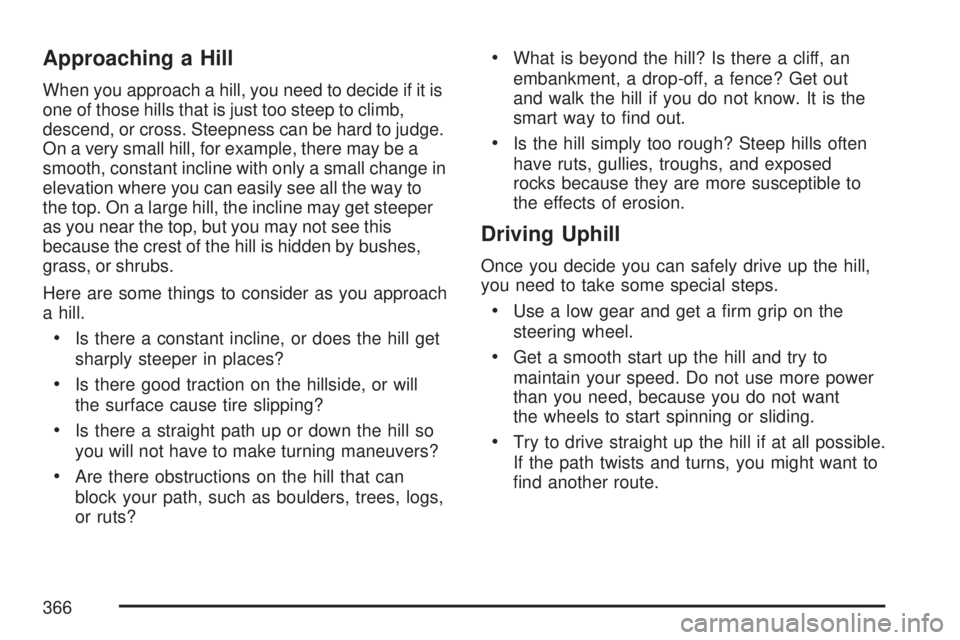
When you approach a hill, you need to decide if it is
one of those hills that is just too steep to climb,
descend, or cross. Steepness can be hard to judge.
On a very small hill, for example, there may be a
smooth, constant incline with only a small change in
elevation where you can easily see all the way to
the top. On a large hill, the incline may get steeper
as you near the top, but you may not see this
because the crest of the hill is hidden by bushes,
grass, or shrubs.
Here are some things to consider as you approach
a hill.
Is there a constant incline, or does the hill get
sharply steeper in places?
Is there good traction on the hillside, or will
the surface cause tire slipping?
Is there a straight path up or down the hill so
you will not have to make turning maneuvers?
Are there obstructions on the hill that can
block your path, such as boulders, trees, logs,
or ruts?
What is beyond the hill? Is there a cliff, an
embankment, a drop-off, a fence? Get out
and walk the hill if you do not know. It is the
smart way to nd out.
Is the hill simply too rough? Steep hills often
have ruts, gullies, troughs, and exposed
rocks because they are more susceptible to
the effects of erosion.
Driving Uphill
Once you decide you can safely drive up the hill,
you need to take some special steps.
Use a low gear and get a rm grip on the
steering wheel.
Get a smooth start up the hill and try to
maintain your speed. Do not use more power
than you need, because you do not want
the wheels to start spinning or sliding.
Try to drive straight up the hill if at all possible.
If the path twists and turns, you might want to
nd another route.
366
Page 368 of 608
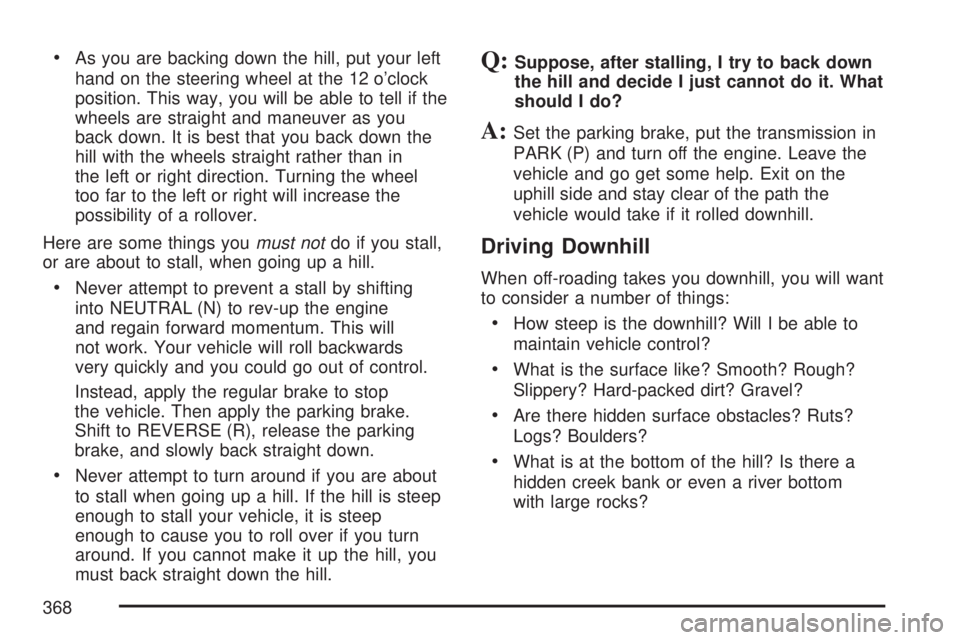
As you are backing down the hill, put your left
hand on the steering wheel at the 12 o’clock
position. This way, you will be able to tell if the
wheels are straight and maneuver as you
back down. It is best that you back down the
hill with the wheels straight rather than in
the left or right direction. Turning the wheel
too far to the left or right will increase the
possibility of a rollover.
Here are some things youmust notdo if you stall,
or are about to stall, when going up a hill.
Never attempt to prevent a stall by shifting
into NEUTRAL (N) to rev-up the engine
and regain forward momentum. This will
not work. Your vehicle will roll backwards
very quickly and you could go out of control.
Instead, apply the regular brake to stop
the vehicle. Then apply the parking brake.
Shift to REVERSE (R), release the parking
brake, and slowly back straight down.
Never attempt to turn around if you are about
to stall when going up a hill. If the hill is steep
enough to stall your vehicle, it is steep
enough to cause you to roll over if you turn
around. If you cannot make it up the hill, you
must back straight down the hill.
Q:Suppose, after stalling, I try to back down
the hill and decide I just cannot do it. What
should I do?
A:Set the parking brake, put the transmission in
PARK (P) and turn off the engine. Leave the
vehicle and go get some help. Exit on the
uphill side and stay clear of the path the
vehicle would take if it rolled downhill.
Driving Downhill
When off-roading takes you downhill, you will want
to consider a number of things:
How steep is the downhill? Will I be able to
maintain vehicle control?
What is the surface like? Smooth? Rough?
Slippery? Hard-packed dirt? Gravel?
Are there hidden surface obstacles? Ruts?
Logs? Boulders?
What is at the bottom of the hill? Is there a
hidden creek bank or even a river bottom
with large rocks?
368
Page 387 of 608
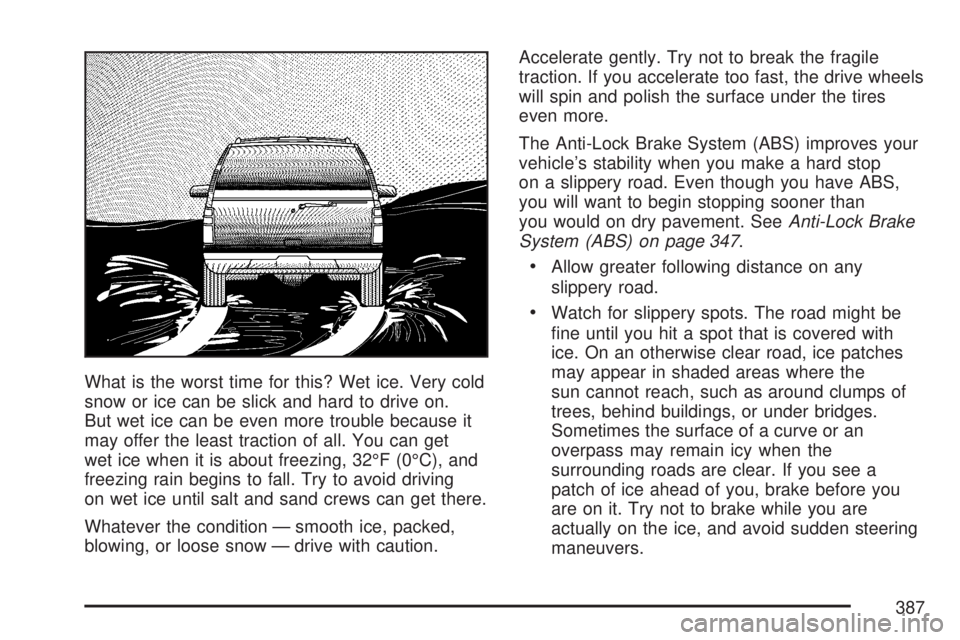
What is the worst time for this? Wet ice. Very cold
snow or ice can be slick and hard to drive on.
But wet ice can be even more trouble because it
may offer the least traction of all. You can get
wet ice when it is about freezing, 32°F (0°C), and
freezing rain begins to fall. Try to avoid driving
on wet ice until salt and sand crews can get there.
Whatever the condition — smooth ice, packed,
blowing, or loose snow — drive with caution.Accelerate gently. Try not to break the fragile
traction. If you accelerate too fast, the drive wheels
will spin and polish the surface under the tires
even more.
The Anti-Lock Brake System (ABS) improves your
vehicle’s stability when you make a hard stop
on a slippery road. Even though you have ABS,
you will want to begin stopping sooner than
you would on dry pavement. SeeAnti-Lock Brake
System (ABS) on page 347.
Allow greater following distance on any
slippery road.
Watch for slippery spots. The road might be
ne until you hit a spot that is covered with
ice. On an otherwise clear road, ice patches
may appear in shaded areas where the
sun cannot reach, such as around clumps of
trees, behind buildings, or under bridges.
Sometimes the surface of a curve or an
overpass may remain icy when the
surrounding roads are clear. If you see a
patch of ice ahead of you, brake before you
are on it. Try not to brake while you are
actually on the ice, and avoid sudden steering
maneuvers.
387
Page 389 of 608

{CAUTION:
Snow can trap exhaust gases under your
vehicle. This can cause deadly CO
(carbon monoxide) gas to get inside. CO
could overcome you and kill you. You
cannot see it or smell it, so you might not
know it is in your vehicle. Clear away
snow from around the base of your
vehicle, especially any that is blocking
your exhaust pipe. And check around
again from time to time to be sure snow
does not collect there.
Open a window just a little on the side of
the vehicle that is away from the wind.
This will help keep CO out.Run your engine only as long as you must. This
saves fuel. When you run the engine, make it
go a little faster than just idle. That is, push the
accelerator slightly. This uses less fuel for the heat
that you get and it keeps the battery charged.
You will need a well-charged battery to restart the
vehicle, and possibly for signaling later on with
your headlamps. Let the heater run for a while.
Then, shut the engine off and close the window
almost all the way to preserve the heat. Start
the engine again and repeat this only when you
feel really uncomfortable from the cold. But do it as
little as possible. Preserve the fuel as long as
you can. To help keep warm, you can get out of
the vehicle and do some fairly vigorous exercises
every half hour or so until help comes.
389
Page 392 of 608
Loading Your Vehicle
It is very important to know how much weight your
vehicle can carry. This weight is called the
vehicle capacity weight and includes the weight of
all occupants, cargo and all nonfactory-installed
options. Two labels on your vehicle show how
much weight it was designed to carry, the Tire
and Loading Information label and the
Certication/Tire label.
{CAUTION:
Do not load your vehicle any heavier than
the Gross Vehicle Weight Rating (GVWR),
or either the maximum front or rear Gross
Axle Weight Rating (GAWR). If you do,
parts on your vehicle can break, and it
can change the way your vehicle handles.
These could cause you to lose control
and crash. Also, overloading can shorten
the life of your vehicle.
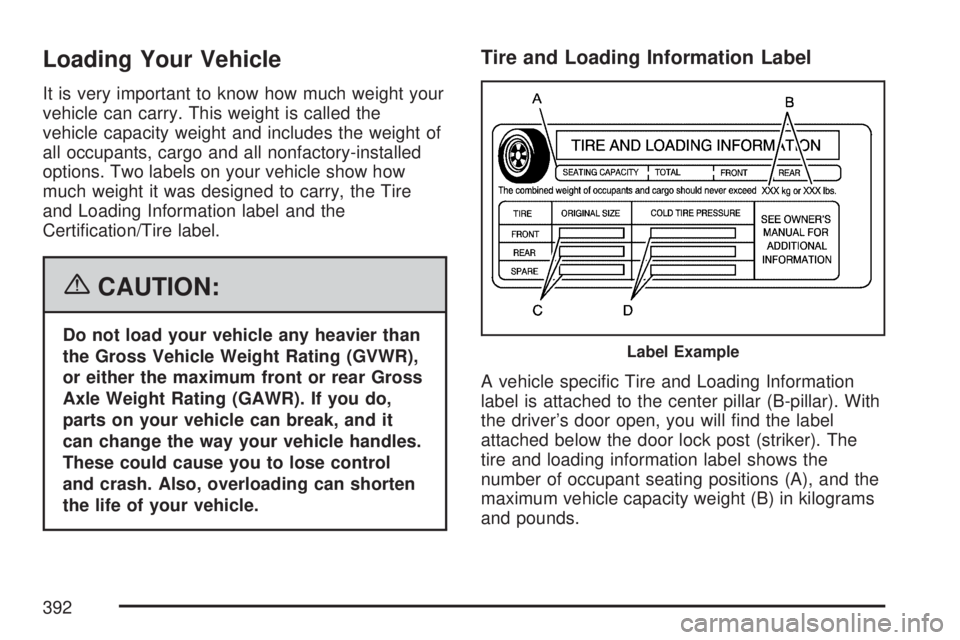
Tire and Loading Information Label
A vehicle specic Tire and Loading Information
label is attached to the center pillar (B-pillar). With
the driver’s door open, you will nd the label
attached below the door lock post (striker). The
tire and loading information label shows the
number of occupant seating positions (A), and the
maximum vehicle capacity weight (B) in kilograms
and pounds.
Label Example
392
Page 419 of 608

Windshield, Backglass, and Wiper Blades.... 532
Aluminum Wheels...................................... 532
Tires......................................................... 533
Sheet Metal Damage................................. 533
Finish Damage.......................................... 534
Underbody Maintenance............................ 534
Chemical Paint Spotting............................ 534
Vehicle Care/Appearance Materials............ 535
Vehicle Identication.................................. 535
Vehicle Identication Number (VIN)........... 536
Service Parts Identication Label............... 536Electrical System........................................ 537
Add-On Electrical Equipment..................... 537
Windshield Wiper Fuses............................ 537
Power Windows and Other Power
Options.................................................. 537
Fuses and Circuit Breakers....................... 538
Instrument Panel Fuse Block..................... 538
Center Instrument Panel Fuse Block......... 539
Underhood Fuse Block.............................. 541
Capacities and Specications.................... 546
Section 5 Service and Appearance Care
419
Page 421 of 608
Accessories and Modications
When you add non-GM accessories to your vehicle
they can affect your vehicle’s performance and
safety, including such things as, airbags, braking,
stability, ride and handling, emissions systems,
aerodynamics, durability, and electronic systems
like anti-lock brakes, traction control and stability
control. Some of these accessories may even
cause malfunction or damage not covered by
warranty.
GM Accessories are designed to complement and
function with other systems on your vehicle. Your
GM dealer can accessorize your vehicle using
genuine GM Accessories. When you go to your
GM dealer and ask for GM Accessories, you will
know that GM-trained and supported service
technicians will perform the work using genuine
GM Accessories.
California Proposition 65 Warning
Most motor vehicles, including this one, contain
and/or emit chemicals known to the State of
California to cause cancer and birth defects or
other reproductive harm. Engine exhaust,
many parts and systems (including some inside
the vehicle), many uids, and some component
wear by-products contain and/or emit these
chemicals.
421
Page 426 of 608
Filling the Tank
{CAUTION:
Fuel vapor burns violently and a fuel re
can cause bad injuries. To help avoid
injuries to you and others, read and follow
all the instructions on the pump island.
Turn off your engine when you are
refueling. Do not smoke if you are near
fuel or refueling your vehicle. Keep
sparks, ames, and smoking materials
away from fuel. Do not leave the fuel
pump unattended when refueling your
vehicle. This is against the law in some
places. Keep children away from the fuel
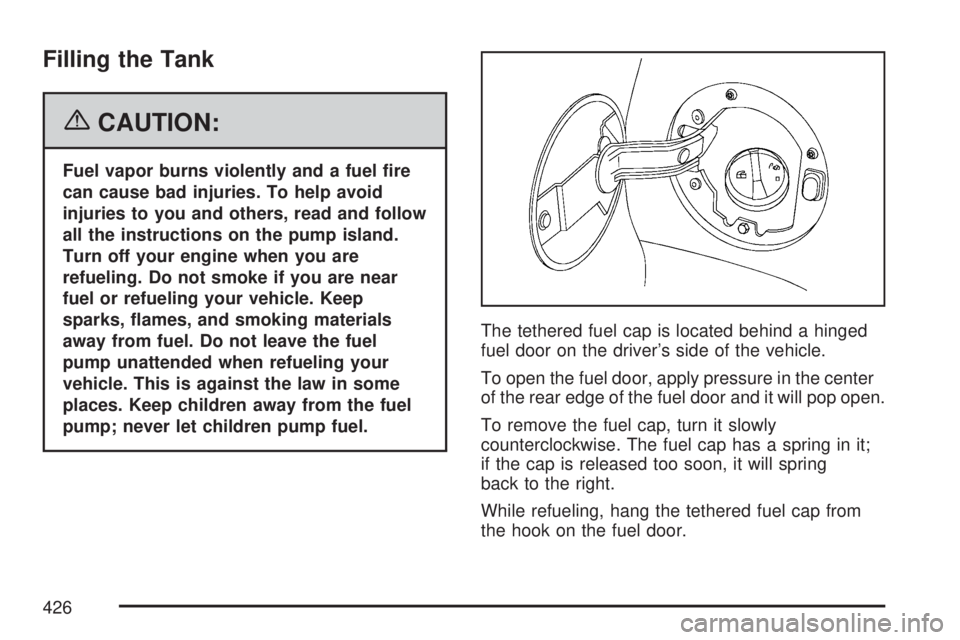
pump; never let children pump fuel.The tethered fuel cap is located behind a hinged
fuel door on the driver’s side of the vehicle.
To open the fuel door, apply pressure in the center
of the rear edge of the fuel door and it will pop open.
To remove the fuel cap, turn it slowly
counterclockwise. The fuel cap has a spring in it;
if the cap is released too soon, it will spring
back to the right.
While refueling, hang the tethered fuel cap from
the hook on the fuel door.
426
Page 427 of 608

{CAUTION:
If you spill fuel and then something ignites
it, you could be badly burned. Fuel can
spray out on you if you open the fuel cap
too quickly. This spray can happen if your
tank is nearly full, and is more likely in hot
weather. Open the fuel cap slowly and wait
for any hiss noise to stop. Then unscrew
the cap all the way.
Be careful not to spill fuel. Do not top off or overll
the tank and wait a few seconds after you have
nished pumping before removing the nozzle.
Clean fuel from painted surfaces as soon as
possible. SeeWashing Your Vehicle on page 530.
When replacing the fuel cap, turn it clockwise until
it clicks. Make sure the cap is fully installed. The
diagnostic system can determine if the fuel cap has
been left off or improperly installed. This would
allow fuel to evaporate into the atmosphere.
SeeMalfunction Indicator Lamp on page 237.If your vehicle has a Driver Information Center
(DIC), the TIGHTEN GAS CAP message will be
displayed if the fuel cap is not properly installed.
{CAUTION:
If a re starts while you are refueling,
do not remove the nozzle. Shut off the
ow of fuel by shutting off the pump or
by notifying the station attendant. Leave
the area immediately.
Notice:If you need a new fuel cap, be sure to
get the right type. Your dealer can get one
for you. If you get the wrong type, it may not
t properly. This may cause your malfunction
indicator lamp to light and may damage
your fuel tank and emissions system. See
Malfunction Indicator Lamp on page 237.
427