lock GMC YUKON DENALI 2003 Owners Manual
[x] Cancel search | Manufacturer: GMC, Model Year: 2003, Model line: YUKON DENALI, Model: GMC YUKON DENALI 2003Pages: 447, PDF Size: 21.97 MB
Page 361 of 447
Rust or dirt on the wheel, or on the parts to
which
it is fastened, can make the wheel nuts
become loose after a time. The wheel could
come
off and cause an accident. When you
change
a wheel, remove any rust or dirt from
the places where the wheel attaches to the
vehicle. In an emergency, you can use a cloth or a paper towel to do this; but be sure to use
a scraper or wire brush later, if you need to, to
get all the rust or dirt
off.
1
Never use oil or grease on studs or nuts. If
you do, the nuts might come loose. Your wheel
could fall
off, causing a serious accident.
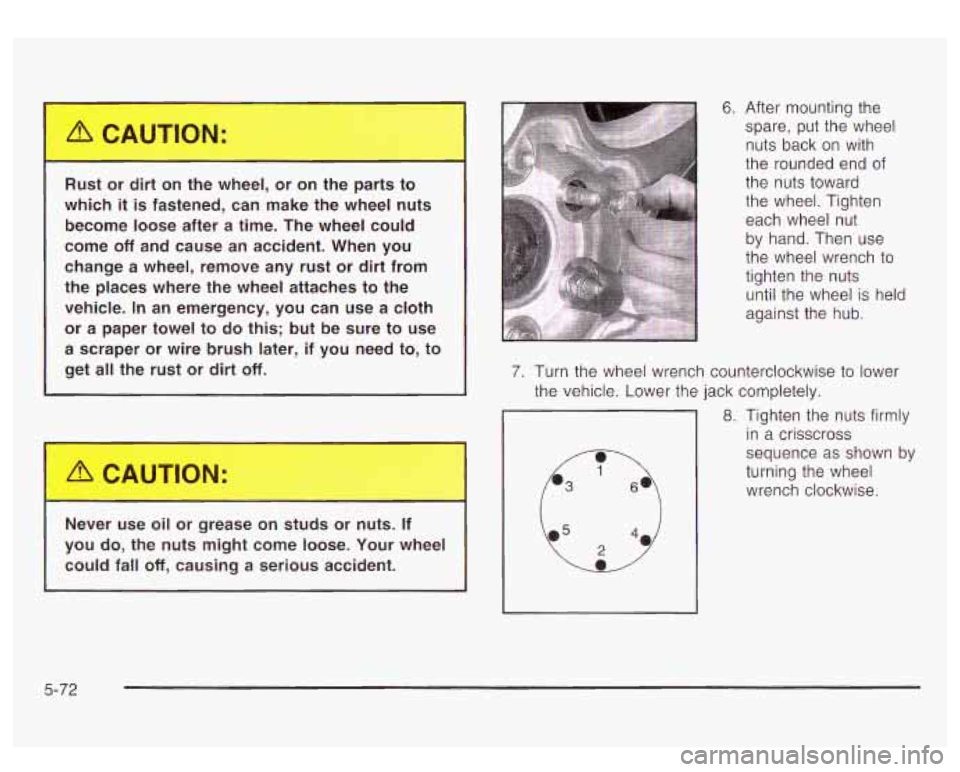
6. After mounting the spare, put the wheel
nuts back on with
the rounded end of
the nuts toward
the wheel. Tighten
each wheel nut
by hand. Then use
the wheel wrench
to
tighten the nuts
until the wheel is held
against the hub.
7. Turn the wheel wrench counterclockwise to lower
the vehicle. Lower the jack completely.
8. Tighten the nuts firmly
in a crisscross
sequence as shown by
turning the wheel
wrench clockwise.
5-72
Page 363 of 447
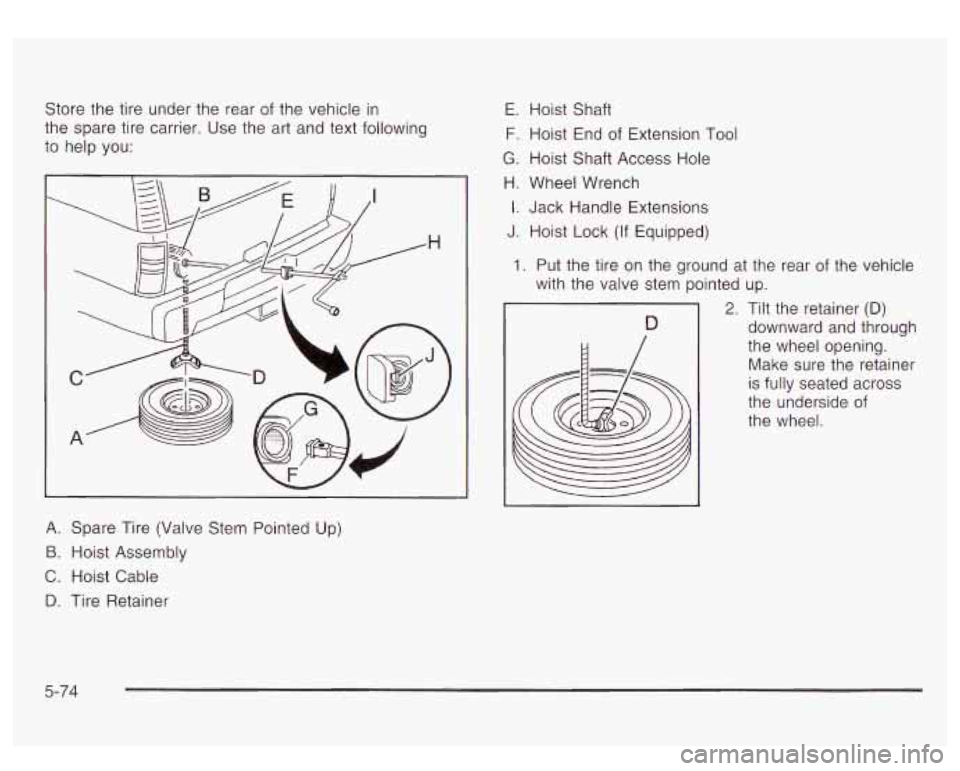
Store the tire under the rear of the vehicle in
the spare tire carrier. Use the art and text following
to help you:
A. Spare Tire (Valve Stem Pointed Up)
B. Hoist Assembly
C. Hoist Cable
D. Tire Retainer
E. Hoist Shaft
F. Hoist End of Extension Tool
G. Hoist Shaft Access Hole
H. Wheel Wrench
I. Jack Handle Extensions
I. Hoist Lock (If Equipped)
1. Put the tire on the ground at the rear of the vehicle
with the valve stem pointed up.
D
/
2. Tilt the retainer (D)
downward and through
the wheel opening.
Make sure the retainer
is fully seated across
the underside of
the wheel.
5-74
Page 364 of 447
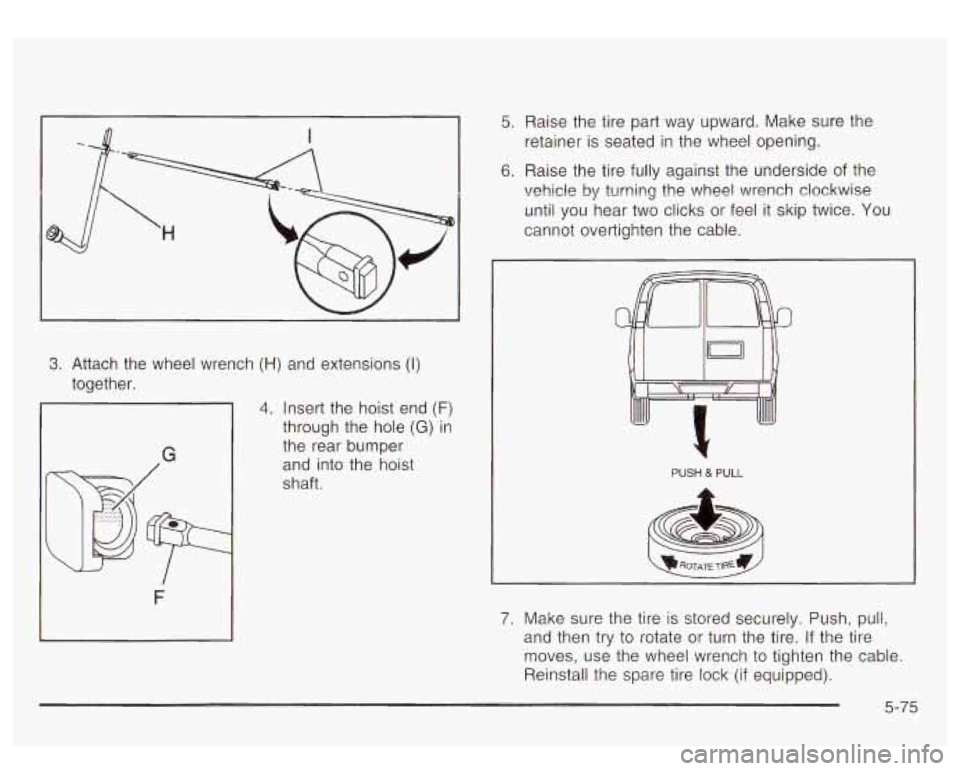
3. Attach the wheel wrench (H) and extensions (I)
together.
G
F
4. Insert the hoist end (F)
through the hole (G) in
the rear bumper
and into the hoist
shaft.
5. Raise the tire part way upward. Make sure the
retainer is seated in the wheel opening.
6. Raise the tire fully against the underside of the
vehicle by turning the wheel wrench clockwise
until you hear two clicks or feel it skip twice. You
cannot overtighten the cable.
PUSH & PULL
7. Make sure the tire is stored securely. Push, pull,
and then try to rotate or turn the tire. If the tire
moves, use the wheel wrench
to tighten the cable.
Reinstall the spare tire lock
(if equipped).
5-75
Page 365 of 447
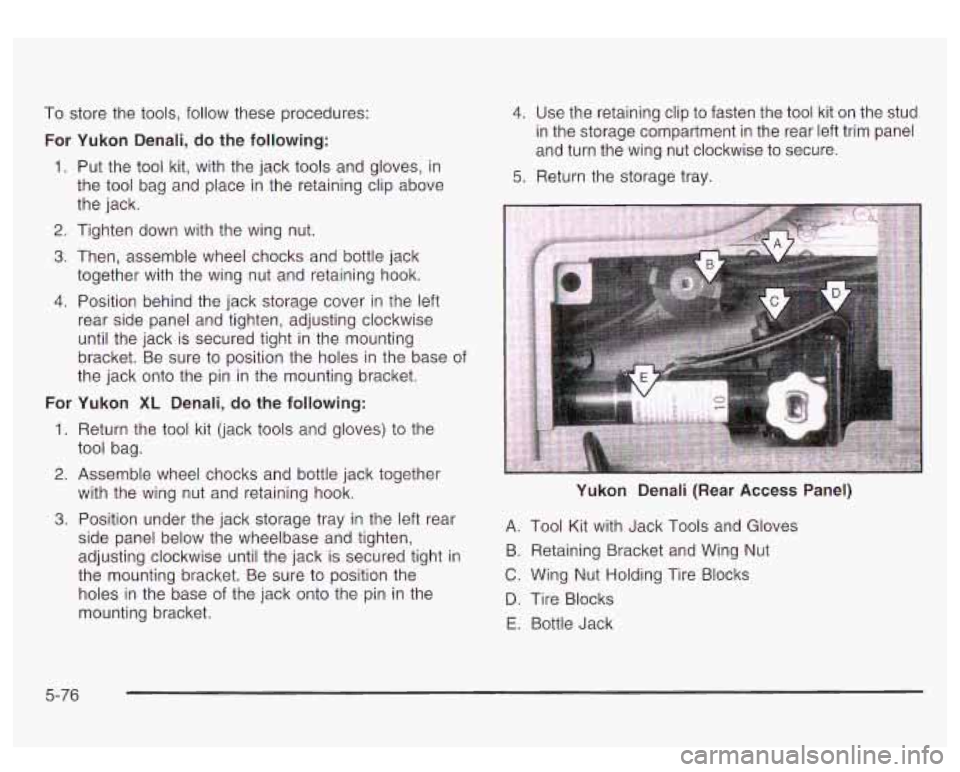
To store the tools, follow these procedures:
For Yukon Denali, do the following:
1. Put the tool kit, with the jack tools and gloves, in
the tool bag and place in the retaining clip above
the jack.
2. Tighten down with the wing nut.
3. Then, assemble wheel chocks and bottle jack
together with the wing nut and retaining hook.
4. Position behind the jack storage cover in the left
rear side panel and tighten, adjusting clockwise
until the jack is secured tight in the mounting
bracket. Be sure
to position the holes in the base of
the jack onto the pin in the mounting bracket.
For Yukon XL Denali, do the following:
1. Return the tool kit (jack tools and gloves) to the
tool bag.
2. Assemble wheel chocks and bottle jack together
with the wing nut and retaining hook.
3. Position under the jack storage tray in the left rear
side panel below the wheelbase and tighten,
adjusting clockwise until the jack
is secured tight in
the mounting bracket. Be sure to position the
holes in the base of the jack onto the pin in the
mounting bracket.
4. Use the retaining clip to fasten the tool kit on the stud
in the storage compartment in the rear left trim panel
and turn the wing nut clockwise
to secure.
5. Return the storage tray.
Yukon Denali (Rear Access Panel)
A. Tool Kit with Jack Tools and Gloves
B. Retaining Bracket and Wing Nut
C. Wing Nut Holding Tire Blocks
D. Tire Blocks
E. Bottle Jack
5-76
Page 366 of 447
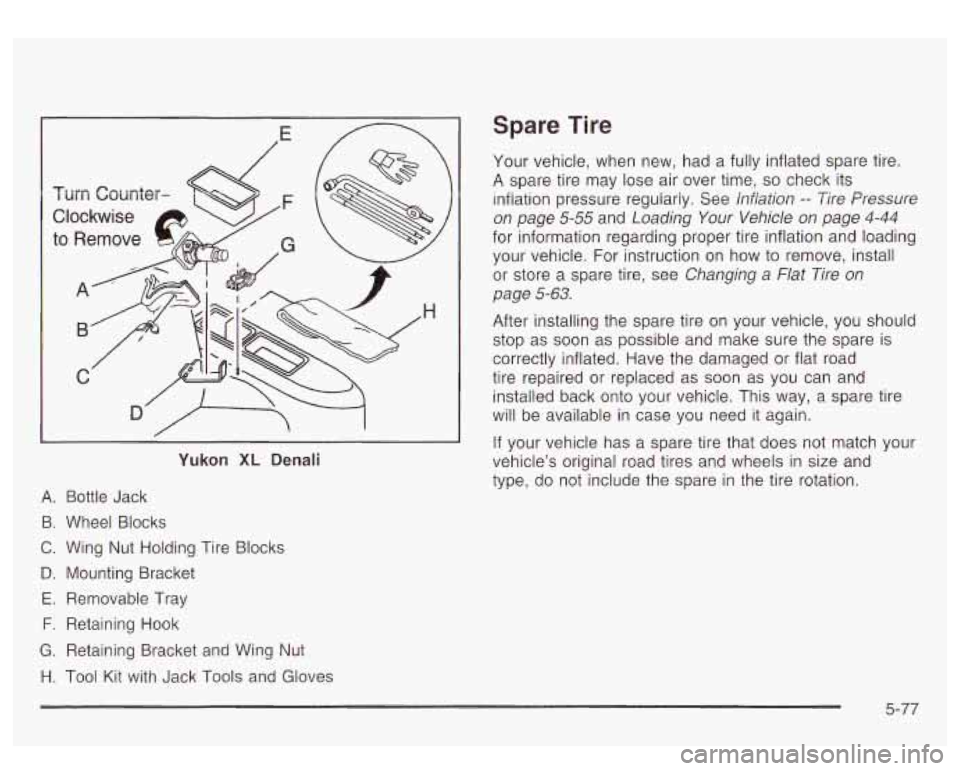
Yukon XL Denali
A. Bottle Jack
B. Wheel Blocks
C. Wing Nut Holding Tire Blocks
D. Mounting Bracket
E. Removable Tray
F. Retaining Hook
G. Retaining Bracket and Wing Nut
H. Tool Kit with Jack Tools and Gloves
Spare Tire
Your vehicle, when new, had a fully inflated spare tire.
A spare tire may lose air over time, so check its
inflation pressure reguiariy. See infiation
-- Tire Pressure
on page
5-55 and Loading Your Vehicle on page 4-44
for information regarding proper tire inflation and loading
your vehicle. For instruction on how to remove, install
or store a spare tire, see Changing a Flat Tire
on
page 5-63.
After installing the spare tire on your vehicle, you should
stop as soon as possible and make sure the spare is
correctly inflated. Have the damaged or flat road
tire repaired or replaced as soon as you can and
installed back onto your vehicle. This way, a spare tire
will be available in case you need it again.
If your vehicle has a spare tire that does not match your
vehicle’s original road tires and wheels in size and
type,
do not include the spare in the tire rotation.
5-77
Page 377 of 447
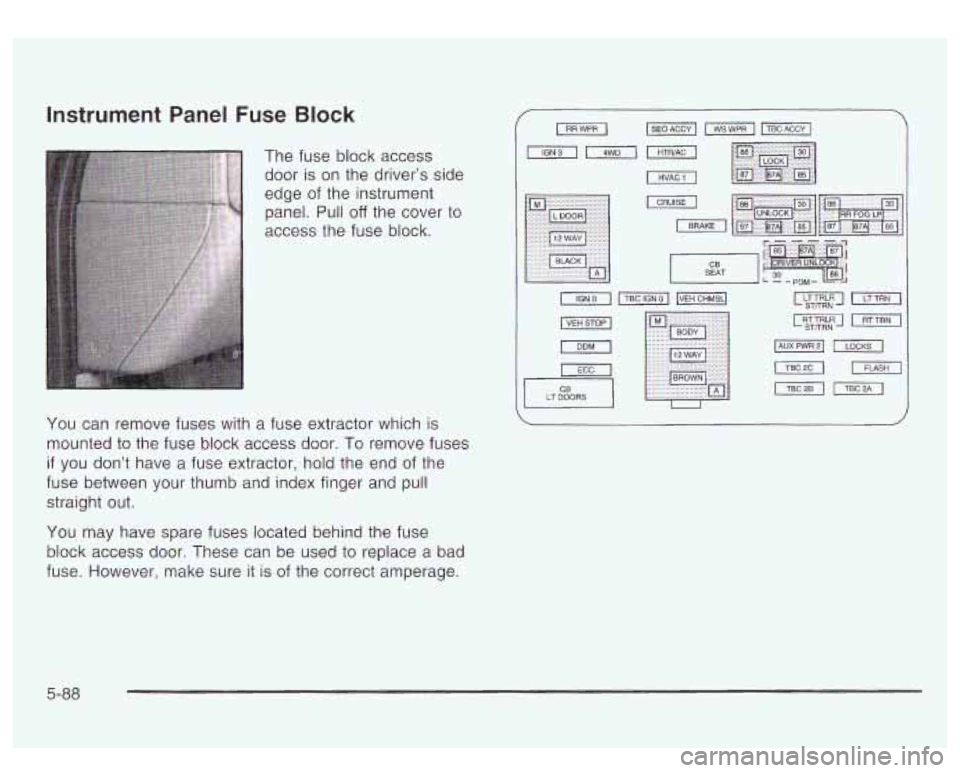
Instrument Panel Fuse Block
The fuse block access
door is on the driver’s side
edge of the instrument
panel. Pull
off the cover to
access the fuse block.
You can remove fuses with a fuse extractor which
is
mounted to the fuse block access door. To remove fuses
if you don’t have a fuse extractor, hold the end of the
fuse between your thumb and index finger and pull
straight out.
VJ
LT DOORS
I’ I U
You may have spare fuses located behind the fuse
block access door. These can be used
to replace a bad
fuse. However, make sure it
is of the correct amperage.
5-88
Page 378 of 447
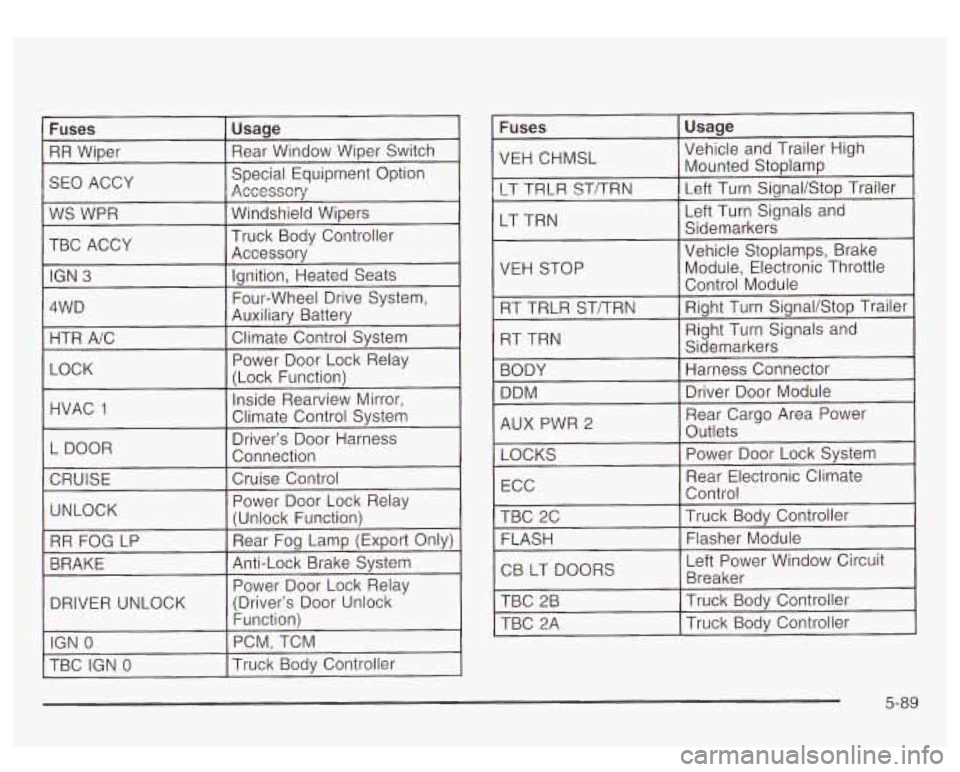
Power Door Lock Relay
DRIVER UNLOCK (Driver’s
Door Unlock
Fuses
VEH CHMSL
LT TRLR ST/TRN
LT TRN
VEH STOP
Usage
Vehicle and Trailer High
Mounted Stoplamp
Left Turn SignaVStop Trailer
Left Turn Signals and
Sidemarkers
Vehicle Stoplamps, Brake Module, Electronic Throttle
Control Module
RT TRLR ST/TRN Right Turn Signal/Stop Trailer
-
RT TRN Right Turn Signals and
Sidemarkers
AUX
PWR 2 I
Rear Cargo Area Power
Outlets
5-89
Page 379 of 447
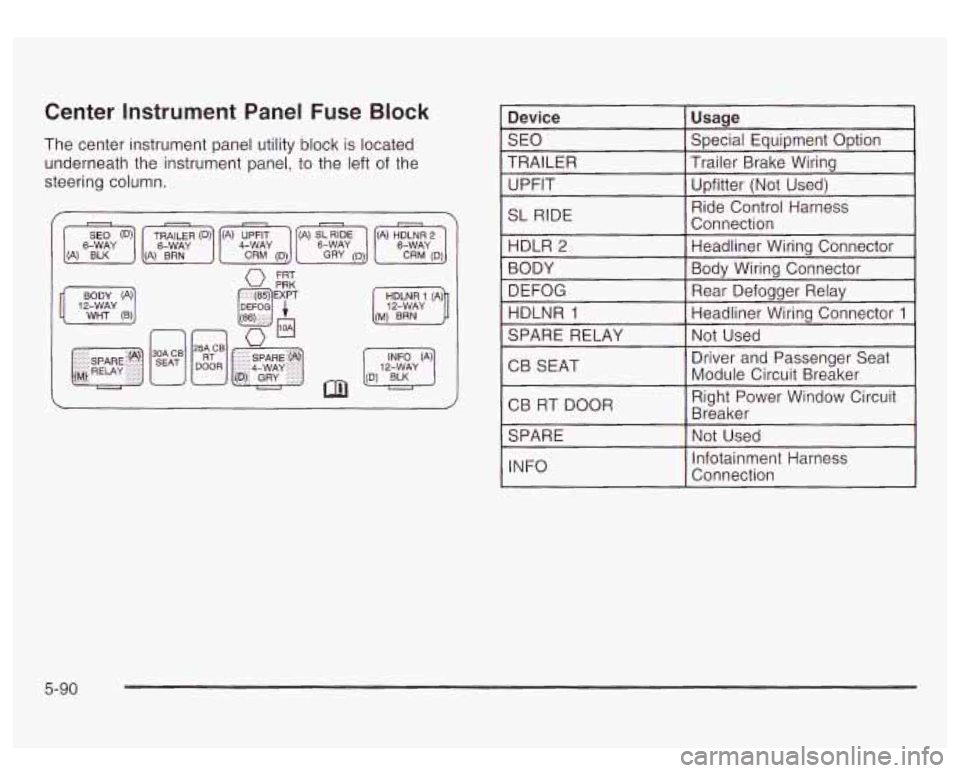
Center Instrument Panel Fuse Block
The center instrument panel utility block is located
underneath the instrument panel,
to the left of the
steering column.
A FRT
[ 12-WAY) BODY (A) WHT (B)
HDLNR 1 (A)
12-WAY
1 2-WAY
5-90
SL RIDE
HDLR
2 Headliner Wiring Connector
Ride Control
Harness
Connection ~~ [BODY I Body Wiring Connector ---- - I Utl-uti Rear Defogger Relay
HDLNR
1 Headliner Wiring Connector 1
SPARE RELAY Not Used
CB
SEAT
CB RT DOOR Driver
and Passenger Seat
Module Circuit Breaker
Right Power Window Circuit
Breaker
SPARE Not Used
INFO Infotainment Harness
Connection
Page 380 of 447
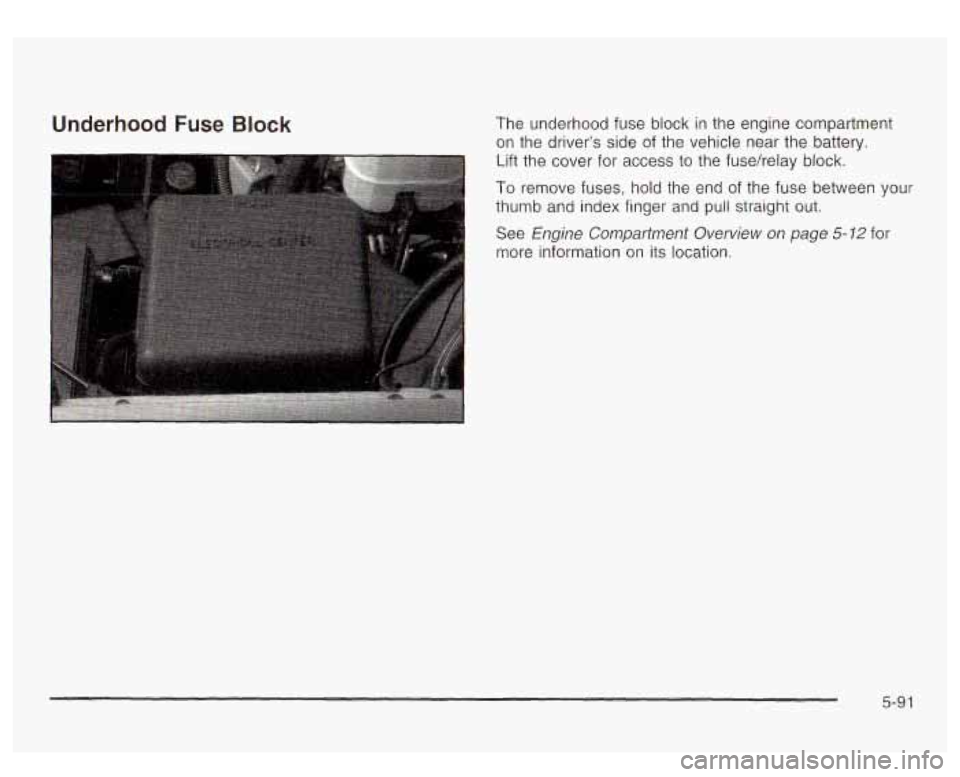
Underhood Fuse Block The underhood fuse block in the engine compartment
on the driver’s side
of the vehicle near the battery.
Lift the cover for access to the fuse/relay block.
To remove fuses, hold the end of the fuse between your
thumb and index finger and puli straight out.
See Engine Compartment Overview on page
5-12 for
more information on
its location.
5-91
Page 382 of 447
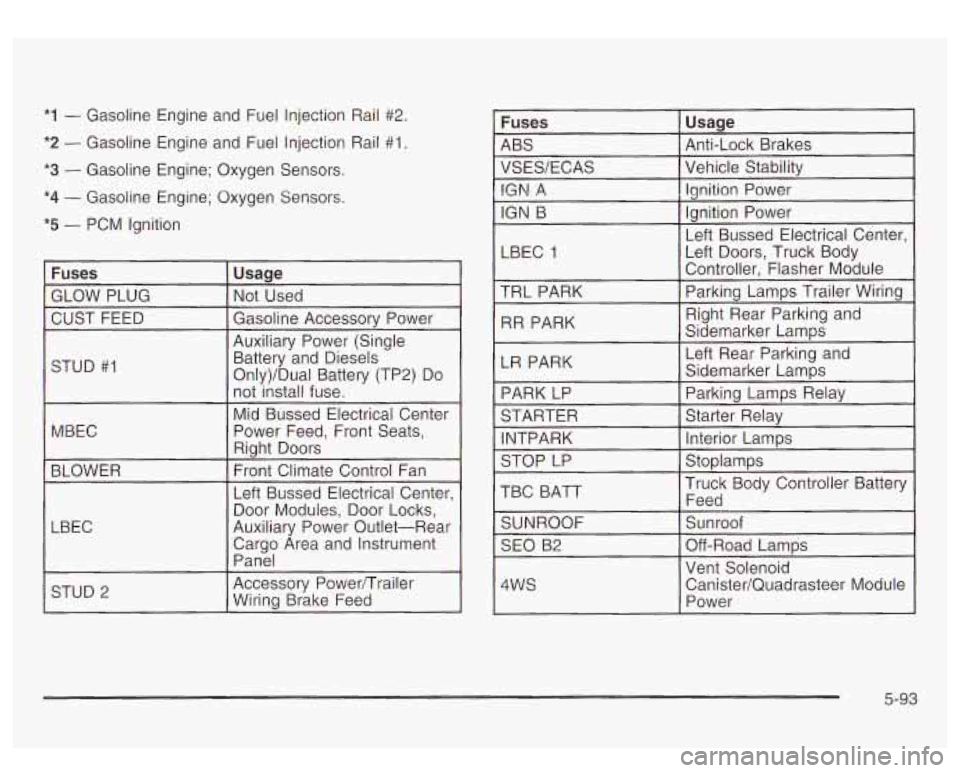
*I - Gasoline Engine and Fuel Injection Rail #2.
*2 - Gasoline Engine and Fuel Injection Rail #l.
*3 - Gasoline Engine; Oxygen Sensors.
*4 - Gasoline Engine; Oxygen Sensors.
*5 - PCM Ignition
I Fuses I Usage I
I STUD #1 I
Battery-and Diesels
Only)/Dual Battery (TP2) Do
not -install fuse.
Mid Bussed Electrical Center
MBEC Power
Feed, Front Seats,
LBEC Door Modules, Door Locks,
Auxiliary Power Outlet-Rear
Cargo Area and Instrument
Panel
STUD 2 Accessory
Powerflrailer
Wirinq Brake Feed LBEC
1
~~
I RR PARK I
Right
Rear Parking and
Sidemarker LamDs
I
5-93