battery GMC YUKON DENALI 2003 User Guide
[x] Cancel search | Manufacturer: GMC, Model Year: 2003, Model line: YUKON DENALI, Model: GMC YUKON DENALI 2003Pages: 447, PDF Size: 21.97 MB
Page 177 of 447
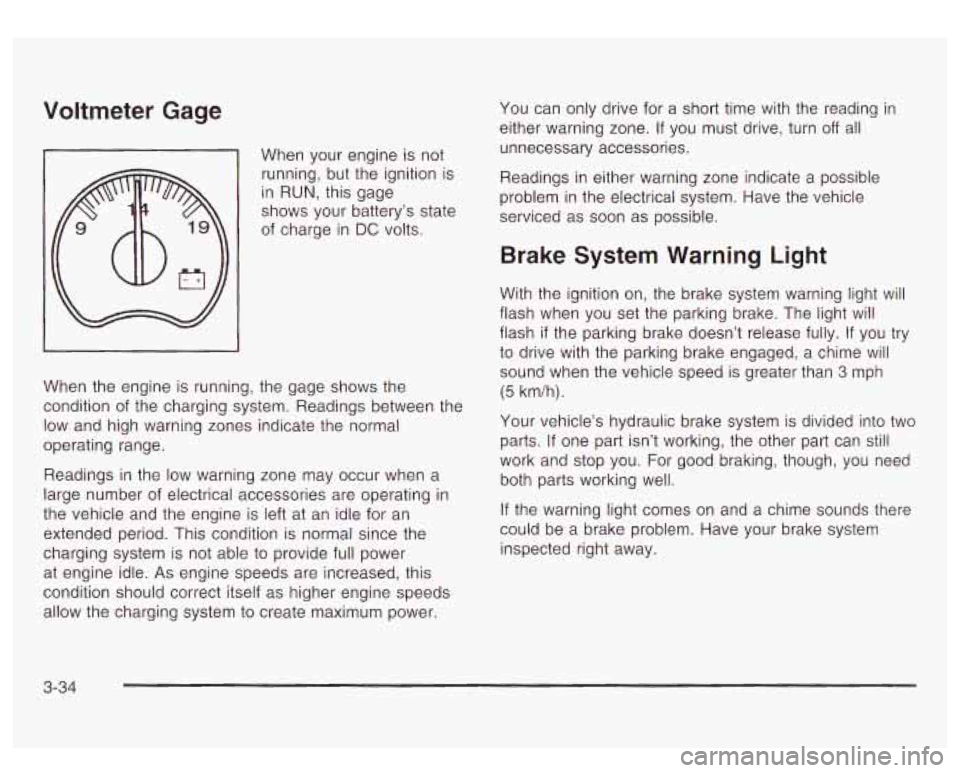
Voltmeter Gage
When your engine is not
running, but the ignition is
in
RUN, this gage
shows your battery’s state
of charge in
DC volts.
When the engine is running, the gage shows the
condition of the charging system. Readings between the
low and high warning zones indicate the normal
operating range.
Readings in the low warning zone may occur when a
large number of electrical accessories are operating in
the vehicle and the engine is left at an idle for an
extended period. This condition is normal since the
charging system is not able
to provide full power
at engine idle.
As engine speeds are increased, this
condition should correct itself as higher engine speeds allow the charging system
to create maximum power. You
can only drive for a short time with the reading in
either warning zone. If you must drive, turn
off all
unnecessary accessories.
Readings in either warning zone indicate a possible
problem in the electrical system. Have the vehicle
serviced as soon as possible.
Brake System Warning Light
With the ignition on, the brake system warning light will
flash when you set the parking brake. The light will
flash
if the parking brake doesn’t release fully. If you try
to drive with the parking brake engaged, a chime will
sound when the vehicle speed is greater than 3 mph
(5 km/h).
Your vehicle’s hydraulic brake system
is divided into two
parts. If one part isn’t working, the other part can still
work and stop you. For good braking, though, you need
both parts working well.
If the warning light comes on and a chime sounds there
could be a brake problem. Have your brake system
inspected right away.
3-34
Page 183 of 447
If none of the above steps have made the light turn off,
have your dealer or qualified service center check
the vehicle. Your dealer has the proper test equipment
and diagnostic
tools to fix any mechanical or electrical
problems that may have developed.
€missions Inspection and Maintenance
Programs
Some state/provincial and local governments have or
may begin programs
to inspect the emission control
equipment on your vehicle. Failure to pass this
inspection could prevent you from getting a vehicle
registration.
Here are some things you need
to know to help your
vehicle pass an inspection:
Your vehicle will not pass this inspection
if the Check
Engine light is on or not working properly.
Your vehicle will not pass this inspection
if the OBD
(on-board diagnostic) system determines that critical
emission control systems have not been completely
diagnosed by the system. The vehicle would be
considered not ready for inspection. This can happen
if
you have recently replaced your battery or if your
battery has run down. The diagnostic system is
designed
to evaluate critical emission control systems
during normal driving. This may take several days
of routine driving.
If you have done this and your vehicle still does
not pass the inspection for lack of
OBD
system readiness, see your dealer or qualified service
center to prepare the vehicle for inspection.
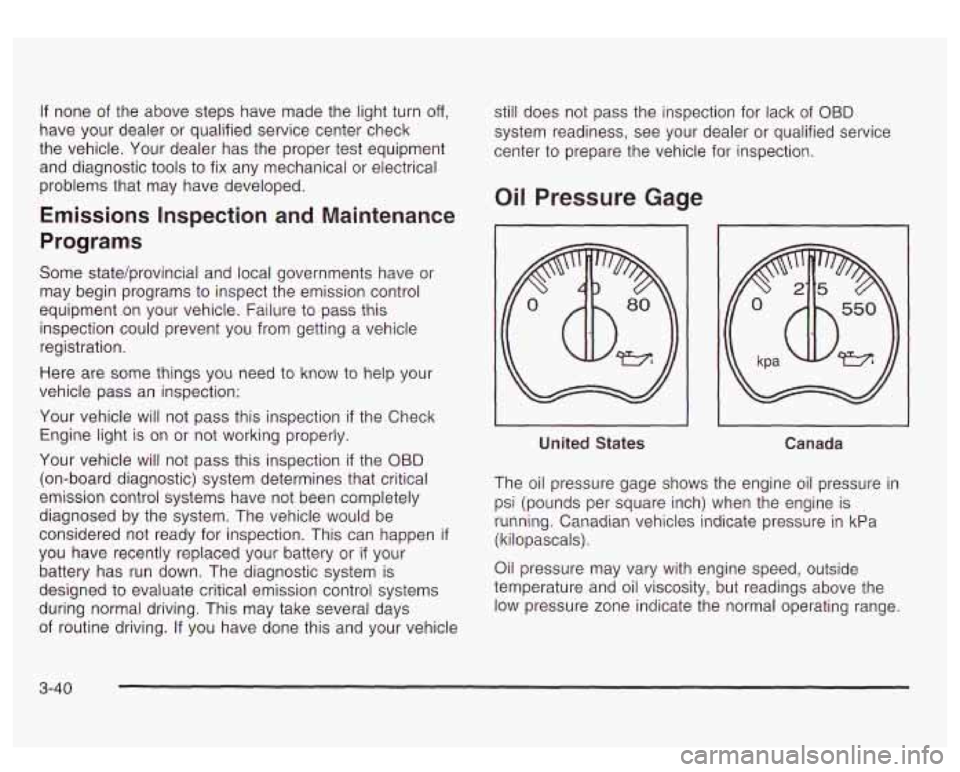
Oil Pressure Gage
_I
United States Canada
The oil pressure gage shows the engine oil pressure in
psi (pounds per square inch) when the engine is
running. Canadian vehicles indicate pressure in kPa
(kilopascals).
Oil pressure may vary with engine speed, outside
temperature and
oil viscosity, but readings above the
low pressure zone indicate the normal operating range.
3-40
Page 197 of 447
BATTERY
If the battery is not charging during operation, this
message will appear
on the DIG. Driving with this
problem could drain your battery. Have the electrical
system checked as soon as possible. Pressing the
select button will acknowledge this message and clear
it
from the DIC display.
SERVlCE AIR
If there is a problem with the air bag system, this
message will be displayed on the DIC. Have a qualified
technician inspect the system for problems. Pressing
the select button will acknowledge this message
and clear
it from the DIC display.
SERVICE BRAKE SYSTE
If a problem occurs with the brake system, this message
will appear on the DIC. If this message appears, stop
as soon as possible and turn
off the vehicle. Restart the
vehicle and check for the message
on the DIC display.
If the message is still displayed, or appears again when
you begin driving, the brake system needs service.
SERVICE 4W
If a problem occurs with the all-wheel drive system? this
message will appear on the DIG.
If this message
appears, stop as
soon as possible and turn off the
vehicle. Restart the vehicle and check for the message
3-54
on the DIC display. If the message is still displayed, or
appears again when you begin driving, the four
wheel drive system needs service.
ONTROL
If a problem occurs with the suspension system, this
message will appear on the DIC.
If this message
appears, stop and turn
off the vehicle. Restart the
vehicle and check for the message on the
DIC display.
If the message is still displayed, or appears again
when you begin driving, the suspension system needs
service.
TURN SIGNAL ON
If a turn signal is left on for 3/4 of a mile (1.2 km), this
message will appear on the display and you will hear a
chime. Move the turn signal/multifunction lever
to the
off position. Pressing the select button will acknowledge
this message and clear
it from the DIC display.
If the liftgate is open while the ignition is in
RUN, this
message will appear on the DIC and you will hear
a chime. Turn
off the vehicle and check the liftgate.
Restart the vehicle and check for the message on the
DlC display. Pressing the select button will acknowledge
this message and clear it from the
DIC display.
Page 199 of 447
Stop the vehicle and let it idle to allow the transmission
to cool. This message will clear and the chime will
stop when the fluid temperature reaches a safe level.
DRIVER DOOR AJAR
If the driver’s door is not fully closed and the vehicle is
in a drive gear, this message will appear on the
display and you will hear a chime. Stop and turn
off the
vehicle, check the door for obstacles, and close the
door again. Check
to see if the message still appears on
the DIC. Pressing the select button will acknowledge
this message and clear it from the DIC display.
PASSENGER DOOR AJAR
If the passenger’s door is not fully closed and the
vehicle is in a drive gear, this message will appear on
the display and you will hear a chime. Stop and turn
off
the vehicle, check the door for obstacles, and close
the door again. Check
to see if the message still
appears on the DIC. Pressing the select button will
acknowledge this message and clear it from the DIC
display.
LEFT REAR DOOR AJAR
If the driver’s side rear door is not fully closed and the
vehicle is in a drive gear, this message will appear
on the display and you will hear a chime. Stop and turn
off the vehicle, check the door for obstacles, and
close the door again. Check
to see if the message still
3-56
appears on the DlC. Pressing the select button will
acknowledge this message and clear it from the DIC
display.
RIGHT REAR DOOR AJAR
If the passenger’s side rear door is not fully closed and
the vehicle is in a drive gear, this message will
appear on the display and you
will hear a chime. Stop
and turn
off the vehicle, check the door for obstacles,
and close the door again. Check
to see if the message
still appears on the DIC. Pressing the select button
will acknowledge this message and clear it from the DIC
display.
RFA # BATTERY LOW
If a remote keyless entry transmitter battery is low, this
message will appear on the DIC. The battery needs
to be replaced in the transmitter. Pressing the select
button will acknowledge this message and clear it from
the DIC display.
STABILITY SYS ACTIVE
You may see the STABILITY SYS ACTIVE message on
the DIC. It means that an advanced computer-controlled
system has come on
to help your vehicle continue to
go in the direction in which you’re steering.
Stabilitrak@activates when the computer senses that
your vehicle is just starting to spin, as
it might if you hit
a patch of ice or other slippery spot on the road.
Page 218 of 447
Video Screen
The video screen is located in the overhead console. To
use the video screen, push forward on the release
latch ana the screen
will fold down. Adjirsi the screerfs
position as desired. When the video screen is not in
use, push it up into its latched position.
The DVD player and display will continue
to operate
when the screen is in either the up or the down position.
The video screen contains the infrared transmitters for
the wireless headphones and the infrared receiver
for the remote control. If the screen is in the closed
position, the infrared signals will not be available for the
operation of the headphones and the remote control.
Notice: Avoid directly touching the video screen, as
damage may occur. See “Cleaning the Video
Screen” in the Index for more information.
Remote Control
To use the remote control, aim it at the infrared window
below the video screen and press the desired button.
Direct sunlight or very bright light may affect the ability of
the entertainment system
to receive signals from the
remote control. If the remote control does not seem to
be working, the batteries may need
to be replaced.
See “Battery Replacement” later in this section.
Objects blocking the line of sight may also affect the
function of the remote control.
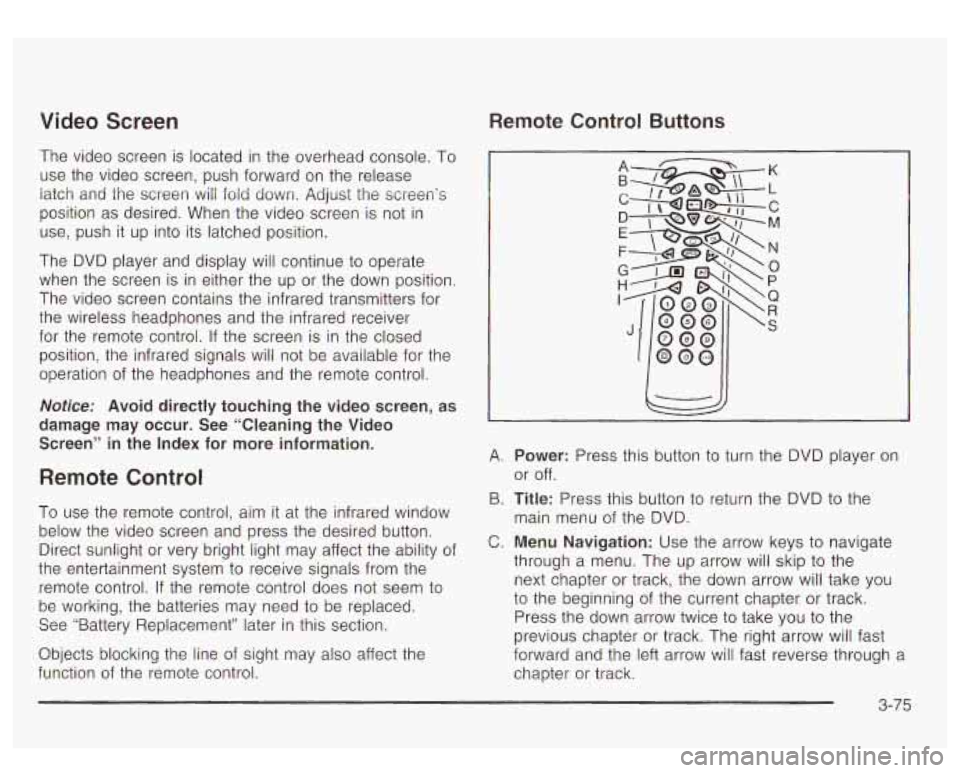
Remote Control Buttons
A. Power: Press this button to turn the DVD player on
or off.
B.
Title: Press this button to return the DVD to the
main menu of the DVD.
C. Menu Navigation: Use the arrow keys to navigate
through a menu. The up arrow will skip
to the
next chapter or track, the down arrow will take you
to the beginning of the current chapter or track.
Press the down arrow twice
to take you to the
previous chapter or track. The right arrow will fast
forward and the left arrow will fast reverse through a
chapter or track.
3-75
Page 220 of 447
Battery Replacement
To change the batteries, do the following:
1.
2.
3.
Remove the battery compartment door located on
the bottom of
the remote control.
Replace the two AA batteries in the compartment.
Make sure that they are installed correctly.
Close the battery door securely.
Notice: Do not store the remote control in heat or
direct sunlight. This could damage the remote
control and it would not be covered by your vehicles
warranty. Keep the remote control stored in a
cool, dry place.
If the remote control is to be stored for a long period of
time, remove the batteries and keep them in a cool,
dry place.
Headphones
The RSE system includes two sets of wireless infrared
headphones.
Each set
of headphones has an OWOFF control. An
indicator light will illuminate
on the headphones
when they are on. If the light does
not illuminate, the
batteries may need
to be replaced. See “Battery
Replacement” later in this section for more information.
To turn the headphones OFF activate the ON/OFF
control. Each
set of headphones has a volume knob. To adjust
the volume, adjust this knob.
The headphones will automatically turn
off if they lose
the infrared signal from the system after approximately
four minutes in order
to preserve their battery power.
The signal may be
lost if the system is turned off or if the
headphones are out
of range of the infrared signal
transmitters that are located below the video display screen.
Battery Replacement
To change the batteries, do the following:
1. Loosen the screw on the battery compartment door
located on the left side of the headphone earpiece.
2. Replace the two AAA batteries in the compartment.
3. Tighten the screws to close the compartment door.
Make sure that they are installed correctly.
Notice: Do not store the
headphones in heat or
direct sunlight. This could damage the headphones
and would not be covered by your warranty.
Keep the headphones stored in a cool place.
If the headphones are to be stored for a long period of
time, remove the batteries and keep them in a cool,
dry place.
3-77
Page 273 of 447
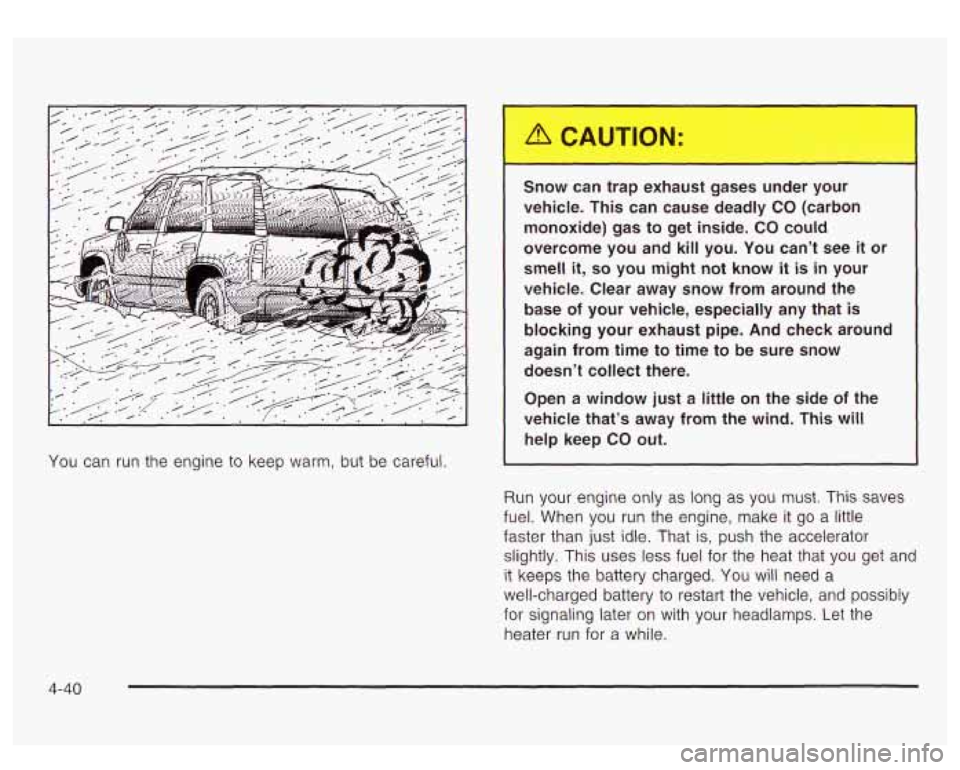
You can run the engine to keep warm, but be careful.
L..Jw can trap exhaust gases ,..der your
vehicle. This can cause deadly CO (carbon
monoxide) gas to get inside.
CO could
overcome you and kill you. You can’t see
it or
smell it, so you might not know it is in your
vehicle. Clear away snow from around the base of your vehicle, especially any that is
blocking your exhaust pipe. And check around
again from time to time to be sure snow
doesn’t collect there.
Open a window just
a little on the side of the
vehicle that’s away from the wind. This will
help keep
CO out.
Run your engine only
as long as you must. This saves
fuel. When
you run the engine, make it go a little
faster than just idle. That
is, push the accelerator
slightly. This uses less fuel for the heat that
you get and
it keeps the battery charged. You will need a
well-charged battery
to restart the vehicle, and possibly
for signaling later
on with your headlamps. Let the
heater run for
a while.
4-40
Page 289 of 447
Trailer Wiring Harness
Heavy-Duty Trailer Wiring Package
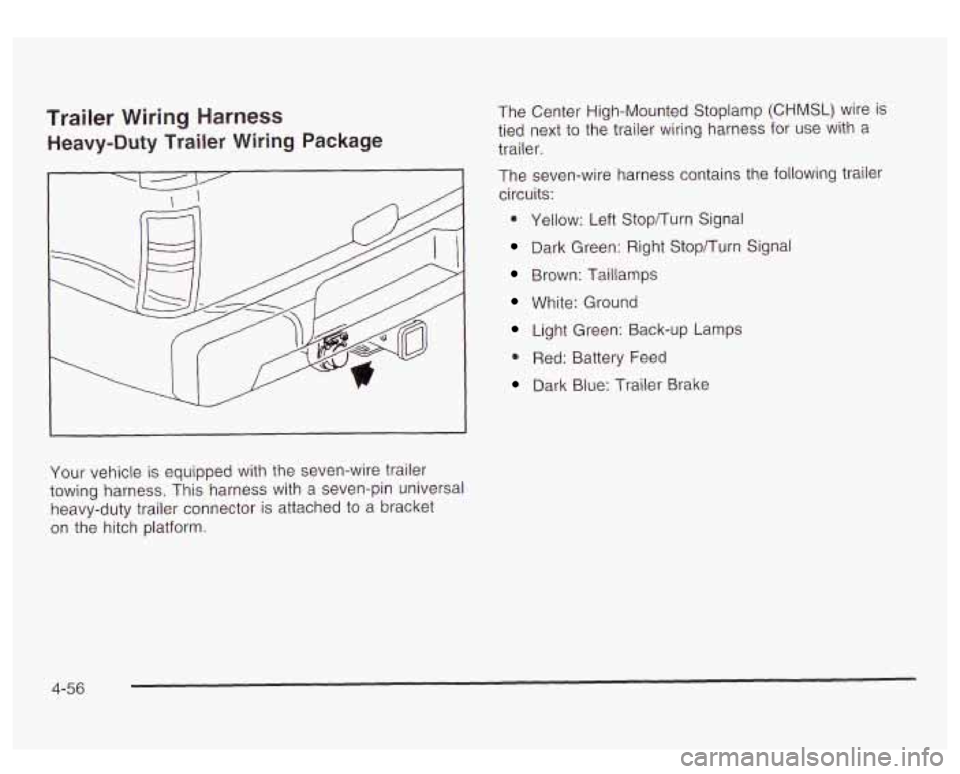
Your vehicle is equipped with the seven-wire trailer
towing harness. This harness with a seven-pin universal heavy-duty trailer connector
is attached to a bracket
on the hitch platform. The Center High-Mounted Stoplamp
(CHMSL) wire is
tied next
to the trailer wiring harness for use with a
trailer.
The seven-wire harness contains the following trailer
circuits:
0 Yellow: Left Stop/Turn Signal
Dark Green: Right Stop/Turn Signal
Brown: Taillamps
White: Ground
Light Green: Back-up Lamps
0 Red: Battery Feed
Dark Blue: Trailer Brake
4-56
Page 290 of 447
Section 5 Service and Appearance Care
Service ............................................................ 5.3
Doing Your Own Service Work
......................... 5-3
Adding Equipment
to the Outside of Your
Vehicle
.................................................. 5-4
................................................................ Fuel 5.5
Gasoline Octane ............................................ 5.5
Gasoline Specifications ................................... 5-5
California Fuel ............................................... 5-6
Additives
....................................................... 5.6
Fuels in Foreign Countries
............................... 5-6
Filling Your Tank
............................................ 5-7
Filling a Portable Fuel Container ....................... 5.9
the Hood .................... , .................... 5.10
Hood Release ...................... ................ 5-10
Engine Compartment Overview ....... ......... 5-12
Engine Oil ....................................... ..... 5.13
Engine Air Cleaner/Filter ............................. 5.17
Automatic Transmission Fluid ......................... 5-20
Engine Coolant ......................................... 5-22
Checking Things Under
~~
Coolant Surge Tank Pressure Cap ............... 5-25
Engine Overheating ....................................... 5-25
Cooling System ............................................ 5.28
Engine Fan Noise ......................................... 5.33
Power Steering Fluid
..................................... 5-34
Windshield Washer Fluid
................................ 5.34
Brakes
........................................................ 5.36
Battery
........................................................ 5-39
Jump Starting
............................................... 5.40
All-Wheel Drive .............................................. 5.46
Rear Axle .................................. .......... 5-48
Bulb Replacement .......................................... 5-49
Halogen Bulbs .............................................. 5-49
Headlamps
.................................................. 5-49
Running Lamps
......................................... 5-50
Center High-Mounted Stoplamp (CHMSL) ......... 5-52
Taillamps ..................................................... 5-52
Replacement Bulbs ................................... 5.53
Front Turn Signal, Sidemarker and Daytime
5- 1
Page 302 of 447
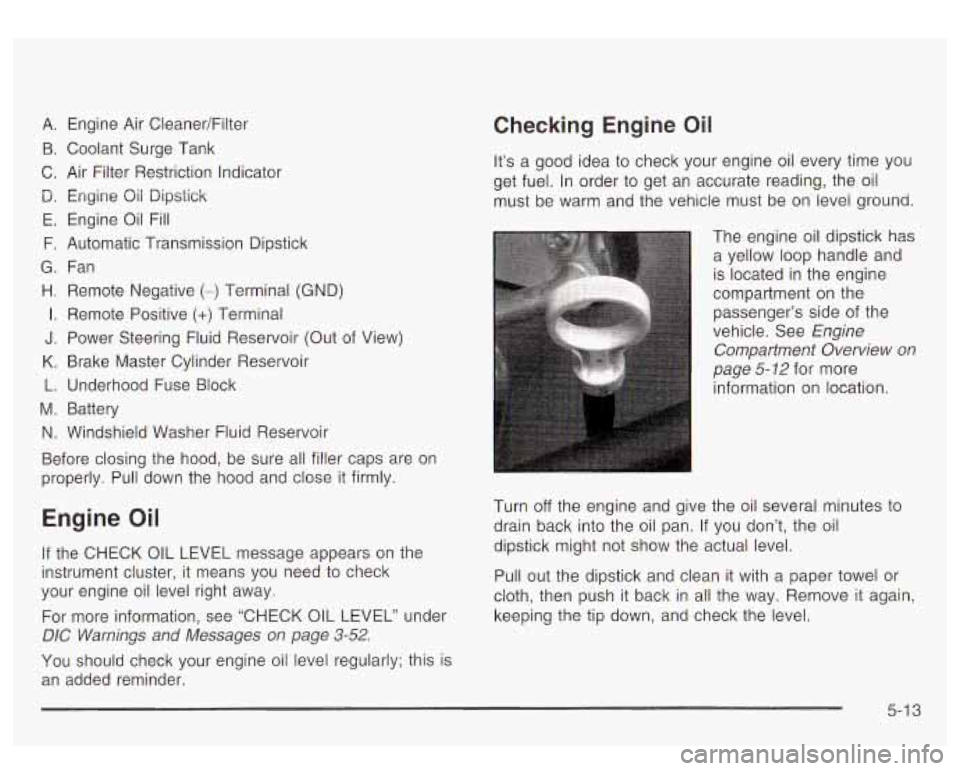
A. Engine Air CleanedFilter
B. Coolant Surge Tank
C. Air Filter Restriction Indicator
D. Engine Qii Dipstick
E. Engine Oil Fill
F. Automatic Transmission Dipstick
G. Fan
H. Remote Negative (-) Terminal (GND)
I. Remote Positive (+) Terminal
J. Power Steering Fluid Reservoir (Out of View)
K. Brake Master Cylinder Reservoir
L. Underhood Fuse Block
M. Battery
N. Windshield Washer Fluid Reservoir
Before closing the hood, be sure all filler caps are on
properly. Pull down the hood and close
it firmly.
Engine Oil
If the CHECK OIL LEVEL message appears on the
instrument cluster, it means you need to check
your engine oil level right away.
For more information, see “CHECK OIL LEVEL” under
DIC Warnings and Messages on page 3-52.
You should check your engine oil level regularly; this is
an added reminder.
Checking Engine Oil
It’s a good idea to check your engine oil every time you
get fuel. In order to get an accurate reading, the oil
must be warm and the vehicle must be on level ground.
The engine oil dipstick has a yellow loop handle and
is located in the engine
compartment on the
passenger’s side of the
vehicle. See Engine
Compartment Overview on
page
5- 12 for more
information on location.
Turn
off the engine and give the oil several minutes to
drain back into the oil pan. If you don’t, the oil
dipstick might not show the actual level.
Pull out the dipstick and clean it with a paper towel or
cloth, then push it back in all the way. Remove it again,
keeping the tip down, and check the level.
5-1 3