battery GMC YUKON DENALI 2003 Owner's Manual
[x] Cancel search | Manufacturer: GMC, Model Year: 2003, Model line: YUKON DENALI, Model: GMC YUKON DENALI 2003Pages: 447, PDF Size: 21.97 MB
Page 328 of 447

Brake Pedal Travel Battery
See your dealer if the brake pedal does not return to
normal height, or
if there is a rapid increase in
pedal travel. This could be a sign of brake trouble.
Brake Adjustment
Every time you make a brake stop, your disc brakes
adjust for wear.
Replacing Brake System Parts
The braking system on a vehicle is complex. Its many
parts have to be
of top quality and work well together if
the vehicle is to have really good braking. Your
vehicle was designed and tested with top-quality
GM
brake parts. When you replace parts of your braking
system
- for example, when your brake linings
wear down and you need new ones put in
- be sure
you get new approved
GM replacement parts. If
you don’t, your brakes may no longer work properly. For
example,
if someone puts in brake linings that are
wrong for your vehicle, the balance between your front
and rear brakes can change
- for the worse. The
braking performance you’ve come to expect can change
in many other ways
if someone puts in the wrong
replacement brake parts. Your
new vehicle comes with a maintenance free
ACDelco@ battery. When it’s time for a new battery, get
one that has the replacement number shown on the
original battery’s label. We recommend an ACDelco@
battery. See Engine Compartment Overview
on
page 5-72 for battery location.
Warning: Battery posts, terminals and related
accessories contain lead and lead compounds,
chemicals known to the State of California to cause
cancer and reproductive harm. Wash hands after
handling.
Vehicle Storage
If you’re not going to drive your vehicle for 25 days or
more, remove the black, negative
(-) cable from
+‘-? battery. This will hc’- keep your battery from
Batteries have acid that can burn you and gas
that can explode. You can be badly hurt if you
aren’t careful. See “Jump Starting” next for
tips on working around a battery without
getting hurt.
5-39
Page 329 of 447
Contact your dealer to learn how to prepare your
vehicle for longer storage periods.
Also, for your audio system, see Theft-Deterrent
Feature
on page 3-85.
Jump Starting
If your battery has run down, you may want to use
another vehicle and some jumper cables to start your
vehicle. But please use the following steps to do it
safely.
Notice: Ignoring these steps could result in costly
damage to your vehicle that wouldn’t be covered
by your warranty.
Trying to start your vehicle by pushing or pulling
it
won’t work, and it could damage your vehicle.
1. Check the other vehicle. It must have a 12-volt
battery with a negative ground system.
Batteries can hurt you. They can be dangerous
because:
They contain acid that can burn you.
They contain gas that can explode or
They contain enough electricity to burn ignite.
you.
If you don’t follow these steps exactly, some
or all of these things can hurt you.
5-40
Page 330 of 447
Notice: If the other system isn’t a 12-volt system
with a negative ground, both vehicles can be
damaged.
2.
Get the vehicles close enough so the jumper cables
can reach, but be sure the vehicles aren’t touching
each other.
If they are, it could cause a ground
connection you don’t want. You wouldn’t be able
to
start your vehicle, and the bad grounding could
damage the electrical systems.
To avoid the possibility of the vehicles rolling, set
the parking brake firmly on both vehicles involved in
the jump start procedure. Put an automatic
transmission in PARK (P) or a manual transmission
in NEUTRAL before setting the parking brake.
Notice: If you leave your radio on, it could be badly
damaged. The repairs wouldn’t be covered by
your warranty.
3. Turn off the ignition on both vehicles. Unplug
unnecessary accessories plugged into the cigarette
lighter or accessory power outlets. Turn
off the
radio and all lamps that aren’t needed. This
will avoid sparks and help save both batteries.
And it could save your radio!
4. Open the hoods and locate the positive (+) and
negative
(-) terminal locations of the other vehicle.
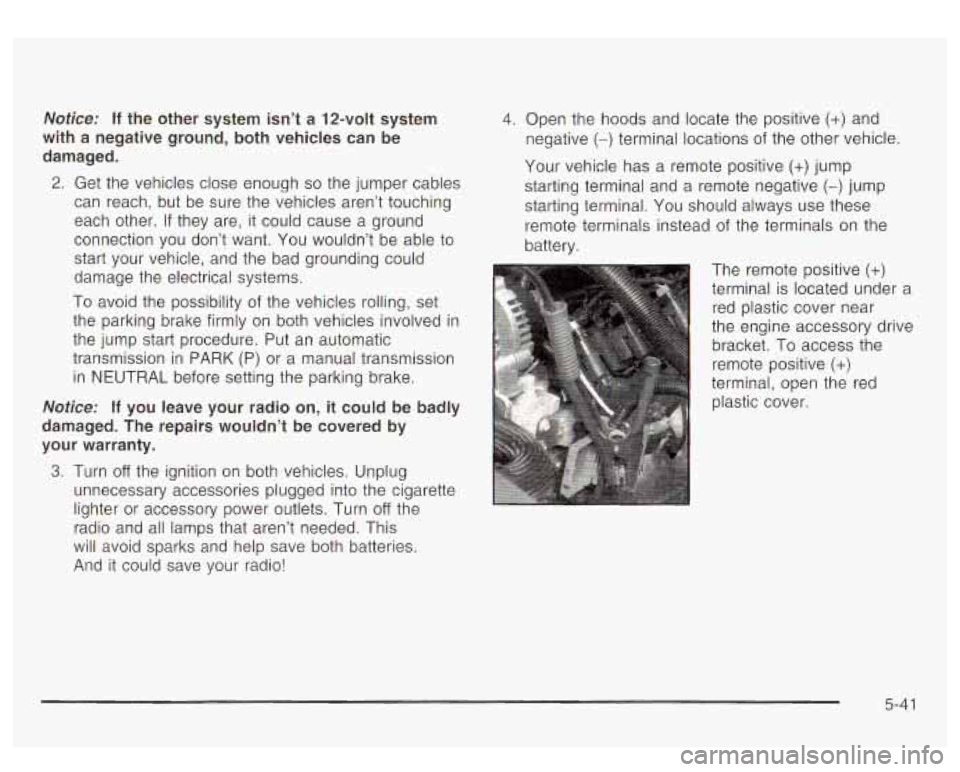
Your vehicle has a remote positive
(+) jump
starting terminal and a remote negative
(-) jump
starting terminal.
You should always use these
remote terminals instead
of the terminals on the
battery.
The remote positive
(+)
terminal is located under a red plastic cover near
the engine accessory drive
bracket.
To access the
remote positive
(+)
terminal, open the red
plastic cover.
5-41
Page 331 of 447
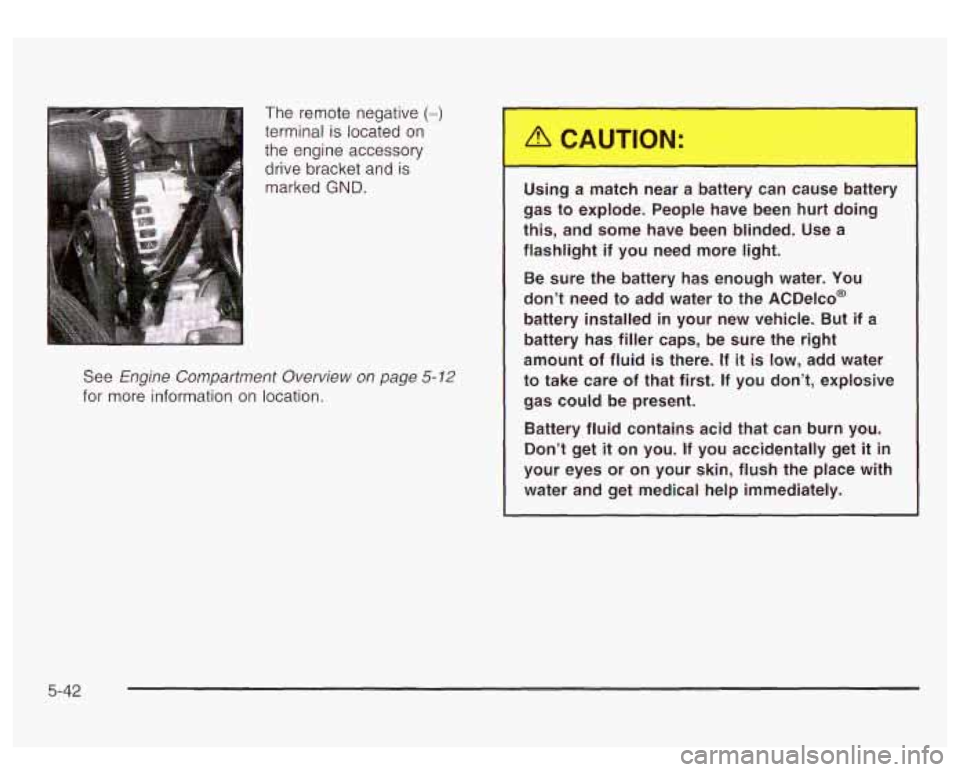
The remote negative (-)
terminal is located on
the engine accessory
drive bracket and
is
marked GND.
See Engine Compartment Overview on page 5-12
for more information on location. Using a match
near
a battery can cause battery
gas to explode. People have been hurt doing
this, and some have been blinded. Use a
flashlight
if you need more light.
Be sure the battery has enough water. You
don’t need to add water to the ACDelco@
battery installed in your new vehicle. But
if a
battery has filler caps, be sure the right
amount of fluid is there.
If it is low, add water
to take care of that first. If you don’t, explosive
gas could be present.
Battery fluid contains acid that can burn you.
Don’t get
it on you. If you accidentally get it in
your eyes or on your skin, flush the place with
water and get medical help immediately.
J
5-42
Page 332 of 447

5. Check that the jumper cables don’t have loose or
missing insulation. If they do, you could get a
shock. The vehicles could be damaged too.
Before you connect the cables, here are some
basic things you should know. Positive
(+) will go to
positive (+) or to a remote positive terminal (+) if
the vehicle has one. Negative (-) will go to a heavy,
unpainted metal engine part or
to a remote
negative
(-) terminal, if the vehicle has one.
Don’t connect positive
(+) to negative (-) or you’ll
get a short that would damage the battery and
maybe other parts
too.
Fans or other moving engine parts can injure
you badly. Keep your hands away from moving
parts once the engine is running.
6. Connect the red
positive
(+) cable to the
positive
(+) terminal of the
dead battery. Use a
remote positive
(+)
terminal if the vehicle
has one.
7. Don’t let the other end
touch metal. Connect it
to the positive
(+)
terminal of the good
battery. Use a remote positive
(+) terminal
if the vehicle has one
5-43
Page 333 of 447
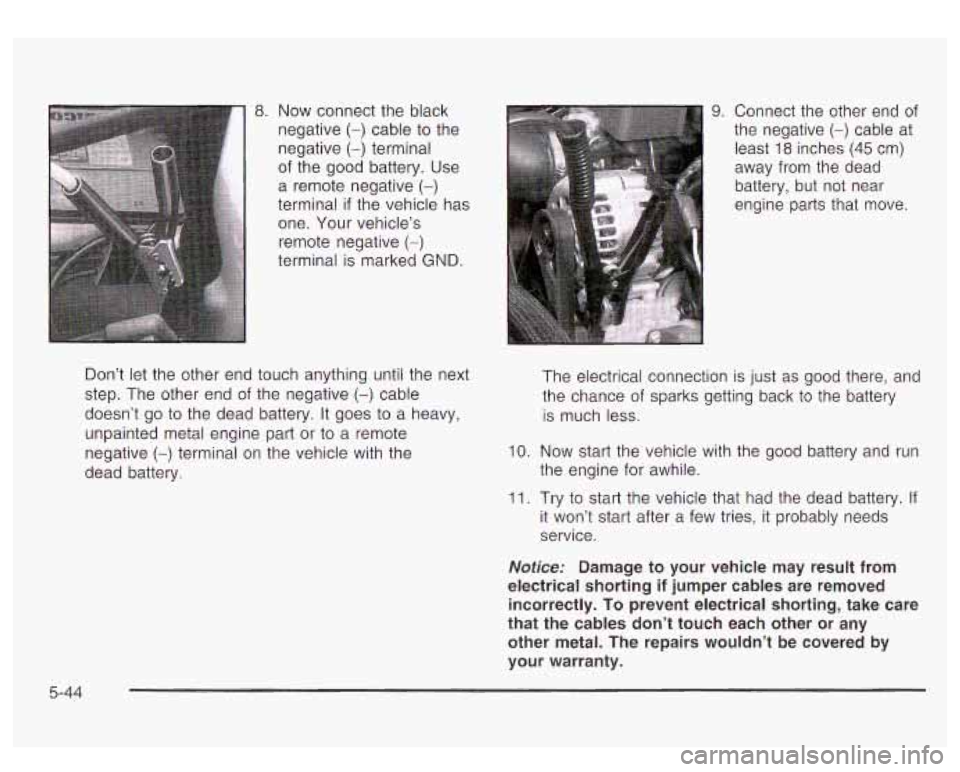
8. Now connect the black
negative
(-) cable to the
negative
(-) terminal
of the good battery. Use
a remote negative
(-)
terminal if the vehicle has
one. Your vehicle’s
remote negative
(-)
terminal is marked GND.
Don’t let the other end touch anything until the next
step. The other end of the negative
(-) cable
doesn’t go to the dead battery.
It goes to a heavy,
unpainted metal engine part or
to a remote
negative
(-) terminal on the vehicle with the
dead battery.
9. Connect the other end of
the negative (-) cable at
least
18 inches (45 cm)
away from the dead
battery, but not near
engine parts that move.
The electrical connection is just as good there, and
the chance of sparks getting back
to the battery
is much less.
10. Now start the vehicle with the good battery and run
the engine for awhile.
11. Try to start the vehicle that had the dead battery. If
it won’t start after a few tries, it probably needs
service.
Notice: Damage to your vehicle may result from
electrical shorting if jumper cables are removed
incorrectly.
To prevent electrical shorting, take care
that the cables don’t touch each other or any
other metal. The repairs wouldn’t be covered by
your warranty.
5-44
Page 334 of 447
A a
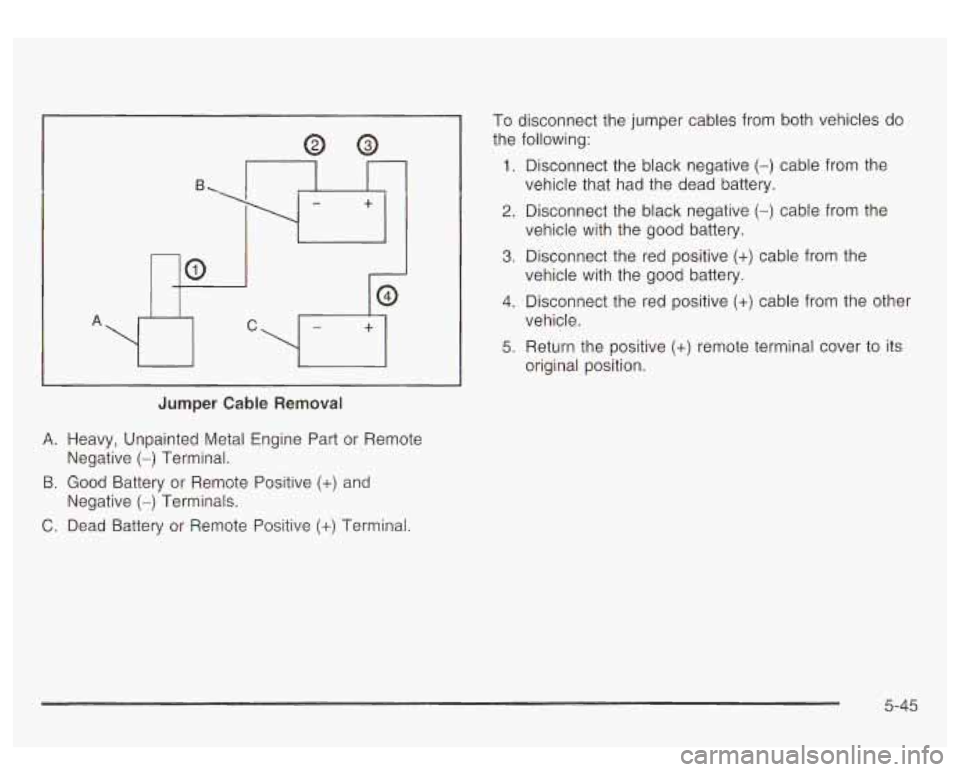
Jumper Cable Removal
A. Heavy, Unpainted Metal Engine Part or Remote
B. Good Battery or Remote Positive
(+) and
C. Dead Battery or Remote Positive (+) Terminal.
Negative
(-) Terminal.
Negative
(-) Terminals.
To disconnect the jumper cables from both vehicles do
the following:
1. Disconnect the black negative (-) cable from the
vehicle that had the dead battery.
2. Disconnect the black negative (-) cable from the
3. Disconnect the red positive (+) cable from the
4. Disconnect the red positive (+) cable from the other
5. Return the positive (+) remote terminal cover to its
vehicle
with the good battery.
vehicle with the good battery.
vehicle. original position.
5-45
Page 380 of 447
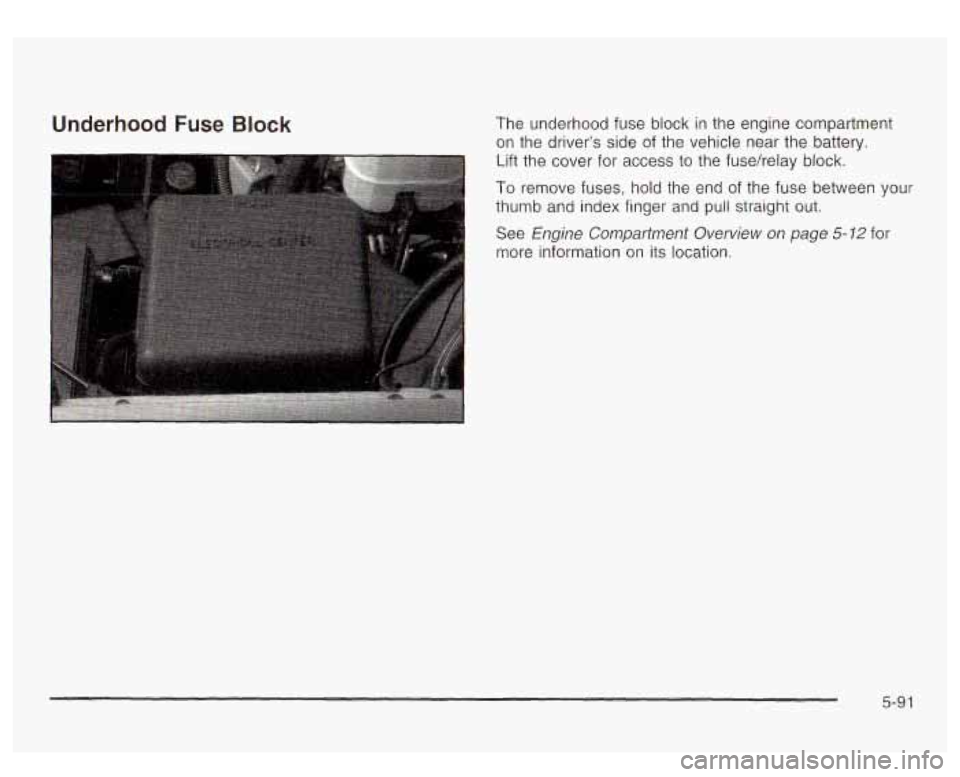
Underhood Fuse Block The underhood fuse block in the engine compartment
on the driver’s side
of the vehicle near the battery.
Lift the cover for access to the fuse/relay block.
To remove fuses, hold the end of the fuse between your
thumb and index finger and puli straight out.
See Engine Compartment Overview on page
5-12 for
more information on
its location.
5-91
Page 382 of 447
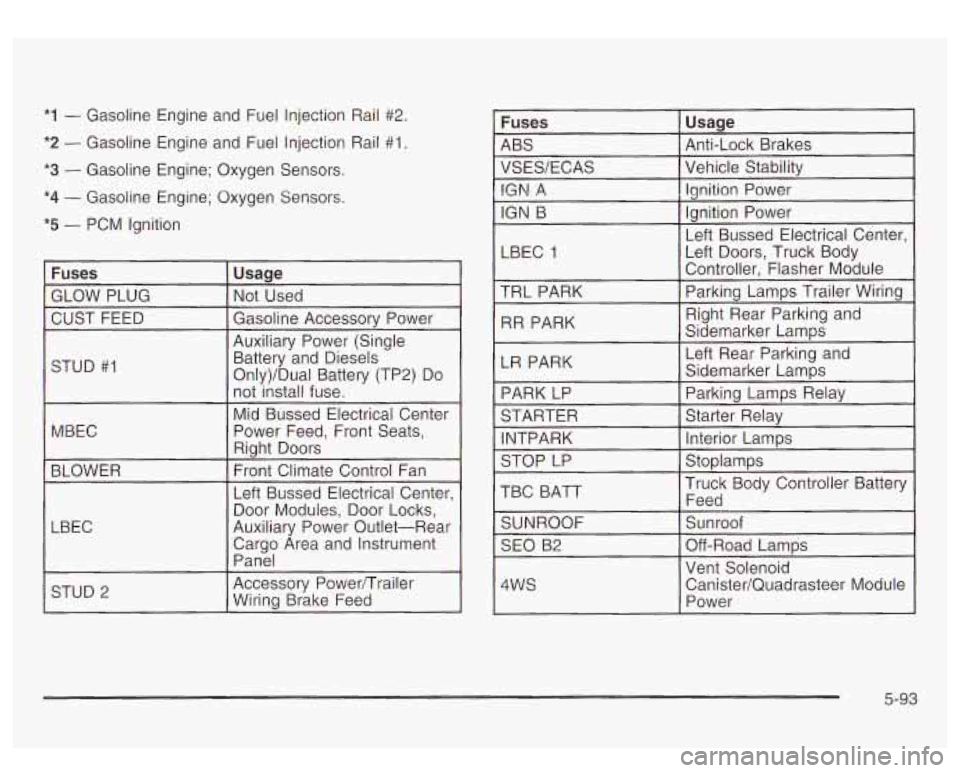
*I - Gasoline Engine and Fuel Injection Rail #2.
*2 - Gasoline Engine and Fuel Injection Rail #l.
*3 - Gasoline Engine; Oxygen Sensors.
*4 - Gasoline Engine; Oxygen Sensors.
*5 - PCM Ignition
I Fuses I Usage I
I STUD #1 I
Battery-and Diesels
Only)/Dual Battery (TP2) Do
not -install fuse.
Mid Bussed Electrical Center
MBEC Power
Feed, Front Seats,
LBEC Door Modules, Door Locks,
Auxiliary Power Outlet-Rear
Cargo Area and Instrument
Panel
STUD 2 Accessory
Powerflrailer
Wirinq Brake Feed LBEC
1
~~
I RR PARK I
Right
Rear Parking and
Sidemarker LamDs
I
5-93
Page 412 of 447
GM Mobility Program for Persons
with Disabilities
This program, avaiiabie io
qualified applicants, can
reimburse you up
to
$1,000 toward aftermarket
driver or passenger
adaptive equipment you
may require for your
vehicle (hand controls,
wheelchair/scooter lifts, etc.).
I I
This program can also provide you with free resource
information, such as area driver assessment centers and
mobility equipment installers. The program is available
for a limited period of time from the date of vehicle
purchase/lease. See your dealer for more details or call
the GM Mobility Assistance Center at 1-800-323-9935.
Text telephone (TTY) users, call 1-800-833-9935.
GM of Canada also has a Mobility Program. Call
1-800-GM-DRIVE (463-7483) for details.
All TTY users
call 1-800-263-3830.
Roadside Assistance Program
GMC’s Roadside Assistance Provides stranded owners
with over-the-phone roadside repairs, location of the
nearest
GhlC dealer or the following special services:
Flat Tire Change: Installation of spare tire will be
covered at no charge (customer is responsible for repair
or replacement of tire).
Fuel Delivery: Delivery of enough fuel for the customer
to get to the nearest service station (up to $5.00)
will be covered.
Jump Start: No-start situations which require a battery
jump start will be covered at no charge.
Lock Out: Replacement keys or locksmith service will be
covered at no charge
if you are unable to gain entry
into your vehicle. Delivery of the replacement key will be
covered within
10 miles (16 km).
Emergency Towing Service: Towing
to the nearest GMC
dealer for warranty related disablements will be
covered.
Trip Routing: Custom-made, computerized highlighted
maps using the most direct or scenic route are provided
free of charge. Maps include points of interest and a
list of GMC dealers along the route. Also included is a
list of hotels along the route that are discounted
7-5