fuel cap GMC YUKON DENALI 2003 User Guide
[x] Cancel search | Manufacturer: GMC, Model Year: 2003, Model line: YUKON DENALI, Model: GMC YUKON DENALI 2003Pages: 447, PDF Size: 21.97 MB
Page 322 of 447
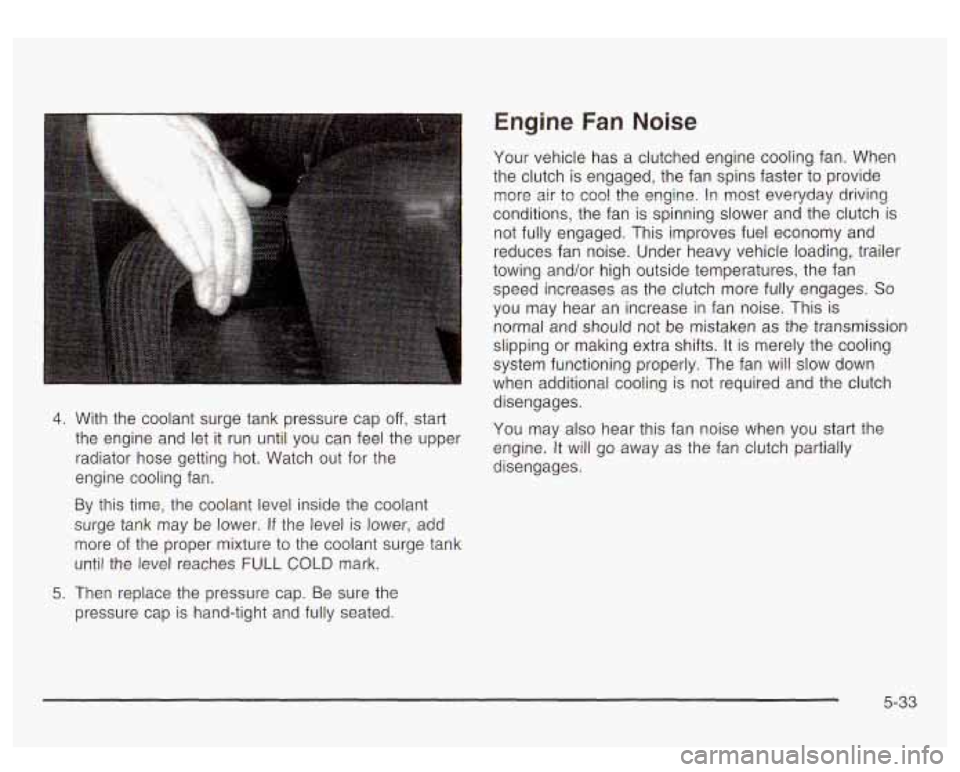
4. With the coolant surge tank pressure cap off, start
the engine and let it run until you can feel the upper
radiator hose getting hot. Watch out for the
engine cooling fan.
By this time, the coolant level inside the coolant
surge tank may be lower. If the level
is lower, add
more of the proper mixture to the coolant surge tank
until the level reaches
FULL COLD mark.
5. Then replace the pressure cap. Be sure the
pressure cap is hand-tight and fully seated.
Engine Fan Noise
Your vehicle has a clutched engine cooling fan. When
the clutch
is engaged, the fan spins faster to provide
more air
tu cool the engine. In most everyday driving
conditions, the fan is spinning slower and the clutch is
not fully engaged. This improves fuel economy and
reduces fan noise. Under heavy vehicle loading, trailer
towing and/or high outside temperatures, the fan
speed increases as the clutch more fully engages.
So
you may hear an increase in fan noise. This is
normal and should not be mistaken as the transmission
slipping or making extra shifts. It is merely the cooling
system functioning properly. The fan will slow down
when additional cooling is not required and the clutch
disengages.
You may also hear this fan noise when you start the
engine.
It will go away as the fan clutch partially
disengages.
5-33
Page 345 of 447
Notice: Don’t let anyone tell you that underinflation
or overinflation is all right. It’s not. If your tires
don’t have enough air (underinflation), you can get
the following:
Too much flexing
Too much heat
0 Tire overloading
Bad wear
Bad handling
Bad fuel economy
If your tires have too much air (overinflation), you
can get the following:
Unusual wear
Bad handling
Rough ride
Needless damage from road hazards
When to Check
Check your tires once a month or more.
Also, check the tire pressure of the spare tire
How to Check
Use a good quality pocket-type gage to check tire
pressure. You can’t tell
if your tires are properly inflated
simply by looking at them. Radial tires may look
properly inflated even when they’re underinflated.
Be sure to put the valve caps back on the valve stems.
They help prevent leaks by keeping out dirt and
moisture.
Tire Inspection and Rotation
Tires should be rotated every 7,500 miles (12,500 km).
Any time you notice unusual wear, rotate your tires
as soon as possible and check wheel alignment.
Also
check for damaged tires or wheels. See When It Is Time
for New Tires on page
5-58 and Wheel Replacement
on page
5-61 for more information.
Make sure the spare tire is stored securely. Push, pull,
and then try to rotate or turn the tire. If
it moves,
use the wheel wrench and jack handle extensions
to
tighten the cable. See Changing a Flat Tire on
page 5-63.
The purpose of regular rotation is to achieve more
uniform wear for all tires on the vehicle.
The first rotation
is the most important. See “Part
A: Scheduled
Maintenance Services,” in Section
6, for scheduled
rotation intervals.
5-56
Page 385 of 447
Capacities and Specifications
Please refer to Part D: Recommended Fluids and Lubricants on page 6-15 for more information.
All capacities are approximate.
Engine Specifications
Engine VIN Code 1 Spark Pluq GaD - I t -
VORTECTM 6000 V8 U I 0.060 inches (1.52 mm)
Capacities and Specifications
Capacities
Application Metric
English
After refill, the level must be rechecked. See Cooling System on page 5-28.
Cooling System 19.0 quarts 18.0 L
After refill, the level must be rechecked. Add enough engine oil so that the fluid is within the proper operating
range. See Engine Oil on page
5-13.
Engine Oil with Filter
Fuel Tank
5.7 L 6.0 quarts
Yukon Denali
Yukon
XL Denali
26.0 gallons
31 .O gallons
98.0 L
117.0 L
5-96
Page 401 of 447
Part C: Periodic Maintenance
Inspections
Listed in this part are inspections and services which
should be performed at least twice a year (for instance,
each spring and fall).
You should let your dealer’s
service department or other qualified service center do
these jobs. Make sure any necessary repairs are
completed at once.
Proper procedures
to perform these services may be
found in a service manual. See Service Publications
Ordering Information on page
7- IO.
Steering and Suspension Inspection
Inspect the front and rear suspension and steering
system for damaged, loose or missing parts, signs of
wear or lack of lubrication. Inspect the power steering
lines and hoses for proper hook-up, binding, leaks,
cracks, chafing, etc.
Exhaust System Inspection
Inspect the complete exhaust system. Inspect the body
near the exhaust system. Look for broken, damaged,
missing or out-of-position parts as well as open seams,
holes, loose connections or other conditions which
could cause a heat build-up in the floor pan or could let
exhaust fumes into the vehicle. See Engine Exhaust
on page 2-29.
Fuel System Inspection
Engine Cooling System Inspection
Inspect the complete fuel system for damage or leaks.
Inspect the hoses and have them replaced
if they
are cracked, swollen or deteriorated. Inspect all pipes,
fittings and clamps; replace as needed. Clean the
outside of the radiator and air conditioning condenser.
To help ensure proper operation, a pressure test of
the cooling system and pressure cap is recommended
at least once a year.
Transfer Case and Front Axle
(All-Wheel Drive) Inspection
Every 12 months, or at engine oil change intervals,
check front axle and transfer case and add lubricant
when necessary.
A fluid loss could indicate a problem.
Check and have it repaired,
if needed. Check vent
hose at transfer case for kinks and proper installation.
Brake System Inspection
Inspect the complete system. Inspect brake lines and
hoses for proper hook-up, binding, leaks, cracks,
chafing, etc. Inspect disc brake pads for wear and rotors
for surface condition. Inspect other brake parts,
including calipers, parking brake, etc. You may need
to
have your brakes inspected more often if your driving
habits or conditions result in frequent braking.
6-1 4
Page 426 of 447
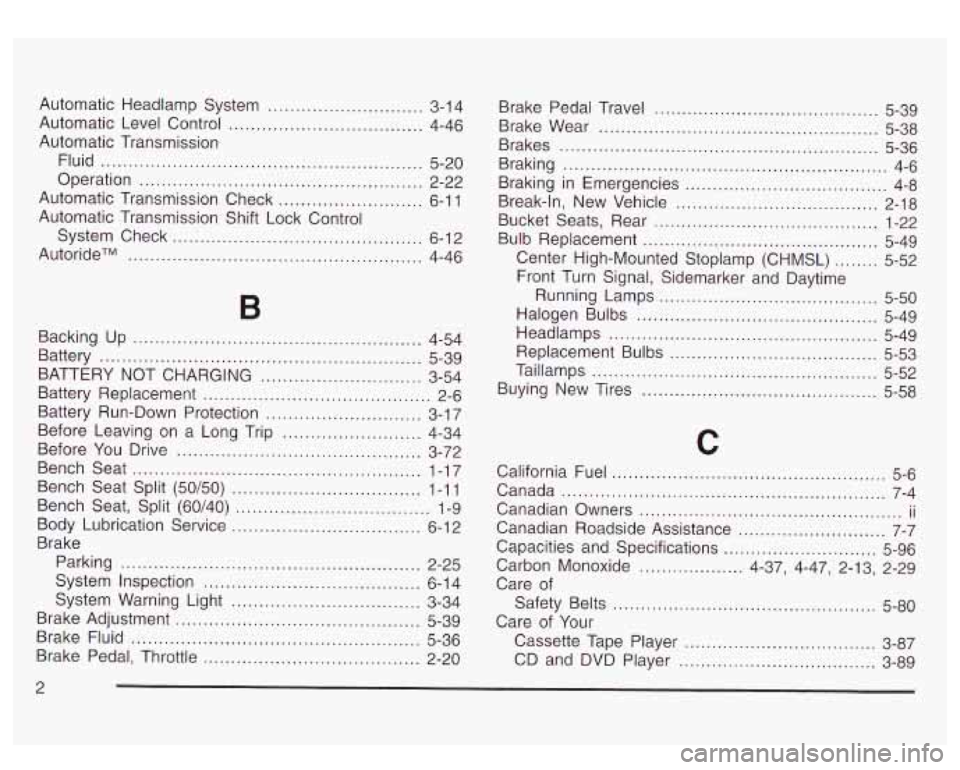
Automatic Headlamp System ............................ 3-1 4
Automatic Level Control
................................... 4-46
Automatic Transmission Fluid
.......................................................... 5-20
Operation
................................................... 2-22
Automatic Transmission Check
.......................... 6-1 1
Automatic Transmission Shift Lock Control
System Check
............................................. 6-12
AutorideTM
................................................. 4-46
B
Backing Up .................................................... 4-54
Battery
.......................................................... 5-39
Battery Replacement
......................................... 2-6
Battery Run-Down Protection
............................ 3-1 7
Before You Drive
............................................ 3-72
Bench Seat
.................................................... 1-17
Bench Seat Split (50/50)
.................................. 1-1 1
Bench Seat, Split (60/40)
................................... 1-9
Body Lubrication Service
.................................. 6-12
Brake
Parking
...................................................... 2-25
System Inspection
....................................... 6-1 4
BATTERY NOT
CHARGING
............................. 3-54
Before Leaving on a Long Trip
......................... 4-34
System Warning Light
.................................. 3-34
Brake
Brake
Brake
2 Adjustment
............................................ 5-39
Fluid
.................................................... 5-36
Pedal. Throttle
....................................... 2-20 Brake Pedal Travel
......................................... 5-39
Brake Wear
................................................... 5-38
Brakes
.......................................................... 5-36
Braking
........................................................... 4-6
Braking in Emergencies
..................................... 4-8
Break-in, New Vehicle
..................................... 2-18
Bucket Seats, Rear
......................................... 1-22
Bulb Replacement
........................................... 5-49
Center High-Mounted Stoplamp (CHMSL)
........ 5-52
Front Turn Signal, Sidemarker and Daytime
Halogen Bulbs
............................................ 5-49
Headlamps
................................................. 5-49
Replacement Bulbs
...................... ........ 5-53
Taillamps
........................................ .... 5-52
Buying New Tires
....................................... 5-58
Running Lamps
........................................ 5-50
C
California Fuel ................................. .......... 5-6
Canada
........................................................... 7-4
Canadian Owners
................................................ ii
Canadian Roadside Assistance ........................... 7-7
Capacities and Specifications ............................ 5-96
Carbon Monoxide
................... 4-37, 4-47, 2.13, 2-29
Care
of
Safety Belts ............................. .... 5-80
Care
of Your
Cassette Tape Player
............................... 3-87
CD and DVD Player .................................... 3-89