steering wheel GMC YUKON DENALI 2003 Owner's Manual
[x] Cancel search | Manufacturer: GMC, Model Year: 2003, Model line: YUKON DENALI, Model: GMC YUKON DENALI 2003Pages: 447, PDF Size: 21.97 MB
Page 260 of 447

Driving in Water
Heavy rain can mean flash flooding, and flood waters
demand extreme caution.
Find out how deep the water
is before you drive through
it. If it’s deep enough to cover your wheel hubs, axles
or exhaust pipe, don’t try
it - you probably won’t
get through. Also, water that deep can damage your
axle and other vehicle parts.
If the water isn’t too deep, drive slowly through it. At
faster speeds, water splashes on your ignition system
and your vehicle can stall. Stalling can also occur
if you
get your tailpipe under water. And, as long as your
tailpipe is under water, you’ll never be able to start your
engine. When you go through water, remember that
when your brakes get wet, it may take you longer
to stop.
I
- - - - -ng through rushing water can be
dangerous. Deep water can sweep your vehicle
downstream and you and your passengers
i could drown. If it’s only shallow water, it can
still wash away the ground from under your
tires, and you could lose traction and roll the
vehicle over. Don’t drive through rushing water.
I I
See Driving in Rain and on Wet Roads on page 4-29 for
more information on driving through water.
After Off-Road Driving
Remove any brush or debris that has collected on the
underbody, chassis or under the hood. These
accumulations can be a fire hazard.
After operation in mud or sand, have the brake linings
cleaned and checked. These substances can cause
glazing and uneven braking. Check the body structure,
steering, suspension, wheels, tires and exhaust
system for damage.
Also, check the fuel lines and
cooling system for any leakage.
Your vehicle will require more frequent service due to
off-road use. Refer
to the Maintenance Schedule
for additional information.
4-27
Page 271 of 447
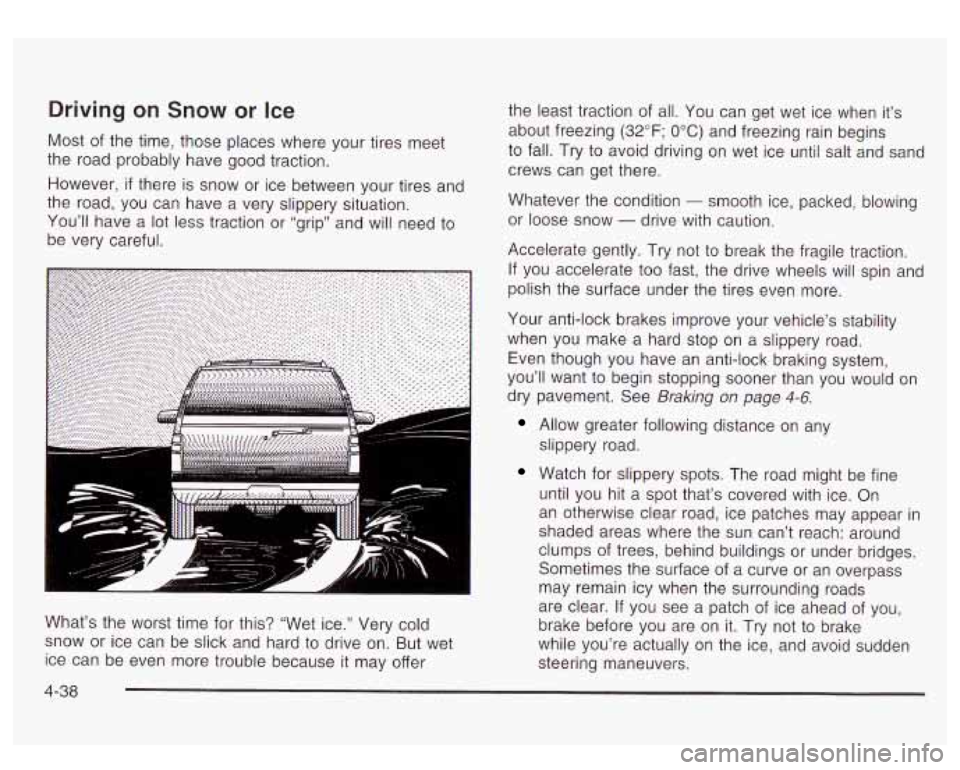
Driving on Snow or Ice
Most of the time, those places where your tires meet
the road probably have good traction.
However,
if there is snow or ice between your tires and
the road, you can have a very slippery situation.
You’ll have a
lot less traction or “grip” and will need to
be very careful.
27
3
What’s the worst time for this? “Wet ice.” Very cold
snow or ice can be slick and hard
to drive on. But wet
ice can be even more trouble because it may offer
4-38
the least traction of all. You can get wet ice when it’s
about freezing
(32°F; OOC) and freezing rain begins
to fall. Try to avoid driving on wet ice until salt and sand
crews can get there.
Whatever the condition
- smooth ice, packed, blowing
or loose snow
- drive with caution.
Accelerate gently. Try not to break the fragile traction.
If you accelerate
too fast, the drive wheels will spin and
polish the surface under the tires even more.
Your anti-lock brakes improve your vehicle’s stability
when you make a hard stop on a slippery road.
Even though you have an anti-lock braking system,
you’ll want to begin stopping sooner than you would on
dry pavement. See Braking on page
4-6.
Allow greater following distance on any
slippery road.
Watch for slippery spots. The road might be fine
until you hit a spot that’s covered with ice. On
an otherwise clear road, ice patches may appear in
shaded areas where the sun can’t reach: around
clumps of trees, behind buildings or under bridges.
Sometimes the surface of a curve or an overpass
may remain icy when the surrounding roads
are clear. If you see a patch of ice ahead of you,
brake before you are on it. Try not
to brake
while you’re actually on the ice, and avoid sudden
steering maneuvers.
Page 275 of 447
Rocking Your Vehicle To Get It Out
First, turn your steering wheel left and right. That will
clear the area around your front wheels. If your vehicle
has the Stabilitrak@System, turn the system off by
pressing the Stabilitrak@button
so that the STABILITY
SYS DISABLED message and the traction off light
are illuminated on the instrument panel cluster. Then
shift back and forth between REVERSE (R) and
a
forward gear, spinning the wheels as little as possible.
Release the accelerator pedal while you shift, and press
lightly on the accelerator pedal when the transmission
is in gear. By slowly spinning your wheels in the forward
and reverse directions, you will cause a rocking
motion that may free your vehicle.
If that doesn’t get
you out after a few tries, you may need to be towed out.
Or, you can use your recovery hooks
if your vehicle
has them. If you do need to be towed out, see Towing
Your Vehicle on page 4-44.
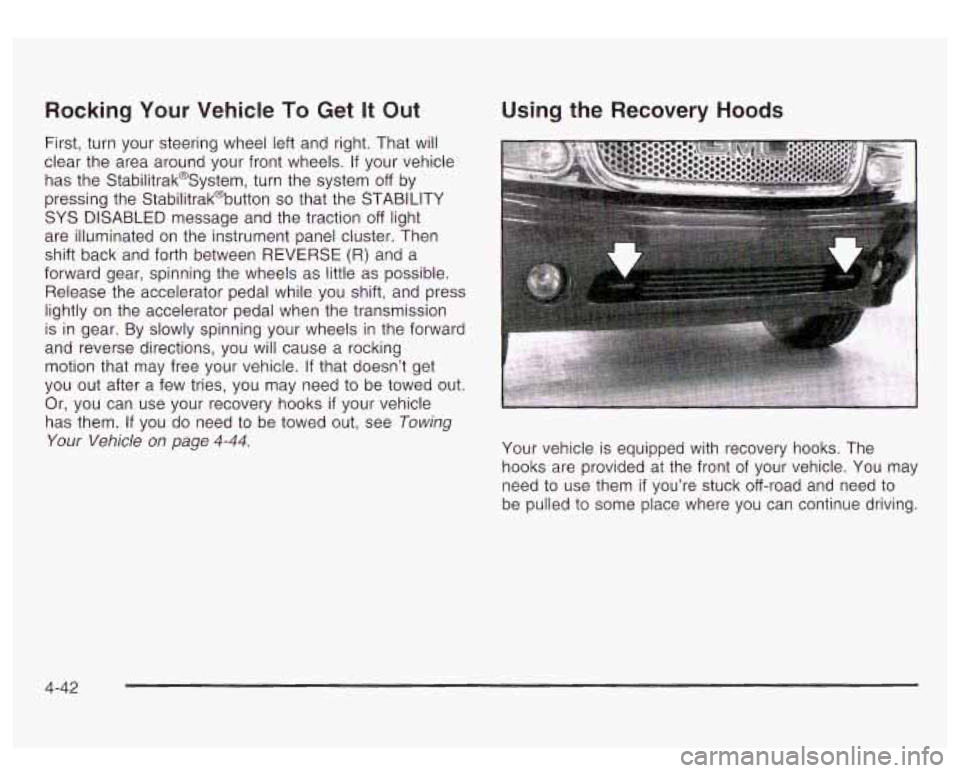
Using the Recovery Hoods
Your vehicle is equipped with recovery hooks. The
hooks are provided at the front
of your vehicle. You may
need to use them
if you’re stuck off-road and need to
be pulled to some place where you can continue driving.
4-42
Page 279 of 447
Automatic Level Control
The automatic level control rear suspension comes as a
part of the AutorideTMsuspension. See AutorideTM on
page
4-46.
This type of level control is fully automatic and will
provide a better leveled riding position as well as better
handling under a variety of passenger and loading
conditions. An air compressor connected
to the rear
shocks will raise or lower the rear of the vehicle
to maintain proper vehicle height. The system is
activated when the ignition key
is turned to RUN and
will automatically adjust vehicle height thereafter.
The system may exhaust (lower vehicle height) for up
to
10 minutes after the ignition key has been turned to
OFF. You may hear the air compressor operating when
the height is being adjusted.
If a weight-distributing hitch is being used, it is
recommended
to allow the shocks to inflate, thereby
leveling the vehicle prior to adjusting the height.
AutorideTM
The AutorideTM feature provides superior vehicle ride
and handling under a variety
of passenger and loading
conditions.
The system is fully automatic and
uses a computer
controller
to continuously monitor vehicle speed, wheel
to body position, IifVdive and steering position of the
vehicle. The controller then sends signals to each shock
absorber
to independently adjust the damping level to
provide the optimum vehicle ride.
AutorideTM also interacts with the towlhaul mode that,
when activated, will provide additional control of
the shock absorbers. This additional control results in
better ride and handling characteristics when the vehicle
is loaded or towing a trailer. See "Tow/Haul Mode"
under Towing a Trailer on page
4-47 for more
information.
4-46
Page 287 of 447
Backing Up
Hold the bottom of the steering wheel with one hand.
Then,
to move the trailer to the left, just move that hand
to the left. To move the trailer to the right, move your
hand
to the right. Always back up slowly and, if possible,
have someone guide you.
Making Turns
Notice: Making very sharp turns while trailering
could
cause the trailer to come in contact with the
vehicle. Your vehicle could
be damaged. Avoid
making very sharp turns while trailering.
When you’re turning with a trailer, make wider turns
than normal.
Do this so your trailer won’t strike
soft shoulders, curbs, road signs, trees or other objects.
Avoid jerky or sudden maneuvers. Signal well in
advance.
Turn Signals When Towing a Trailer
The arrows on your instrument panel will flash whenever
you signal a turn or lane change. Properly hooked up,
the trailer lamps will also flash, telling other drivers
you’re about
to turn, change lanes or stop.
When towing a trailer, the arrows on your instrument panel will flash for turns even
if the bulbs on the trailer
are burned out. Thus, you may think drivers behind
4-54
you are seeing your signal when they are not. It’s
important to check occasionally to be sure the trailer
bulbs are still working.
Driving On Grades
Reduce speed and shift to a lower gear before you start
down a long or steep downgrade.
If you don’t shift
down, you might have to use your brakes
so much that
they would get hot and no longer work well.
You can tow in
DRIVE (D). You may want to shift the
transmission
to THIRD (3) or, if necessary, a lower gear
selection
if the transmission shifts too often
(e.g., under heavy loads and/or hilly conditions).
You may also want
to activate the tow/haul mode if the
transmission shifts
too often. See “Tow/Haul Mode”
under Towing a Trailer
on page 4-47.
When towing at high altitude on steep uphill grades,
consider the following: Engine coolant will boil at a lower
temperature than at normal altitudes.
If you turn your
engine
off immediately after towing at high altitude
on steep uphill grades, your vehicle may show signs
similar
to engine overheating. To avoid this, let the
engine run while parked (preferably on level ground)
with the automatic transmission in PARK (P) for a
few minutes before turning the engine
off. If you do get
the overheat warning, see Engine Overheating
on
page 5-25.
Page 290 of 447
Section 5 Service and Appearance Care
Service ............................................................ 5.3
Doing Your Own Service Work
......................... 5-3
Adding Equipment
to the Outside of Your
Vehicle
.................................................. 5-4
................................................................ Fuel 5.5
Gasoline Octane ............................................ 5.5
Gasoline Specifications ................................... 5-5
California Fuel ............................................... 5-6
Additives
....................................................... 5.6
Fuels in Foreign Countries
............................... 5-6
Filling Your Tank
............................................ 5-7
Filling a Portable Fuel Container ....................... 5.9
the Hood .................... , .................... 5.10
Hood Release ...................... ................ 5-10
Engine Compartment Overview ....... ......... 5-12
Engine Oil ....................................... ..... 5.13
Engine Air Cleaner/Filter ............................. 5.17
Automatic Transmission Fluid ......................... 5-20
Engine Coolant ......................................... 5-22
Checking Things Under
~~
Coolant Surge Tank Pressure Cap ............... 5-25
Engine Overheating ....................................... 5-25
Cooling System ............................................ 5.28
Engine Fan Noise ......................................... 5.33
Power Steering Fluid
..................................... 5-34
Windshield Washer Fluid
................................ 5.34
Brakes
........................................................ 5.36
Battery
........................................................ 5-39
Jump Starting
............................................... 5.40
All-Wheel Drive .............................................. 5.46
Rear Axle .................................. .......... 5-48
Bulb Replacement .......................................... 5-49
Halogen Bulbs .............................................. 5-49
Headlamps
.................................................. 5-49
Running Lamps
......................................... 5-50
Center High-Mounted Stoplamp (CHMSL) ......... 5-52
Taillamps ..................................................... 5-52
Replacement Bulbs ................................... 5.53
Front Turn Signal, Sidemarker and Daytime
5- 1
Page 299 of 447
Checking Things Under
the
Hood
- .lings It burn can get c hot engine parts
and start a fire. These include liquids like fuel,
oil, coolant, brake fluid, windshield washer and
other fluids, and plastic or rubber.
You or
others could be burned. Be careful not to drop
or spill things that will burn onto
a hot engine.
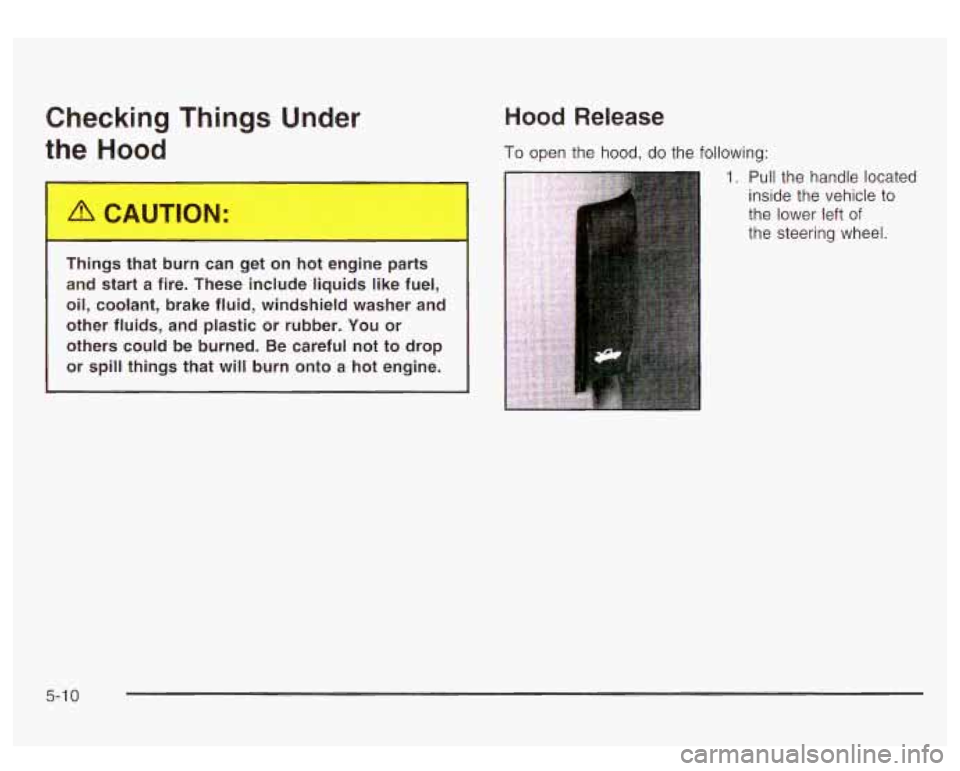
Hood Release
To open the hood, do the following:
1. Pull the handle located
inside the vehicle
to
the lower left of
the steering wheel.
5-1 0
Page 352 of 447
If a Tire Goes Flat
It’s unusual for a tire to “blowout” while you’re driving,
especially
if you maintain your tires properly. If air goes
out
of a tire, it’s much more likely to ieak out siowiy.
But if you should ever have a “blowout”, here are a few
tips about what
to expect and what to do:
If a front tire fails, the flat tire will create a drag that
pulls the vehicle toward that side. Take your foot
off the
accelerator pedal and grip the steering wheel firmly.
Steer to maintain lane position, and then gently brake
to
a stop well out of the traffic lane.
A rear blowout, particularly on a curve, acts much like a
skid and may require the same correction you’d use
in a skid.
In any rear blowout, remove your foot from the
accelerator pedal. Get the vehicle under control by
steering the way you want the vehicle
to go. It may be
very bumpy and noisy, but you can still steer. Gently
brake to a stop
- well off the road if possible.
If a tire goes flat, the next part shows how to use your
jacking equipment to change a flat tire safely.
Changing a Flat Tire
If a tire goes flat, avoid further tire and wheel damage
by driving slowly to a level place. Turn on your
hazard warning
fi hers.
Changing a tire can cause an injury. The
vehicle can slip
off the jack and roll over you
or other people. You and they could be badly injured. Find a level place to change your tire.
To help prevent the vehicle from moving:
1. Set the parking brake firmly.
2. Put the shift lever in PARK (P).
3. Turn off the engine.
4. Put the wheel blocks at the front and rear
of the tire farthest away from the one
being changed. That would be the tire on
the other side
of the vehicle, at the
opposite end.
5-63
Page 388 of 447
Section 6 Maintenance Schedule
Maintenance Schedule ...................................... 6.2
Introduction
................................................... 6.2
Your Vehicle and the Environment
.................... 6-2
Maintenance Requirements
.............................. 6.2
How This Section is Organized
......................... 6-3
Part A: Scheduled Maintenance Services
........... 6-4
Using Your Maintenance Schedule
.................... 6-4
Scheduled Maintenance
................................... 6-5
Part
B: Owner Checks and Sewices ................ 6-10
At Each Fuel Fill
.......................................... 6-10
At Least Once a Month
................................. 6-10
At Least Twice a Year
................................... 6-10
~~
At Least Once a Year ................................... 6.11
Part C: Periodic Maintenance Inspections
......... 6.14
Steering and Suspension Inspection
................ 6.14
Exhaust System Inspection
............................ 6.14
Fuel System Inspection
.................................. 6.14
Engine Cooling System Inspection
................... 6.14
Drive) Inspection
....................................... 6.14
Brake System Inspection
................................ 6.14
Part D: Recommended Fluids and Lubricants
.... 6.15
Part E: Maintenance Record
........................... 6.17
Transfer Case and Front
Axle (All-Wheel
6- 1
Page 401 of 447
Part C: Periodic Maintenance
Inspections
Listed in this part are inspections and services which
should be performed at least twice a year (for instance,
each spring and fall).
You should let your dealer’s
service department or other qualified service center do
these jobs. Make sure any necessary repairs are
completed at once.
Proper procedures
to perform these services may be
found in a service manual. See Service Publications
Ordering Information on page
7- IO.
Steering and Suspension Inspection
Inspect the front and rear suspension and steering
system for damaged, loose or missing parts, signs of
wear or lack of lubrication. Inspect the power steering
lines and hoses for proper hook-up, binding, leaks,
cracks, chafing, etc.
Exhaust System Inspection
Inspect the complete exhaust system. Inspect the body
near the exhaust system. Look for broken, damaged,
missing or out-of-position parts as well as open seams,
holes, loose connections or other conditions which
could cause a heat build-up in the floor pan or could let
exhaust fumes into the vehicle. See Engine Exhaust
on page 2-29.
Fuel System Inspection
Engine Cooling System Inspection
Inspect the complete fuel system for damage or leaks.
Inspect the hoses and have them replaced
if they
are cracked, swollen or deteriorated. Inspect all pipes,
fittings and clamps; replace as needed. Clean the
outside of the radiator and air conditioning condenser.
To help ensure proper operation, a pressure test of
the cooling system and pressure cap is recommended
at least once a year.
Transfer Case and Front Axle
(All-Wheel Drive) Inspection
Every 12 months, or at engine oil change intervals,
check front axle and transfer case and add lubricant
when necessary.
A fluid loss could indicate a problem.
Check and have it repaired,
if needed. Check vent
hose at transfer case for kinks and proper installation.
Brake System Inspection
Inspect the complete system. Inspect brake lines and
hoses for proper hook-up, binding, leaks, cracks,
chafing, etc. Inspect disc brake pads for wear and rotors
for surface condition. Inspect other brake parts,
including calipers, parking brake, etc. You may need
to
have your brakes inspected more often if your driving
habits or conditions result in frequent braking.
6-1 4