instrument panel GMC YUKON DENALI 2003 Owner's Guide
[x] Cancel search | Manufacturer: GMC, Model Year: 2003, Model line: YUKON DENALI, Model: GMC YUKON DENALI 2003Pages: 447, PDF Size: 21.97 MB
Page 186 of 447
Driver Information Center (DIC)
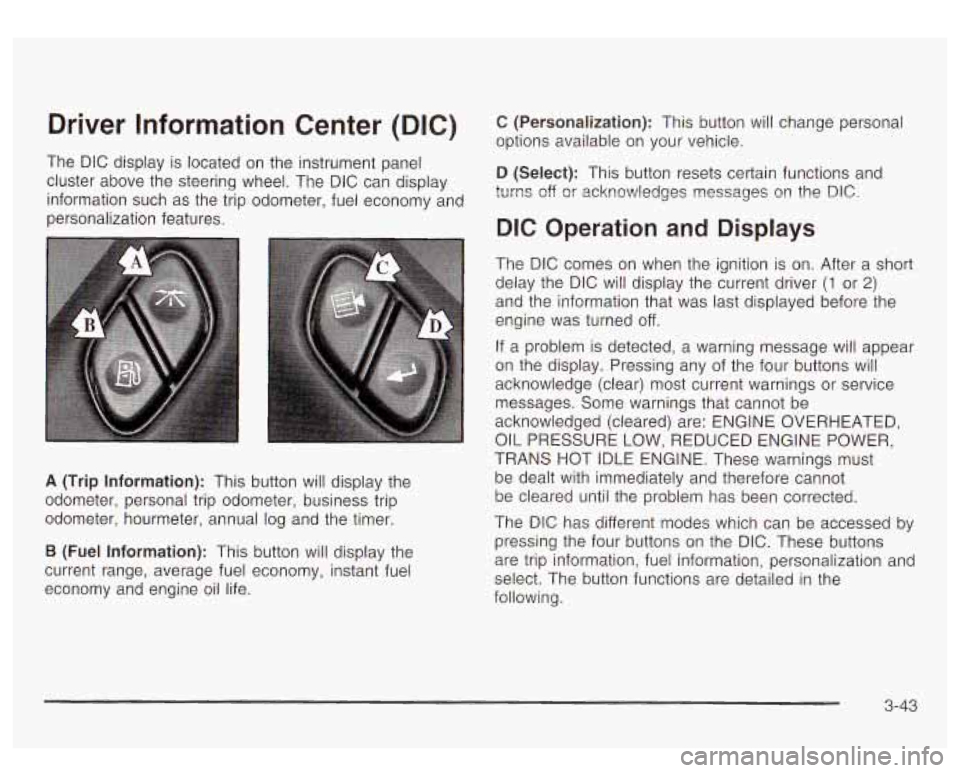
The DIC display is located on the instrument panel
cluster above the steering wheel. The DIC can display
information such as the trip odometer, fuel economy and
personalization features.
A (Trip Information): This button will display the
odometer, personal trip odometer, business trip
odometer, hourmeter, annual log and the timer.
B (Fuel Information): This button will display the
current range, average fuel economy, instant fuel
economy and engine oil life.
C (Personalization): This button will change personal
options available on your vehicle.
D (Select): This button resets certain functions and
turns off
or acknowledges nessages on the DIC.
DIC Operation and Displays
The DIC comes on when the ignition is on. After a short
delay the DIC will display the current driver
(1 or 2)
and the information that was last displayed before the
engine was turned off.
If a problem is detected, a warning message will appear
on the display. Pressing any of the four buttons will
acknowledge (clear) most current warnings or service
messages. Some warnings that cannot be
acknowledged (cleared) are: ENGINE OVERHEATED,
OIL PRESSURE LOW, REDUCED ENGINE POWER,
TRANS HOT IDLE ENGINE. These warnings must
be dealt with immediately and therefore cannot
be cleared until the problem has been corrected.
The DIC has different modes which can be accessed
by
pressing the four buttons on the DIC. These buttons
are trip information, fuel information, personalization and
select. The button functions are detailed in the
following.
3-43
Page 275 of 447
Rocking Your Vehicle To Get It Out
First, turn your steering wheel left and right. That will
clear the area around your front wheels. If your vehicle
has the Stabilitrak@System, turn the system off by
pressing the Stabilitrak@button
so that the STABILITY
SYS DISABLED message and the traction off light
are illuminated on the instrument panel cluster. Then
shift back and forth between REVERSE (R) and
a
forward gear, spinning the wheels as little as possible.
Release the accelerator pedal while you shift, and press
lightly on the accelerator pedal when the transmission
is in gear. By slowly spinning your wheels in the forward
and reverse directions, you will cause a rocking
motion that may free your vehicle.
If that doesn’t get
you out after a few tries, you may need to be towed out.
Or, you can use your recovery hooks
if your vehicle
has them. If you do need to be towed out, see Towing
Your Vehicle on page 4-44.
Using the Recovery Hoods
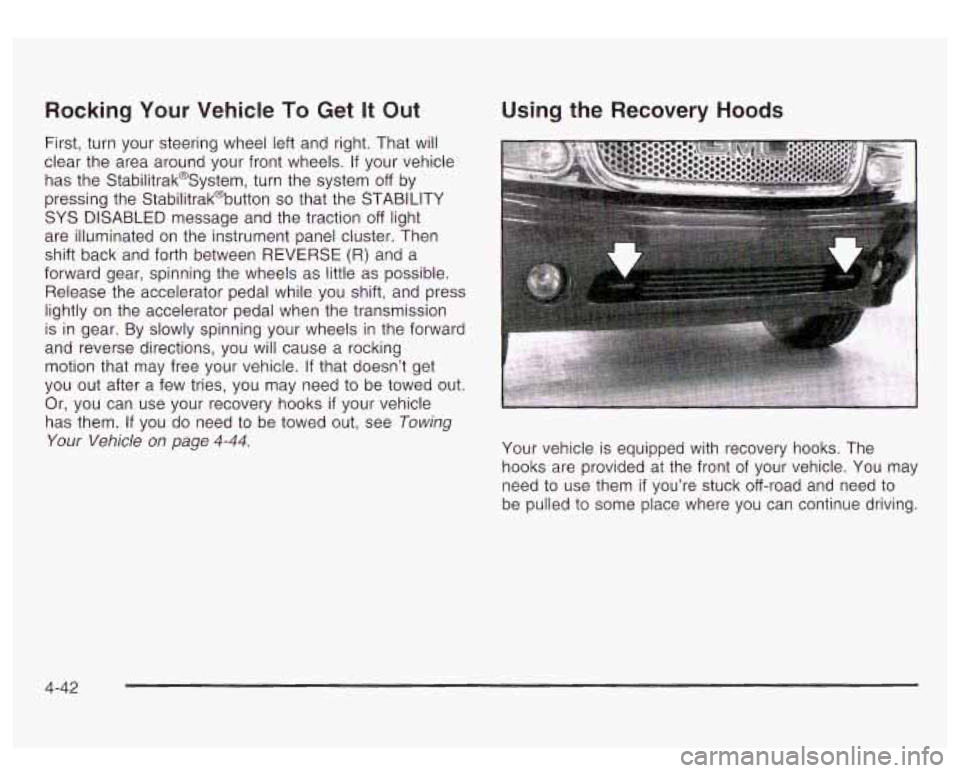
Your vehicle is equipped with recovery hooks. The
hooks are provided at the front
of your vehicle. You may
need to use them
if you’re stuck off-road and need to
be pulled to some place where you can continue driving.
4-42
Page 282 of 447
Tow/Haul Mode
The tow/haul feature assists when pulling a heavy trailer
or a large or heavy load. The purpose
of the tow/haul
mode
is to:
Reduce the frequency and improve the predictability
of transmission shifts when pulling a heavy trailer or
a large or heavy load.
Provide the same solid shift feel when pulling a
heavy trailer or a large or heavy load as when
the vehicle is unloaded.
Improve control of vehicle speed while requiring
less throttle pedal activity when pulling a heavy
trailer or a large or heavy load.
Your vehicle is provided with a button at the end of the
shift lever which when pressed enables tow/haul.
When the button is pressed, a light on the instrument
panel will illuminate
to indicate that tow/haul has
been selected. Tow/haul may be turned
off by pressing
the button again, at which time the indicator light on
the instrument panel will turn off. The vehicle will
automatically turn off tow/haul every time it is started. Tow/haul
is designed
to be most effective when the
vehicle and trailer combined weight is at least
75 percent
of the vehicle’s Gross Combination Weight Rating
(GCWR). See Weight
of the Trailer later in this section.
Tovdhaul is mcst useful wder the f~l!~~ing driving
conditions:
When pulling a heavy trailer or a large or heavy
0 When pulling a heavy trailer or a large or heavy
load through rolling terrain.
load
in stop and go traffic.
When pulling a heavy trailer or a large or heavy
load in busy parking
lots where improved low
speed control of the vehicle is desired.
Operating the vehicle in tow/haul when lightly loaded or
with no trailer at all will not cause damage. However,
there is no benefit
to the selection of tow/haul when the
vehicle is unloaded. Such a selection when unloaded may result in unpleasant engine and transmission driving
characteristics and reduced fuel economy. Tow/haul
is recommended only when pulling a heavy trailer or a
large or heavy load.
4-49
Page 287 of 447
Backing Up
Hold the bottom of the steering wheel with one hand.
Then,
to move the trailer to the left, just move that hand
to the left. To move the trailer to the right, move your
hand
to the right. Always back up slowly and, if possible,
have someone guide you.
Making Turns
Notice: Making very sharp turns while trailering
could
cause the trailer to come in contact with the
vehicle. Your vehicle could
be damaged. Avoid
making very sharp turns while trailering.
When you’re turning with a trailer, make wider turns
than normal.
Do this so your trailer won’t strike
soft shoulders, curbs, road signs, trees or other objects.
Avoid jerky or sudden maneuvers. Signal well in
advance.
Turn Signals When Towing a Trailer
The arrows on your instrument panel will flash whenever
you signal a turn or lane change. Properly hooked up,
the trailer lamps will also flash, telling other drivers
you’re about
to turn, change lanes or stop.
When towing a trailer, the arrows on your instrument panel will flash for turns even
if the bulbs on the trailer
are burned out. Thus, you may think drivers behind
4-54
you are seeing your signal when they are not. It’s
important to check occasionally to be sure the trailer
bulbs are still working.
Driving On Grades
Reduce speed and shift to a lower gear before you start
down a long or steep downgrade.
If you don’t shift
down, you might have to use your brakes
so much that
they would get hot and no longer work well.
You can tow in
DRIVE (D). You may want to shift the
transmission
to THIRD (3) or, if necessary, a lower gear
selection
if the transmission shifts too often
(e.g., under heavy loads and/or hilly conditions).
You may also want
to activate the tow/haul mode if the
transmission shifts
too often. See “Tow/Haul Mode”
under Towing a Trailer
on page 4-47.
When towing at high altitude on steep uphill grades,
consider the following: Engine coolant will boil at a lower
temperature than at normal altitudes.
If you turn your
engine
off immediately after towing at high altitude
on steep uphill grades, your vehicle may show signs
similar
to engine overheating. To avoid this, let the
engine run while parked (preferably on level ground)
with the automatic transmission in PARK (P) for a
few minutes before turning the engine
off. If you do get
the overheat warning, see Engine Overheating
on
page 5-25.
Page 314 of 447
Adding Coolant
If you need more coolant, add the proper DEX-COOL@
coolant mixture
at the surge tank, but only when the
engine
is cool.
1 “J can be burned if you sb... coolant on hot
engine parts. Coolant contains ethylene glycol, and
it will burn if the engine parts are hot
enough. Don’t spill coolant on a hot engine.
When replacing the pressure cap, make sure it is
hand-tight.
Coolant Surge Tank Pressure Cap
The coolant surge tank pressure cap must be fully
installed on the coolant surge tank. See Engine
Compartment Overview on page
5-12 for more
information on location.
Notice: Your pressure cap is a pressure-type cap
and must be tightly installed to prevent coolant
loss
and possible engine damage from overheating.
See “Capacities and Specifications” for more
information.
Engine Overheating
You will find a coolant temperature gage on your
vehicle’s instrument panel. See Engine Coolant
Temperature Gage
on page 3-36. in addition, yoti ill
find a LOW COOLANT, ENGINE COOLANT HOT,
ENGINE OVERHEATED and a REDUCED ENGINE
POWER message in the DIC on the instrument panel.
See DIC Warnings and Messages on page
3-52.
Overheated Engine Protection
Operating Mode
If an overheated engine condition exists and the
REDUCED ENGINE POWER message is displayed, an
overheat protection mode which alternates firing
groups of cylinders helps prevent engine damage.
In
this mode, you will notice a loss in power and engine
performance. This operating mode allows your vehicle to
be driven
to a safe place in an emergency. Driving
extended miles (km) and/or towing a trailer in the
overheat protection mode should be avoided.
Notice: After driving in the overheated engine
protection operating mode, to avoid engine damage,
allow the engine to cool before attempting any repair.
The engine oil will be severely degraded. Repair the cause of coolant
loss, change the oil and reset the oil
life system. See “Engine Oil” in the Index.
5-25
Page 368 of 447
Here are some cleaning tips: Leather
0 Always read the instructions on the cleaner label.
0 Clean up stains as soon as you can - before
they set.
Carefully scrape off any excess stain.
Use a clean cloth or sponge, and change to a clean
area often.
A soft brush may be used if stains are
stubborn.
0 If a ring forms on fabric after spot cleaning, clean
the entire area immediately or
it will set.
Vinyl
Use warm water and a clean cloth.
Rub with a clean, damp cloth to remove dirt. You
may have to do this more than once.
Things like tar, asphalt and shoe polish will stain if
you don’t get them off quickly. Use a clean cloth
and vinyl/leather cleaner. See your dealer for
this product. Use a
soft cloth with lukewarm water and a mild soap or
saddle soap and wipe dry with a soft cloth. Then, let
the
leather dry naturally. Do not use heat to dry.
e For stubborn stains, use a leather cleaner. See your
dealer for this product.
0 Never use oils, varnishes, solvent-based or abrasive
cleaners, furniture polish or shoe polish on leather.
0 Soiled or stained leather should be cleaned
immediately.
If dirt is allowed to work into the finish,
it can harm the leather.
Top of the Instrument Panel
Use only mild soap and water to clean the top surfaces
of the instrument panel. Sprays containing silicones
or waxes may cause annoying reflections in the
windshield and even make it difficult
to see through the
windshield under certain conditions.
Interior Plastic Components
Use on a mild soap and water solution on a soft cloth or
sponge. Commercial cleaners may affect the surface
finish.
5-79
Page 375 of 447
Vehicle Identification
Vehicle Identification Number (VIN)
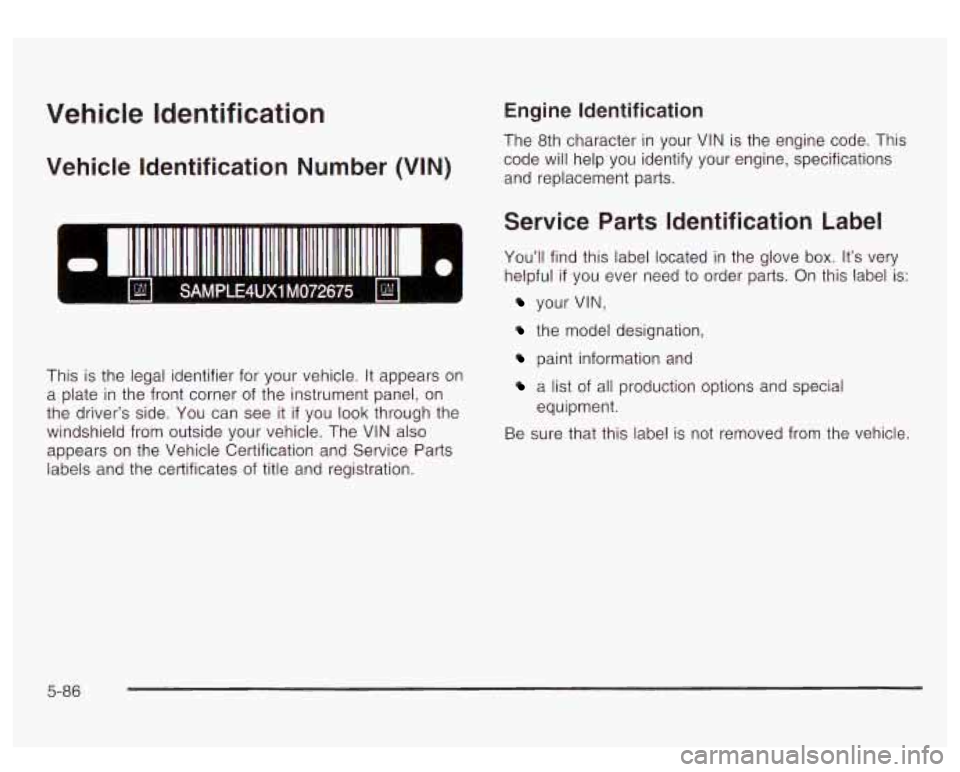
SAMPLE4UXl M072675
This is the legal identifier for your vehicle. It appears on
a plate in the front corner of the instrument panel, on
the driver’s side. You can see it
if you look through the
windshield from outside your vehicle. The VIN also
appears on the Vehicle Certification and Service Parts
labels and the certificates of title and registration.
Engine Identification
The 8th character in your VIN is the engine code. This
code will help you identify your engine, specifications
and replacement parts.
Service Parts Identification Label
You’ll find this label located in the glove box. It’s very
helpful
if you ever need to order parts. On this label is:
your VIN,
the model designation’
paint information and
a list of all production options and special
equipment.
Be sure that this label is not removed from the vehicle.
5-86
Page 377 of 447
Instrument Panel Fuse Block
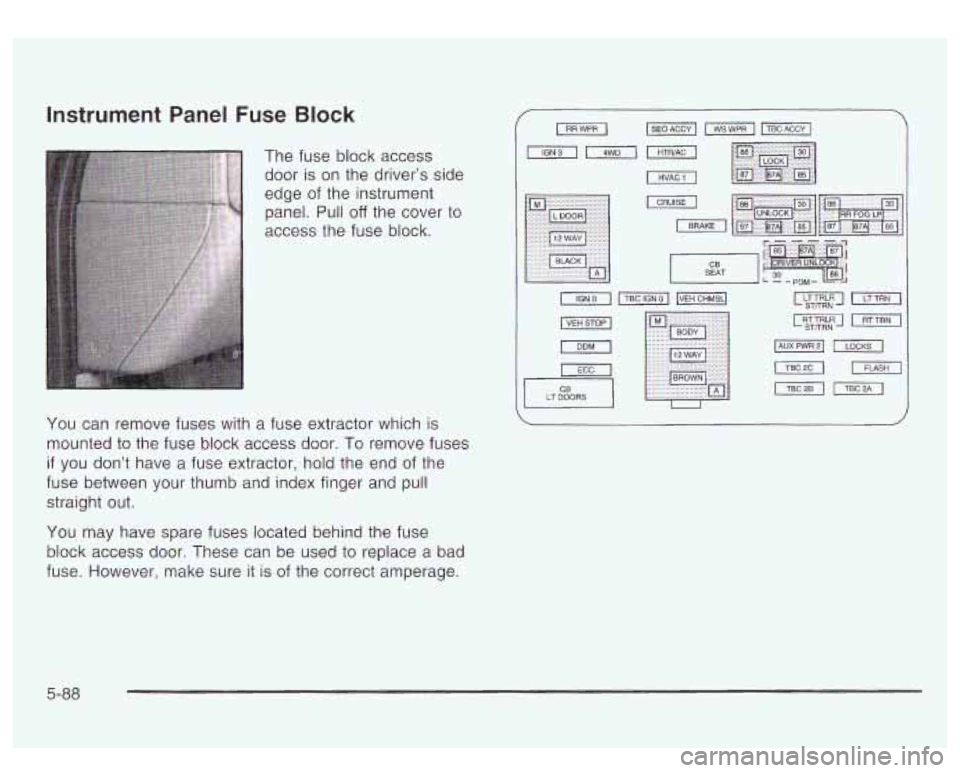
The fuse block access
door is on the driver’s side
edge of the instrument
panel. Pull
off the cover to
access the fuse block.
You can remove fuses with a fuse extractor which
is
mounted to the fuse block access door. To remove fuses
if you don’t have a fuse extractor, hold the end of the
fuse between your thumb and index finger and pull
straight out.
VJ
LT DOORS
I’ I U
You may have spare fuses located behind the fuse
block access door. These can be used
to replace a bad
fuse. However, make sure it
is of the correct amperage.
5-88
Page 379 of 447
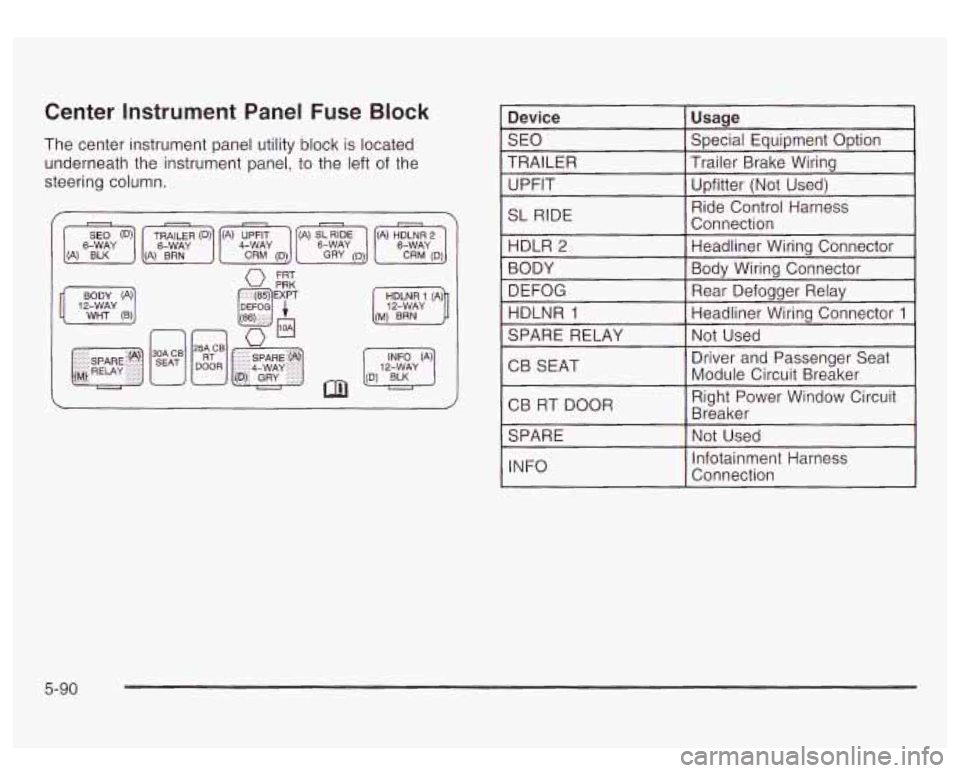
Center Instrument Panel Fuse Block
The center instrument panel utility block is located
underneath the instrument panel,
to the left of the
steering column.
A FRT
[ 12-WAY) BODY (A) WHT (B)
HDLNR 1 (A)
12-WAY
1 2-WAY
5-90
SL RIDE
HDLR
2 Headliner Wiring Connector
Ride Control
Harness
Connection ~~ [BODY I Body Wiring Connector ---- - I Utl-uti Rear Defogger Relay
HDLNR
1 Headliner Wiring Connector 1
SPARE RELAY Not Used
CB
SEAT
CB RT DOOR Driver
and Passenger Seat
Module Circuit Breaker
Right Power Window Circuit
Breaker
SPARE Not Used
INFO Infotainment Harness
Connection
Page 382 of 447
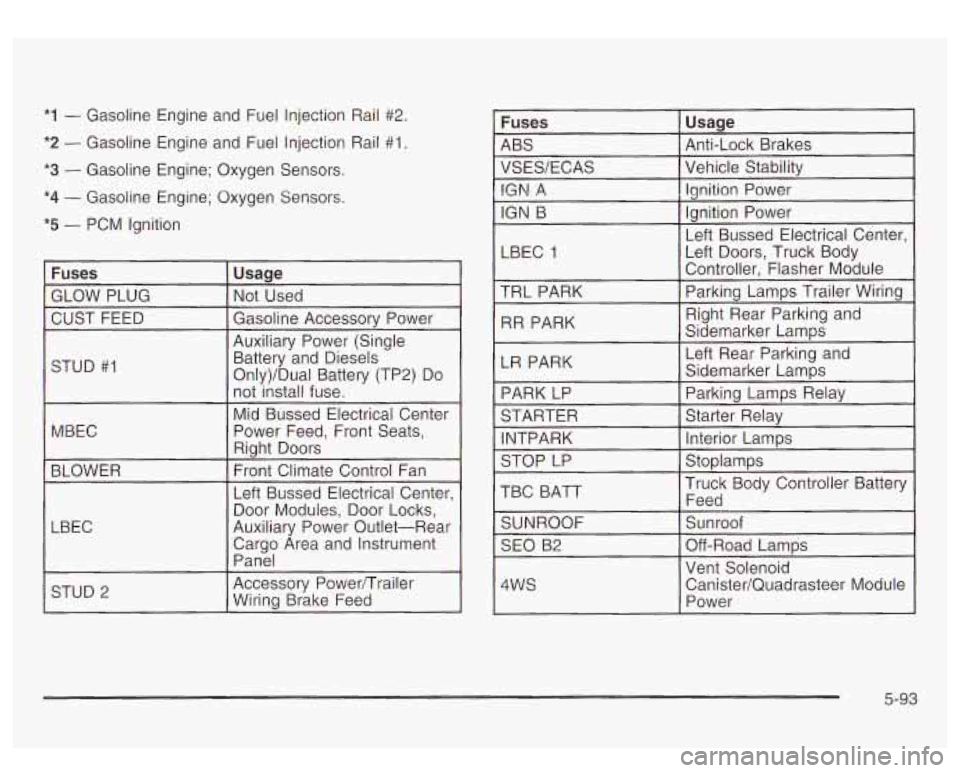
*I - Gasoline Engine and Fuel Injection Rail #2.
*2 - Gasoline Engine and Fuel Injection Rail #l.
*3 - Gasoline Engine; Oxygen Sensors.
*4 - Gasoline Engine; Oxygen Sensors.
*5 - PCM Ignition
I Fuses I Usage I
I STUD #1 I
Battery-and Diesels
Only)/Dual Battery (TP2) Do
not -install fuse.
Mid Bussed Electrical Center
MBEC Power
Feed, Front Seats,
LBEC Door Modules, Door Locks,
Auxiliary Power Outlet-Rear
Cargo Area and Instrument
Panel
STUD 2 Accessory
Powerflrailer
Wirinq Brake Feed LBEC
1
~~
I RR PARK I
Right
Rear Parking and
Sidemarker LamDs
I
5-93