brake GMC YUKON DENALI 2003 Workshop Manual
[x] Cancel search | Manufacturer: GMC, Model Year: 2003, Model line: YUKON DENALI, Model: GMC YUKON DENALI 2003Pages: 447, PDF Size: 21.97 MB
Page 290 of 447
Section 5 Service and Appearance Care
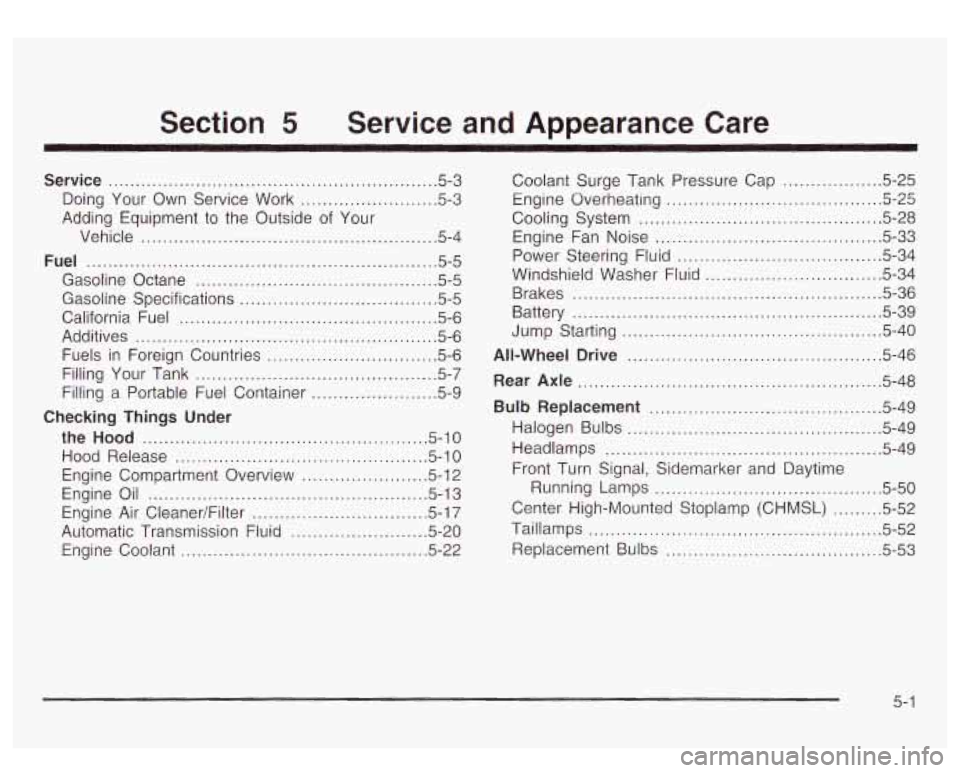
Service ............................................................ 5.3
Doing Your Own Service Work
......................... 5-3
Adding Equipment
to the Outside of Your
Vehicle
.................................................. 5-4
................................................................ Fuel 5.5
Gasoline Octane ............................................ 5.5
Gasoline Specifications ................................... 5-5
California Fuel ............................................... 5-6
Additives
....................................................... 5.6
Fuels in Foreign Countries
............................... 5-6
Filling Your Tank
............................................ 5-7
Filling a Portable Fuel Container ....................... 5.9
the Hood .................... , .................... 5.10
Hood Release ...................... ................ 5-10
Engine Compartment Overview ....... ......... 5-12
Engine Oil ....................................... ..... 5.13
Engine Air Cleaner/Filter ............................. 5.17
Automatic Transmission Fluid ......................... 5-20
Engine Coolant ......................................... 5-22
Checking Things Under
~~
Coolant Surge Tank Pressure Cap ............... 5-25
Engine Overheating ....................................... 5-25
Cooling System ............................................ 5.28
Engine Fan Noise ......................................... 5.33
Power Steering Fluid
..................................... 5-34
Windshield Washer Fluid
................................ 5.34
Brakes
........................................................ 5.36
Battery
........................................................ 5-39
Jump Starting
............................................... 5.40
All-Wheel Drive .............................................. 5.46
Rear Axle .................................. .......... 5-48
Bulb Replacement .......................................... 5-49
Halogen Bulbs .............................................. 5-49
Headlamps
.................................................. 5-49
Running Lamps
......................................... 5-50
Center High-Mounted Stoplamp (CHMSL) ......... 5-52
Taillamps ..................................................... 5-52
Replacement Bulbs ................................... 5.53
Front Turn Signal, Sidemarker and Daytime
5- 1
Page 299 of 447
Checking Things Under
the
Hood
- .lings It burn can get c hot engine parts
and start a fire. These include liquids like fuel,
oil, coolant, brake fluid, windshield washer and
other fluids, and plastic or rubber.
You or
others could be burned. Be careful not to drop
or spill things that will burn onto
a hot engine.
Hood Release
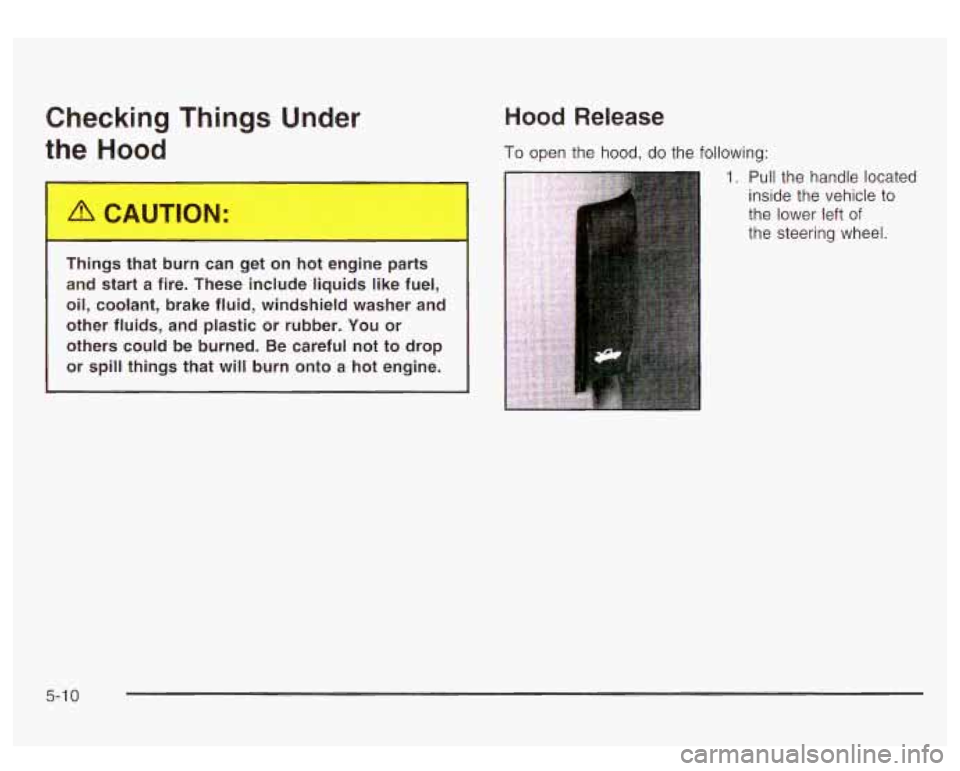
To open the hood, do the following:
1. Pull the handle located
inside the vehicle
to
the lower left of
the steering wheel.
5-1 0
Page 302 of 447
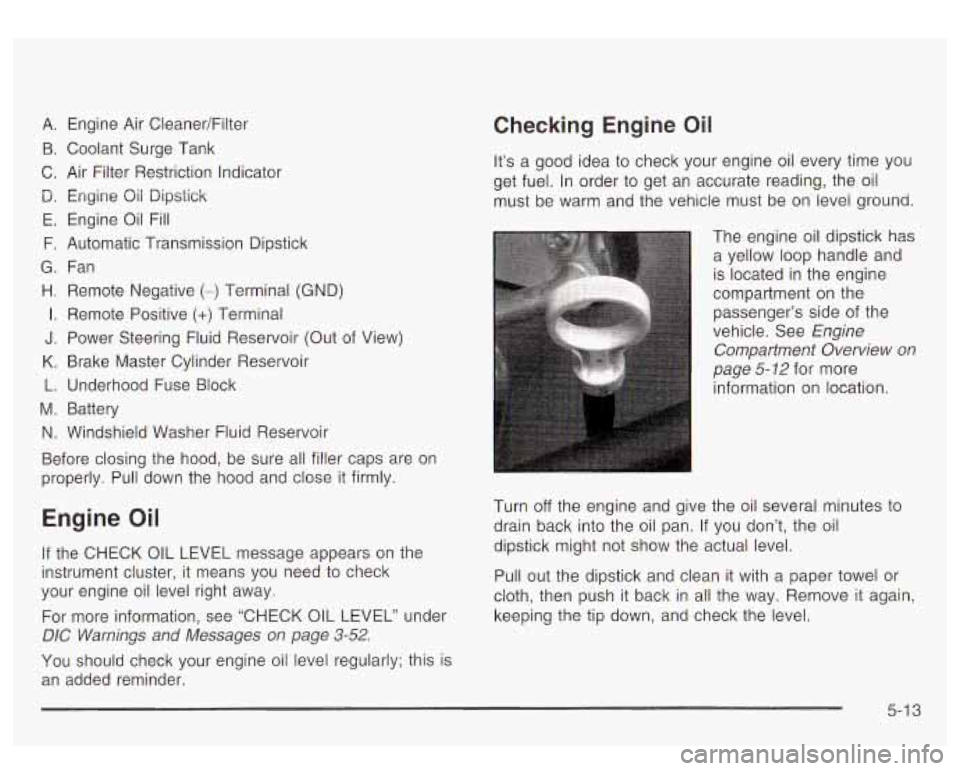
A. Engine Air CleanedFilter
B. Coolant Surge Tank
C. Air Filter Restriction Indicator
D. Engine Qii Dipstick
E. Engine Oil Fill
F. Automatic Transmission Dipstick
G. Fan
H. Remote Negative (-) Terminal (GND)
I. Remote Positive (+) Terminal
J. Power Steering Fluid Reservoir (Out of View)
K. Brake Master Cylinder Reservoir
L. Underhood Fuse Block
M. Battery
N. Windshield Washer Fluid Reservoir
Before closing the hood, be sure all filler caps are on
properly. Pull down the hood and close
it firmly.
Engine Oil
If the CHECK OIL LEVEL message appears on the
instrument cluster, it means you need to check
your engine oil level right away.
For more information, see “CHECK OIL LEVEL” under
DIC Warnings and Messages on page 3-52.
You should check your engine oil level regularly; this is
an added reminder.
Checking Engine Oil
It’s a good idea to check your engine oil every time you
get fuel. In order to get an accurate reading, the oil
must be warm and the vehicle must be on level ground.
The engine oil dipstick has a yellow loop handle and
is located in the engine
compartment on the
passenger’s side of the
vehicle. See Engine
Compartment Overview on
page
5- 12 for more
information on location.
Turn
off the engine and give the oil several minutes to
drain back into the oil pan. If you don’t, the oil
dipstick might not show the actual level.
Pull out the dipstick and clean it with a paper towel or
cloth, then push it back in all the way. Remove it again,
keeping the tip down, and check the level.
5-1 3
Page 310 of 447
To get the right reading, the fluid should be at normal
operating temperature, which is 180°F
to 200°F
(82°C
to 93°C).
Get the vehicle warmed up by driving about 15 miles
(24 km) when outside temperatures are above 50°F
(10°C). If it's colder than 50°F
(IO'C), drive the vehicle
in THIRD
(3) until the engine temperature gage
moves and then remains steady for
10 minutes.
A cold fluid check can be made after the vehicle has
been sitting for eight hours or more with the engine
off,
but this is used only as a reference. Let the engine
run at idle for five minutes
if outside temperatures are
50°F (10°C) or more.
If it's colder than 50°F (IO'C), you
may have to idle the engine longer. Should the fluid
level be low during this cold check,
you must check the
fluid hot before adding fluid. Checking the fluid hot
will give you a more accurate reading of the fluid level.
Checking the Fluid Level
Prepare your vehicle as follows:
@ Park your vehicle on a level place. Keep the engine
running.
With the parking brake applied, place the shift lever
in PARK (P).
With your foot on the brake pedal, move the shift
lever through each gear range, pausing for about
three seconds in each range. Then, position the shift
lever in
PARK (P).
@ Let the engine run at idle for three minutes or more.
Then, without shutting
off the engine, follow
these steps:
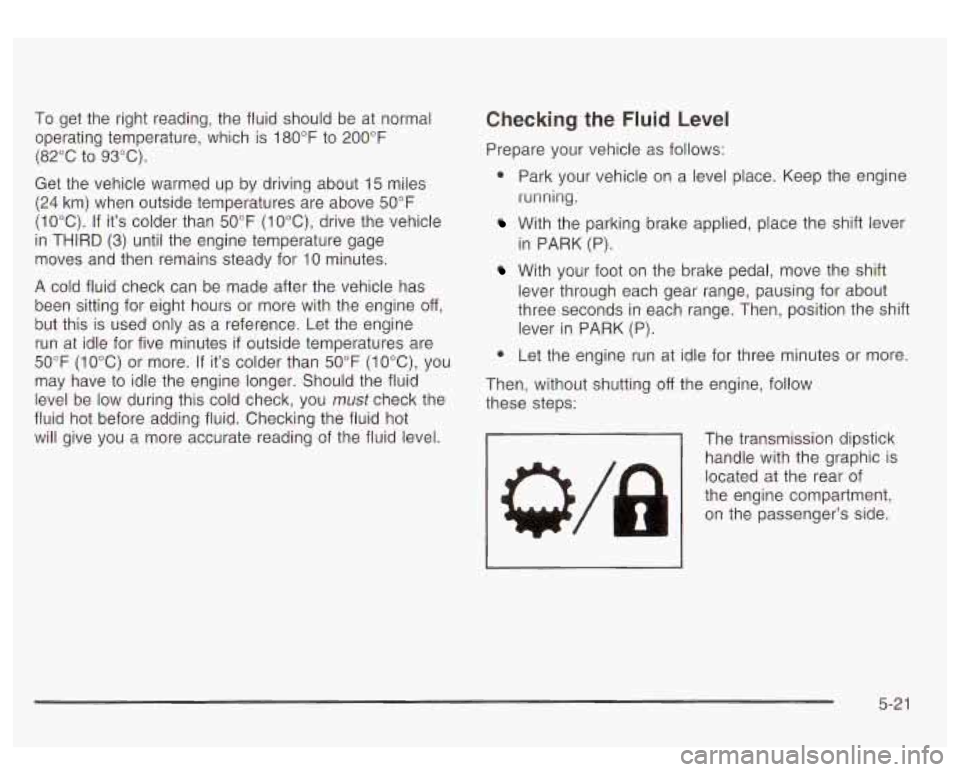
1- The transmission dipstick handle with the graphic is
located at the rear of
the engine compartment,
on the passenger's side.
5-21
Page 325 of 447
Brakes
Brake Fluid
Your brake master cylinder reservoir is filled with DOT-3
brake fluid. See Engine Compartment Overview on
page
5-12 for the location of the reservoir.
There are only two reasons why the brake fluid level in
the reservoir might go down. The first is that the
brake fluid goes down to an acceptable level during
normal brake lining wear. When new linings are put in,
the fluid level goes back up. The other reason is
that fluid is leaking out of the brake system. If it is, you
should have your brake system fixed, since a leak
means that sooner or later your brakes won’t work well,
or won’t work at all.
So, it isn’t a good idea to “top off’ your brake fluid.
Adding brake fluid won’t correct a leak. If you add fluid
when your linings are worn, then you’ll have
too
much fluid when you get new brake linings. You should
add (or remove) brake fluid, as necessary, only when
work is done on the brake hydraulic system.
If you have too n._.:h brake ------) it can s,
the engine. The fluid will burn if the enginc
... I on
e is
hot enough. You or others could be burned,
and your vehicle could be damaged. Add brake
fluid only when work is done
on the brake
hydraulic system. See “Checking Brake Fluid”
in this section.
Refer to the Maintenance Schedule to determine when
to check your brake fluid. See Part C: Periodic
Maintenance Inspections on page
6- 14.
5-36
Page 326 of 447
Checking Brake Fluid
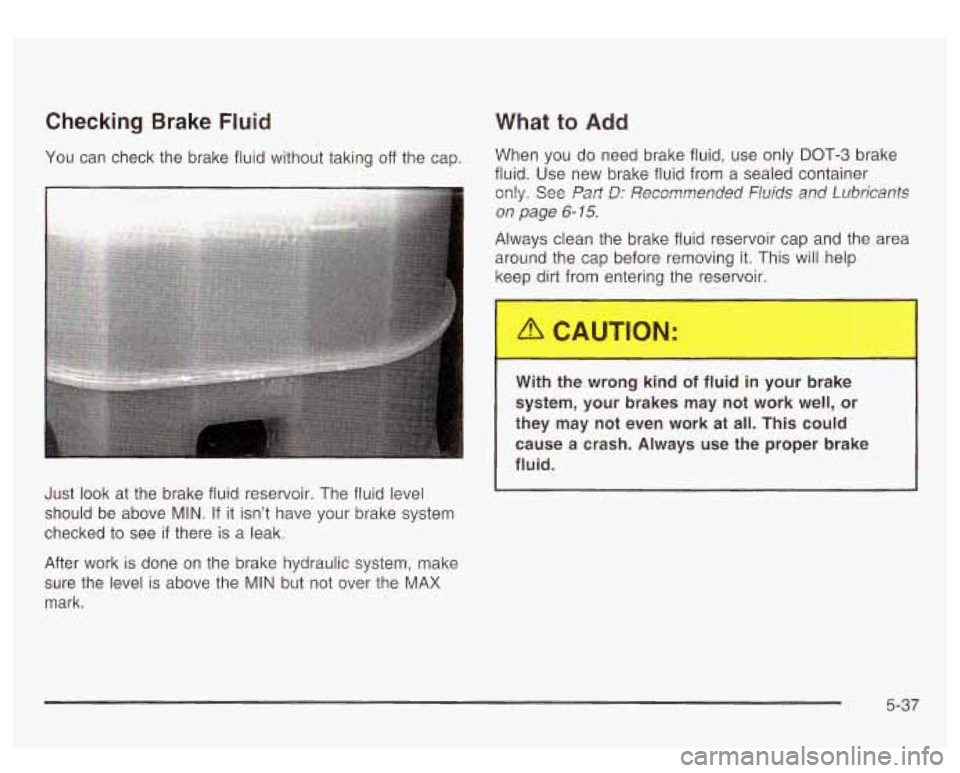
You can check the brake fluid without taking off the cap.
What to Add
When you do need brake fluid, use only DOT-3 brake
fluid. Use new brake fluid from a sealed container only.
see Part D: Recommended Fluids and Lubrjcaats
on page 6- 15.
Just look at the brake fluid reservoir. The fluid level
should be above
MIN. If it isn’t have your brake system
checked to see
if there is a leak.
After work
is done on the brake hydraulic system, make
sure the level is above the
MIN but not over the MAX
mark. Always clean the brake fluid reservoir cap
and the area
around the cap before removing it. This will help
keep dirt from enterinc ++e reservoir.
I
With the wrong kind of fluid in yo^. brake
system, your brakes may not work well, or
they may not even work at all. This could
cause a crash. Always use the proper brake
fluid.
5-37
Page 327 of 447
Notice;
Using the wrong fluid can badly damage brake
system parts. For example, just a few drops of mineral-based oil, such as engine oil, in your
brake system can damage brake system
parts
so badly that they’ll have to be replaced.
Don’t let someone put
in the wrong kind of fluid.
If you spill brake fluid on your vehicle’s painted
surfaces,
the paint finish can be damaged. Be
careful not to spill brake fluid on your vehicle. If
you do, wash
it off immediately. See
“Appearance Care’’ in the Index.
Brake Wear
Your vehicle has four-wheel disc brakes.
Disc brake pads have built-in wear indicators that make
a high-pitched warning sound when the brake pads
are worn and new pads are needed. The sound
may come and go or be heard all the time your vehicle
is moving (except when you are pushing on the
brake pedal firmly).
~ The brake wea rarl -g sou.-_. ... eans that
soon your brakes won’t work well. That could
lead to an accident. When you hear the brake
wear warning sound, have your vehicle
serviced.
Notice: Continuing to drive with worn-out brake
pads could result in costly brake repair.
Some driving conditions or climates may cause a brake
squeal when the brakes are first applied or lightly
applied. This does not mean something is wrong with
your brakes.
Properly torqued wheel nuts are necessary
to help
prevent brake pulsation. When tires are rotated, inspect
brake pads for wear and evenly tighten wheel nuts in
the proper sequence to
GM torque specifications.
Brake linings should always be replaced as complete
axle sets.
See
Brake System Inspection on page 6-14.
5-38
Page 328 of 447

Brake Pedal Travel Battery
See your dealer if the brake pedal does not return to
normal height, or
if there is a rapid increase in
pedal travel. This could be a sign of brake trouble.
Brake Adjustment
Every time you make a brake stop, your disc brakes
adjust for wear.
Replacing Brake System Parts
The braking system on a vehicle is complex. Its many
parts have to be
of top quality and work well together if
the vehicle is to have really good braking. Your
vehicle was designed and tested with top-quality
GM
brake parts. When you replace parts of your braking
system
- for example, when your brake linings
wear down and you need new ones put in
- be sure
you get new approved
GM replacement parts. If
you don’t, your brakes may no longer work properly. For
example,
if someone puts in brake linings that are
wrong for your vehicle, the balance between your front
and rear brakes can change
- for the worse. The
braking performance you’ve come to expect can change
in many other ways
if someone puts in the wrong
replacement brake parts. Your
new vehicle comes with a maintenance free
ACDelco@ battery. When it’s time for a new battery, get
one that has the replacement number shown on the
original battery’s label. We recommend an ACDelco@
battery. See Engine Compartment Overview
on
page 5-72 for battery location.
Warning: Battery posts, terminals and related
accessories contain lead and lead compounds,
chemicals known to the State of California to cause
cancer and reproductive harm. Wash hands after
handling.
Vehicle Storage
If you’re not going to drive your vehicle for 25 days or
more, remove the black, negative
(-) cable from
+‘-? battery. This will hc’- keep your battery from
Batteries have acid that can burn you and gas
that can explode. You can be badly hurt if you
aren’t careful. See “Jump Starting” next for
tips on working around a battery without
getting hurt.
5-39
Page 330 of 447
Notice: If the other system isn’t a 12-volt system
with a negative ground, both vehicles can be
damaged.
2.
Get the vehicles close enough so the jumper cables
can reach, but be sure the vehicles aren’t touching
each other.
If they are, it could cause a ground
connection you don’t want. You wouldn’t be able
to
start your vehicle, and the bad grounding could
damage the electrical systems.
To avoid the possibility of the vehicles rolling, set
the parking brake firmly on both vehicles involved in
the jump start procedure. Put an automatic
transmission in PARK (P) or a manual transmission
in NEUTRAL before setting the parking brake.
Notice: If you leave your radio on, it could be badly
damaged. The repairs wouldn’t be covered by
your warranty.
3. Turn off the ignition on both vehicles. Unplug
unnecessary accessories plugged into the cigarette
lighter or accessory power outlets. Turn
off the
radio and all lamps that aren’t needed. This
will avoid sparks and help save both batteries.
And it could save your radio!
4. Open the hoods and locate the positive (+) and
negative
(-) terminal locations of the other vehicle.
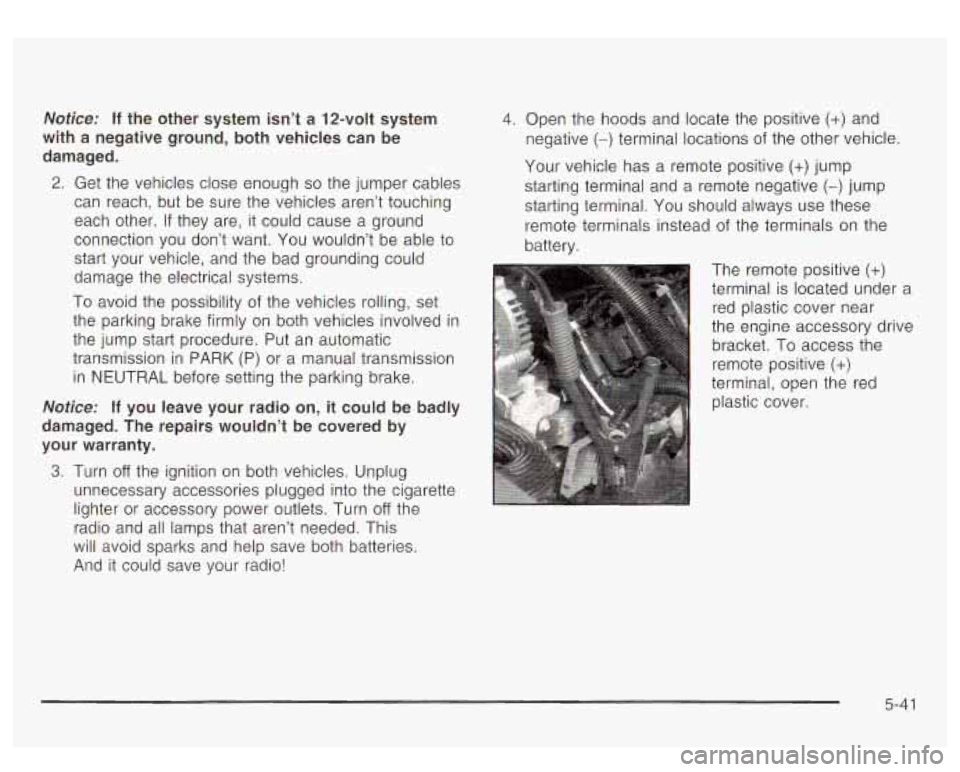
Your vehicle has a remote positive
(+) jump
starting terminal and a remote negative
(-) jump
starting terminal.
You should always use these
remote terminals instead
of the terminals on the
battery.
The remote positive
(+)
terminal is located under a red plastic cover near
the engine accessory drive
bracket.
To access the
remote positive
(+)
terminal, open the red
plastic cover.
5-41
Page 350 of 447
Wheel Alignment and Tire Balance
The wheels on your vehicle were aligned and balanced
carefully at the factory
to give you the longest tire life
and best overall performance.
Scheduled wheel alignment and wheel balancing are
not needed. However,
if you notice unusual tire wear or
your vehicle pulling one way or the other, the alignment
may need
to be reset. If you notice your vehicle
vibrating when driving on a smooth road, your wheels
may need
to be rebalanced.
Wheel Replacement
Replace any wheel that is bent, cracked, or badly rusted
or corroded.
If wheel nuts keep coming loose, the
wheel, wheel bolts and wheel nuts should be replaced.
If the wheel leaks air, replace it (except some
aluminum wheels, which can sometimes be repaired).
See your dealer
if any of these conditions exist.
Your dealer will know the kind of wheel you need.
Each new wheel should have the same load-carrying
capacity, diameter, width, offset and be mounted
the same way as the one it replaces.
If you need to replace any of your wheels, wheel bolts
or wheel nuts, replace them only with new
GM
original equipment parts. This way, you will be sure to
have the right wheel, wheel bolts and wheel nuts
for your vehicle. Using the wrong replacement wheels, wheel
bolts or wheel nuts on your vehicle can be
dangerous. It could affect the braking and handling
of your vehicle, make your tires lose
air and make you lose control. You could have
a collision in which you or others could be
injured. Always use the correct wheel, wheel
bolts and wheel nuts for replacement.
Notice: The wrong wheel can also cause problems
with bearing life, brake cooling, speedometer or
odometer calibration, headlamp aim, bumper height,
vehicle ground clearance and
tire clearance to the
body and chassis.
See
Changing a Flat Tire on page 5-63 for more
information.
5-6 1