brake GMC YUKON DENALI 2003 Repair Manual
[x] Cancel search | Manufacturer: GMC, Model Year: 2003, Model line: YUKON DENALI, Model: GMC YUKON DENALI 2003Pages: 447, PDF Size: 21.97 MB
Page 351 of 447
Used Replacement Wheels Tire Chains
-
Putting a used wheel on your vehicle is
dangerous. You can’t know how
it’s been used
or how far
it’s been driven. It could fail
suddenly and cause a crash. If you have to replace
a wheel, use a new GM original
equipment wheel. Don’t use
ti., ch; ... s. There’s
not ,..ough
clearance. Tire chains used
on a vehicle without
the proper amount of clearance can cause
damage to the brakes, suspension or other
vehicle parts. The area damaged by the tire
chains could cause you to lose control of your
vehicle and you or others may be injured
in a
crash. Use another type of traction device only
if its manufacturer recommends
it for use on
your vehicle and tire size combination and road conditions. Follow that manufacturer’s instructions. To help avoid damage to your
vehicle, drive slowly, readjust or remove
the
device if it’s contacting your vehicle, and don’t
spin your wheels.
If you do find traction devices
that will
fit, install them on the rear tires.
5-62
Page 352 of 447
If a Tire Goes Flat
It’s unusual for a tire to “blowout” while you’re driving,
especially
if you maintain your tires properly. If air goes
out
of a tire, it’s much more likely to ieak out siowiy.
But if you should ever have a “blowout”, here are a few
tips about what
to expect and what to do:
If a front tire fails, the flat tire will create a drag that
pulls the vehicle toward that side. Take your foot
off the
accelerator pedal and grip the steering wheel firmly.
Steer to maintain lane position, and then gently brake
to
a stop well out of the traffic lane.
A rear blowout, particularly on a curve, acts much like a
skid and may require the same correction you’d use
in a skid.
In any rear blowout, remove your foot from the
accelerator pedal. Get the vehicle under control by
steering the way you want the vehicle
to go. It may be
very bumpy and noisy, but you can still steer. Gently
brake to a stop
- well off the road if possible.
If a tire goes flat, the next part shows how to use your
jacking equipment to change a flat tire safely.
Changing a Flat Tire
If a tire goes flat, avoid further tire and wheel damage
by driving slowly to a level place. Turn on your
hazard warning
fi hers.
Changing a tire can cause an injury. The
vehicle can slip
off the jack and roll over you
or other people. You and they could be badly injured. Find a level place to change your tire.
To help prevent the vehicle from moving:
1. Set the parking brake firmly.
2. Put the shift lever in PARK (P).
3. Turn off the engine.
4. Put the wheel blocks at the front and rear
of the tire farthest away from the one
being changed. That would be the tire on
the other side
of the vehicle, at the
opposite end.
5-63
Page 362 of 447
incorrect wheel nuts or improperly tightened
wheel nuts can cause the wheel to come loose
and even come
off. This could lead to an
accident. Be sure to use the correct wheel
nuts.
If you have to replace them, be sure to
get new
GM original equipment wheel nuts.
Stop somewhere as soon as you can and have
the nuts tightened with a torque wrench to the
proper torque specification. See “Capacities
and Specifications”
in the Index for wheel nut
torque specification.
Notice: Improperly tightened wheel nuts can lead
to brake pulsation and rotor damage.
To avoid
expensive brake repairs, evenly tighten the wheel nuts in the proper sequence and to the proper
torque specification. See “Capacities and
Specifications” in the index for the wheel nut
torque specification. When
you reinstall the regular wheel and tire, you must
also reinstall the center cap. Place the cap on the
wheel and tap it into place until
it seats flush with the
wheel. The cap only goes
on one way. Be sure to line up
the tab
on the center cap with the indentation on the
wheel.
Storing a Flat or Spare Tire, Jack
and Tools
Storing a jack, a tire, or other equipment in the
passenger compartment of the vehicle could
cause injury. In a sudden stop or collision, loose equipment could strike someone. Store
all these in the proper place.
Notice: An aluminum wheel with a flat tire should
always be stored under the vehicle with the
hoist. However, storing
it that way for an extended
period of time could damage the wheel.
To avoid
this, always stow the wheel properly with the valve stem pointing up and have the wheel repaired as
soon as possible.
5-73
Page 378 of 447
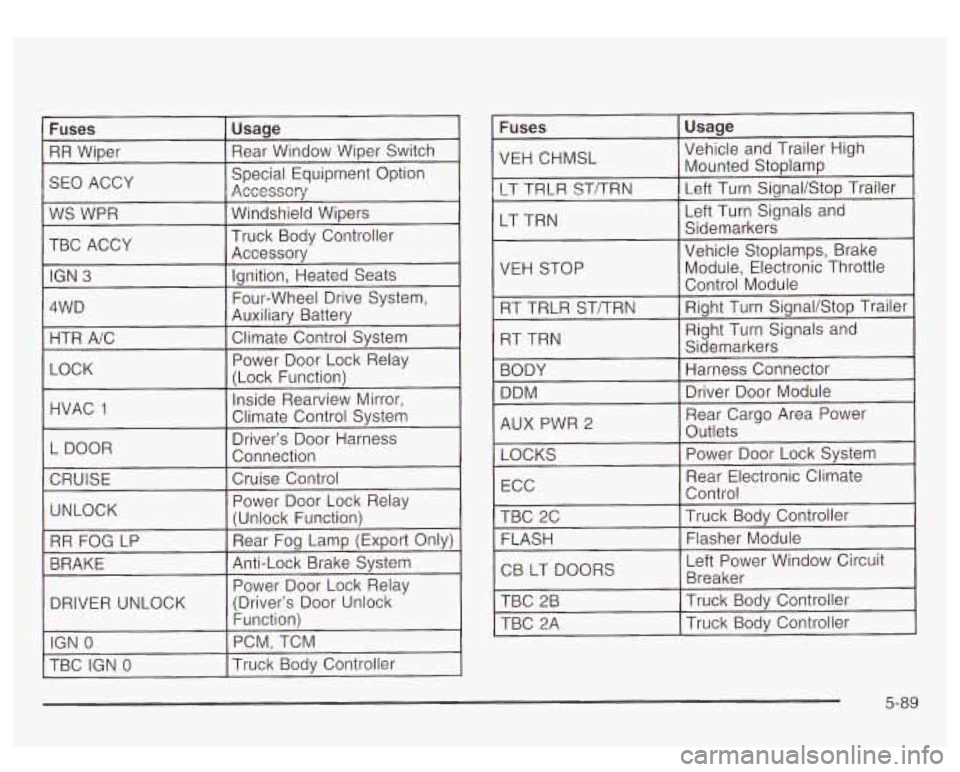
Power Door Lock Relay
DRIVER UNLOCK (Driver’s
Door Unlock
Fuses
VEH CHMSL
LT TRLR ST/TRN
LT TRN
VEH STOP
Usage
Vehicle and Trailer High
Mounted Stoplamp
Left Turn SignaVStop Trailer
Left Turn Signals and
Sidemarkers
Vehicle Stoplamps, Brake Module, Electronic Throttle
Control Module
RT TRLR ST/TRN Right Turn Signal/Stop Trailer
-
RT TRN Right Turn Signals and
Sidemarkers
AUX
PWR 2 I
Rear Cargo Area Power
Outlets
5-89
Page 382 of 447
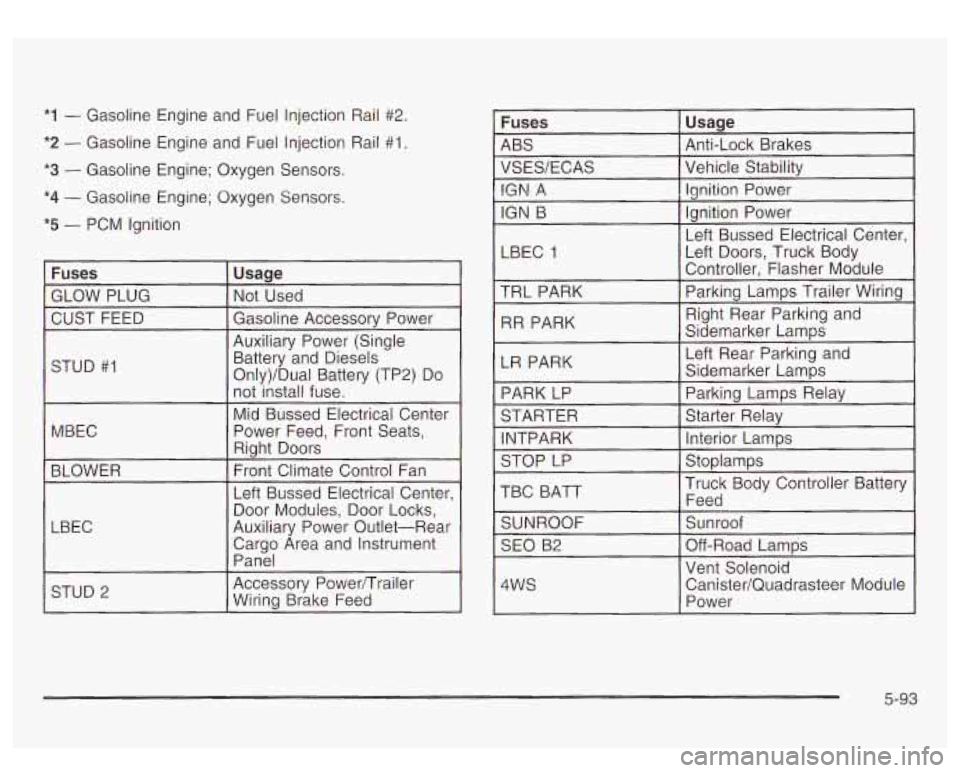
*I - Gasoline Engine and Fuel Injection Rail #2.
*2 - Gasoline Engine and Fuel Injection Rail #l.
*3 - Gasoline Engine; Oxygen Sensors.
*4 - Gasoline Engine; Oxygen Sensors.
*5 - PCM Ignition
I Fuses I Usage I
I STUD #1 I
Battery-and Diesels
Only)/Dual Battery (TP2) Do
not -install fuse.
Mid Bussed Electrical Center
MBEC Power
Feed, Front Seats,
LBEC Door Modules, Door Locks,
Auxiliary Power Outlet-Rear
Cargo Area and Instrument
Panel
STUD 2 Accessory
Powerflrailer
Wirinq Brake Feed LBEC
1
~~
I RR PARK I
Right
Rear Parking and
Sidemarker LamDs
I
5-93
Page 383 of 447
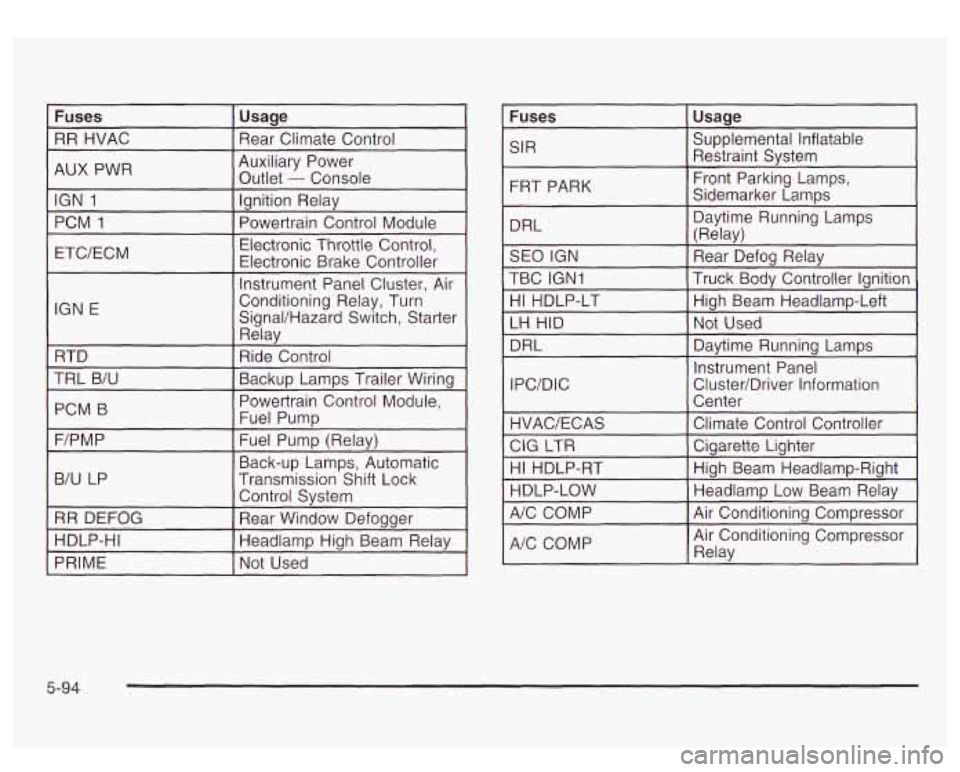
Fuses
RR HVAC
Usage
Rear Climate Control
AUX PWR I
Auxiliary Power
Outlet
- Console
IGN
1
PCM 1 Ignition Relay
Electronic Throttle Control,
ETC/ECM Powertrain Control Module
Electronic Brake Controller
IGN E Instrument Panel Cluster,
Air
Conditioning Relay, Turn
SignaVHazard Switch, Starter
Relav
RTD I Ride Control I
TRL B/U
~~
I Backup LampsTrailG Wiring 1
PCM B I
Powertrain Control Module,
Fuel Pumr,
I I
F/PMP I Fuel Pump (Relay)
B/U LP
I
Back-up Lamps, Automatic
Transmission Shift Lock
I
Control System
RR DEFOG
Rear Window Defoaaer
HDLP-HI
~~~ ____
HeadlampHighBeam Relay
PRIME Not Used
Fuses I Usage I
SIR Supplemental Inflatable
Restraint System
FRT PARK
DRL Front Parking Lamps,
Sidemarker Lamps
Daytime Running Lamps
(Relav)
SEO IGN
Truck Body Controller Ignition
TBC IGN1 Rear
Defog Relay
HI HDLP-LT High
Beam Headlamp-Left
LH HID Not
Used
DRL
I Davtime Runnina LamDs I
Instrument Panel
IPC/DIC Cluster/Driver Information
HI HDLP-RT
HDLP-LOW High
Beam Headlamp-Right
Headlamp Low Beam Relav
A/C COMP
I Air Conditionina Comm-essor I v
A/C COMP Air
Conditioning Compressor
Relav
5-94
Page 388 of 447
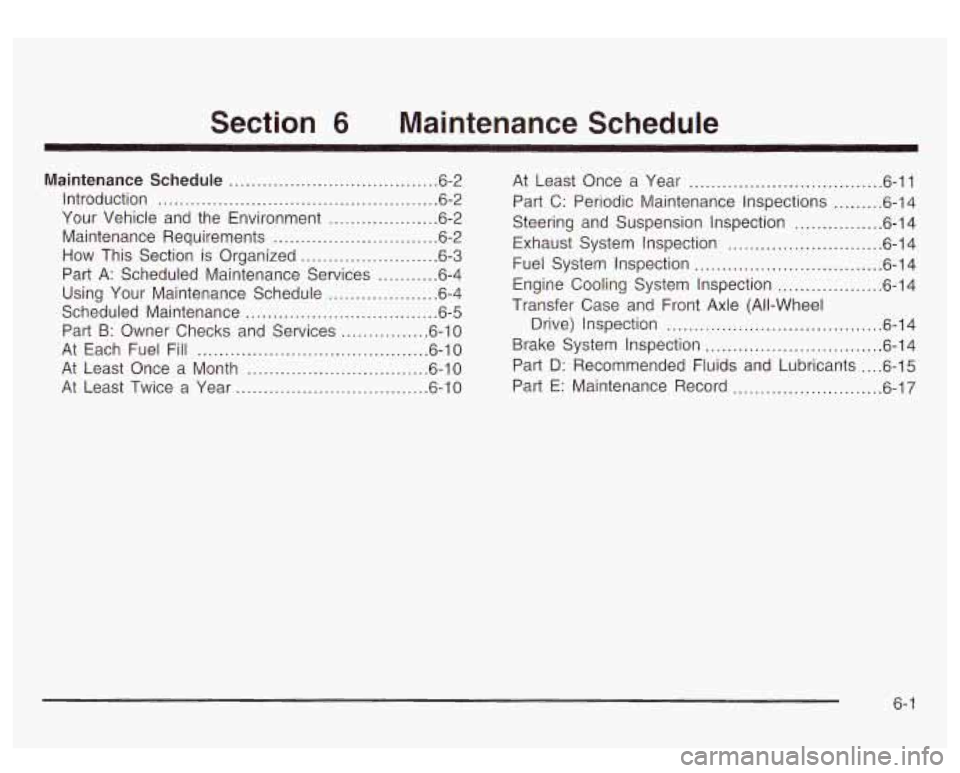
Section 6 Maintenance Schedule
Maintenance Schedule ...................................... 6.2
Introduction
................................................... 6.2
Your Vehicle and the Environment
.................... 6-2
Maintenance Requirements
.............................. 6.2
How This Section is Organized
......................... 6-3
Part A: Scheduled Maintenance Services
........... 6-4
Using Your Maintenance Schedule
.................... 6-4
Scheduled Maintenance
................................... 6-5
Part
B: Owner Checks and Sewices ................ 6-10
At Each Fuel Fill
.......................................... 6-10
At Least Once a Month
................................. 6-10
At Least Twice a Year
................................... 6-10
~~
At Least Once a Year ................................... 6.11
Part C: Periodic Maintenance Inspections
......... 6.14
Steering and Suspension Inspection
................ 6.14
Exhaust System Inspection
............................ 6.14
Fuel System Inspection
.................................. 6.14
Engine Cooling System Inspection
................... 6.14
Drive) Inspection
....................................... 6.14
Brake System Inspection
................................ 6.14
Part D: Recommended Fluids and Lubricants
.... 6.15
Part E: Maintenance Record
........................... 6.17
Transfer Case and Front
Axle (All-Wheel
6- 1
Page 392 of 447
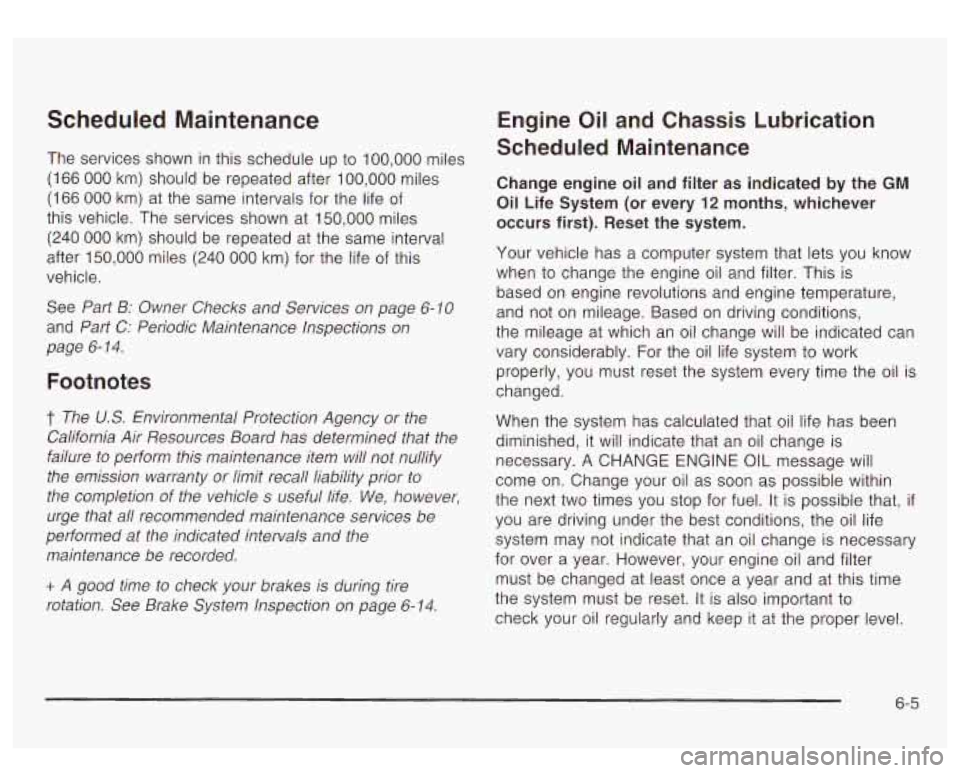
Scheduled Maintenance
The services shown in this schedule up to 100,000 miles
(1 66 000 km) should be repeated after 100,000 miles
(166
000 km) at the same intervals for the life of
this vehicle. The services shown at
150,000 miles
(240 000 km) should be repeated at the same interval
after 150,000 miles
(240 000 km) for the life of this
vehicle.
See Part B: Owner Checks and Services
on page 6- 10
and Part C: Periodic Maintenance Inspections on
page 6- 14.
Footnotes
t The U.S. Environmental Protection Agency or the
California Air Resources Board has determined that the
failure to perform this maintenance item will not nullify
the emission warranty or limit recall liability prior to
the completion of the vehicle
s useful life. We, however,
urge that all recommended maintenance services be
performed at the indicated intervals and the
maintenance be recorded.
+ A good time to check your brakes is during tire
rotation. See Brake System Inspection
on page 6-14.
Engine Oil and Chassis Lubrication
Scheduled Maintenance
Change engine oil and filter as indicated by the GM
Oil Life System (or every 12 months, whichever
occurs first). Reset the system.
Your vehicle has a computer system that lets you know
when
to change the engine oil and filter. This is
based on engine revolutions and engine temperature,
and not on mileage. Based on driving conditions,
the mileage at which an oil change will be indicated can
vary considerably. For the oil life system
to work
properly, you must reset the system every time the oil is
changed.
When the system has calculated that oil life has been
diminished, it will indicate that an oil change is
necessary. A CHANGE ENGINE
OIL message will
come on. Change your oil as soon as possible within
the next two times you stop for fuel.
It is possible that, if
you are driving under the best conditions, the oil life
system may not indicate that an oil change is necessary
for over a year. However, your engine oil and filter
must be changed at least once a year and at this time
the system must be reset.
It is also important to
check your oil regularly and keep it at the proper level.
6-5
Page 393 of 447
If the system is ever reset accidentally, you must
change your oil at
3,000 miles (5 000 km) since your
last oil change. Remember
to reset the oil life system
whenever the oil is changed. See Engine Oil on
page
5-13 for information on resetting the system.
An Emission Control Service.
Lubricate chassis components with each engine oil
and filter change.
Lubricate the front suspension, ball joints, steering
linkage, transmission shift linkage and parking brake
cable guides. Ball joints should not be lubricated unless
their temperature is 10°F (-12°C) or higher, or they
could be damaged.
After the services are performed, record the date,
odometer reading and who performed the service on the
maintenance record pages in Part
E of this schedule.
7,500 Miles (12 500 km)
U Check rear/front axle fluid level and add fluid as
needed. Check constant velocity joints and axle seals
for leaking.
page
5-56 for proper rotation pattern and additional
information. (See footnote
+.)
0 Rotate tires. See Tire Inspection and Rotation on
15,000 Miles (25 000 km)
17 Check readfront axle fluid level and add fluid as
needed. Check constant velocity joints and axle seals
for leaking.
page
5-56 for proper rotation pattern and additional
information. (See footnote
+.)
0 Rotate tires. See Tire lnspection and Rotation on
22,500 Miles (37 500 km)
0 Check readfront axle fluid level and add fluid as
needed. Check constant velocity joints and axle seals
for leaking.
page
5-56 for proper rotation pattern and additional
information. (See footnote
+.)
CI Rotate tires. See Tire Inspection and Rotation on
30,000 Miles (50 000 km)
3 Check readfront axle fluid level and add fluid as
needed. Check constant velocity joints and axle seals
for leaking.
page
5-56 for proper rotation pattern and additional
information. (See footnote
+.)
(See footnote t.)
U Rotate tires. See Tire Inspection and Rotation on
U Replace fuel filter. An Emission Control Service.
6-6
Page 399 of 447
Body Lubrication Service
Lubricate all hood latch assembly, secondary latch,
pivots, spring anchor, release pawl, door hinges, liftgate
hinge, liftgate linkage, liftgate handle pivot points, latch
bolt, fuel door hinge, locks and folding seat hardware.
Part
D tells you what to use. More frequent lubrication
may be required when exposed
to a corrosive
environment.
Star+nr Sw'+zh Check
ten you are doing this check, the v_--icle
could move suddenly.
If it does, you or others
could be injured. Follow the steps below.
3. Try to start the engine in each gear. The starter
should work only in PARK (P) or NEUTRAL (N).
If the starter works in any other position, your
vehicle needs service.
Automatic Transmission Shift Lock
Control System Check
1. Before you start, be sure you have enough room
2. Firmly apply both the parking brake and the regular
around
the vehicle.
brake. See Parking Brake on page
2-25 if
necessary.
Do not use the accelerator pedal, and be ready to
turn off the engine immediately if it starts.
Whe.. IOU a1 - rloing this check, tt.- vehicle
could move suddenly.
If it does, you or others
could
be injured. Follow the steps below.
1. Before you start, be sure you have enough room
around the vehicle.
It should be parked on a level
surface.
2. Firmly apply the parking brake. See Parking Brake
on page 2-25 if necessary.
Be ready
to apply the regular brake immediately if
the vehicle begins to move.
3. With the engine off, turn the key to the RUN
position, but don't start the engine. Without applying
the regular brake, try to move the shift lever
out
of PARK (P) with normal effort. If the shift lever
moves out of PARK
(P), your vehicle needs service.
6-1 2