light GMC YUKON DENALI 2007 Owner's Manual
[x] Cancel search | Manufacturer: GMC, Model Year: 2007, Model line: YUKON DENALI, Model: GMC YUKON DENALI 2007Pages: 608, PDF Size: 2.92 MB
Page 127 of 608
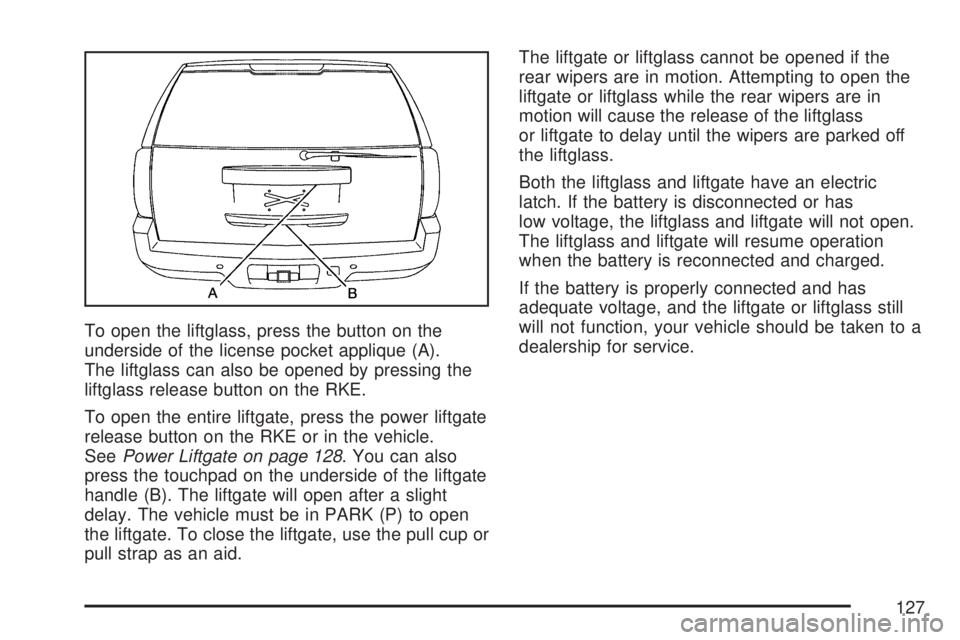
To open the liftglass, press the button on the
underside of the license pocket applique (A).
The liftglass can also be opened by pressing the
liftglass release button on the RKE.
To open the entire liftgate, press the power liftgate
release button on the RKE or in the vehicle.
SeePower Liftgate on page 128. You can also
press the touchpad on the underside of the liftgate
handle (B). The liftgate will open after a slight
delay. The vehicle must be in PARK (P) to open
the liftgate. To close the liftgate, use the pull cup or
pull strap as an aid.The liftgate or liftglass cannot be opened if the
rear wipers are in motion. Attempting to open the
liftgate or liftglass while the rear wipers are in
motion will cause the release of the liftglass
or liftgate to delay until the wipers are parked off
the liftglass.
Both the liftglass and liftgate have an electric
latch. If the battery is disconnected or has
low voltage, the liftglass and liftgate will not open.
The liftglass and liftgate will resume operation
when the battery is reconnected and charged.
If the battery is properly connected and has
adequate voltage, and the liftgate or liftglass still
will not function, your vehicle should be taken to a
dealership for service.
127
Page 129 of 608
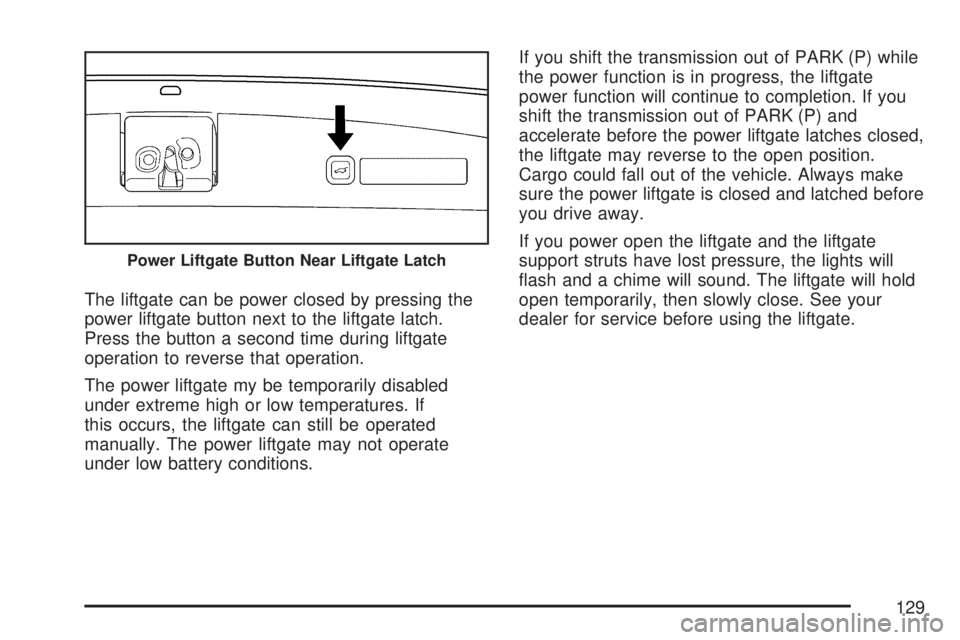
The liftgate can be power closed by pressing the
power liftgate button next to the liftgate latch.
Press the button a second time during liftgate
operation to reverse that operation.
The power liftgate my be temporarily disabled
under extreme high or low temperatures. If
this occurs, the liftgate can still be operated
manually. The power liftgate may not operate
under low battery conditions.If you shift the transmission out of PARK (P) while
the power function is in progress, the liftgate
power function will continue to completion. If you
shift the transmission out of PARK (P) and
accelerate before the power liftgate latches closed,
the liftgate may reverse to the open position.
Cargo could fall out of the vehicle. Always make
sure the power liftgate is closed and latched before
you drive away.
If you power open the liftgate and the liftgate
support struts have lost pressure, the lights will
ash and a chime will sound. The liftgate will hold
open temporarily, then slowly close. See your
dealer for service before using the liftgate.
Power Liftgate Button Near Liftgate Latch
129
Page 130 of 608
Obstacle Detection Features
If the liftgate encounters an obstacle during a
power open or close cycle, a warning chime will
sound and the liftgate will automatically reverse
direction to the full closed or open position.
After removing the obstruction, the liftgate may be
power opened or closed normally. If the liftgate
encounters multiple obstacles on the same power
cycle, the power function will deactivate, and
the liftgate will switch to manual operation. The
REAR ACCESS OPEN warning message in
the Driver Information Center (DIC) will indicate
that the liftgate is open. After removing the
obstructions, manually open the liftgate to the full
open position or close the liftgate to the fully
closed and latched position. The liftgate will now
resume normal power operation.
Your vehicle has pinch sensors located on the
side edges of the liftgate. If an object is caught
between the liftgate and the vehicle body and
presses against this sensor, the liftgate will reverse
direction and open fully. The liftgate will remain
open until it is activated again or closed manually.
Manual Operation of Power Liftgate
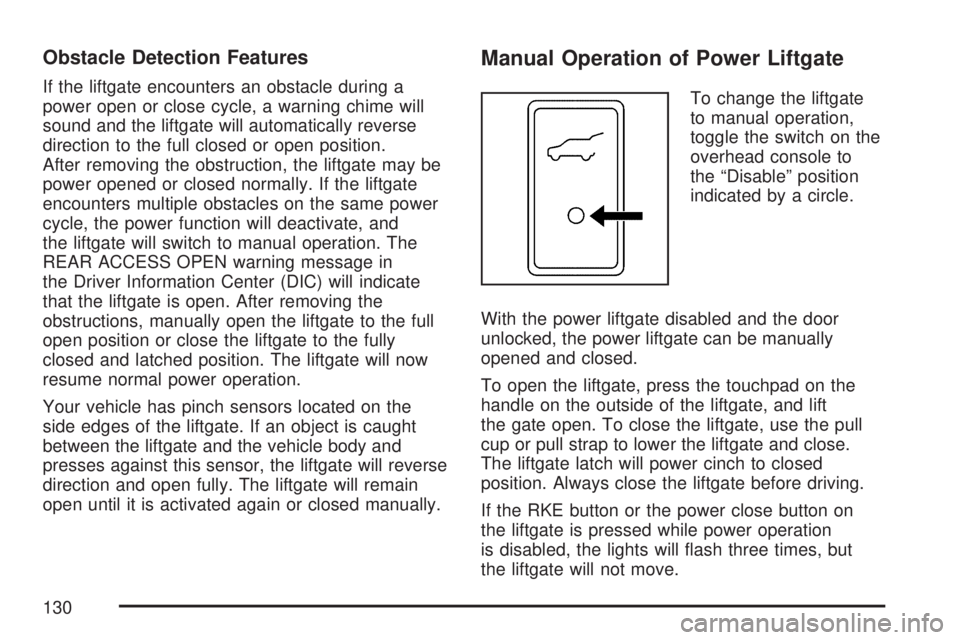
To change the liftgate
to manual operation,
toggle the switch on the
overhead console to
the “Disable” position
indicated by a circle.
With the power liftgate disabled and the door
unlocked, the power liftgate can be manually
opened and closed.
To open the liftgate, press the touchpad on the
handle on the outside of the liftgate, and lift
the gate open. To close the liftgate, use the pull
cup or pull strap to lower the liftgate and close.
The liftgate latch will power cinch to closed
position. Always close the liftgate before driving.
If the RKE button or the power close button on
the liftgate is pressed while power operation
is disabled, the lights will ash three times, but
the liftgate will not move.
130
Page 134 of 608
Express-Down Windows
The driver and front passenger windows have an
express-down feature that allows the windows to be
lowered without holding the switch. Press down
fully on the window switch, then release, to activate
the express-down mode. The express-down mode
can be canceled at any time by pulling up on the
switch.
Window Lockout
o
(Window Lockout):The window lockout
switch is located with the power window switches
on the driver’s door armrest. This feature
prevents the rear passenger windows from
operating, except from the driver’s position. Press
the switch to turn on the lockout feature. An
indicator light will come on to show the lockout
feature is on. To turn the feature off, press
the switch again and the indicator light will go off.
Sun Visors
Pull the sun visor down to block glare. Detach the
sun visor from the center mount and slide it
along the rod from side-to-side to cover the driver
or passenger side of the front window. Swing
the sun visor to the side to cover the side window.
It can be moved along the rod from side-to-side
in this position also.
Lighted Visor Vanity Mirror
Your vehicle has lighted visor vanity mirrors on
both the driver’s and passenger’s sun visors. Pull
the sun visor down and lift the mirror cover to
turn the lamps on.
Theft-Deterrent Systems
Vehicle theft is big business, especially in some
cities. Although your vehicle has a number of
theft-deterrent features, we know that nothing we
put on it can make it impossible to steal.
134
Page 135 of 608
Content Theft-Deterrent
Your vehicle has a content theft-deterrent alarm
system.
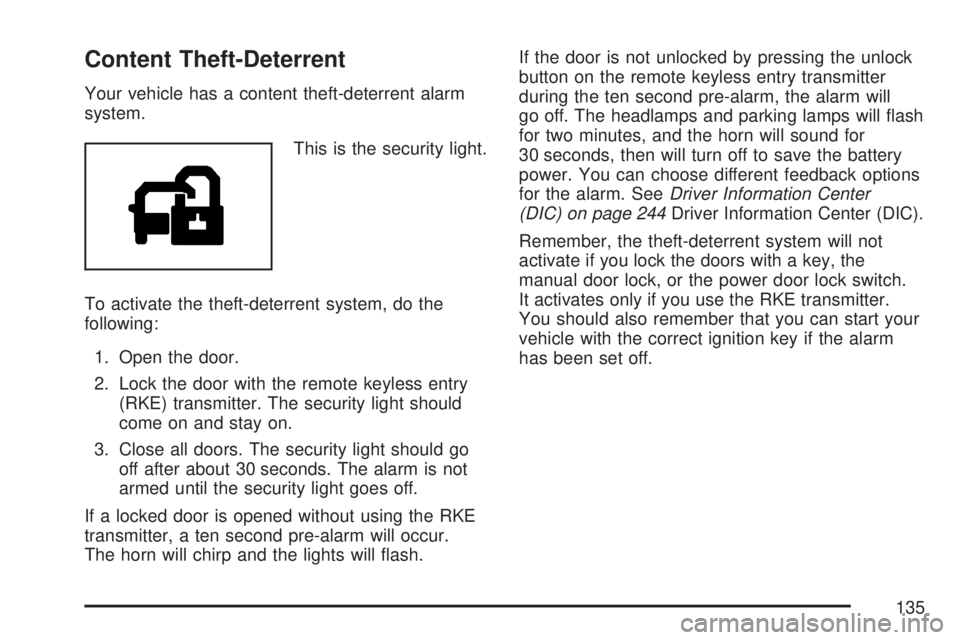
This is the security light.
To activate the theft-deterrent system, do the
following:
1. Open the door.
2. Lock the door with the remote keyless entry
(RKE) transmitter. The security light should
come on and stay on.
3. Close all doors. The security light should go
off after about 30 seconds. The alarm is not
armed until the security light goes off.
If a locked door is opened without using the RKE
transmitter, a ten second pre-alarm will occur.
The horn will chirp and the lights will ash.If the door is not unlocked by pressing the unlock
button on the remote keyless entry transmitter
during the ten second pre-alarm, the alarm will
go off. The headlamps and parking lamps will ash
for two minutes, and the horn will sound for
30 seconds, then will turn off to save the battery
power. You can choose different feedback options
for the alarm. SeeDriver Information Center
(DIC) on page 244Driver Information Center (DIC).
Remember, the theft-deterrent system will not
activate if you lock the doors with a key, the
manual door lock, or the power door lock switch.
It activates only if you use the RKE transmitter.
You should also remember that you can start your
vehicle with the correct ignition key if the alarm
has been set off.
135
Page 136 of 608
Here is how to avoid setting off the alarm by
accident:
If you do not want to activate the theft-deterrent
system, the vehicle should be locked with the
door key after the doors are closed.
Always unlock a door with the RKE transmitter.
Unlocking a door any other way will set off
the alarm.
If you set off the alarm by accident, turn off the
alarm by pressing the unlock button on the
RKE transmitter. The alarm will not stop if you try
to unlock a door any other way.
Testing the Alarm
The alarm can be tested by following these steps:
1. From inside the vehicle, lower the driver’s
window and open the driver’s door.
2. Activate the system by locking the doors with
the RKE transmitter.
3. Get out of the vehicle, close the door and wait
for the security light to go out.
4. Then reach in through the window, unlock the
door with the manual door lock and open the
door. This should set off the alarm.While the alarm is set, the power door unlock
switch will not work.
If the alarm does not sound when it should but the
headlamps ash, check to see if the horn works.
The horn fuse may be blown. To replace the fuse,
seeFuses and Circuit Breakers on page 538.
If the alarm does not sound or the headlamps do
not ash, the vehicle should be serviced by
your dealer.
PASS-Key®III+
The PASS-Key®III+ system operates on a radio
frequency subject to Federal Communications
Commission (FCC) Rules and with Industry
Canada.
This device complies with Part 15 of the FCC
Rules. Operation is subject to the following
two conditions:
1. This device may not cause harmful
interference.
2. This device must accept any interference
received, including interference that may
cause undesired operation.
136
Page 137 of 608
This device complies with RSS-210 of Industry
Canada. Operation is subject to the following
two conditions:
1. This device may not cause interference.
2. This device must accept any interference
received, including interference that may
cause undesired operation of the device.
Changes or modications to this system by other
than an authorized service facility could void
authorization to use this equipment.
PASS-Key
®III+ uses a radio frequency
transponder in the key that matches a decoder
in your vehicle.
PASS-Key®III+ Operation
Your vehicle has PASS-Key®III+ (Personalized
Automotive Security System) theft-deterrent
system. PASS-Key
®III+ is a passive
theft-deterrent system. This means you do not
have to do anything special to arm or disarm the
system. It works when you transition the key
to RUN, ACCESSORY or START from the
OFF position.When the PASS-Key
®III+ system senses that
someone is using the wrong key, it prevents the
vehicle from starting. Anyone using a trial-and-error
method to start the vehicle will be discouraged
because of the high number of electrical key codes.
If the engine does not start and the security light
on the instrument panel comes on when trying
to start the vehicle, the key may have a damaged
transponder. Turn the ignition off and try again.
If the engine still does not start, and the key
appears to be undamaged, try another ignition
key. At this time, you may also want to check
the fuse, seeFuses and Circuit Breakers on
page 538. If the engine still does not start with the
other key, your vehicle needs service. If your
vehicle does start, the rst key may be faulty. See
your dealer who can service the PASS-Key
®III+
to have a new key made. In an emergency,
contact Roadside Assistance.
137
Page 138 of 608
It is possible for the PASS-Key®III+ decoder
to “learn” the transponder value of a new
or replacement key. Up to nine additional keys
may be programmed for the vehicle. The following
procedure is for programming additional keys
only. If all the currently programmed keys are lost
or do not operate, you must see your dealer or
a locksmith who can service PASS-Key
®III+
to have keys made and programmed to the
system.
See your dealer or a locksmith who can service
PASS-Key
®III+ to get a new key blank that is cut
exactly as the ignition key that operates the
system.
To program the new additional key do the
following:
1. Verify that the new key has a
1stamped on it.
2. Insert the original, already programmed, key
in the ignition and start the engine. If the
engine will not start, see your dealer
for service.
3. After the engine has started, turn the key to
OFF, and remove the key.4. Insert the new key to be programmed
and turn it to the RUN position within
ve seconds of removing the original key.
5. The security light will turn off once the key
has been programmed.
6. Repeat Steps 1 through 5 if additional keys
are to be programmed.
If you are driving and the security light comes on
and stays on, you may be able to restart your
engine. Your PASS-Key
®III+ system, however,
may not be working properly and must be serviced
by your dealer.
If you lose or damage your PASS-Key
®III+ key,
see your dealer or a locksmith who can service
PASS-Key
®III+ to have a new key made.
138
Page 151 of 608
Press the button located on the end of the shift
lever to turn the tow/haul on or off. When the
tow/haul is on, a light on the instrument panel
cluster will come on.
SeeTow/Haul Mode Light on page 242for more
information.
Also see “Tow Haul Mode” underTowing a Trailer
on page 400for more information.
The tow/haul mode works with the Autoride
®
feature, if the vehicle has this, to enhance the ride
when trailering or with a loaded vehicle. See
Autoride
®on page 399.
Grade Braking
Grade Braking assists when driving on a downhill
grade. It maintains the vehicle’s speed by
automatically implementing a shift schedule that
uses the engine and the transmission to slow
the vehicle. This reduces wear on the brakes
system and increases control of the vehicle. The
system constantly monitors the vehicle’s speed,
acceleration, throttle position, and whether
the brake pedal is being pressed, and determines
when to keep the current vehicle speed or to
slow down. The system will then automatically
command downshifts that reduces the vehicles
speed, until the brake pedal is no longer
being pressed. This indicates the desired vehicle
speed has been reached.
The tow/haul mode and grade braking shift
modes can be activated by pressing the button on
the end of the shift control stalk. While in the
DSC mode, grade braking is deactivated, allowing
the driver to select a gear.
SeeAutomatic Transmission Operation on
page 145for more information.
151
Page 152 of 608
Parking Brake
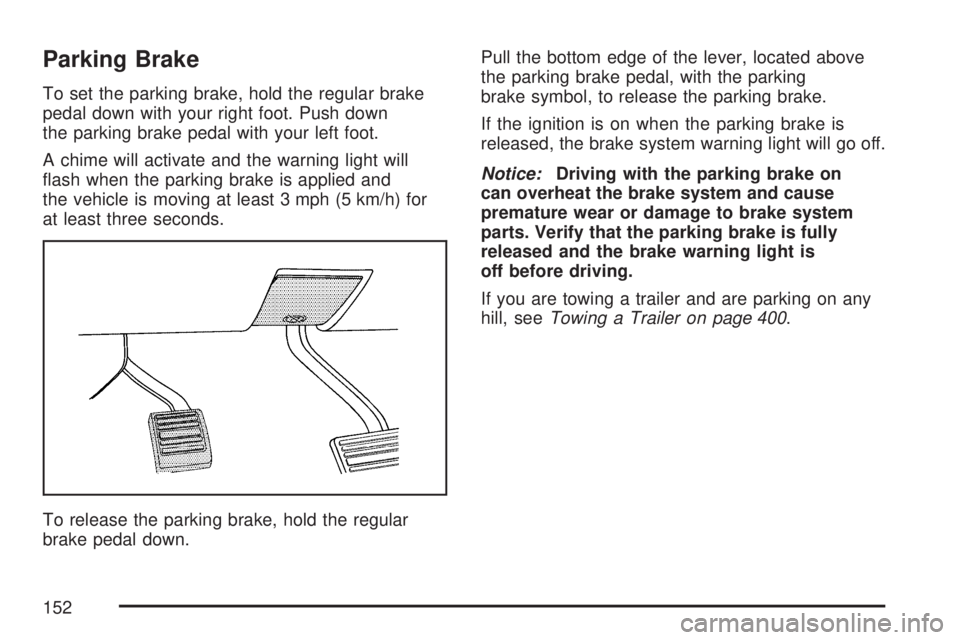
To set the parking brake, hold the regular brake
pedal down with your right foot. Push down
the parking brake pedal with your left foot.
A chime will activate and the warning light will
ash when the parking brake is applied and
the vehicle is moving at least 3 mph (5 km/h) for
at least three seconds.
To release the parking brake, hold the regular
brake pedal down.Pull the bottom edge of the lever, located above
the parking brake pedal, with the parking
brake symbol, to release the parking brake.
If the ignition is on when the parking brake is
released, the brake system warning light will go off.
Notice:Driving with the parking brake on
can overheat the brake system and cause
premature wear or damage to brake system
parts. Verify that the parking brake is fully
released and the brake warning light is
off before driving.
If you are towing a trailer and are parking on any
hill, seeTowing a Trailer on page 400.
152