tow GMC YUKON DENALI 2010 User Guide
[x] Cancel search | Manufacturer: GMC, Model Year: 2010, Model line: YUKON DENALI, Model: GMC YUKON DENALI 2010Pages: 560, PDF Size: 4.32 MB
Page 51 of 560
Folding and Tumbling the Seat(s) from the
Third Row Seats
{WARNING:
Using the third row seating position while the
second row is folded, or folded and tumbled, could
cause injury in a sudden stop or crash. Be sure to
return the seat to the passenger seating position.
Push and pull on the seat to make sure it is
locked into place.
Notice: Folding a rear seat with the safety belts still
fastened may cause damage to the seat or the
safety belts. Always unbuckle the safety belts and
return them to their normal stowed position before
folding a rear seat. To fold and tumble the seat from the third row seats,
if your vehicle has them:
1. Make sure that there is nothing under, in front of, or on the seat.
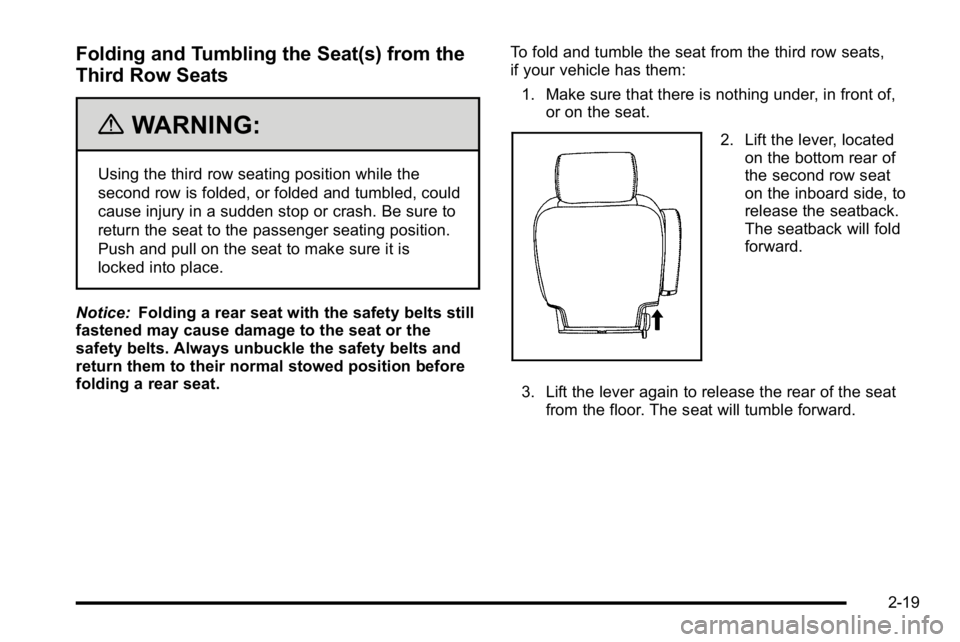
2. Lift the lever, locatedon the bottom rear of
the second row seat
on the inboard side, to
release the seatback.
The seatback will fold
forward.
3. Lift the lever again to release the rear of the seat from the floor. The seat will tumble forward.
2-19
Page 52 of 560
Automatic Seat Release Fold and
Tumble Feature
The transmission must be in (P) for this feature
to work.
{WARNING:
Automatically folding and tumbling the seat when
someone is sitting in the seat, could cause injury
to the person sitting there. Always make sure
there is no one sitting in the seat before pressing
the automatic seat release button.
Folding and Tumbling the Second Row
Seat(s) from the Third Row Seats or
Outside
{WARNING:
Using the third row seating position while the
second row is folded, or folded and tumbled, could
cause injury in a sudden stop or crash. Be sure to
return the seat to the passenger seating position.
Push and pull on the seat to make sure it is
locked into place.
To fold and tumble the seat from the third row seats,
if your vehicle has them, do the following: 1. Make sure that there is nothing under, in front of, or on the seat.
Notice: Folding a rear seat with the safety belts still
fastened may cause damage to the seat or the
safety belts. Always unbuckle the safety belts and
return them to their normal stowed position before
folding a rear seat.
2-20
Page 54 of 560
Third Row Seat
If the vehicle has a third row seat, the seatback(s)
can be folded and the entire seat can be tumbled,
or removed from the vehicle.
Folding the Seatback(s)
To fold the seatback, do the following:1. Open the liftgate to access the controls for the seat.
2. Remove all items on the seat cushion.
Notice: Folding a rear seat with the safety belts
still fastened may cause damage to the seat or the
safety belts. Always unbuckle the safety belts and
return them to their normal stowed position before
folding a rear seat.
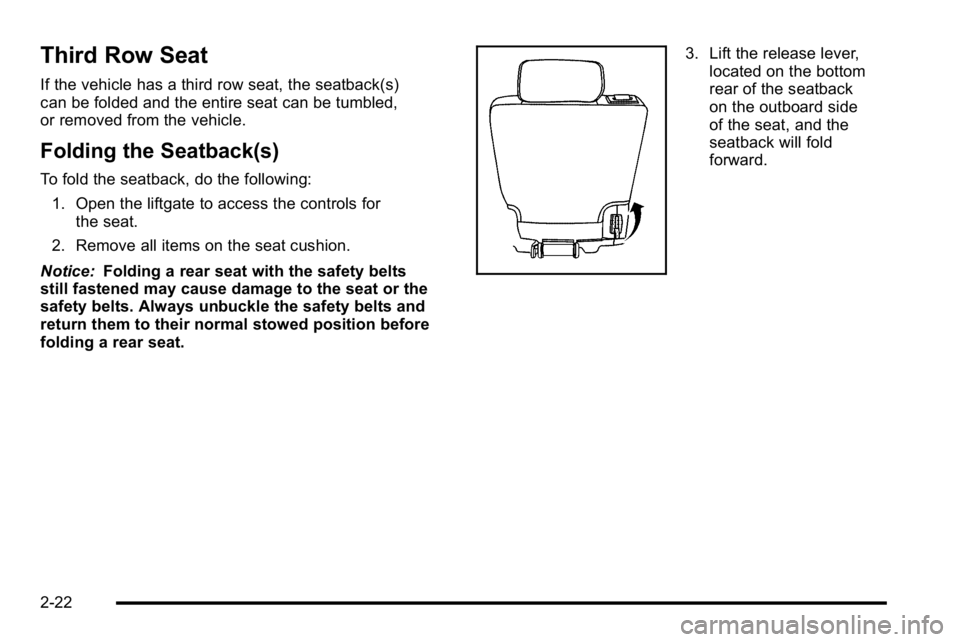
3. Lift the release lever, located on the bottom
rear of the seatback
on the outboard side
of the seat, and the
seatback will fold
forward.
2-22
Page 74 of 560
4. If equipped with a shoulder belt height adjuster,move it to the height that is right for you. See
“Shoulder Belt Height Adjustment” later in this
section for instructions on use and important
safety information.
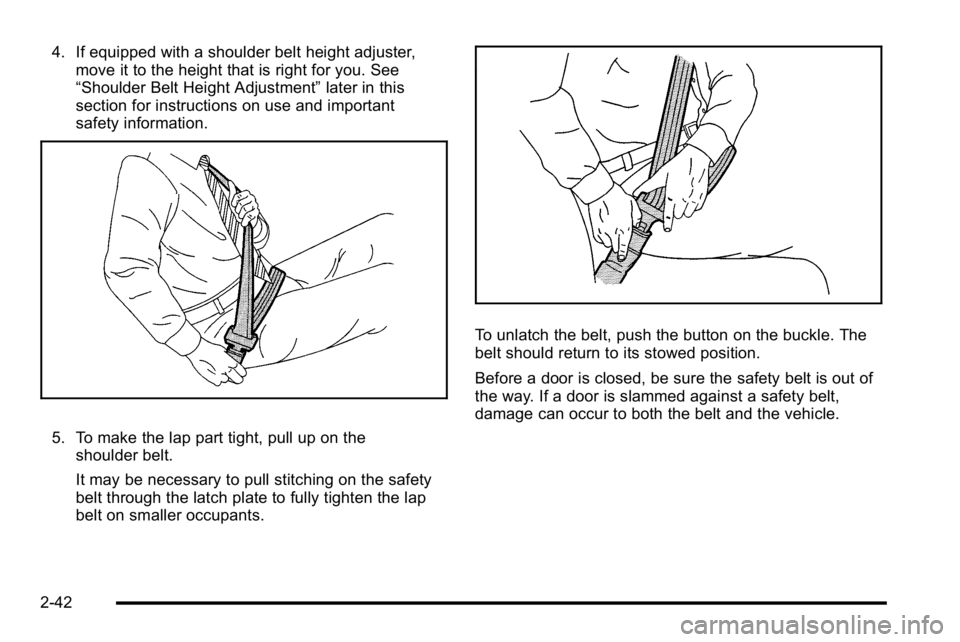
5. To make the lap part tight, pull up on the shoulder belt.
It may be necessary to pull stitching on the safety
belt through the latch plate to fully tighten the lap
belt on smaller occupants.
To unlatch the belt, push the button on the buckle. The
belt should return to its stowed position.
Before a door is closed, be sure the safety belt is out of
the way. If a door is slammed against a safety belt,
damage can occur to both the belt and the vehicle.
2-42
Page 97 of 560
Notice:Do not let the LATCH attachments rub
against the vehicle’ s safety belts. This may damage
these parts. If necessary, move buckled safety belts
to avoid rubbing the LATCH attachments.
Do not fold the empty rear seat with a safety belt
buckled. This could damage the safety belt or the
seat. Unbuckle and return the safety belt to its
stowed position, before folding the seat.
1. Attach and tighten the lower attachments to the lower anchors. If the child restraint does not have
lower attachments or the desired seating position
does not have lower anchors, secure the child
restraint with the top tether and the safety belts.
Refer to your child restraint manufacturer
instructions and the instructions in this manual.
1. 1. Find the lower anchors for the desired seating position.
1. 2. Put the child restraint on the seat.
1. 3. Attach and tighten the lower attachments on the child restraint to the lower anchors. 2. If the child restraint manufacturer recommends that
the top tether be attached, attach and tighten the
top tether to the top tether anchor, if the vehicle
has one. Refer to the child restraint instructions
and the following steps:
2. 1. Find the top tether anchor.
2. 2. Route, attach and tighten the top tether
according to your child restraint instructions
and the following instructions:
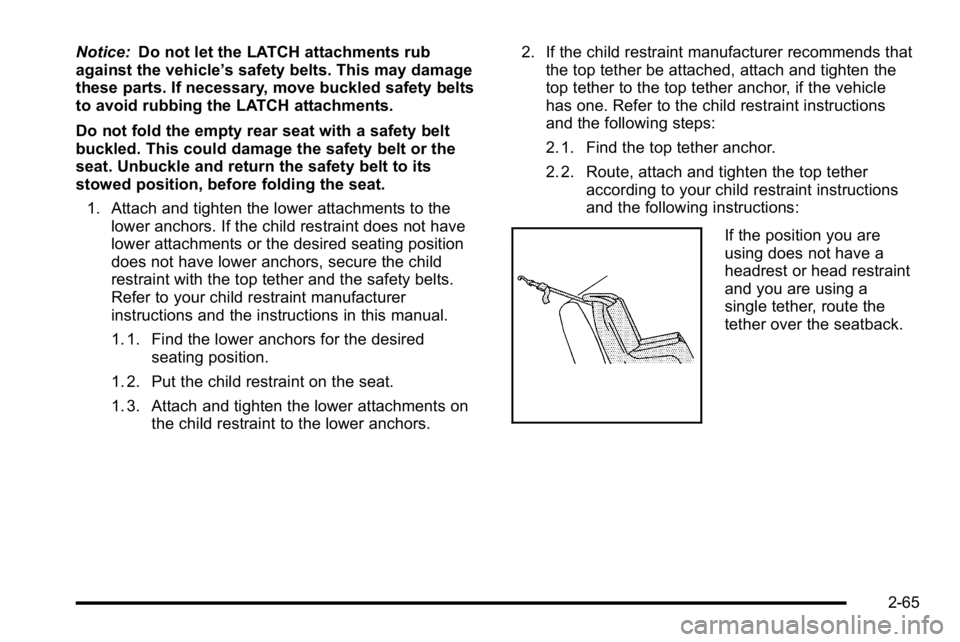
If the position you are
using does not have a
headrest or head restraint
and you are using a
single tether, route the
tether over the seatback.
2-65
Page 102 of 560
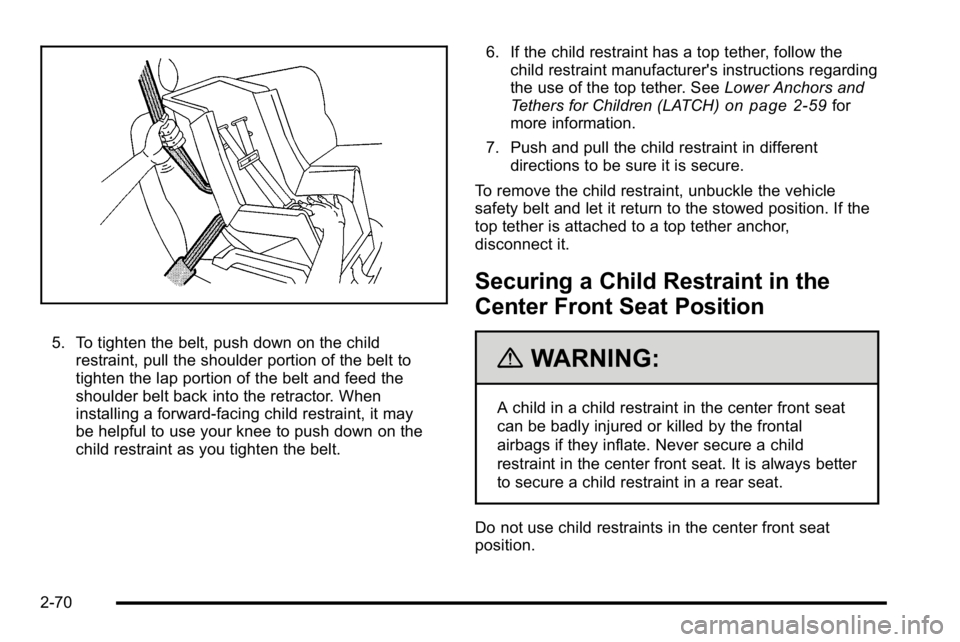
5. To tighten the belt, push down on the childrestraint, pull the shoulder portion of the belt to
tighten the lap portion of the belt and feed the
shoulder belt back into the retractor. When
installing a forward-facing child restraint, it may
be helpful to use your knee to push down on the
child restraint as you tighten the belt. 6. If the child restraint has a top tether, follow the
child restraint manufacturer's instructions regarding
the use of the top tether. See Lower Anchors and
Tethers for Children (LATCH)
on page 2‑59for
more information.
7. Push and pull the child restraint in different directions to be sure it is secure.
To remove the child restraint, unbuckle the vehicle
safety belt and let it return to the stowed position. If the
top tether is attached to a top tether anchor,
disconnect it.
Securing a Child Restraint in the
Center Front Seat Position
{WARNING:
A child in a child restraint in the center front seat
can be badly injured or killed by the frontal
airbags if they inflate. Never secure a child
restraint in the center front seat. It is always better
to secure a child restraint in a rear seat.
Do not use child restraints in the center front seat
position.
2-70
Page 106 of 560
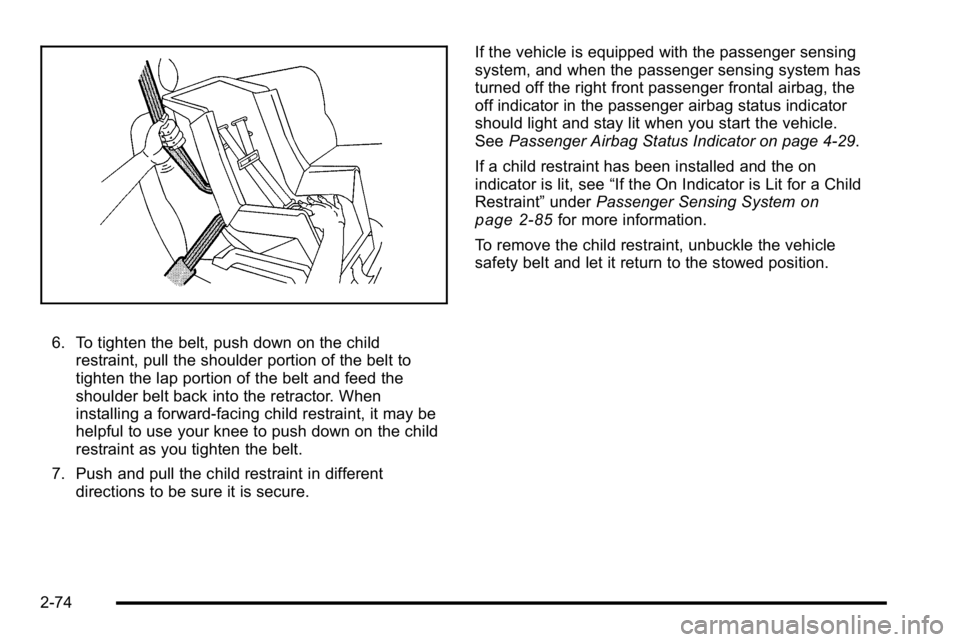
6. To tighten the belt, push down on the childrestraint, pull the shoulder portion of the belt to
tighten the lap portion of the belt and feed the
shoulder belt back into the retractor. When
installing a forward-facing child restraint, it may be
helpful to use your knee to push down on the child
restraint as you tighten the belt.
7. Push and pull the child restraint in different directions to be sure it is secure. If the vehicle is equipped with the passenger sensing
system, and when the passenger sensing system has
turned off the right front passenger frontal airbag, the
off indicator in the passenger airbag status indicator
should light and stay lit when you start the vehicle.
See
Passenger Airbag Status Indicator on page 4‑29.
If a child restraint has been installed and the on
indicator is lit, see “If the On Indicator is Lit for a Child
Restraint” underPassenger Sensing System
on
page 2‑85for more information.
To remove the child restraint, unbuckle the vehicle
safety belt and let it return to the stowed position.
2-74
Page 115 of 560
What Makes an Airbag Inflate?
In a deployment event, the sensing system sends an
electrical signal triggering a release of gas from the
inflator. Gas from the inflator fills the airbag causing the
bag to break out of the cover and deploy. The inflator,
the airbag, and related hardware are all part of the
airbag module.
Frontal airbag modules are located inside the
steering wheel and instrument panel. For vehicles with
seat‐mounted side impact airbags, there are airbags
modules in the side of the front seatbacks closest to the
door. For vehicles with roof-rail airbags, there are airbag
modules in the ceiling of the vehicle, near the side
windows that have occupant seating positions.
How Does an Airbag Restrain?
In moderate to severe frontal or near frontal collisions,
even belted occupants can contact the steering wheel
or the instrument panel. In moderate to severe side
collisions, even belted occupants can contact the
inside of the vehicle.Airbags supplement the protection provided by safety
belts. Frontal airbags distribute the force of the impact
more evenly over the occupant's upper body, stopping
the occupant more gradually. Seat‐mounted side impact
and roof-rail airbags distribute the force of the impact
more evenly over the occupant's upper body.
Rollover capable roof-rail airbags are designed to help
contain the head and chest of occupants in the
outboard seating positions in the first, second, and third
rows, if equipped with a third row seat. The rollover
capable roof-rail airbags are designed to help reduce
the risk of full or partial ejection in rollover events,
although no system can prevent all such ejections.
But airbags would not help in many types of collisions,
primarily because the occupant's motion is not toward
those airbags. See
When Should an Airbag Inflate?
on
page 2‑81for more information.
Airbags should never be regarded as anything more
than a supplement to safety belts.
2-83
Page 122 of 560
Additional Factors Affecting System
Operation
Safety belts help keep the passenger in position on the
seat during vehicle maneuvers and braking, which helps
the passenger sensing system maintain the passenger
airbag status. See“Safety Belts”and“Child Restraints”
in the Index for additional information about the
importance of proper restraint use.
If the shoulder portion of the belt is pulled out all the
way, the child restraint locking feature will be engaged.
This may unintentionally cause the passenger sensing
system to turn the airbag off for some adult size
occupants. If this happens, let the belt go back all the
way and start again.
A thick layer of additional material, such as a blanket
or cushion, or aftermarket equipment such as seat
covers, seat heaters, and seat massagers can affect
how well the passenger sensing system operates. We recommend that you not use seat covers or other
aftermarket equipment except when approved by GM
for your specific vehicle. See
Adding Equipment to Your
Airbag-Equipped Vehicleon page 2‑91for more
information about modifications that can affect how the
system operates.
The on indicator may be lit if an object, such as a
briefcase, handbag, grocery bag, laptop or other
electronic device, is put on an unoccupied seat.
If this is not desired remove the object from the seat.
{WARNING:
Stowing of articles under the passenger seat or
between the passenger seat cushion and
seatback may interfere with the proper operation
of the passenger sensing system.
2-90
Page 127 of 560
Section 3 Features and Controls
Keys. . . . . . . . . . . . . . . . . . . . . . . . . . . . . . . . . . . . . . . . . . . . . . . . 3-3
Remote Keyless Entry (RKE) System . . . . . . . . . . . 3-4
Remote Keyless Entry (RKE) System Operation . . . . . . . . . . . . . . . . . . . . . . . . . . . . . . . . . . . . . 3-4
Remote Vehicle Start . . . . . . . . . . . . . . . . . . . . . . . . . . . 3-7
Doors and Locks . . . . . . . . . . . . . . . . . . . . . . . . . . . . . . . . . . 3-9
Door Locks . . . . . . . . . . . . . . . . . . . . . . . . . . . . . . . . . . . . . 3-9
Power Door Locks . . . . . . . . . . . . . . . . . . . . . . . . . . . . . 3-10
Delayed Locking . . . . . . . . . . . . . . . . . . . . . . . . . . . . . . . 3-10
Programmable Automatic Door Locks . . . . . . . . . . 3-10
Rear Door Security Locks . . . . . . . . . . . . . . . . . . . . . 3-10
Lockout Protection . . . . . . . . . . . . . . . . . . . . . . . . . . . . . 3-11
Liftgate/Liftglass . . . . . . . . . . . . . . . . . . . . . . . . . . . . . . . 3-12
Power Liftgate . . . . . . . . . . . . . . . . . . . . . . . . . . . . . . . . . 3-14
Power Assist Steps . . . . . . . . . . . . . . . . . . . . . . . . . . . . 3-17
Windows . . . . . . . . . . . . . . . . . . . . . . . . . . . . . . . . . . . . . . . . . . 3-18
Power Windows . . . . . . . . . . . . . . . . . . . . . . . . . . . . . . . 3-19
Sun Visors . . . . . . . . . . . . . . . . . . . . . . . . . . . . . . . . . . . . . 3-20 Theft-Deterrent Systems
. . . . . . . . . . . . . . . . . . . . . . . . .3-20
Content Theft-Deterrent . . . . . . . . . . . . . . . . . . . . . . . . 3-20
PASS-Key
®III+ Electronic Immobilizer . . . . . . . . . 3-22
PASS-Key®III+ Electronic Immobilizer
Operation . . . . . . . . . . . . . . . . . . . . . . . . . . . . . . . . . . . . 3-22
Starting and Operating Your Vehicle . . . . . . . . . . . .3-24
New Vehicle Break-In . . . . . . . . . . . . . . . . . . . . . . . . . . 3-24
Ignition Positions . . . . . . . . . . . . . . . . . . . . . . . . . . . . . . 3-25
Retained Accessory Power (RAP) . . . . . . . . . . . . . 3-26
Starting the Engine . . . . . . . . . . . . . . . . . . . . . . . . . . . . 3-26
Adjustable Throttle and Brake Pedal . . . . . . . . . . . 3-28
Engine Coolant Heater . . . . . . . . . . . . . . . . . . . . . . . . . 3-28
Active Fuel Management™ . . . . . . . . . . . . . . . . . . . . 3-29
Automatic Transmission Operation . . . . . . . . . . . . . 3-30
Tow/Haul Mode . . . . . . . . . . . . . . . . . . . . . . . . . . . . . . . . 3-34
Parking Brake . . . . . . . . . . . . . . . . . . . . . . . . . . . . . . . . . 3-36
Shifting Into Park . . . . . . . . . . . . . . . . . . . . . . . . . . . . . . 3-37
Shifting Out of Park . . . . . . . . . . . . . . . . . . . . . . . . . . . . 3-38
Parking Over Things That Burn . . . . . . . . . . . . . . . . 3-39
Engine Exhaust . . . . . . . . . . . . . . . . . . . . . . . . . . . . . . . . 3-40
Running the Vehicle While Parked . . . . . . . . . . . . . 3-41
3-1