air condition GMC YUKON XL 2011 Service Manual
[x] Cancel search | Manufacturer: GMC, Model Year: 2011, Model line: YUKON XL, Model: GMC YUKON XL 2011Pages: 528, PDF Size: 7.64 MB
Page 401 of 528

Black plate (23,1)GMC Yukon/Yukon XL Owner Manual - 2011
Vehicle Care 10-23
.Idles for long periods in traffic.
.Tows a trailer. SeeTrailer
Towing on page 9‑79.
If the overheat warning is displayed
with no sign of steam:
1. Turn the air conditioning off.
2. Turn the heater on to the highest temperature and to the highest
fan speed. Open the windows as
necessary.
3. In heavy traffic, let the engine idle in N (Neutral)
while stopped. If it is safe to
do so, pull off the road, shift to
P (Park) or N (Neutral) and let
the engine idle.
If the temperature overheat gauge
is no longer in the overheat zone
or an overheat warning no longer
displays, the vehicle can be driven.
Continue to drive the vehicle slowly
for about 10 minutes. Keep a safe
vehicle distance from the vehicle in
front. If the warning does not come
back on, continue to drive normally. If the warning continues, pull
over, stop, and park the vehicle
right away.
If there is no sign of steam, idle
the engine for three minutes
while parked. If the warning is still
displayed, turn off the engine until it
cools down. Also, see
“Overheated
Engine Protection Operating Mode”
later in this section.
Overheated Engine
Protection
Operating Mode
If an overheated engine condition
exists and the ENGINE POWER IS
REDUCED message is displayed,
an overheat protection mode which
alternates firing groups of cylinders
helps prevent engine damage. In
this mode, a loss in power and
engine performance will be noticed.
This operating mode allows the
vehicle to be driven to a safe place
in an emergency. Driving extended distances and/or towing a trailer
in the overheat protection mode
should be avoided.
Notice:
After driving in the
overheated engine protection
operating mode, to avoid engine
damage, allow the engine to cool
before attempting any repair.
The engine oil will be severely
degraded. Repair the cause of
coolant loss, change the oil and
reset the oil life system. See
Engine Oil on page 10‑7.
Engine Fan
If the vehicle has a clutched
engine cooling fan, when the clutch
is engaged, the fan spins faster to
provide more air to cool the engine.
In most everyday driving conditions,
the fan is spinning slower and
the clutch is not fully engaged.
Page 402 of 528
Black plate (24,1)GMC Yukon/Yukon XL Owner Manual - 2011
10-24 Vehicle Care
This improves fuel economy and
reduces fan noise. Under heavy
vehicle loading, trailer towing, and/
or high outside temperatures, the
fan speed increases as the clutch
more fully engages, so an increase
in fan noise may be heard. This is
normal and should not be mistaken
as the transmission slipping or
making extra shifts. It is merely the
cooling system functioning properly.
The fan will slow down when
additional cooling is not required
and the clutch disengages.
This fan noise may also be heard
when starting the engine. It will go
away as the fan clutch partially
disengages.
If the vehicle has electric cooling
fans, the fans may be heard
spinning at low speed during most
everyday driving. The fans may
turn off if no cooling is required.
Under heavy vehicle loading, trailer
towing, high outside temperatures,or operation of the air conditioning
system, the fans may change to
high speed and an increase in fan
noise may be heard. This is
normal and indicates that the
cooling system is functioning
properly. The fans will change to
low speed when additional cooling
is no longer required.
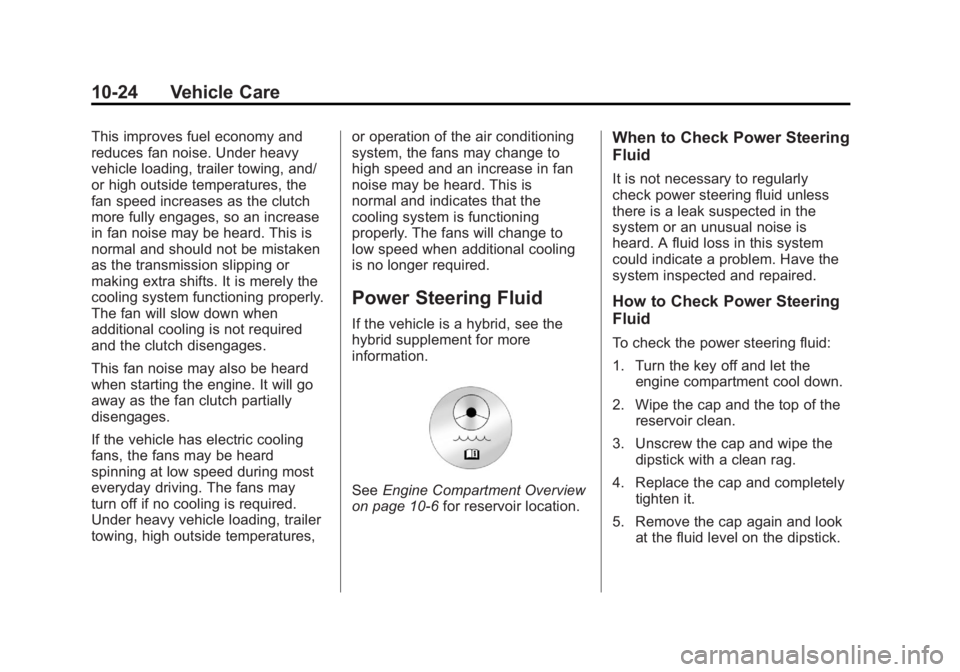
Power Steering Fluid
If the vehicle is a hybrid, see the
hybrid supplement for more
information.
See
Engine Compartment Overview
on page 10‑6 for reservoir location.
When to Check Power Steering
Fluid
It is not necessary to regularly
check power steering fluid unless
there is a leak suspected in the
system or an unusual noise is
heard. A fluid loss in this system
could indicate a problem. Have the
system inspected and repaired.
How to Check Power Steering
Fluid
To check the power steering fluid:
1. Turn the key off and let the
engine compartment cool down.
2. Wipe the cap and the top of the reservoir clean.
3. Unscrew the cap and wipe the dipstick with a clean rag.
4. Replace the cap and completely tighten it.
5. Remove the cap again and look at the fluid level on the dipstick.
Page 404 of 528
Black plate (26,1)GMC Yukon/Yukon XL Owner Manual - 2011
10-26 Vehicle Care
Brakes
This vehicle has disc brakes. Disc
brake pads have built-in wear
indicators that make a high-pitched
warning sound when the brake pads
are worn and new pads are needed.
The sound can come and go or be
heard all the time the vehicle is
moving, except when applying the
brake pedal firmly.
{WARNING
The brake wear warning sound
means that soon the brakes will
not work well. That could lead to
a crash. When the brake wear
warning sound is heard, have the
vehicle serviced.
Notice: Continuing to drive with
worn-out brake pads could result
in costly brake repair. Some driving conditions or climates
can cause a brake squeal when the
brakes are first applied or lightly
applied. This does not mean
something is wrong with the brakes.
Properly torqued wheel nuts are
necessary to help prevent brake
pulsation. When tires are rotated,
inspect brake pads for wear and
evenly tighten wheel nuts in
the proper sequence to torque
specifications in
Capacities and
Specifications on page 12‑2.
Brake linings should always be
replaced as complete axle sets.
Brake Pedal Travel
See your dealer if the brake pedal
does not return to normal height,
or if there is a rapid increase in
pedal travel. This could be a
sign that brake service might be
required.
Brake Adjustment
Every time the brakes are applied,
with or without the vehicle moving,
the brakes adjust for wear.
Replacing Brake System Parts
The braking system on a vehicle is
complex. Its many parts have to be
of top quality and work well together
if the vehicle is to have really good
braking. The vehicle was designed
and tested with top-quality brake
parts. When parts of the braking
system are replaced, be sure to get
new, approved replacement parts.
If this is not done, the brakes might
not work properly. For example,
installing disc brake pads that are
wrong for the vehicle, can change
the balance between the front and
rear brakes —for the worse. The
braking performance expected can
change in many other ways if the
wrong replacement brake parts are
installed.
Page 421 of 528
Black plate (43,1)GMC Yukon/Yukon XL Owner Manual - 2011
Vehicle Care 10-43
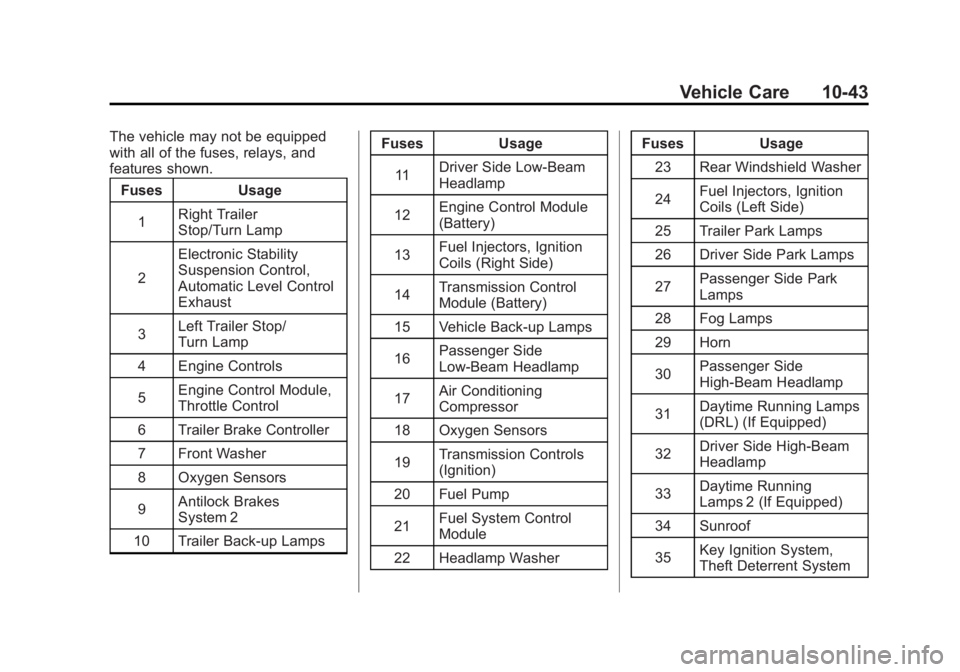
The vehicle may not be equipped
with all of the fuses, relays, and
features shown.Fuses Usage
1 Right Trailer
Stop/Turn Lamp
2 Electronic Stability
Suspension Control,
Automatic Level Control
Exhaust
3 Left Trailer Stop/
Turn Lamp
4 Engine Controls
5 Engine Control Module,
Throttle Control
6 Trailer Brake Controller
7 Front Washer
8 Oxygen Sensors
9 Antilock Brakes
System 2
10 Trailer Back-up Lamps Fuses Usage
11 Driver Side Low-Beam
Headlamp
12 Engine Control Module
(Battery)
13 Fuel Injectors, Ignition
Coils (Right Side)
14 Transmission Control
Module (Battery)
15 Vehicle Back-up Lamps
16 Passenger Side
Low-Beam Headlamp
17 Air Conditioning
Compressor
18 Oxygen Sensors
19 Transmission Controls
(Ignition)
20 Fuel Pump
21 Fuel System Control
Module
22 Headlamp Washer Fuses Usage
23 Rear Windshield Washer
24 Fuel Injectors, Ignition
Coils (Left Side)
25 Trailer Park Lamps
26 Driver Side Park Lamps
27 Passenger Side Park
Lamps
28 Fog Lamps
29 Horn
30 Passenger Side
High-Beam Headlamp
31 Daytime Running Lamps
(DRL) (If Equipped)
32 Driver Side High-Beam
Headlamp
33 Daytime Running
Lamps 2 (If Equipped)
34 Sunroof
35 Key Ignition System,
Theft Deterrent System
Page 423 of 528
Black plate (45,1)GMC Yukon/Yukon XL Owner Manual - 2011
Vehicle Care 10-45
J-CaseFuses Usage
68 Stud 1 (Trailer Connector
Battery Power)
69 Mid-Bussed Electrical
Center 1
70 Climate Control Blower
71 Power Liftgate Module
72 Left Bussed Electrical
Center 2
Relays Usage
FAN HI Cooling Fan High
Speed
FAN LO Cooling Fan Low
Speed
FAN
CNTRL Cooling Fan Control Relays Usage
HDLP
LO/HID Low-Beam Headlamp
FOG
LAMP Front Fog Lamps
A/C
CMPRSR Air Conditioning
Compressor
STRTR Starter
PWR/TRN Powertrain
FUEL
PMP Fuel Pump
PRK
LAMP Parking Lamps
REAR
DEFOG Rear Defogger
RUN/
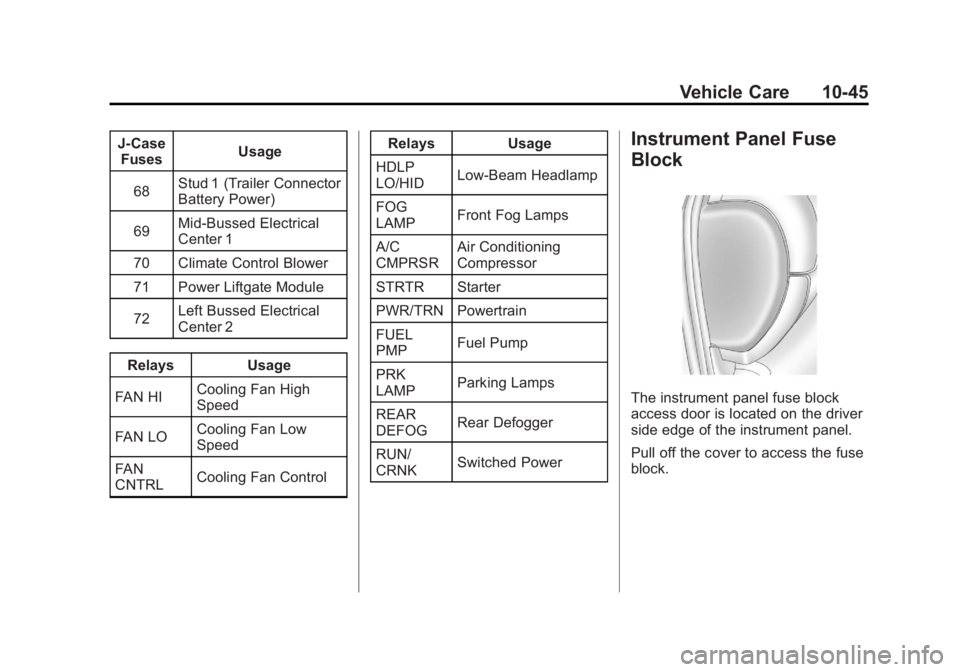
CRNK Switched PowerInstrument Panel Fuse
Block
The instrument panel fuse block
access door is located on the driver
side edge of the instrument panel.
Pull off the cover to access the fuse
block.
Page 431 of 528
Black plate (53,1)GMC Yukon/Yukon XL Owner Manual - 2011
Vehicle Care 10-53
size means a light truck tire
engineered to standards set
by the U.S. Tire and Rim
Association.
(B) Tire Width
:The three‐digit
number indicates the tire section
width in millimeters from
sidewall to sidewall.
(C) Aspect Ratio
:A two‐digit
number that indicates the tire
height‐to‐width measurements.
For example, if the tire size
aspect ratio is 75, as shown
in item C of the light truck
(LT‐Metric) tire illustration, it
would mean that the tire's
sidewall is 75 percent as high
as it is wide. (D) Construction Code
:A
letter code is used to indicate
the type of ply construction in
the tire. The letter R means
radial ply construction; the
letter D means diagonal or
bias ply construction; and the
letter B means belted‐bias ply
construction.
(E) Rim Diameter
:Diameter of
the wheel in inches.
(F) Load Range
:Load Range.
(G) Service Description
:The
service description indicates the
load index and speed rating of a
tire. If two numbers are given as
in the example, 120/116, then
this represents the load index for
single versus dual wheel usage
(single/dual). The speed rating
is the maximum speed a tire is
certified to carry a load.
Tire Terminology and
Definitions
Air Pressure:The amount
of air inside the tire pressing
outward on each square inch
of the tire. Air pressure is
expressed in psi (pounds per
square inch) or kPa (kilopascal).
Accessory Weight
:The
combined weight of optional
accessories. Some examples
of optional accessories are,
automatic transmission, power
steering, power brakes, power
windows, power seats, and air
conditioning.
Aspect Ratio
:The relationship
of a tire's height to its width.
Belt
:A rubber coated layer of
cords that is located between
the plies and the tread. Cords
may be made from steel or other
reinforcing materials.
Page 437 of 528
Black plate (59,1)GMC Yukon/Yukon XL Owner Manual - 2011
Vehicle Care 10-59
alternate tires and wheels allow
the TPMS to continue to function
properly.
SeeTire Pressure Monitor
Operation on page 10‑59 for
additional information.
Federal Communications
Commission (FCC) and
Industry Canada
See Radio Frequency Statement on
page 13‑16 for information
regarding Part 15 of the Federal
Communications Commission (FCC)
rules and Industry Canada
Standards RSS-210/220/310.
Tire Pressure Monitor
Operation
If the vehicle is a hybrid, see the
hybrid supplement for more
information. This vehicle may have a Tire
Pressure Monitor System (TPMS).
The TPMS is designed to warn the
driver when a low tire pressure
condition exists. TPMS sensors are
mounted onto each tire and wheel
assembly, excluding the spare tire
and wheel assembly. The TPMS
sensors monitor the air pressure
in the tires and transmit the tire
pressure readings to a receiver
located in the vehicle.
When a low tire pressure condition
is detected, the TPMS illuminates
the low tire pressure warning light
located on the instrument cluster.
If the warning light comes on, stop
as soon as possible and inflate
the tires to the recommendedpressure shown on the tire loading
information label. See
Vehicle Load
Limits on page 9‑23.
A message to check the pressure in
a specific tire displays in the Driver
Information Center (DIC). The low
tire pressure warning light and the
DIC warning message come on at
each ignition cycle until the tires
are inflated to the correct inflation
pressure. Using the DIC, tire
pressure levels can be viewed.
For additional information and
details about the DIC operation
and displays see Driver Information
Center (DIC) on page 5‑28 andTire
Messages on page 5‑45.
The low tire pressure warning light
may come on in cool weather when
the vehicle is first started, and then
turn off as the vehicle is driven. This
could be an early indicator that the
air pressure is getting low and
needs to be inflated to the proper
pressure.
Page 446 of 528
Black plate (68,1)GMC Yukon/Yukon XL Owner Manual - 2011
10-68 Vehicle Care
Temperature–A, B, C
The temperature grades
are A (the highest), B, and C,
representing the tire's resistance
to the generation of heat and
its ability to dissipate heat
when tested under controlled
conditions on a specified indoor
laboratory test wheel. Sustained
high temperature can cause
the material of the tire to
degenerate and reduce tire
life, and excessive temperature
can lead to sudden tire failure.
The grade C corresponds to a
level of performance which all
passenger car tires must meet
under the Federal Motor Safety
Standard No. 109. Grades B
and A represent higher levels of
performance on the laboratory
test wheel than the minimum
required by law. Warning: The
temperature grade for this tire is established for a tire that is
properly inflated and not
overloaded. Excessive speed,
underinflation, or excessive
loading, either separately or in
combination, can cause heat
buildup and possible tire failure.
Wheel Alignment and Tire
Balance
The tires and wheels were aligned
and balanced at the factory to
provide the longest tire life and best
overall performance. Adjustments to
wheel alignment and tire balancing
will not be necessary on a regular
basis. However, check the
alignment if there is unusual tire
wear or if the vehicle is pulling to
one side or the other. If the vehicle
vibrates when driving on a smooth
road, the tires and wheels might
need to be rebalanced. See your
dealer for proper diagnosis.
Wheel Replacement
Replace any wheel that is bent,
cracked, or badly rusted or
corroded. If wheel nuts keep coming
loose, the wheel, wheel bolts, and
wheel nuts should be replaced.
If the wheel leaks air, replace it.
Some aluminum wheels can be
repaired. See your dealer if any of
these conditions exist.
Your dealer will know the kind of
wheel that is needed.
Each new wheel should have the
same load-carrying capacity,
diameter, width, offset, and be
mounted the same way as the one it
replaces.
Replace wheels, wheel bolts, wheel
nuts, or Tire Pressure Monitor
System (TPMS) sensors with new
GM original equipment parts.
Page 478 of 528
Black plate (100,1)GMC Yukon/Yukon XL Owner Manual - 2011
10-100 Vehicle Care
Exterior painted surfaces are
subject to aging, weather and
chemical fallout that can take their
toll over a period of years. To help
keep the paint finish looking new,
keep the vehicle garaged or
covered whenever possible.
Protecting Exterior Bright Metal
Parts
Bright metal parts should be
cleaned regularly to keep their
luster. Washing with water is all that
is usually needed. However, chrome
polish may be used on chrome or
stainless steel trim, if necessary.
Use special care with aluminum
trim. To avoid damaging protective
trim, never use auto or chrome
polish, steam or caustic soap to
clean aluminum. A coating of
wax, rubbed to high polish, is
recommended for all bright metal
parts.Windshield, Backglass, and
Wiper Blades
Clean the outside of the windshield
and backglass with glass cleaner.
Clean the rubber blades using a lint
free cloth or paper towel soaked
with windshield washer fluid or a
mild detergent. Wash the windshield
thoroughly when you clean the
blades. Bugs, road grime, sap
and a buildup of vehicle wash/wax
treatments may cause wiper
streaking. Replace the wiper blades
if they are worn or damaged.
Wipers can be damaged by:
.Extreme dusty conditions
.Sand and salt
.Heat and sun
.Snow and ice, without proper
removal
Aluminum Wheels
Notice:Using strong soaps,
chemicals, abrasive polishes,
cleaners, brushes, or cleaners
that contain acid on aluminum or
chrome-plated wheels, could
damage the surface of the
wheel(s). The repairs would
not be covered by the vehicle
warranty. Use only approved
cleaners on aluminum or
chrome-plated wheels.
Keep the wheels clean using a
soft clean cloth with mild soap and
water. Rinse with clean water. After
rinsing thoroughly, dry with a soft
clean towel. A wax may then be
applied.
Notice: Using chrome polish on
aluminum wheels could damage
the wheels. The repairs would
not be covered by the vehicle
warranty. Use chrome polish on
chrome wheels only.
Page 480 of 528
Black plate (102,1)GMC Yukon/Yukon XL Owner Manual - 2011
10-102 Vehicle Care
At least every spring, flush these
materials from the underbody
with plain water. Clean any areas
where mud and debris can collect.
Dirt packed in close areas of the
frame should be loosened before
being flushed. Your dealer or an
underbody car washing system can
do this.
Chemical Paint Spotting
Some weather and atmospheric
conditions can create a chemical
fallout. Airborne pollutants can fall
upon and attack painted surfaces on
the vehicle. This damage can take
two forms: blotchy, ring-shaped
discolorations, and small, irregular
dark spots etched into the paint
surface.
Although no defect in the paint job
causes this, we will repair, at no
charge to the owner, the surfaces
of new vehicles damaged by this
fallout condition within 12 months or
20 000 km (12,000 mi) of purchase,
whichever occurs first.
Interior Care
The interior will continue to look its
best if it is cleaned often. Although
not always visible, dust and dirt can
accumulate on the upholstery. Dirt
can damage carpet, fabric, leather,
and plastic surfaces. Regular
vacuuming is recommended
to remove particles from the
upholstery. It is important to keep
the upholstery from becoming and
remaining heavily soiled. Soils
should be removed as quickly
as possible. The interior may
experience extremes of heat that
could cause stains to set rapidly.
Lighter colored interiors may
require more frequent cleaning.
Use care because newspapers and
garments that transfer color to home
furnishings may also transfer color
to the interior.When cleaning the interior, only
use cleaners specifically designed
for the surfaces being cleaned.
Permanent damage may result
from using cleaners on surfaces for
which they were not intended.
Use glass cleaner only on glass.
Remove any accidental over-spray
from other surfaces immediately. To
prevent over-spray, apply cleaner
directly to the cleaning cloth.
Notice:
Using abrasive cleaners
when cleaning glass surfaces on
the vehicle, could scratch the
glass and/or cause damage to
the rear window defogger. When
cleaning the glass on the vehicle,
use only a soft cloth and glass
cleaner.
Many cleaners contain solvents that
may become concentrated in the
breathing space. Before using
cleaners, read and adhere to all
safety instructions on the label.
While cleaning the interior, maintain
adequate ventilation by opening the
doors and windows.