steering GREAT WALL FLORID 2008 Owner's Manual
[x] Cancel search | Manufacturer: GREAT WALL, Model Year: 2008, Model line: FLORID, Model: GREAT WALL FLORID 2008Pages: 281, PDF Size: 43.97 MB
Page 120 of 281
Downloaded from www.Manualslib.com manuals search engine 113Brake System
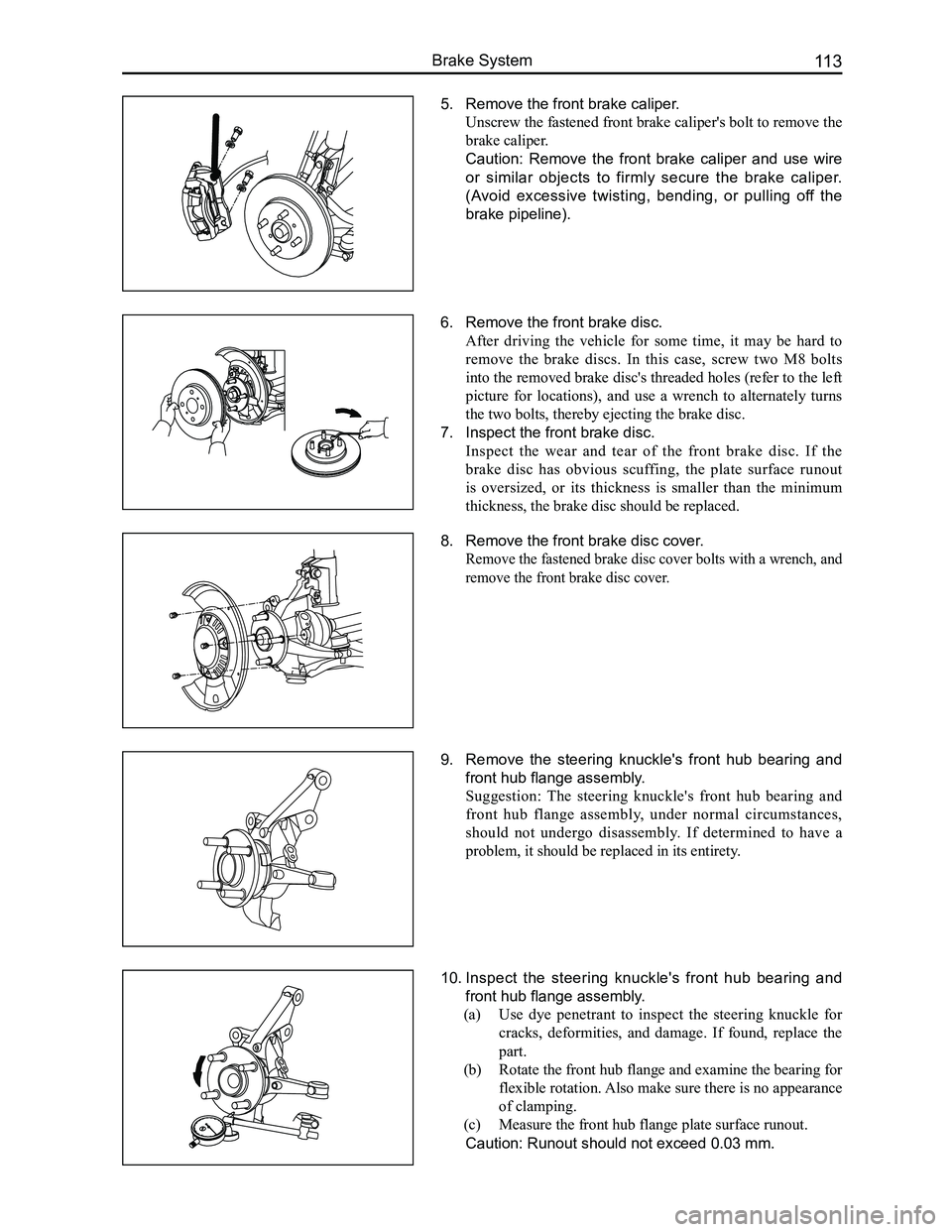
5. Remove the front brake caliper.
Unscrew the fastened front brake caliper's bolt to remove the
brake caliper.
Caution: Remove the front brake caliper and use wire
or similar objects to firmly secure the brake caliper.
(Avoid excessive twisting, bending, or pulling off the
brake pipeline).
6. Remove the front brake disc.
After driving the vehicle for some time, it may be hard to
remove the brake discs. In this case, screw two M8 bolts
into the removed brake disc's threaded holes (refer to the left
picture for locations), and use a wrench to alternately turns
the two bolts, thereby ejecting the brake disc.
7. Inspect the front brake disc.
Inspect the wear and tear of the front brake disc. If the
brake disc has obvious scuffing, the plate surface runout
is oversized, or its thickness is smaller than the minimum
thickness, the brake disc should be replaced.
8. Remove the front brake disc cover.
Remove the fastened brake disc cover bolts with a wrench, and
remove the front brake disc cover.
9. Remove the steering knuckle's front hub bearing and
front hub flange assembly.
Suggestion: The steering knuckle's front hub bearing and
front hub flange assembly, under normal circumstances,
should not undergo disassembly. If determined to have a
problem, it should be replaced in its entirety.
10. Inspect the steering knuckle's front hub bearing and
front hub flange assembly.
(a) Use dye penetrant to inspect the steering knuckle for
cracks, deformities, and damage. If found, replace the
part.
(b) Rotate the front hub flange and examine the bearing for
flexible rotation. Also make sure there is no appearance
of clamping.
(c) Measure the front hub flange plate surface runout.
Caution: Runout should not exceed 0.03 mm.
Page 121 of 281
Downloaded from www.Manualslib.com manuals search engine GWFLORID Maintenance Manual114
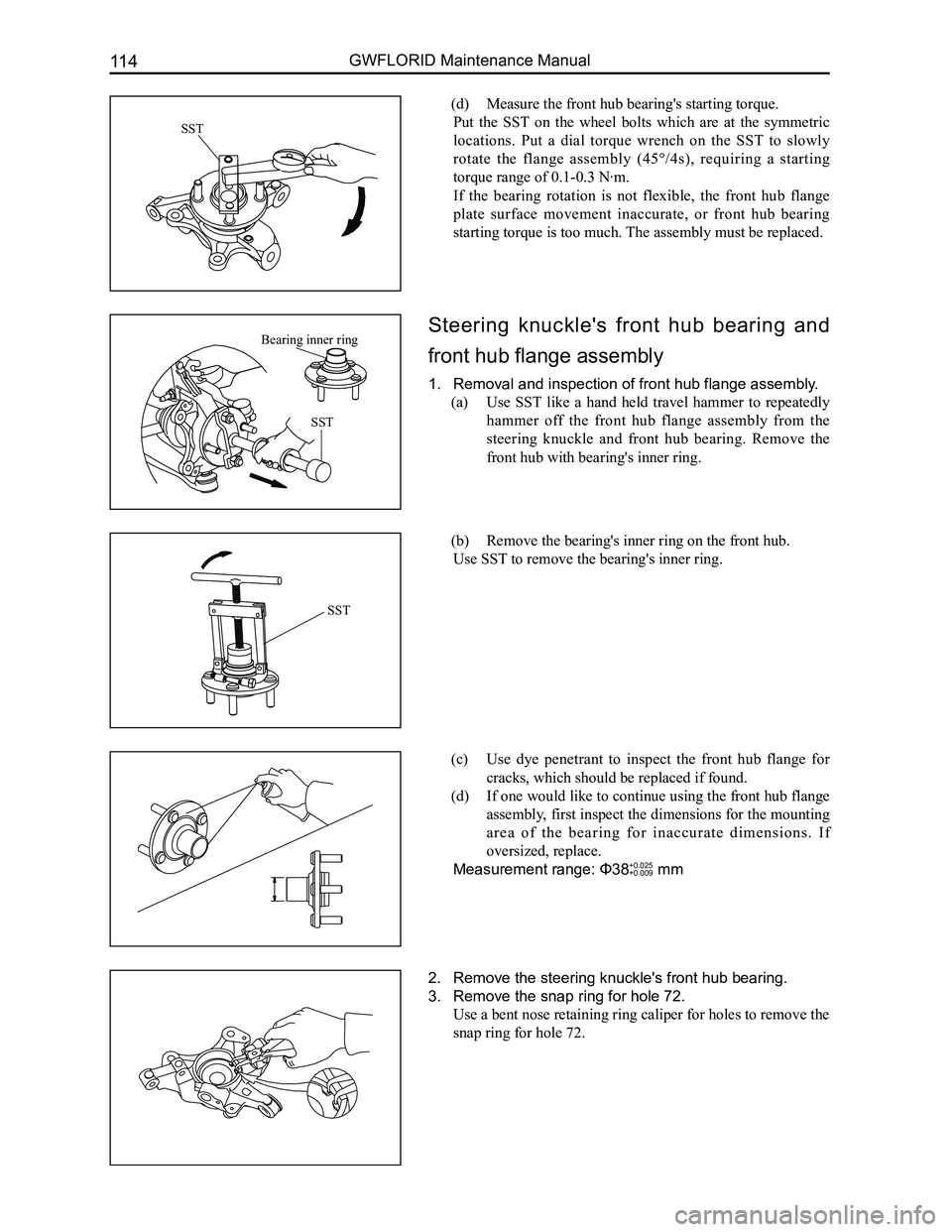
(d) Measure the front hub bearing's starting torque.
Put the SST on the wheel bolts which are at the symmetric
locations. Put a dial torque wrench on the SST to slowly
rotate the flange assembly (45°/4s), requiring a starting
torque range of 0.1-0.3 N·m.
If the bearing rotation is not flexible, the front hub flange
plate surface movement inaccurate, or front hub bearing
starting torque is too much. The assembly must be replaced.
Steering knuckle's front hub bearing and
front hub flange assembly
1. Removal and inspection of front hub flange assembly.
(a) Use SST like a hand held travel hammer to repeatedly
hammer off the front hub flange assembly from the
steering knuckle and front hub bearing. Remove the
front hub with bearing's inner ring.
(b) Remove the bearing's inner ring on the front hub.
Use SST to remove the bearing's inner ring.
SST
SST
Bearing inner ring
SST
(c) Use dye penetrant to inspect the front hub flange for
cracks, which should be replaced if found.
(d) If one would like to continue using the front hub flange
assembly, first inspect the dimensions for the mounting
area of the bearing for inaccurate dimensions. If
oversized, replace.
Measurement range: Φ38+0.025 +0.009 mm
2. Remove the steering knuckle's front hub bearing.
3. Remove the snap ring for hole 72.
Use a bent nose retaining ring caliper for holes to remove the
snap ring for hole 72.
Page 122 of 281
Downloaded from www.Manualslib.com manuals search engine 115Brake System
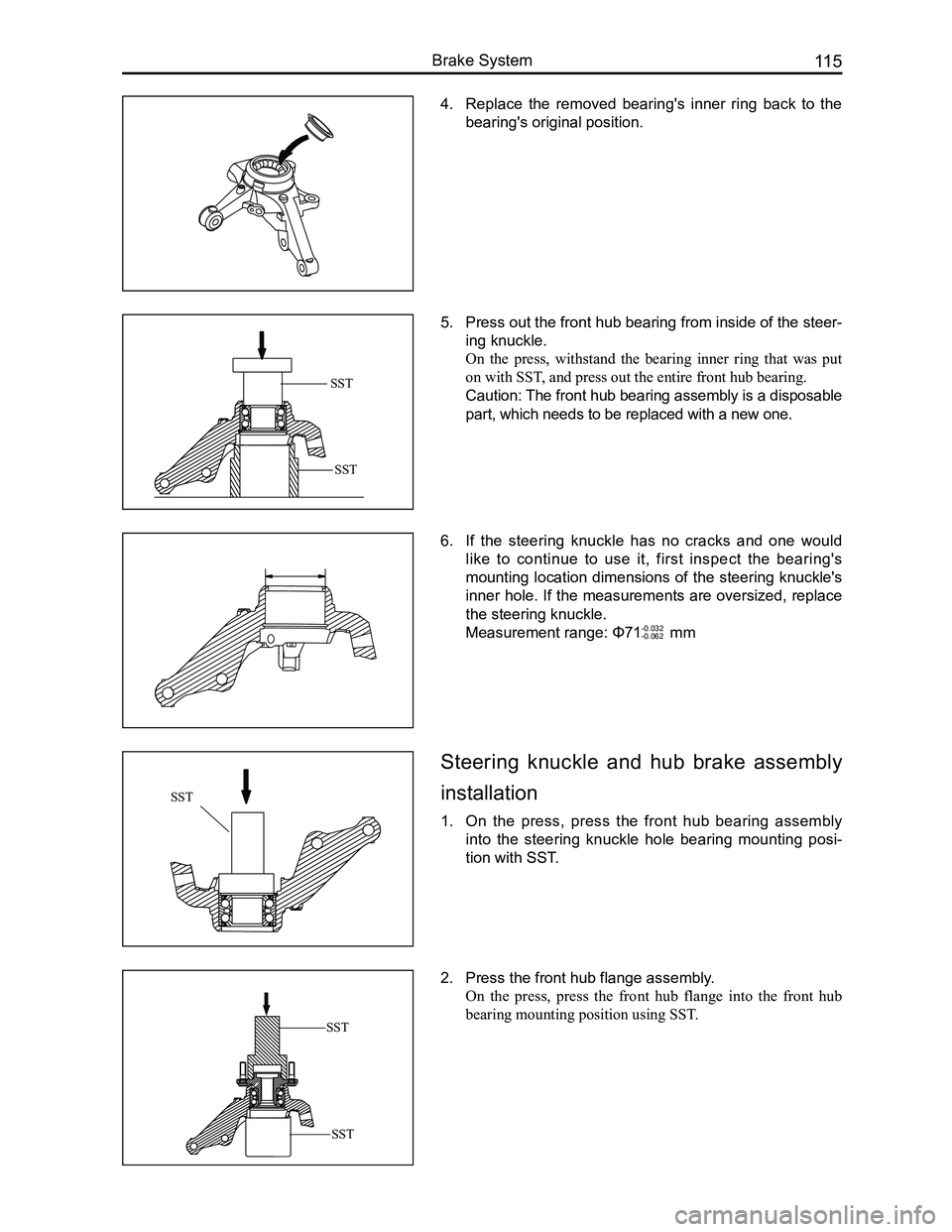
4. Replace the removed bearing's inner ring back to the
bearing's original position.
5. Press out the front hub bearing from inside of the steer-
ing knuckle.
On the press, withstand the bearing inner ring that was put
on with SST, and press out the entire front hub bearing.
Caution: The front hub bearing assembly is a disposable
part, which needs to be replaced with a new one.
Steering knuckle and hub brake assembly
installation
1. On the press, press the front hub bearing assembly
into the steering knuckle hole bearing mounting posi-
tion with SST.
SST
SST
SST
6. If the steering knuckle has no cracks and one would
like to continue to use it, first inspect the bearing's
mounting location dimensions of the steering knuckle's
inner hole. If the measurements are oversized, replace
the steering knuckle.
Measurement range: Φ71-0.032 -0.062 mm
2. Press the front hub flange assembly.
On the press, press the front hub flange into the front hub
bearing mounting position using SST.
SST
SST
Page 123 of 281
Downloaded from www.Manualslib.com manuals search engine GWFLORID Maintenance Manual116
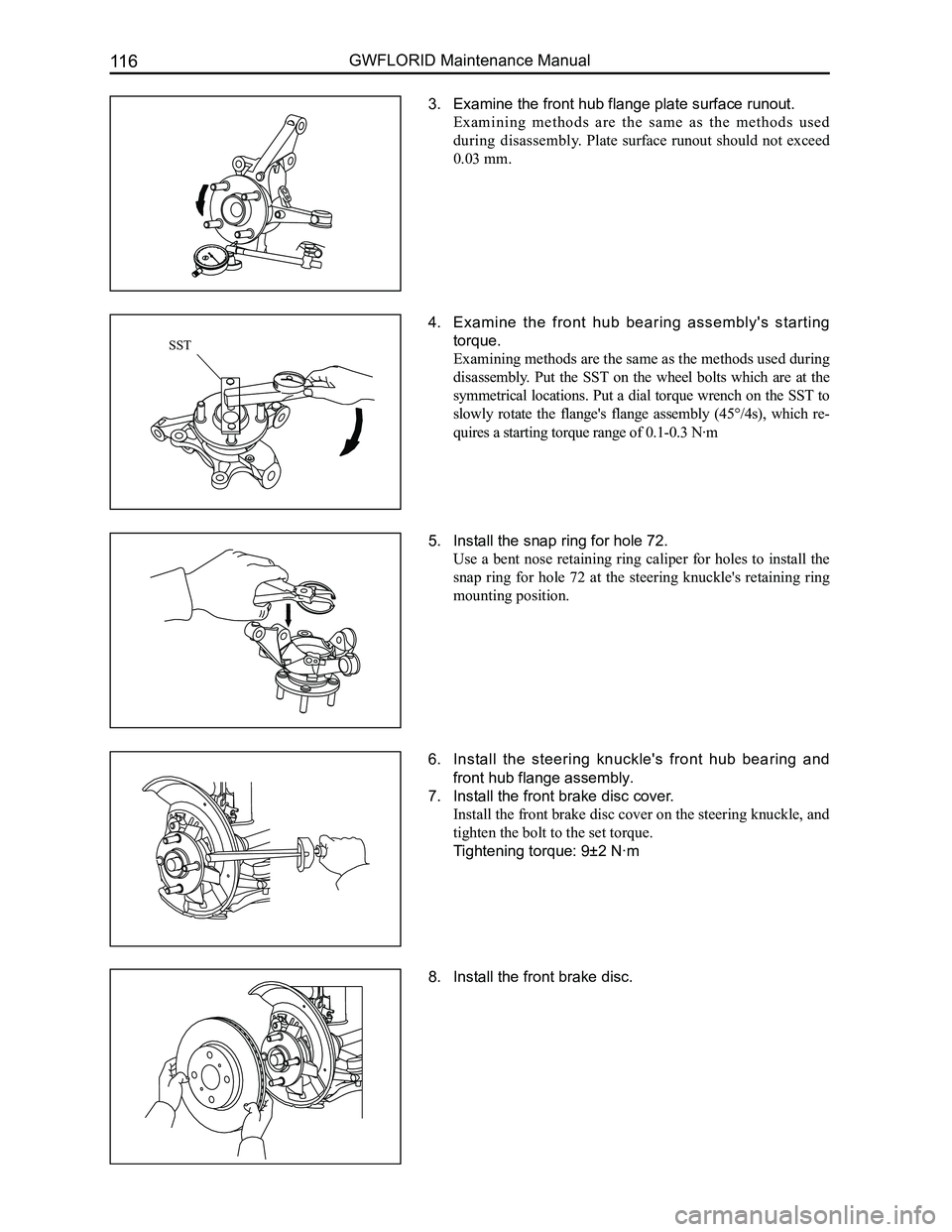
3. Examine the front hub flange plate surface runout.
Examining methods are the same as the methods used
during disassembly. Plate surface runout should not exceed
0.03 mm.
4. Examine the front hub bearing assembly's starting
torque.
Examining methods are the same as the methods used during
disassembly. Put the SST on the wheel bolts which are at the
symmetrical locations. Put a dial torque wrench on the SST to
slowly rotate the flange's flange assembly (45°/4s), which re-
quires a starting torque range of 0.1-0.3 N·m
5. Install the snap ring for hole 72.
Use a bent nose retaining ring caliper for holes to install the
snap ring for hole 72 at the steering knuckle's retaining ring
mounting position.
6. Install the steering knuckle's front hub bearing and
front hub flange assembly.
7. Install the front brake disc cover.
Install the front brake disc cover on the steering knuckle, and
tighten the bolt to the set torque.
Tightening torque: 9±2 N·m
SST
8. Install the front brake disc.
Page 124 of 281
Downloaded from www.Manualslib.com manuals search engine 117Brake System
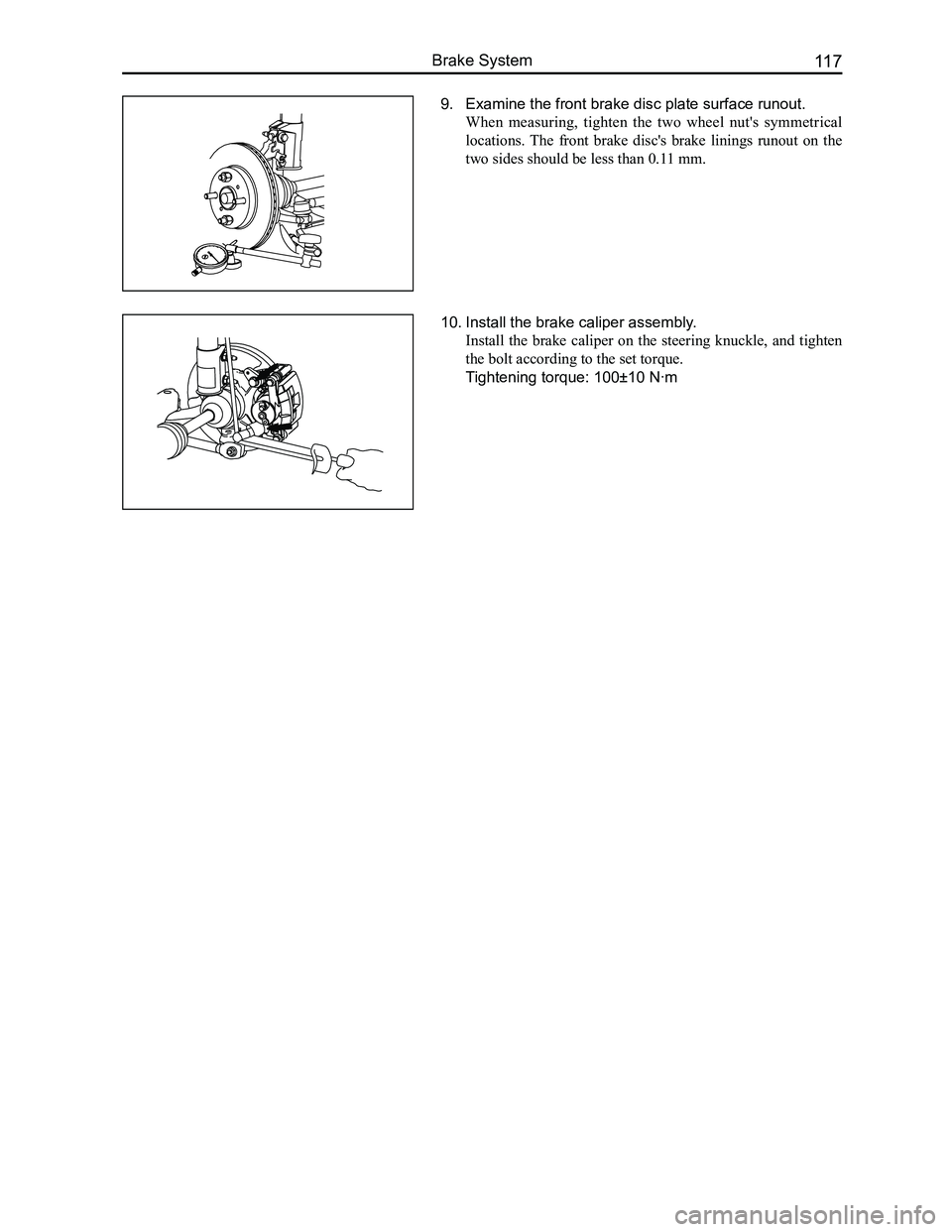
9. Examine the front brake disc plate surface runout.
When measuring, tighten the two wheel nut's symmetrical
locations. The front brake disc's brake linings runout on the
two sides should be less than 0.11 mm.
10. Install the brake caliper assembly.
Install the brake caliper on the steering knuckle, and tighten
the bolt according to the set torque.
Tightening torque: 100±10 N·m
Page 126 of 281
Downloaded from www.Manualslib.com manuals search engine 119Brake System
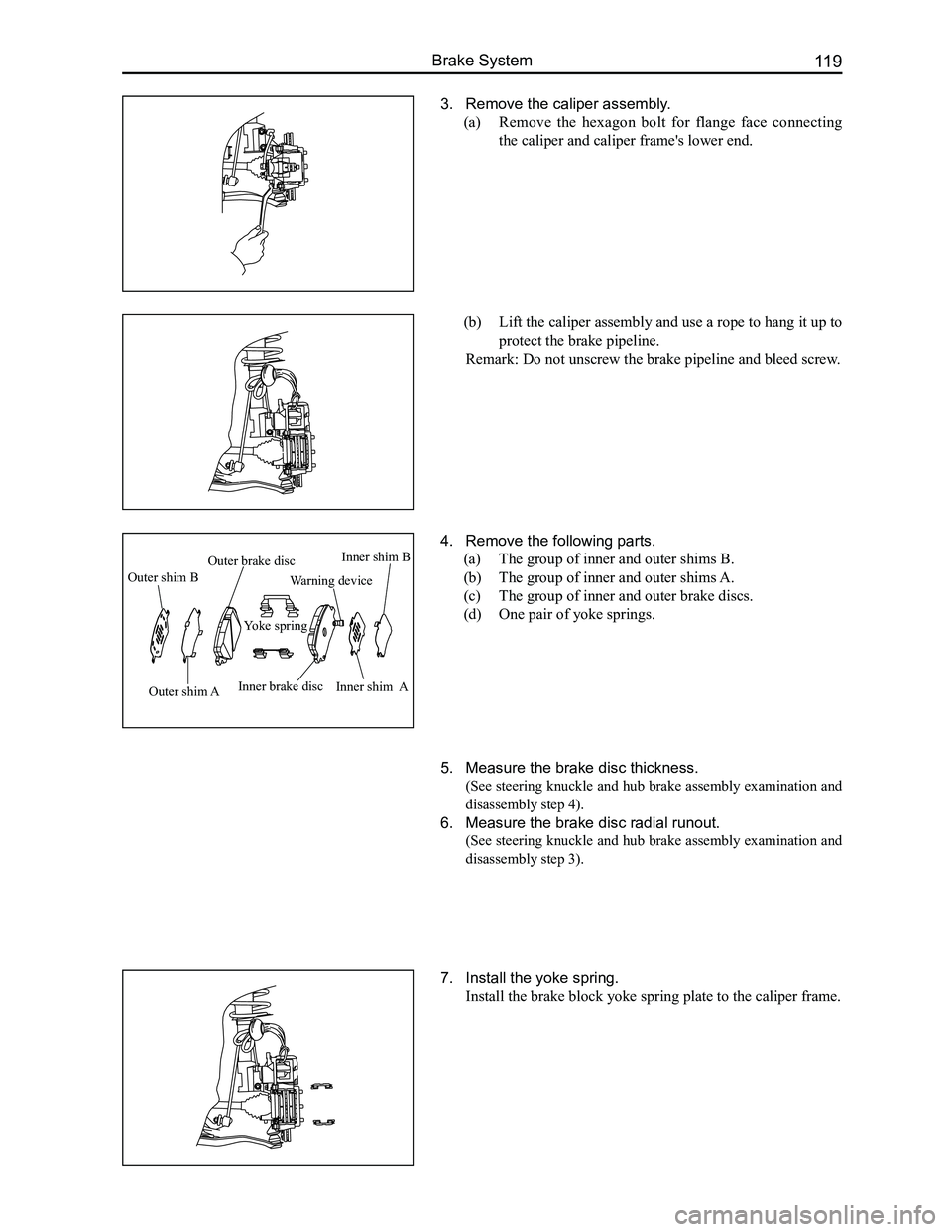
3. Remove the caliper assembly.
(a) Remove the hexagon bolt for flange face connecting
the caliper and caliper frame's lower end.
(b) Lift the caliper assembly and use a rope to hang it up to
protect the brake pipeline.
Remark: Do not unscrew the brake pipeline and bleed screw.
4. Remove the following parts.
(a) The group of inner and outer shims B.
(b) The group of inner and outer shims A.
(c) The group of inner and outer brake discs.
(d) One pair of yoke springs.
5. Measure the brake disc thickness.
(See steering knuckle and hub brake assembly examination and
disassembly step 4).
6. Measure the brake disc radial runout.
(See steering knuckle and hub brake assembly examination and
disassembly step 3).
7. Install the yoke spring.
Install the brake block yoke spring plate to the caliper frame.
Outer shim B
Outer shim AInner brake disc
Warning device
Inner shim B
Inner shim A
Outer brake disc
Yoke spring
Page 140 of 281
Downloaded from www.Manualslib.com manuals search engine 133Brake System
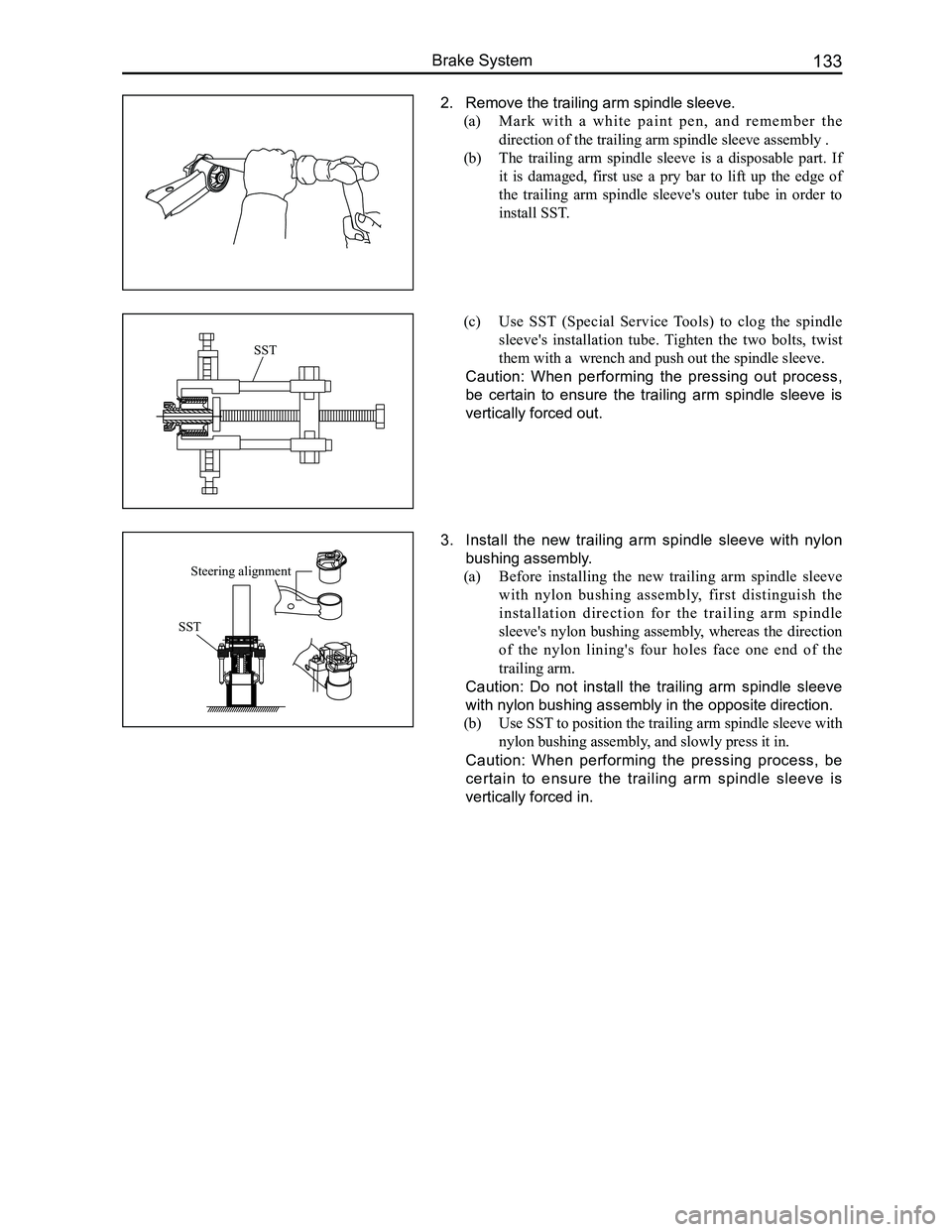
2. Remove the trailing arm spindle sleeve.
(a) M a r k w i t h a w h i t e p a i n t p e n , a n d r e m e m b e r t h e
direction of the trailing arm spindle sleeve assembly .
(b) The trailing arm spindle sleeve is a disposable part. If
it is damaged, first use a pry bar to lift up the edge of
the trailing arm spindle sleeve's outer tube in order to
install SST.
(c) Use SST (Special Service Tools) to clog the spindle
sleeve's installation tube. Tighten the two bolts, twist
them with a wrench and push out the spindle sleeve.
Caution: When performing the pressing out process,
be certain to ensure the trailing arm spindle sleeve is
vertically forced out.
3. Install the new trailing arm spindle sleeve with nylon
bushing assembly.
(a) Before installing the new trailing arm spindle sleeve
with nylon bushing assembly, first distinguish the
installation direction for the trailing arm spindle
sleeve's nylon bushing assembly, whereas the direction
of the nylon lining's four holes face one end of the
trailing arm.
Caution: Do not install the trailing arm spindle sleeve
with nylon bushing assembly in the opposite direction.
(b) Use SST to position the trailing arm spindle sleeve with
nylon bushing assembly, and slowly press it in.
Caution: When performing the pressing process, be
certain to ensure the trailing arm spindle sleeve is
vertically forced in.
SST
Steering alignment
SST
Page 141 of 281
Downloaded from www.Manualslib.com manuals search engine GWFLORID Maintenance Manual134
Steering System
Troubleshooting ..................................................................135
Steering System Maintenance............................................137
Power Steering Fluid Instructions .......................................141
Technical Requirements .....................................................141
Page 142 of 281
Downloaded from www.Manualslib.com manuals search engine 135Steering System
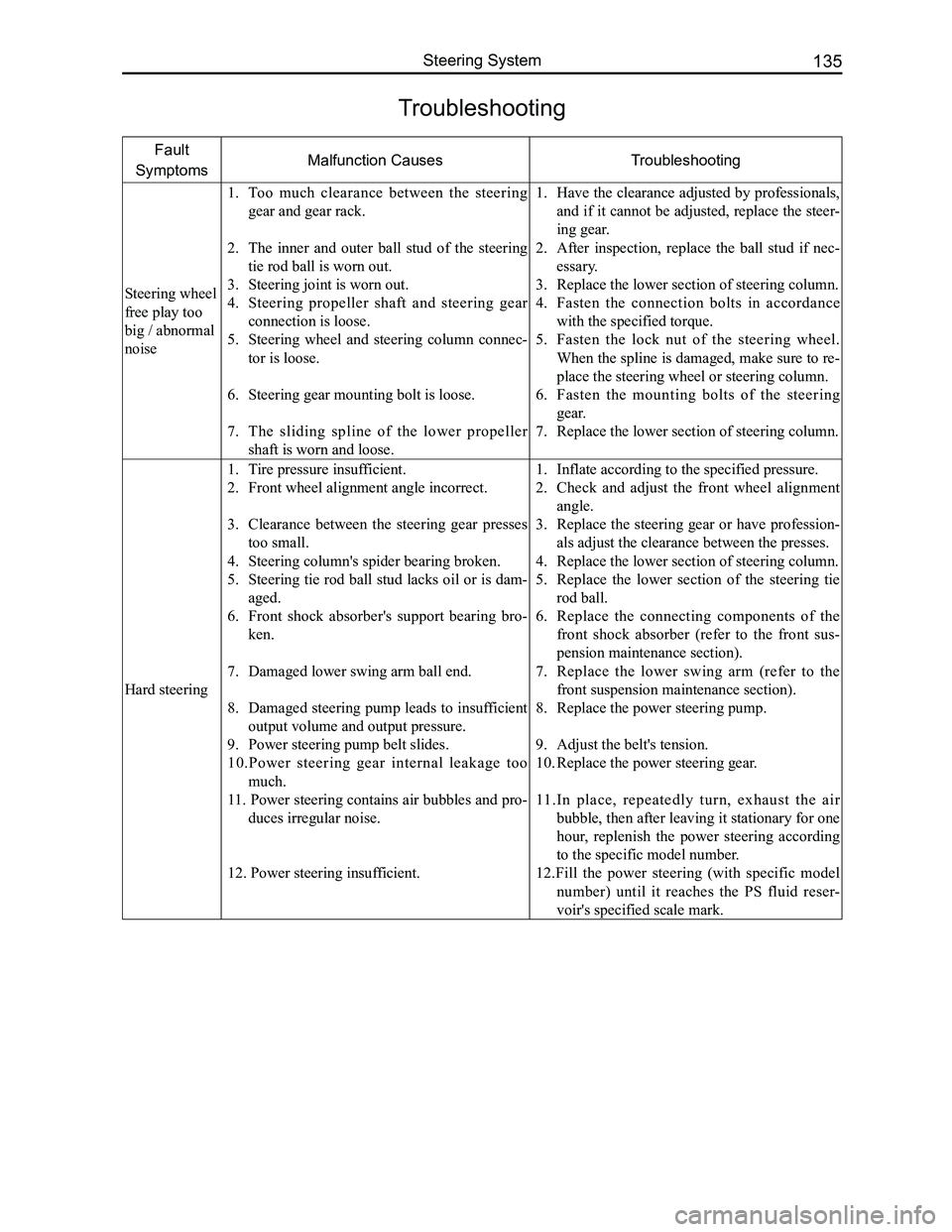
Troubleshooting
Fault
SymptomsMalfunction CausesTroubleshooting
Steering wheel
free play too
big / abnormal
noise
1. Too much clearance between the steering
gear and gear rack.
2. The inner and outer ball stud of the steering
tie rod ball is worn out.
3. Steering joint is worn out.
4. Steering propeller shaft and steering gear
connection is loose.
5. Steering wheel and steering column connec-
tor is loose.
6. Steering gear mounting bolt is loose.
7. The sliding spline of the lower propeller
shaft is worn and loose.
1. Have the clearance adjusted by professionals,
and if it cannot be adjusted, replace the steer-
ing gear.
2. After inspection, replace the ball stud if nec-
essary.
3. Replace the lower section of steering column.
4. Fasten the connection bolts in accordance
with the specified torque.
5. Fasten the lock nut of the steering wheel.
When the spline is damaged, make sure to re-
place the steering wheel or steering column.
6. Fasten the mounting bolts of the steering
gear.
7. Replace the lower section of steering column.
Hard steering
1. Tire pressure insufficient.
2. Front wheel alignment angle incorrect.
3. Clearance between the steering gear presses
too small.
4. Steering column's spider bearing broken.
5. Steering tie rod ball stud lacks oil or is dam-
aged.
6. Front shock absorber's support bearing bro-
ken.
7. Damaged lower swing arm ball end.
8. Damaged steering pump leads to insufficient
output volume and output pressure.
9. Power steering pump belt slides.
10.Power steering gear internal leakage too
much.
11. Power steering contains air bubbles and pro-
duces irregular noise.
12. Power steering insufficient.
1. Inflate according to the specified pressure.
2. Check and adjust the front wheel alignment
angle.
3. Replace the steering gear or have profession-
als adjust the clearance between the presses.
4. Replace the lower section of steering column.
5. Replace the lower section of the steering tie
rod ball.
6. Replace the connecting components of the
front shock absorber (refer to the front sus-
pension maintenance section).
7. Replace the lower swing arm (refer to the
front suspension maintenance section).
8. Replace the power steering pump.
9. Adjust the belt's tension.
10. Replace the power steering gear.
11.In place, repeatedly turn, exhaust the air
bubble, then after leaving it stationary for one
hour, replenish the power steering according
to the specific model number.
12.Fill the power steering (with specific model
number) until it reaches the PS fluid reser-
voir's specified scale mark.
Page 143 of 281
Downloaded from www.Manualslib.com manuals search engine GWFLORID Maintenance Manual136
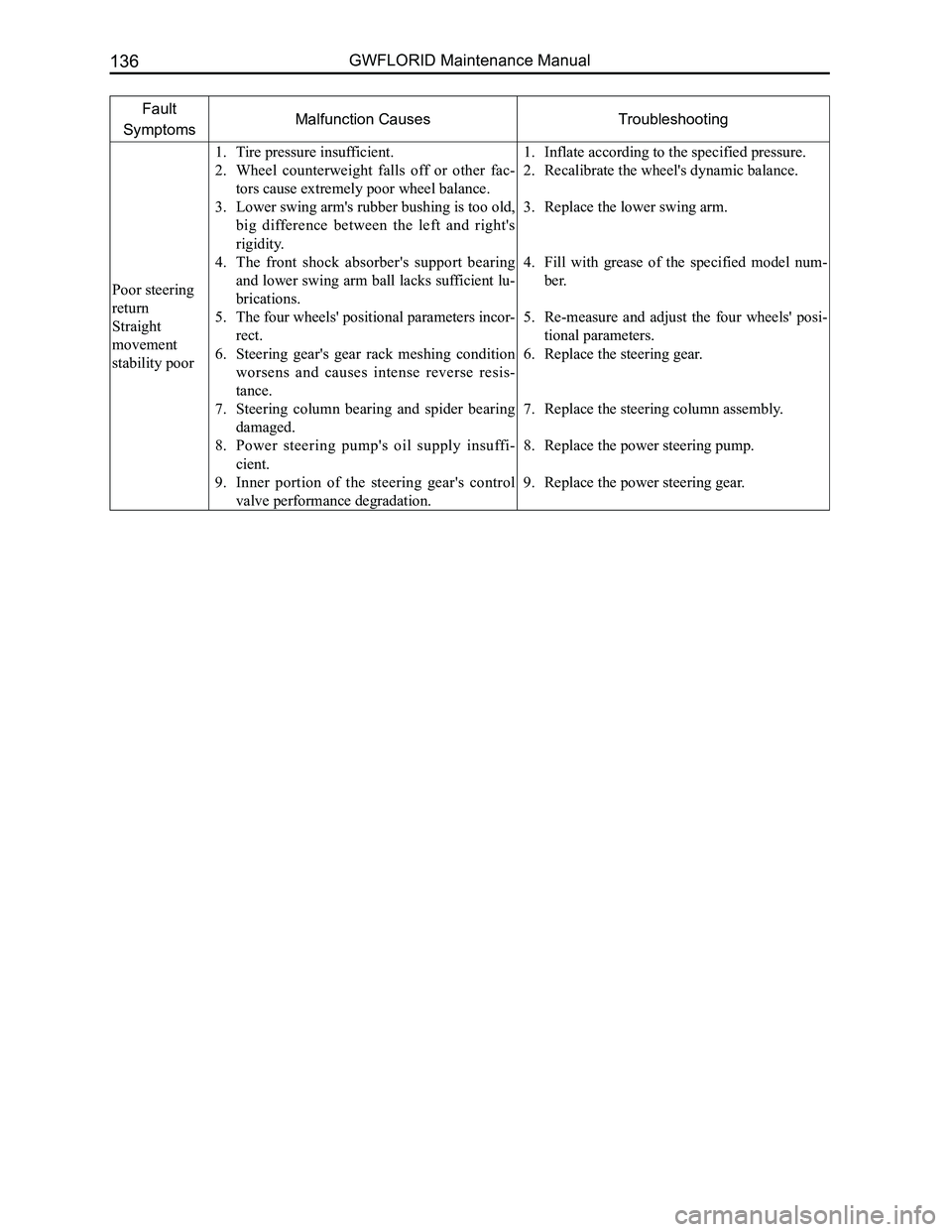
Fault
SymptomsMalfunction CausesTroubleshooting
Poor steering
return
Straight
movement
stability poor
1. Tire pressure insufficient.
2. Wheel counterweight falls off or other fac-
tors cause extremely poor wheel balance.
3. Lower swing arm's rubber bushing is too old,
big difference between the left and right's
rigidity.
4. The front shock absorber's support bearing
and lower swing arm ball lacks sufficient lu-
brications.
5. The four wheels' positional parameters incor-
rect.
6. Steering gear's gear rack meshing condition
worsens and causes intense reverse resis-
tance.
7. Steering column bearing and spider bearing
damaged.
8. Power steering pump's oil supply insuffi-
cient.
9. Inner portion of the steering gear's control
valve performance degradation.
1. Inflate according to the specified pressure.
2. Recalibrate the wheel's dynamic balance.
3. Replace the lower swing arm.
4. Fill with grease of the specified model num-
ber.
5. Re-measure and adjust the four wheels' posi-
tional parameters.
6. Replace the steering gear.
7. Replace the steering column assembly.
8. Replace the power steering pump.
9. Replace the power steering gear.