brake GREAT WALL FLORID 2008 Workshop Manual
[x] Cancel search | Manufacturer: GREAT WALL, Model Year: 2008, Model line: FLORID, Model: GREAT WALL FLORID 2008Pages: 281, PDF Size: 43.97 MB
Page 134 of 281
Downloaded from www.Manualslib.com manuals search engine 127Brake System
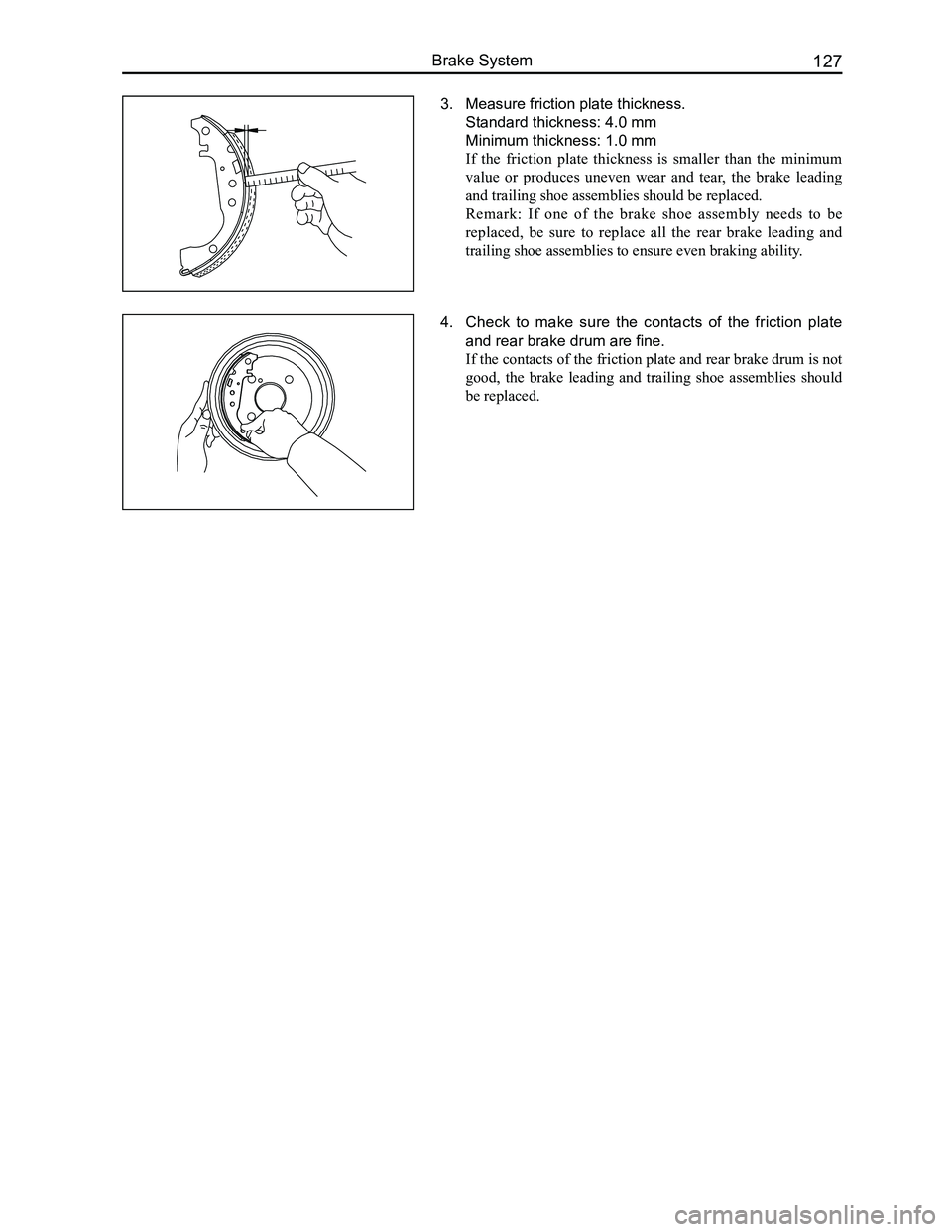
3. Measure friction plate thickness.
Standard thickness: 4.0 mm
Minimum thickness: 1.0 mm
If the friction plate thickness is smaller than the minimum
value or produces uneven wear and tear, the brake leading
and trailing shoe assemblies should be replaced.
Remark: If one of the brake shoe assembly needs to be
replaced, be sure to replace all the rear brake leading and
trailing shoe assemblies to ensure even braking ability.
4. Check to make sure the contacts of the friction plate
and rear brake drum are fine.
If the contacts of the friction plate and rear brake drum is not
good, the brake leading and trailing shoe assemblies should
be replaced.
Page 135 of 281
Downloaded from www.Manualslib.com manuals search engine GWFLORID Maintenance Manual128
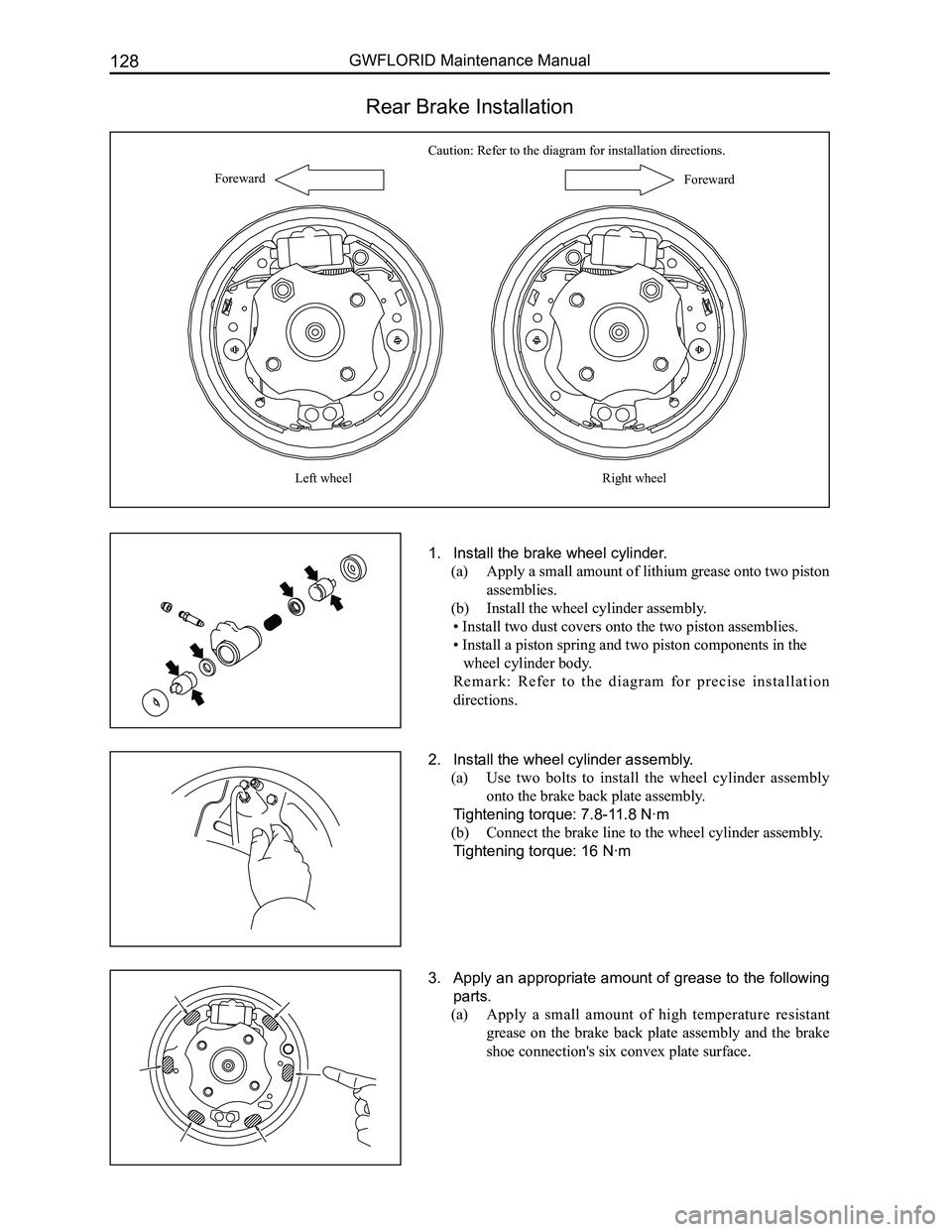
Rear Brake Installation
1. Install the brake wheel cylinder.
(a) Apply a small amount of lithium grease onto two piston
assemblies.
(b) Install the wheel cylinder assembly.
• Install two dust covers onto the two piston assemblies.
• Install a piston spring and two piston components in the
wheel cylinder body.
R e m a r k : R e f e r t o t h e d i a g r a m f o r p r e c i s e i n s t a l l a t i o n
directions.
2. Install the wheel cylinder assembly.
(a) Use two bolts to install the wheel cylinder assembly
onto the brake back plate assembly.
Tightening torque: 7.8-11.8 N·m
(b) Connect the brake line to the wheel cylinder assembly.
Tightening torque: 16 N·m
3. Apply an appropriate amount of grease to the following
parts.
(a) Apply a small amount of high temperature resistant
grease on the brake back plate assembly and the brake
shoe connection's six convex plate surface.
Caution: Refer to the diagram for installation directions.
ForewardForeward
Left wheelRight wheel
Page 136 of 281
Downloaded from www.Manualslib.com manuals search engine 129Brake System
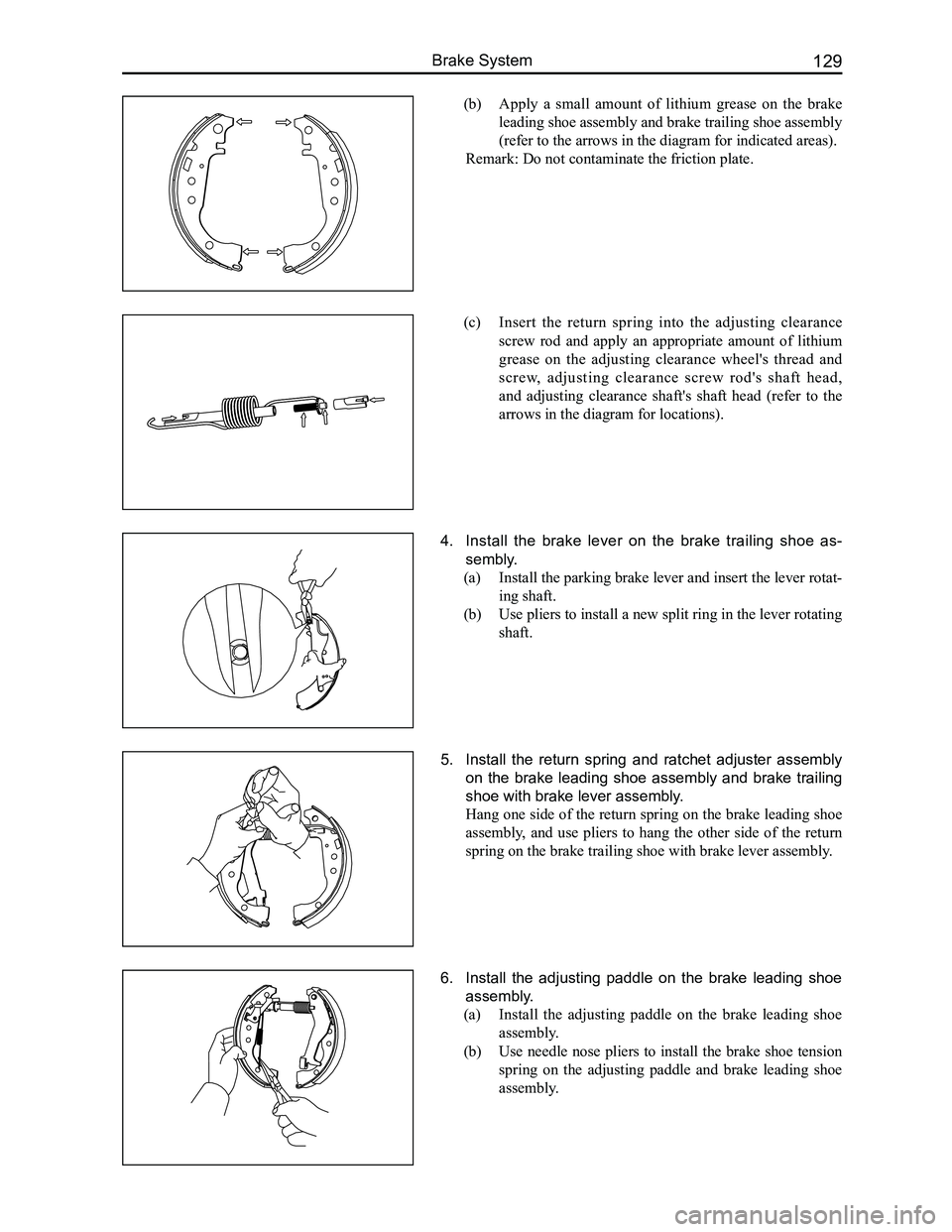
(b) Apply a small amount of lithium grease on the brake
leading shoe assembly and brake trailing shoe assembly
(refer to the arrows in the diagram for indicated areas).
Remark: Do not contaminate the friction plate.
(c) Insert the return spring into the adjusting clearance
screw rod and apply an appropriate amount of lithium
grease on the adjusting clearance wheel's thread and
screw, adjusting clearance screw rod's shaft head,
and adjusting clearance shaft's shaft head (refer to the
arrows in the diagram for locations).
4. Install the brake lever on the brake trailing shoe as-
sembly.
(a) Install the parking brake lever and insert the lever rotat-
ing shaft.
(b) Use pliers to install a new split ring in the lever rotating
shaft.
5. Install the return spring and ratchet adjuster assembly
on the brake leading shoe assembly and brake trailing
shoe with brake lever assembly.
Hang one side of the return spring on the brake leading shoe
assembly, and use pliers to hang the other side of the return
spring on the brake trailing shoe with brake lever assembly.
6. Install the adjusting paddle on the brake leading shoe
assembly.
(a) Install the adjusting paddle on the brake leading shoe
assembly.
(b) Use needle nose pliers to install the brake shoe tension
spring on the adjusting paddle and brake leading shoe
assembly.
Page 137 of 281
Downloaded from www.Manualslib.com manuals search engine GWFLORID Maintenance Manual130
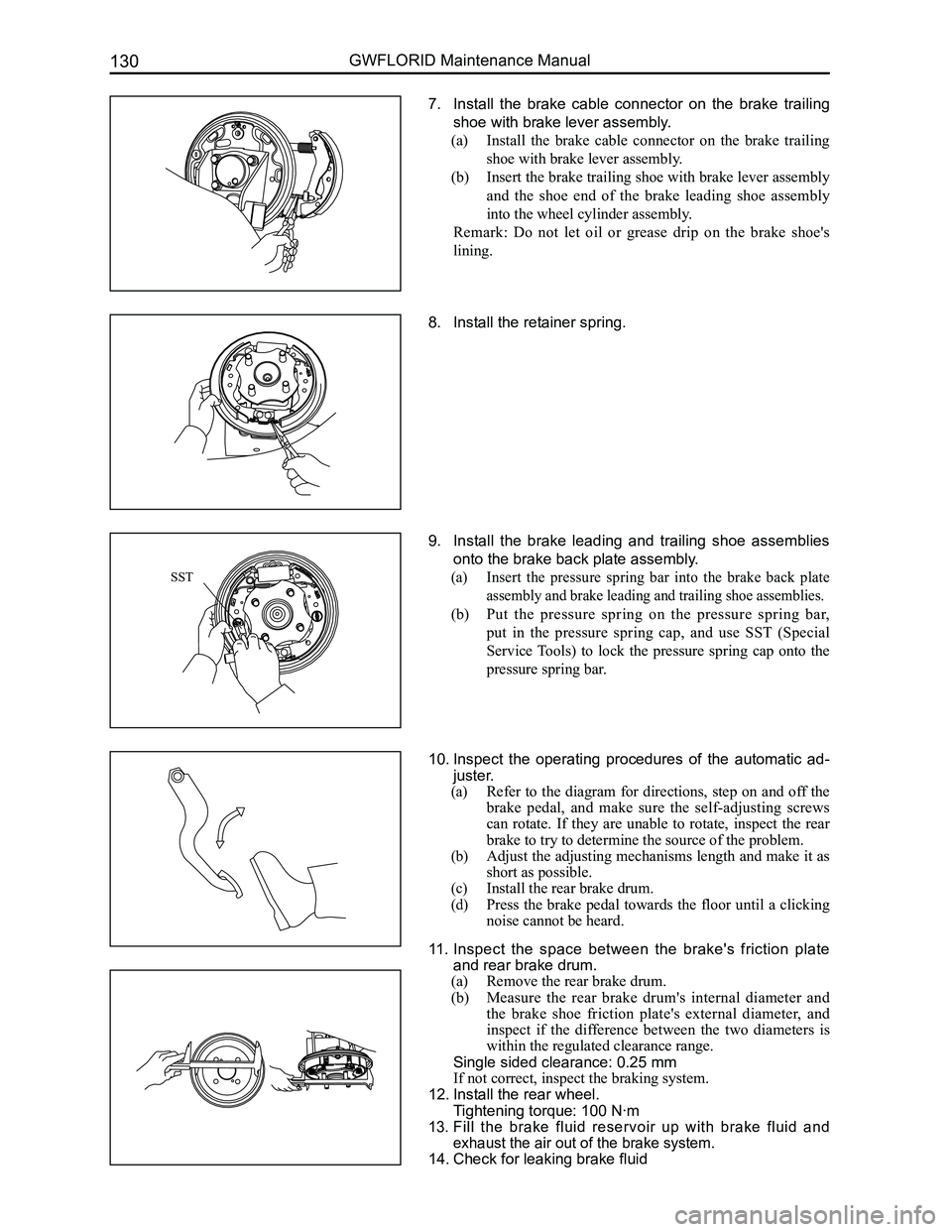
7. Install the brake cable connector on the brake trailing
shoe with brake lever assembly.
(a) Install the brake cable connector on the brake trailing
shoe with brake lever assembly.
(b) Insert the brake trailing shoe with brake lever assembly
and the shoe end of the brake leading shoe assembly
into the wheel cylinder assembly.
Remark: Do not let oil or grease drip on the brake shoe's
lining.
8. Install the retainer spring.
9. Install the brake leading and trailing shoe assemblies
onto the brake back plate assembly.
(a) Insert the pressure spring bar into the brake back plate
assembly and brake leading and trailing shoe assemblies.
(b) Put the pressure spring on the pressure spring bar,
put in the pressure spring cap, and use SST (Special
Service Tools) to lock the pressure spring cap onto the
pressure spring bar.
10. Inspect the operating procedures of the automatic ad-
juster.
(a) Refer to the diagram for directions, step on and off the
brake pedal, and make sure the self-adjusting screws
can rotate. If they are unable to rotate, inspect the rear
brake to try to determine the source of the problem.
(b) Adjust the adjusting mechanisms length and make it as
short as possible.
(c) Install the rear brake drum.
(d) Press the brake pedal towards the floor until a clicking
noise cannot be heard.
11. Inspect the space between the brake's friction plate
and rear brake drum.
(a) Remove the rear brake drum.
(b) Measure the rear brake drum's internal diameter and
the brake shoe friction plate's external diameter, and
inspect if the difference between the two diameters is
within the regulated clearance range.
Single sided clearance: 0.25 mm
If not correct, inspect the braking system.
12. Install the rear wheel.
Tightening torque: 100 N·m
13. Fill the brake fluid reservoir up with brake fluid and
exhaust the air out of the brake system.
14. Check for leaking brake fluid
SST
Page 138 of 281
Downloaded from www.Manualslib.com manuals search engine 131Brake System
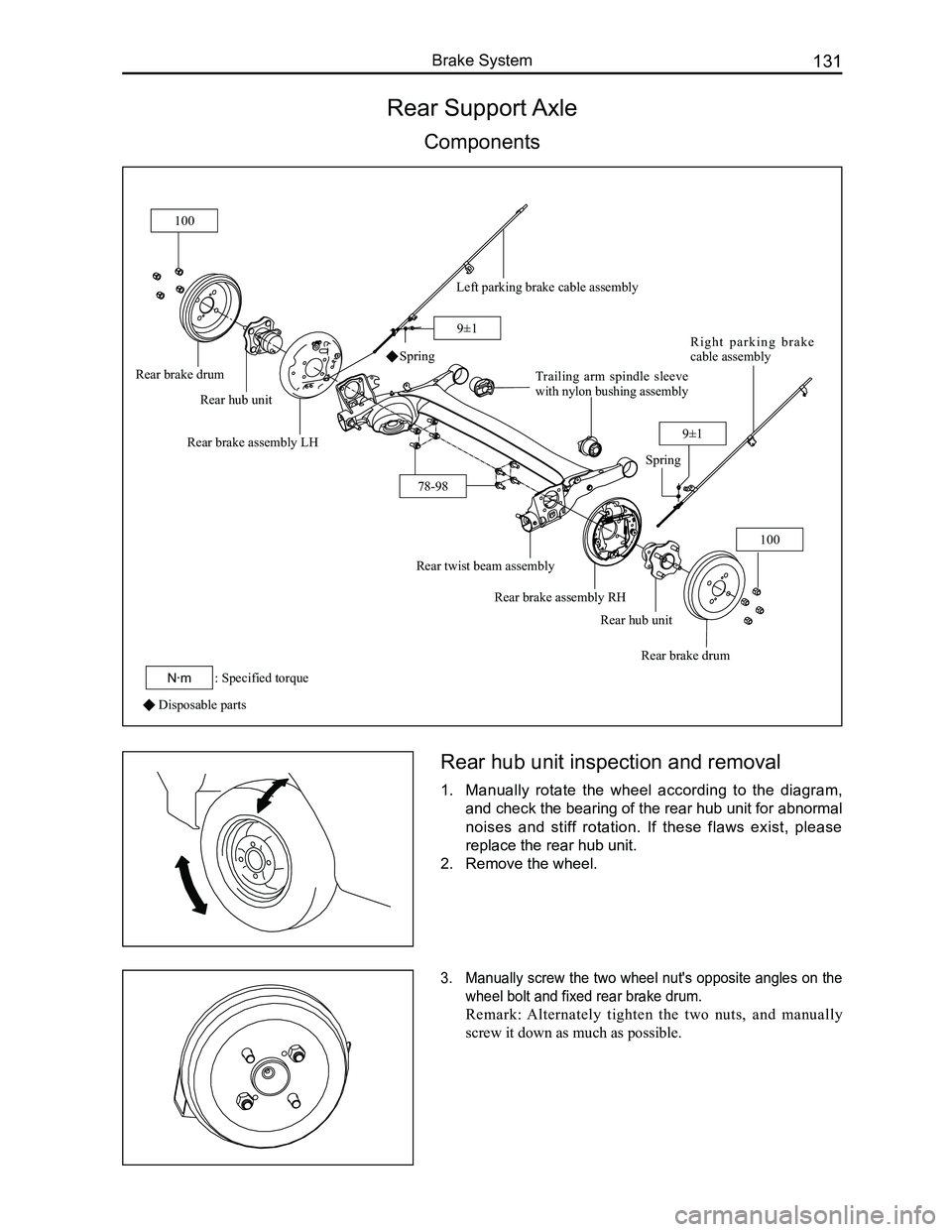
Rear Support Axle
Components
Rear hub unit inspection and removal
1. Manually rotate the wheel according to the diagram,
and check the bearing of the rear hub unit for abnormal
noises and stiff rotation. If these flaws exist, please
replace the rear hub unit.
2. Remove the wheel.
3. Manually screw the two wheel nut's opposite angles on the
wheel bolt and fixed rear brake drum.
Remark: Alternately tighten the two nuts, and manually
screw it down as much as possible.
Rear brake drum
Rear brake assembly RH
R i g h t p a r k i n g b r a k e cable assembly
Rear hub unit
Trailing arm spindle sleeve with nylon bushing assembly
Rear twist beam assembly
Rear brake assembly LH
Rear brake drum
Rear hub unit
Left parking brake cable assembly
Disposable parts
Spring
Spring
9±1
: Specified torqueN·m
78-98
9±1
100
100
Page 139 of 281
Downloaded from www.Manualslib.com manuals search engine GWFLORID Maintenance Manual132
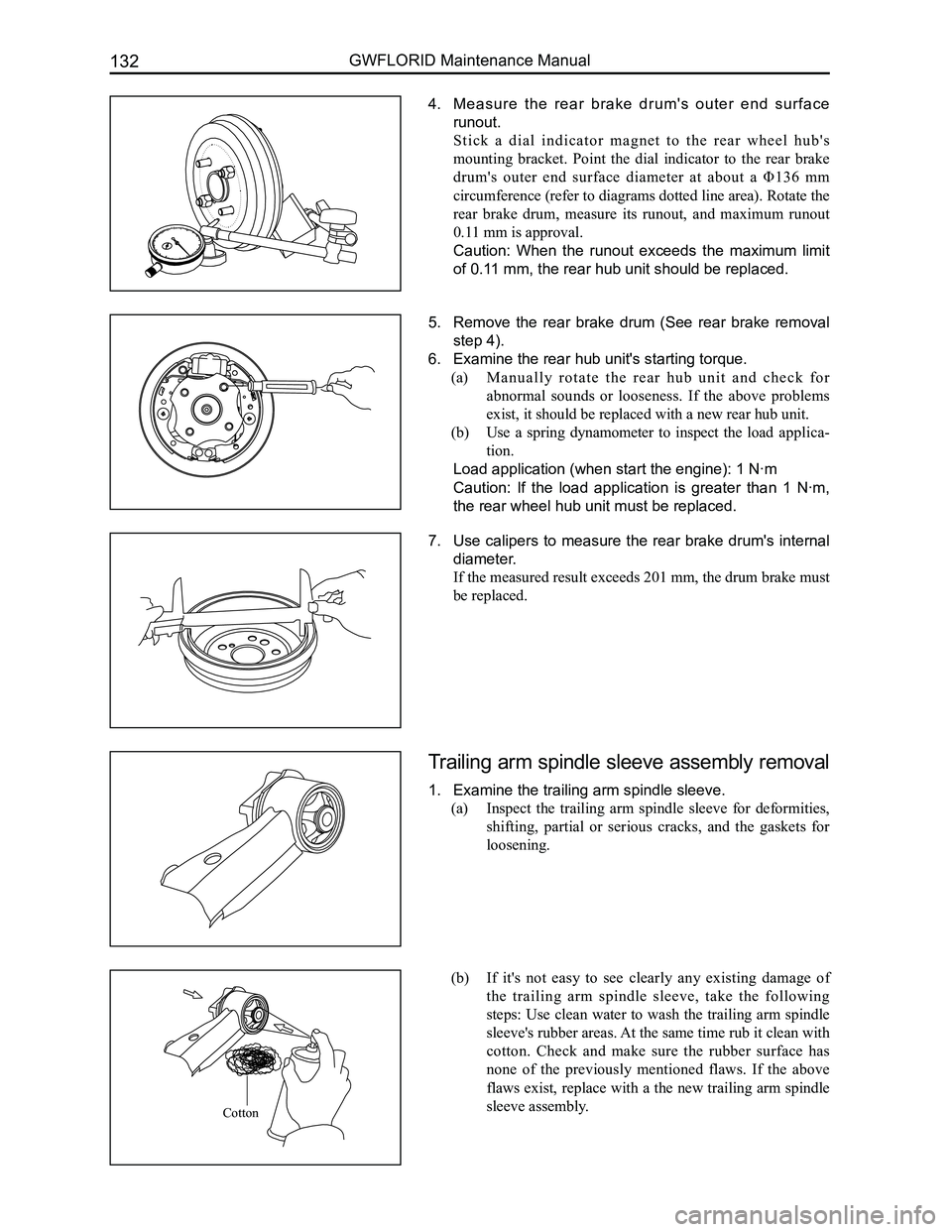
4. Measure the rear brake drum's outer end surface
runout.
S t i c k a d i a l i n d i c a t o r m a g n e t t o t h e r e a r w h e e l h u b ' s
mounting bracket. Point the dial indicator to the rear brake
drum's outer end surface diameter at about a Φ136 mm
circumference (refer to diagrams dotted line area). Rotate the
rear brake drum, measure its runout, and maximum runout
0.11 mm is approval.
Caution: When the runout exceeds the maximum limit
of 0.11 mm, the rear hub unit should be replaced.
5. Remove the rear brake drum (See rear brake removal
step 4).
6. Examine the rear hub unit's starting torque.
(a) M a n u a l l y r o t a t e t h e r e a r h u b u n i t a n d c h e c k f o r
abnormal sounds or looseness. If the above problems
exist, it should be replaced with a new rear hub unit.
(b) Use a spring dynamometer to inspect the load applica-
tion.
Load application (when start the engine): 1 N·m
Caution: If the load application is greater than 1 N·m,
the rear wheel hub unit must be replaced.
7. Use calipers to measure the rear brake drum's internal
diameter.
If the measured result exceeds 201 mm, the drum brake must
be replaced.
Trailing arm spindle sleeve assembly removal
1. Examine the trailing arm spindle sleeve.
(a) Inspect the trailing arm spindle sleeve for deformities,
shifting, partial or serious cracks, and the gaskets for
loosening.
(b) If it's not easy to see clearly any existing damage of
the trailing arm spindle sleeve, take the following
steps: Use clean water to wash the trailing arm spindle
sleeve's rubber areas. At the same time rub it clean with
cotton. Check and make sure the rubber surface has
none of the previously mentioned flaws. If the above
flaws exist, replace with a the new trailing arm spindle
sleeve assembly.Cotton
Page 140 of 281
Downloaded from www.Manualslib.com manuals search engine 133Brake System
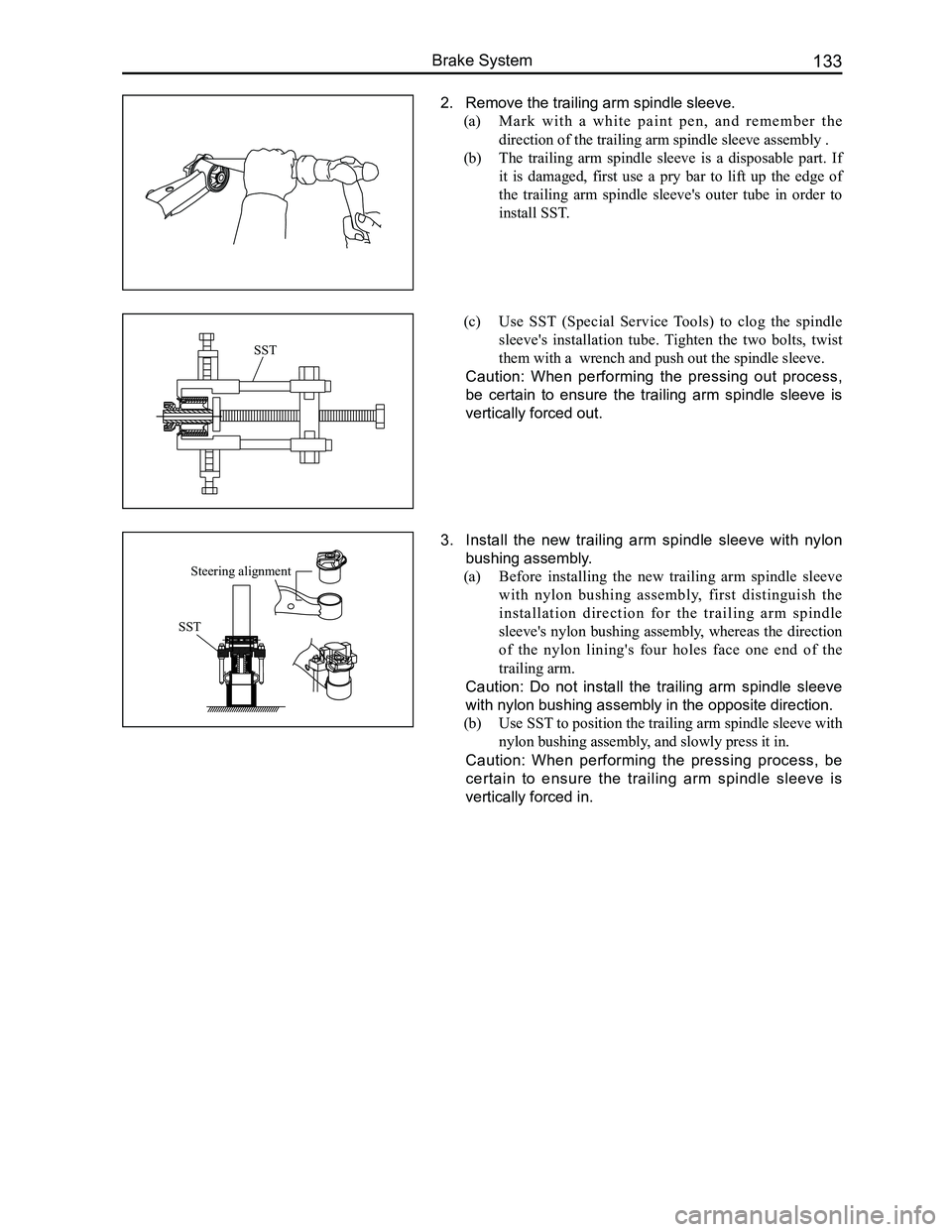
2. Remove the trailing arm spindle sleeve.
(a) M a r k w i t h a w h i t e p a i n t p e n , a n d r e m e m b e r t h e
direction of the trailing arm spindle sleeve assembly .
(b) The trailing arm spindle sleeve is a disposable part. If
it is damaged, first use a pry bar to lift up the edge of
the trailing arm spindle sleeve's outer tube in order to
install SST.
(c) Use SST (Special Service Tools) to clog the spindle
sleeve's installation tube. Tighten the two bolts, twist
them with a wrench and push out the spindle sleeve.
Caution: When performing the pressing out process,
be certain to ensure the trailing arm spindle sleeve is
vertically forced out.
3. Install the new trailing arm spindle sleeve with nylon
bushing assembly.
(a) Before installing the new trailing arm spindle sleeve
with nylon bushing assembly, first distinguish the
installation direction for the trailing arm spindle
sleeve's nylon bushing assembly, whereas the direction
of the nylon lining's four holes face one end of the
trailing arm.
Caution: Do not install the trailing arm spindle sleeve
with nylon bushing assembly in the opposite direction.
(b) Use SST to position the trailing arm spindle sleeve with
nylon bushing assembly, and slowly press it in.
Caution: When performing the pressing process, be
certain to ensure the trailing arm spindle sleeve is
vertically forced in.
SST
Steering alignment
SST
Page 151 of 281

Downloaded from www.Manualslib.com manuals search engine GWFLORID Maintenance Manual144
Double-colored wire: Primary color is Red, secondary color is Blue, mark\
ed as RBl.
0.5BrGr means Brown wire with a Gray fine wire, and sectional area is 0.\
5 mm2.
Areas of importance in circuit maintenance
1. Before operating any electronic devices, and when tools or maintenance devices may easily make
contact with an uncovered electronic terminal, please make sure to turn the ignition switch to the LOCK
position, and then disconnect the battery's negative cable to avoid injury or vehicle damage. When the
ignition switch is on the ON position, please do not disconnect the battery's connecting wire or take out
the power's fuse, regardless if the engine is running or not.Otherwise it would seriously damage the
ECU and related microelectronic devices such as sensors.
2. When changing the fuse, please make sure that the new fuse possesses the proper current rating,
and is not above or below this rating.
3. When repairing the wire harnesses of the airbag and pretensioner, only specified contact points,
plugs, and wires are allowed to be used.
4. Before repairing the wire harness, make sure to eliminate any factor that might cause damage,
for example, the edge of a vehicle body part is too sharp, or the used electronics are damaged or
corroded.
5. Shielded wire should not be repaired, it must be replaced entirely once it is damaged.
6. Unless it is specified during the test, please do not use an analog multimeter to test the ECU and
sensor, instead use a high-impedance digital multimeter (internal resistance should be ≥10 kΩ) or a
vehicle multimeter for inspection.
7. When inspecting the connector with a digital multimeter, take the waterproof rubber cover off the
connector, and tightly insert the test pen along the connecting terminal. Don't use too much force, as
to avoid cracking the connector.
Circuit inspection steps
The principle of troubleshooting is to confirm the "possible cause". Once the possible cause is confirmed, the
components that need to be inspected are limited to the components that are related to the possible cause. The
confirmed possible cause should be based on theory and be supported by facts, but not just by intuition. If
one tries to solve the problem but does not adopt the proper troubleshooting steps, it may make the problem
worse. Then the possible cause not only can't be confirmed, but also maintenance can't be performed properly.
Troubleshooting should adhere to the four steps below:
1. Observe the symptoms carefully, inspect if there is anything else abnormal, and record it.
2. While confirming the possible causes, study the circuit diagram carefully, and regard it as a whole
system in order to understand the circuit. Thorough knowledge of switches, relays, and other
electronic components is obligatory for proper analysis.
3. Inspect and eliminate the problems one by one until the cause is found.
4. After the malfunction is fixed, make sure to check if the inspected system is working properly, and also
check if the maintenance may have caused any new problems.
Compres-
sor relay
Reserve
Sunroof (Elite) Lamplet
Reserve
Reserve
Reserve
Reserve Door and window Reserve Blower
Lamplet
relay Flasher relay Blower high
speed relay (Elite) Door and
window relay (Comfort, Luxury) Blower relay
Reserve
Front fog lamp
Combination
meter
Interior
lighting
central
door lock
brake lamp
CD player
Reserve
Reserve
Reserve
Cigarette
lighter
Rearview
mirror
Front wiper
Charge
Airbag
Reserve
Reverse lamp Rear fog lamp
Rear wiper
Defroster Compressor
ACC relay
IG relayRear wiper
relay Defroster
relay
Front fog
lamp relay Rear fog
lamp relay
Warning lamp
Turn signal lamp
Cab No.1 fuse box
Fuse Box
Page 152 of 281
Downloaded from www.Manualslib.com manuals search engine 145Vehicle Body Electronic System
Fuse numberCurrent ratingFuse typePowerBearer circuit
F01Reserve
AutoFuse
30 Battery (+)
F0225 ASunroof (Elite)
F0310 AParking lamp relay, front fog lamp
switch, rear fog lamp switch
F0415 A
F05Reserve
F0615 AHazard warning lamp
F0710 A15a IG1 Turn signal lamp
F0815 A
30 Battery (+)
Front fog lamp relay
F0910 ARear fog lamp relay
F1010 ACompressor relay
F1110 ARear wiper relay
F1225 ARear defroster, rearview mirror defroster
F1310 ACombination meter
F1410 AInternal lighting
F1520 ACentral lock controller
F1610 ABrake lamp switch
F1715 AStereo
F18Reserve
F19Reserve
F20Reserve
F2125 AX Attached
ACC
Front cigarette lighter, rear cigarette
lighter, backup power supply
F2215 APower rearview mirror
F2315 A
15a IG1
Front wiper motor, front and rear washer motor
F2410 ACombination meter indicator lamp power
F2510 AABS ECU
F2615 AAirbag
F27Reserve
F2810 AReverse lamp, air conditioner controller
S/B1Reserve
Slow burn fuse 30 Battery (+)
S/B230 ADoor and window relay (Non Jam Protection)
S/B3Reserve
S/B440 ABlower relay
S/B5Reserve
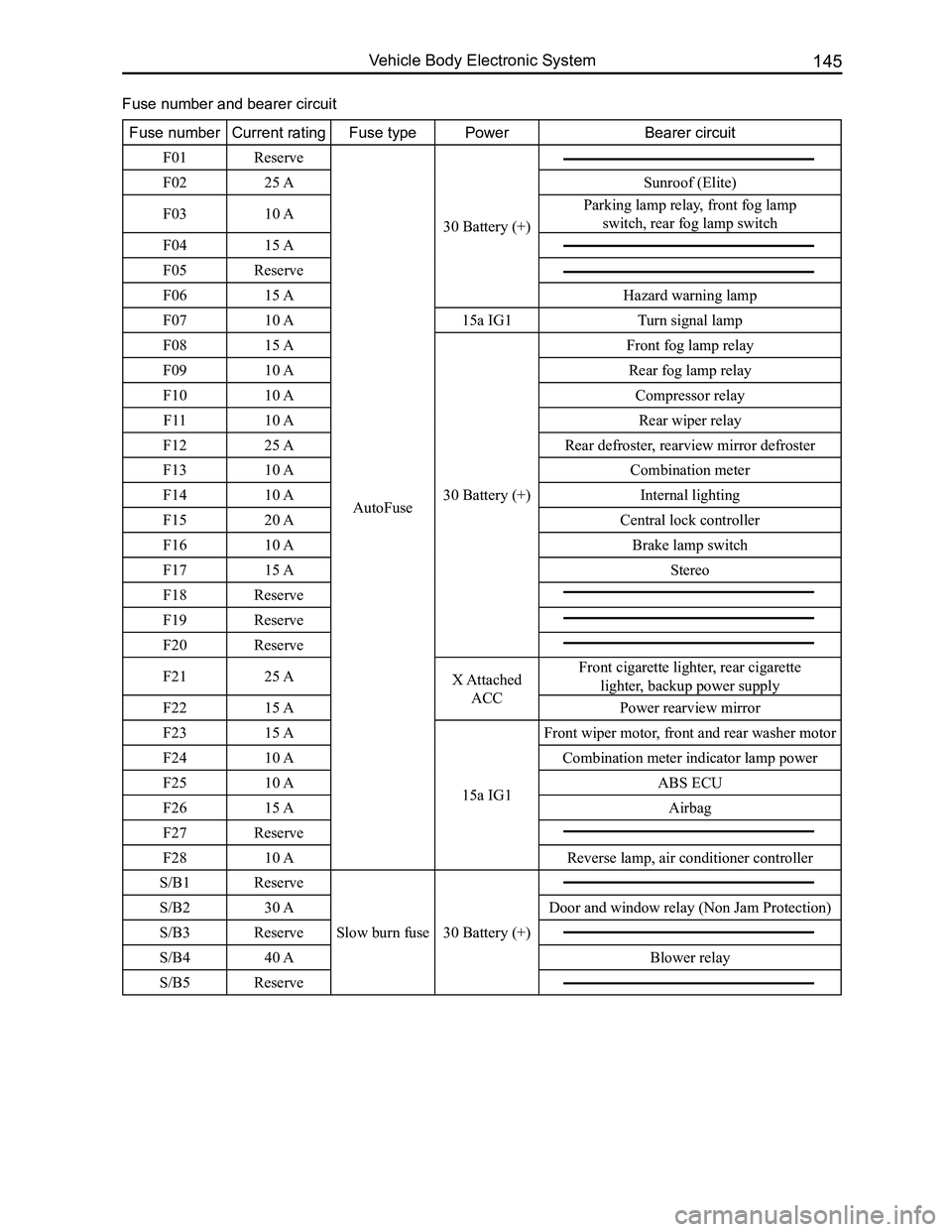
Fuse number and bearer circuit
Page 156 of 281
Downloaded from www.Manualslib.com manuals search engine 149Vehicle Body Electronic System
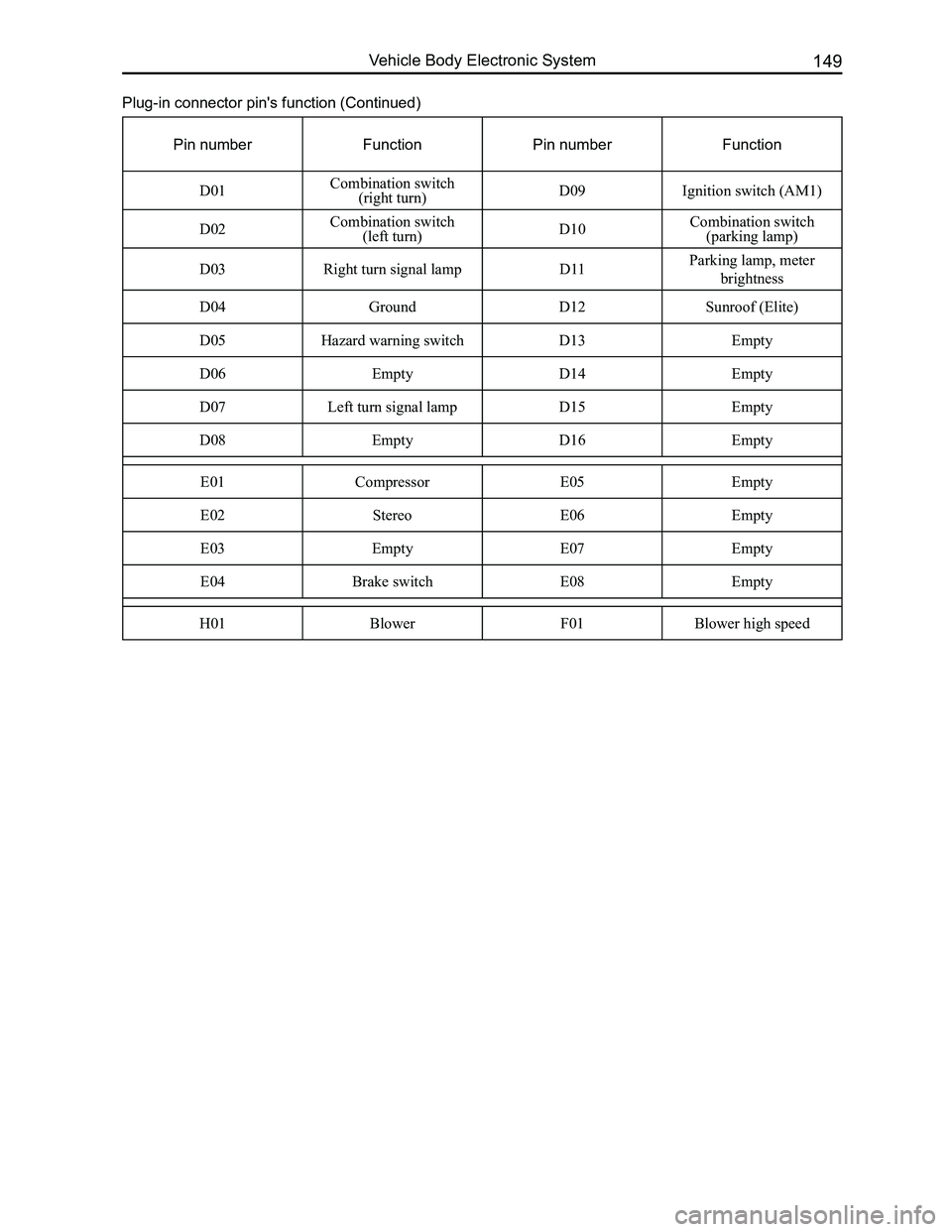
Plug-in connector pin's function (Continued)
Pin numberFunctionPin numberFunction
D01Combination switch (right turn)D09Ignition switch (AM1)
D02Combination switch (left turn)D10Combination switch (parking lamp)
D03Right turn signal lampD11Parking lamp, meter
brightness
D04GroundD12Sunroof (Elite)
D05Hazard warning switchD13Empty
D06EmptyD14Empty
D07Left turn signal lampD15Empty
D08EmptyD16Empty
E01CompressorE05Empty
E02StereoE06Empty
E03EmptyE07Empty
E04Brake switchE08Empty
H01BlowerF01Blower high speed