brake GREAT WALL FLORID 2008 User Guide
[x] Cancel search | Manufacturer: GREAT WALL, Model Year: 2008, Model line: FLORID, Model: GREAT WALL FLORID 2008Pages: 281, PDF Size: 43.97 MB
Page 44 of 281
Downloaded from www.Manualslib.com manuals search engine 37Clutch Operational System
Areas of Importance
1. Clutch Rigid Pipe Installation
Before installing, check to make sure that the rigid pipe flare contact area is in good condition, the pipeline is
clean, and that there is no foreign materials.
2. Clutch Hose Installation
Check the surface of the clutch hose to make sure that there is no scuffing and that the pipeline is clean.
3. Coat grease on the U-joint of the pedal and the master cylinder.
4. Strictly adhere to the set torque guidelines when tightening the pipe fittings.
Rigid pipe and the master cylinder: M10 16±2 N·m
Clutch rigid pipe and hose: M10 16±2 N·m
5. While the clutch system is undergoing the exhausting process, make sure that all the air bubbles in
the pipeline are cleared out. Then check the brake fluid level in the reservoir, it should be between
MIN and MAX.
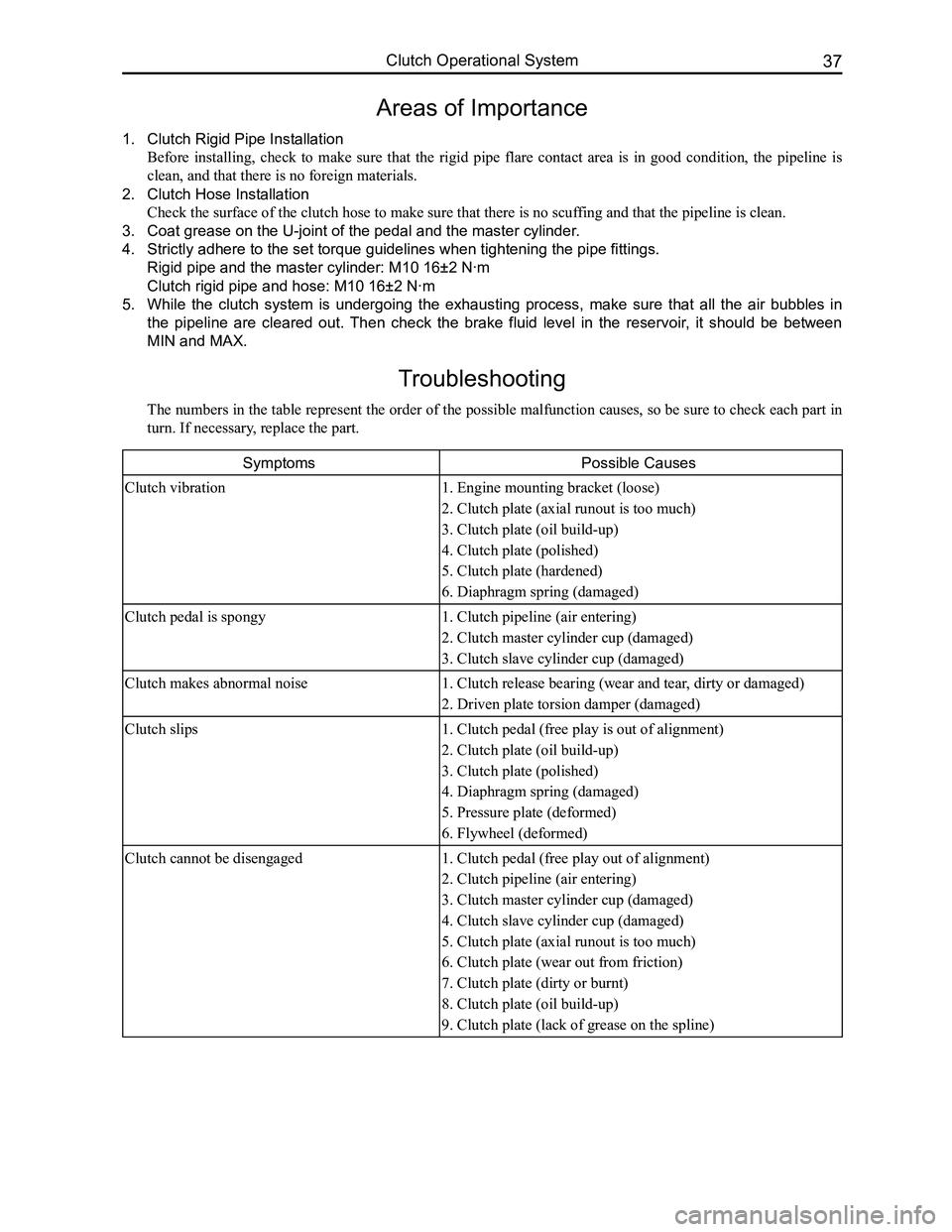
Troubleshooting
The numbers in the table represent the order of the possible malfunction causes, so be sure to check each part in
turn. If necessary, replace the part.
SymptomsPossible Causes
Clutch vibration1. Engine mounting bracket (loose)
2. Clutch plate (axial runout is too much)
3. Clutch plate (oil build-up)
4. Clutch plate (polished)
5. Clutch plate (hardened)
6. Diaphragm spring (damaged)
Clutch pedal is spongy1. Clutch pipeline (air entering)
2. Clutch master cylinder cup (damaged)
3. Clutch slave cylinder cup (damaged)
Clutch makes abnormal noise1. Clutch release bearing (wear and tear, dirty or damaged)
2. Driven plate torsion damper (damaged)
Clutch slips1. Clutch pedal (free play is out of alignment)
2. Clutch plate (oil build-up)
3. Clutch plate (polished)
4. Diaphragm spring (damaged)
5. Pressure plate (deformed)
6. Flywheel (deformed)
Clutch cannot be disengaged1. Clutch pedal (free play out of alignment)
2. Clutch pipeline (air entering)
3. Clutch master cylinder cup (damaged)
4. Clutch slave cylinder cup (damaged)
5. Clutch plate (axial runout is too much)
6. Clutch plate (wear out from friction)
7. Clutch plate (dirty or burnt)
8. Clutch plate (oil build-up)
9. Clutch plate (lack of grease on the spline)
Page 45 of 281
Downloaded from www.Manualslib.com manuals search engine GWFLORID Maintenance Manual38
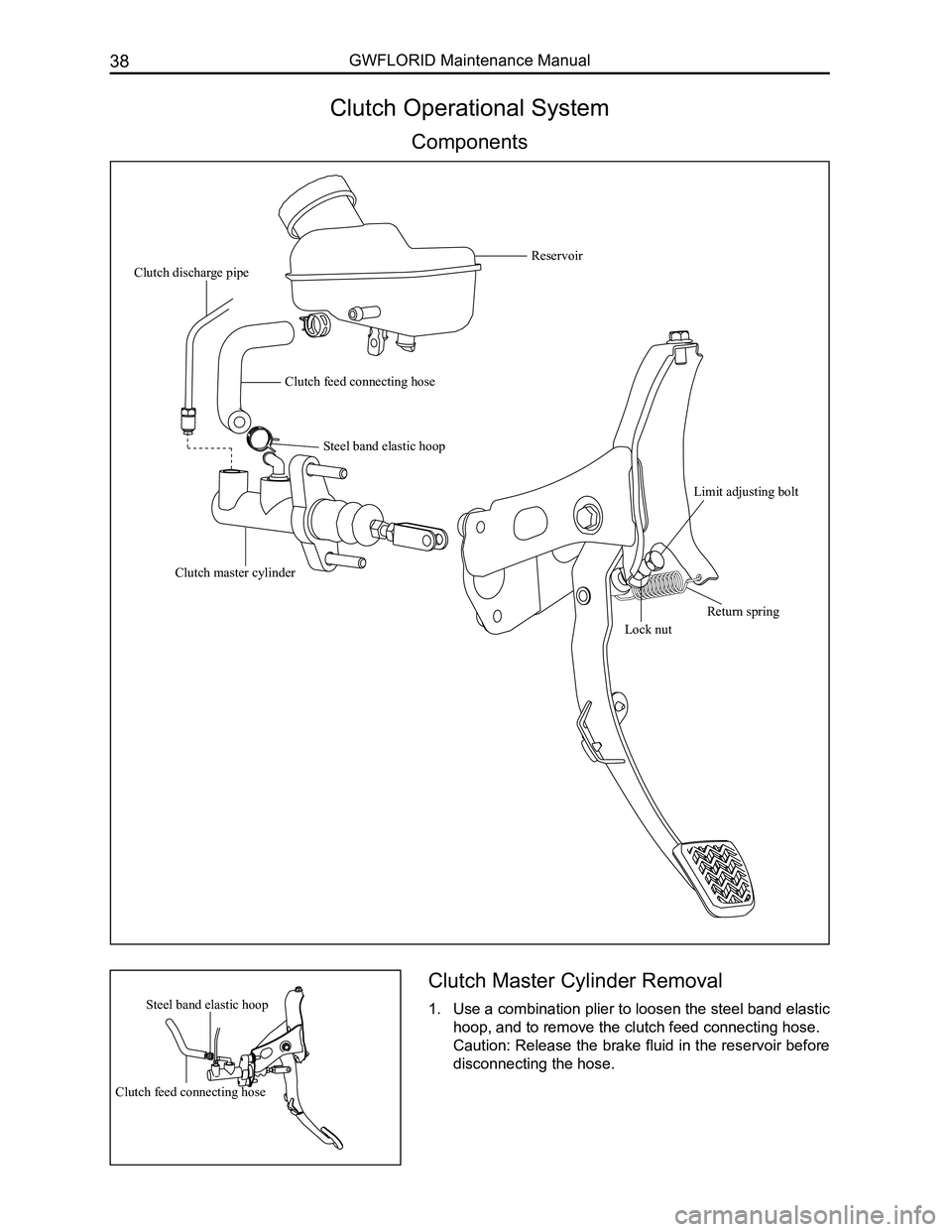
Clutch Operational System
Components
Clutch Master Cylinder Removal
1. Use a combination plier to loosen the steel band elastic
hoop, and to remove the clutch feed connecting hose.
Caution: Release the brake fluid in the reservoir before
disconnecting the hose.
Steel band elastic hoop
Clutch feed connecting hose
Reservoir
Steel band elastic hoop
Clutch feed connecting hose
Clutch discharge pipe
Clutch master cylinder
Limit adjusting bolt
Return spring
Lock nut
Page 47 of 281
Downloaded from www.Manualslib.com manuals search engine GWFLORID Maintenance Manual40
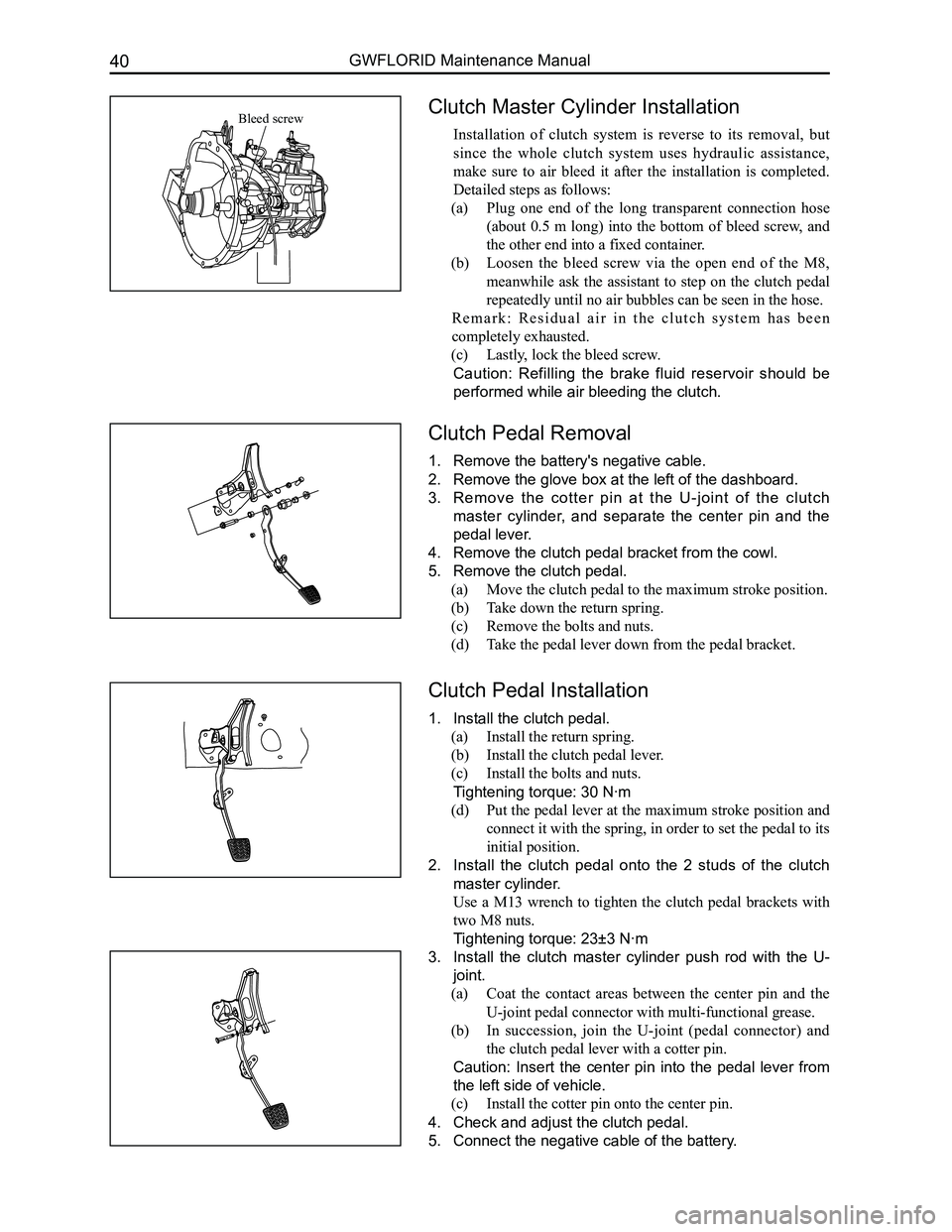
Clutch Master Cylinder Installation
Installation of clutch system is reverse to its removal, but
since the whole clutch system uses hydraulic assistance,
make sure to air bleed it after the installation is completed.
Detailed steps as follows:
(a) Plug one end of the long transparent connection hose
(about 0.5 m long) into the bottom of bleed screw, and
the other end into a fixed container.
(b) Loosen the bleed screw via the open end of the M8,
meanwhile ask the assistant to step on the clutch pedal
repeatedly until no air bubbles can be seen in the hose.
R e m a r k : R e s i d u a l a i r i n t h e c l u t c h s y s t e m h a s b e e n
completely exhausted.
(c) Lastly, lock the bleed screw.
Caution: Refilling the brake fluid reservoir should be
performed while air bleeding the clutch.
Clutch Pedal Removal
1. Remove the battery's negative cable.
2. Remove the glove box at the left of the dashboard.
3. Remove the cotter pin at the U-joint of the clutch
master cylinder, and separate the center pin and the
pedal lever.
4. Remove the clutch pedal bracket from the cowl.
5. Remove the clutch pedal.
(a) Move the clutch pedal to the maximum stroke position.
(b) Take down the return spring.
(c) Remove the bolts and nuts.
(d) Take the pedal lever down from the pedal bracket.
Clutch Pedal Installation
1. Install the clutch pedal.
(a) Install the return spring.
(b) Install the clutch pedal lever.
(c) Install the bolts and nuts.
Tightening torque: 30 N·m
(d) Put the pedal lever at the maximum stroke position and
connect it with the spring, in order to set the pedal to its
initial position.
2. Install the clutch pedal onto the 2 studs of the clutch
master cylinder.
Use a M13 wrench to tighten the clutch pedal brackets with
two M8 nuts.
Tightening torque: 23±3 N·m
3. Install the clutch master cylinder push rod with the U-
joint.
(a) Coat the contact areas between the center pin and the
U-joint pedal connector with multi-functional grease.
(b) In succession, join the U-joint (pedal connector) and
the clutch pedal lever with a cotter pin.
Caution: Insert the center pin into the pedal lever from
the left side of vehicle.
(c) Install the cotter pin onto the center pin.
4. Check and adjust the clutch pedal.
5. Connect the negative cable of the battery.
Bleed screw
Page 80 of 281
Downloaded from www.Manualslib.com manuals search engine 73Suspension System
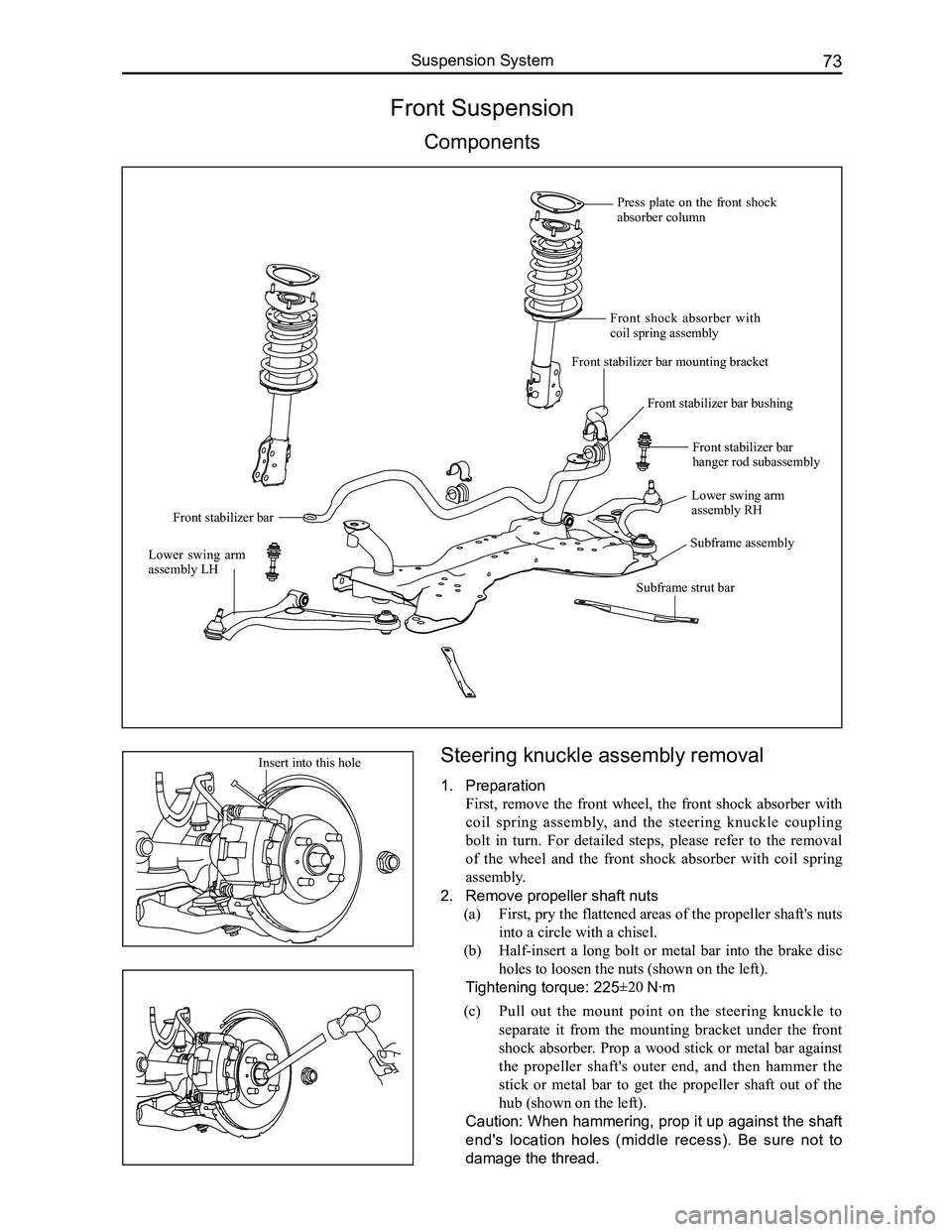
Steering knuckle assembly removal
1. Preparation
First, remove the front wheel, the front shock absorber with
coil spring assembly, and the steering knuckle coupling
bolt in turn. For detailed steps, please refer to the removal
of the wheel and the front shock absorber with coil spring
assembly.
2. Remove propeller shaft nuts
(a) First, pry the flattened areas of the propeller shaft's nuts
into a circle with a chisel.
(b) Half-insert a long bolt or metal bar into the brake disc
holes to loosen the nuts (shown on the left).
Tightening torque: 225±20 N·m
Front Suspension
Components
(c) Pull out the mount point on the steering knuckle to
separate it from the mounting bracket under the front
shock absorber. Prop a wood stick or metal bar against
the propeller shaft's outer end, and then hammer the
stick or metal bar to get the propeller shaft out of the
hub (shown on the left).
Caution: When hammering, prop it up against the shaft
end's location holes (middle recess). Be sure not to
damage the thread.
Insert into this hole
Press plate on the front shock absorber column
Front shock absorber with coil spring assembly
Front stabilizer bar mounting bracket
Front stabilizer bar bushing
Front stabilizer bar
Lower swing arm assembly RH
Lower swing arm assembly LH
Subframe assembly
Front stabilizer bar hanger rod subassembly
Subframe strut bar
Page 81 of 281
Downloaded from www.Manualslib.com manuals search engine GWFLORID Maintenance Manual74
3. Remove the wheel speed sensor and the brake hose
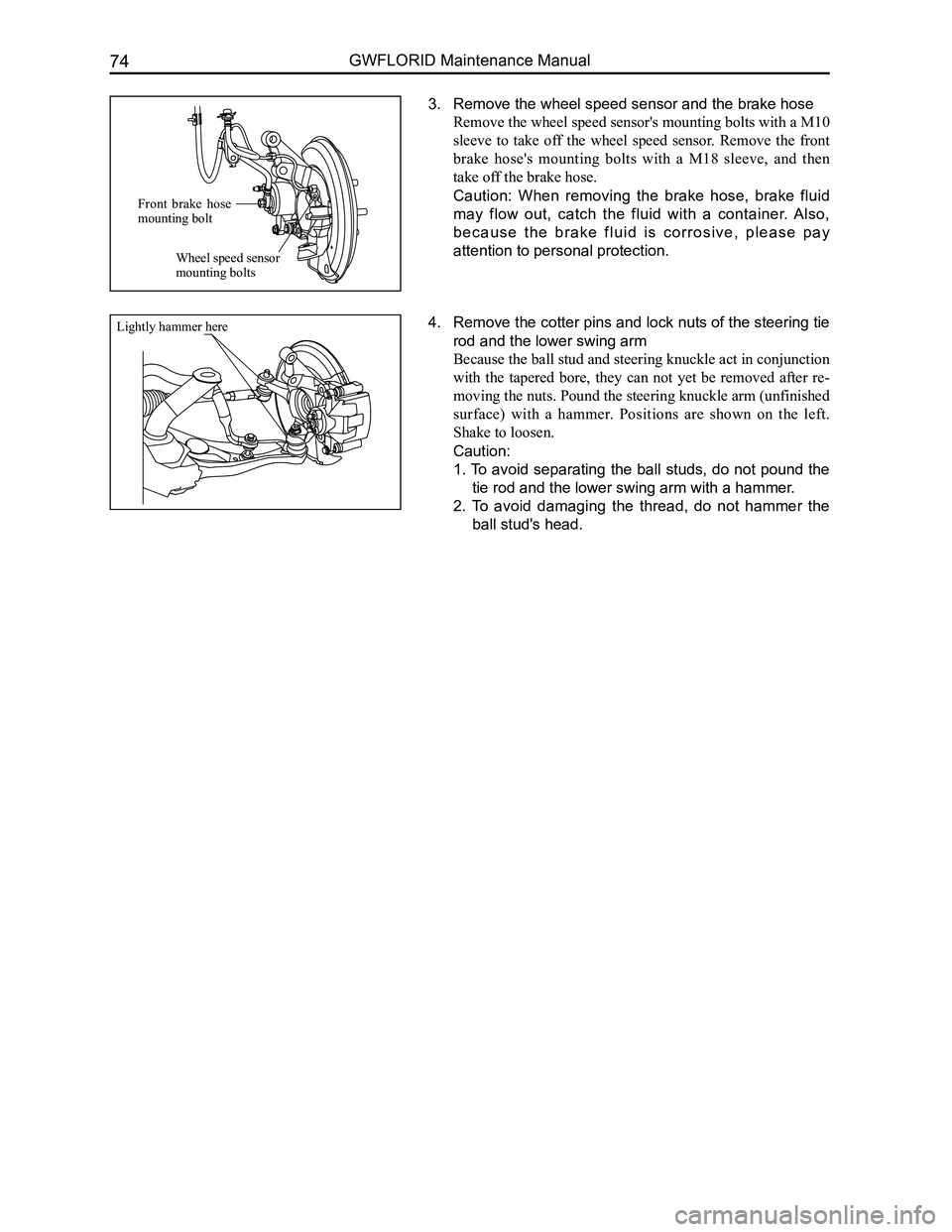
Remove the wheel speed sensor's mounting bolts with a M10
sleeve to take off the wheel speed sensor. Remove the front
brake hose's mounting bolts with a M18 sleeve, and then
take off the brake hose.
Caution: When removing the brake hose, brake fluid
may flow out, catch the fluid with a container. Also,
b e c a u s e t h e b r a k e f l u i d i s c o r r o s i v e , p l e a s e p a y
attention to personal protection.
4. Remove the cotter pins and lock nuts of the steering tie
rod and the lower swing arm
Because the ball stud and steering knuckle act in conjunction
with the tapered bore, they can not yet be removed after re-
moving the nuts. Pound the steering knuckle arm (unfinished
surface) with a hammer. Positions are shown on the left.
Shake to loosen.
Caution:
1. To avoid separating the ball studs, do not pound the
tie rod and the lower swing arm with a hammer.
2. To avoid damaging the thread, do not hammer the
ball stud's head.
Front brake hose mounting bolt
Wheel speed sensor mounting bolts
Lightly hammer here
Page 82 of 281
Downloaded from www.Manualslib.com manuals search engine 75Suspension System
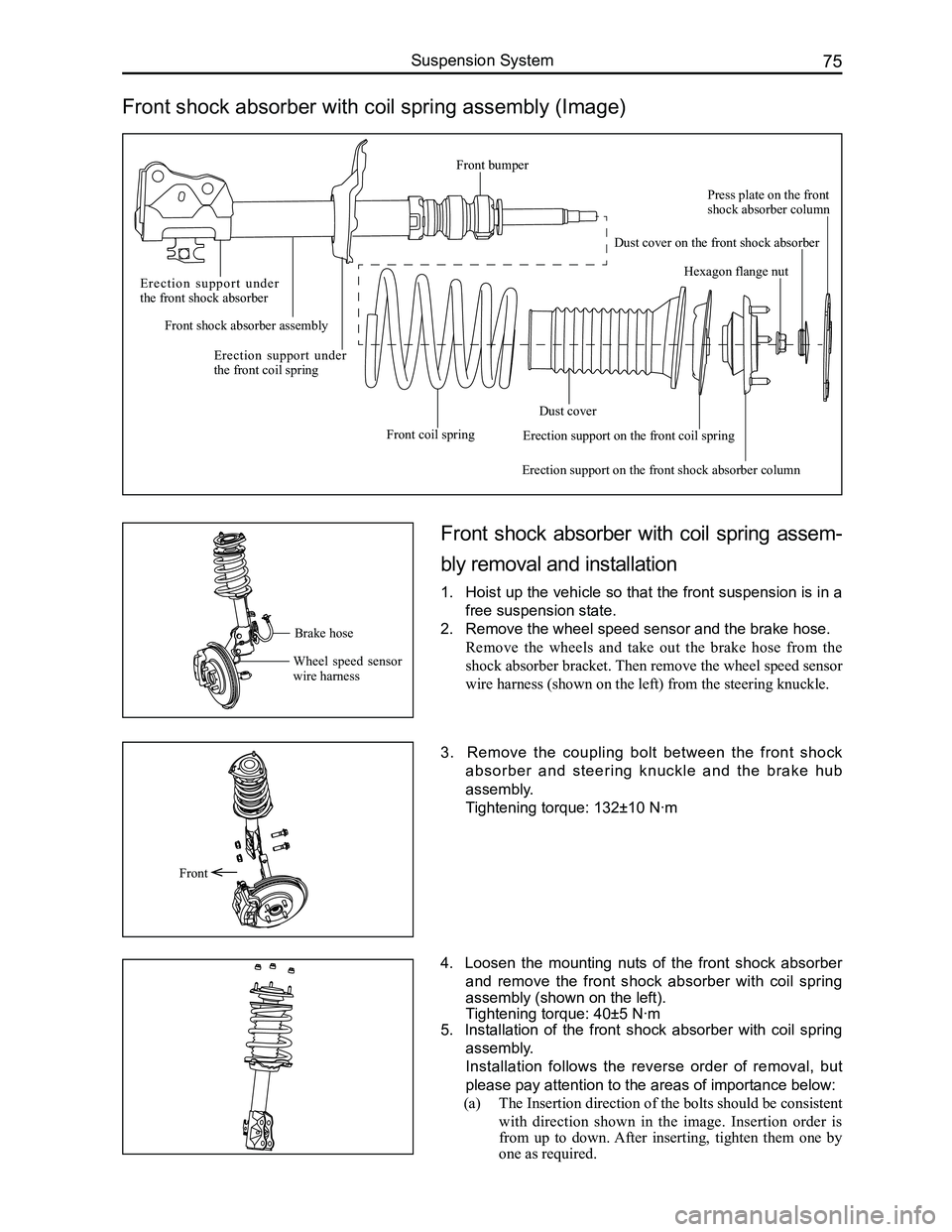
Front shock absorber with coil spring assembly (Image)
Front shock absorber with coil spring assem-
bly removal and installation
1. Hoist up the vehicle so that the front suspension is in a
free suspension state.
2. Remove the wheel speed sensor and the brake hose.
Remove the wheels and take out the brake hose from the
shock absorber bracket. Then remove the wheel speed sensor
wire harness (shown on the left) from the steering knuckle.
3. Remove the coupling bolt between the front shock
absorber and steering knuckle and the brake hub
assembly.
Tightening torque: 132±10 N·m
4. Loosen the mounting nuts of the front shock absorber
and remove the front shock absorber with coil spring
assembly (shown on the left).
Tightening torque: 40±5 N·m
5. Installation of the front shock absorber with coil spring
assembly.
Installation follows the reverse order of removal, but
please pay attention to the areas of importance below:
(a) The Insertion direction of the bolts should be consistent
with direction shown in the image. Insertion order is
from up to down. After inserting, tighten them one by
one as required.
Front
Brake hose
Wheel speed sensor wire harness
E r e c t i o n s u p p o r t u n d e r the front shock absorber
Front shock absorber assembly
Erection support under the front coil spring
Front coil spring
Dust cover
Erection support on the front shock absorber column
Hexagon flange nut
Press plate on the front shock absorber column
Dust cover on the front shock absorber
Erection support on the front coil spring
Front bumper
Page 99 of 281
Downloaded from www.Manualslib.com manuals search engine GWFLORID Maintenance Manual92
Wheel
General tire balancing procedures
Clean out the accumulated dirt and debris from the inside of the rim.
Warning:
The gravel on the tread must be eliminated to avoid flying out and injuring the operator when
undergoing rotational balancing. This is also a good way to acquire better balance. First thoroughly
inspect the tire's damaged condition, then according to the balancing device manufacture's
recommendations, carry out the balancing operation.
Off-vehicle balancing
Most off-vehicle balancers are more accurate and convenient than on-vehicle rotational balancers. They are
also able to perform dynamic (two sided) balancing. Although it does not correct drum brake and brake disc
imbalance like on-vehicle balancing, it achieves the same effect based on its accuracy.
On-vehicle balancing
On-vehicle balancing is different based on equipment and tool manufacturer. Therefore, when performing
balancing operations, be sure to comply to each manufacturer's operating\
instructions.
Warning: Control the wheel rotation speed to make sure the speedometer stays within 55 km/h.
This restriction is necessary because when a driven wheel slides while the other one stays still, the
speedometer will display only half of the actual wheel speed. When a wheel is sliding, be extremely
careful, because sliding wheels can reach very high speeds. This may lead to the tire rubber peeling
or differential damage, which may cause serious personal injury, or damage to the vehicle.
Tire installation and removal
• Install or remove tires with a tire changer. When operating machinery, make sure to comply to the machine
manufacturers operation manual. Please do not change tires merely with manual hand tools or tire installation
crowbars. This will damage the tire chafer or the vehicle wheel's rim.
• Use a wire brush or coarse steel wool to clean off grease and old rubber, as well as light rust or corrosion from
the rim tire bead's tire chafer seat. Before tire installation or removal, first use the indicated tire lubricant to
thoroughly lube the tire chafer portions one time.
• After installing the tire, inflate it to the specified pressure and make\
sure the tire bead is properly seated.
Warning: Do not over-inflate the tire. If the tire bead severally expands and exceeds the safety limit,
it may burst and cause serious personal injury. While inflating, do not exceed the specified pressure.
If the specified pressure does not allow the tire bead to sit properly, deflate the tire, re-lubricate, and
then re-inflate.
Spare tire usage
• Spare tire standard inflation pressure: 420 kPa.
• Spare tire pressure measurements should be taken under normal temperatur\
e conditions.
• After inflating the spare tire, soapy water should be used to check if the air nozzles core is leaking air, then
lock on the air nozzle cap.
• The spare tire should always be kept in a useable state. Check the air p\
ressure at least once a month.
• When the spare tire's working limit, indicated by the remaining pattern's depth, reaches 1.6 mm (and its pat-
tern groove bottom protrudes to the same level), for your safety, please stop using the spare tire.
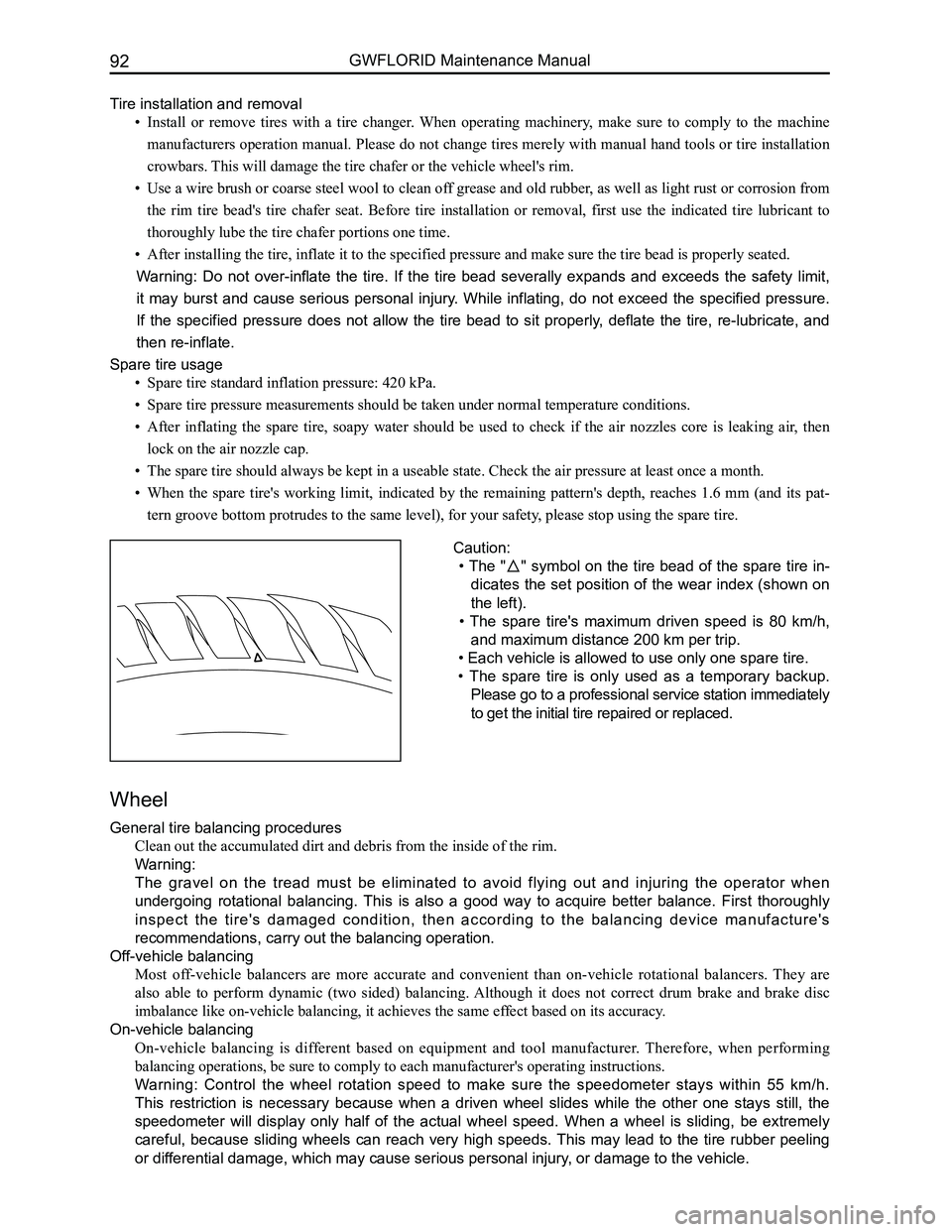
Caution:
• The "" symbol on the tire bead of the spare tire in-
dicates the set position of the wear index (shown on
the left).
• The spare tire's maximum driven speed is 80 km/h,
and maximum distance 200 km per trip.
• Each vehicle is allowed to use only one spare tire.
• The spare tire is only used as a temporary backup.
Please go to a professional service station immediately
to get the initial tire repaired or replaced.
Page 100 of 281
Downloaded from www.Manualslib.com manuals search engine 93Suspension System
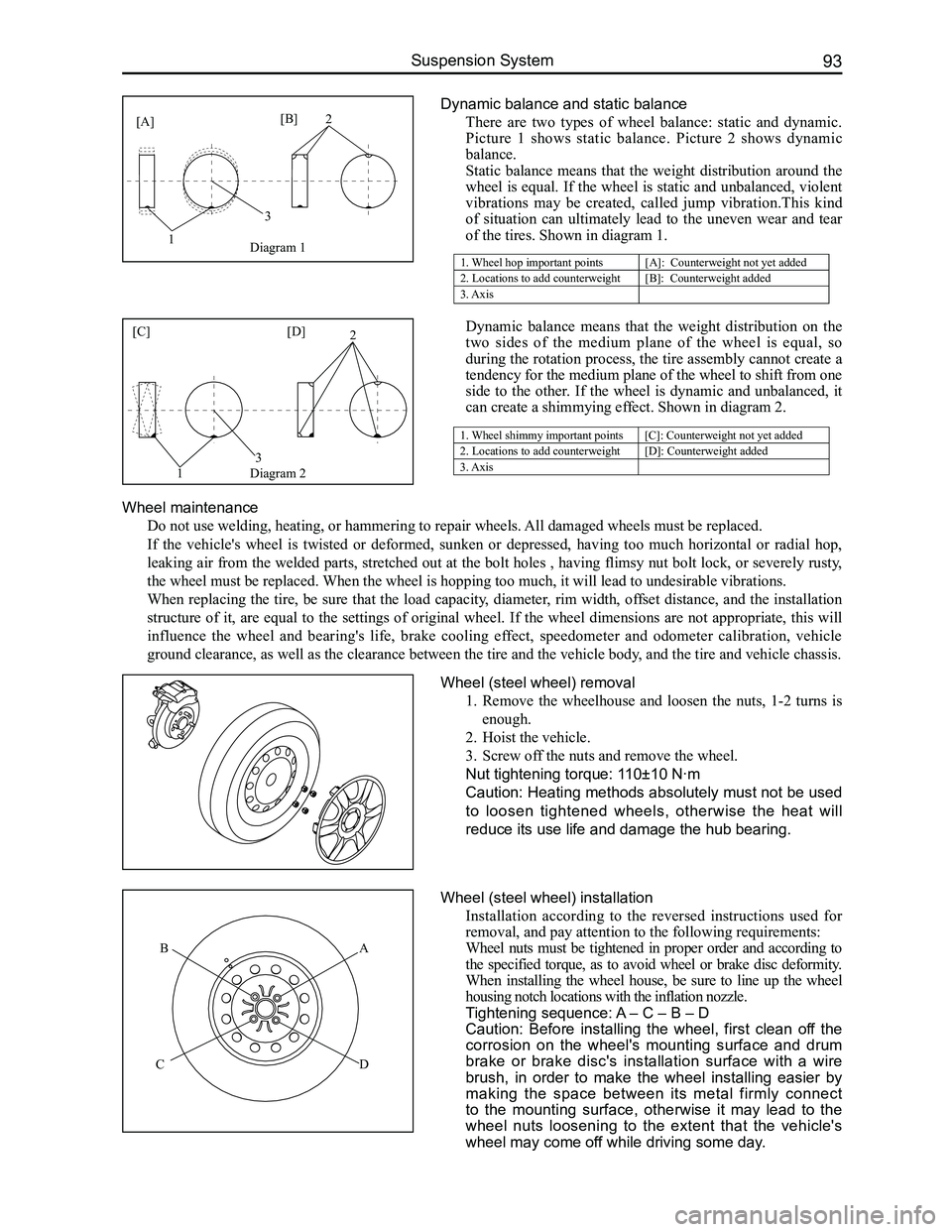
Dynamic balance and static balance
There are two types of wheel balance: static and dynamic.
Picture 1 shows static balance. Picture 2 shows dynamic
balance.
Static balance means that the weight distribution around the
wheel is equal. If the wheel is static and unbalanced, violent
vibrations may be created, called jump vibration.This kind
of situation can ultimately lead to the uneven wear and tear
of the tires. Shown in diagram 1.
Dynamic balance means that the weight distribution on the
two sides of the medium plane of the wheel is equal, so
during the rotation process, the tire assembly cannot create a
tendency for the medium plane of the wheel to shift from one
side to the other. If the wheel is dynamic and unbalanced, it
can create a shimmying effect. Shown in diagram 2.
1. Wheel shimmy important points[C]: Counterweight not yet added
2. Locations to add counterweight[D]: Counterweight added
3. Axis
Wheel maintenance
Do not use welding, heating, or hammering to repair wheels. All damaged wheels must be replaced.
If the vehicle's wheel is twisted or deformed, sunken or depressed, having too much horizontal or radial hop,
leaking air from the welded parts, stretched out at the bolt holes , having flimsy nut bolt lock, or severely rusty,
the wheel must be replaced. When the wheel is hopping too much, it will lead to undesirable vibratio\
ns.
When replacing the tire, be sure that the load capacity, diameter, rim width, offset distance, and the installation
structure of it, are equal to the settings of original wheel. If the wheel dimensions are not appropriate, this will
influence the wheel and bearing's life, brake cooling effect, speedometer and odometer calibration, vehicle
ground clearance, as well as the clearance between the tire and the vehi\
cle body, and the tire and vehicle chassis.
Wheel (steel wheel) removal
1. Remove the wheelhouse and loosen the nuts, 1-2 turns is
enough.
2. Hoist the vehicle.
3. Screw off the nuts and remove the wheel.
Nut tightening torque: 110±10 N·m
Caution: Heating methods absolutely must not be used
to loosen tightened wheels, otherwise the heat will
reduce its use life and damage the hub bearing.
Wheel (steel wheel) installation
Installation according to the reversed instructions used for
removal, and pay attention to the following requirements:
Wheel nuts must be tightened in proper order and according to
the specified torque, as to avoid wheel or brake disc deformity.
When installing the wheel house, be sure to line up the wheel
housing notch locations with the inflation nozzle.
Tightening sequence: A – C – B – D
Caution: Before installing the wheel, first clean off the
corrosion on the wheel's mounting surface and drum
brake or brake disc's installation surface with a wire
brush, in order to make the wheel installing easier by
making the space between its metal firmly connect
to the mounting surface, otherwise it may lead to the
wheel nuts loosening to the extent that the vehicle's
wheel may come off while driving some day.
1
3
2[A][B]
1. Wheel hop important points[A]: Counterweight not yet added
2. Locations to add counterweight[B]: Counterweight added
3. Axis
Diagram 1
Diagram 2
[C][D]
1
3
2
AB
CD
Page 101 of 281
Downloaded from www.Manualslib.com manuals search engine GWFLORID Maintenance Manual94
Brake System
Brake System Components Arrangement Schematics.......95
Brake System Maintenance................................................96
Brake Pedal ........................................................................\
98
Parking Brake Control Mechanism Assembly...................102
Vacuum Booster with Brake Cylinder Assembly ...............103
Anti-lock Brake System ....................................................107
ABS General Problem Maintenance and
Areas of Importance .........................................................109
Steering Knuckle and Hub Brake Assembly .....................112
Front Brake Caliper ..........................................................118
Rear Brake .......................................................................124
Rear Support Axle ............................................................131
Page 102 of 281
Downloaded from www.Manualslib.com manuals search engine 95Brake System
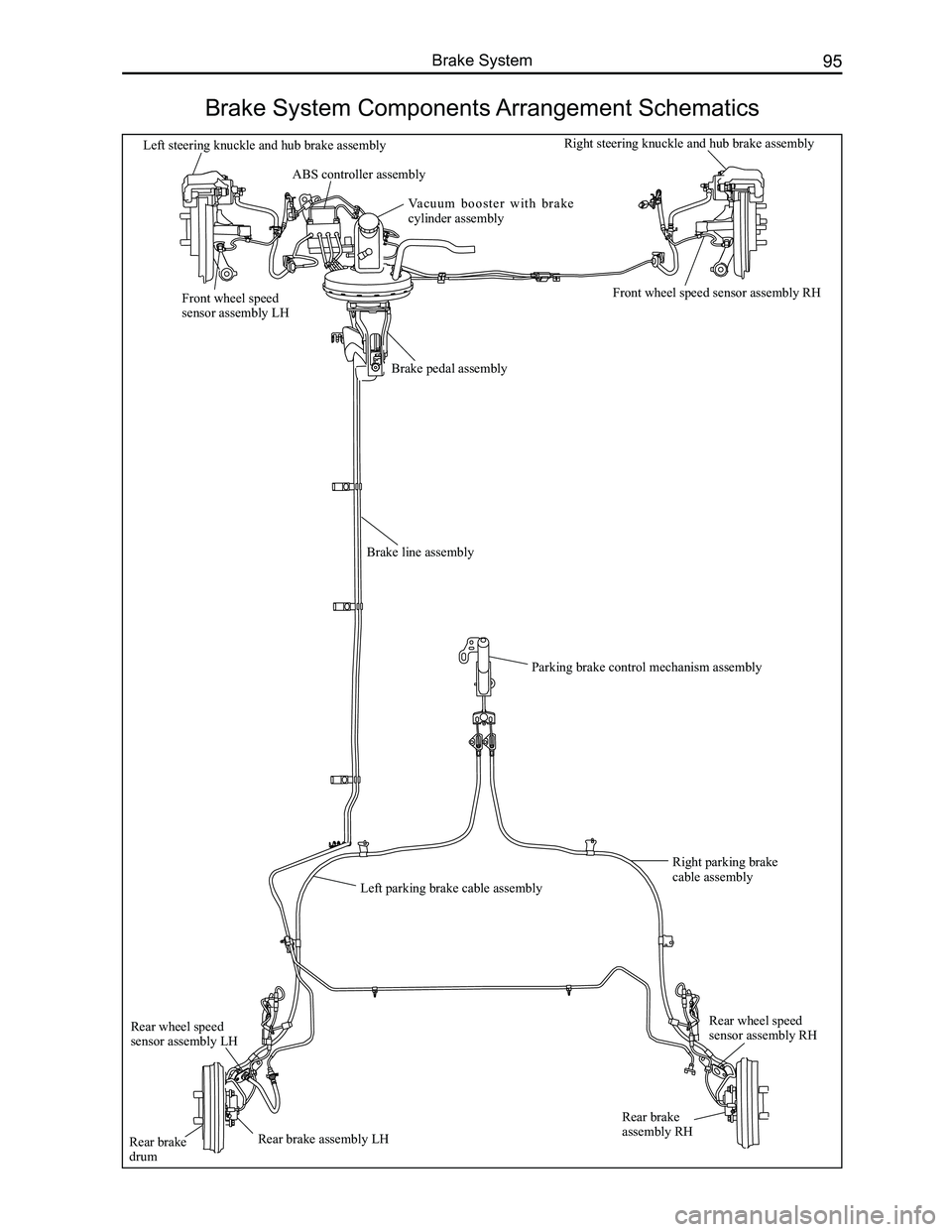
Brake System Components Arrangement Schematics
Brake pedal assembly
Vacuum booster with brake cylinder assembly
Left steering knuckle and hub brake assembly
Left parking brake cable assembly
Rear brake assembly RHRear brake drum
Rear wheel speed sensor assembly RH
Right parking brake cable assembly
ABS controller assembly
Right steering knuckle and hub brake assembly
Brake line assembly
Rear wheel speed
sensor assembly LH
Front wheel speed sensor assembly RHFront wheel speed sensor assembly LH
Rear brake assembly LH
Parking brake control mechanism assembly