ect GREAT WALL FLORID 2008 Manual Online
[x] Cancel search | Manufacturer: GREAT WALL, Model Year: 2008, Model line: FLORID, Model: GREAT WALL FLORID 2008Pages: 281, PDF Size: 43.97 MB
Page 130 of 281
Downloaded from www.Manualslib.com manuals search engine 123Brake System
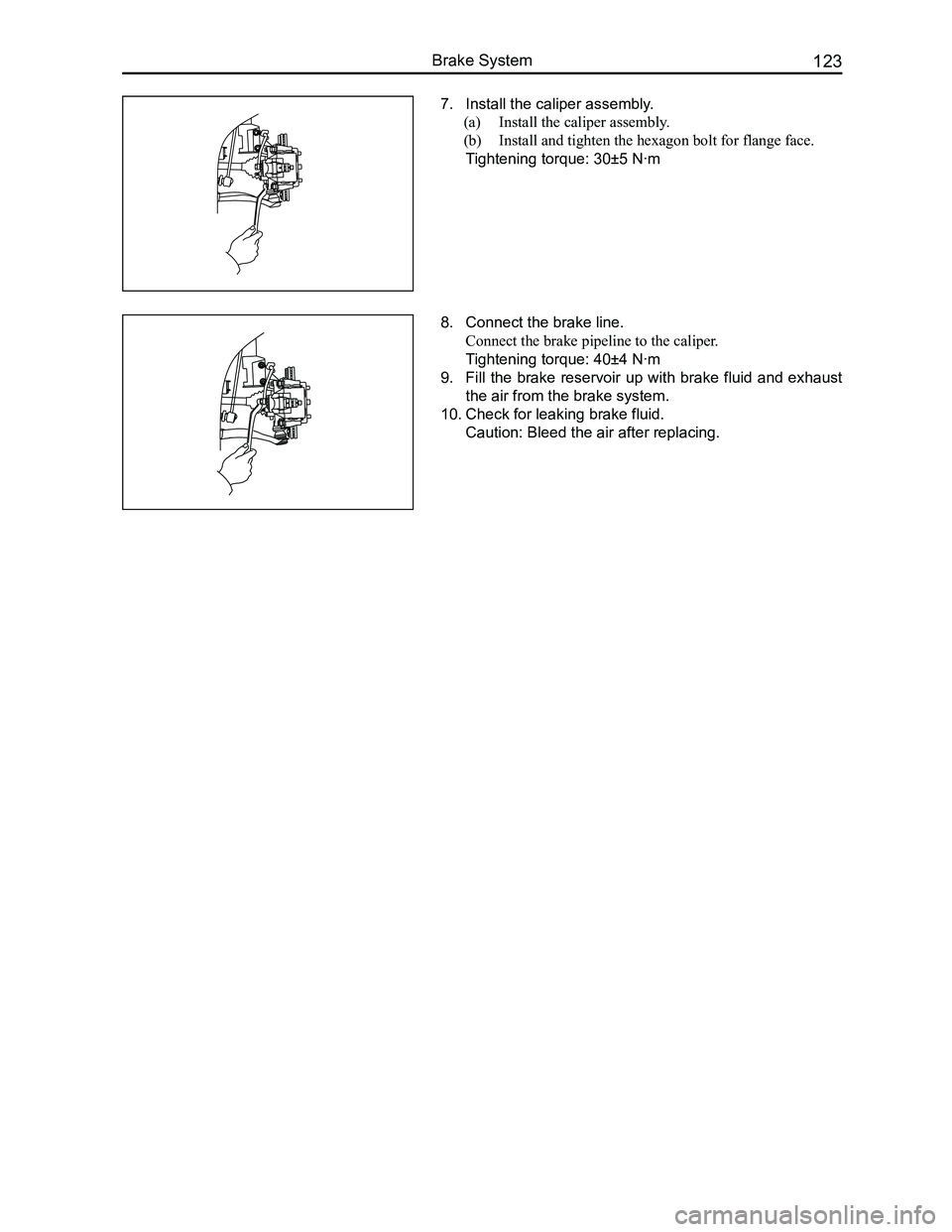
7. Install the caliper assembly.
(a) Install the caliper assembly.
(b) Install and tighten the hexagon bolt for flange face.
Tightening torque: 30±5 N·m
8. Connect the brake line.
Connect the brake pipeline to the caliper.
Tightening torque: 40±4 N·m
9. Fill the brake reservoir up with brake fluid and exhaust
the air from the brake system.
10. Check for leaking brake fluid.
Caution: Bleed the air after replacing.
Page 131 of 281
Downloaded from www.Manualslib.com manuals search engine GWFLORID Maintenance Manual124
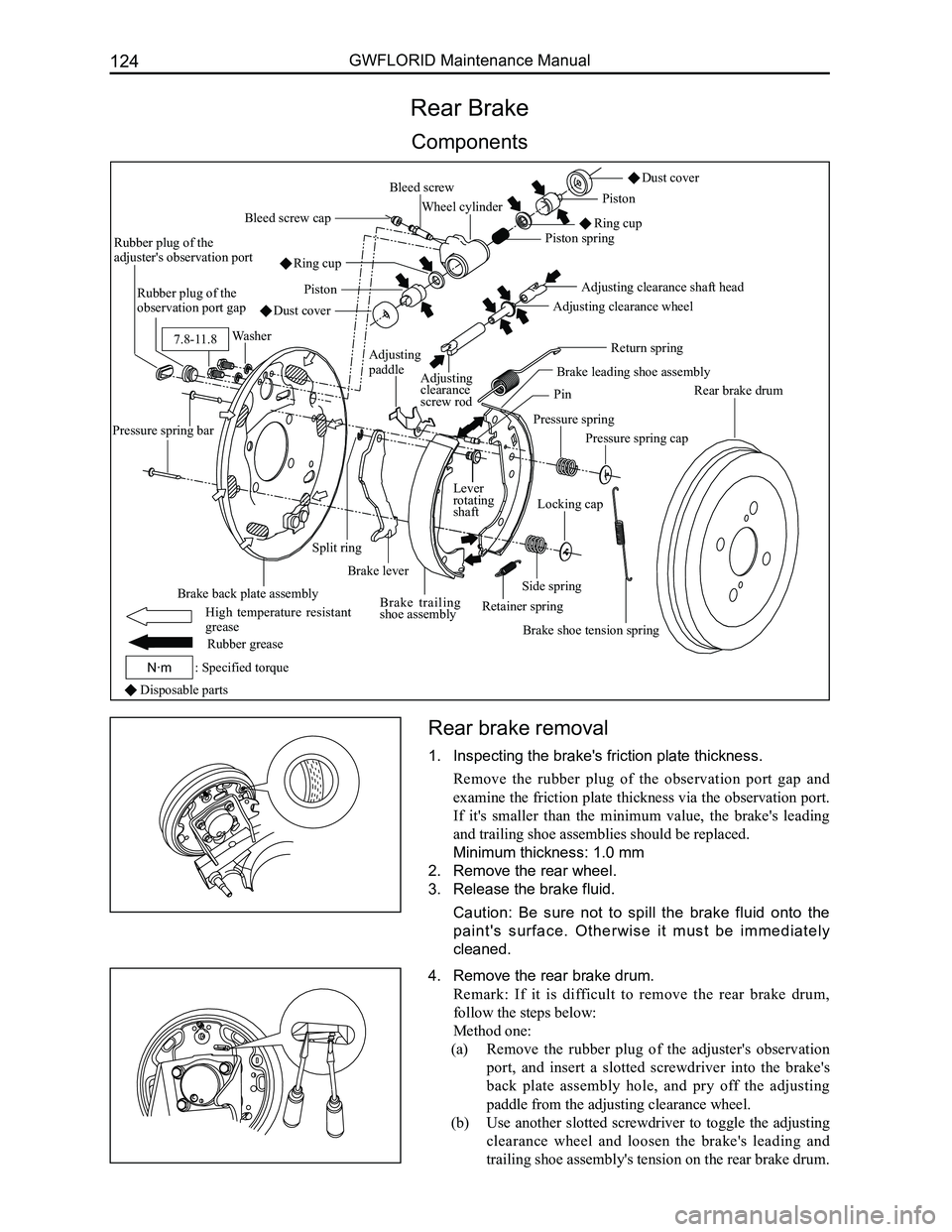
Rear Brake
Components
4. Remove the rear brake drum.
Remark: If it is difficult to remove the rear brake drum,
follow the steps below:
Method one:
(a) Remove the rubber plug of the adjuster's observation
port, and insert a slotted screwdriver into the brake's
back plate assembly hole, and pry off the adjusting
paddle from the adjusting clearance wheel.
(b) Use another slotted screwdriver to toggle the adjusting
clearance wheel and loosen the brake's leading and
trailing shoe assembly's tension on the rear brake drum.
Disposable parts
Dust cover
Brake leading shoe assembly
Pressure spring
Pressure spring cap
Brake shoe tension spring
Rear brake drum
Lever rotating shaft
Retainer spring
Locking cap
Split ring
Brake lever
Brake trailing shoe assembly
Brake back plate assembly
Pressure spring bar
Rubber plug of the adjuster's observation port
Rubber plug of the observation port gap
Washer
Bleed screw cap
Bleed screwPiston
Ring cup
Piston spring
Wheel cylinder
Adjusting clearance shaft head
Adjusting clearance wheel
Adjusting clearance screw rod
Return springAdjusting paddle
Pin
Side spring
Dust cover
Piston
Ring cup
Rubber grease
: Specified torqueN·m
7.8-11.8
High temperature resistant grease
Rear brake removal
1. Inspecting the brake's friction plate thickness.
Remove the rubber plug of the observation port gap and
examine the friction plate thickness via the observation port.
If it's smaller than the minimum value, the brake's leading
and trailing shoe assemblies should be replaced.
Minimum thickness: 1.0 mm
2. Remove the rear wheel.
3. Release the brake fluid.
Caution: Be sure not to spill the brake fluid onto the
paint's surface. Otherwise it must be immediately
cleaned.
Page 132 of 281
Downloaded from www.Manualslib.com manuals search engine 125Brake System
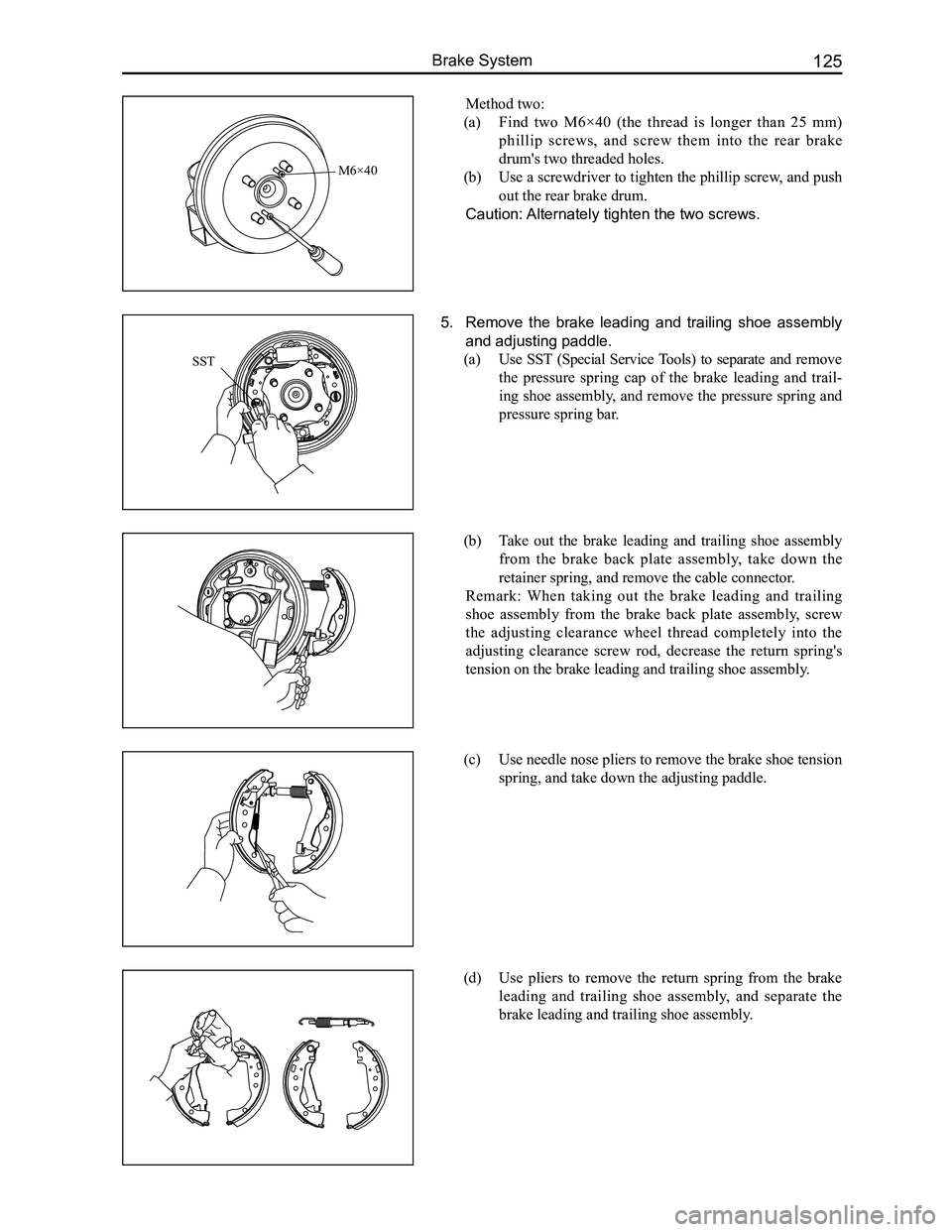
Method two:
(a) Find two M6×40 (the thread is longer than 25 mm)
phillip screws, and screw them into the rear brake
drum's two threaded holes.
(b) Use a screwdriver to tighten the phillip screw, and push
out the rear brake drum.
Caution: Alternately tighten the two screws.
5. Remove the brake leading and trailing shoe assembly
and adjusting paddle.
(a) Use SST (Special Service Tools) to separate and remove
the pressure spring cap of the brake leading and trail-
ing shoe assembly, and remove the pressure spring and
pressure spring bar.
(b) Take out the brake leading and trailing shoe assembly
from the brake back plate assembly, take down the
retainer spring, and remove the cable connector.
Remark: When taking out the brake leading and trailing
shoe assembly from the brake back plate assembly, screw
the adjusting clearance wheel thread completely into the
adjusting clearance screw rod, decrease the return spring's
tension on the brake leading and trailing shoe assembly.
(c) Use needle nose pliers to remove the brake shoe tension
spring, and take down the adjusting paddle.
(d) Use pliers to remove the return spring from the brake
leading and trailing shoe assembly, and separate the
brake leading and trailing shoe assembly.
SST
M6×40
Page 133 of 281
Downloaded from www.Manualslib.com manuals search engine GWFLORID Maintenance Manual126
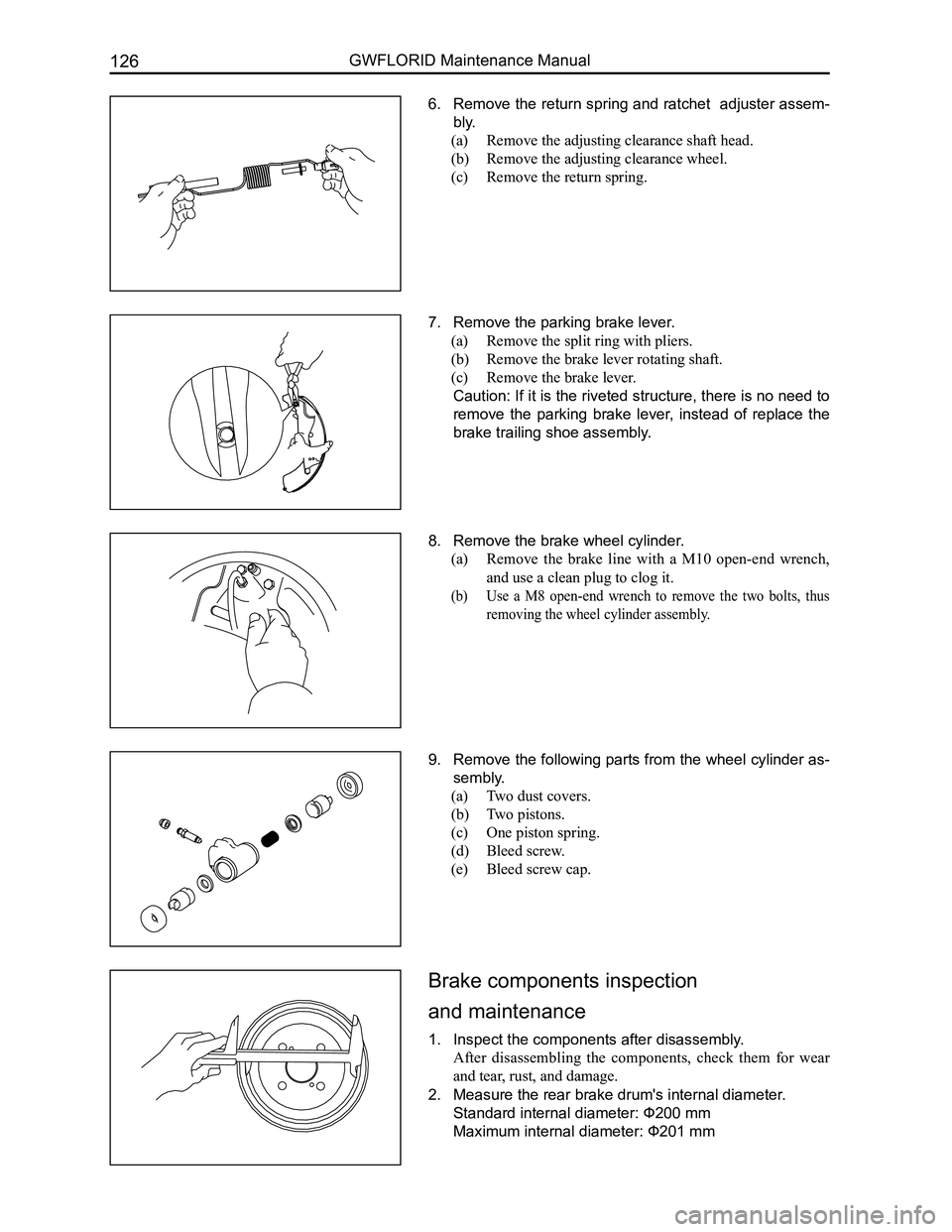
6. Remove the return spring and ratchet adjuster assem-
bly.
(a) Remove the adjusting clearance shaft head.
(b) Remove the adjusting clearance wheel.
(c) Remove the return spring.
7. Remove the parking brake lever.
(a) Remove the split ring with pliers.
(b) Remove the brake lever rotating shaft.
(c) Remove the brake lever.
Caution: If it is the riveted structure, there is no need to
remove the parking brake lever, instead of replace the
brake trailing shoe assembly.
8. Remove the brake wheel cylinder.
(a) Remove the brake line with a M10 open-end wrench,
and use a clean plug to clog it.
(b) Use a M8 open-end wrench to remove the two bolts, thus
removing the wheel cylinder assembly.
9. Remove the following parts from the wheel cylinder as-
sembly.
(a) Two dust covers.
(b) Two pistons.
(c) One piston spring.
(d) Bleed screw.
(e) Bleed screw cap.
Brake components inspection
and maintenance
1. Inspect the components after disassembly.
After disassembling the components, check them for wear
and tear, rust, and damage.
2. Measure the rear brake drum's internal diameter.
Standard internal diameter: Ф200 mm
Maximum internal diameter: Ф201 mm
Page 135 of 281
Downloaded from www.Manualslib.com manuals search engine GWFLORID Maintenance Manual128
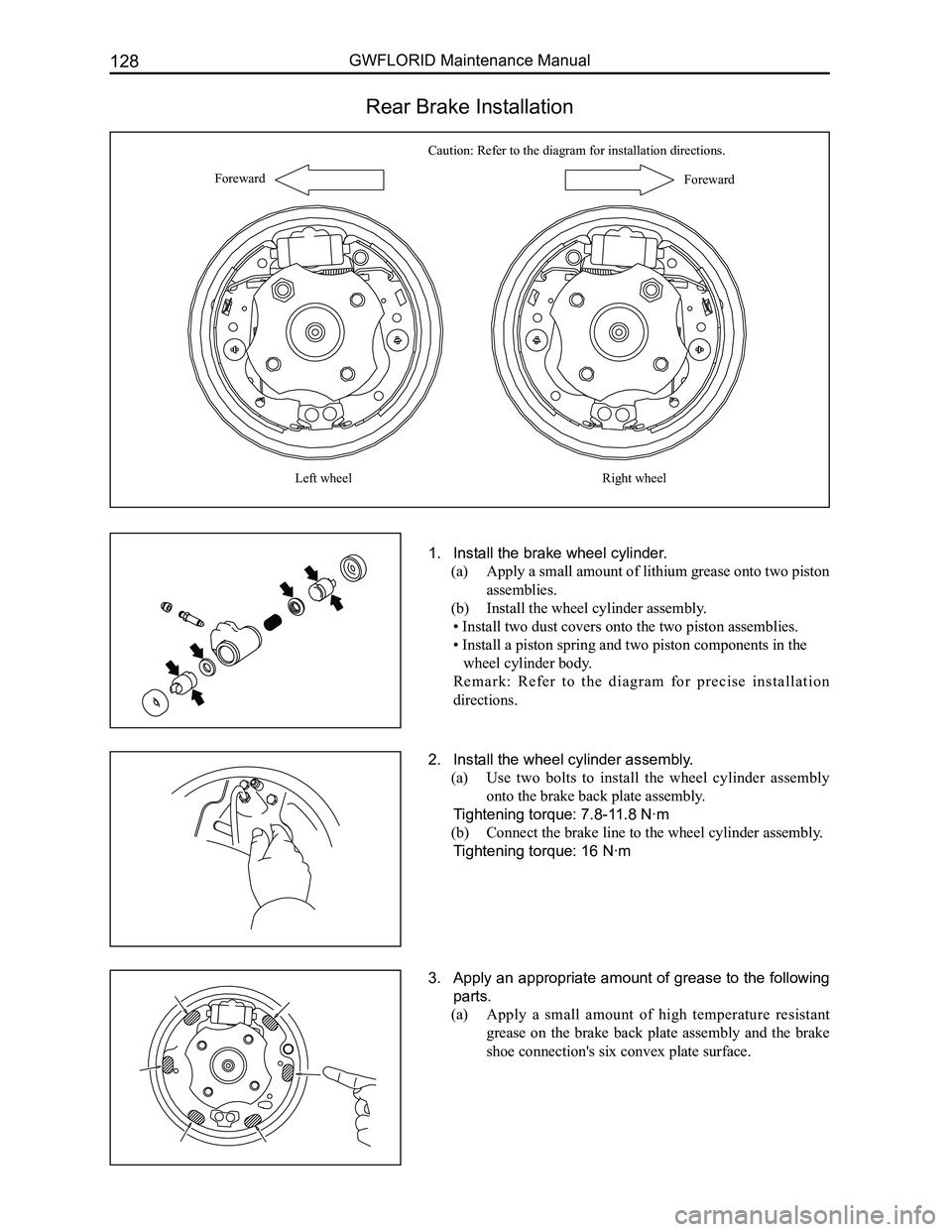
Rear Brake Installation
1. Install the brake wheel cylinder.
(a) Apply a small amount of lithium grease onto two piston
assemblies.
(b) Install the wheel cylinder assembly.
• Install two dust covers onto the two piston assemblies.
• Install a piston spring and two piston components in the
wheel cylinder body.
R e m a r k : R e f e r t o t h e d i a g r a m f o r p r e c i s e i n s t a l l a t i o n
directions.
2. Install the wheel cylinder assembly.
(a) Use two bolts to install the wheel cylinder assembly
onto the brake back plate assembly.
Tightening torque: 7.8-11.8 N·m
(b) Connect the brake line to the wheel cylinder assembly.
Tightening torque: 16 N·m
3. Apply an appropriate amount of grease to the following
parts.
(a) Apply a small amount of high temperature resistant
grease on the brake back plate assembly and the brake
shoe connection's six convex plate surface.
Caution: Refer to the diagram for installation directions.
ForewardForeward
Left wheelRight wheel
Page 137 of 281
Downloaded from www.Manualslib.com manuals search engine GWFLORID Maintenance Manual130
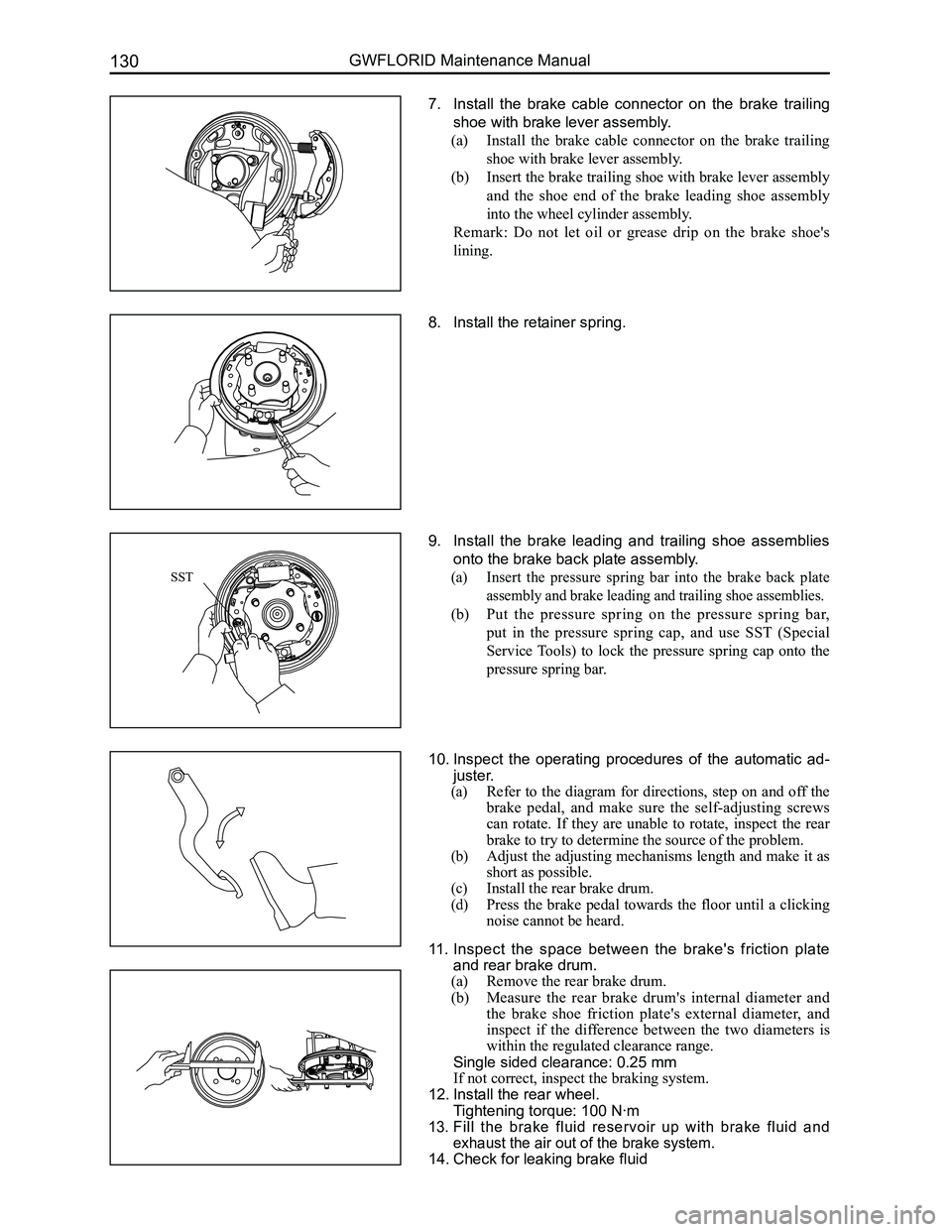
7. Install the brake cable connector on the brake trailing
shoe with brake lever assembly.
(a) Install the brake cable connector on the brake trailing
shoe with brake lever assembly.
(b) Insert the brake trailing shoe with brake lever assembly
and the shoe end of the brake leading shoe assembly
into the wheel cylinder assembly.
Remark: Do not let oil or grease drip on the brake shoe's
lining.
8. Install the retainer spring.
9. Install the brake leading and trailing shoe assemblies
onto the brake back plate assembly.
(a) Insert the pressure spring bar into the brake back plate
assembly and brake leading and trailing shoe assemblies.
(b) Put the pressure spring on the pressure spring bar,
put in the pressure spring cap, and use SST (Special
Service Tools) to lock the pressure spring cap onto the
pressure spring bar.
10. Inspect the operating procedures of the automatic ad-
juster.
(a) Refer to the diagram for directions, step on and off the
brake pedal, and make sure the self-adjusting screws
can rotate. If they are unable to rotate, inspect the rear
brake to try to determine the source of the problem.
(b) Adjust the adjusting mechanisms length and make it as
short as possible.
(c) Install the rear brake drum.
(d) Press the brake pedal towards the floor until a clicking
noise cannot be heard.
11. Inspect the space between the brake's friction plate
and rear brake drum.
(a) Remove the rear brake drum.
(b) Measure the rear brake drum's internal diameter and
the brake shoe friction plate's external diameter, and
inspect if the difference between the two diameters is
within the regulated clearance range.
Single sided clearance: 0.25 mm
If not correct, inspect the braking system.
12. Install the rear wheel.
Tightening torque: 100 N·m
13. Fill the brake fluid reservoir up with brake fluid and
exhaust the air out of the brake system.
14. Check for leaking brake fluid
SST
Page 138 of 281
Downloaded from www.Manualslib.com manuals search engine 131Brake System
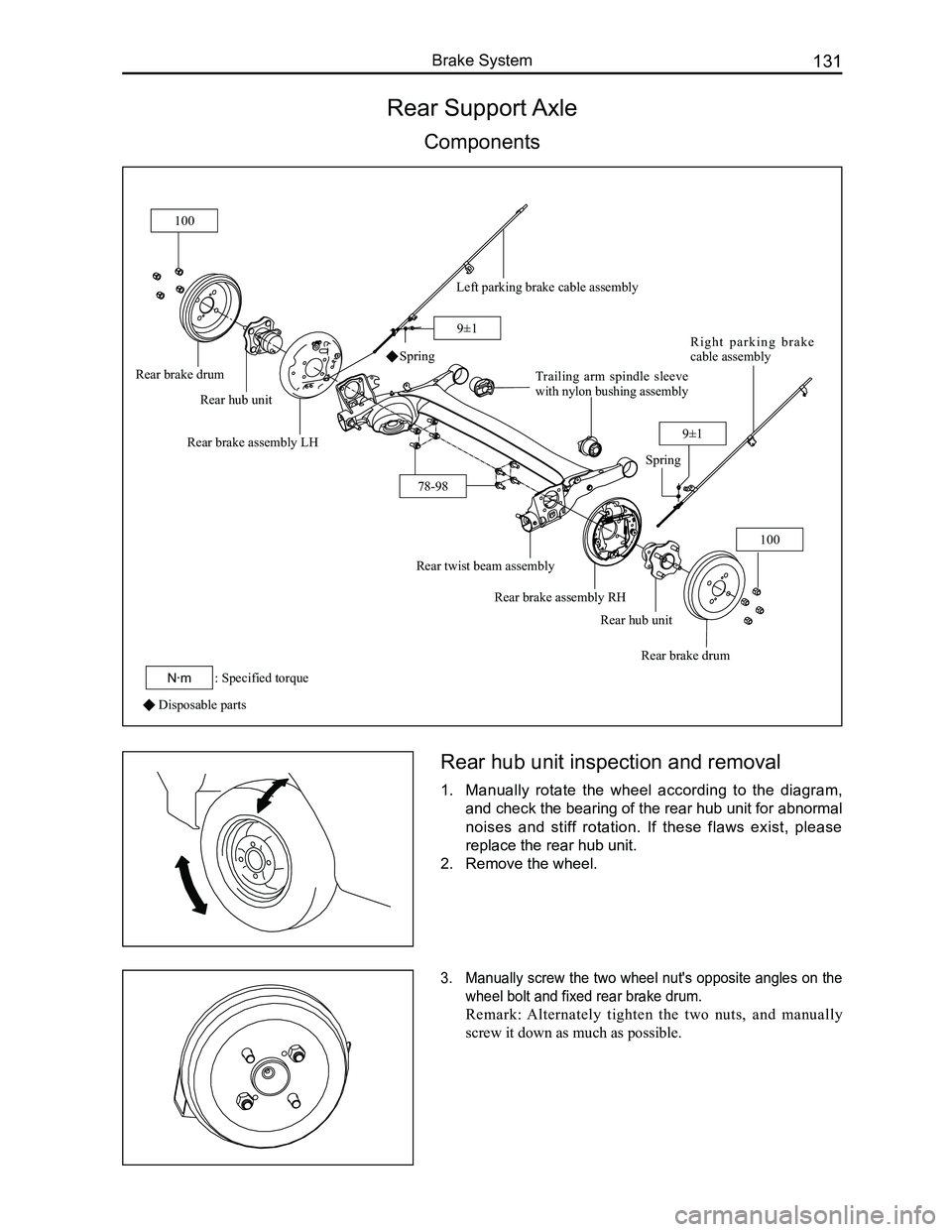
Rear Support Axle
Components
Rear hub unit inspection and removal
1. Manually rotate the wheel according to the diagram,
and check the bearing of the rear hub unit for abnormal
noises and stiff rotation. If these flaws exist, please
replace the rear hub unit.
2. Remove the wheel.
3. Manually screw the two wheel nut's opposite angles on the
wheel bolt and fixed rear brake drum.
Remark: Alternately tighten the two nuts, and manually
screw it down as much as possible.
Rear brake drum
Rear brake assembly RH
R i g h t p a r k i n g b r a k e cable assembly
Rear hub unit
Trailing arm spindle sleeve with nylon bushing assembly
Rear twist beam assembly
Rear brake assembly LH
Rear brake drum
Rear hub unit
Left parking brake cable assembly
Disposable parts
Spring
Spring
9±1
: Specified torqueN·m
78-98
9±1
100
100
Page 139 of 281
Downloaded from www.Manualslib.com manuals search engine GWFLORID Maintenance Manual132
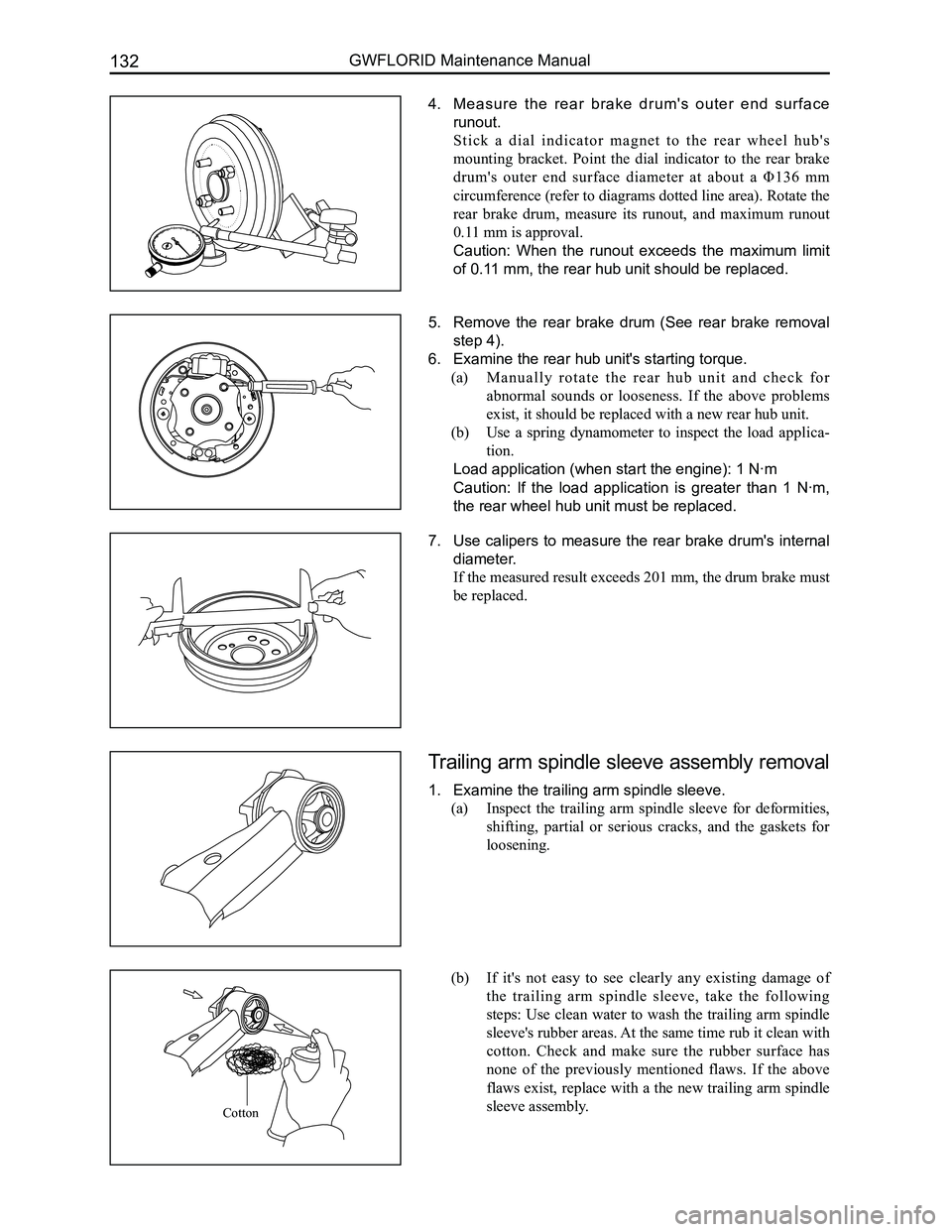
4. Measure the rear brake drum's outer end surface
runout.
S t i c k a d i a l i n d i c a t o r m a g n e t t o t h e r e a r w h e e l h u b ' s
mounting bracket. Point the dial indicator to the rear brake
drum's outer end surface diameter at about a Φ136 mm
circumference (refer to diagrams dotted line area). Rotate the
rear brake drum, measure its runout, and maximum runout
0.11 mm is approval.
Caution: When the runout exceeds the maximum limit
of 0.11 mm, the rear hub unit should be replaced.
5. Remove the rear brake drum (See rear brake removal
step 4).
6. Examine the rear hub unit's starting torque.
(a) M a n u a l l y r o t a t e t h e r e a r h u b u n i t a n d c h e c k f o r
abnormal sounds or looseness. If the above problems
exist, it should be replaced with a new rear hub unit.
(b) Use a spring dynamometer to inspect the load applica-
tion.
Load application (when start the engine): 1 N·m
Caution: If the load application is greater than 1 N·m,
the rear wheel hub unit must be replaced.
7. Use calipers to measure the rear brake drum's internal
diameter.
If the measured result exceeds 201 mm, the drum brake must
be replaced.
Trailing arm spindle sleeve assembly removal
1. Examine the trailing arm spindle sleeve.
(a) Inspect the trailing arm spindle sleeve for deformities,
shifting, partial or serious cracks, and the gaskets for
loosening.
(b) If it's not easy to see clearly any existing damage of
the trailing arm spindle sleeve, take the following
steps: Use clean water to wash the trailing arm spindle
sleeve's rubber areas. At the same time rub it clean with
cotton. Check and make sure the rubber surface has
none of the previously mentioned flaws. If the above
flaws exist, replace with a the new trailing arm spindle
sleeve assembly.Cotton
Page 140 of 281
Downloaded from www.Manualslib.com manuals search engine 133Brake System
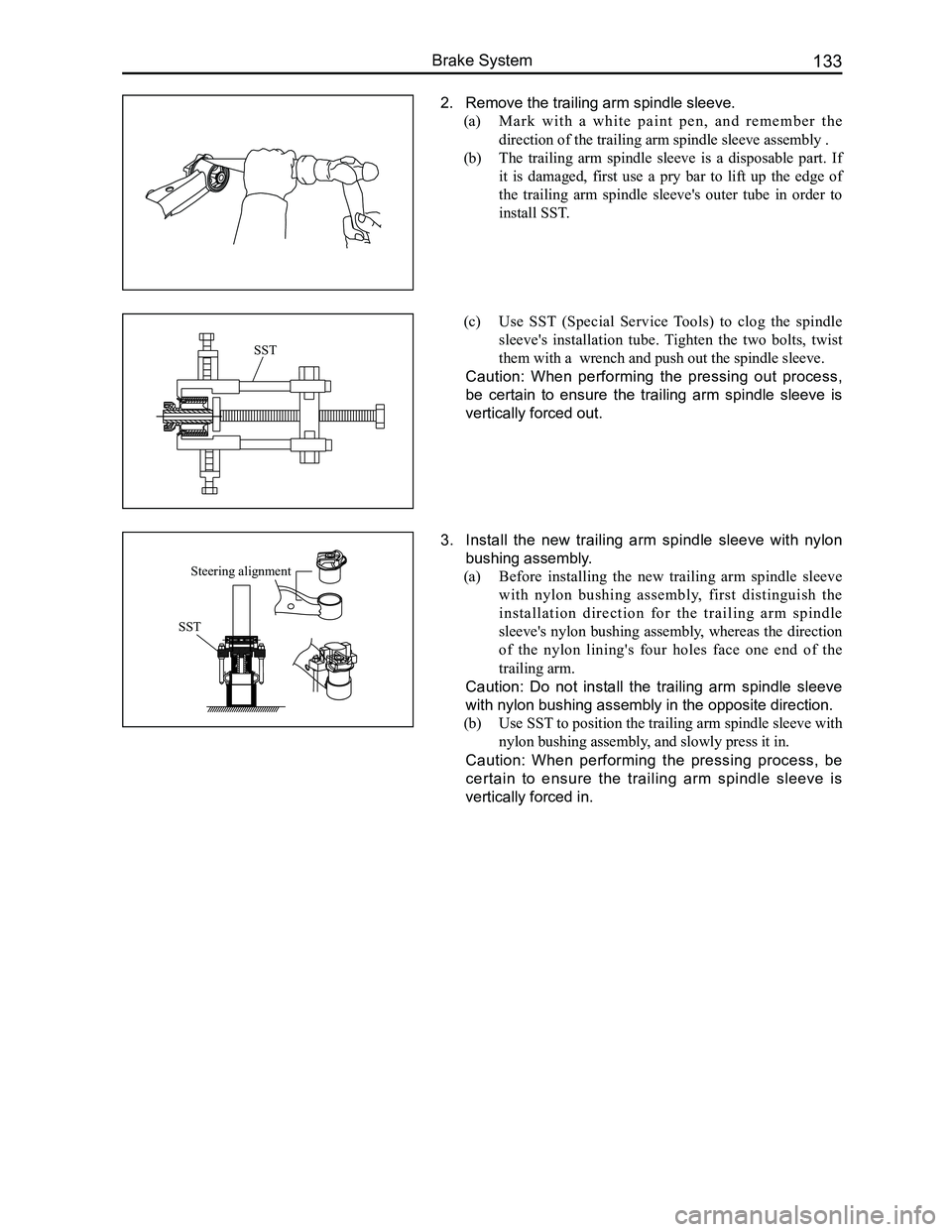
2. Remove the trailing arm spindle sleeve.
(a) M a r k w i t h a w h i t e p a i n t p e n , a n d r e m e m b e r t h e
direction of the trailing arm spindle sleeve assembly .
(b) The trailing arm spindle sleeve is a disposable part. If
it is damaged, first use a pry bar to lift up the edge of
the trailing arm spindle sleeve's outer tube in order to
install SST.
(c) Use SST (Special Service Tools) to clog the spindle
sleeve's installation tube. Tighten the two bolts, twist
them with a wrench and push out the spindle sleeve.
Caution: When performing the pressing out process,
be certain to ensure the trailing arm spindle sleeve is
vertically forced out.
3. Install the new trailing arm spindle sleeve with nylon
bushing assembly.
(a) Before installing the new trailing arm spindle sleeve
with nylon bushing assembly, first distinguish the
installation direction for the trailing arm spindle
sleeve's nylon bushing assembly, whereas the direction
of the nylon lining's four holes face one end of the
trailing arm.
Caution: Do not install the trailing arm spindle sleeve
with nylon bushing assembly in the opposite direction.
(b) Use SST to position the trailing arm spindle sleeve with
nylon bushing assembly, and slowly press it in.
Caution: When performing the pressing process, be
certain to ensure the trailing arm spindle sleeve is
vertically forced in.
SST
Steering alignment
SST
Page 142 of 281
Downloaded from www.Manualslib.com manuals search engine 135Steering System
Troubleshooting
Fault
SymptomsMalfunction CausesTroubleshooting
Steering wheel
free play too
big / abnormal
noise
1. Too much clearance between the steering
gear and gear rack.
2. The inner and outer ball stud of the steering
tie rod ball is worn out.
3. Steering joint is worn out.
4. Steering propeller shaft and steering gear
connection is loose.
5. Steering wheel and steering column connec-
tor is loose.
6. Steering gear mounting bolt is loose.
7. The sliding spline of the lower propeller
shaft is worn and loose.
1. Have the clearance adjusted by professionals,
and if it cannot be adjusted, replace the steer-
ing gear.
2. After inspection, replace the ball stud if nec-
essary.
3. Replace the lower section of steering column.
4. Fasten the connection bolts in accordance
with the specified torque.
5. Fasten the lock nut of the steering wheel.
When the spline is damaged, make sure to re-
place the steering wheel or steering column.
6. Fasten the mounting bolts of the steering
gear.
7. Replace the lower section of steering column.
Hard steering
1. Tire pressure insufficient.
2. Front wheel alignment angle incorrect.
3. Clearance between the steering gear presses
too small.
4. Steering column's spider bearing broken.
5. Steering tie rod ball stud lacks oil or is dam-
aged.
6. Front shock absorber's support bearing bro-
ken.
7. Damaged lower swing arm ball end.
8. Damaged steering pump leads to insufficient
output volume and output pressure.
9. Power steering pump belt slides.
10.Power steering gear internal leakage too
much.
11. Power steering contains air bubbles and pro-
duces irregular noise.
12. Power steering insufficient.
1. Inflate according to the specified pressure.
2. Check and adjust the front wheel alignment
angle.
3. Replace the steering gear or have profession-
als adjust the clearance between the presses.
4. Replace the lower section of steering column.
5. Replace the lower section of the steering tie
rod ball.
6. Replace the connecting components of the
front shock absorber (refer to the front sus-
pension maintenance section).
7. Replace the lower swing arm (refer to the
front suspension maintenance section).
8. Replace the power steering pump.
9. Adjust the belt's tension.
10. Replace the power steering gear.
11.In place, repeatedly turn, exhaust the air
bubble, then after leaving it stationary for one
hour, replenish the power steering according
to the specific model number.
12.Fill the power steering (with specific model
number) until it reaches the PS fluid reser-
voir's specified scale mark.