ect GREAT WALL FLORID 2008 Manual PDF
[x] Cancel search | Manufacturer: GREAT WALL, Model Year: 2008, Model line: FLORID, Model: GREAT WALL FLORID 2008Pages: 281, PDF Size: 43.97 MB
Page 117 of 281
Downloaded from www.Manualslib.com manuals search engine GWFLORID Maintenance Manual110
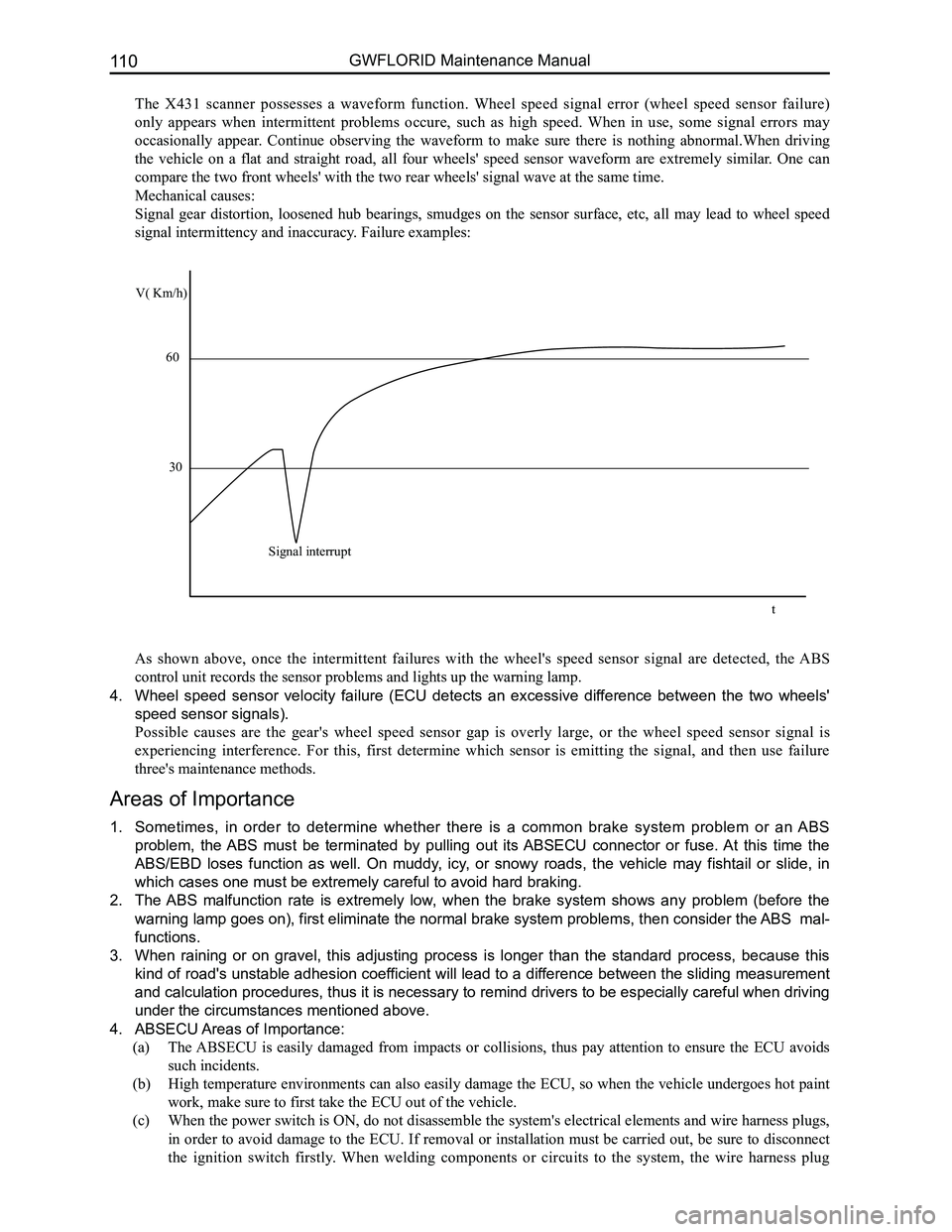
The X431 scanner possesses a waveform function. Wheel speed signal error (wheel speed sensor failure)
only appears when intermittent problems occure, such as high speed. When in use, some signal errors may
occasionally appear. Continue observing the waveform to make sure there is nothing abnormal.When driving
the vehicle on a flat and straight road, all four wheels' speed sensor waveform are extremely similar. One can
compare the two front wheels' with the two rear wheels' signal wave at t\
he same time.
Mechanical causes:
Signal gear distortion, loosened hub bearings, smudges on the sensor surface, etc, all may lead to wheel speed
signal intermittency and inaccuracy. Failure examples:
As shown above, once the intermittent failures with the wheel's speed sensor signal are detected, the ABS
control unit records the sensor problems and lights up the warning lamp.\
4. Wheel speed sensor velocity failure (ECU detects an excessive difference between the two wheels'
speed sensor signals).
Possible causes are the gear's wheel speed sensor gap is overly large, or the wheel speed sensor signal is
experiencing interference. For this, first determine which sensor is emitting the signal, and then use failure
three's maintenance methods.
Areas of Importance
1. Sometimes, in order to determine whether there is a common brake system problem or an ABS
problem, the ABS must be terminated by pulling out its ABSECU connector or fuse. At this time the
ABS/EBD loses function as well. On muddy, icy, or snowy roads, the vehicle may fishtail or slide, in
which cases one must be extremely careful to avoid hard braking.
2. The ABS malfunction rate is extremely low, when the brake system shows any problem (before the
warning lamp goes on), first eliminate the normal brake system problems, then consider the ABS mal-
functions.
3. When raining or on gravel, this adjusting process is longer than the standard process, because this
kind of road's unstable adhesion coefficient will lead to a difference between the sliding measurement
and calculation procedures, thus it is necessary to remind drivers to be especially careful when driving
under the circumstances mentioned above.
4. ABSECU Areas of Importance:
(a) The ABSECU is easily damaged from impacts or collisions, thus pay attention to ensure the ECU avoids
such incidents.
(b) High temperature environments can also easily damage the ECU, so when the vehicle undergoes hot paint
work, make sure to first take the ECU out of the vehicle.
(c) When the power switch is ON, do not disassemble the system's electrical elements and wire harness plugs,
in order to avoid damage to the ECU. If removal or installation must be carried out, be sure to disconnect
the ignition switch firstly. When welding components or circuits to the system, the wire harness plug
V( Km/h)
60
30
Signal interrupt
t
Page 118 of 281
Downloaded from www.Manualslib.com manuals search engine 111Brake System
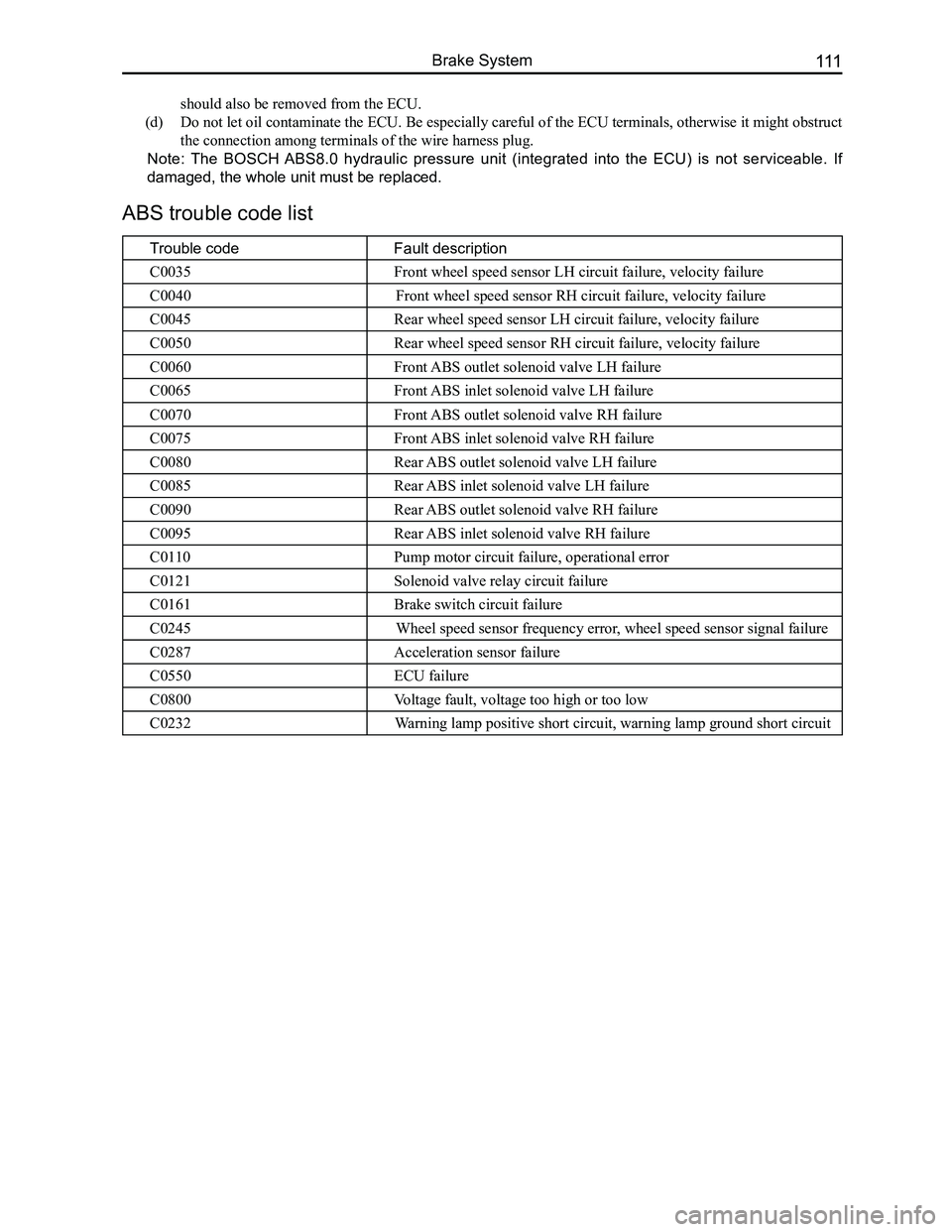
ABS trouble code list
Trouble codeFault description
C0035Front wheel speed sensor LH circuit failure, velocity failure
C0040Front wheel speed sensor RH circuit failure, velocity failure
C0045Rear wheel speed sensor LH circuit failure, velocity failure
C0050Rear wheel speed sensor RH circuit failure, velocity failure
C0060Front ABS outlet solenoid valve LH failure
C0065Front ABS inlet solenoid valve LH failure
C0070Front ABS outlet solenoid valve RH failure
C0075Front ABS inlet solenoid valve RH failure
C0080Rear ABS outlet solenoid valve LH failure
C0085Rear ABS inlet solenoid valve LH failure
C0090Rear ABS outlet solenoid valve RH failure
C0095Rear ABS inlet solenoid valve RH failure
C0110Pump motor circuit failure, operational error
C0121Solenoid valve relay circuit failure
C0161Brake switch circuit failure
C0245Wheel speed sensor frequency error, wheel speed sensor signal failure
C0287Acceleration sensor failure
C0550ECU failure
C0800Voltage fault, voltage too high or too low
C0232Warning lamp positive short circuit, warning lamp ground short circuit
should also be removed from the ECU.
(d) Do not let oil contaminate the ECU. Be especially careful of the ECU terminals, otherwise it might obstruct
the connection among terminals of the wire harness plug.
Note: The BOSCH ABS8.0 hydraulic pressure unit (integrated into the ECU) is not serviceable. If
damaged, the whole unit must be replaced.
Page 119 of 281
Downloaded from www.Manualslib.com manuals search engine GWFLORID Maintenance Manual112
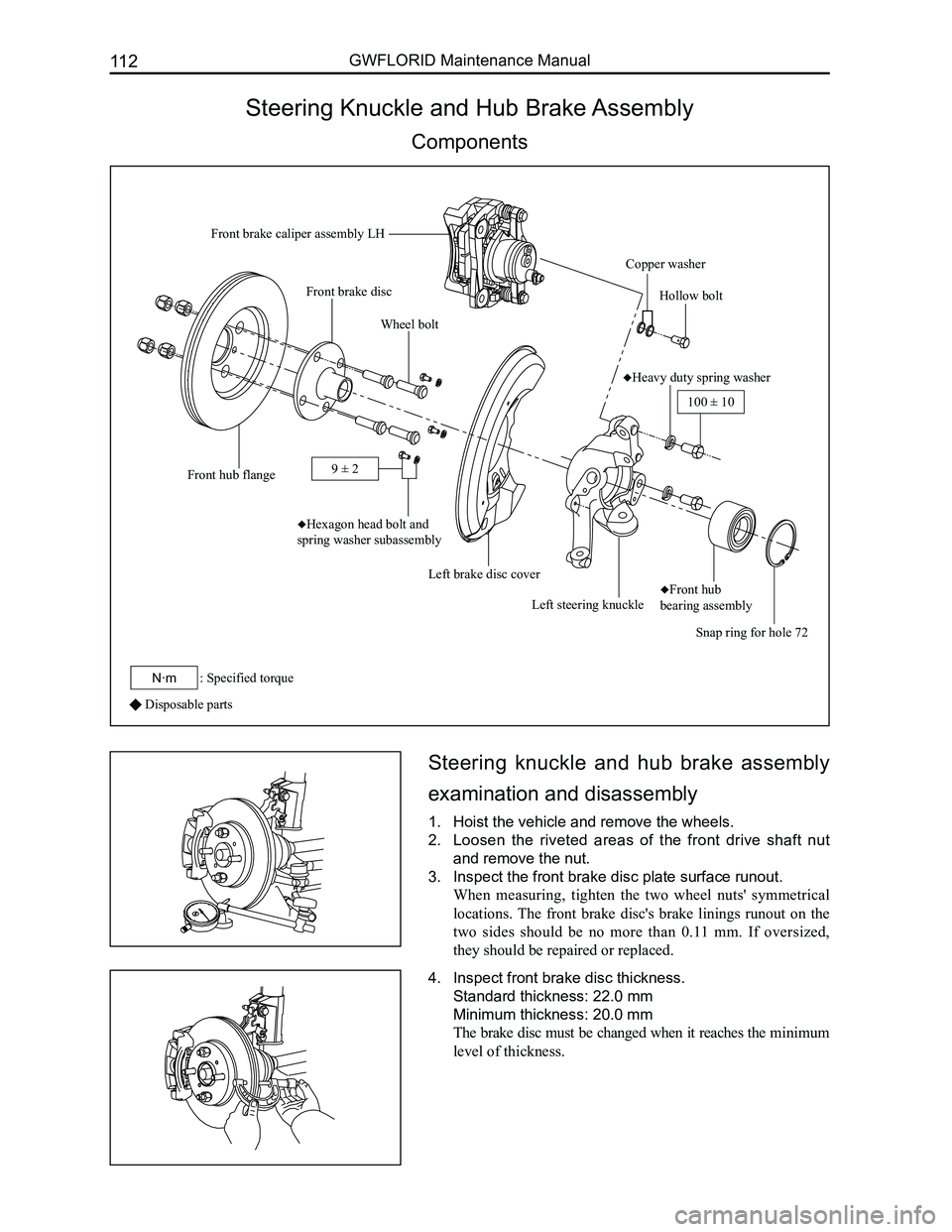
Steering Knuckle and Hub Brake Assembly
Components
Disposable parts
Steering knuckle and hub brake assembly
examination and disassembly
1. Hoist the vehicle and remove the wheels.
2. Loosen the riveted areas of the front drive shaft nut
and remove the nut.
3. Inspect the front brake disc plate surface runout.
When measuring, tighten the two wheel nuts' symmetrical
locations. The front brake disc's brake linings runout on the
two sides should be no more than 0.11 mm. If oversized,
they should be repaired or replaced.
4. Inspect front brake disc thickness.
Standard thickness: 22.0 mm
Minimum thickness: 20.0 mm
The brake disc must be changed when it reaches the minimum
level of thickness.
Front brake caliper assembly LH
Copper washer
Hollow bolt
♦Heavy duty spring washer
Snap ring for hole 72
♦Front hub
bearing assemblyLeft steering knuckle
Left brake disc cover
♦Hexagon head bolt and
spring washer subassembly
Wheel bolt
Front hub flange
Front brake disc
100 ± 10
: Specified torqueN·m
9 ± 2
Page 120 of 281
Downloaded from www.Manualslib.com manuals search engine 113Brake System
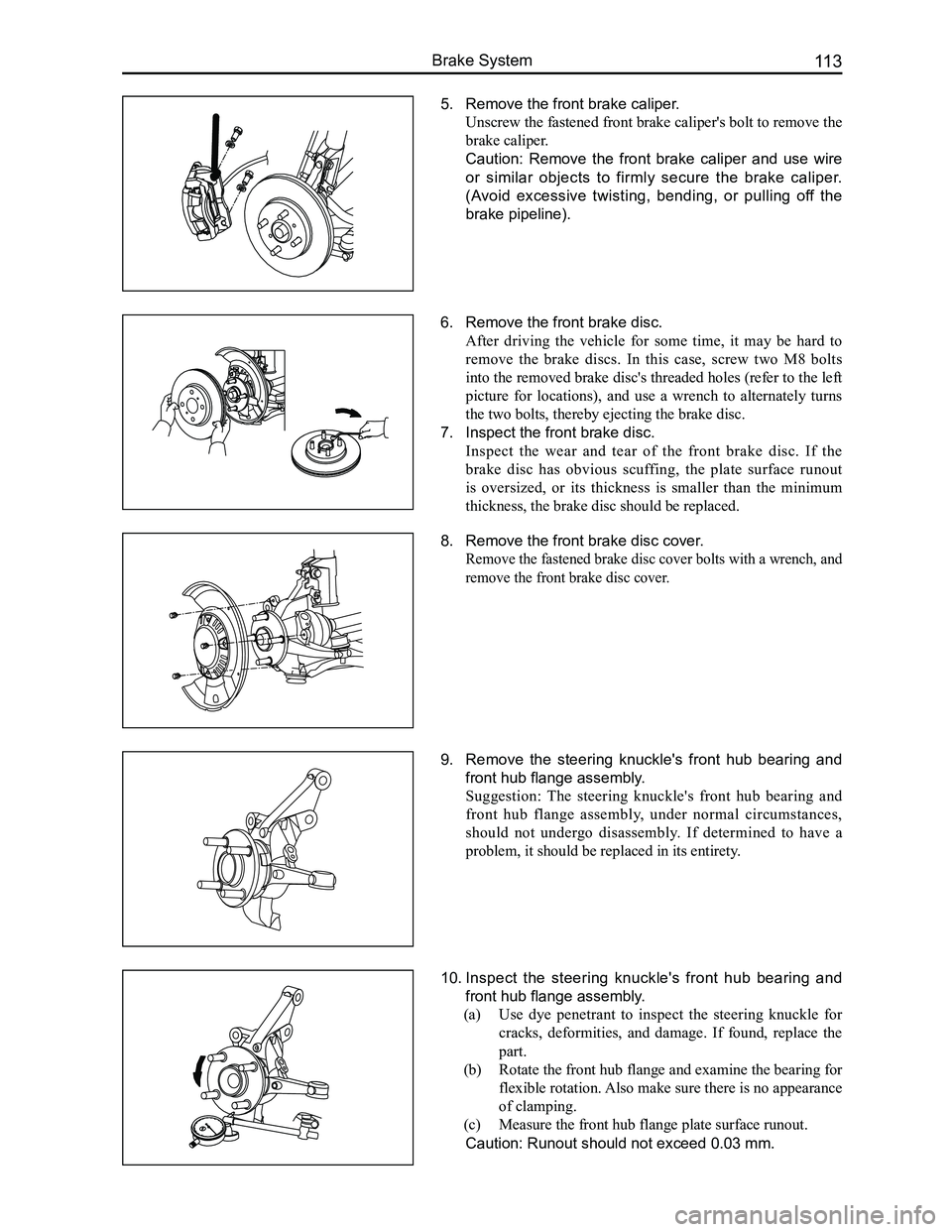
5. Remove the front brake caliper.
Unscrew the fastened front brake caliper's bolt to remove the
brake caliper.
Caution: Remove the front brake caliper and use wire
or similar objects to firmly secure the brake caliper.
(Avoid excessive twisting, bending, or pulling off the
brake pipeline).
6. Remove the front brake disc.
After driving the vehicle for some time, it may be hard to
remove the brake discs. In this case, screw two M8 bolts
into the removed brake disc's threaded holes (refer to the left
picture for locations), and use a wrench to alternately turns
the two bolts, thereby ejecting the brake disc.
7. Inspect the front brake disc.
Inspect the wear and tear of the front brake disc. If the
brake disc has obvious scuffing, the plate surface runout
is oversized, or its thickness is smaller than the minimum
thickness, the brake disc should be replaced.
8. Remove the front brake disc cover.
Remove the fastened brake disc cover bolts with a wrench, and
remove the front brake disc cover.
9. Remove the steering knuckle's front hub bearing and
front hub flange assembly.
Suggestion: The steering knuckle's front hub bearing and
front hub flange assembly, under normal circumstances,
should not undergo disassembly. If determined to have a
problem, it should be replaced in its entirety.
10. Inspect the steering knuckle's front hub bearing and
front hub flange assembly.
(a) Use dye penetrant to inspect the steering knuckle for
cracks, deformities, and damage. If found, replace the
part.
(b) Rotate the front hub flange and examine the bearing for
flexible rotation. Also make sure there is no appearance
of clamping.
(c) Measure the front hub flange plate surface runout.
Caution: Runout should not exceed 0.03 mm.
Page 121 of 281
Downloaded from www.Manualslib.com manuals search engine GWFLORID Maintenance Manual114
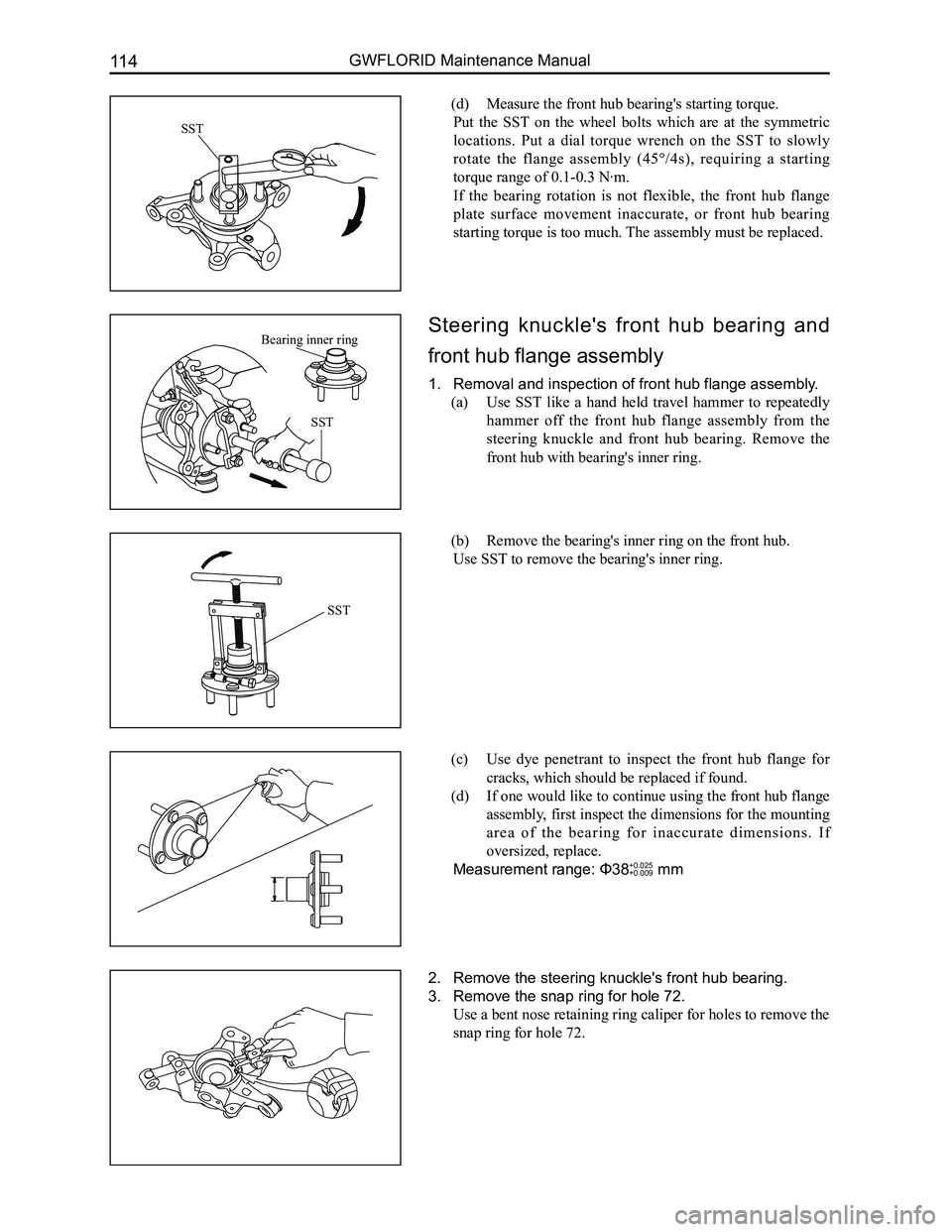
(d) Measure the front hub bearing's starting torque.
Put the SST on the wheel bolts which are at the symmetric
locations. Put a dial torque wrench on the SST to slowly
rotate the flange assembly (45°/4s), requiring a starting
torque range of 0.1-0.3 N·m.
If the bearing rotation is not flexible, the front hub flange
plate surface movement inaccurate, or front hub bearing
starting torque is too much. The assembly must be replaced.
Steering knuckle's front hub bearing and
front hub flange assembly
1. Removal and inspection of front hub flange assembly.
(a) Use SST like a hand held travel hammer to repeatedly
hammer off the front hub flange assembly from the
steering knuckle and front hub bearing. Remove the
front hub with bearing's inner ring.
(b) Remove the bearing's inner ring on the front hub.
Use SST to remove the bearing's inner ring.
SST
SST
Bearing inner ring
SST
(c) Use dye penetrant to inspect the front hub flange for
cracks, which should be replaced if found.
(d) If one would like to continue using the front hub flange
assembly, first inspect the dimensions for the mounting
area of the bearing for inaccurate dimensions. If
oversized, replace.
Measurement range: Φ38+0.025 +0.009 mm
2. Remove the steering knuckle's front hub bearing.
3. Remove the snap ring for hole 72.
Use a bent nose retaining ring caliper for holes to remove the
snap ring for hole 72.
Page 122 of 281
Downloaded from www.Manualslib.com manuals search engine 115Brake System
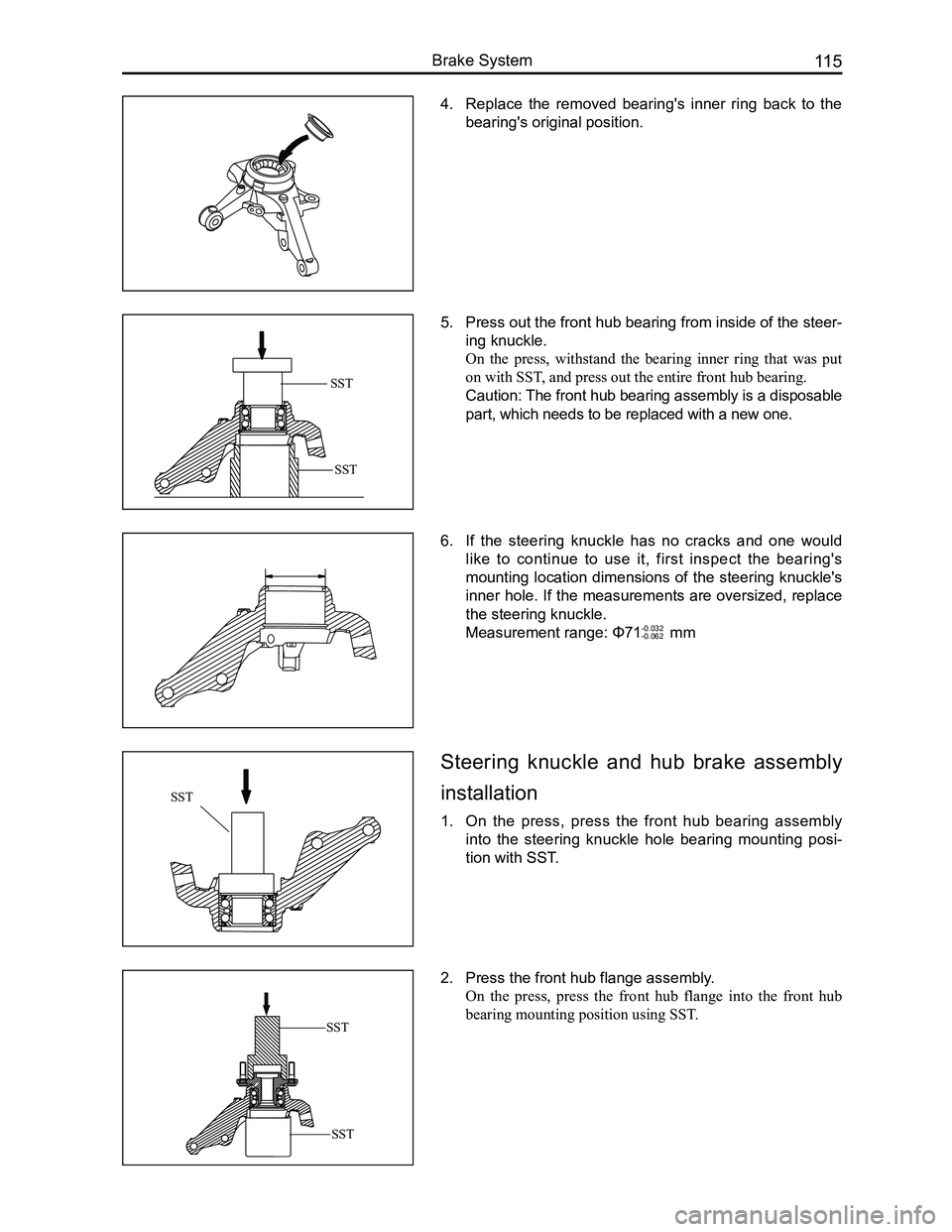
4. Replace the removed bearing's inner ring back to the
bearing's original position.
5. Press out the front hub bearing from inside of the steer-
ing knuckle.
On the press, withstand the bearing inner ring that was put
on with SST, and press out the entire front hub bearing.
Caution: The front hub bearing assembly is a disposable
part, which needs to be replaced with a new one.
Steering knuckle and hub brake assembly
installation
1. On the press, press the front hub bearing assembly
into the steering knuckle hole bearing mounting posi-
tion with SST.
SST
SST
SST
6. If the steering knuckle has no cracks and one would
like to continue to use it, first inspect the bearing's
mounting location dimensions of the steering knuckle's
inner hole. If the measurements are oversized, replace
the steering knuckle.
Measurement range: Φ71-0.032 -0.062 mm
2. Press the front hub flange assembly.
On the press, press the front hub flange into the front hub
bearing mounting position using SST.
SST
SST
Page 125 of 281
Downloaded from www.Manualslib.com manuals search engine GWFLORID Maintenance Manual118
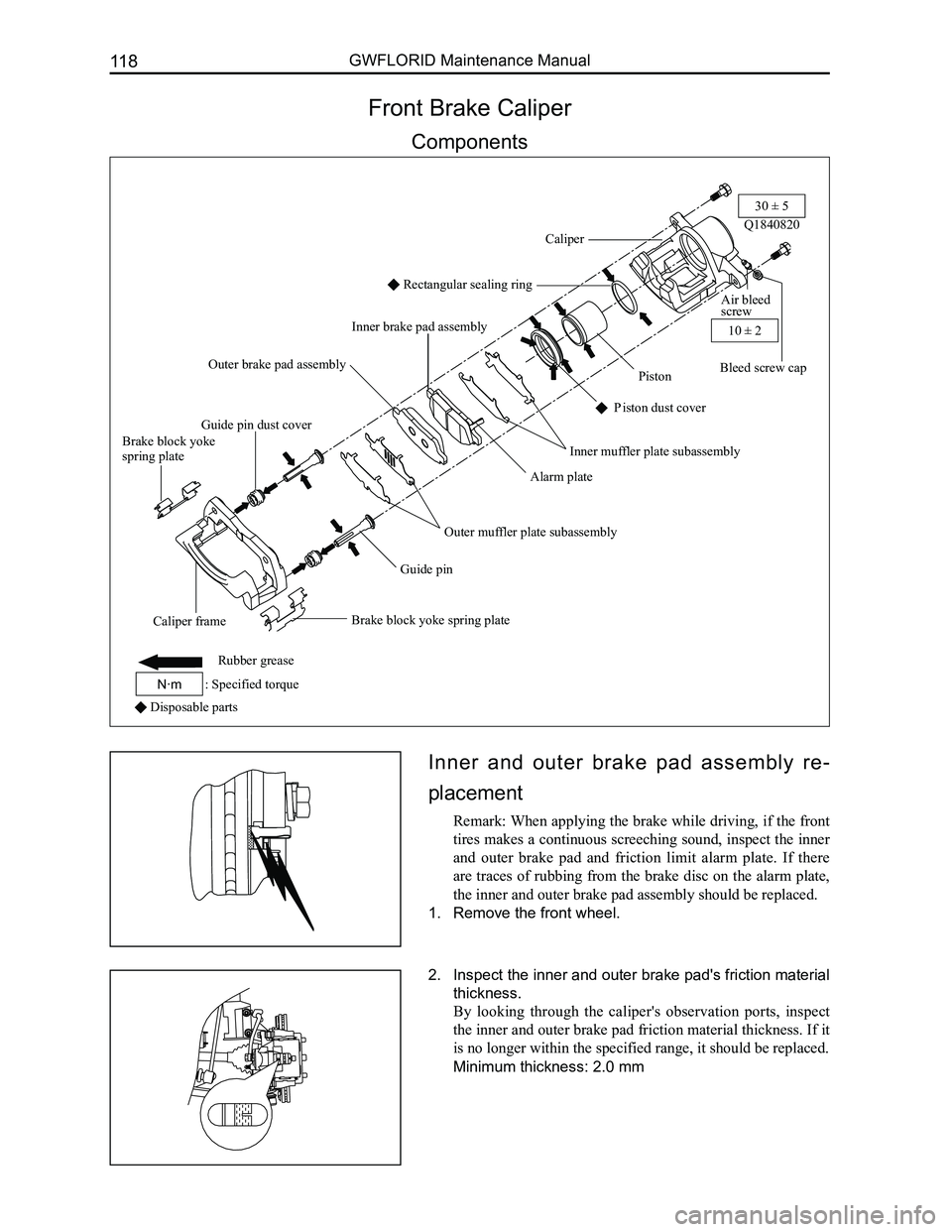
Front Brake Caliper
Components
Disposable parts
Inner and outer brake pad assembly re-
placement
Remark: When applying the brake while driving, if the front
tires makes a continuous screeching sound, inspect the inner
and outer brake pad and friction limit alarm plate. If there
are traces of rubbing from the brake disc on the alarm plate,
the inner and outer brake pad assembly should be replaced.
1. Remove the front wheel.
2. Inspect the inner and outer brake pad's friction material
thickness.
By looking through the caliper's observation ports, inspect
the inner and outer brake pad friction material thickness. If it
is no longer within the specified range, it should be replaced.
Minimum thickness: 2.0 mm
Bleed screw cap
Air bleed screw
Caliper
Rectangular sealing ring
Piston
P iston dust cover
Inner muffler plate subassembly
Alarm plate
Inner brake pad assembly
Outer brake pad assembly
Outer muffler plate subassembly
Guide pin
Guide pin dust cover
Caliper frame
Brake block yoke spring plate
Brake block yoke spring plate
30 ± 5
: Specified torqueN·m
10 ± 2
Q1840820
Rubber grease
Page 126 of 281
Downloaded from www.Manualslib.com manuals search engine 119Brake System
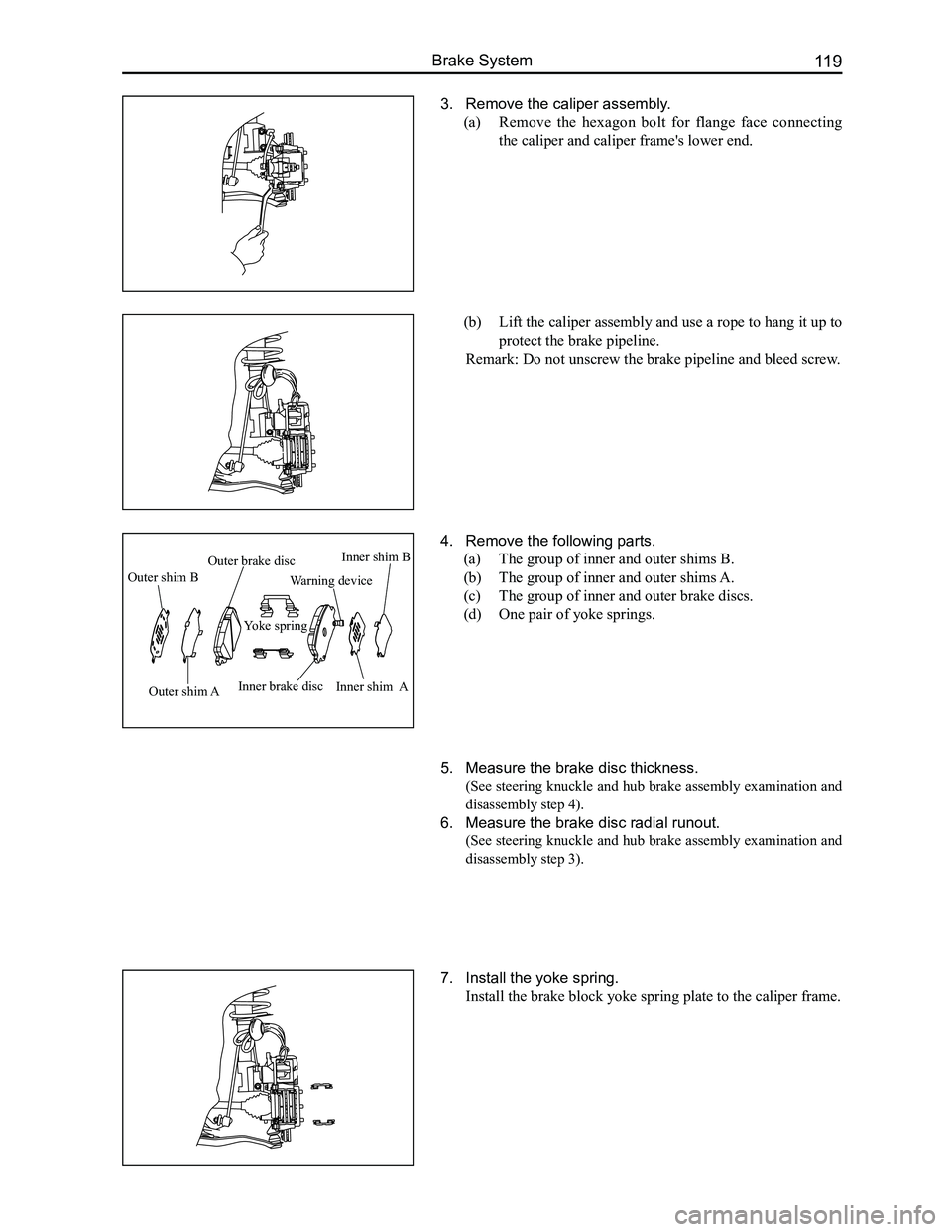
3. Remove the caliper assembly.
(a) Remove the hexagon bolt for flange face connecting
the caliper and caliper frame's lower end.
(b) Lift the caliper assembly and use a rope to hang it up to
protect the brake pipeline.
Remark: Do not unscrew the brake pipeline and bleed screw.
4. Remove the following parts.
(a) The group of inner and outer shims B.
(b) The group of inner and outer shims A.
(c) The group of inner and outer brake discs.
(d) One pair of yoke springs.
5. Measure the brake disc thickness.
(See steering knuckle and hub brake assembly examination and
disassembly step 4).
6. Measure the brake disc radial runout.
(See steering knuckle and hub brake assembly examination and
disassembly step 3).
7. Install the yoke spring.
Install the brake block yoke spring plate to the caliper frame.
Outer shim B
Outer shim AInner brake disc
Warning device
Inner shim B
Inner shim A
Outer brake disc
Yoke spring
Page 128 of 281
Downloaded from www.Manualslib.com manuals search engine 121Brake System
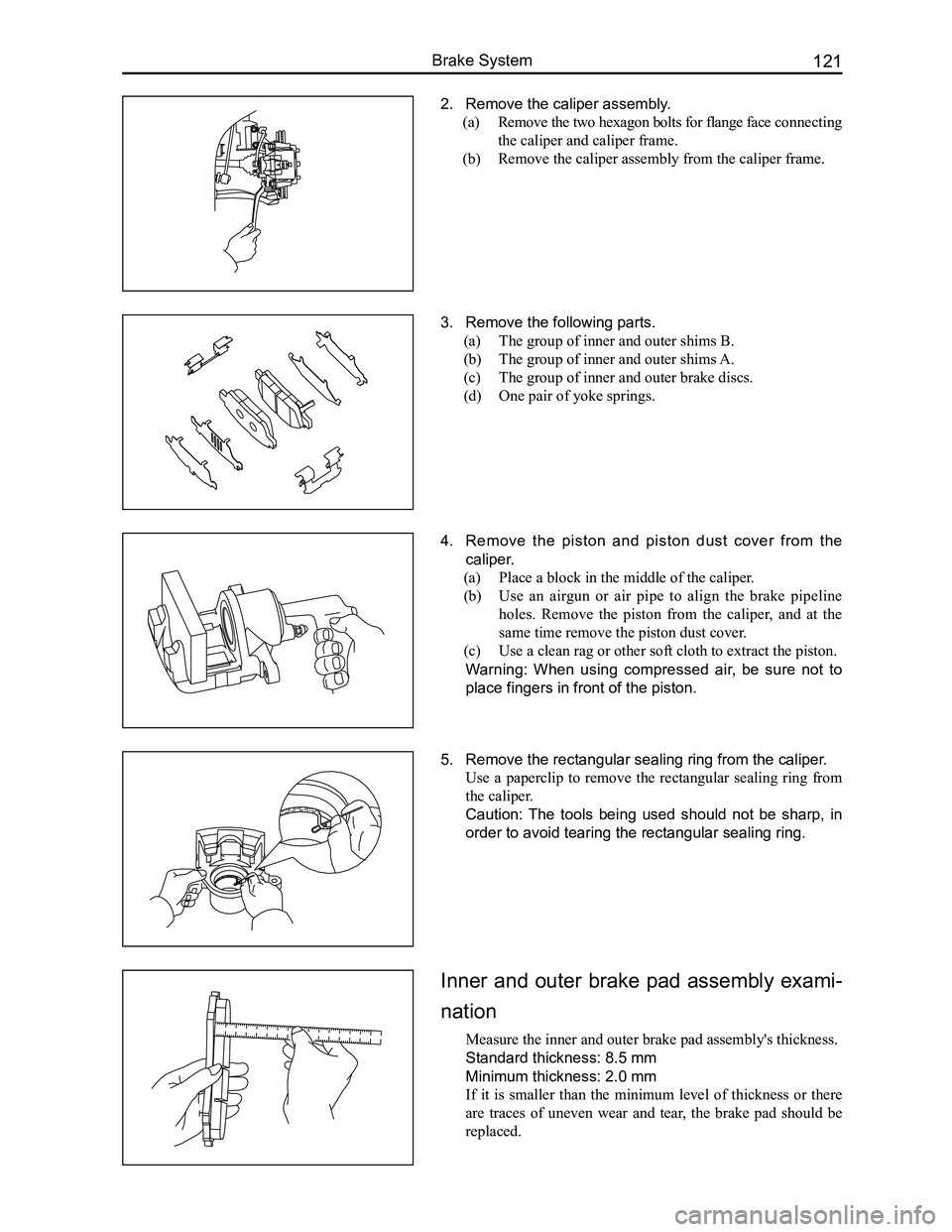
2. Remove the caliper assembly.
(a) Remove the two hexagon bolts for flange face connecting
the caliper and caliper frame.
(b) Remove the caliper assembly from the caliper frame.
3. Remove the following parts.
(a) The group of inner and outer shims B.
(b) The group of inner and outer shims A.
(c) The group of inner and outer brake discs.
(d) One pair of yoke springs.
4. Remove the piston and piston dust cover from the
caliper.
(a) Place a block in the middle of the caliper.
(b) Use an airgun or air pipe to align the brake pipeline
holes. Remove the piston from the caliper, and at the
same time remove the piston dust cover.
(c) Use a clean rag or other soft cloth to extract the piston.
Warning: When using compressed air, be sure not to
place fingers in front of the piston.
5. Remove the rectangular sealing ring from the caliper.
Use a paperclip to remove the rectangular sealing ring from
the caliper.
Caution: The tools being used should not be sharp, in
order to avoid tearing the rectangular sealing ring.
Inner and outer brake pad assembly exami-
nation
Measure the inner and outer brake pad assembly's thickness.
Standard thickness: 8.5 mm
Minimum thickness: 2.0 mm
If it is smaller than the minimum level of thickness or there
are traces of uneven wear and tear, the brake pad should be
replaced.
Page 129 of 281
Downloaded from www.Manualslib.com manuals search engine GWFLORID Maintenance Manual122
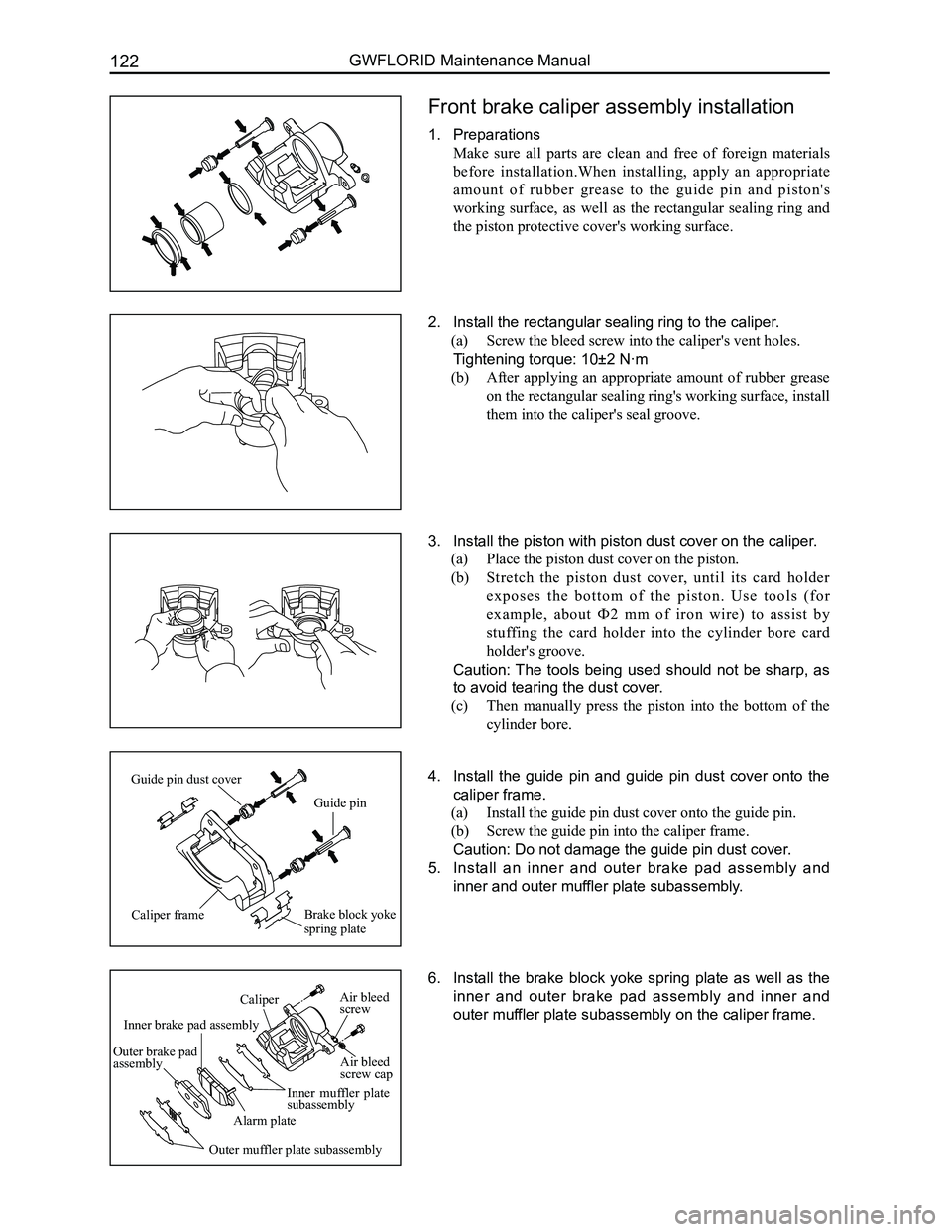
Front brake caliper assembly installation
1. Preparations
Make sure all parts are clean and free of foreign materials
before installation.When installing, apply an appropriate
amount of rubber grease to the guide pin and piston's
working surface, as well as the rectangular sealing ring and
the piston protective cover's working surface.
2. Install the rectangular sealing ring to the caliper.
(a) Screw the bleed screw into the caliper's vent holes.
Tightening torque: 10±2 N·m
(b) After applying an appropriate amount of rubber grease
on the rectangular sealing ring's working surface, install
them into the caliper's seal groove.
3. Install the piston with piston dust cover on the caliper.
(a) Place the piston dust cover on the piston.
(b) Stretch the piston dust cover, until its card holder
exposes the bottom of the piston. Use tools (for
example, about Ф2 mm of iron wire) to assist by
stuffing the card holder into the cylinder bore card
holder's groove.
Caution: The tools being used should not be sharp, as
to avoid tearing the dust cover.
(c) Then manually press the piston into the bottom of the
cylinder bore.
4. Install the guide pin and guide pin dust cover onto the
caliper frame.
(a) Install the guide pin dust cover onto the guide pin.
(b) Screw the guide pin into the caliper frame.
Caution: Do not damage the guide pin dust cover.
5. Install an inner and outer brake pad assembly and
inner and outer muffler plate subassembly.
6. Install the brake block yoke spring plate as well as the
inner and outer brake pad assembly and inner and
outer muffler plate subassembly on the caliper frame.
Guide pin
Guide pin dust cover
Caliper frameBrake block yoke spring plate
Air bleed screw cap
Air bleed screw Caliper
Inner muffler plate subassembly
Alarm plate
Inner brake pad assembly
Outer brake pad assembly
Outer muffler plate subassembly