parking brake GREAT WALL HOVER 2006 Service User Guide
[x] Cancel search | Manufacturer: GREAT WALL, Model Year: 2006, Model line: HOVER, Model: GREAT WALL HOVER 2006Pages: 425, PDF Size: 26.05 MB
Page 138 of 425

Figure 8.11 Rear servo barCaution:
Pay attention to do not coat the sealant between the bolt and crown bar.
e. Install the parking operating lever (as Figure 8.12), including the return spring and shaft pin. Coat the external end of shaft pin
with small sealant.
f. Use the circlip to protect the shaft pin. Pay attention to ensure the operating lever can rotate around the shaft pin freely and
the spring can make the parking operating lever returns to the correct position.
g. Install the parking brake lever pin and spring. Refer to Figure 8.13.Caution: ensure the rake lever can rotate freely.
h. Connect the parking brake lever to the manual-operated valve connecting rod. Shown as Figure 8.14. Ensure the spring and cam
axle ring are installed on the connecting rod fixedly.
i. Check the cam axle ring for smooth sliding on rod.
j. Install the cross shaft in the box in reverse direction of Gear-position sensor, then install the concussion spring on the shaft.Figure 8.12 Parking operating lever
Figure 8.13 Typical parking brake shaft pin and spring
Figure 8.14 Parking lever and manual shaft
Page 139 of 425
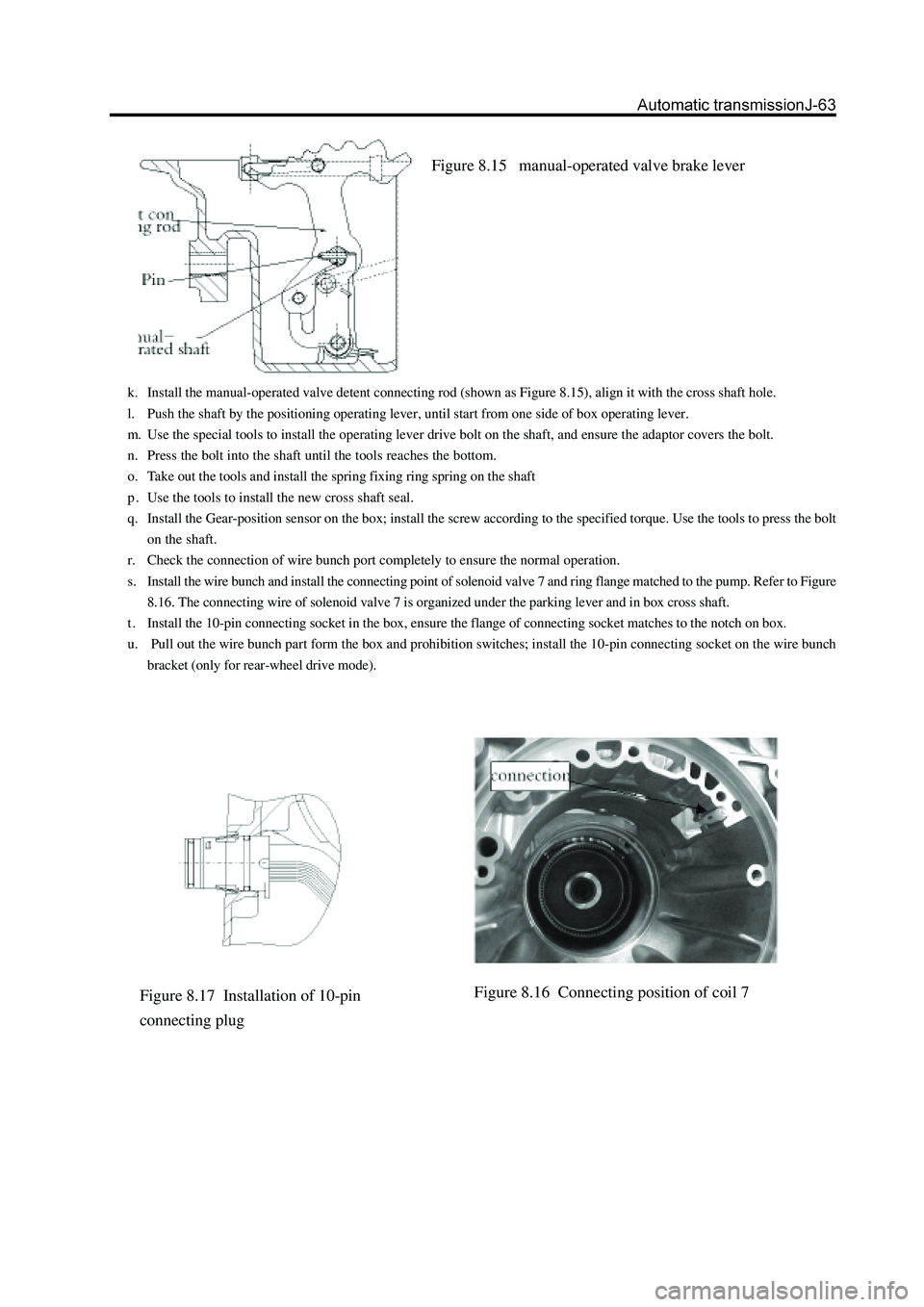
Figure 8.15 manual-operated valve brake lever
k. Install the manual-operated valve detent connecting rod (shown as Figure 8.15), align it with the cross shaft hole.
l. Push the shaft by the positioning operating lever, until start from one side of box operating lever.
m. Use the special tools to install the operating lever drive bolt on the shaft, and ensure the adaptor covers the bolt.
n. Press the bolt into the shaft until the tools reaches the bottom.
o. Take out the tools and install the spring fixing ring spring on the shaft
p . Use the tools to install the new cross shaft seal.
q. Install the Gear-position sensor on the box; install the screw according to the specified torque. Use the tools to press the bolt
on the shaft.
r. Check the connection of wire bunch port completely to ensure the normal operation.
s. Install the wire bunch and install the connecting point of solenoid valve 7 and ring flange matched to the pump. Refer to Figure
8.16. The connecting wire of solenoid valve 7 is organized under the parking lever and in box cross shaft.
t . Install the 10-pin connecting socket in the box, ensure the flange of connecting socket matches to the notch on box.
u. Pull out the wire bunch part form the box and prohibition switches; install the 10-pin connecting socket on the wire bunch
bracket (only for rear-wheel drive mode).
Figure 8.16 Connecting position of coil 7Figure 8.17 Installation of 10-pin
connecting plug
Page 140 of 425
2.output shaft and gear assembly
The assembly procedure of output shaft and gear assembly (Refer to Figure 8.19),is shown as follows:
a. Check the output shaft bush for damage, replace it if necessary.
b. Check the parking detent on the ring gear for damage ; replace it if necessary.
c. Check the sealing ring groove for damage.
d. Use the automatic transmission liquid to lubricate the gasket.
e. Place the scarfing notch upwardly and install the sealing ring on the output shaft.
f. If has been removed., it should use the ring spring for reinforcement when install the ring gear on the output shaft. Ensure the
ring spring is fixed in the groove.
g. Use the Vaseline oil for lubrication; install the thrust bearing assembly NO.10 on the output shaft.
h. It should be carefully when install the output shaft on the box to avoid the damage of sealing ring.
3. Rear brake belt assembly
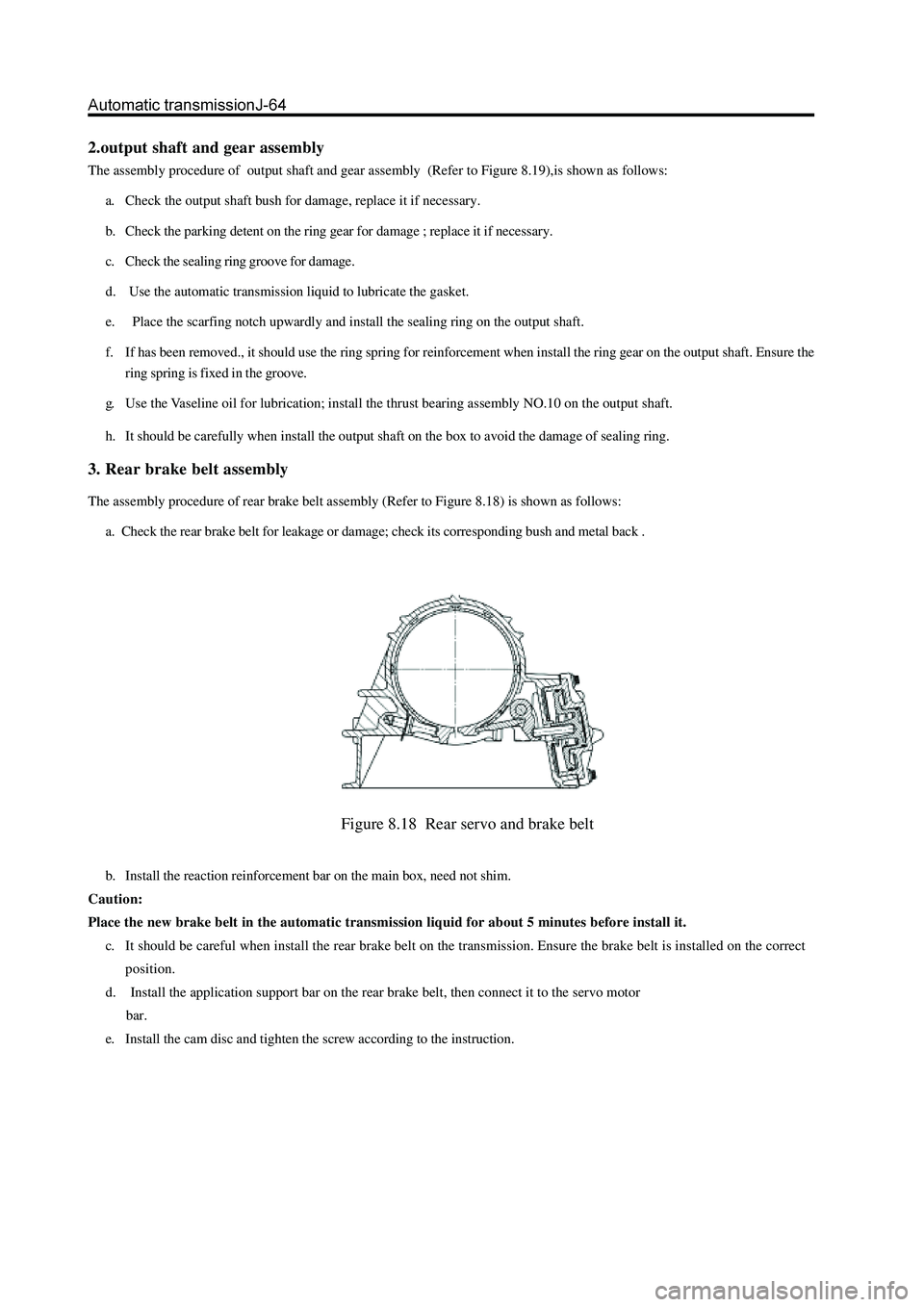
The assembly procedure of rear brake belt assembly (Refer to Figure 8.18) is shown as follows:
a. Check the rear brake belt for leakage or damage; check its corresponding bush and metal back .
Figure 8.18 Rear servo and brake belt
b. Install the reaction reinforcement bar on the main box, need not shim.
Caution:
Place the new brake belt in the automatic transmission liquid for about 5 minutes before install it.
c. It should be careful when install the rear brake belt on the transmission. Ensure the brake belt is installed on the correct
position.
d. Install the application support bar on the rear brake belt, then connect it to the servo motor
bar.
e. Install the cam disc and tighten the screw according to the instruction.
Page 268 of 425
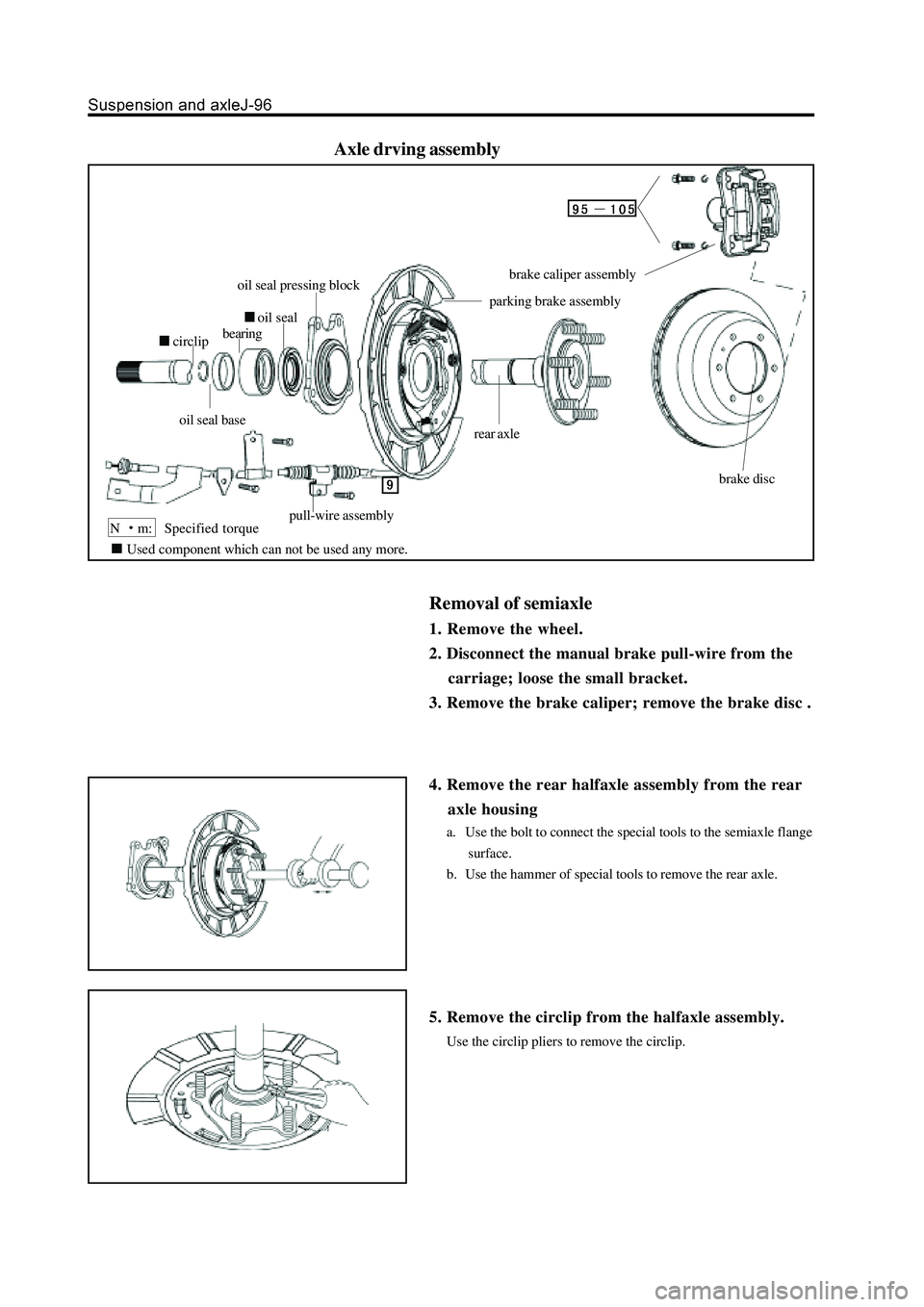
Axle drving assembly
Removal of semiaxle
1. Remove the wheel.
2. Disconnect the manual brake pull-wire from the
carriage; loose the small bracket.
3. Remove the brake caliper; remove the brake disc .
4. Remove the rear halfaxle assembly from the rear
axle housing
a. Use the bolt to connect the special tools to the semiaxle flange
surface.
b. Use the hammer of special tools to remove the rear axle.
brake caliper assembly
brake disc
circlip
oil seal base
bearing
oil seal
oil seal pressing block
parking brake assembly
rear axle
N
m: Specified torque
Used component which can not be used any more.
pull-wire assembly
5. Remove the circlip from the halfaxle assembly.
Use the circlip pliers to remove the circlip.
Page 287 of 425

Brake-1
Chapter 8
Brake
Cautions...................................................................................... 2
Troubleshooting............................................................................2
Check and adjustment..................................................................5
Brake pedal..................................................................................7
Parking brake...............................................................................8
Front brake...................................................................................9
Rear brake...................................................................................16
Rear parking brake......................................................................22
Sensor load proportional valve.....................................................29
Antilock Braking System (ABS)..................................................31
Page 288 of 425
Brake-2
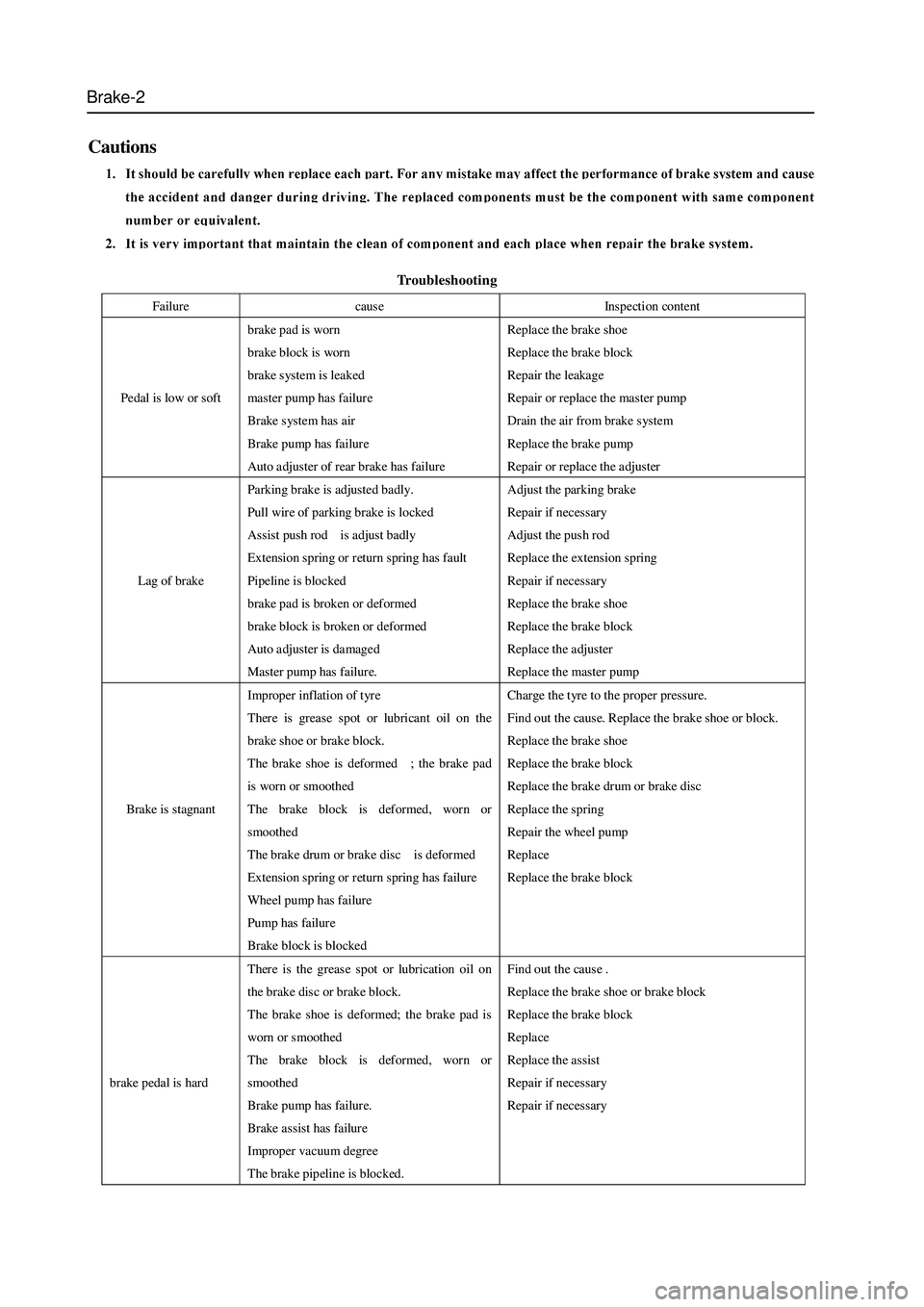
Troubleshooting
Cautions
Failure cause Inspection content
Pedal is low or soft brake pad is worn
brake block is worn
brake system is leaked
master pump has failure
Brake system has air
Brake pump has failure
Auto adjuster of rear brake has failure Replace the brake shoe
Replace the brake block
Repair the leakage
Repair or replace the master pump
Drain the air from brake system
Replace the brake pump
Repair or replace the adjuster
Lag of brake Parking brake is adjusted badly.
Pull wire of parking brake is locked
Assist push rod is adjust badly
Extension spring or return spring has fault
Pipeline is blocked
brake pad is broken or deformed
brake block is broken or deformed
Auto adjuster is damaged
Master pump has failure. Adjust the parking brake
Repair if necessary
Adjust the push rod
Repla ce the extension spring
Repair if necessary
Replace the brake shoe
Replace the brake block
Repla ce the a djuster
Repla ce the master pump
Brake is stagnant Improper inflation of tyre
There is grease spot or lubricant oil on the
brake shoe or brake block.
The brake shoe is deformed ; the brake pad
is worn or smoothed
The brake block is deformed, worn or
smoothed
The brake drum or brake disc is deformed
Extension spring or return spring has failure
Wheel pump has failure
Pump has failure
Brake block is blocked Charge the tyre to the proper pressure.
Find out the cause. Replace the brake shoe or block.
Replace the brake shoe
Replace the brake block
Replace the brake drum or brake disc
Repla ce the spring
Repair the wheel pump
Replace
Replace the brake block
brake pedal is hard There is the grease spot or lubrication oil on
the brake disc or brake block.
The brake shoe is deformed; the brake pad is
worn or s moothed
The brake block is deformed, worn or
smoothed
Brake pump has failure.
Brake assist has failure
Improper vacuum degree
The brake pipeline is blocked. Find out the caus e .
Replace the brake shoe or brake block
Replace the brake block
Replace
Replace the assist
Repair if necessary
Repair if necessary
Page 291 of 425
Brake-5
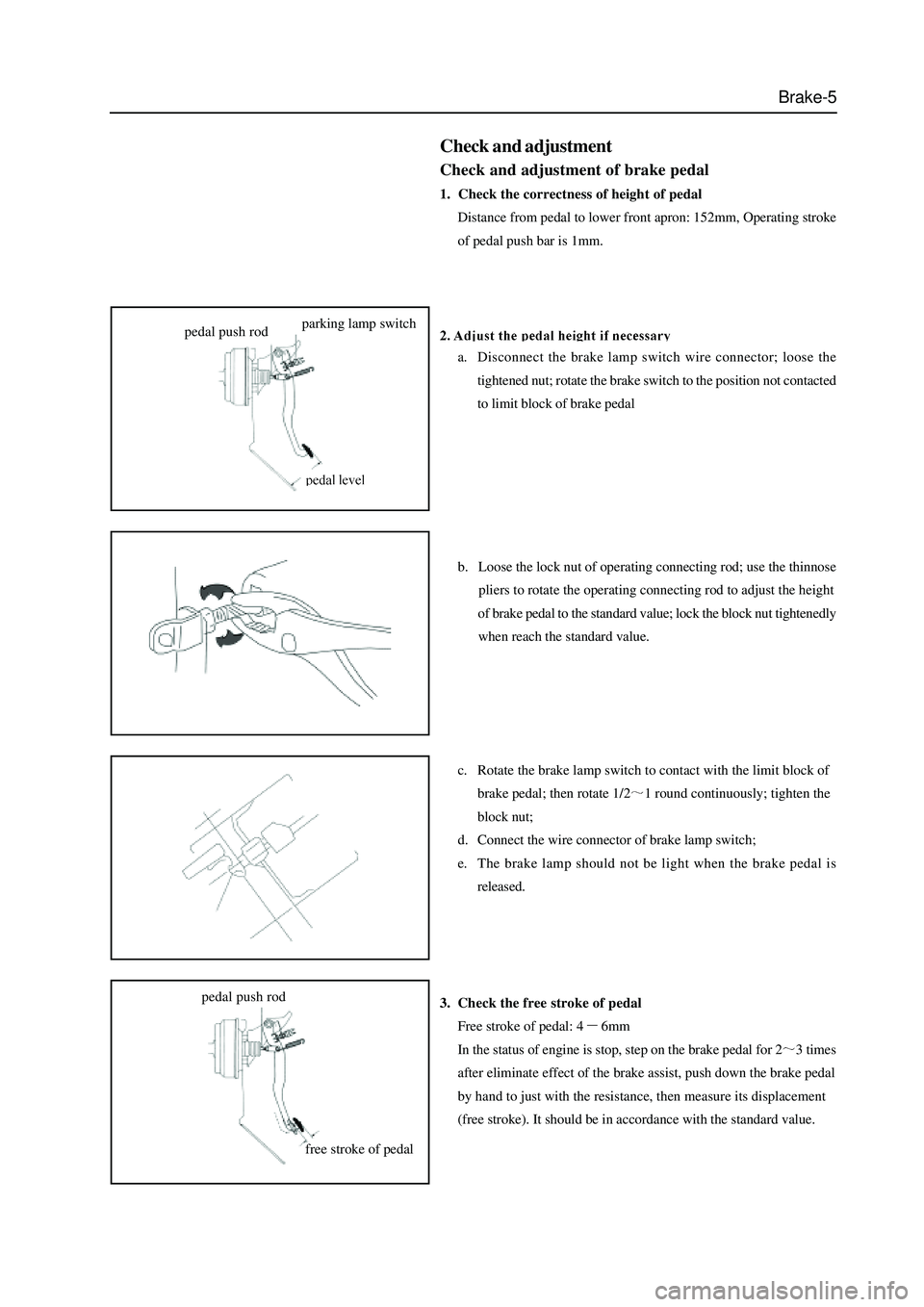
Check and adjustment
Check and adjustment of brake pedal
1. Check the correctness of height of pedal
Distance from pedal to lower front apron: 152mm, Operating stroke
of pedal push bar is 1mm.
a. Disconnect the brake lamp switch wire connector; loose the
tightened nut; rotate the brake switch to the position not contacted
to limit block of brake pedal
b. Loose the lock nut of operating connecting rod; use the thinnose
pliers to rotate the operating connecting rod to adjust the height
of brake pedal to the standard value; lock the block nut tightenedly
when reach the standard value.
c. Rotate the brake lamp switch to contact with the limit block of
brake pedal; then rotate 1/2
1 round continuously; tighten the
block nut;
d. Connect the wire connector of brake lamp switch;
e. The brake lamp should not be light when the brake pedal is
released.
3. Check the free stroke of pedal
Free stroke of pedal: 4
6mm
In the status of engine is stop, step on the brake pedal for 2
3 times
after eliminate effect of the brake assist, push down the brake pedal
by hand to just with the resistance, then measure its displacement
(free stroke). It should be in accordance with the standard value.
pedal push rodparking lamp switch
free stroke of pedal pedal push rod
Page 294 of 425
Brake-8
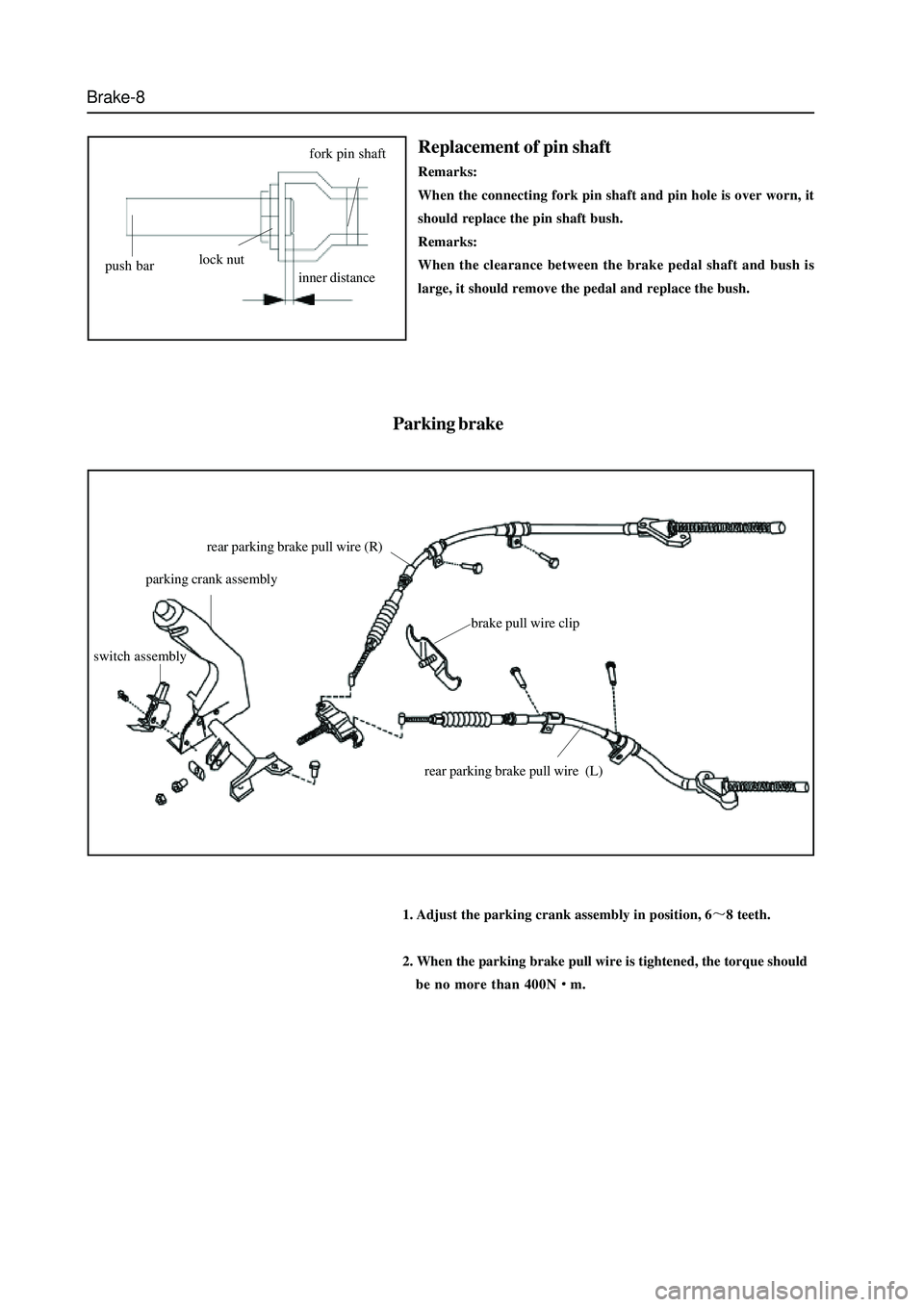
Replacement of pin shaft
Remarks:
When the connecting fork pin shaft and pin hole is over worn, it
should replace the pin shaft bush.
Remarks:
When the clearance between the brake pedal shaft and bush is
large, it should remove the pedal and replace the bush.
push barlock nut
inner distance
fork pin shaft
Parking brake
parking crank assembly
switch assembly
rear parking brake pull wire (R)
rear parking brake pull wire (L)
brake pull wire clip
1. Adjust the parking crank assembly in position, 6
8 teeth.
2. When the parking brake pull wire is tightened, the torque should
be no more than 400N
m.
Page 308 of 425
Brake-22
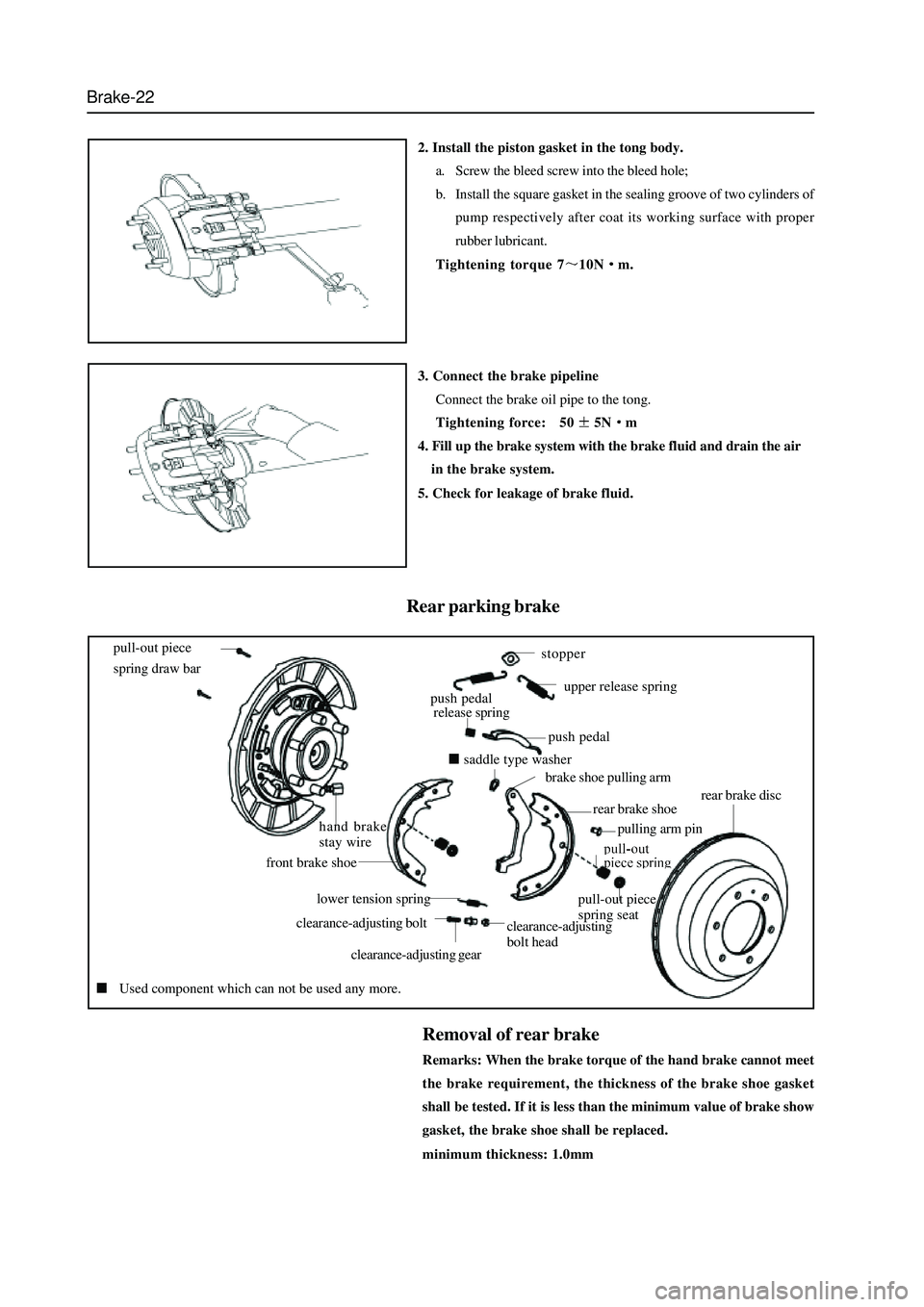
2. Install the piston gasket in the tong body.
a. Screw the bleed screw into the bleed hole;
b. Install the square gasket in the sealing groove of two cylinders of
pump respectively after coat its working surface with proper
rubber lubricant.
Tightening torque 7
10Nm.
3. Connect the brake pipeline
Connect the brake oil pipe to the tong.
Tightening force: 50
5Nm
4. Fill up the brake system with the brake fluid and drain the air
in the brake system.
5. Check for leakage of brake fluid.
Rear parking brake
pull-out piece
spring draw bar
hand brake
stay wire
front brake shoe
lower tension spring
clearance-adjusting bolt
clearance-adjusting gear
clearance-adjusting
bolt head
pull-out piece
spring seat
pulling arm pin
rear brake shoe
brake shoe pulling arm
saddle type washer
push pedal
push pedal
release spring
stopper
upper release spring
rear brake disc
Used component which can not be used any more.
Removal of rear brake
Remarks: When the brake torque of the hand brake cannot meet
the brake requirement, the thickness of the brake shoe gasket
shall be tested. If it is less than the minimum value of brake show
gasket, the brake shoe shall be replaced.
minimum thickness: 1.0mm
Page 310 of 425
Brake-24
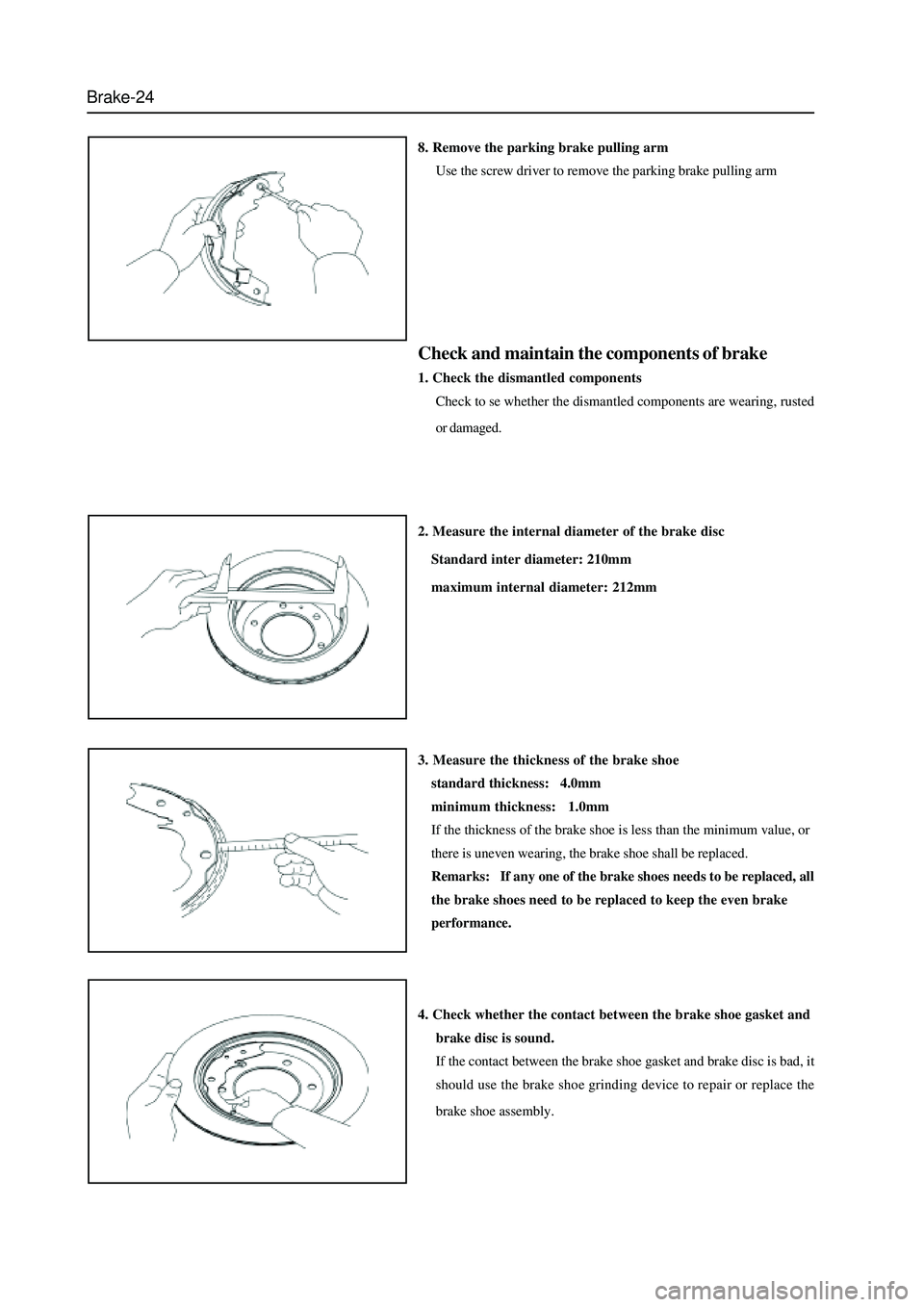
8. Remove the parking brake pulling arm
Use the screw driver to remove the parking brake pulling arm
Check and maintain the components of brake
1. Check the dismantled components
Check to se whether the dismantled components are wearing, rusted
or damaged.
2. Measure the internal diameter of the brake disc
Standard inter diameter: 210mm
maximum internal diameter: 212mm
3. Measure the thickness of the brake shoe
standard thickness: 4.0mm
minimum thickness: 1.0mm
If the thickness of the brake shoe is less than the minimum value, or
there is uneven wearing, the brake shoe shall be replaced.
Remarks: If any one of the brake shoes needs to be replaced, all
the brake shoes need to be replaced to keep the even brake
performance.
4. Check whether the contact between the brake shoe gasket and
brake disc is sound.
If the contact between the brake shoe gasket and brake disc is bad, it
should use the brake shoe grinding device to repair or replace the
brake shoe assembly.