suspension GREAT WALL HOVER 2006 Service User Guide
[x] Cancel search | Manufacturer: GREAT WALL, Model Year: 2006, Model line: HOVER, Model: GREAT WALL HOVER 2006Pages: 425, PDF Size: 26.05 MB
Page 187 of 425
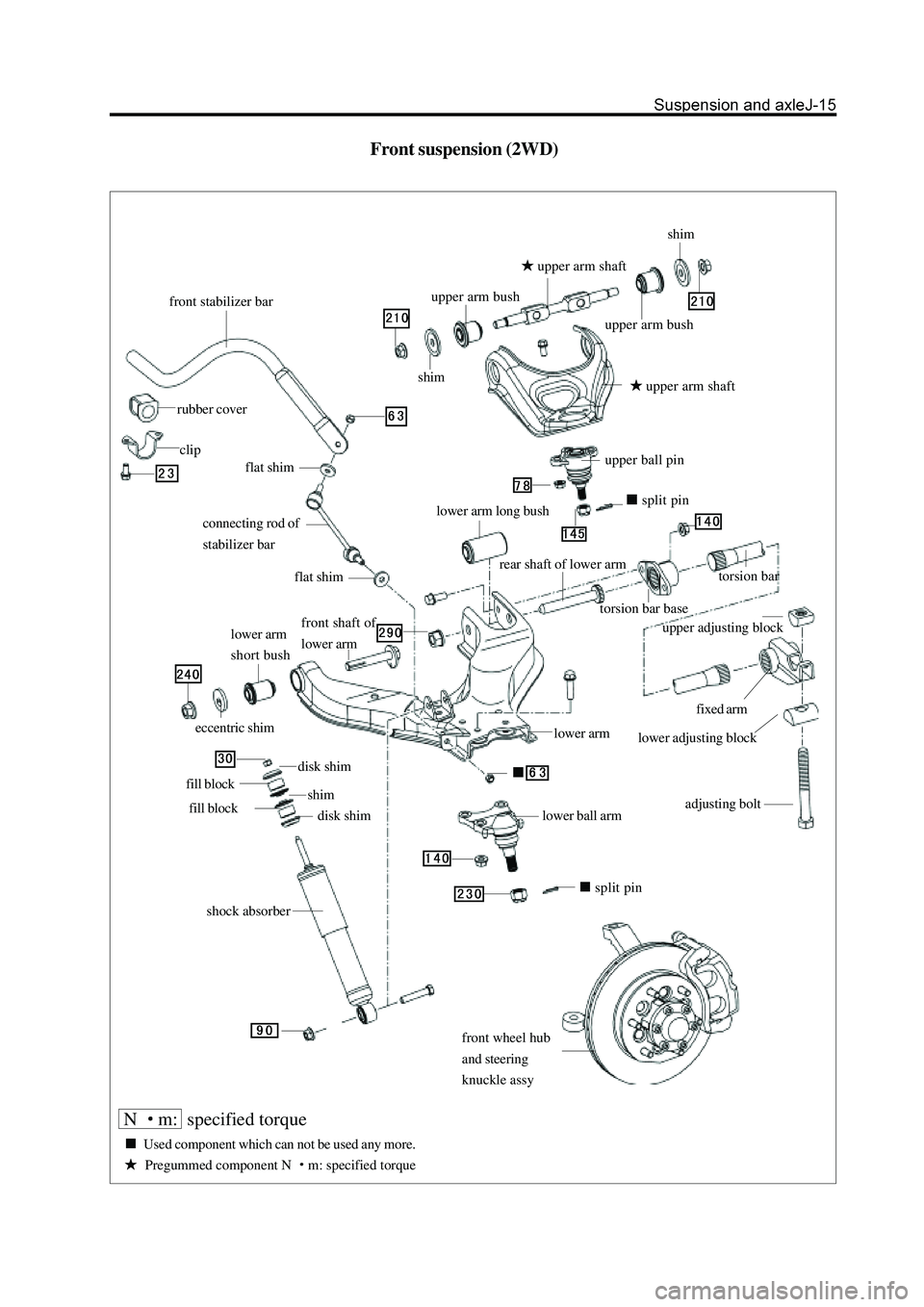
Front suspension (2WD)
front stabilizer bar
rubber cover
clip
connecting rod of
stabilizer bar
flat shim
front shaft of
lower arm
split pin
adjusting bolt
lower adjusting block
fixed arm
upper adjusting block
lower arm
rear shaft of lower arm
torsion bar base
torsion bar
lower arm long bushsplit pin
upper ball pin
upper arm shaft
upper arm bush
flat shim
lower arm
short bush
eccentric shim
disk shim
fill block
fill block
disk shim shim
shock absorbershimshim
upper arm bush
upper arm shaft
lower ball arm
front wheel hub
and steering
knuckle assy
N m: specified torque
Used component which can not be used any more.
Pregummed component N m: specified torque
Page 191 of 425
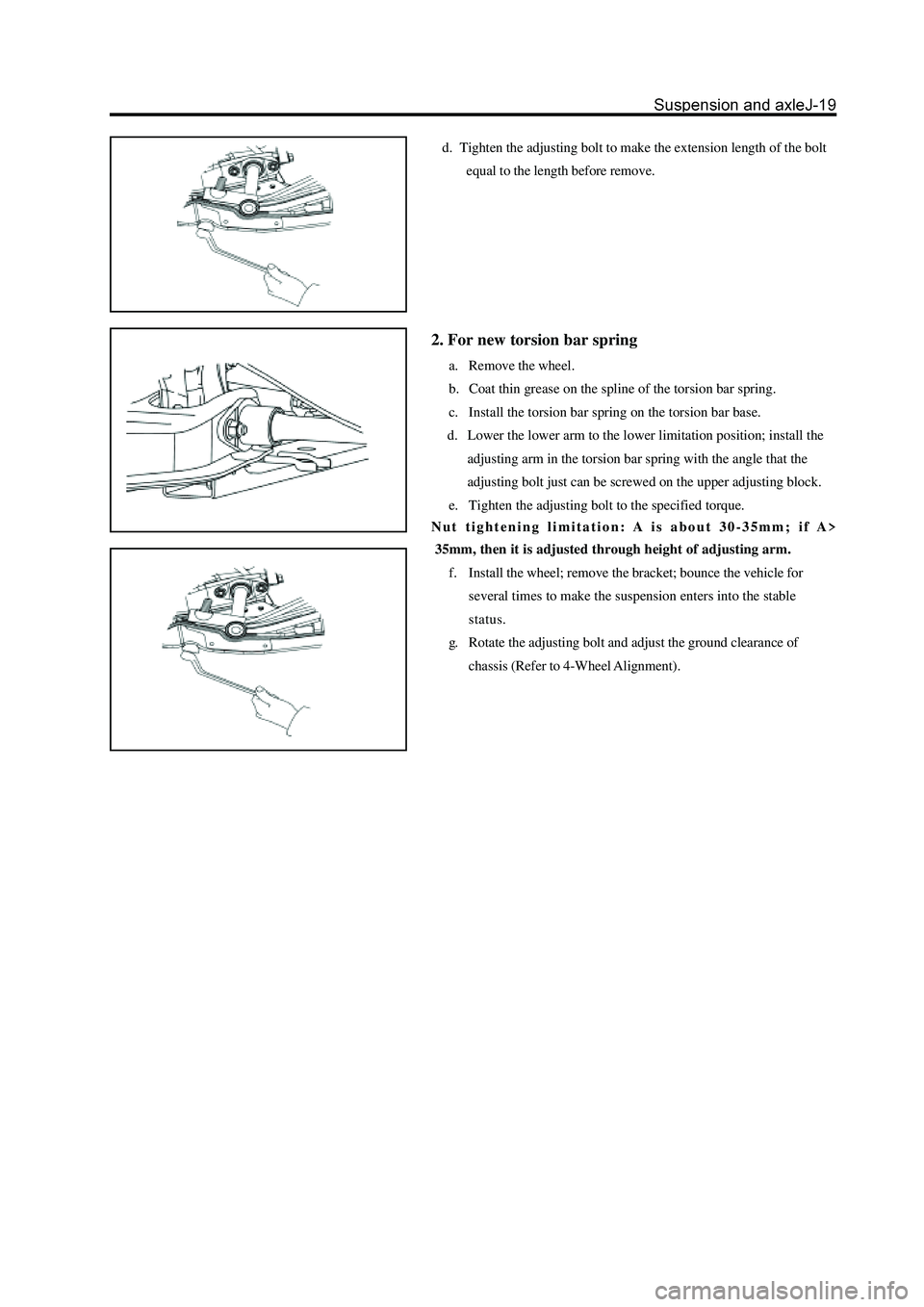
d. Tighten the adjusting bolt to make the extension length of the bolt
equal to the length before remove.
2. For new torsion bar spring
a. Remove the wheel.
b. Coat thin grease on the spline of the torsion bar spring.
c. Install the torsion bar spring on the torsion bar base.
d. Lower the lower arm to the lower limitation position; install the
adjusting arm in the torsion bar spring with the angle that the
adjusting bolt just can be screwed on the upper adjusting block.
e. Tighten the adjusting bolt to the specified torque.
Nut tightening limitation: A is about 30-35mm; if A>
35mm, then it is adjusted through height of adjusting arm.
f. Install the wheel; remove the bracket; bounce the vehicle for
several times to make the suspension enters into the stable
status.
g. Rotate the adjusting bolt and adjust the ground clearance of
chassis (Refer to 4-Wheel Alignment).
Page 192 of 425
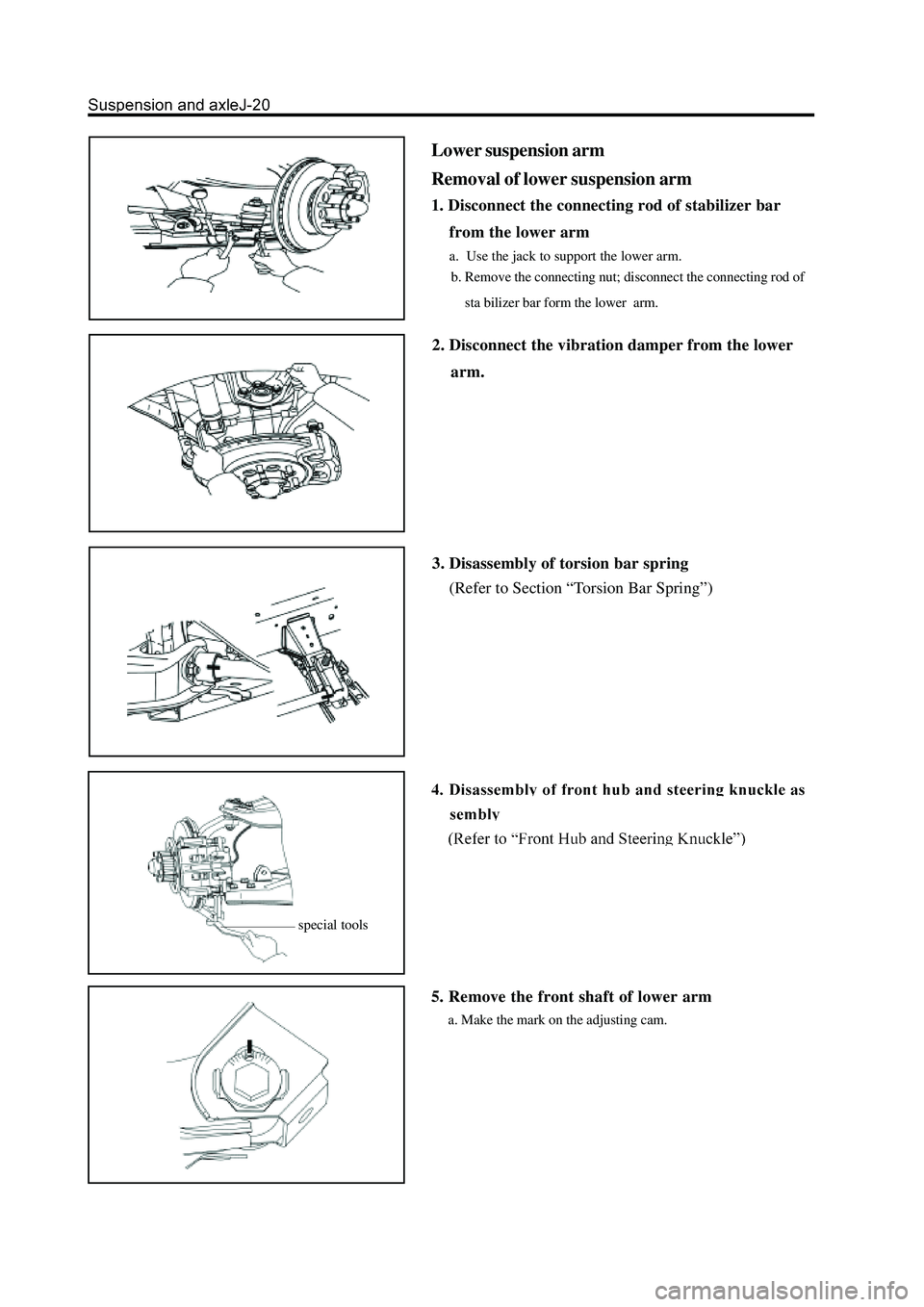
2. Disconnect the vibration damper from the lower
arm.
3. Disassembly of torsion bar spring
(Refer to Section “Torsion Bar Spring”)
Lower suspension arm
Removal of lower suspension arm
1. Disconnect the connecting rod of stabilizer bar
from the lower arm
a. Use the jack to support the lower arm.
b. Remove the connecting nut; disconnect the connecting rod of
sta bilizer bar form the lower arm.
5. Remove the front shaft of lower arm
a. Make the mark on the adjusting cam.
special tools
Page 193 of 425
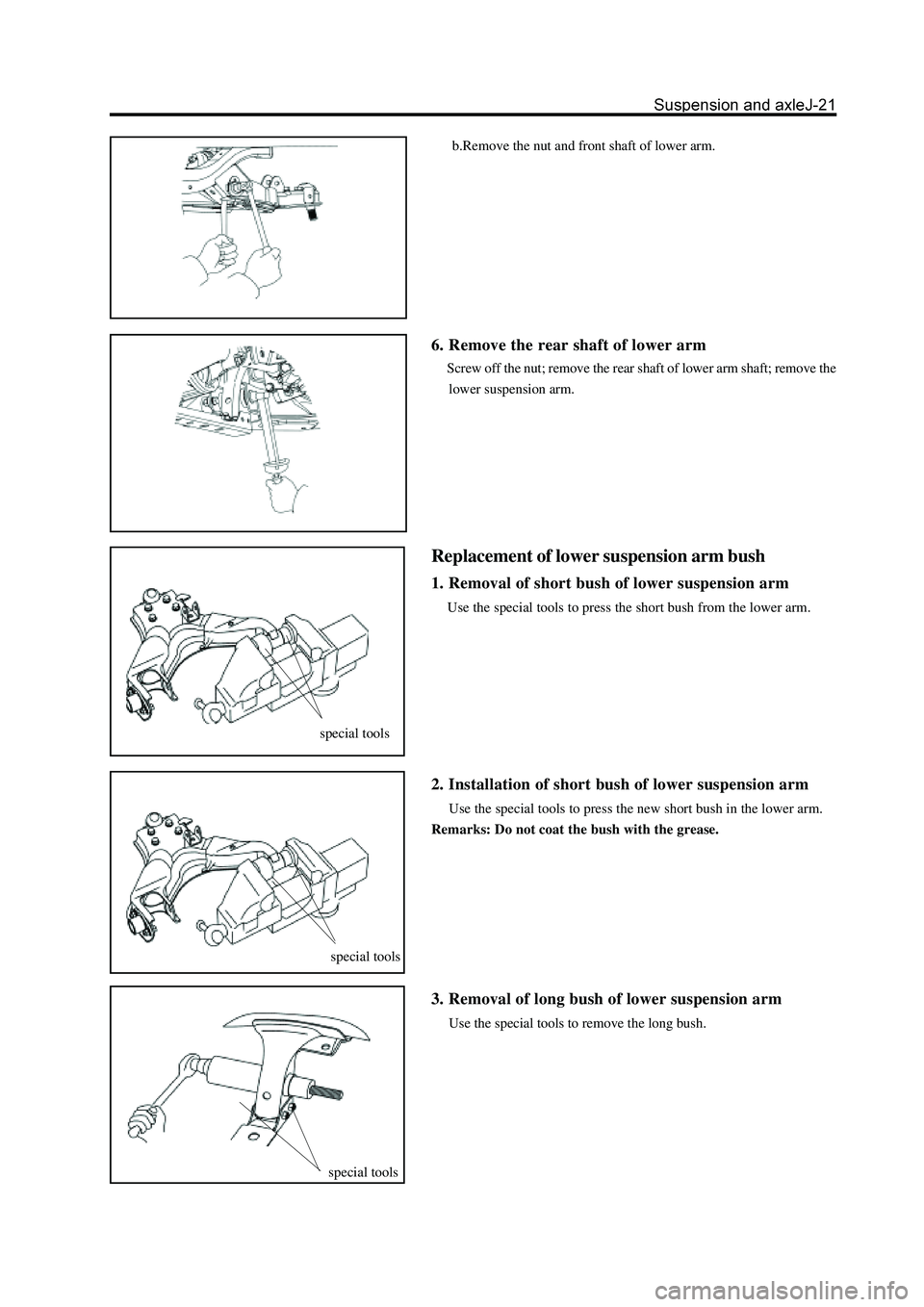
b.Remove the nut and front shaft of lower arm.
6. Remove the rear shaft of lower arm
Screw off the nut; remove the rear shaft of lower arm shaft; remove the
lower suspension arm.
Replacement of lower suspension arm bush
1. Removal of short bush of lower suspension arm
Use the special tools to press the short bush from the lower arm.
2. Installation of short bush of lower suspension arm
Use the special tools to press the new short bush in the lower arm.
Remarks: Do not coat the bush with the grease.
special tools
special tools
3. Removal of long bush of lower suspension arm
Use the special tools to remove the long bush.
special tools
Page 194 of 425
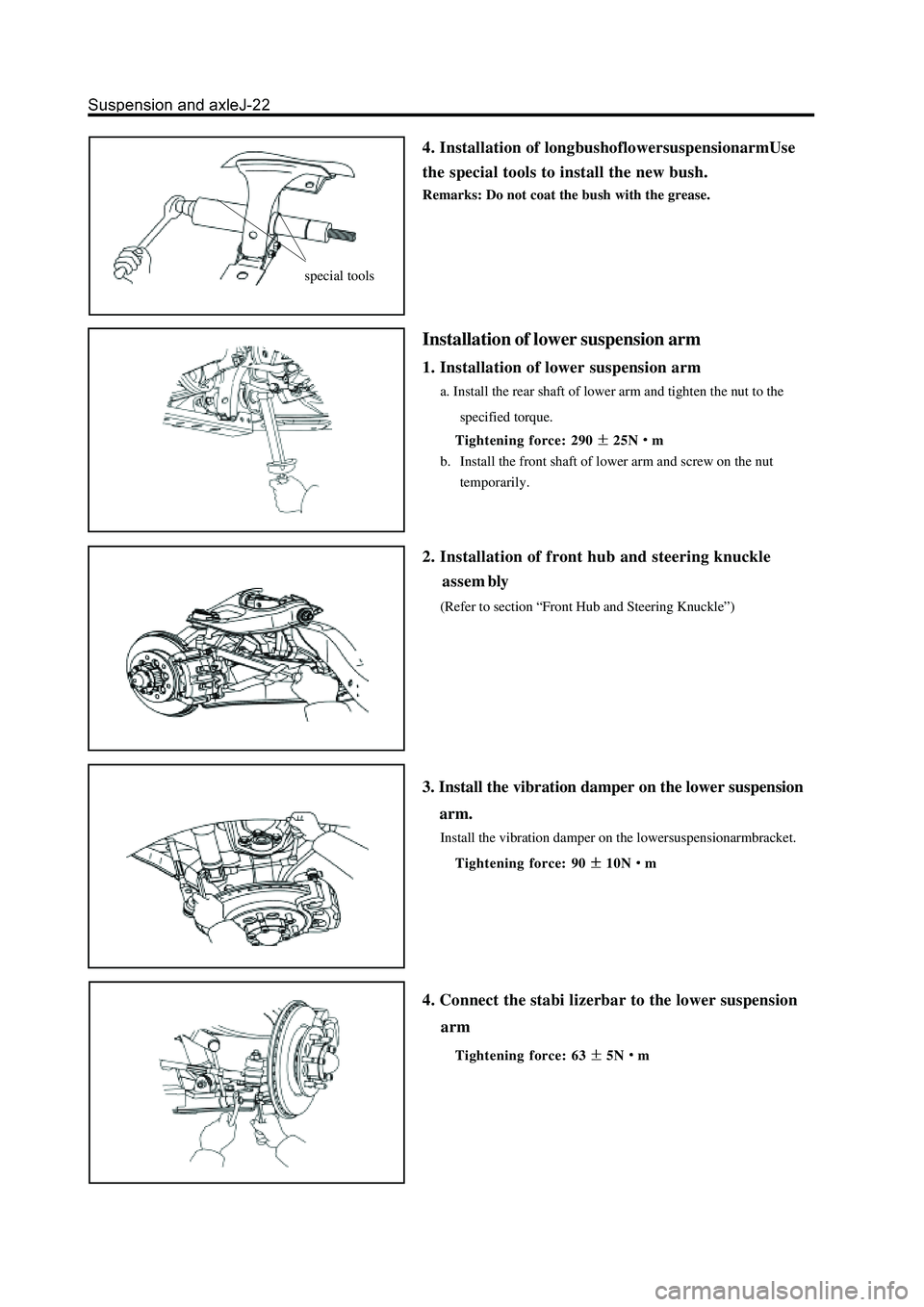
4. Installation of longbushoflowersuspensionarmUse
the special tools to install the new bush.
Remarks: Do not coat the bush with the grease.
Installation of lower suspension arm
1. Installation of lower suspension arm
a. Install the rear shaft of lower arm and tighten the nut to the
specified torque.
Tightening force: 290
25Nm
b. Install the front shaft of lower arm and screw on the nut
temporarily.
2. Installation of front hub and steering knuckle
assem bly
(Refer to section “Front Hub and Steering Knuckle”)
3. Install the vibration damper on the lower suspension
arm.
Install the vibration damper on the lowersuspensionarmbracket.
Tightening force: 90
10Nm
4. Connect the stabi lizerbar to the lower suspension
arm
Tightening force: 635Nm
special tools
Page 196 of 425
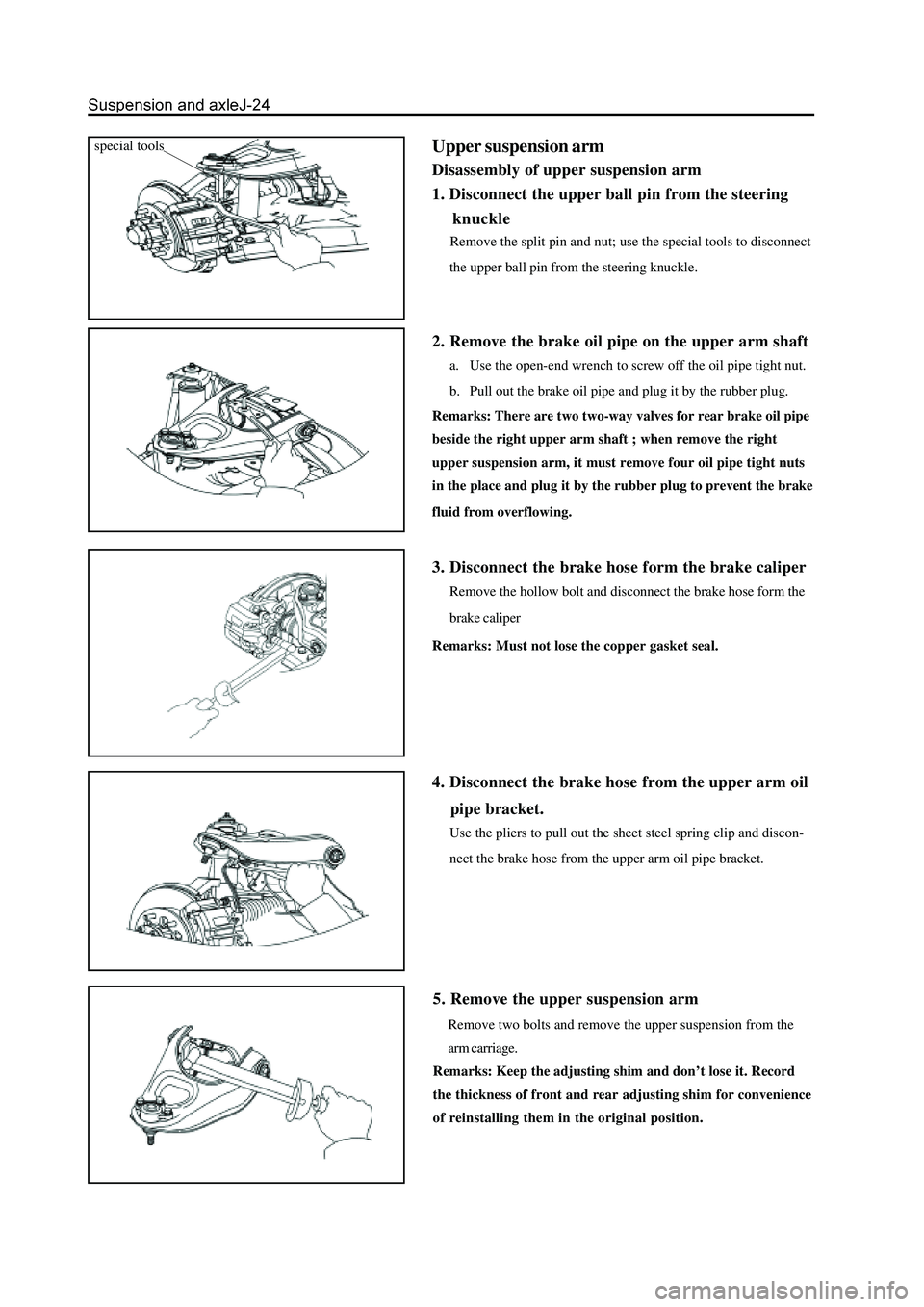
special toolsUpper suspension arm
Disassembly of upper suspension arm
1. Disconnect the upper ball pin from the steering
knuckle
Remove the split pin and nut; use the special tools to disconnect
the upper ball pin from the steering knuckle.
2. Remove the brake oil pipe on the upper arm shaft
a. Use the open-end wrench to screw off the oil pipe tight nut.
b. Pull out the brake oil pipe and plug it by the rubber plug.
Remarks: There are two two-way valves for rear brake oil pipe
beside the right upper arm shaft ; when remove the right
upper suspension arm, it must remove four oil pipe tight nuts
in the place and plug it by the rubber plug to prevent the brake
fluid from overflowing.
3. Disconnect the brake hose form the brake caliper
Remove the hollow bolt and disconnect the brake hose form the
brake caliper
Remarks: Must not lose the copper gasket seal.
4. Disconnect the brake hose from the upper arm oil
pipe bracket.
Use the pliers to pull out the sheet steel spring clip and discon-
nect the brake hose from the upper arm oil pipe bracket.
5. Remove the upper suspension arm
Remove two bolts and remove the upper suspension from the
arm carriage.
Remarks: Keep the adjusting shim and don’t lose it. Record
the thickness of front and rear adjusting shim for convenience
of reinstalling them in the original position.
Page 198 of 425
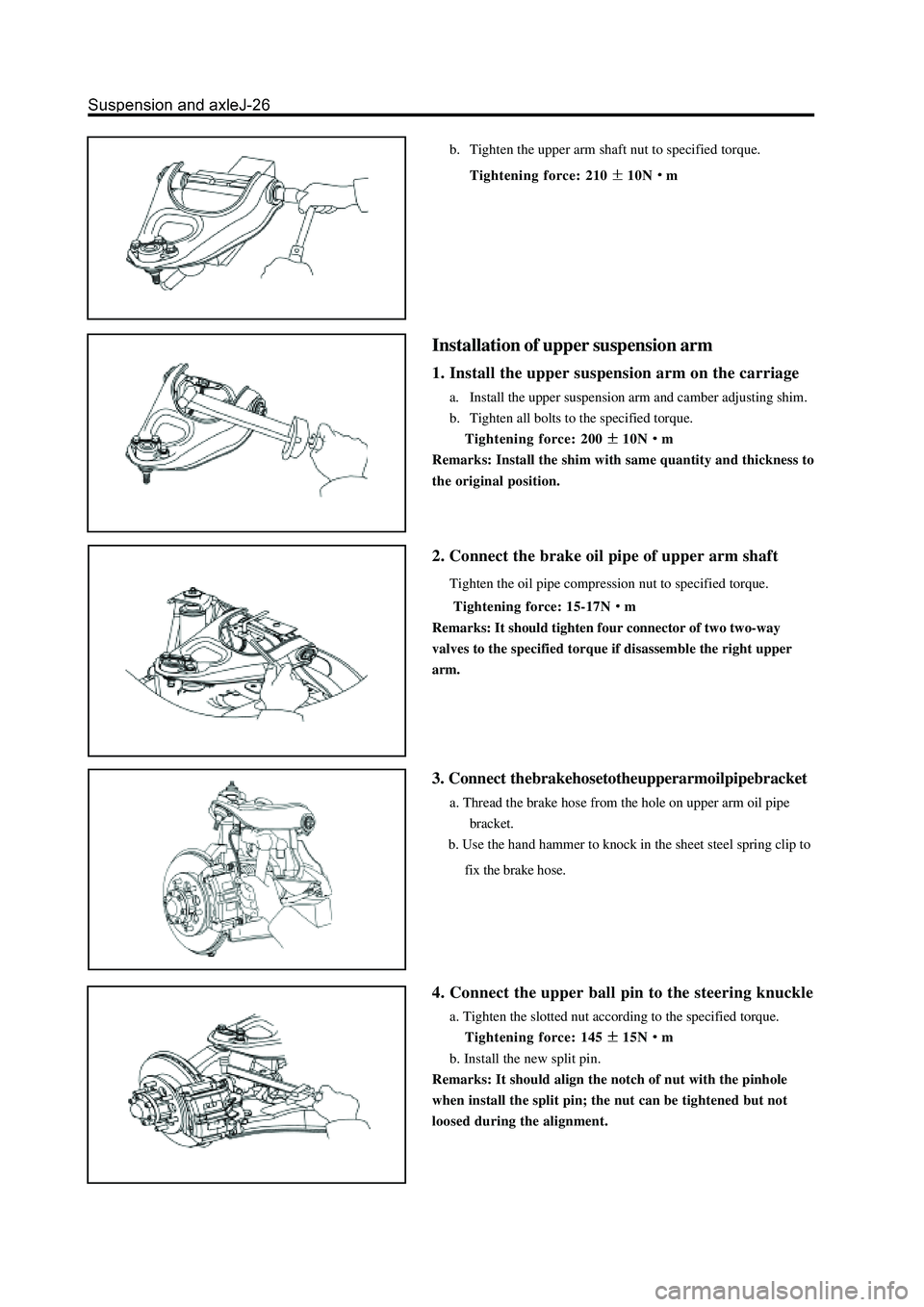
b. Tighten the upper arm shaft nut to specified torque.
Tightening force: 210
10Nm
Installation of upper suspension arm
1. Install the upper suspension arm on the carriage
a. Install the upper suspension arm and camber adjusting shim.
b. Tighten all bolts to the specified torque.
Tightening force: 200
10Nm
Remarks: Install the shim with same quantity and thickness to
the original position.
2. Connect the brake oil pipe of upper arm shaft
Tighten the oil pipe compression nut to specified torque.
Tightening force: 15-17N
m
Remarks: It should tighten four connector of two two-way
valves to the specified torque if disassemble the right upper
arm.
3. Connect thebrakehosetotheupperarmoilpipebracket
a. Thread the brake hose from the hole on upper arm oil pipe
bracket.
b. Use the hand hammer to knock in the sheet steel spring clip to
fix the brake hose.
4. Connect the upper ball pin to the steering knuckle
a. Tighten the slotted nut according to the specified torque.
Tightening force: 145
15Nm
b. Install the new split pin.
Remarks: It should align the notch of nut with the pinhole
when install the split pin; the nut can be tightened but not
loosed during the alignment.
Page 201 of 425
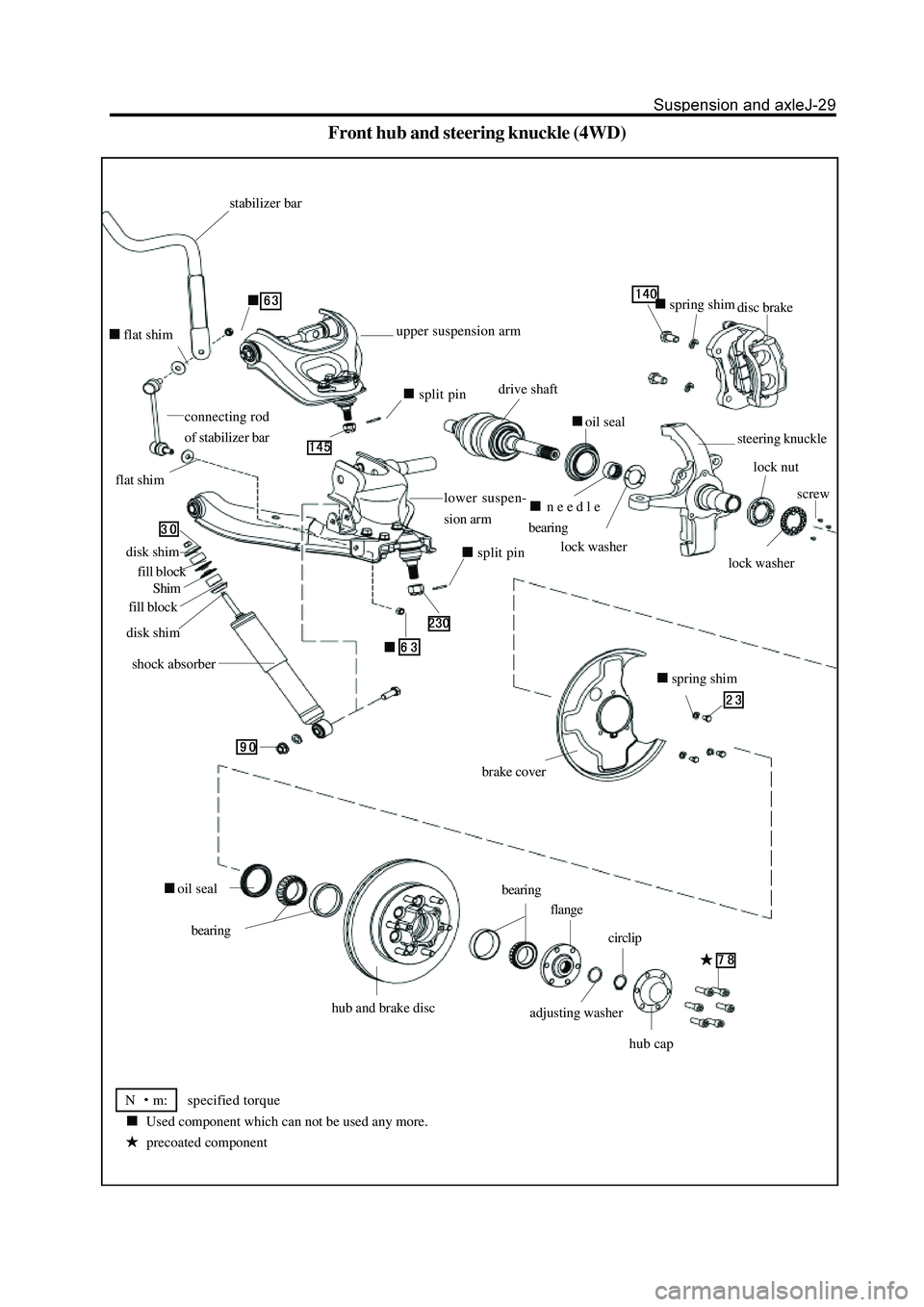
N m: specified torque
Used component which can not be used any more.
precoated component
Front hub and steering knuckle (4WD)
stabilizer bar
flat shim
connecting rod
of stabilizer bar
hub and brake disc
flange
adjusting washer
circlip
hub cap
spring shimdisc brake
split pin
lower suspen-
sion arm
split pin
upper suspension arm
drive shaft
oil seal
needle
bearing
lock washer
steering knuckle
lock nut
lock washer
screw
brake cover
spring shim
flat shim
disk shimShim
fill blockfill block disk shim
oil seal
bearingbearing shock absorber
Page 210 of 425
clip
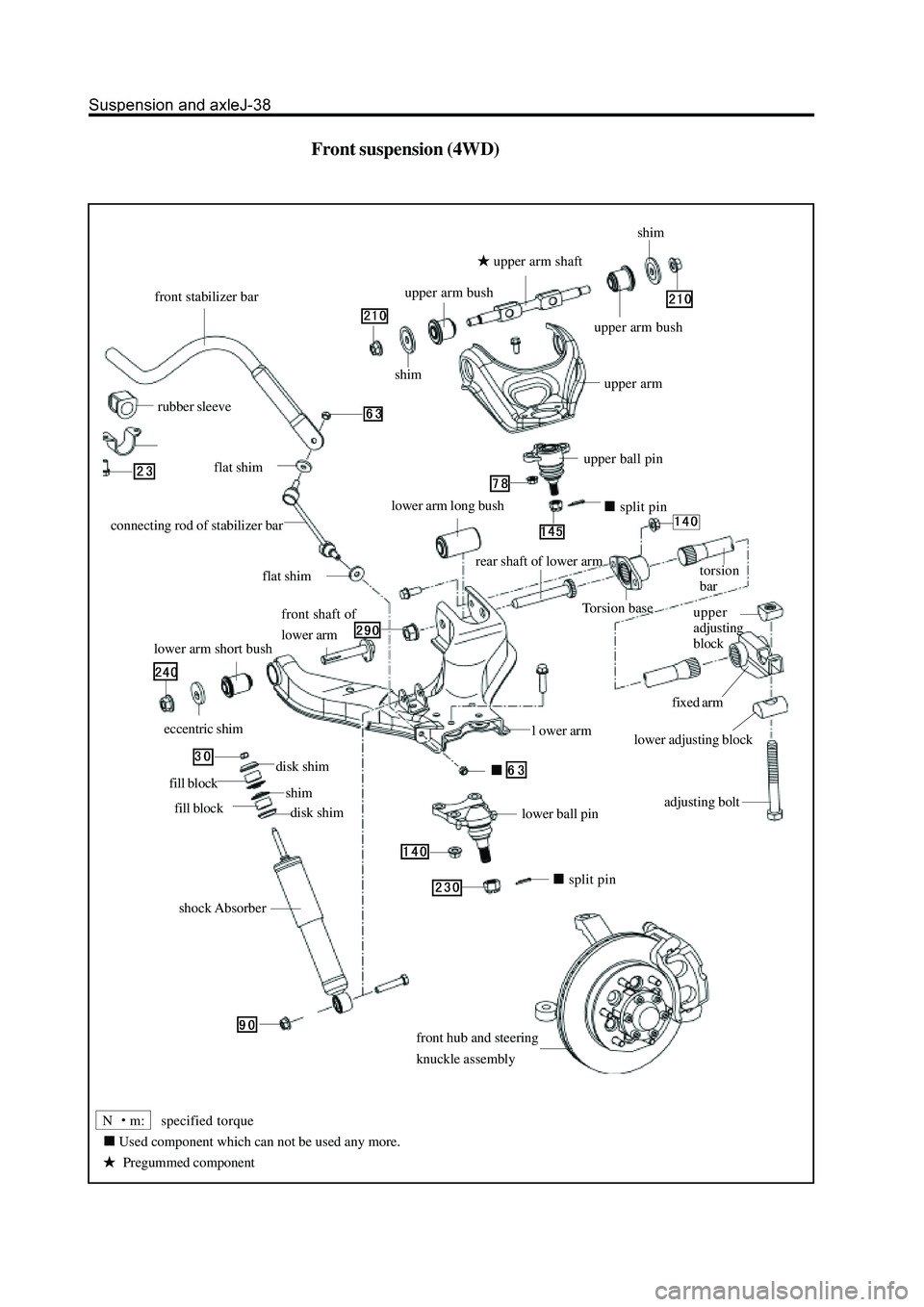
Front suspension (4WD)
N m: specified torque
Used component which can not be used any more.
Pregummed component
rubber sleeve
front shaft of
lower arm
disk shim
fill blockshimfill blockdisk shim
shock Absorber
front hub and steering
knuckle assembly
split pin
lower ball pinadjusting bolt
lower adjusting block
fixed arm
upper
adjusting
block
l ower arm
rear shaft of lower arm
Torsion base
torsion
bar
lower arm long bushsplit pin
upper ball pin
upper arm
shim
upper arm bush
upper arm shaft
upper arm bush
shim
front stabilizer bar
flat shim
connecting rod of stabilizer bar
flat shim
lower arm short bush
eccentric shim
Page 214 of 425
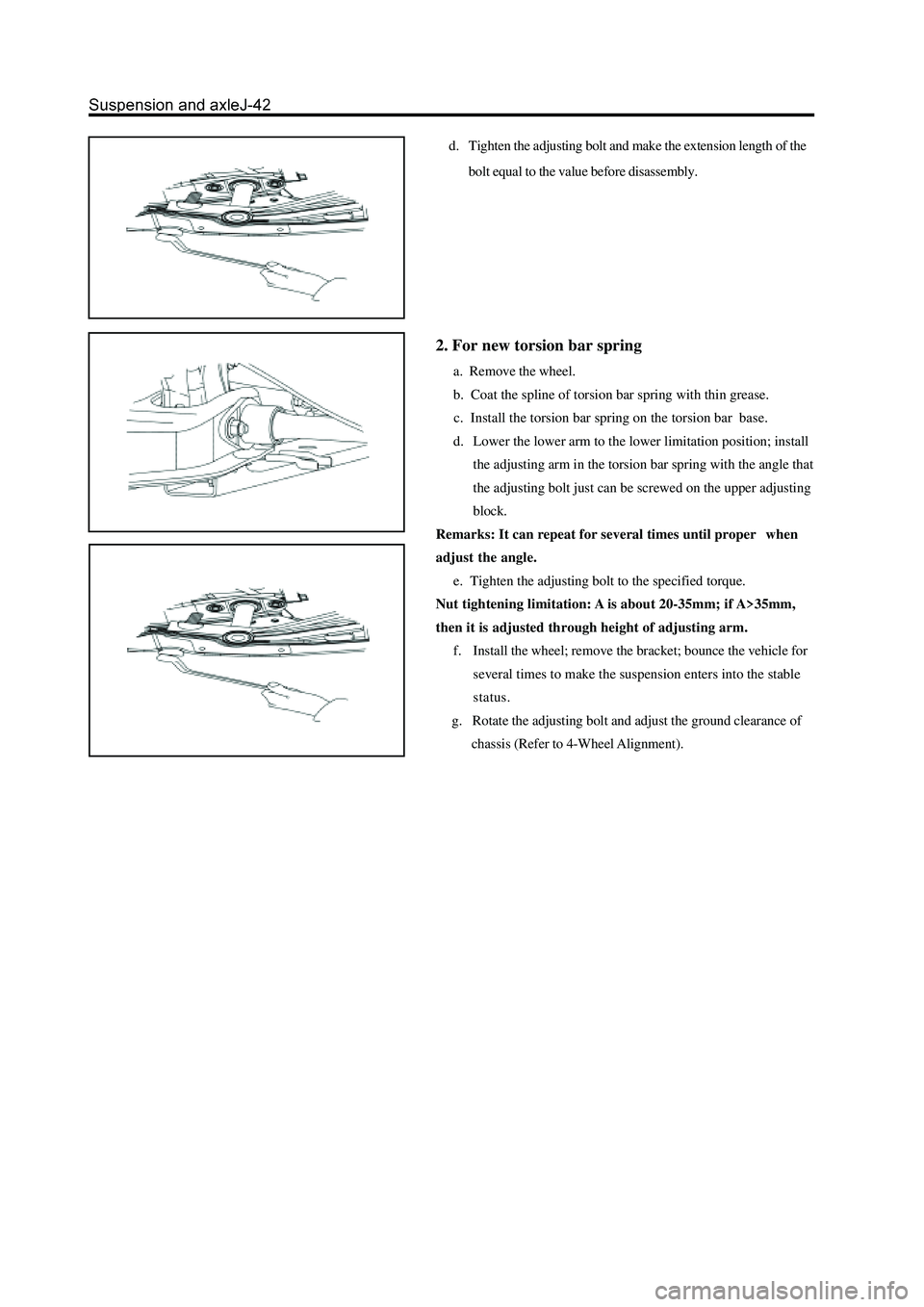
d. Tighten the adjusting bolt and make the extension length of the
bolt equal to the value before disassembly.
2. For new torsion bar spring
a. Remove the wheel.
b. Coat the spline of torsion bar spring with thin grease.
c. Install the torsion bar spring on the torsion bar base.
d. Lower the lower arm to the lower limitation position; install
the adjusting arm in the torsion bar spring with the angle that
the adjusting bolt just can be screwed on the upper adjusting
block.
Remarks: It can repeat for several times until proper when
adjust the angle.
e. Tighten the adjusting bolt to the specified torque.
Nut tightening limitation: A is about 20-35mm; if A>35mm,
then it is adjusted through height of adjusting arm.
f. Install the wheel; remove the bracket; bounce the vehicle for
several times to make the suspension enters into the stable
status.
g. Rotate the adjusting bolt and adjust the ground clearance of
chassis (Refer to 4-Wheel Alignment).