check oil GREAT WALL HOVER 2006 Service Owner's Guide
[x] Cancel search | Manufacturer: GREAT WALL, Model Year: 2006, Model line: HOVER, Model: GREAT WALL HOVER 2006Pages: 425, PDF Size: 26.05 MB
Page 258 of 425
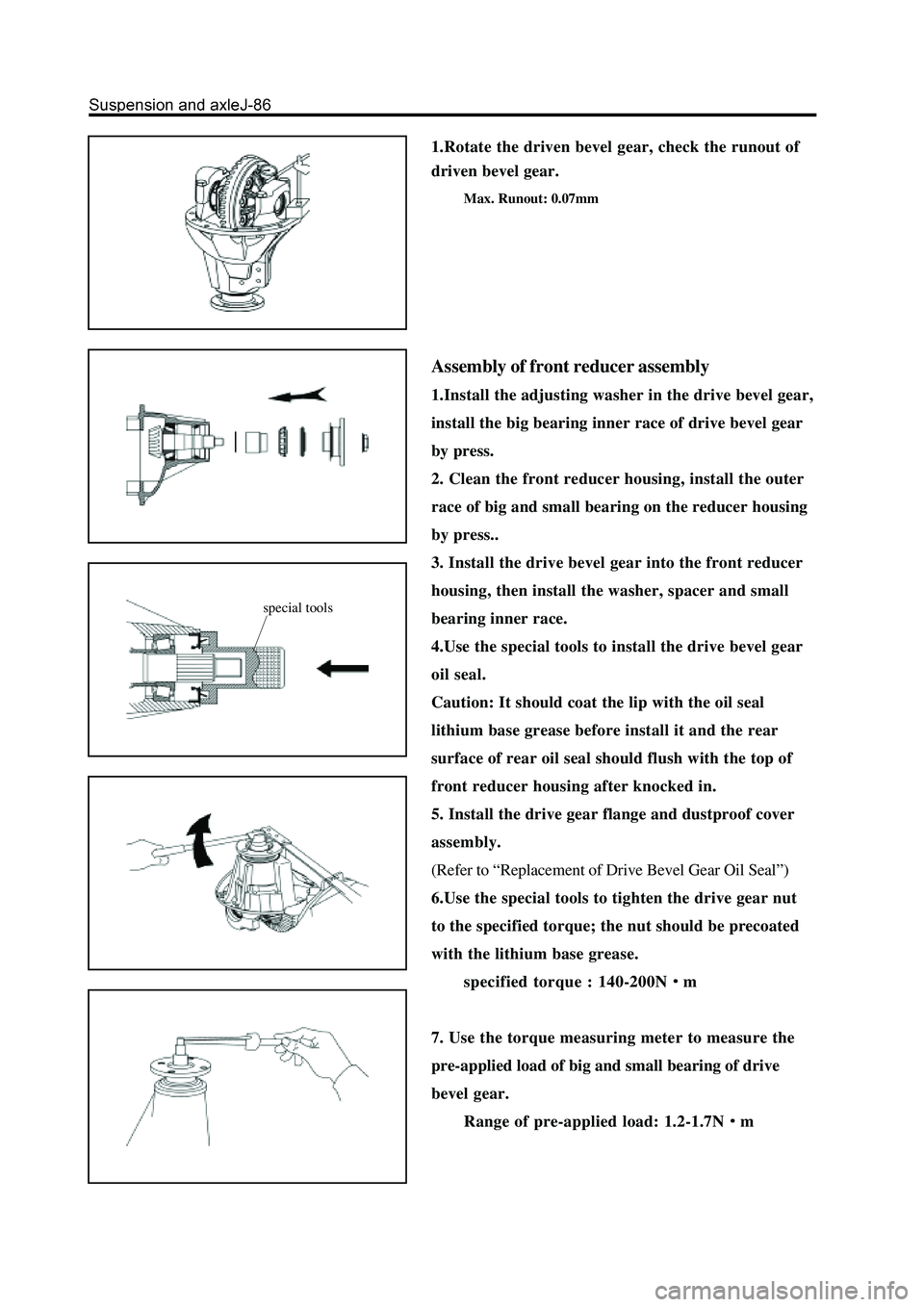
1.Rotate the driven bevel gear, check the runout of
driven bevel gear.
Max. Runout: 0.07mm
Assembly of front reducer assembly
1.Install the adjusting washer in the drive bevel gear,
install the big bearing inner race of drive bevel gear
by press.
2. Clean the front reducer housing, install the outer
race of big and small bearing on the reducer housing
by press..
3. Install the drive bevel gear into the front reducer
housing, then install the washer, spacer and small
bearing inner race.
4.Use the special tools to install the drive bevel gear
oil seal.
Caution: It should coat the lip with the oil seal
lithium base grease before install it and the rear
surface of rear oil seal should flush with the top of
front reducer housing after knocked in.
5. Install the drive gear flange and dustproof cover
assembly.
(Refer to “Replacement of Drive Bevel Gear Oil Seal”)
6.Use the special tools to tighten the drive gear nut
to the specified torque; the nut should be precoated
with the lithium base grease.
specified torque : 140-200N
m
7. Use the torque measuring meter to measure the
pre-applied load of big and small bearing of drive
bevel gear.
Range of pre-applied load: 1.2-1.7N
m
special tools
Page 263 of 425
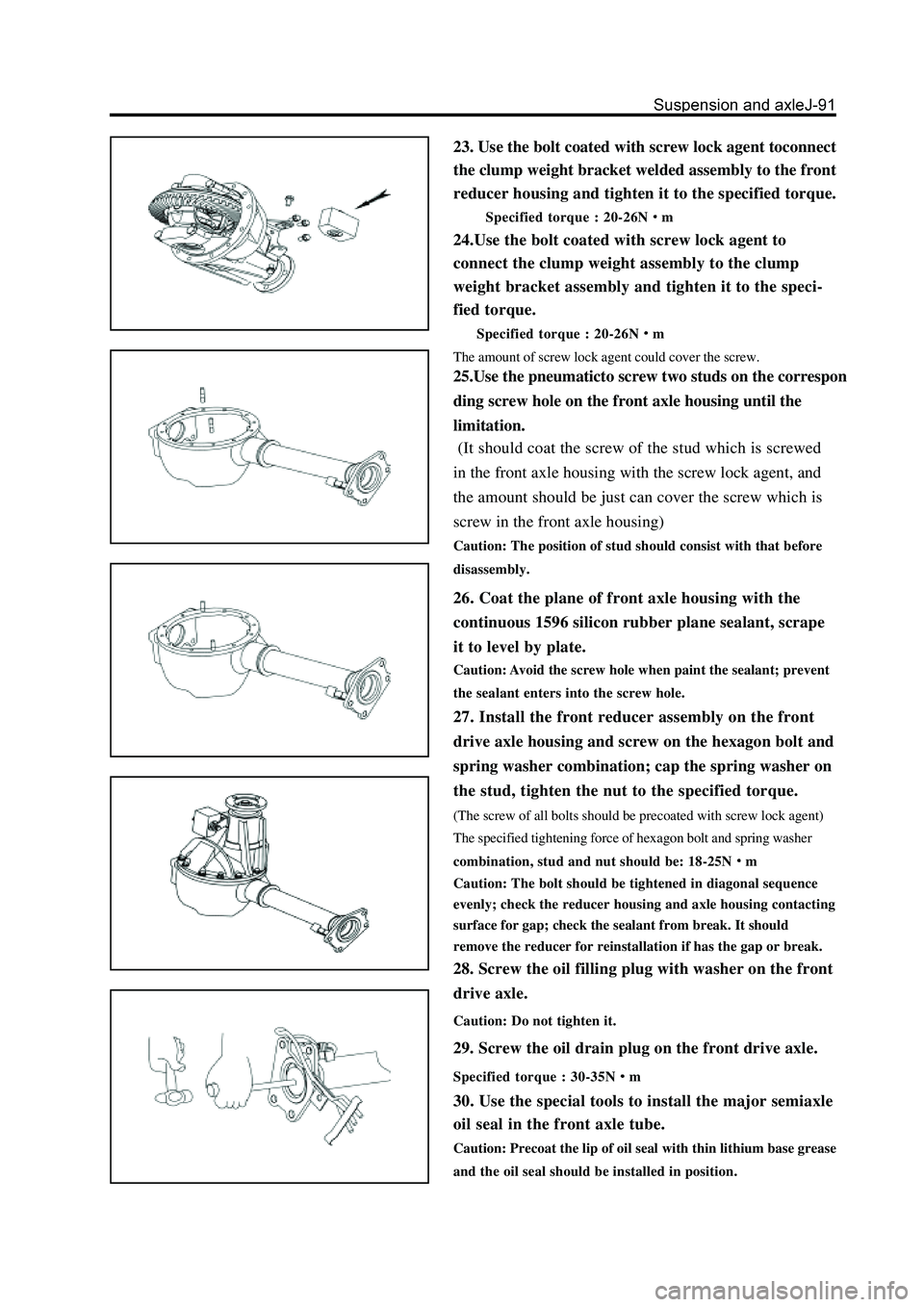
23. Use the bolt coated with screw lock agent toconnect
the clump weight bracket welded assembly to the front
reducer housing and tighten it to the specified torque.
Specified torque : 20-26Nm
24.Use the bolt coated with screw lock agent to
connect the clump weight assembly to the clump
weight bracket assembly and tighten it to the speci-
fied torque.
Specified torque : 20-26Nm
The amount of screw lock agent could cover the screw.
25.Use the pneumaticto screw two studs on the correspon
ding screw hole on the front axle housing until the
limitation.
26. Coat the plane of front axle housing with the
continuous 1596 silicon rubber plane sealant, scrape
it to level by plate.
Caution: Avoid the screw hole when paint the sealant; prevent
the sealant enters into the screw hole.
27. Install the front reducer assembly on the front
drive axle housing and screw on the hexagon bolt and
spring washer combination; cap the spring washer on
the stud, tighten the nut to the specified torque.
(The screw of all bolts should be precoated with screw lock agent)
The specified tightening force of hexagon bolt and spring washer
combination, stud and nut should be: 18-25N
m
Caution: The bolt should be tightened in diagonal sequence
evenly; check the reducer housing and axle housing contacting
surface for gap; check the sealant from break. It should
remove the reducer for reinstallation if has the gap or break.
28. Screw the oil filling plug with washer on the front
drive axle.
Caution: Do not tighten it.
29. Screw the oil drain plug on the front drive axle.
Specified torque : 30-35Nm
30. Use the special tools to install the major semiaxle
oil seal in the front axle tube.
Caution: Precoat the lip of oil seal with thin lithium base grease
and the oil seal should be installed in position.
(It should coat the screw of the stud which is screwed
in the front axle housing with the screw lock agent, and
the amount should be just can cover the screw which is
screw in the front axle housing)
Caution: The position of stud should consist with that before
disassembly.
Page 269 of 425
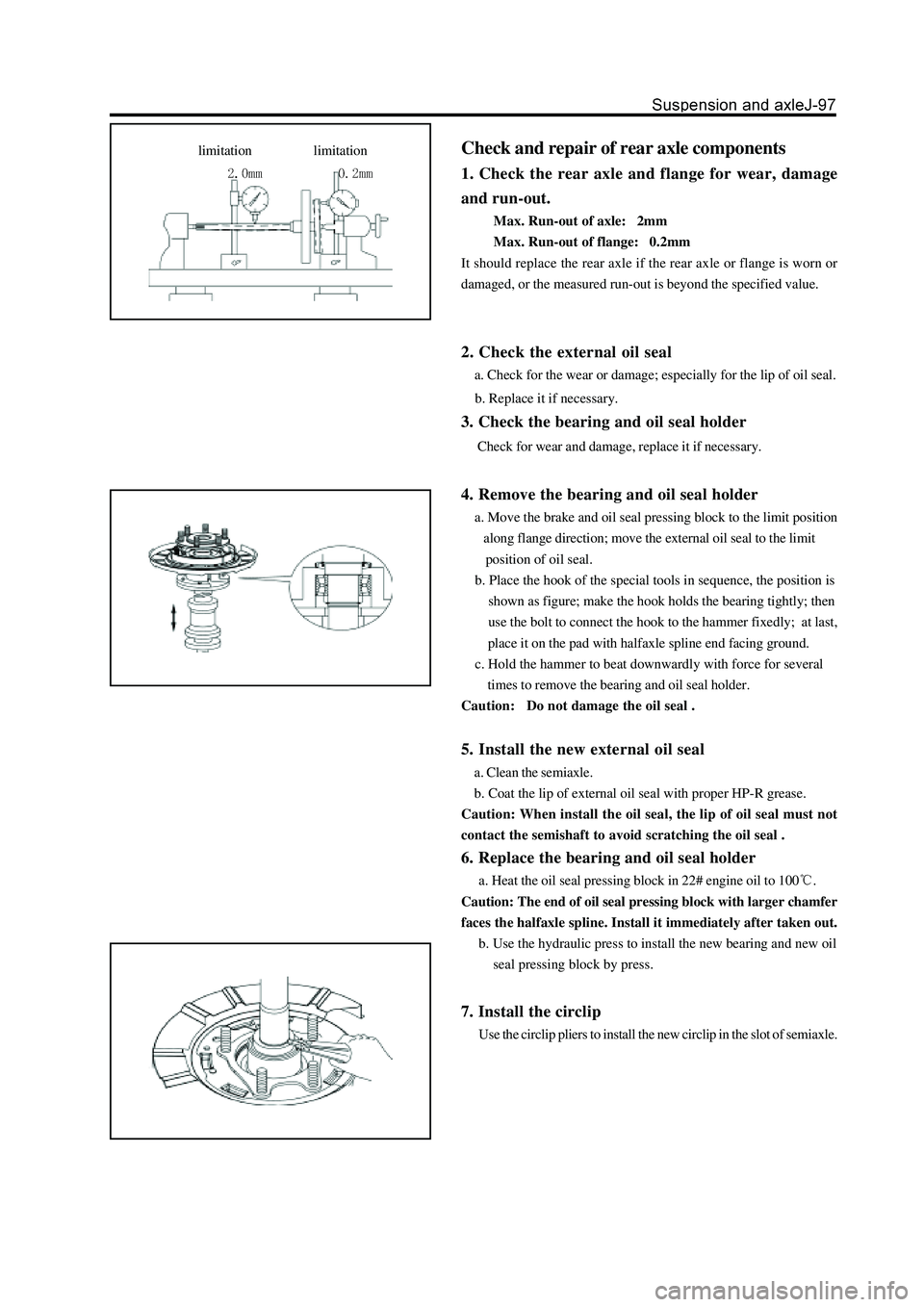
limitationlimitationCheck and repair of rear axle components
1. Check the rear axle and flange for wear, damage
and run-out.
Max. Run-out of axle: 2mm
Max. Run-out of flange: 0.2mm
It should replace the rear axle if the rear axle or flange is worn or
damaged, or the measured run-out is beyond the specified value.
2. Check the external oil seal
a. Check for the wear or damage; especially for the lip of oil seal.
b. Replace it if necessary.
3. Check the bearing and oil seal holder
Check for wear and damage, replace it if necessary.
4. Remove the bearing and oil seal holder
a. Move the brake and oil seal pressing block to the limit position
along flange direction; move the external oil seal to the limit
position of oil seal.
b. Place the hook of the special tools in sequence, the position is
shown as figure; make the hook holds the bearing tightly; then
use the bolt to connect the hook to the hammer fixedly; at last,
place it on the pad with halfaxle spline end facing ground.
c. Hold the hammer to beat downwardly with force for several
times to remove the bearing and oil seal holder.
Caution: Do not damage the oil seal .
5. Install the new external oil seal
a. Clean the semiaxle.
b. Coat the lip of external oil seal with proper HP-R grease.
Caution: When install the oil seal, the lip of oil seal must not
contact the semishaft to avoid scratching the oil seal .
6. Replace the bearing and oil seal holder
a. Heat the oil seal pressing block in 22# engine oil to 100.
Caution: The end of oil seal pressing block with larger chamfer
faces the halfaxle spline. Install it immediately after taken out.
b. Use the hydraulic press to install the new bearing and new oil
seal pressing block by press.
7. Install the circlip
Use the circlip pliers to install the new circlip in the slot of semiaxle.
Page 270 of 425
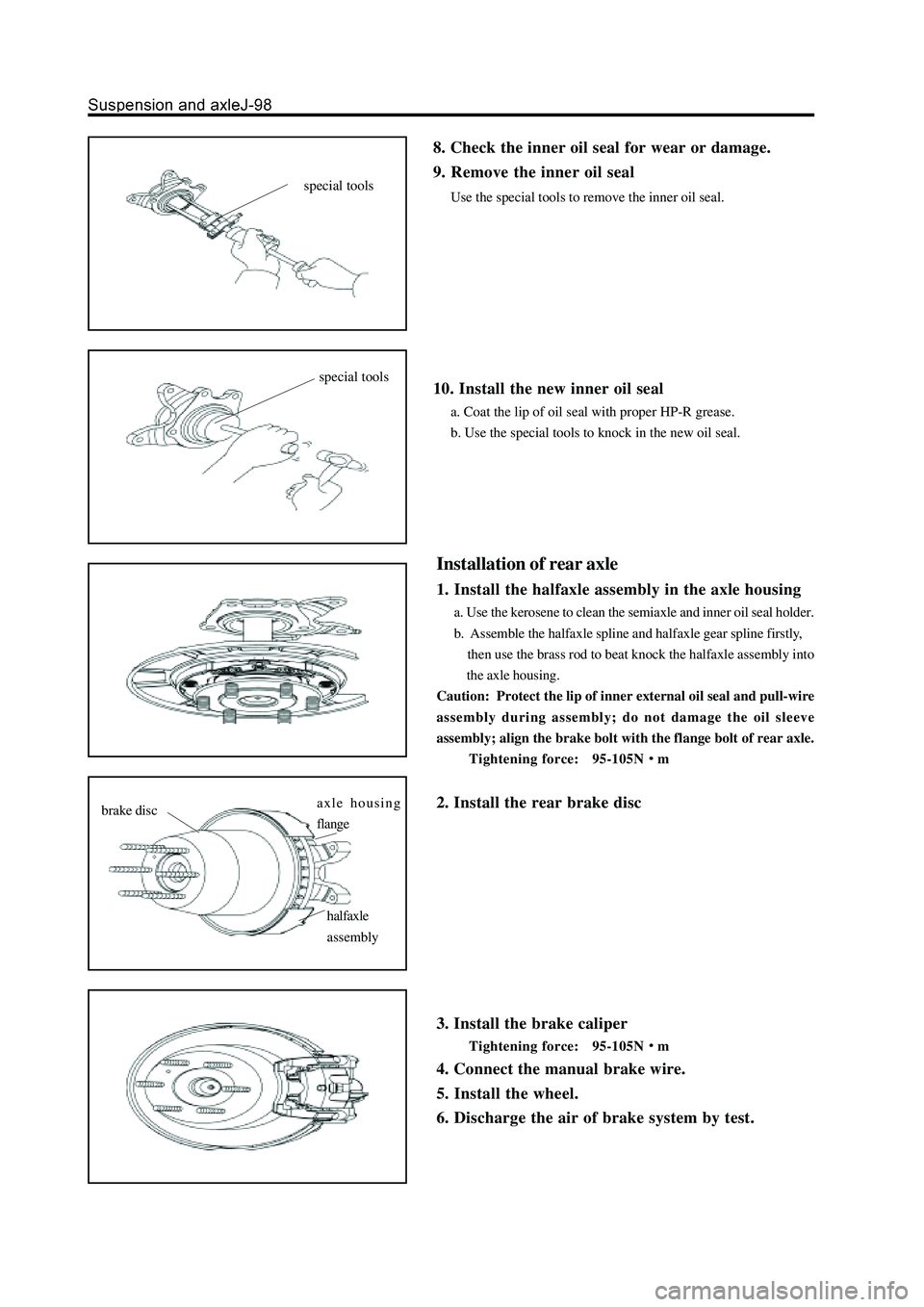
8. Check the inner oil seal for wear or damage.
9. Remove the inner oil seal
Use the special tools to remove the inner oil seal.
10. Install the new inner oil seal
a. Coat the lip of oil seal with proper HP-R grease.
b. Use the special tools to knock in the new oil seal.
Installation of rear axle
1. Install the halfaxle assembly in the axle housing
a. Use the kerosene to clean the semiaxle and inner oil seal holder.
b. Assemble the halfaxle spline and halfaxle gear spline firstly,
then use the brass rod to beat knock the halfaxle assembly into
the axle housing.
Caution: Protect the lip of inner external oil seal and pull-wire
assembly during assembly; do not damage the oil sleeve
assembly; align the brake bolt with the flange bolt of rear axle.
Tightening force: 95-105N
m
2. Install the rear brake disc
3. Install the brake caliper
Tightening force: 95-105Nm
4. Connect the manual brake wire.
5. Install the wheel.
6. Discharge the air of brake system by test.
special tools
special tools
brake discaxle housing
flange
halfaxle
assembly
Page 272 of 425
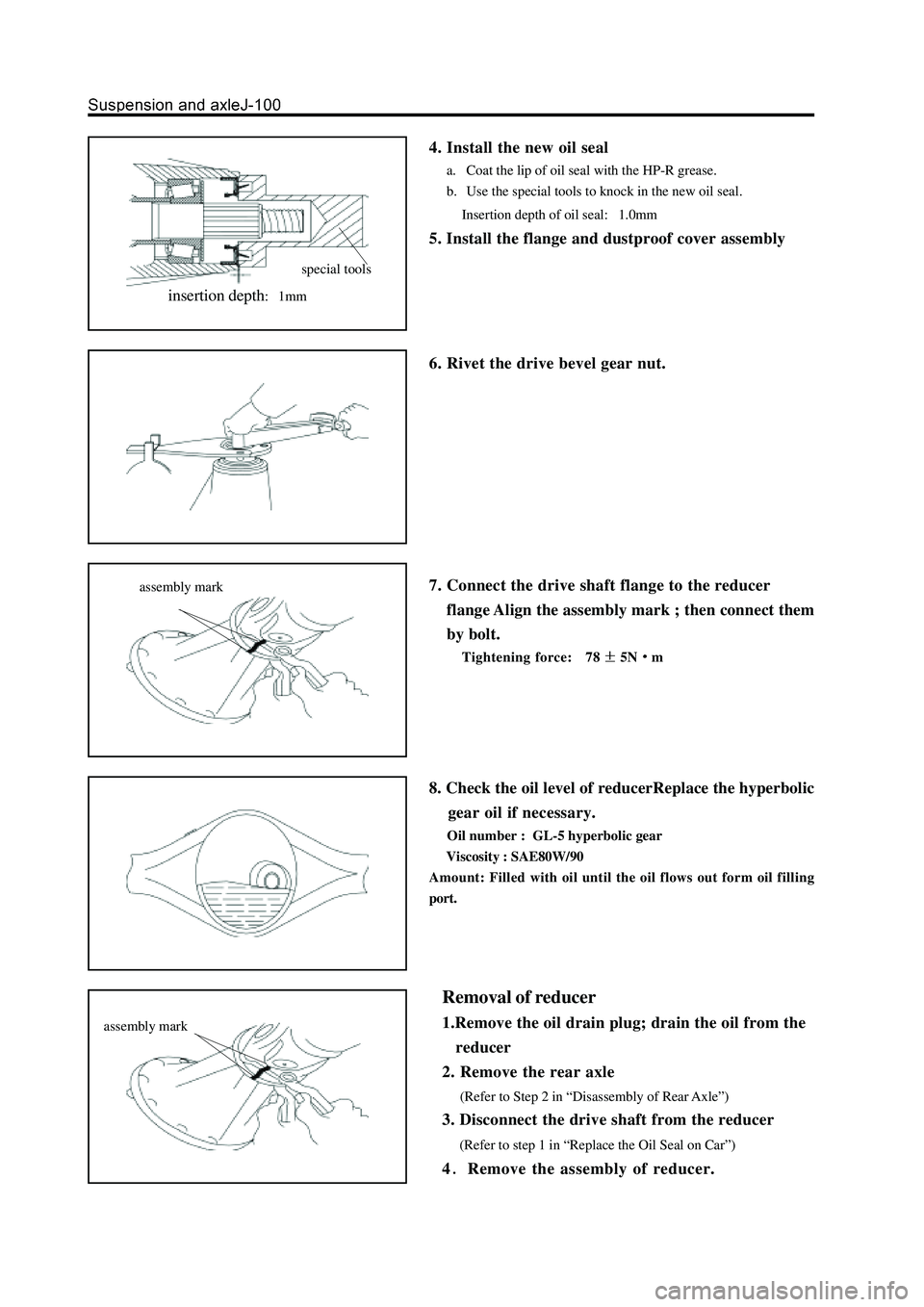
4. Install the new oil seal
a. Coat the lip of oil seal with the HP-R grease.
b. Use the special tools to knock in the new oil seal.
Insertion depth of oil seal: 1.0mm
5. Install the flange and dustproof cover assembly
6. Rivet the drive bevel gear nut.
7. Connect the drive shaft flange to the reducer
flange Align the assembly mark ; then connect them
by bolt.
Tightening force: 785Nm
8. Check the oil level of reducerReplace the hyperbolic
gear oil if necessary.
Oil number : GL-5 hyperbolic gear
Viscosity : SAE80W/90
Amount: Filled with oil until the oil flows out form oil filling
port.
Removal of reducer
1.Remove the oil drain plug; drain the oil from the
reducer
2. Remove the rear axle
(Refer to Step 2 in “Disassembly of Rear Axle”)
3. Disconnect the drive shaft from the reducer
(Refer to step 1 in “Replace the Oil Seal on Car”)
4Remove the assembly of reducer.
special tools
insertion depth: 1mm
assembly mark
assembly mark
Page 281 of 425
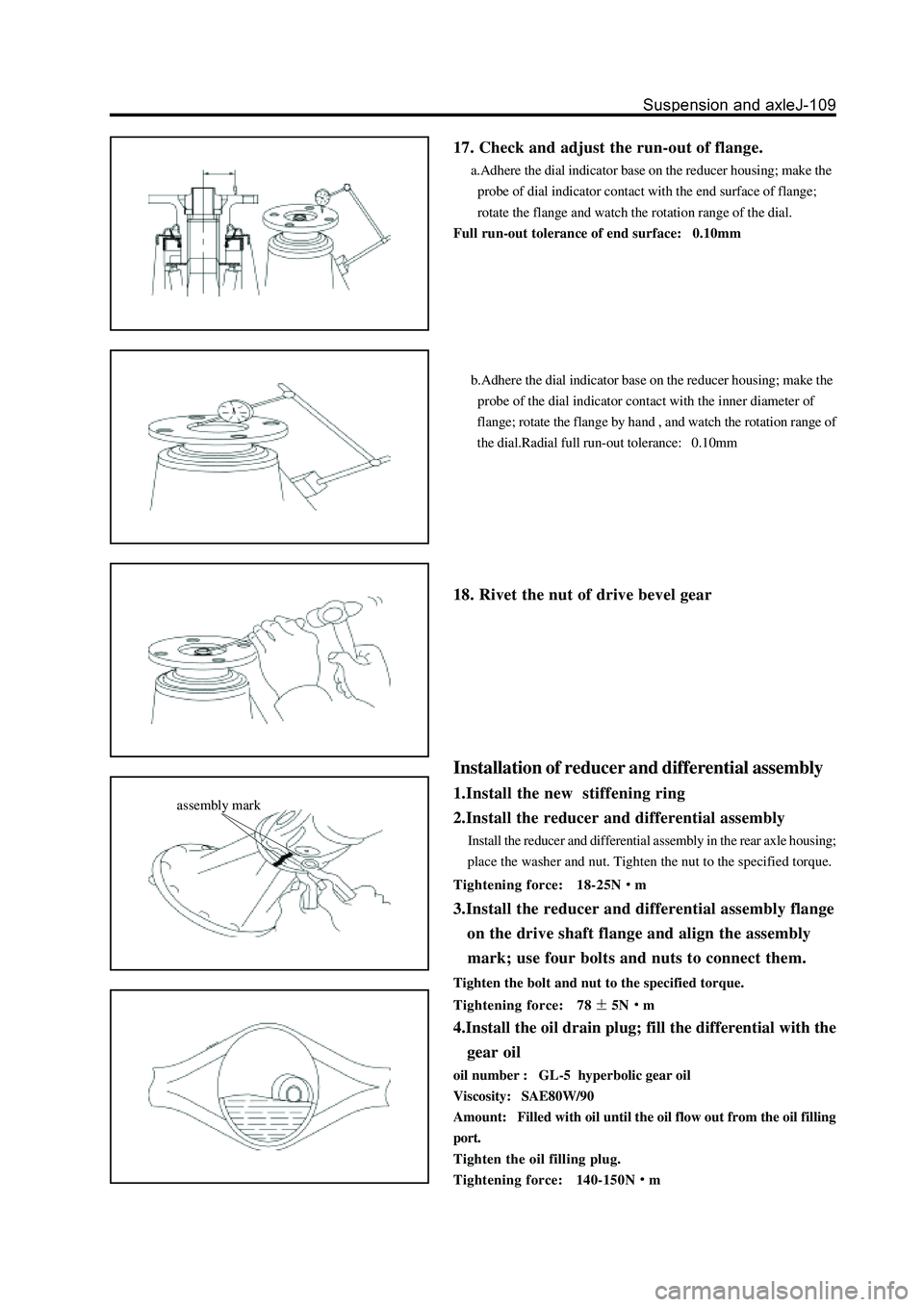
17. Check and adjust the run-out of flange.
a.Adhere the dial indicator base on the reducer housing; make the
probe of dial indicator contact with the end surface of flange;
rotate the flange and watch the rotation range of the dial.
Full run-out tolerance of end surface: 0.10mm
b.Adhere the dial indicator base on the reducer housing; make the
probe of the dial indicator contact with the inner diameter of
flange; rotate the flange by hand , and watch the rotation range of
the dial.Radial full run-out tolerance: 0.10mm
18. Rivet the nut of drive bevel gear
Installation of reducer and differential assembly
1.Install the new stiffening ring
2.Install the reducer and differential assembly
Install the reducer and differential assembly in the rear axle housing;
place the washer and nut. Tighten the nut to the specified torque.
Tightening force: 18-25N
m
3.Install the reducer and differential assembly flange
on the drive shaft flange and align the assembly
mark; use four bolts and nuts to connect them.
Tighten the bolt and nut to the specified torque.
Tightening force: 78
5Nm
4.Install the oil drain plug; fill the differential with the
gear oil
oil number : GL-5 hyperbolic gear oil
Viscosity: SAE80W/90
Amount: Filled with oil until the oil flow out from the oil filling
port.
Tighten the oil filling plug.
Tightening force: 140-150N
m
assembly mark
Page 289 of 425
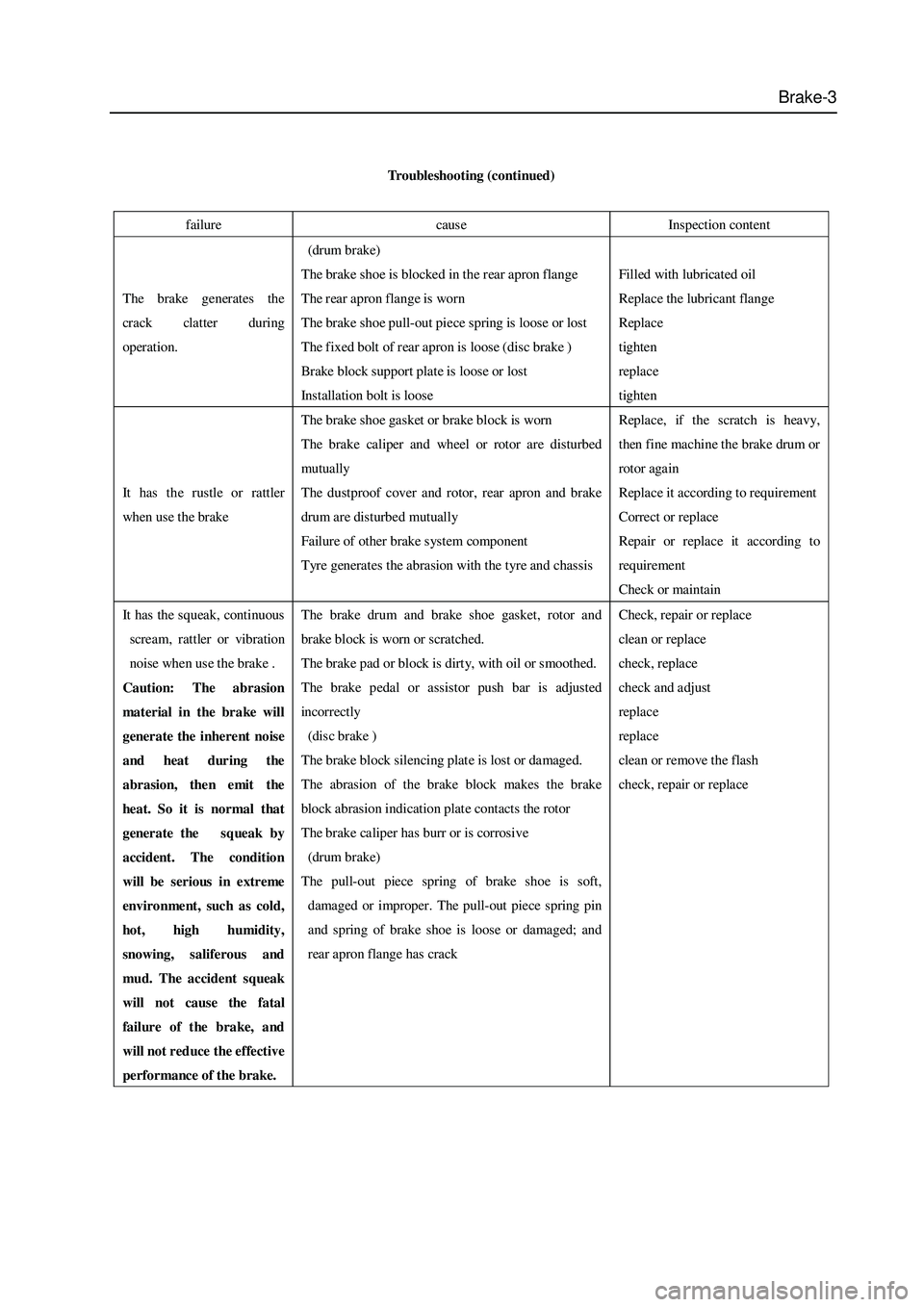
Brake-3
Troubleshooting (continued)
failure caus e Inspection content
The brake generates the
crack clatter during
operation. (drum brake)
The brake shoe is blocked in the rear apron flange
The rear apron flange is worn
The brake shoe pull-out piece spring is loose or lost
The fixed bolt of rear apron is loose (disc brake )
Brake block support plate is loose or lost
Installation bolt is loose
Filled with lubricated oil
Replace the lubricant flange
Replace
tighten
replace
tighten
It has the rustle or rattler
when use the brake The brake shoe gasket or brake block is worn
The brake caliper and wheel or rotor are disturbed
mutually
The dustproof cover and rotor, rear apron and brake
drum are disturbed mutually
Failure of other brake system component
Tyre generates the abrasion with the tyre and chassis Replace, if the scratch is heavy,
then fine machine the brake drum or
rotor again
Replace it according to requirement
Correct or replace
Repair or replace it according to
requirement
Check or maintain
It has the squeak, continuous
scream, rattler or vibration
noise when use the brake .
Caution: The abrasion
material in the brake will
generate the inherent noise
and heat during the
abrasion, then emit the
heat. So it is normal that
generate the squeak by
accident. The condition
will be serious in extreme
environment, such as cold,
hot, high humidity,
snowing, saliferous and
mud. The accident squeak
will not cause the fatal
failure of the brake, and
will not reduce the effective
performance of the brake. The brake drum and brake shoe gasket, rotor and
brake block is worn or scratched.
The brake pad or block is dirty, with oil or smoothed.
The brake pedal or assistor push bar is adjusted
incorrectly
(dis c brake )
The brake block silencing plate is lost or damaged.
The abrasion of the brake block makes the brake
block abrasion indication plate contacts the rotor
The brake ca lip er has burr or is corrosive
(drum brake)
The pull-out piece spring of brake shoe is soft,
damaged or improper. The pull-out piece spring pin
and spring of brake shoe is loose or damaged; and
rear apron flange has crack Check, repair or replace
clean or replace
check, replace
check and adjust
replace
replace
clean or remove the flash
check, repair or replace
Page 290 of 425
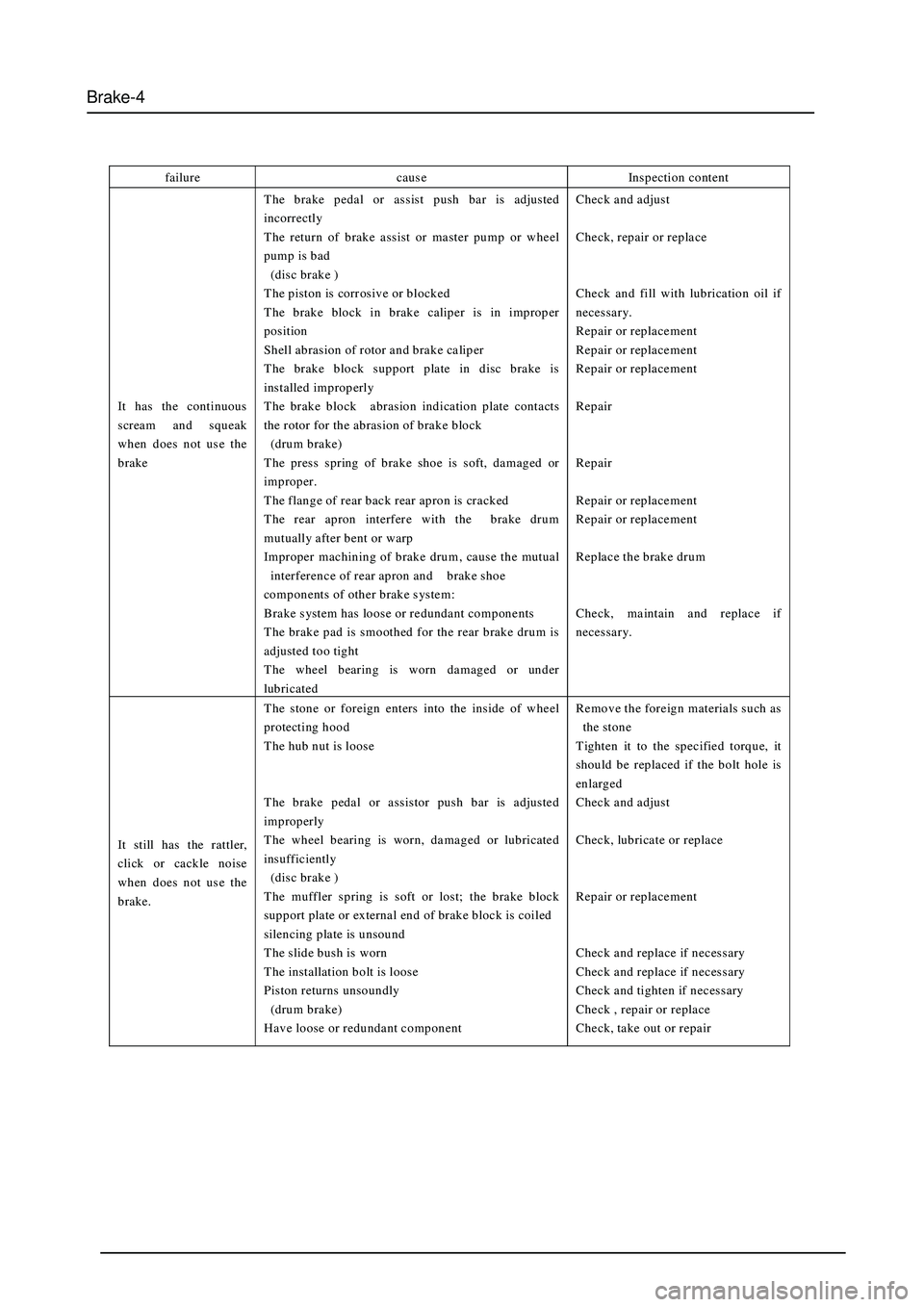
Brake-4
failure caus e Inspection content
It has the continuous
scream and squeak
when does not us e the
brake The brake pedal or assist push bar is adjusted
incorrectly
The return of brake assist or master pump or wheel
pump is bad
(dis c brake )
T he piston is corr osive or blocked
T he brake block in brake calip er is in improp er
position
Shell abrasion of rotor and brake caliper
The brake block support plate in disc brake is
installed improperly
The brake block abrasion indication plate contacts
the rotor for the abrasion of brake block
(drum brake)
The press spring of brake shoe is soft, damaged or
improper.
The flange of rear back rear apron is cracked
T he rear apron interfer e with the brake drum
mutually after bent or warp
Improper machining of brake drum , caus e the mutual
interference of rear apron and brake shoe
components of other brake s ystem :
Brake system has loose or redundant components
T he brake pad is smoothed for the rear brake drum is
adjusted too tight
The wheel bearing is worn damaged or under
lubricated Check and adjust
Check, repair or replace
Check and fill with lubrication oil if
necessary.
Repair or replacement
Repair or replacement
Repair or replacement
Repair
Repair
Repair or replacement
Repair or replacement
Replace the brake drum
Check, maintain and replace if
necessary.
It still has the rattler,
click or cackle noise
when does not us e the
brake. The stone or foreign enters into the inside of wheel
protecting hood
The hub nut is loose
The brake pedal or assistor push bar is adjusted
improperly
The wheel bearing is worn, damaged or lubricated
insufficiently
(dis c brake )
T he muffler spring is soft or lost; the brake block
support plate or external end of brake block is coiled
silencing plate is unsound
T he slide bush is worn
T he installation bolt is loos e
Piston returns unsoundly
(drum brake)
Have loose or redundant component Remove the foreign materials such as
the stone
Tighten it to the specified torque, it
should be replaced if the bolt hole is
enlarged
Check and adjust
Check, lubricate or replace
Repair or replacement
Check and replace if necessary
Check and replace if necessary
Check and tighten if necessary
Check , repair or replace
Check, take out or repair
Page 295 of 425
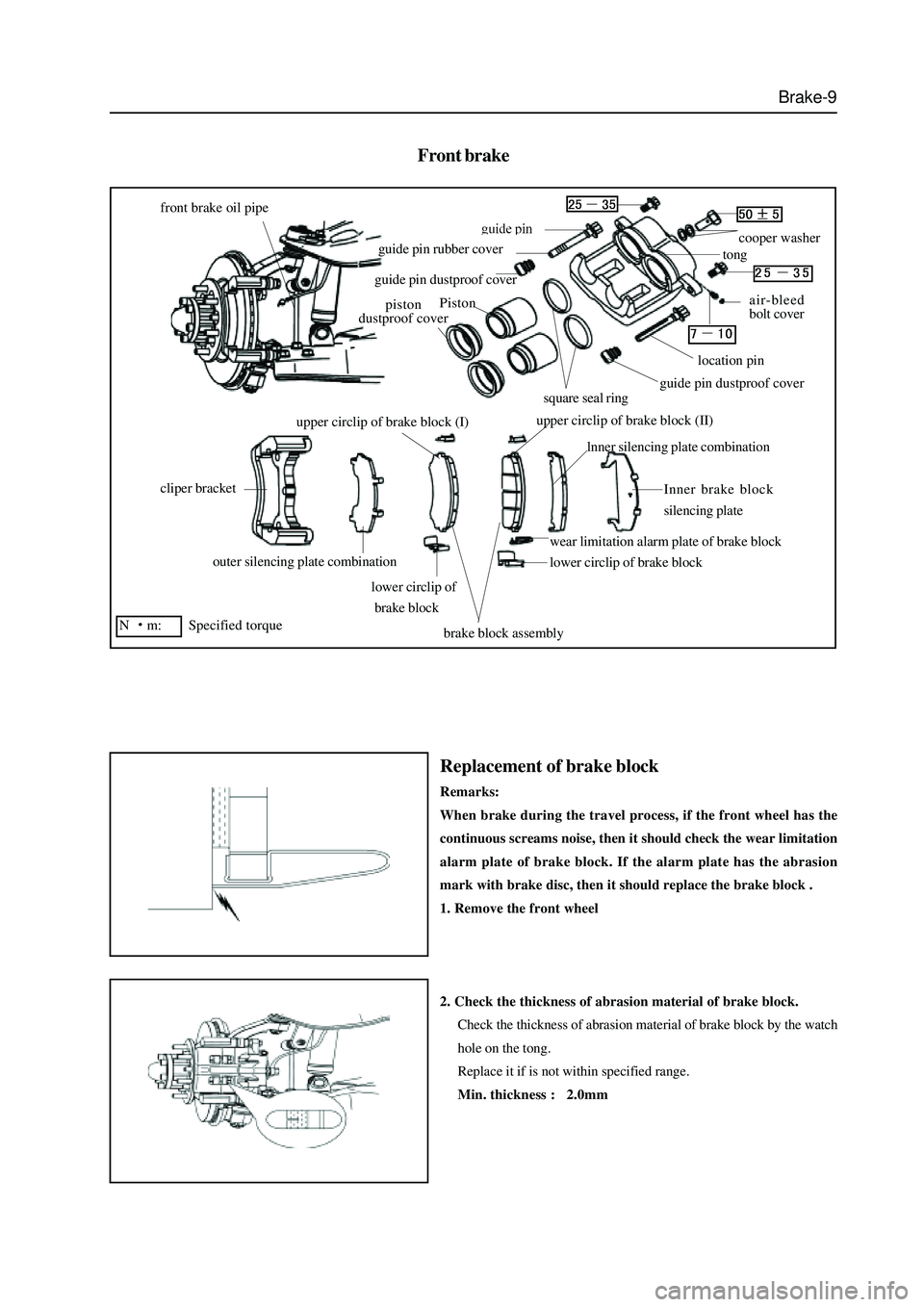
Brake-9
Front brake
front brake oil pipe
cliper bracket
outer silencing plate combination
lower circlip of
brake block
brake block assembly
lower circlip of brake block
wear limitation alarm plate of brake block
lnner silencing plate combination
Inner brake block
silencing plate
upper circlip of brake block (I)upper circlip of brake block (II)
piston
dustproof cover
guide pin dustproof cover
guide pin rubber covercooper washer
tong
air-bleed
bolt cover
location pin
guide pin dustproof coversquare seal ring
N
m: Specified torque
Piston
Replacement of brake block
Remarks:
When brake during the travel process, if the front wheel has the
continuous screams noise, then it should check the wear limitation
alarm plate of brake block. If the alarm plate has the abrasion
mark with brake disc, then it should replace the brake block .
1. Remove the front wheel
2. Check the thickness of abrasion material of brake block.
Check the thickness of abrasion material of brake block by the watch
hole on the tong.
Replace it if is not within specified range.
Min. thickness : 2.0mm
Page 301 of 425
Brake-15
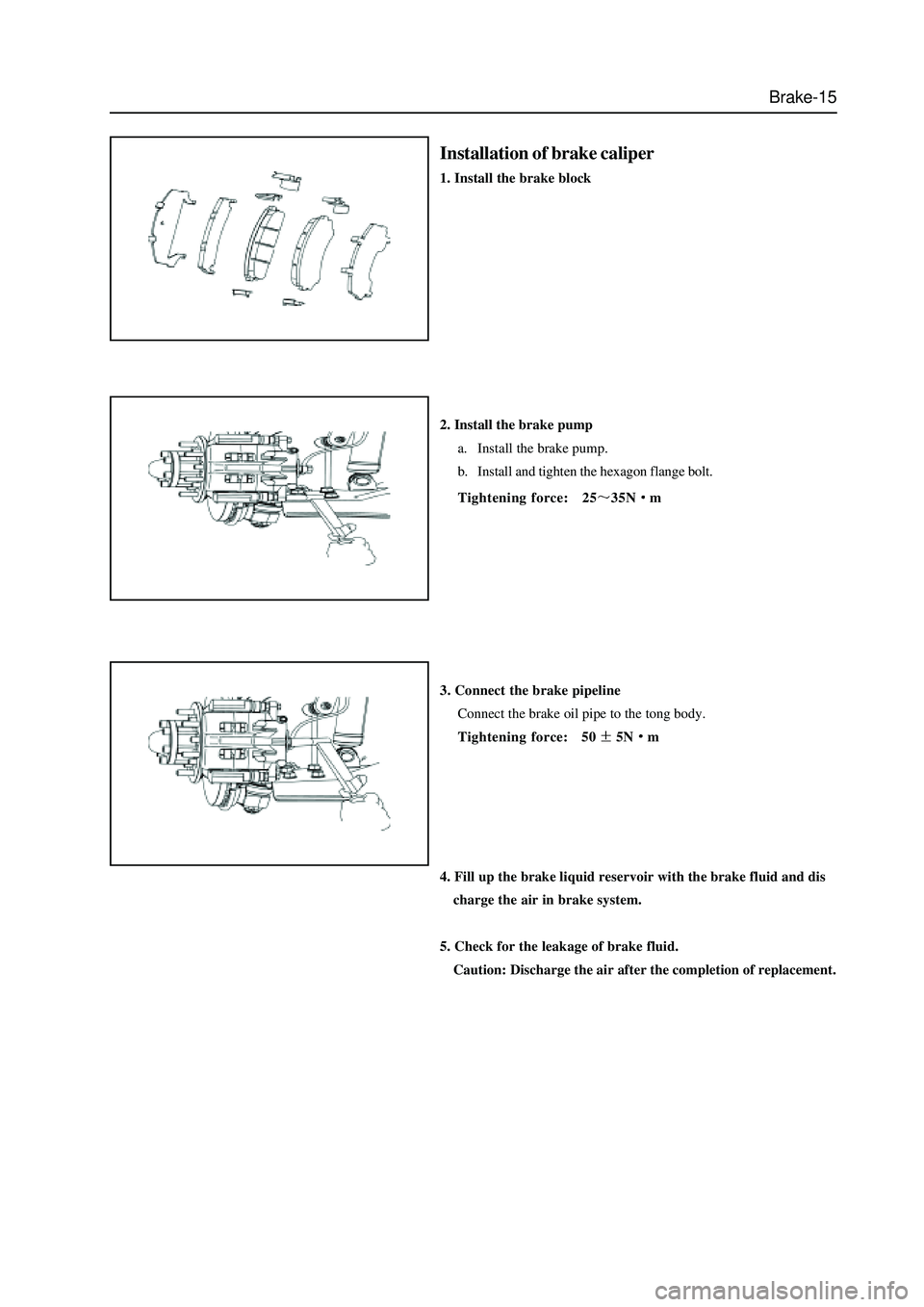
Installation of brake caliper
1. Install the brake block
2. Install the brake pump
a. Install the brake pump.
b. Install and tighten the hexagon flange bolt.
Tightening force: 25
35Nm
3. Connect the brake pipeline
Connect the brake oil pipe to the tong body.
Tightening force: 50
5Nm
4. Fill up the brake liquid reservoir with the brake fluid and dis
charge the air in brake system.
5. Check for the leakage of brake fluid.
Caution: Discharge the air after the completion of replacement.