check oil GREAT WALL HOVER 2006 Service Owner's Manual
[x] Cancel search | Manufacturer: GREAT WALL, Model Year: 2006, Model line: HOVER, Model: GREAT WALL HOVER 2006Pages: 425, PDF Size: 26.05 MB
Page 152 of 425
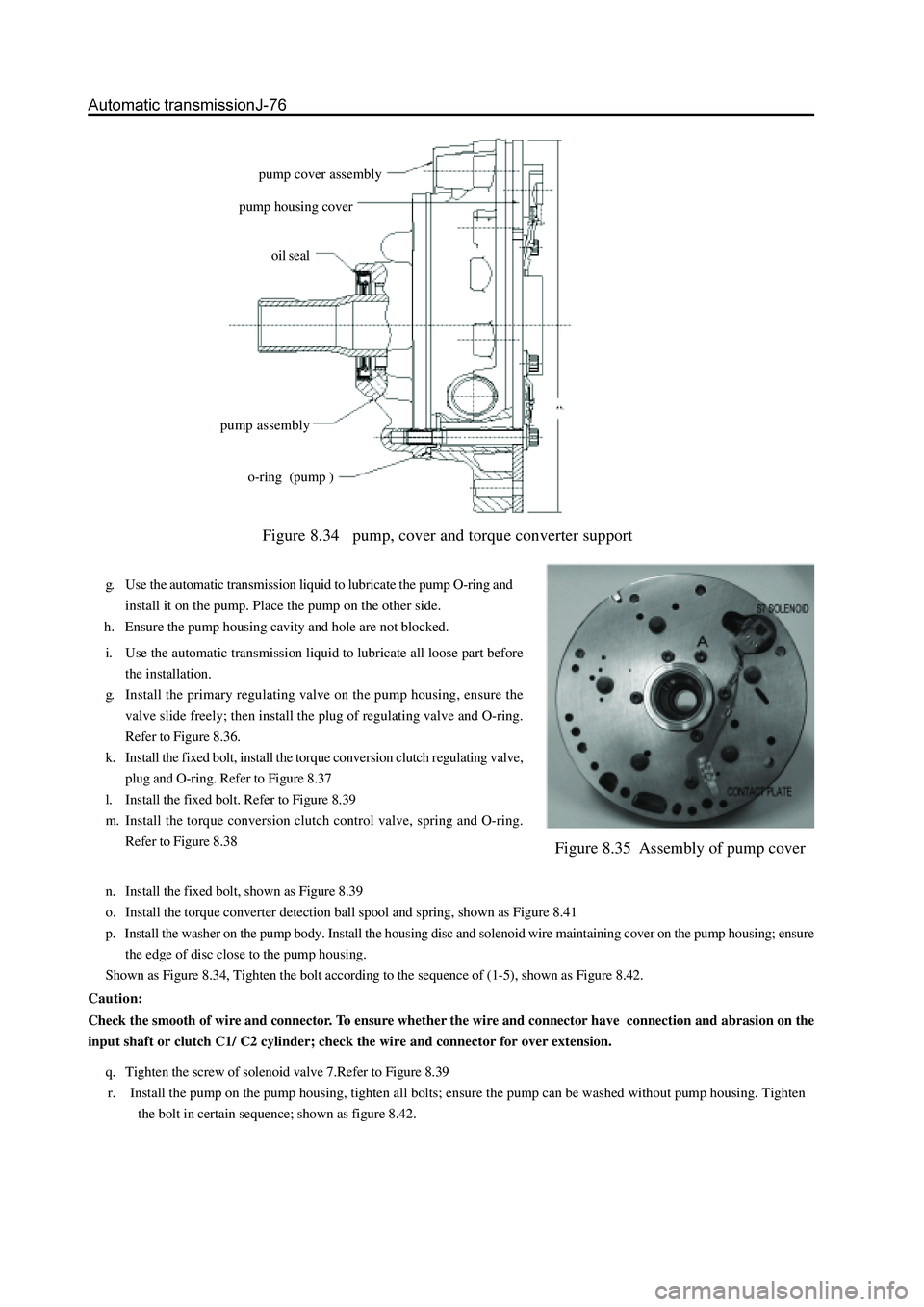
Figure 8.34 pump, cover and torque converter support
g. Use the automatic transmission liquid to lubricate the pump O-ring and
install it on the pump. Place the pump on the other side.
h. Ensure the pump housing cavity and hole are not blocked.
Figure 8.35 Assembly of pump cover
i. Use the automatic transmission liquid to lubricate all loose part before
the installation.
g. Install the primary regulating valve on the pump housing, ensure the
valve slide freely; then install the plug of regulating valve and O-ring.
Refer to Figure 8.36.
k. Install the fixed bolt, install the torque conversion clutch regulating valve,
plug and O-ring. Refer to Figure 8.37
l. Install the fixed bolt. Refer to Figure 8.39
m. Install the torque conversion clutch control valve, spring and O-ring.
Refer to Figure 8.38pump cover assembly
pump housing cover
oil seal
pump assembly
o-ring (pump )
n. Install the fixed bolt, shown as Figure 8.39
o. Install the torque converter detection ball spool and spring, shown as Figure 8.41
p. Install the washer on the pump body. Install the housing disc and solenoid wire maintaining cover on the pump housing; ensure
the edge of disc close to the pump housing.
Shown as Figure 8.34, Tighten the bolt according to the sequence of (1-5), shown as Figure 8.42.
Caution:
Check the smooth of wire and connector. To ensure whether the wire and connector have connection and abrasion on the
input shaft or clutch C1/ C2 cylinder; check the wire and connector for over extension.
q. Tighten the screw of solenoid valve 7.Refer to Figure 8.39
r. Install the pump on the pump housing, tighten all bolts; ensure the pump can be washed without pump housing. Tighten
the bolt in certain sequence; shown as figure 8.42.
Page 156 of 425
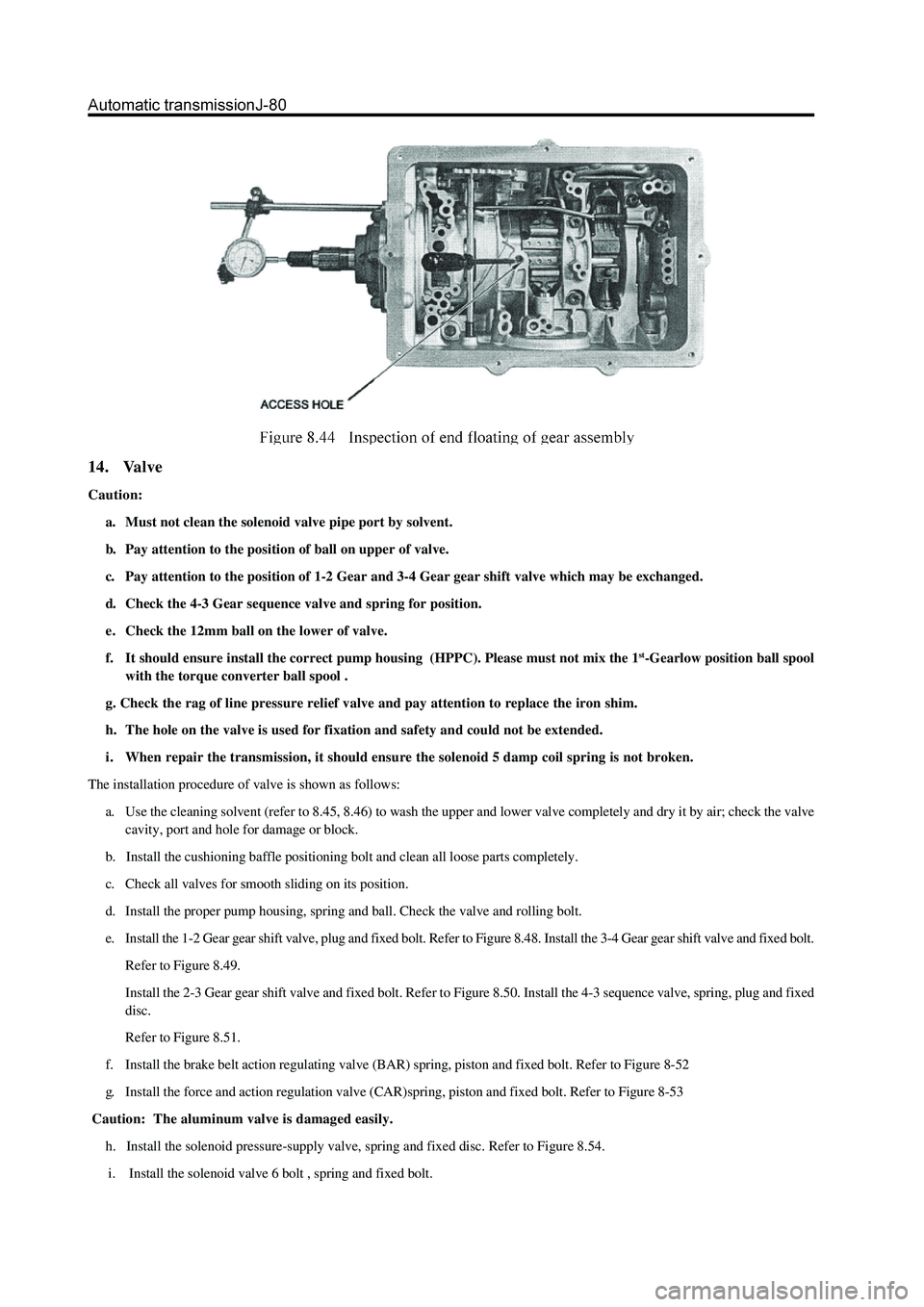
14. Valve
Caution:
a. Must not clean the solenoid valve pipe port by solvent.
b. Pay attention to the position of ball on upper of valve.
c. Pay attention to the position of 1-2 Gear and 3-4 Gear gear shift valve which may be exchanged.
d. Check the 4-3 Gear sequence valve and spring for position.
e. Check the 12mm ball on the lower of valve.
f. It should ensure install the correct pump housing (HPPC). Please must not mix the 1
st-Gearlow position ball spool
with the torque converter ball spool .
g. Check the rag of line pressure relief valve and pay attention to replace the iron shim.
h. The hole on the valve is used for fixation and safety and could not be extended.
i . When repair the transmission, it should ensure the solenoid 5 damp coil spring is not broken.
The installation procedure of valve is shown as follows:
a. Use the cleaning solvent (refer to 8.45, 8.46) to wash the upper and lower valve completely and dry it by air; check the valve
cavity, port and hole for damage or block.
b. Install the cushioning baffle positioning bolt and clean all loose parts completely.
c. Check all valves for smooth sliding on its position.
d. Install the proper pump housing, spring and ball. Check the valve and rolling bolt.
e. Install the 1-2 Gear gear shift valve, plug and fixed bolt. Refer to Figure 8.48. Install the 3-4 Gear gear shift valve and fixed bolt.
Refer to Figure 8.49.
Install the 2-3 Gear gear shift valve and fixed bolt. Refer to Figure 8.50. Install the 4-3 sequence valve, spring, plug and fixed
disc.
Refer to Figure 8.51.
f. Install the brake belt action regulating valve (BAR) spring, piston and fixed bolt. Refer to Figure 8-52
g. Install the force and action regulation valve (CAR)spring, piston and fixed bolt. Refer to Figure 8-53
Caution: The aluminum valve is damaged easily.
h. Install the solenoid pressure-supply valve, spring and fixed disc. Refer to Figure 8.54.
i. Install the solenoid valve 6 bolt , spring and fixed bolt.
Page 162 of 425
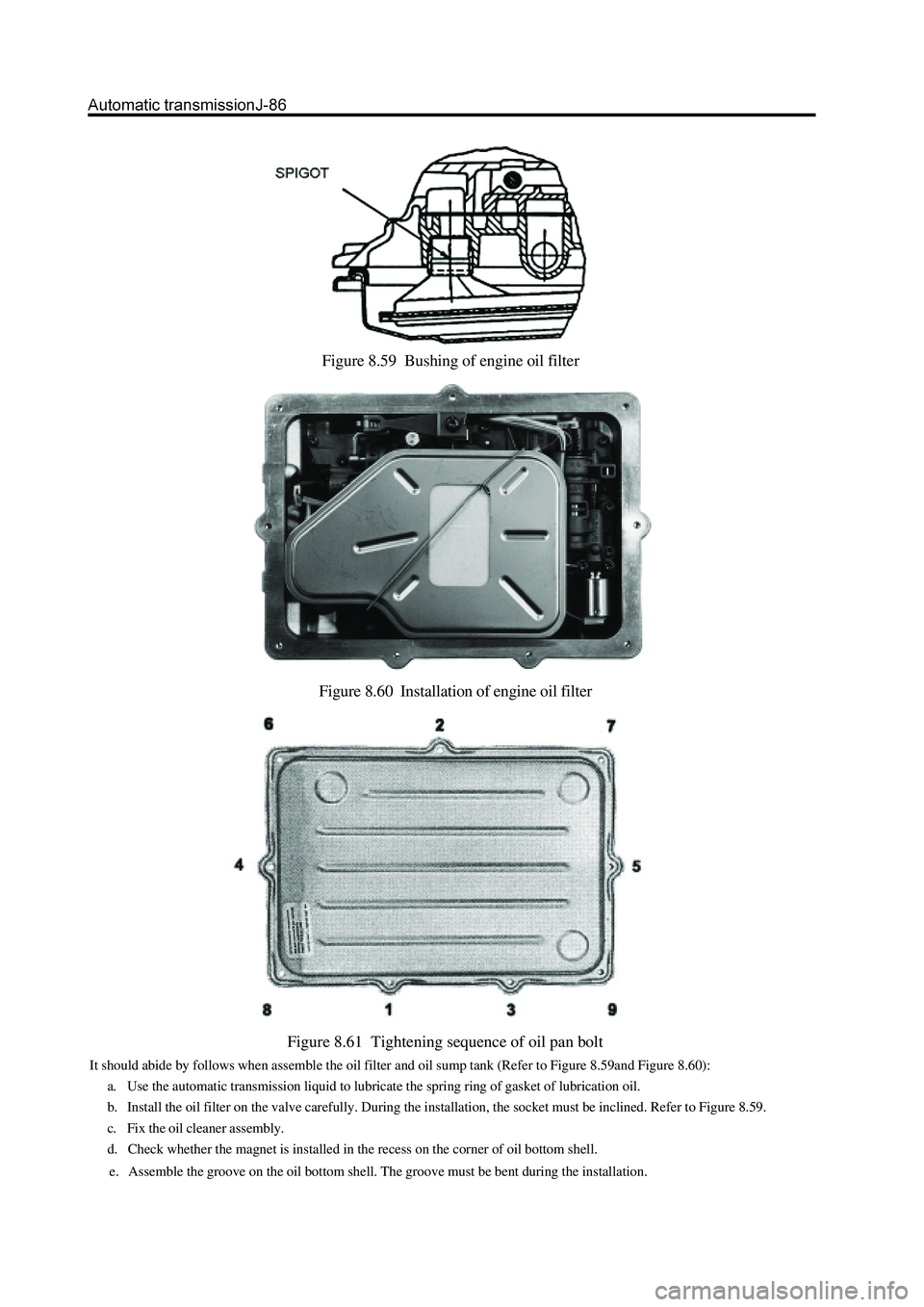
Figure 8.59 Bushing of engine oil filter
Figure 8.60 Installation of engine oil filter
Figure 8.61 Tightening sequence of oil pan bolt
It should abide by follows when assemble the oil filter and oil sump tank (Refer to Figure 8.59and Figure 8.60):
a. Use the automatic transmission liquid to lubricate the spring ring of gasket of lubrication oil.
b. Install the oil filter on the valve carefully. During the installation, the socket must be inclined. Refer to Figure 8.59.
c. Fix the oil cleaner assembly.
d. Check whether the magnet is installed in the recess on the corner of oil bottom shell.
e. Assemble the groove on the oil bottom shell. The groove must be bent during the installation.
Page 174 of 425
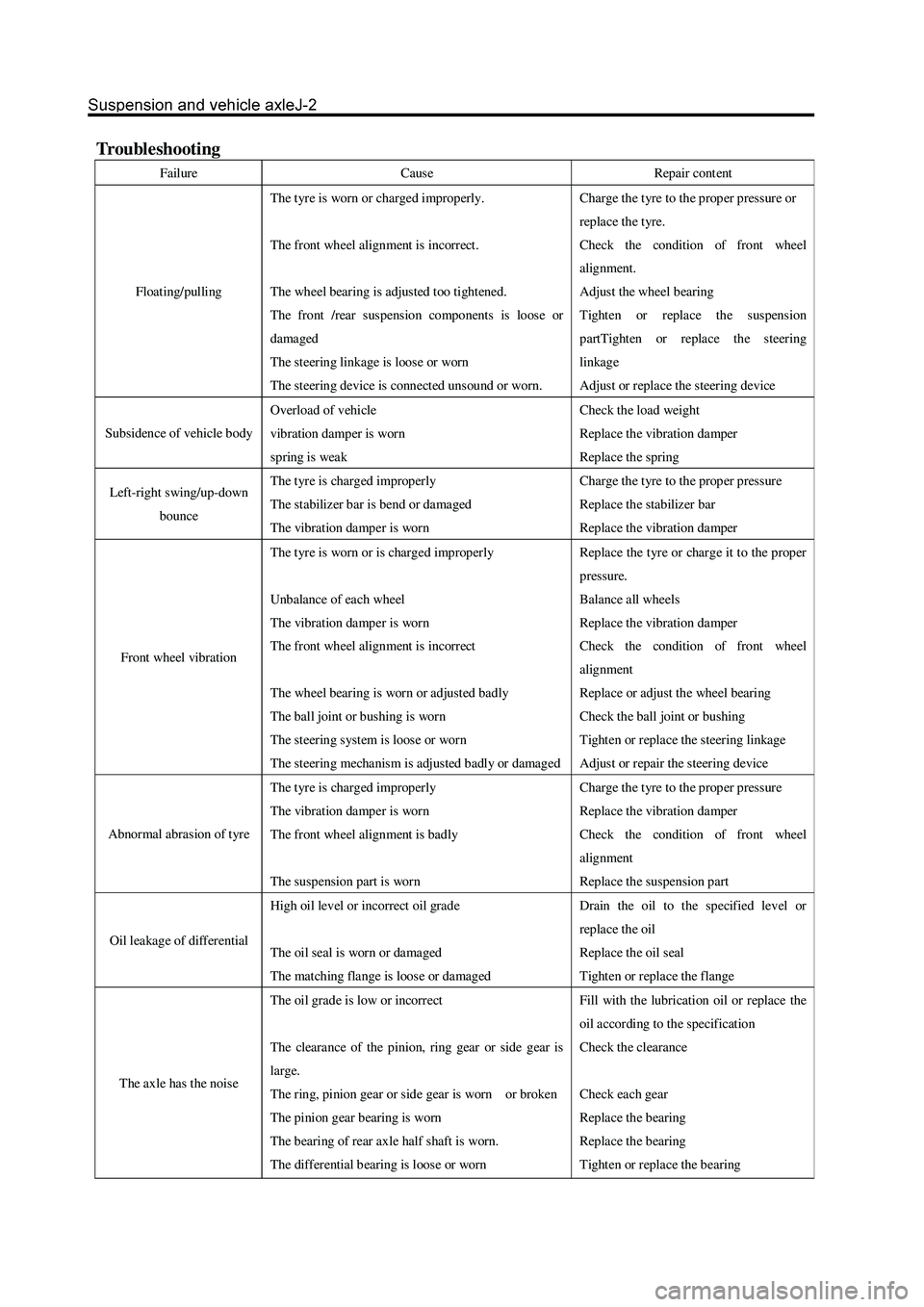
Troubleshooting
Failure Cause Repair cont ent
Floating/pulling The t yre is worn or charged improperly.
The front wheel alignment is incorrect.
The wheel bearing is adjusted too tightened.
The front /rear suspension components is loose or
damaged
The steering linkage is loose or worn
The steering device is connect ed unsound or worn. Charge the t yre to the prop er pressur e or
repla ce the t yre.
Check the condition of front wheel
alignment.
Adjust the wheel bearing
Tighten or replace the suspension
partTighten or replace the steering
linkage
Adjust or replace the steering device
Subsidence of vehicle body Overload of vehicle
vibration damper is worn
spring is weak Check the load weight
Replace the vibration damper
Replace the spring
Left-right swing/up-down
bounce The t yre is charged improperly
The stabilizer bar is bend or damaged
The vibration damper is worn Charge the t yre to the prop er pressur e
Replace the stabilizer bar
Replace the vibration damper
Front wheel vibration The t yre is worn or is charged improperly
Unbalance of each wheel
The vibration damper is worn
The front wheel alignment is incorrect
The wheel bearing is worn or adjusted badly
The ball joint or bushing is worn
The steering system is loose or worn
The steering mechanism is adjusted badly or damaged Repla ce the t yr e or char ge it to the prop er
pressure.
Balance all wheels
Replace the vibration damper
Check the condition of front wheel
alignment
Replace or adjust the wheel bearing
Check the ball joint or bushing
Tighten or replace the steering linkage
Adjust or repair the steering device
Abnormal abrasion of tyre The t yre is charged improperly
The vibration damper is worn
The front wheel alignment is badly
The suspension part is worn Charge the t yre to the prop er pressur e
Replace the vibration damper
Check the condition of front wheel
alignment
Replace the suspension part
Oil leakage of differential High oil level or incorrect oil grade
The oil seal is worn or damaged
The matching flange is loose or damaged Drain the oil to the specified level or
repla ce the oil
Replace the oil seal
Tighten or replace the flange
The axle has the nois e The oil grade is low or incorrect
The clearance of the pinion, ring gear or side gear is
large.
The ring, pinion gear or side gear is worn or broken
The pinion gear bearing is worn
The b earing of rear axle half shaft is worn.
The differential b earing is loos e or worn Fill with the lubrication oil or replace the
oil according to the specification
Check the clearance
Check each gear
Replace the bearing
Replace the bearing
Tighten or replace the bearing
Page 181 of 425
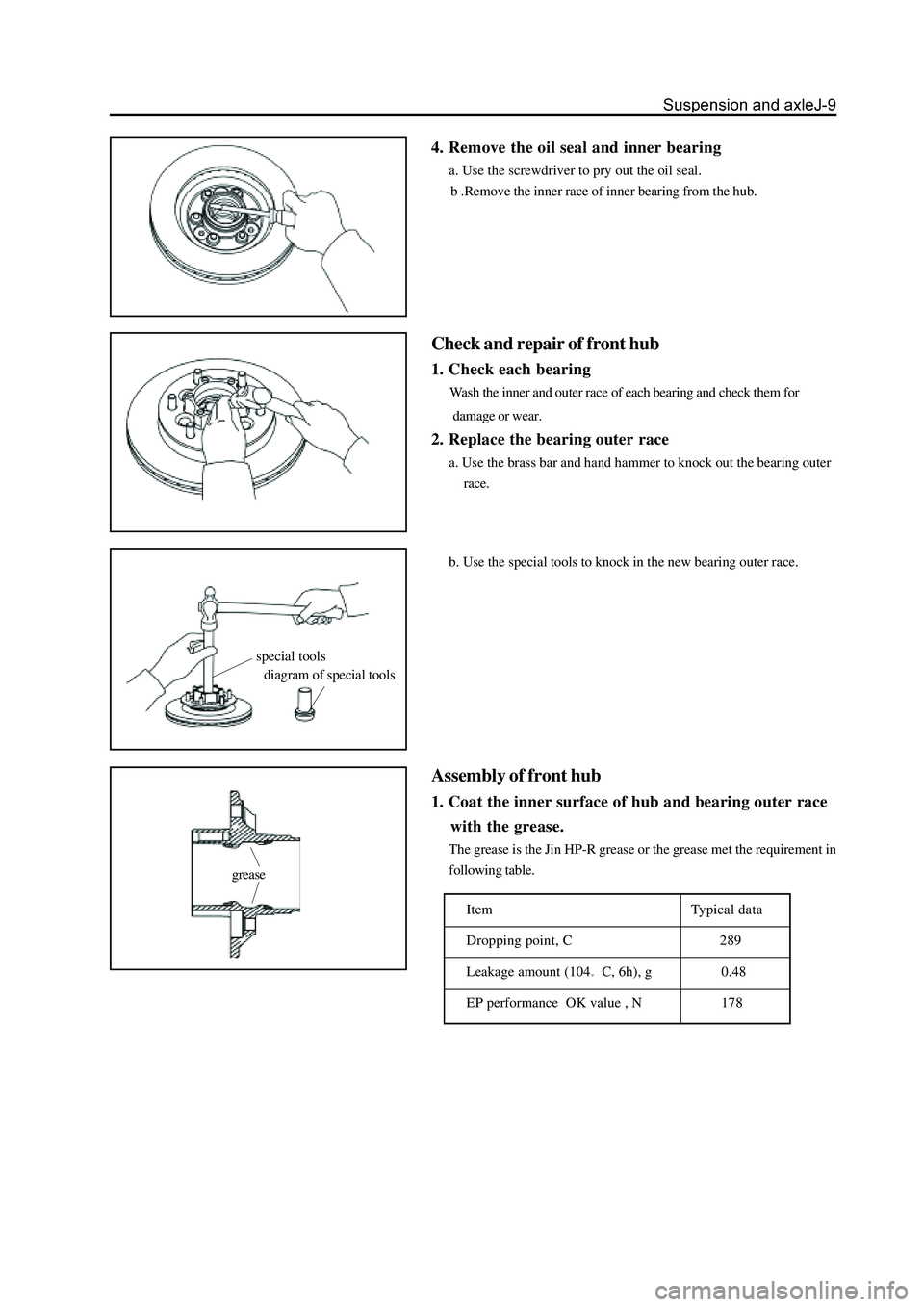
special tools
diagram of special tools
grease
4. Remove the oil seal and inner bearing
a. Use the screwdriver to pry out the oil seal.
b .Remove the inner race of inner bearing from the hub.
Check and repair of front hub
1. Check each bearing
Wash the inner and outer race of each bearing and check them for
damage or wear.
2. Replace the bearing outer race
a. Use the brass bar and hand hammer to knock out the bearing outer
race.
b. Use the special tools to knock in the new bearing outer race.
Assembly of front hub
1. Coat the inner surface of hub and bearing outer race
with the grease.
The grease is the Jin HP-R grease or the grease met the requirement in
following table.
Item Typical data
Dropping point, C
289
Leakage amount (104
C, 6h), g 0.48
EP performance OK value , N
178
Page 182 of 425
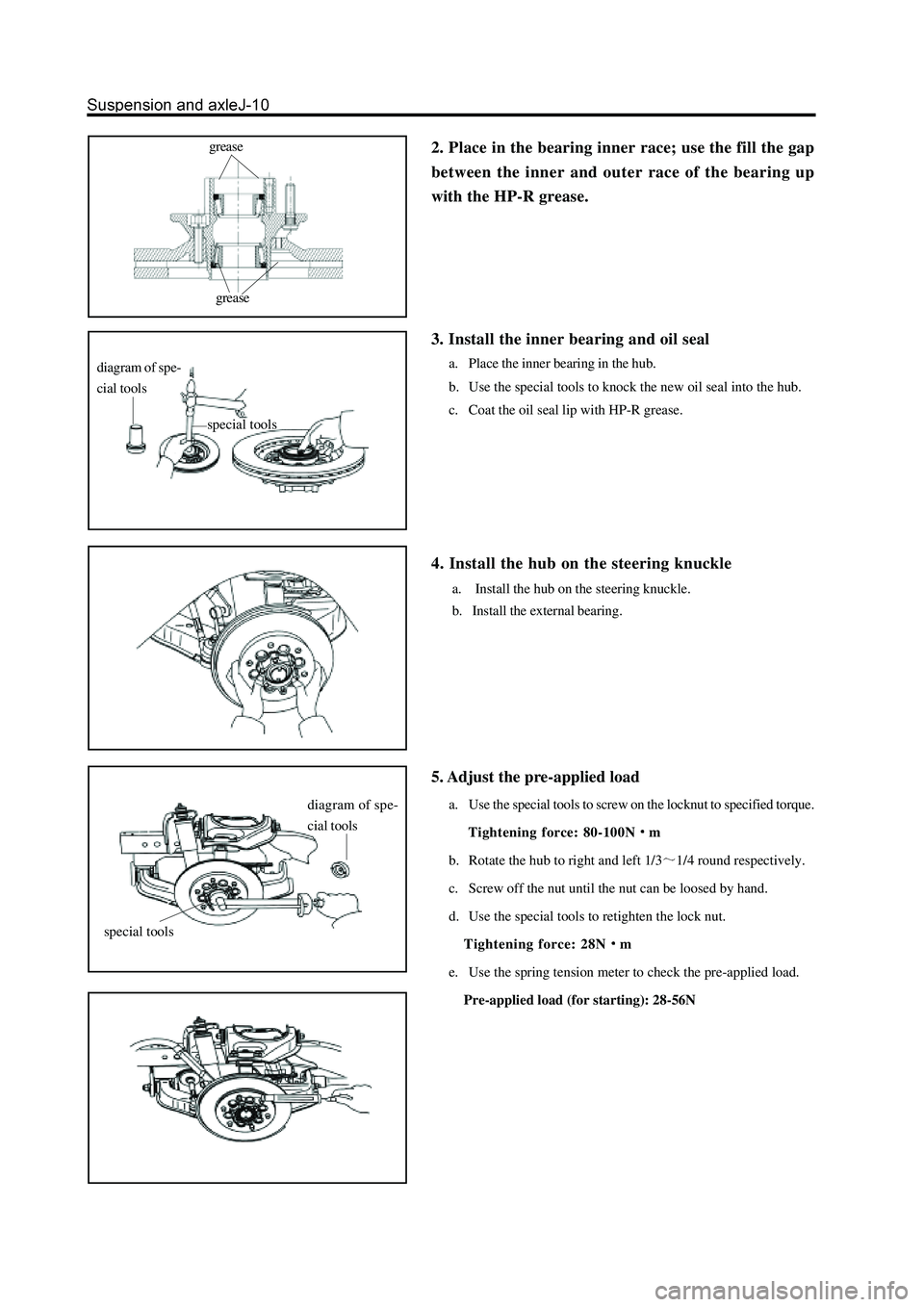
2. Place in the bearing inner race; use the fill the gap
between the inner and outer race of the bearing up
with the HP-R grease.grease
grease
3. Install the inner bearing and oil seal
a. Place the inner bearing in the hub.
b. Use the special tools to knock the new oil seal into the hub.
c. Coat the oil seal lip with HP-R grease.
4. Install the hub on the steering knuckle
a. Install the hub on the steering knuckle.
b. Install the external bearing.
diagram of spe-
cial tools
special tools
5. Adjust the pre-applied load
a. Use the special tools to screw on the locknut to specified torque.
Tightening force: 80-100N
m
b. Rotate the hub to right and left 1/3
1/4 round respectively.
c. Screw off the nut until the nut can be loosed by hand.
d. Use the special tools to retighten the lock nut.
Tightening force: 28N
m
e. Use the spring tension meter to check the pre-applied load.
Pre-applied load (for starting): 28-56N
diagram of spe-
cial tools
special tools
Page 203 of 425
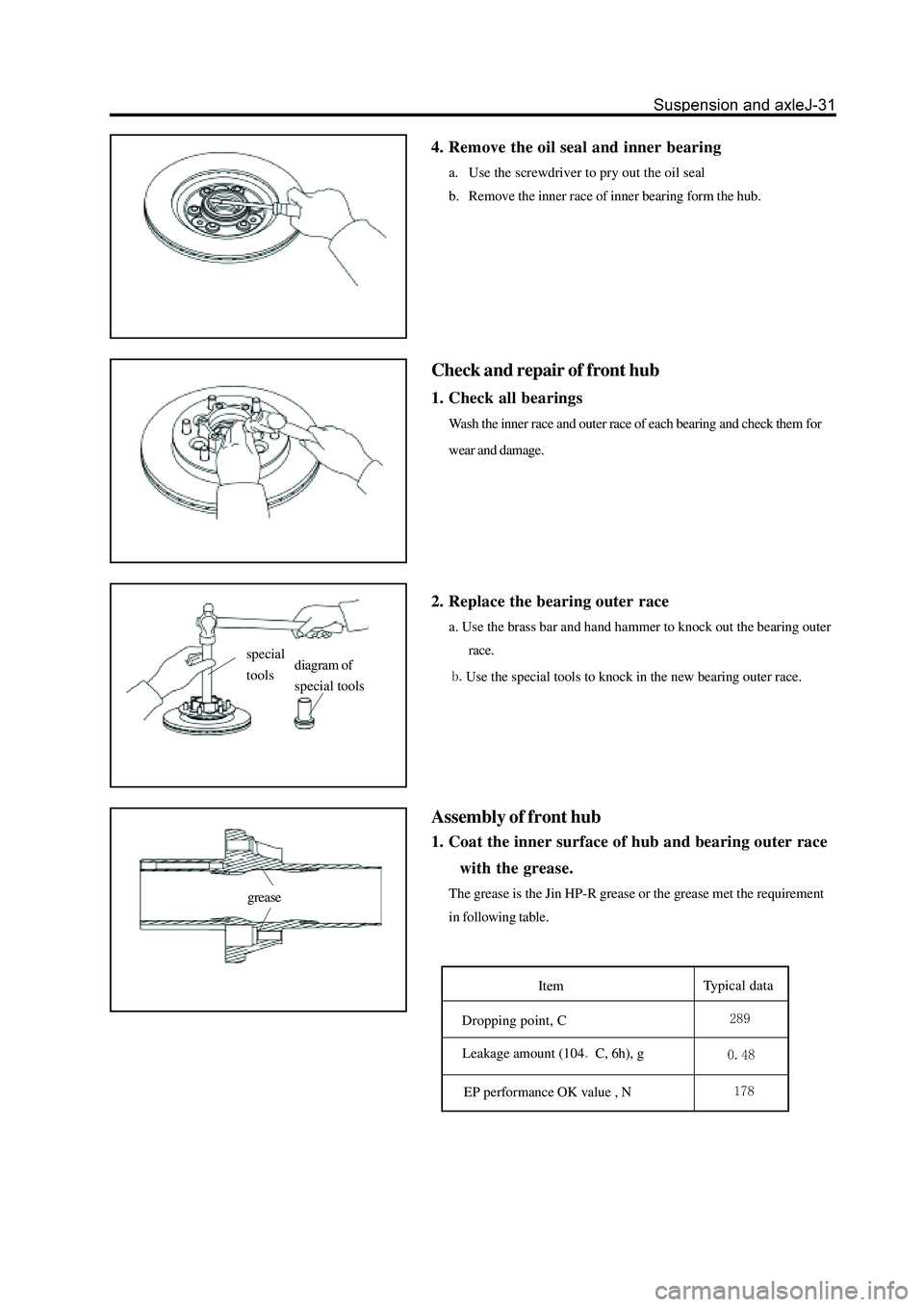
4. Remove the oil seal and inner bearing
a. Use the screwdriver to pry out the oil seal
b. Remove the inner race of inner bearing form the hub.
Check and repair of front hub
1. Check all bearings
Wash the inner race and outer race of each bearing and check them for
wear and damage.
2. Replace the bearing outer race
a. Use the brass bar and hand hammer to knock out the bearing outer
race.
Use the special tools to knock in the new bearing outer race.
Assembly of front hub
1. Coat the inner surface of hub and bearing outer race
with the grease.
The grease is the Jin HP-R grease or the grease met the requirement
in following table.
special
toolsdiagram of
special tools
grease
Dropping point, C
Leakage amount (104C, 6h), g
EP performance OK value , N
ItemTypical data
Page 204 of 425
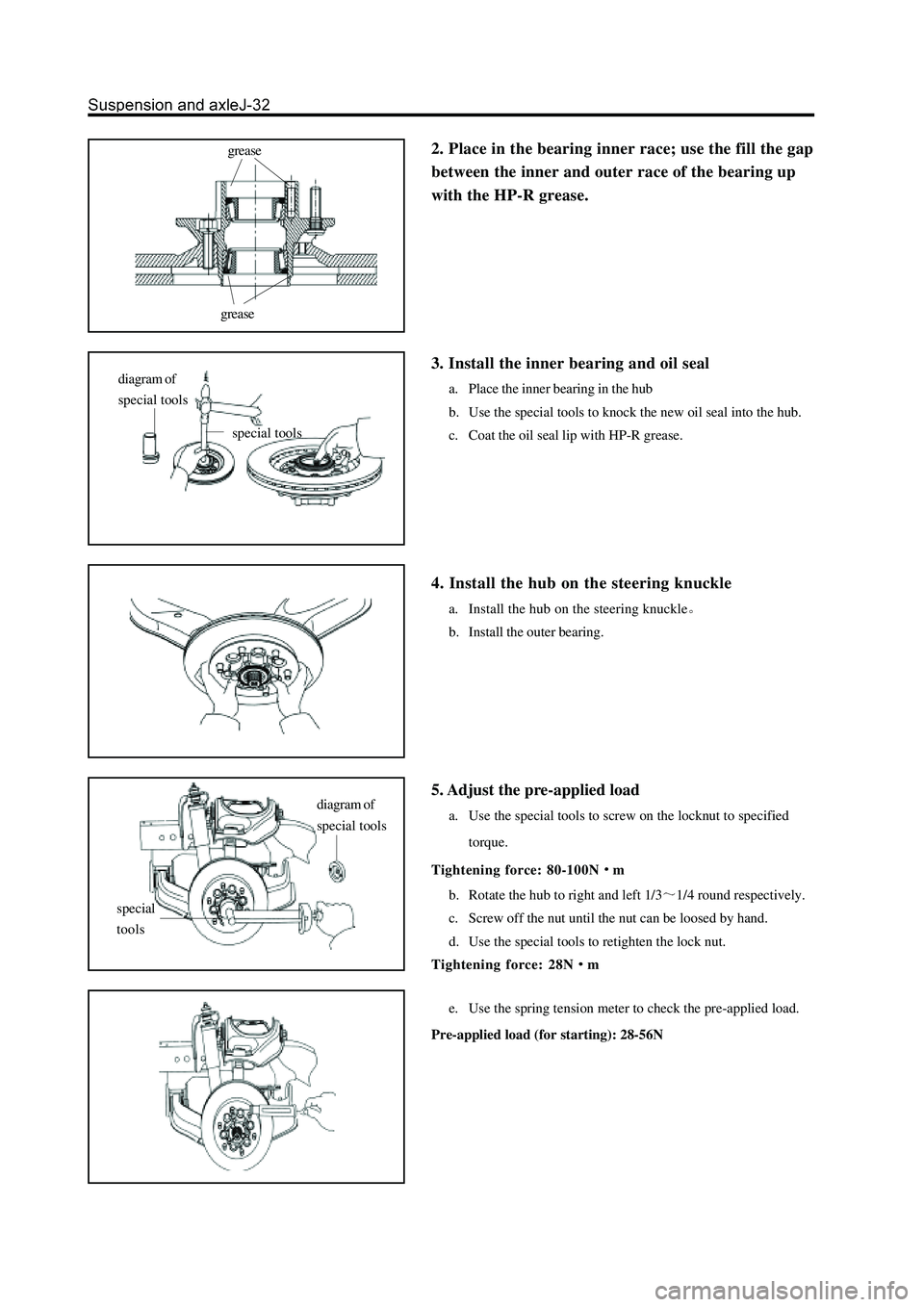
2. Place in the bearing inner race; use the fill the gap
between the inner and outer race of the bearing up
with the HP-R grease.grease
grease
3. Install the inner bearing and oil seal
a. Place the inner bearing in the hub
b. Use the special tools to knock the new oil seal into the hub.
c. Coat the oil seal lip with HP-R grease.diagram of
special tools
special tools
4. Install the hub on the steering knuckle
a. Install the hub on the steering knuckle
b. Install the outer bearing.
5. Adjust the pre-applied load
a. Use the special tools to screw on the locknut to specified
torque.
Tightening force: 80-100N
m
b. Rotate the hub to right and left 1/3
1/4 round respectively.
c. Screw off the nut until the nut can be loosed by hand.
d. Use the special tools to retighten the lock nut.
Tightening force: 28N
m
e. Use the spring tension meter to check the pre-applied load.
Pre-applied load (for starting): 28-56N
special
tools
diagram of
special tools
Page 207 of 425
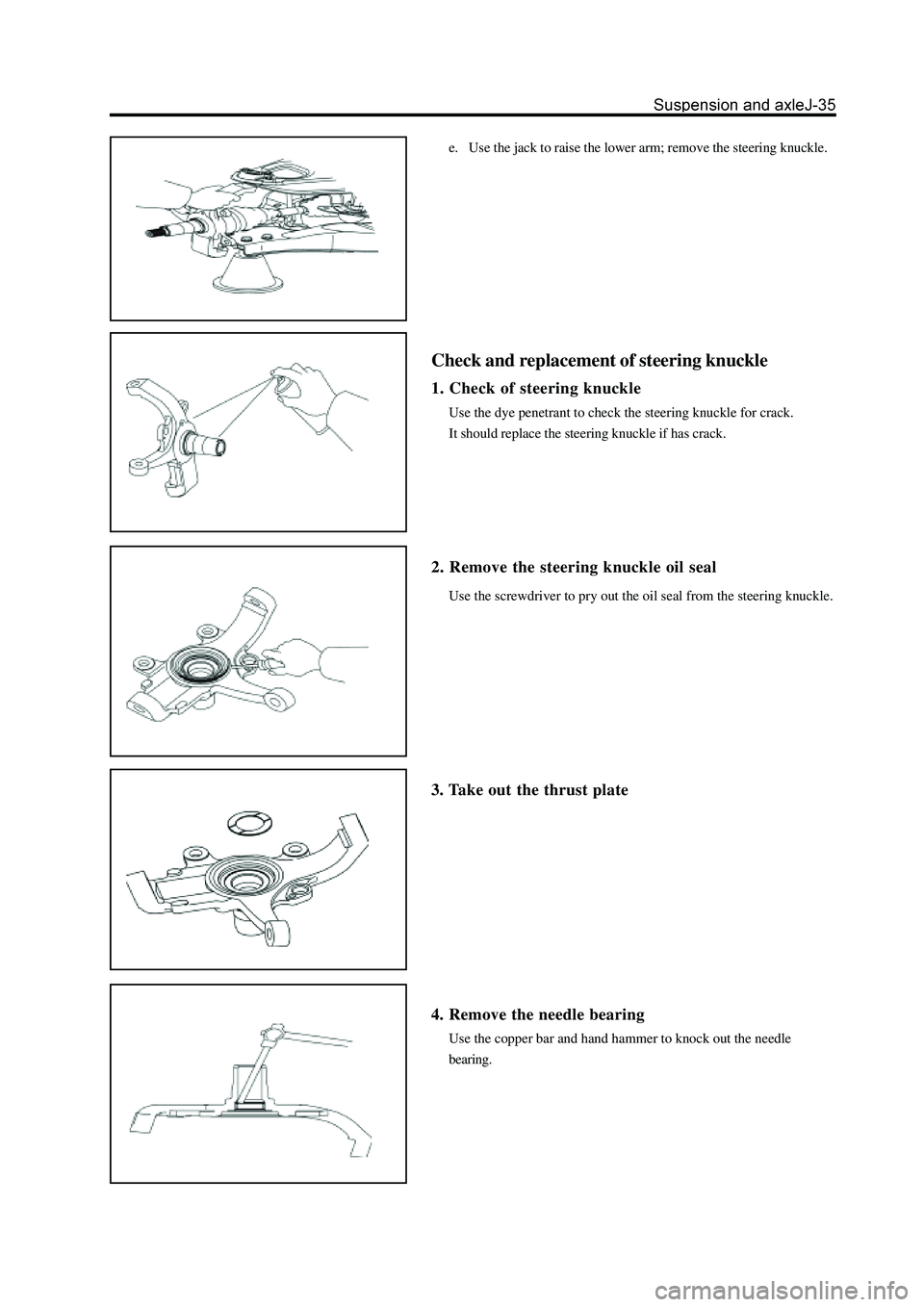
e. Use the jack to raise the lower arm; remove the steering knuckle.
Check and replacement of steering knuckle
1. Check of steering knuckle
Use the dye penetrant to check the steering knuckle for crack.
It should replace the steering knuckle if has crack.
2. Remove the steering knuckle oil seal
Use the screwdriver to pry out the oil seal from the steering knuckle.
3. Take out the thrust plate
4. Remove the needle bearing
Use the copper bar and hand hammer to knock out the needle
bearing.
Page 233 of 425
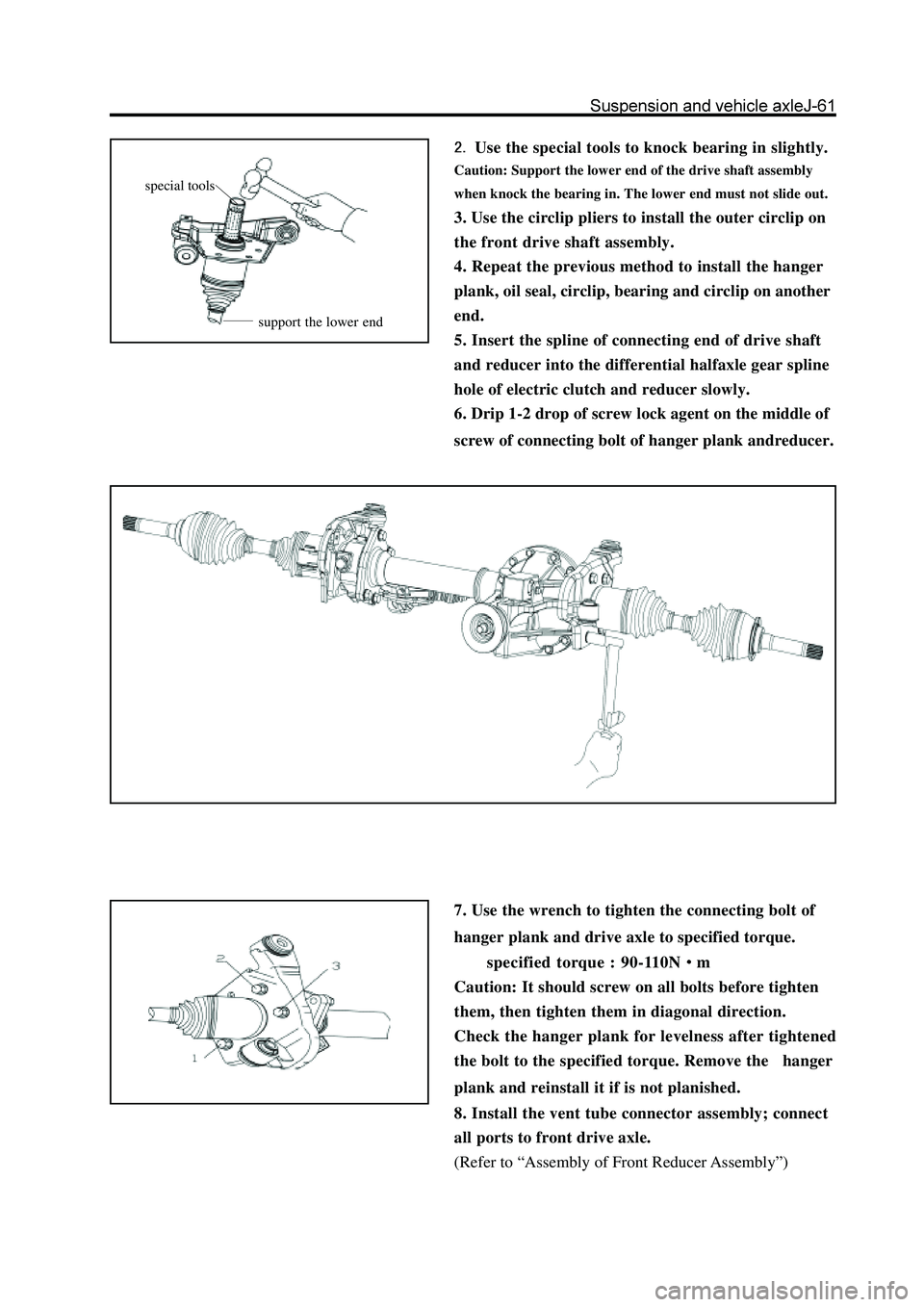
Use the special tools to knock bearing in slightly.
Caution: Support the lower end of the drive shaft assembly
when knock the bearing in. The lower end must not slide out.
3. Use the circlip pliers to install the outer circlip on
the front drive shaft assembly.
4. Repeat the previous method to install the hanger
plank, oil seal, circlip, bearing and circlip on another
end.
5. Insert the spline of connecting end of drive shaft
and reducer into the differential halfaxle gear spline
hole of electric clutch and reducer slowly.
6. Drip 1-2 drop of screw lock agent on the middle of
screw of connecting bolt of hanger plank andreducer.
7. Use the wrench to tighten the connecting bolt of
hanger plank and drive axle to specified torque.
specified torque : 90-110N
m
Caution: It should screw on all bolts before tighten
them, then tighten them in diagonal direction.
Check the hanger plank for levelness after tightened
the bolt to the specified torque. Remove the hanger
plank and reinstall it if is not planished.
8. Install the vent tube connector assembly; connect
all ports to front drive axle.
(Refer to “Assembly of Front Reducer Assembly”)
special tools
support the lower end