wheel torque GREAT WALL HOVER 2006 Service Repair Manual
[x] Cancel search | Manufacturer: GREAT WALL, Model Year: 2006, Model line: HOVER, Model: GREAT WALL HOVER 2006Pages: 425, PDF Size: 26.05 MB
Page 15 of 425
Front shaft/axle
CC6460K wagon has the two-cross arm, independent suspension, breakaway front axle.
CC6460KY wagon has the two-cross arm, independent suspension, breakaway steering drive axle , hyperbolic gear single-stage main
reducer, plain bevel gear differential mechanism, universal drive semiaxle, Birfield ball-joint, main reduction ratio i
0=4.55, Max. input
torque is 900N
m.
Rear axle
Non-breakaway drive axle, integral stamping-welded axle housing, hyperbolic gear single-stage main reducer, plain bevel gear differential
mechanism, semi-floating semiaxle, main reduction ratio i
0=4.55, Max. input torque is 900Nm.
Wheel and tyre
The type, specification and main parameter of wheel and tyre see Table 4.
Table 4 Type, specification and main parameter of wheel and tyre
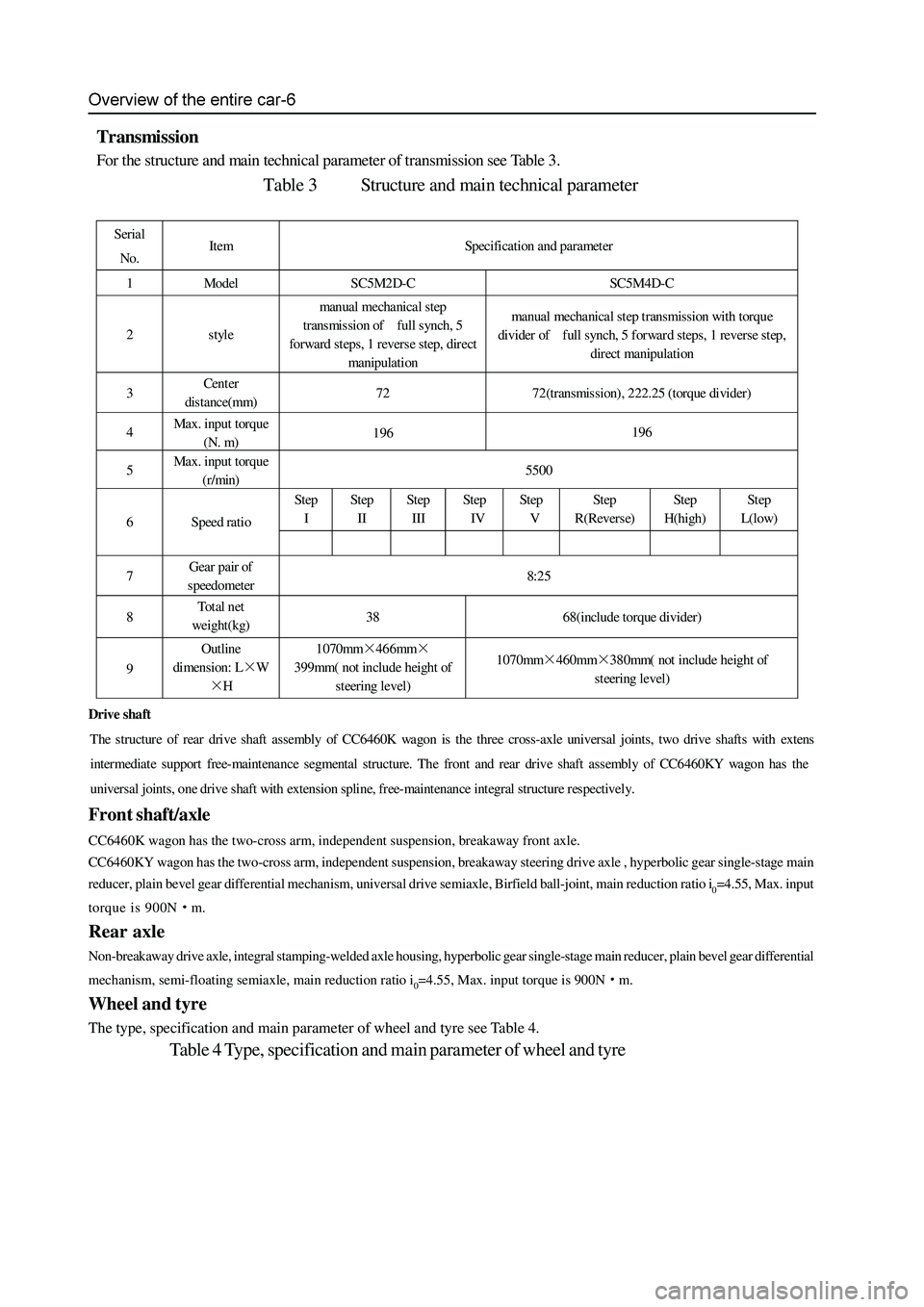
Transmission
For the structure and main technical parameter of transmission see Table 3.
Table 3 Structure and main technical parameter
Serial
No. Item Specification and parameter
1 Model SC5M2D-C SC5M4D-C
2 style manual mechanical step
transmission of full synch, 5
forward steps, 1 revers e step, direct
manipulation manual mechanical step transmission with torque
divider of full synch, 5 forward steps, 1 reverse step,
direct manipulation
3 Cent er
distance(mm) 72 72(transmission), 222.25 (torque divider)
4 Max. input torque
(N. m) 196 196
5 Max. input torque
(r/min) 5500
Step
I Step
II Step
III St ep
IV Step
V Step
R(Reverse) Step
H(high) St ep
L(low)
6 Speed ratio
7 Gear pair of
speedometer 8:25
8 To t a l n et
weight(kg) 38 68(include torque divider)
9 Outline
dimension: L×W
×H 1070mm×466mm×
399mm( not include height of
steering level) 1070mm×460mm×380mm( not include height of
steering level)
Drive shaft
The structure of rear drive shaft assembly of CC6460K wagon is the three cross-axle universal joints, two drive shafts with exten
s
intermediat e support free-maint enance segmental structure. The front and rear dr ive shaft assembly of CC6 460KY wa gon has the
universal joints, one drive shaft with extension spline, free-maintenance integral structure respectively.
Page 16 of 425
Overview of the entire car-7
Suspension
The front suspension is the torsion bar spring, double-cylinder inflatable hydraulic damper, transverse stabilizer rod, double
cross-arm independent suspension. The distance between the center of front shaft of lower arm fixing nut and level ground is
295mm±1mm.
The rear suspension is the four-connecting rod, coil spring, double-cylinder inflatable hydraulic damper, transverse stabilizer
rod, no indep endent suspension.
Carriage
Peripheral trapezoidal structure; welded by two box section longitudinal beams and several box or tube section cross beams.
Steering system
Pinion-and-rack power steering-gear, hydraulic assists steering. Breakaway front steering trapezoidal structure. Diameter of
quadriradistus steering disc φ380mm, adjustable angle, power-absorbing steering pipe. For main technical parameters of
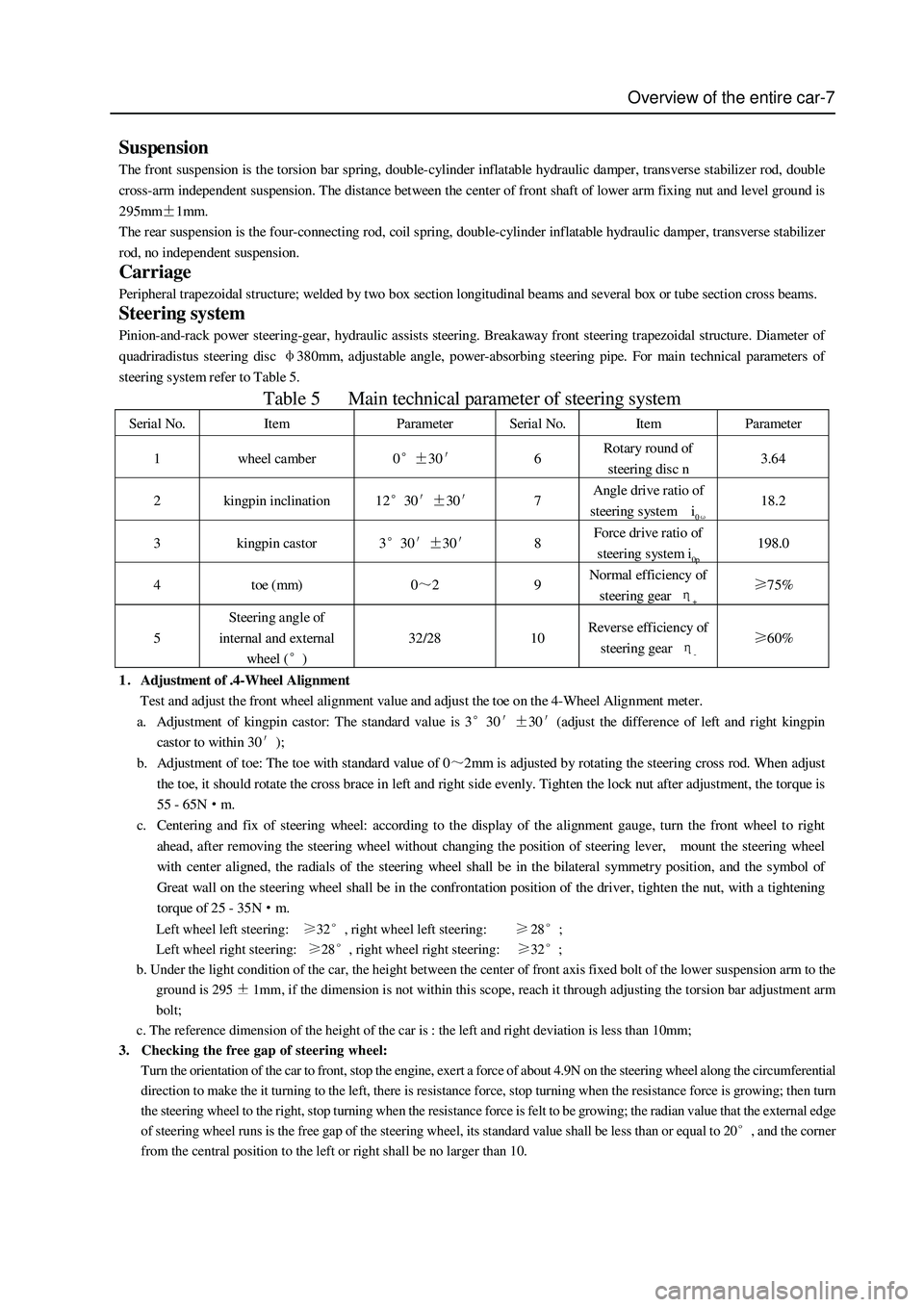
steering s ystem refer to Table 5.
Table 5 Main technical parameter of steering system
Serial No. Item Parameter Serial No. Item Parameter
1 wheel camber 0°±30′ 6 Rotary round of
steering disc n 3.64
2 kingpin inclination 12°30′±30′ 7 Angle drive ratio of
steering system i0ω 18.2
3 kingpin castor 3°30′±30′ 8 Force drive ratio of
steering s ystem i0p 198.0
4 toe (mm) 0~2 9 Normal efficiency of
steering gear η+ ≥75%
5 Steering angle of
internal and external
wheel (°) 32/28 10 Revers e efficiency of
steering gear η- ≥60%
1.Adjustment of .4-Wheel Alignment
Test and adjust the front wheel alignment value and adjust the toe on the 4-Wheel Alignment meter.
a. Adjustment of kingpin castor: The standard value is 3°30′±30′(adjust the difference of left and right kingpin
castor to within 30′);
b. Adjustment of toe: The toe with standard value of 0~2mm is adjusted by rotating the steering cross rod. When adjust
the toe, it should rotate the cross brace in left and right side evenly. Tighten the lock nut after adjustment, the torque is
55 - 65N·m.
c. Centering and fix of steering wheel: according to the display of the alignment gauge, turn the front wheel to right
ahead, after removing the steering wheel without changing the position of steering lever, mount the steering wheel
with center aligned, the radials of the steering wheel shall be in the bilateral symmetry position, and the symbol of
Great wall on the steering wheel shall be in the confrontation position of the driver, tighten the nut, with a tightening
torque of 25 - 35N·m.
Left wheel left steering: 32, right wheel left steering:28;
Left wheel right steering:
28, right wheel right steering: 32;
b. Under the light condition of the car, the height between the center of front axis fixed bolt of the lower suspension arm to the
ground is 295
1mm, if the dimension is not within this scope, reach it through adjusting the torsion bar adjustment arm
bolt;
c. The reference dimension of the height of the car is : the left and right deviation is less than 10mm;
3. Checking the free gap of steering wheel:
Turn the orientation of the car to front, stop the engine, exert a force of about 4.9N on the steering wheel along the circumferential
direction to make the it turning to the left, there is resistance force, stop turning when the resistance force is growing; then turn
the steering wheel to the right, stop turning when the resistance force is felt to be growing; the radian value that the external edge
of steering wheel runs is the free gap of the steering wheel, its standard value shall be less than or equal to 20
, and the corner
from the central position to the left or right shall be no larger than 10.
Page 36 of 425
Clutch-6
Clutch
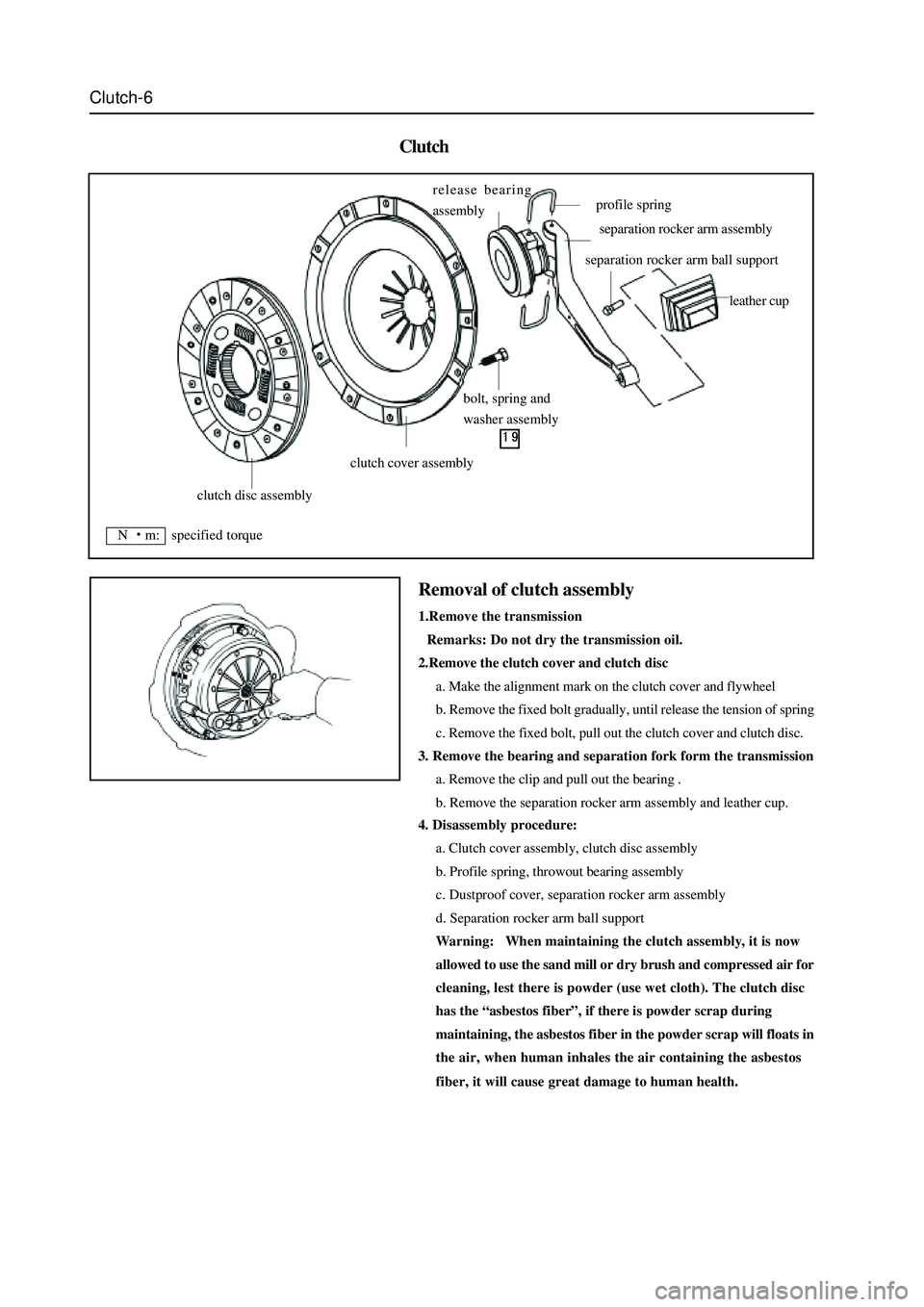
4. Disassembly procedure:
a. Clutch cover assembly, clutch disc assembly
b. Profile spring, throwout bearing assembly
c. Dustproof cover, separation rocker arm assembly
d. Separation rocker arm ball support
Warning: When maintaining the clutch assembly, it is now
allowed to use the sand mill or dry brush and compressed air for
cleaning, lest there is powder (use wet cloth). The clutch disc
has the “asbestos fiber”, if there is powder scrap during
maintaining, the asbestos fiber in the powder scrap will floats in
the air, when human inhales the air containing the asbestos
fiber, it will cause great damage to human health.
Removal of clutch assembly
1.Remove the transmission
Remarks: Do not dry the transmission oil.
2.Remove the clutch cover and clutch disc
a. Make the alignment mark on the clutch cover and flywheel
b. Remove the fixed bolt gradually, until release the tension of spring
c. Remove the fixed bolt, pull out the clutch cover and clutch disc.
3. Remove the bearing and separation fork form the transmission
a. Remove the clip and pull out the bearing .
b. Remove the separation rocker arm assembly and leather cup.
clutch disc assembly
clutch cover assembly
bolt, spring and
washer assembly release bearing
assembly
profile spring
separation rocker arm assembly
separation rocker arm ball support
leather cup
N m: specified torque
Page 78 of 425
Automatic transmission-2
Instruction for automatic transmission
1. M88 4-speed automatic transmission is equipped with the hydraulic torque converter and electric control system with locking.
When keep the stable forward status, the hydraulic torque converter can be locked automatically when the engine operates in low
speed, then reduce the unnecessary slide.
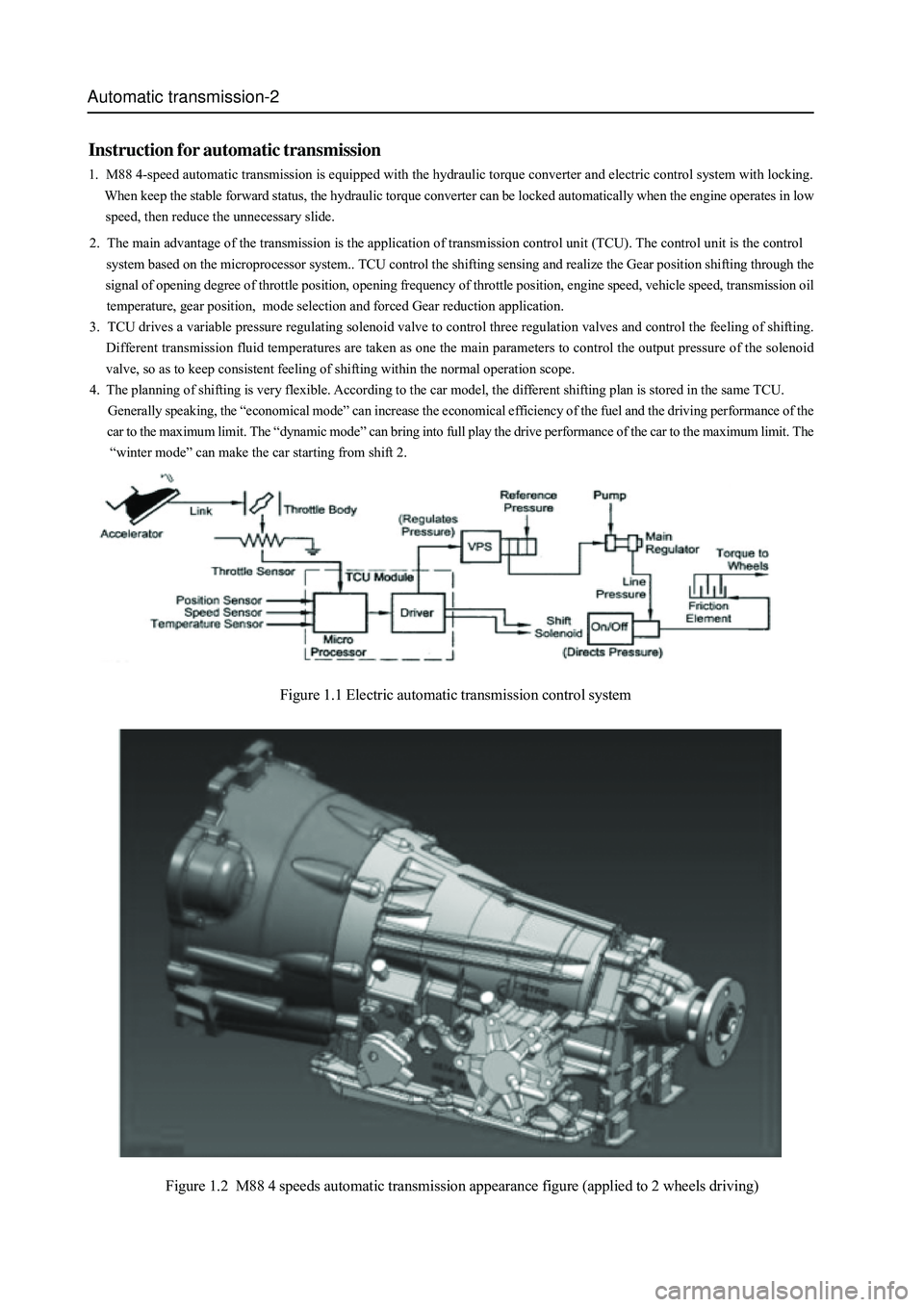
Figure 1.1 Electric automatic transmission control system
Figure 1.2 M88 4 speeds automatic transmission appearance figure (applied to 2 wheels driving)
2. The main advantage of the transmission is the application of transmission control unit (TCU). The control unit is the control
system based on the microprocessor system.. TCU control the shifting sensing and realize the Gear position shifting through the
signal of opening degree of throttle position, opening frequency of throttle position, engine speed, vehicle speed, transmission oil
temperature, gear position, mode selection and forced Gear reduction application.
3. TCU drives a variable pressure regulating solenoid valve to control three regulation valves and control the feeling of shifting.
Different transmission fluid temperatures are taken as one the main parameters to control the output pressure of the solenoid
valve, so as to keep consistent feeling of shifting within the normal operation scope.
4. The planning of shifting is very flexible. According to the car model, the different shifting plan is stored in the same TCU.
Generally speaking, the “economical mode” can increase the economical efficiency of the fuel and the driving performance of the
car to the maximum limit. The “dynamic mode” can bring into full play the drive performance of the car to the maximum limit. The
“winter mode” can make the car starting from shift 2.
Page 98 of 425
Automatic transmission-22
Power transmission system
The power transmission system includes:
Torque converter equipped with single lock clutch.
4 multi-plate clutch assemblies
2 brake belts
2 one-way clutches
Planetary gear assembly
parking mechanism
A traditional planetary gear assembly composed by six pinions is used in four-speed transmission. It realizes the 4 Gear power
transmission through the drive gear bracket.
So, the cross arrangement is the main arranging method. In the box, there are four subassemblies, shown as follows:
Gear bank central support
C1-C2-C3-clutch C4 subassembly
Pump assembly
Valve assembly
One piece or one set of optional shim is located between the input shaft flange and center of stator support shaft axle of and used
to control the end flotation of transmission. The structure arrangement allows the inspection for the subassembly during the
product manufacturing period.
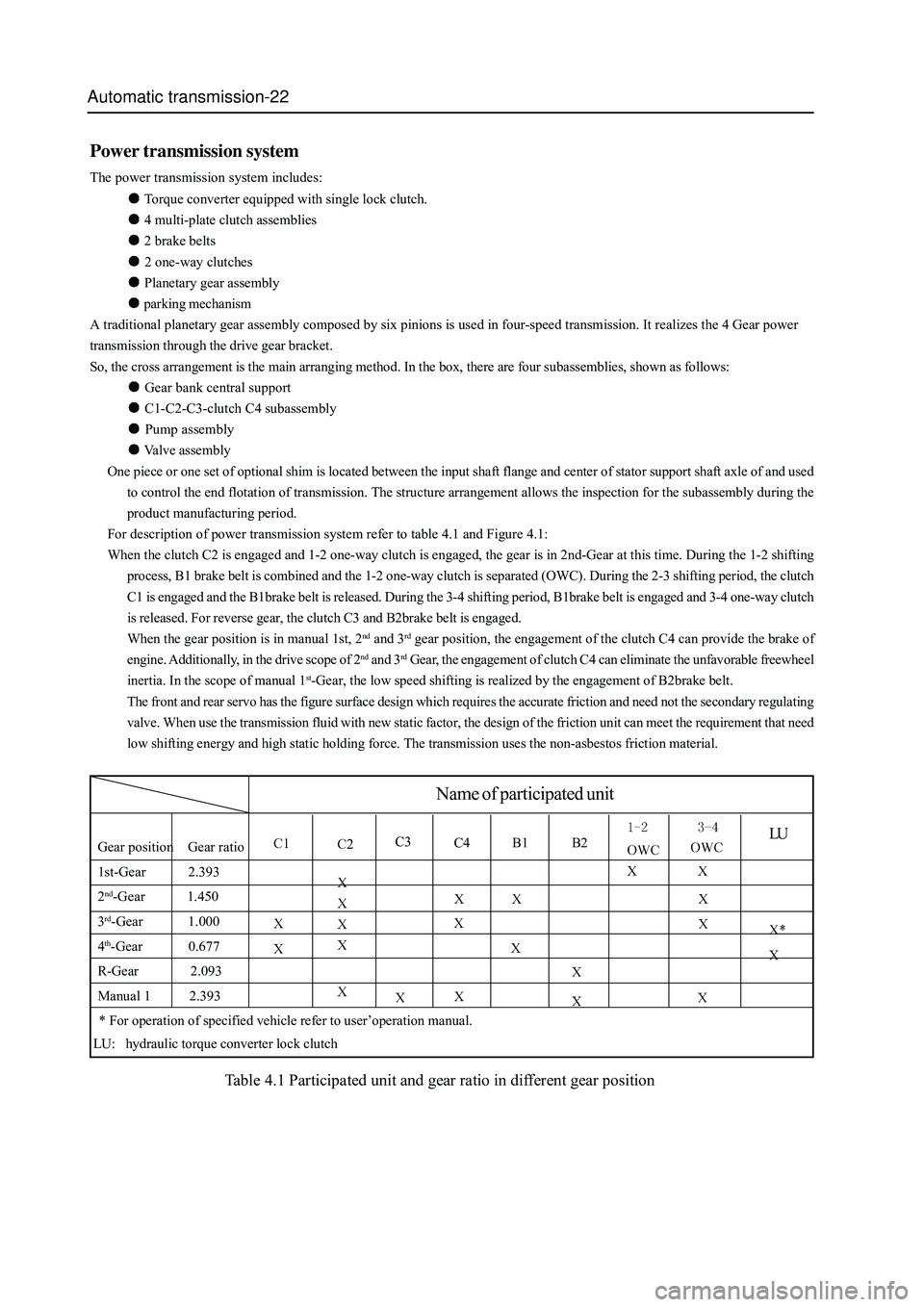
For description of power transmission system refer to table 4.1 and Figure 4.1:
When the clutch C2 is engaged and 1-2 one-way clutch is engaged, the gear is in 2nd-Gear at this time. During the 1-2 shifting
process, B1 brake belt is combined and the 1-2 one-way clutch is separated (OWC). During the 2-3 shifting period, the clutch
C1 is engaged and the B1brake belt is released. During the 3-4 shifting period, B1brake belt is engaged and 3-4 one-way clutch
is released. For reverse gear, the clutch C3 and B2brake belt is engaged.
When the gear position is in manual 1st, 2
nd and 3rd gear position, the engagement of the clutch C4 can provide the brake of
engine. Additionally, in the drive scope of 2
nd and 3rd Gear, the engagement of clutch C4 can eliminate the unfavorable freewheel
inertia. In the scope of manual 1
st-Gear, the low speed shifting is realized by the engagement of B2brake belt.
The front and rear servo has the figure surface design which requires the accurate friction and need not the secondary regulating
valve. When use the transmission fluid with new static factor, the design of the friction unit can meet the requirement that need
low shifting energy and high static holding force. The transmission uses the non-asbestos friction material.
LUGear position Gear ratio
1st-Gear 2.393
2
nd-Gear 1.450
3
rd-Gear 1.000
4
th-Gear 0.677
R-Gear 2.093
Manual 1 2.393
C3C4 B1 B2
Name of participated unit
* For operation of specified vehicle refer to user’operation manual.
LU: hydraulic torque converter lock clutch
Table 4.1 Participated unit and gear ratio in different gear position
Page 99 of 425
Automatic transmission-23
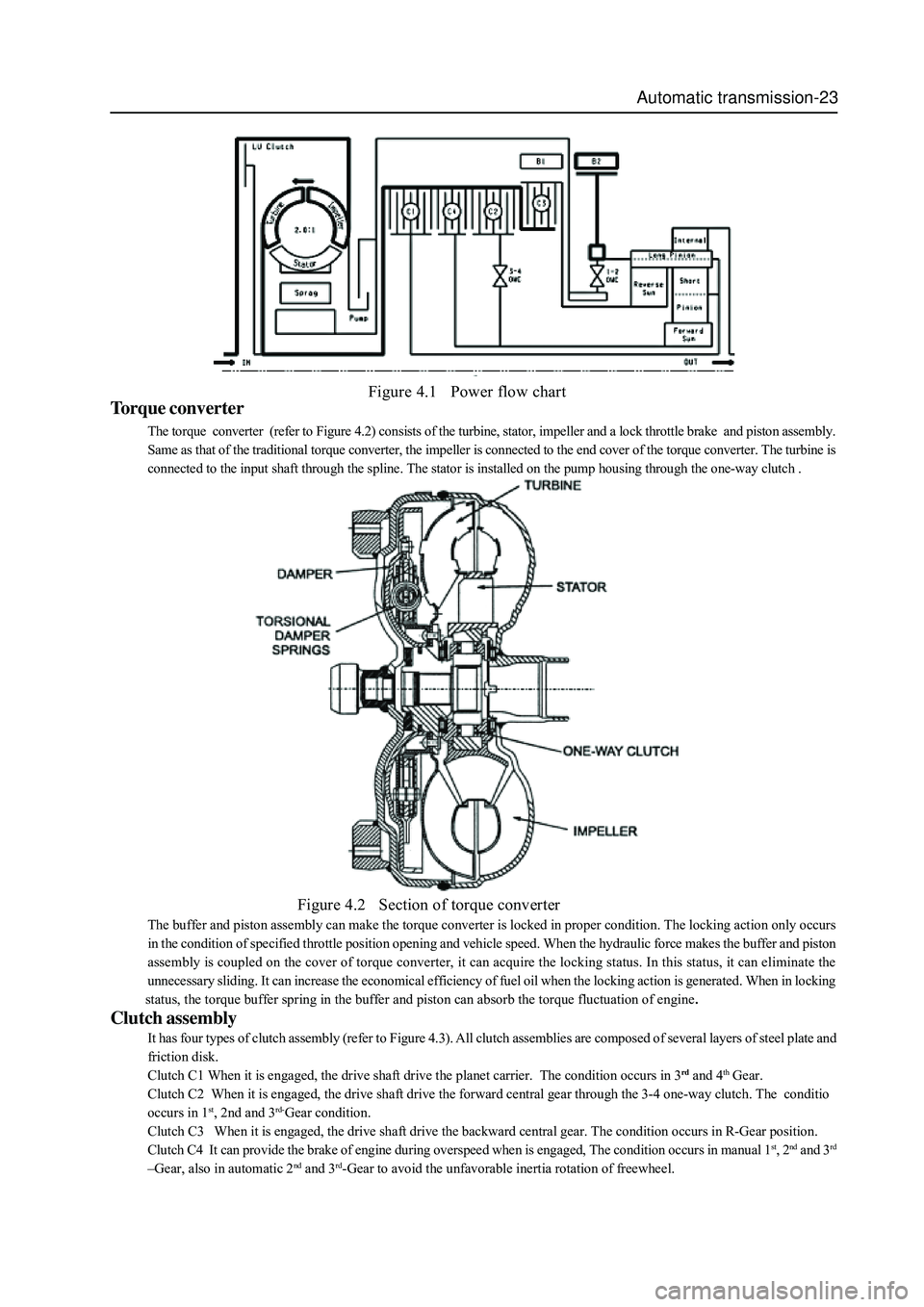
Figure 4.1 Power flow chart
Torque converter
The torque converter (refer to Figure 4.2) consists of the turbine, stator, impeller and a lock throttle brake and piston assembly.
Same as that of the traditional torque converter, the impeller is connected to the end cover of the torque converter. The turbine is
connected to the input shaft through the spline. The stator is installed on the pump housing through the one-way clutch .
Figure 4.2 Section of torque converter
The buffer and piston assembly can make the torque converter is locked in proper condition. The locking action only occurs
in the condition of specified throttle position opening and vehicle speed. When the hydraulic force makes the buffer and piston
assembly is coupled on the cover of torque converter, it can acquire the locking status. In this status, it can eliminate the
unnecessary sliding. It can increase the economical efficiency of fuel oil when the locking action is generated. When in locking
status, the torque buffer spring in the buffer and piston can absorb the torque fluctuation of engine
.
Clutch assembly
It has four types of clutch assembly (refer to Figure 4.3). All clutch assemblies are composed of several layers of steel plate and
friction disk.
Clutch C1 When it is engaged, the drive shaft drive the planet carrier. The condition occurs in 3
rd and 4th Gear.
Clutch C2 When it is engaged, the drive shaft drive the forward central gear through the 3-4 one-way clutch. The conditio
occurs in 1
st, 2nd and 3rd-Gear condition.
Clutch C3 When it is engaged, the drive shaft drive the backward central gear. The condition occurs in R-Gear position.
Clutch C4 It can provide the brake of engine during overspeed when is engaged, The condition occurs in manual 1
st, 2nd and 3rd
–Gear, also in automatic 2nd and 3rd-Gear to avoid the unfavorable inertia rotation of freewheel.
Page 139 of 425
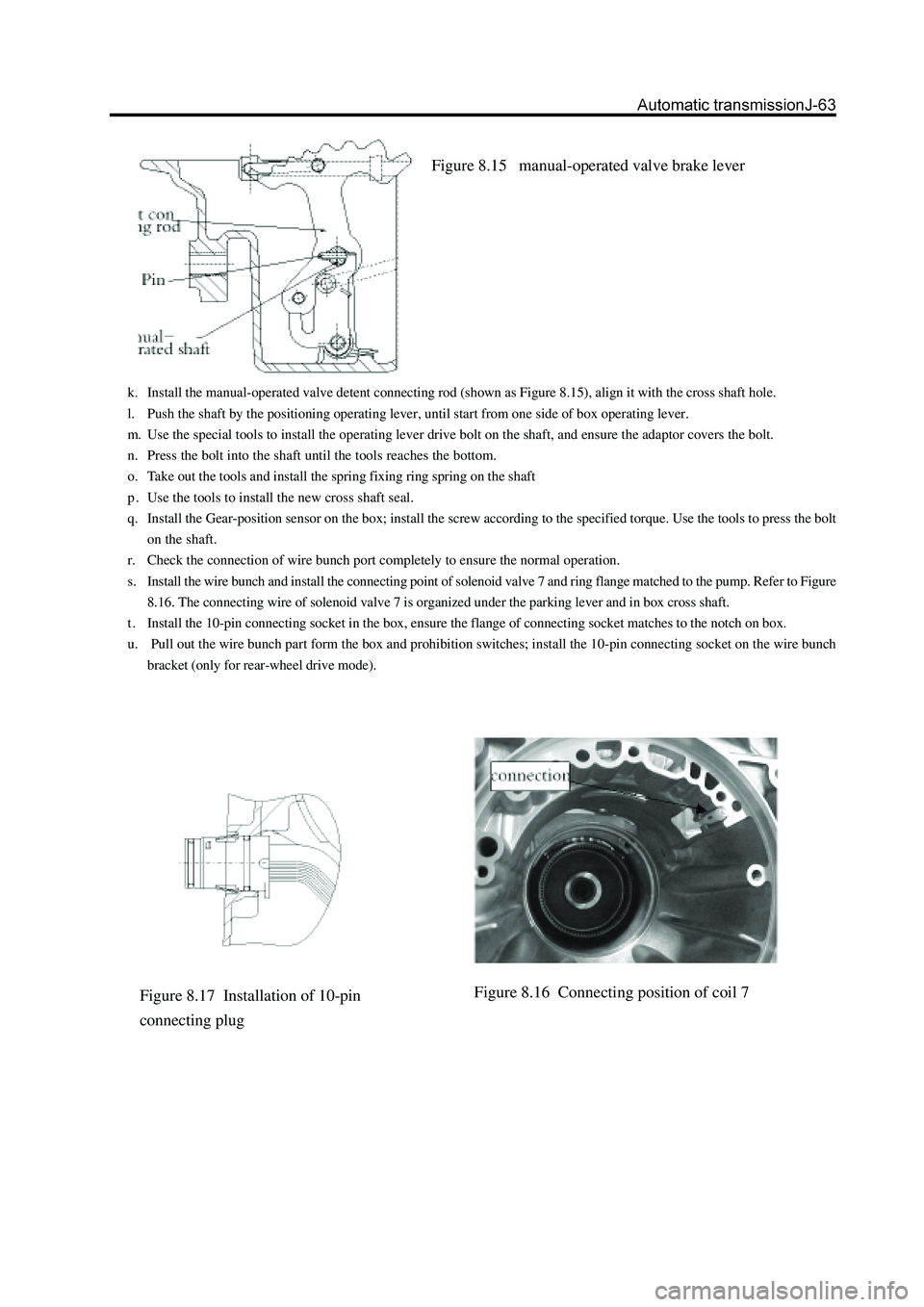
Figure 8.15 manual-operated valve brake lever
k. Install the manual-operated valve detent connecting rod (shown as Figure 8.15), align it with the cross shaft hole.
l. Push the shaft by the positioning operating lever, until start from one side of box operating lever.
m. Use the special tools to install the operating lever drive bolt on the shaft, and ensure the adaptor covers the bolt.
n. Press the bolt into the shaft until the tools reaches the bottom.
o. Take out the tools and install the spring fixing ring spring on the shaft
p . Use the tools to install the new cross shaft seal.
q. Install the Gear-position sensor on the box; install the screw according to the specified torque. Use the tools to press the bolt
on the shaft.
r. Check the connection of wire bunch port completely to ensure the normal operation.
s. Install the wire bunch and install the connecting point of solenoid valve 7 and ring flange matched to the pump. Refer to Figure
8.16. The connecting wire of solenoid valve 7 is organized under the parking lever and in box cross shaft.
t . Install the 10-pin connecting socket in the box, ensure the flange of connecting socket matches to the notch on box.
u. Pull out the wire bunch part form the box and prohibition switches; install the 10-pin connecting socket on the wire bunch
bracket (only for rear-wheel drive mode).
Figure 8.16 Connecting position of coil 7Figure 8.17 Installation of 10-pin
connecting plug
Page 151 of 425
e. If need to install the new friction disk, please remove the clutch assembly and immerse the friction assembly into the
transmission fluid for 5 minutes at least before the installation.
f. Check whether the clutch C1 wheel axle is matched with the overspeed shaft. It should replace the wheel axle and wheel axle
assembly if loose.
g. Coat the small nylon thrust insulation plate with the Vaseline and installs it on the overspeed shaft. Refer to Figure 8.19.
h. It should be carefully when install the overspeed shaft on the C1 cylinder to avoid the damage of sealing ring.
i. Use the Vaseline to install the small copper C1 wheel axle thrust washer, shown as Figure 8.19.
j. Check the input shaft for problem. Install the input shaft on the cylinder and use the ring spring to install the wire safety of
input shaft and cylinder. Ensure the coil is in groove completely.
k. Use the petroleum jelly to install the gasket and place it on the input shaft.
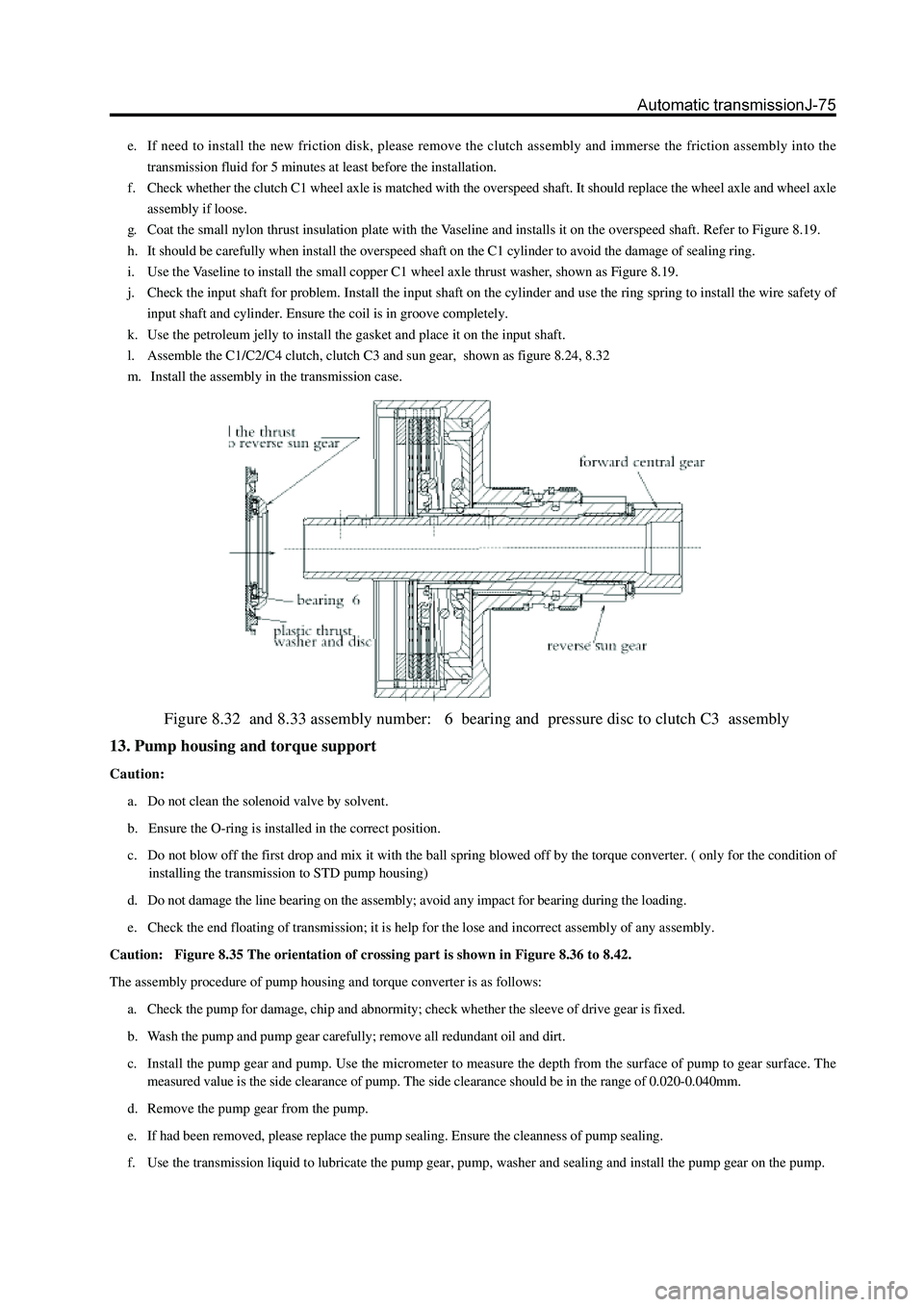
l. Assemble the C1/C2/C4 clutch, clutch C3 and sun gear, shown as figure 8.24, 8.32
m. Install the assembly in the transmission case.
Figure 8.32 and 8.33 assembly number: 6 bearing and pressure disc to clutch C3 assembly
13. Pump housing and torque support
Caution:
a. Do not clean the solenoid valve by solvent.
b. Ensure the O-ring is installed in the correct position.
c. Do not blow off the first drop and mix it with the ball spring blowed off by the torque converter. ( only for the condition of
installing the transmission to STD pump housing)
d. Do not damage the line bearing on the assembly; avoid any impact for bearing during the loading.
e. Check the end floating of transmission; it is help for the lose and incorrect assembly of any assembly.
Caution: Figure 8.35 The orientation of crossing part is shown in Figure 8.36 to 8.42.
The assembly procedure of pump housing and torque converter is as follows:
a. Check the pump for damage, chip and abnormity; check whether the sleeve of drive gear is fixed.
b. Wash the pump and pump gear carefully; remove all redundant oil and dirt.
c. Install the pump gear and pump. Use the micrometer to measure the depth from the surface of pump to gear surface. The
measured value is the side clearance of pump. The side clearance should be in the range of 0.020-0.040mm.
d. Remove the pump gear from the pump.
e. If had been removed, please replace the pump sealing. Ensure the cleanness of pump sealing.
f. Use the transmission liquid to lubricate the pump gear, pump, washer and sealing and install the pump gear on the pump.
Page 163 of 425
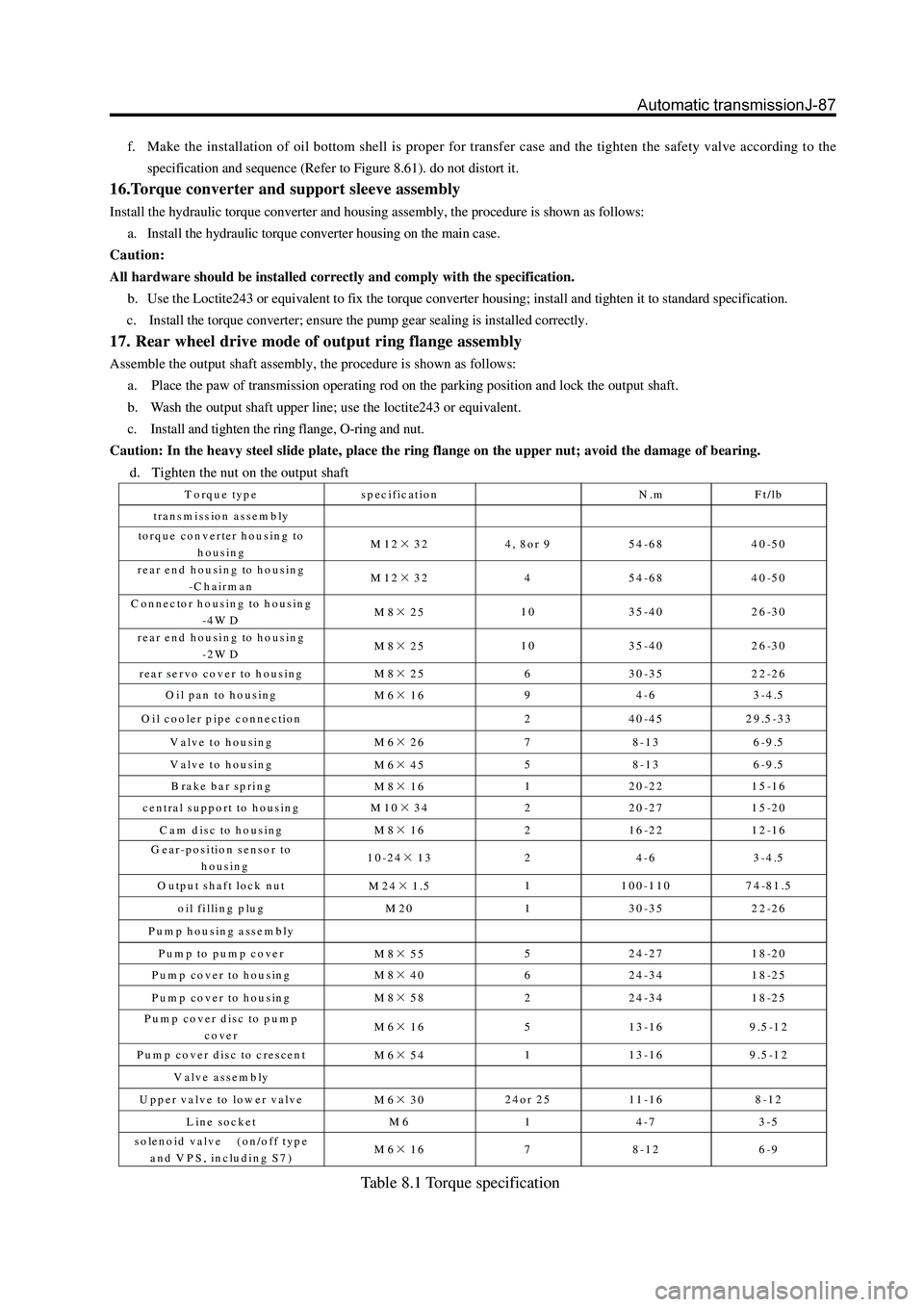
f. Make the installation of oil bottom shell is proper for transfer case and the tighten the safety valve according to the
specification and sequence (Refer to Figure 8.61). do not distort it.
16.Torque converter and support sleeve assembly
Install the hydraulic torque converter and housing assembly, the procedure is shown as follows:
a. Install the hydraulic torque converter housing on the main case.
Caution:
All hardware should be installed correctly and comply with the specification.
b. Use the Loctite243 or equivalent to fix the torque converter housing; install and tighten it to standard specification.
c. Install the torque converter; ensure the pump gear sealing is installed correctly.
17. Rear wheel drive mode of output ring flange assembly
Assemble the output shaft assembly, the procedure is shown as follows:
a. Place the paw of transmission operating rod on the parking position and lock the output shaft.
b. Wash the output shaft upper line; use the loctite243 or equivalent.
c. Install and tighten the ring flange, O-ring and nut.
Caution: In the heavy steel slide plate, place the ring flange on the upper nut; avoid the damage of bearing.
d. Tighten the nut on the output shaft
Torque type specification N.m Ft/lb
tra n s m iss io n as se m b ly
torque converter housing to
housing M12×32 4, 8or 9 54-68 40-50
rear end housing to housing
-C h a irm a n M12×32 4 54-68 40-50
C onnector housing to housing
-4 W D M8×25 10 35-40 26-30
rear end housing to housing
-2 W D M8×25 10 35-40 26-30
rear servo cover to housing
M8×25 6 30-35 22-26
O il pan to housing
M6×16 9 4-6 3-4.5
O il cooler pipe connection
2 40-45 29.5-33
V alve to housing
M6×26 7 8-13 6-9.5
V alve to housing
M6×45 5 8-13 6-9.5
B rake bar spring
M8×16 1 20-22 15-16
central support to housing
M10×34 2 20-27 15-20
C am disc to housing
M8×16 2 16-22 12-16
G ear-position sensor to
housing 10-24×13 2 4-6 3-4.5
O utput shaft lock nut
M24×1.5 1 100-110 74-81.5
oil filling plug M 20 1 30-35 22-26
Pump housing assembly
Pump to pump cover
M8×55 5 24-27 18-20
Pum p cover to housing
M8×40 6 24-34 18-25
Pum p cover to housing
M8×58 2 24-34 18-25
Pum p cover disc to pum p
cover M6×16 5 13-16 9.5-12
Pum p cover disc to crescent
M6×54 1 13-16 9.5-12
Valve assem bly
U p p e r v a lv e to lo w e r v a lv e
M6×30 24or 25 11-16 8-12
Line socket M 6 1 4-7 3-5
solenoid valve (on/off type
and VPS, including S7) M6×16 7 8-12 6-9
Table 8.1 Torque specification
Page 177 of 425
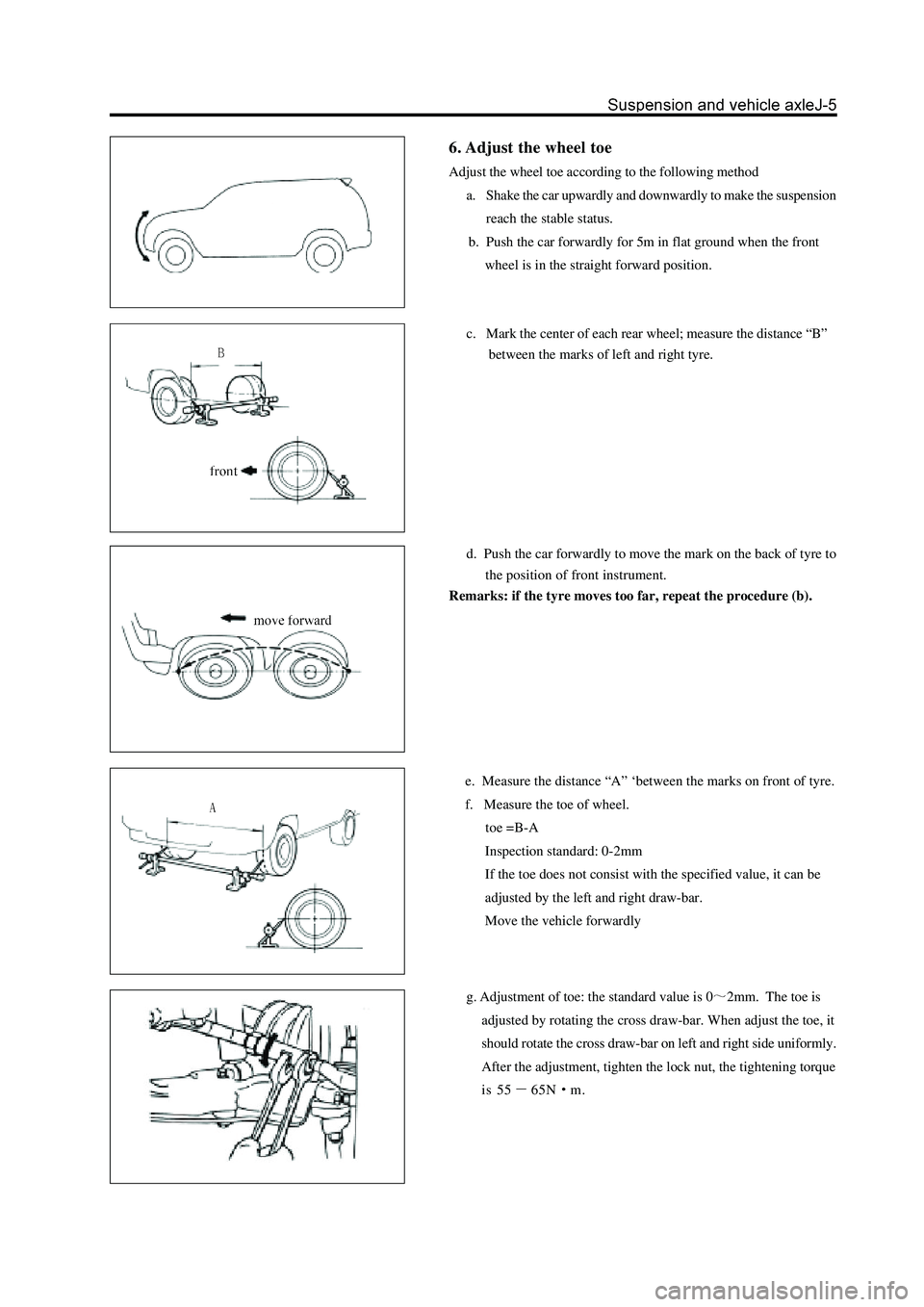
6. Adjust the wheel toe
Adjust the wheel toe according to the following method
a. Shake the car upwardly and downwardly to make the suspension
reach the stable status.
b. Push the car forwardly for 5m in flat ground when the front
wheel is in the straight forward position.
c. Mark the center of each rear wheel; measure the distance “B”
between the marks of left and right tyre.
d. Push the car forwardly to move the mark on the back of tyre to
the position of front instrument.
Remarks: if the tyre moves too far, repeat the procedure (b).
e. Measure the distance “A” ‘between the marks on front of tyre.
f. Measure the toe of wheel.
toe =B-A
Inspection standard: 0-2mm
If the toe does not consist with the specified value, it can be
adjusted by the left and right draw-bar.
Move the vehicle forwardly
g. Adjustment of toe: the standard value is 02mm. The toe is
adjusted by rotating the cross draw-bar. When adjust the toe, it
should rotate the cross draw-bar on left and right side uniformly.
After the adjustment, tighten the lock nut, the tightening torque
is 55
65Nm.