brake GREAT WALL HOVER 2006 Service Service Manual
[x] Cancel search | Manufacturer: GREAT WALL, Model Year: 2006, Model line: HOVER, Model: GREAT WALL HOVER 2006Pages: 425, PDF Size: 26.05 MB
Page 153 of 425
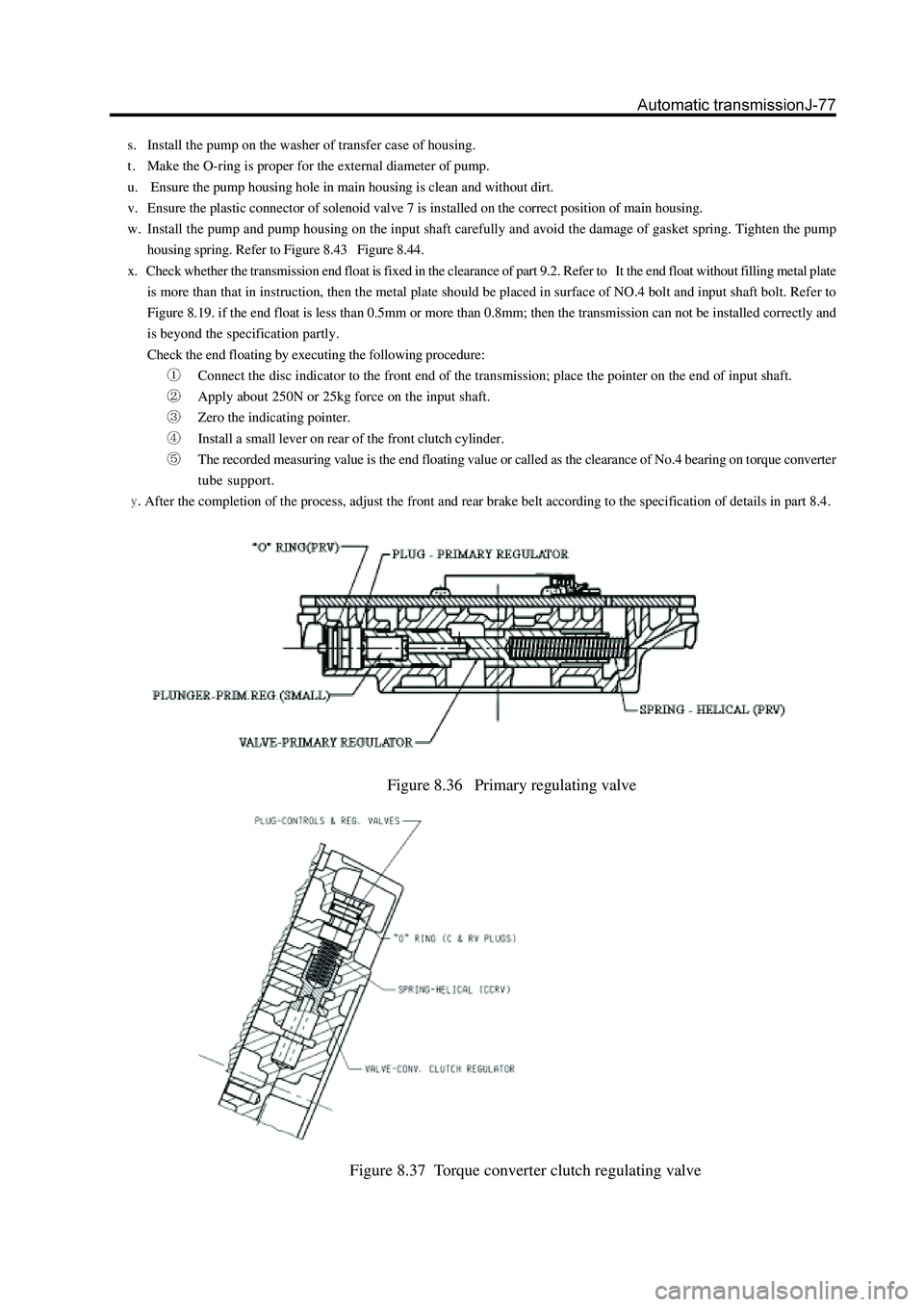
Figure 8.36 Primary regulating valve
Figure 8.37 Torque converter clutch regulating valve
s. Install the pump on the washer of transfer case of housing.
t . Make the O-ring is proper for the external diameter of pump.
u. Ensure the pump housing hole in main housing is clean and without dirt.
v. Ensure the plastic connector of solenoid valve 7 is installed on the correct position of main housing.
w. Install the pump and pump housing on the input shaft carefully and avoid the damage of gasket spring. Tighten the pump
housing spring. Refer to Figure 8.43 Figure 8.44.
x. Check whether the transmission end float is fixed in the clearance of part 9.2. Refer to It the end float without filling metal plate
is more than that in instruction, then the metal plate should be placed in surface of NO.4 bolt and input shaft bolt. Refer to
Figure 8.19. if the end float is less than 0.5mm or more than 0.8mm; then the transmission can not be installed correctly and
is beyond the specification partly.
Check the end floating by executing the following procedure:
Connect the disc indicator to the front end of the transmission; place the pointer on the end of input shaft.
Apply about 250N or 25kg force on the input shaft.
Zero the indicating pointer.
Install a small lever on rear of the front clutch cylinder.
The recorded measuring value is the end floating value or called as the clearance of No.4 bearing on torque converter
tube support.
After the completion of the process, adjust the front and rear brake belt according to the specification of details in part 8.4.
Page 156 of 425
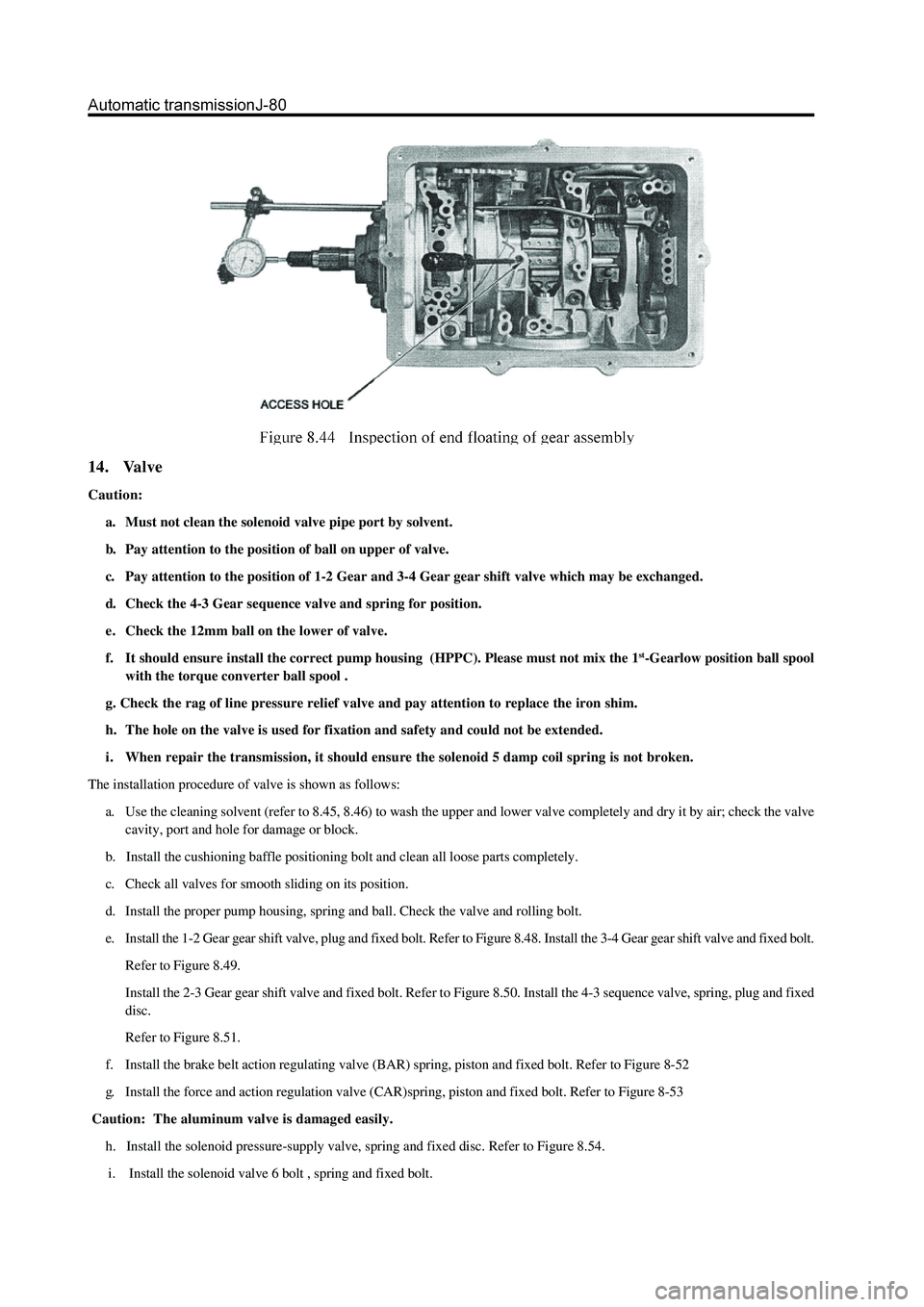
14. Valve
Caution:
a. Must not clean the solenoid valve pipe port by solvent.
b. Pay attention to the position of ball on upper of valve.
c. Pay attention to the position of 1-2 Gear and 3-4 Gear gear shift valve which may be exchanged.
d. Check the 4-3 Gear sequence valve and spring for position.
e. Check the 12mm ball on the lower of valve.
f. It should ensure install the correct pump housing (HPPC). Please must not mix the 1
st-Gearlow position ball spool
with the torque converter ball spool .
g. Check the rag of line pressure relief valve and pay attention to replace the iron shim.
h. The hole on the valve is used for fixation and safety and could not be extended.
i . When repair the transmission, it should ensure the solenoid 5 damp coil spring is not broken.
The installation procedure of valve is shown as follows:
a. Use the cleaning solvent (refer to 8.45, 8.46) to wash the upper and lower valve completely and dry it by air; check the valve
cavity, port and hole for damage or block.
b. Install the cushioning baffle positioning bolt and clean all loose parts completely.
c. Check all valves for smooth sliding on its position.
d. Install the proper pump housing, spring and ball. Check the valve and rolling bolt.
e. Install the 1-2 Gear gear shift valve, plug and fixed bolt. Refer to Figure 8.48. Install the 3-4 Gear gear shift valve and fixed bolt.
Refer to Figure 8.49.
Install the 2-3 Gear gear shift valve and fixed bolt. Refer to Figure 8.50. Install the 4-3 sequence valve, spring, plug and fixed
disc.
Refer to Figure 8.51.
f. Install the brake belt action regulating valve (BAR) spring, piston and fixed bolt. Refer to Figure 8-52
g. Install the force and action regulation valve (CAR)spring, piston and fixed bolt. Refer to Figure 8-53
Caution: The aluminum valve is damaged easily.
h. Install the solenoid pressure-supply valve, spring and fixed disc. Refer to Figure 8.54.
i. Install the solenoid valve 6 bolt , spring and fixed bolt.
Page 158 of 425
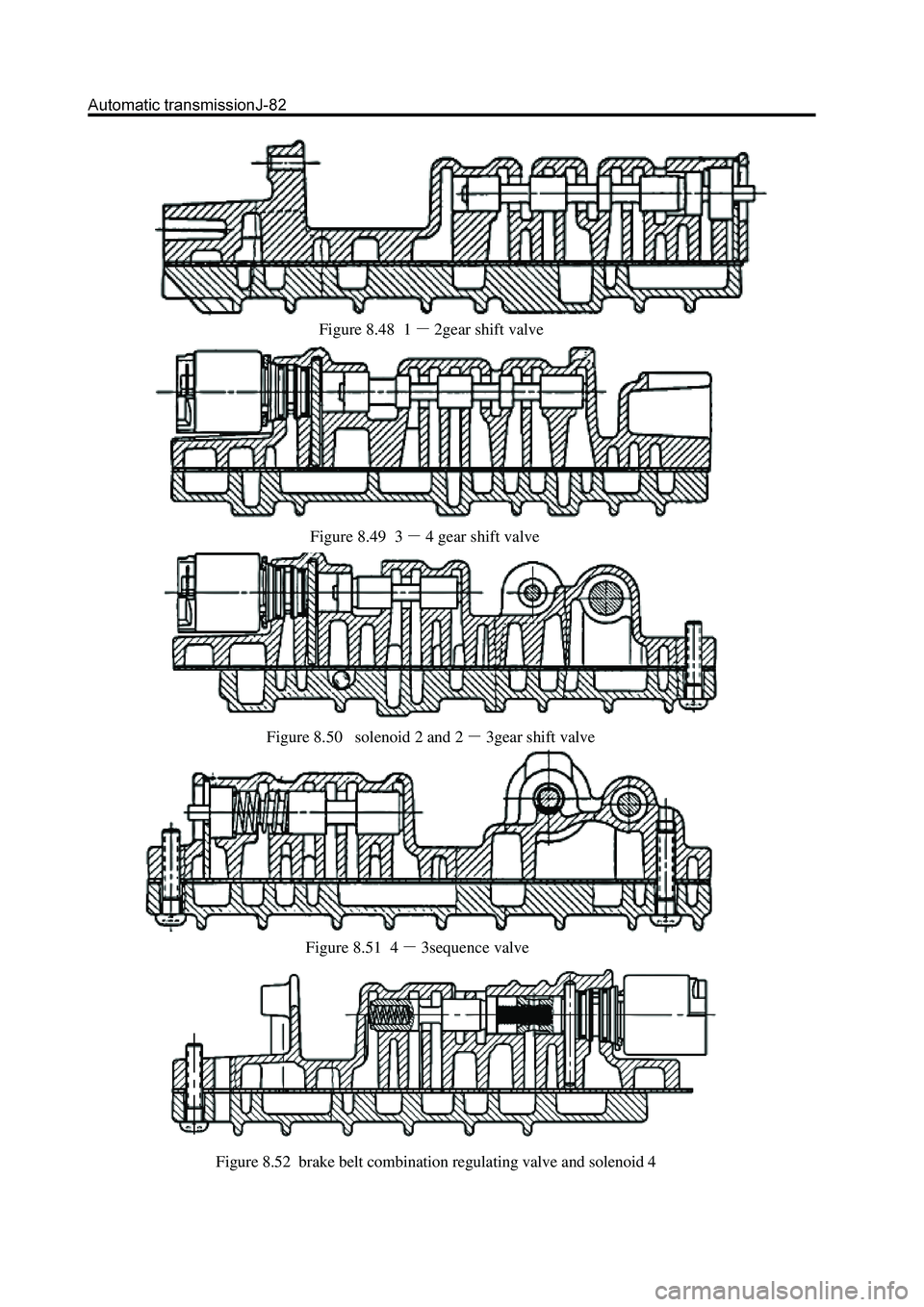
Figure 8.48 12gear shift valve
Figure 8.49 3
4 gear shift valve
Figure 8.50 solenoid 2 and 2
3gear shift valve
Figure 8.51 4
3sequence valve
Figure 8.52 brake belt combination regulating valve and solenoid 4
Page 164 of 425
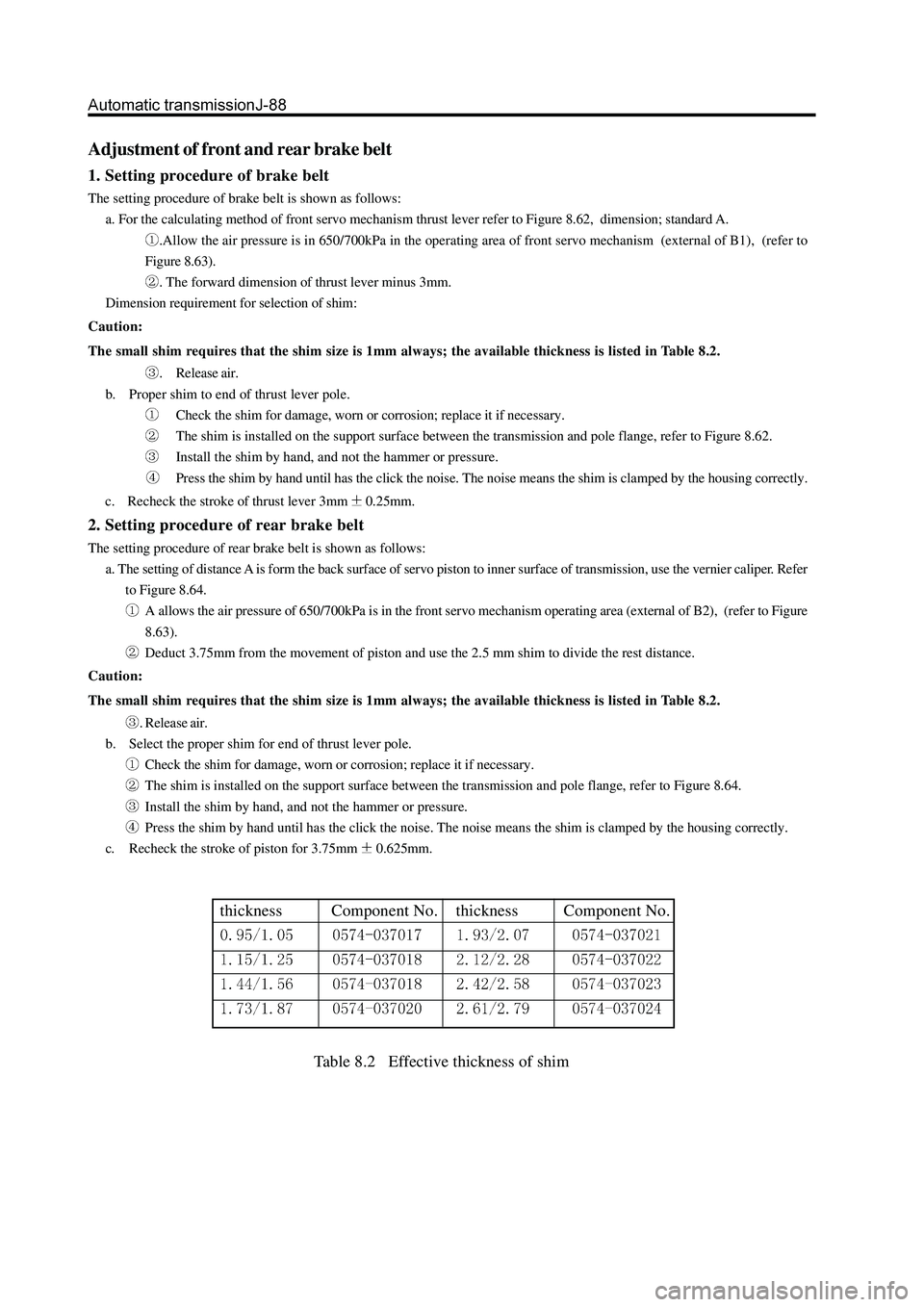
thickness Component No. thickness Component No.
Adjustment of front and rear brake belt
1. Setting procedure of brake belt
The setting procedure of brake belt is shown as follows:
a. For the calculating method of front servo mechanism thrust lever refer to Figure 8.62, dimension; standard A.
.Allow the air pressure is in 650/700kPa in the operating area of front servo mechanism (external of B1), (refer to
Figure 8.63).
. The forward dimension of thrust lever minus 3mm.
Dimension requirement for selection of shim:
Caution:
The small shim requires that the shim size is 1mm always; the available thickness is listed in Table 8.2.
. Release air.
b. Proper shim to end of thrust lever pole.
Check the shim for damage, worn or corrosion; replace it if necessary.
The shim is installed on the support surface between the transmission and pole flange, refer to Figure 8.62.
Install the shim by hand, and not the hammer or pressure.
Press the shim by hand until has the click the noise. The noise means the shim is clamped by the housing correctly.
c. Recheck the stroke of thrust lever 3mm
0.25mm.
2. Setting procedure of rear brake belt
The setting procedure of rear brake belt is shown as follows:
a. The setting of distance A is form the back surface of servo piston to inner surface of transmission, use the vernier caliper. Refer
to Figure 8.64.
A allows the air pressure of 650/700kPa is in the front servo mechanism operating area (external of B2), (refer to Figure
8.63).
Deduct 3.75mm from the movement of piston and use the 2.5 mm shim to divide the rest distance.
Caution:
The small shim requires that the shim size is 1mm always; the available thickness is listed in Table 8.2.
. Release air.
b. Select the proper shim for end of thrust lever pole.
Check the shim for damage, worn or corrosion; replace it if necessary.
The shim is installed on the support surface between the transmission and pole flange, refer to Figure 8.64.
Install the shim by hand, and not the hammer or pressure.
Press the shim by hand until has the click the noise. The noise means the shim is clamped by the housing correctly.
c. Recheck the stroke of piston for 3.75mm
0.625mm.
Table 8.2 Effective thickness of shim
Page 165 of 425
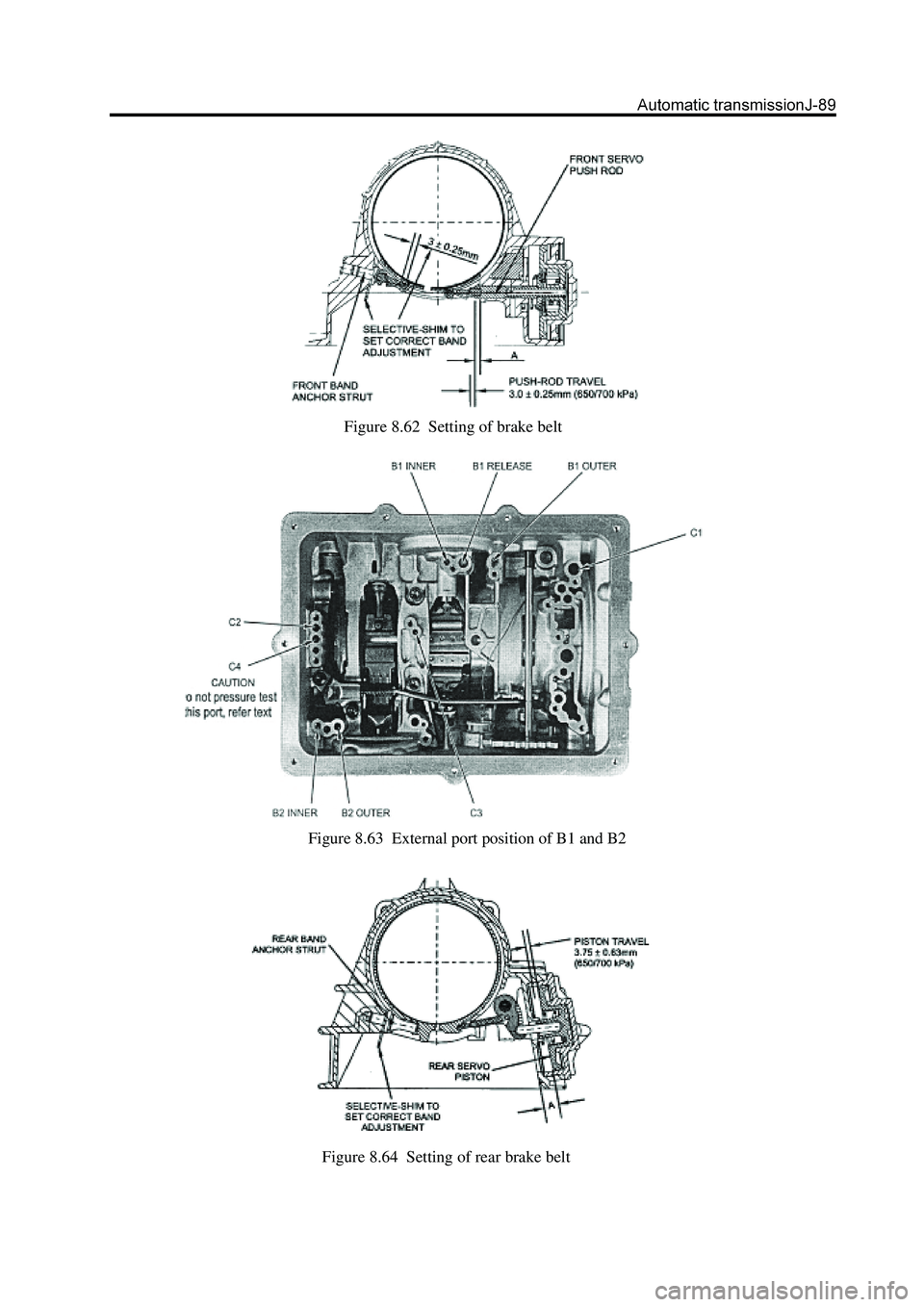
Figure 8.62 Setting of brake belt
Figure 8.63 External port position of B1 and B2
Figure 8.64 Setting of rear brake belt
Page 167 of 425
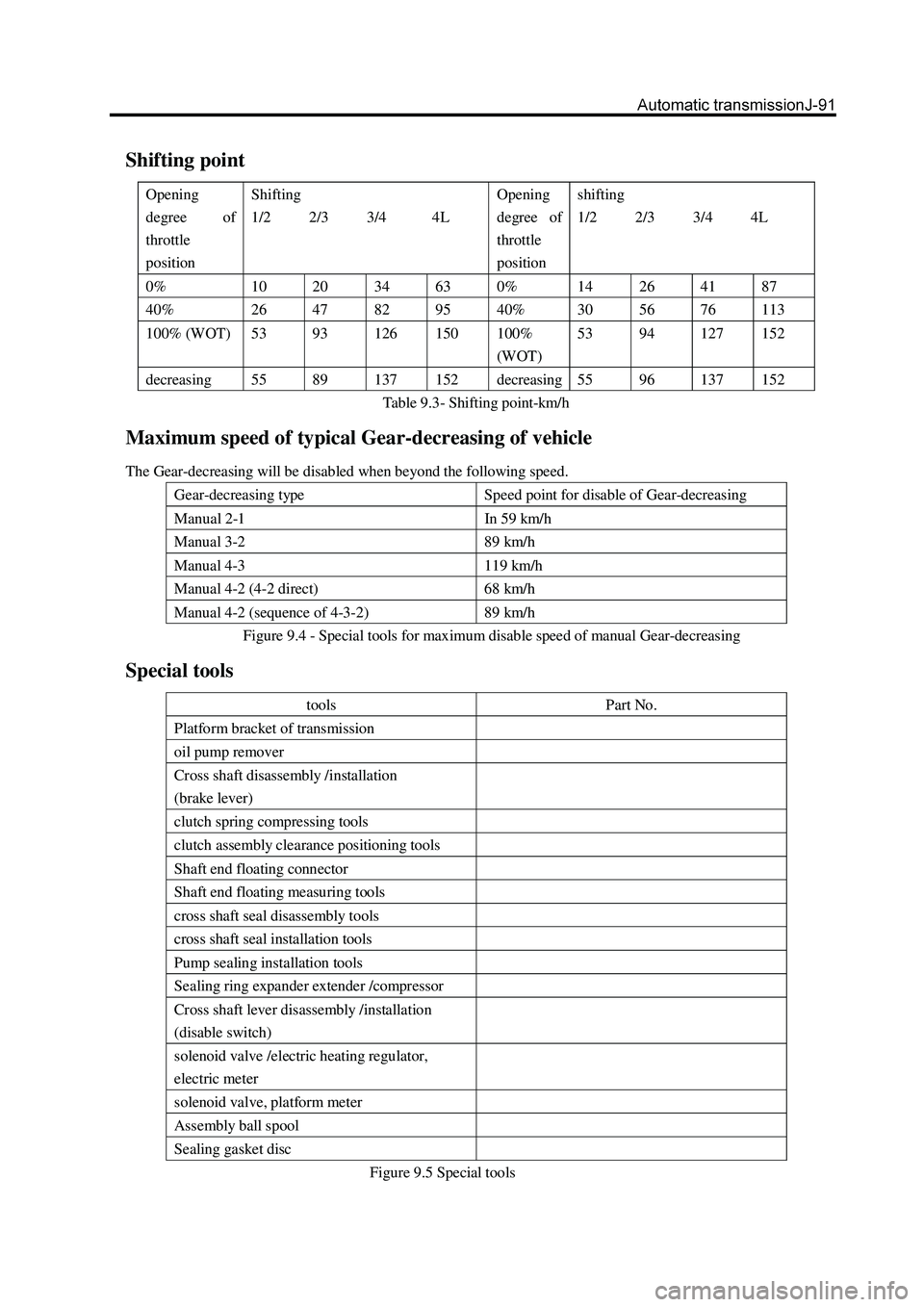
Shifting point
Opening
degree of
throttle
position Shifting
1/2 2/3 3/4 4L Opening
degree of
throttle
position shifting
1/2 2/3 3/4 4L
0% 10 20 34 63 0% 14 26 41 87
40% 26 47 82 95 40% 30 56 76 113
100% (WOT) 53 93 126 150 100%
(WOT) 53
94 127 152
decreasing 55 89 137 152 decreasing 55 96 137 152
Table 9.3- Shifting point-km/h
Maximum speed of typical Gear-decreasing of vehicle
The Gear-decreasing will be disabled when beyond the following speed.
Gear-decreasing type Speed point for disable of Gear-decreasing
Manual 2-1 In 59 km/h
Manual 3-2 89 km/h
Manual 4-3 119 km/h
Manual 4-2 (4-2 direct) 68 km/h
Manual 4-2 (sequence of 4-3-2) 89 km/h
Figure 9.4 - Special tools for maximum disable speed of manual Gear-decreasing
Special tools
tools Part No.
Platform bracket of transmission
oil pump remover
Cross shaft disassembly /installation
(brake lever)
clutch spring compressing tools
clutch assembly clearance positioning tools
Shaft end floating connector
Shaft end floating measuring tools
cross shaft seal disassembly tools
cross shaft seal installation tools
Pump sealing installation tools
Sealing ring expander extender /compressor
Cross shaft lever disassembly /installation
(disable switch)
solenoid valve /electric heating regulator,
electric meter
solenoid valve, platform meter
Assembly ball spool
Sealing gasket disc
Figure 9.5 Special tools
Page 175 of 425
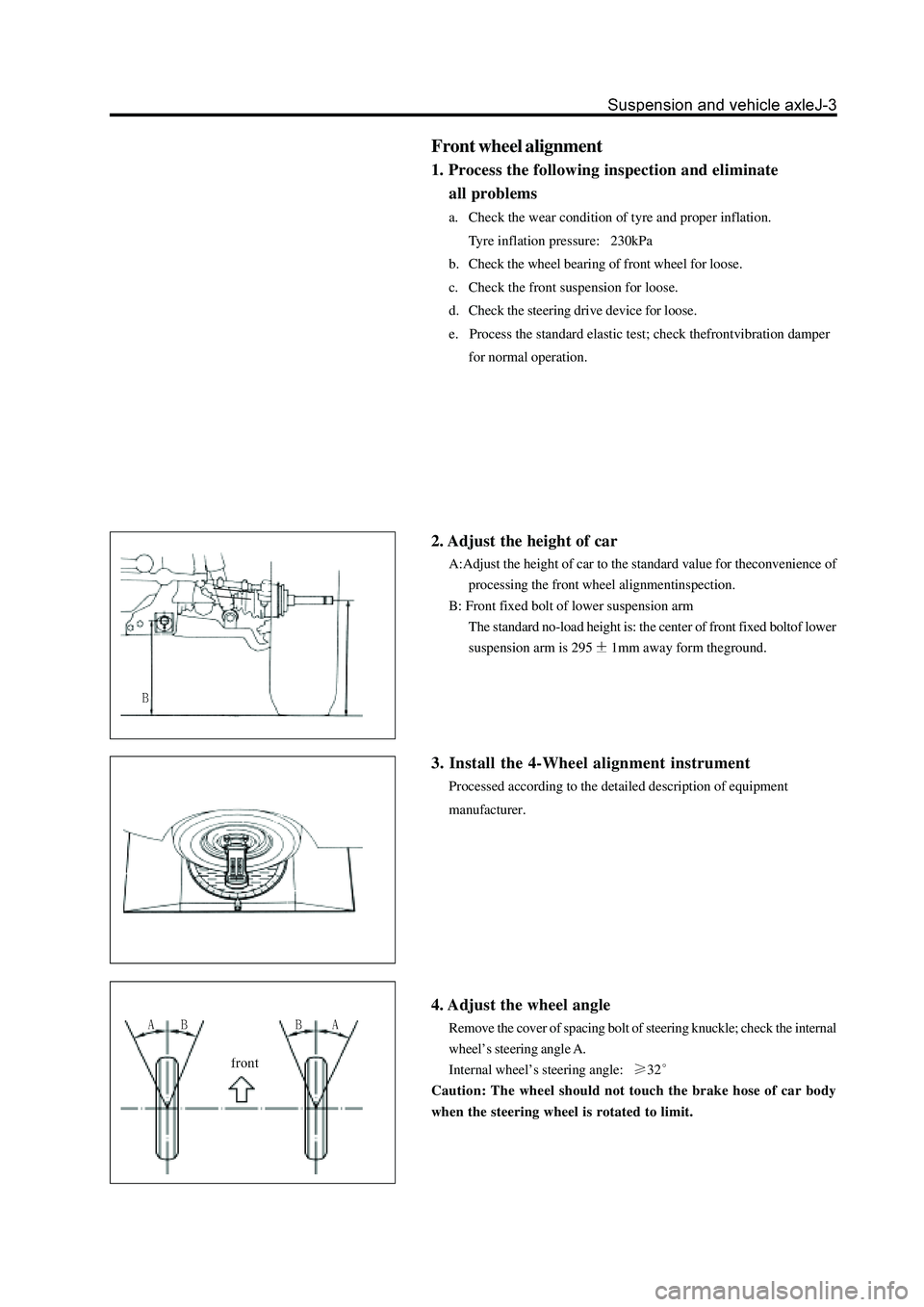
Front wheel alignment
1. Process the following inspection and eliminate
all problems
a. Check the wear condition of tyre and proper inflation.
Tyre inflation pressure: 230kPa
b. Check the wheel bearing of front wheel for loose.
c. Check the front suspension for loose.
d. Check the steering drive device for loose.
e. Process the standard elastic test; check thefrontvibration damper
for normal operation.
3. Install the 4-Wheel alignment instrument
Processed according to the detailed description of equipment
manufacturer.
4. Adjust the wheel angle
Remove the cover of spacing bolt of steering knuckle; check the internal
wheel’s steering angle A.
Internal wheel’s steering angle:
32
Caution: The wheel should not touch the brake hose of car body
when the steering wheel is rotated to limit.
2. Adjust the height of car
A:Adjust the height of car to the standard value for theconvenience of
processing the front wheel alignmentinspection.
B: Front fixed bolt of lower suspension arm
The standard no-load height is: the center of front fixed boltof lower
suspension arm is 295
1mm away form theground.
Page 179 of 425
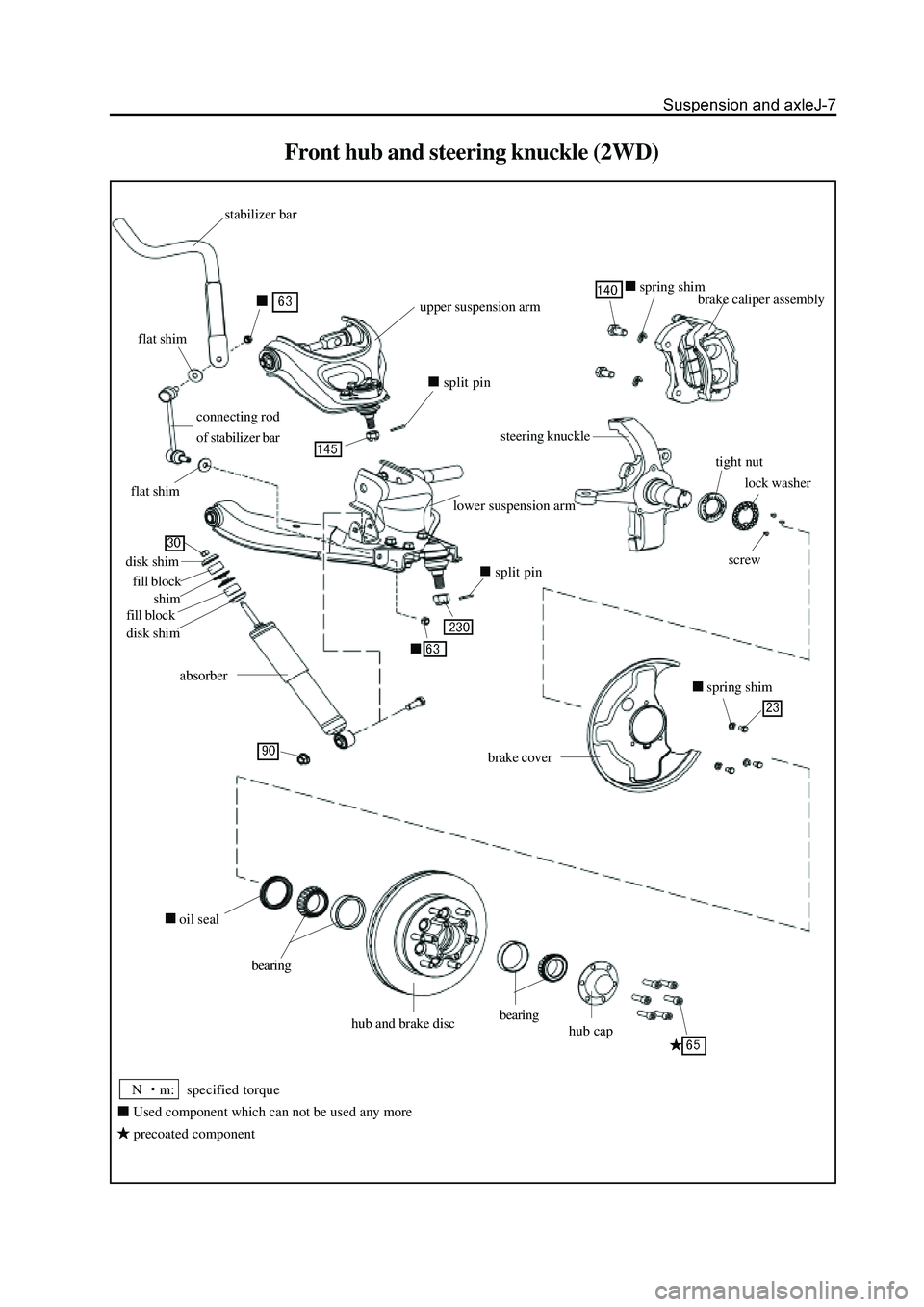
Front hub and steering knuckle (2WD)
stabilizer bar
connecting rod
of stabilizer bar
flat shim
disk shim
fill block
shim
fill block
disk shim
absorber
bearing
hub cap
brake cover
spring shim
split pin
lower suspension arm
split pin
upper suspension arm
spring shimbrake caliper assembly
steering knuckle
tight nut
lock washer
screw
oil seal
bearing
hub and brake disc flat shim
N
m: specified torque
Used component which can not be used any more
precoated component
Page 180 of 425
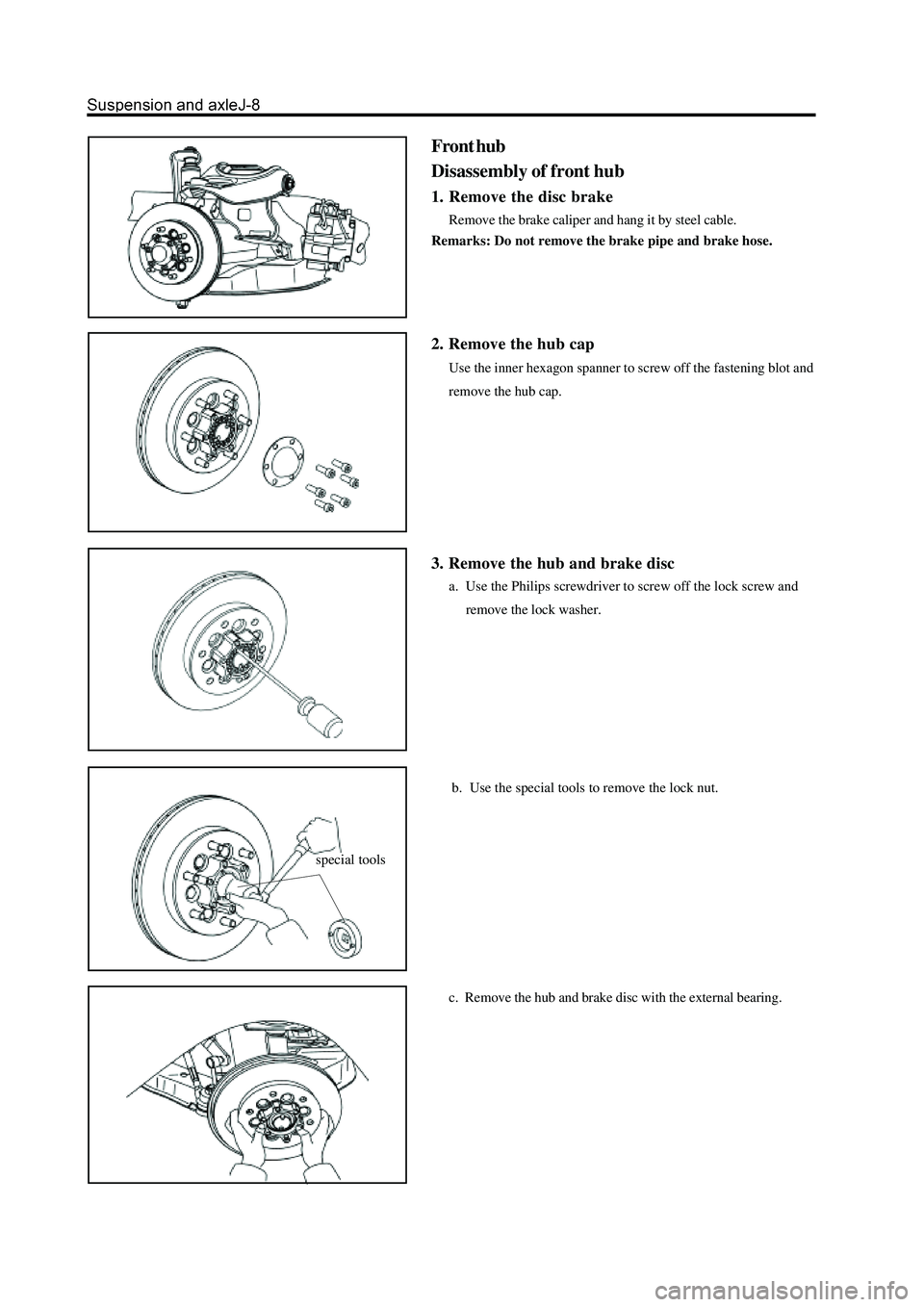
Front hub
Disassembly of front hub
1. Remove the disc brake
Remove the brake caliper and hang it by steel cable.
Remarks: Do not remove the brake pipe and brake hose.
2. Remove the hub cap
Use the inner hexagon spanner to screw off the fastening blot and
remove the hub cap.
3. Remove the hub and brake disc
a. Use the Philips screwdriver to screw off the lock screw and
remove the lock washer.
b. Use the special tools to remove the lock nut.
c. Remove the hub and brake disc with the external bearing.
special tools
Page 183 of 425
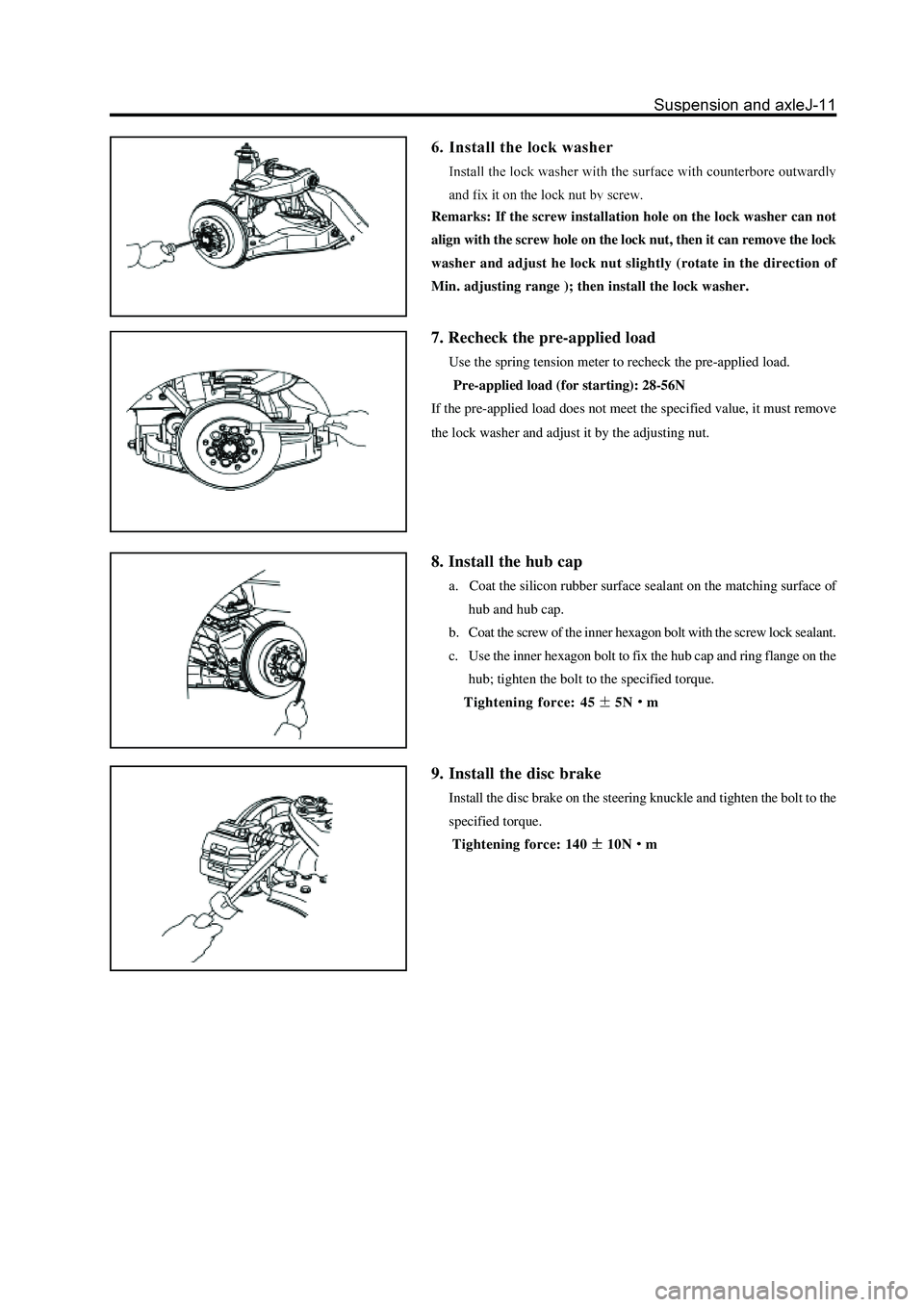
Remarks: If the screw installation hole on the lock washer can not
align with the screw hole on the lock nut, then it can remove the lock
washer and adjust he lock nut slightly (rotate in the direction of
Min. adjusting range ); then install the lock washer.
7. Recheck the pre-applied load
Use the spring tension meter to recheck the pre-applied load.
Pre-applied load (for starting): 28-56N
If the pre-applied load does not meet the specified value, it must remove
the lock washer and adjust it by the adjusting nut.
8. Install the hub cap
a. Coat the silicon rubber surface sealant on the matching surface of
hub and hub cap.
b. Coat the screw of the inner hexagon bolt with the screw lock sealant.
c. Use the inner hexagon bolt to fix the hub cap and ring flange on the
hub; tighten the bolt to the specified torque.
Tightening force: 45
5Nm
9. Install the disc brake
Install the disc brake on the steering knuckle and tighten the bolt to the
specified torque.
Tightening force: 140
10Nm