brake GREAT WALL HOVER 2006 Service Manual PDF
[x] Cancel search | Manufacturer: GREAT WALL, Model Year: 2006, Model line: HOVER, Model: GREAT WALL HOVER 2006Pages: 425, PDF Size: 26.05 MB
Page 209 of 425
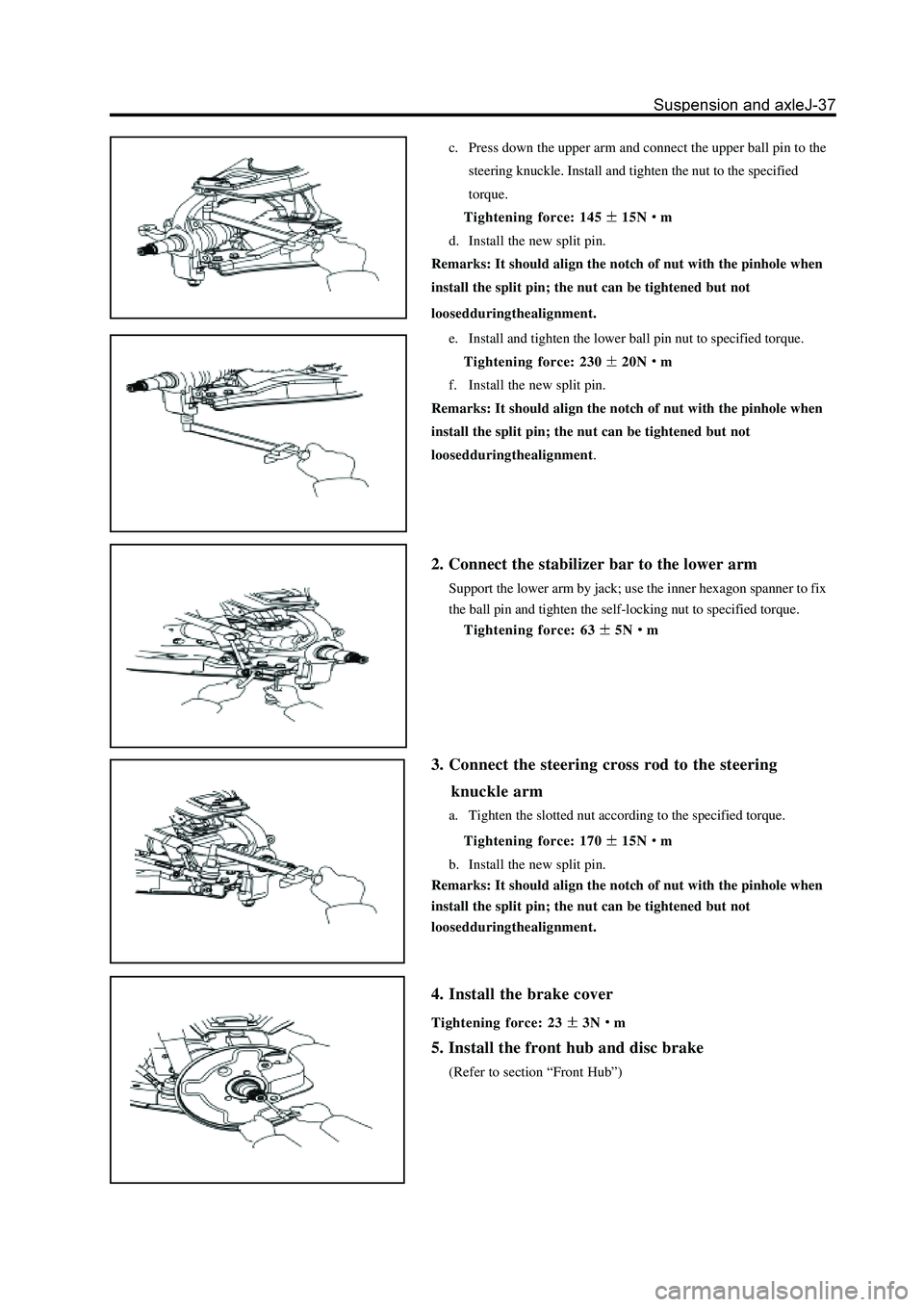
c. Press down the upper arm and connect the upper ball pin to the
steering knuckle. Install and tighten the nut to the specified
torque.
Tightening force: 145
15Nm
d. Install the new split pin.
Remarks: It should align the notch of nut with the pinhole when
install the split pin; the nut can be tightened but not
loosedduringthealignment.
e. Install and tighten the lower ball pin nut to specified torque.
Tightening force: 230
20Nm
f. Install the new split pin.
Remarks: It should align the notch of nut with the pinhole when
install the split pin; the nut can be tightened but not
loosedduringthealignment.
2. Connect the stabilizer bar to the lower arm
Support the lower arm by jack; use the inner hexagon spanner to fix
the ball pin and tighten the self-locking nut to specified torque.
Tightening force: 63
5Nm
3. Connect the steering cross rod to the steering
knuckle arm
a. Tighten the slotted nut according to the specified torque.
Tightening force: 170
15Nm
b. Install the new split pin.
Remarks: It should align the notch of nut with the pinhole when
install the split pin; the nut can be tightened but not
loosedduringthealignment.
4. Install the brake cover
Tightening force: 233Nm
5. Install the front hub and disc brake
(Refer to section “Front Hub”)
Page 211 of 425
Ball pin
Check of ball pin
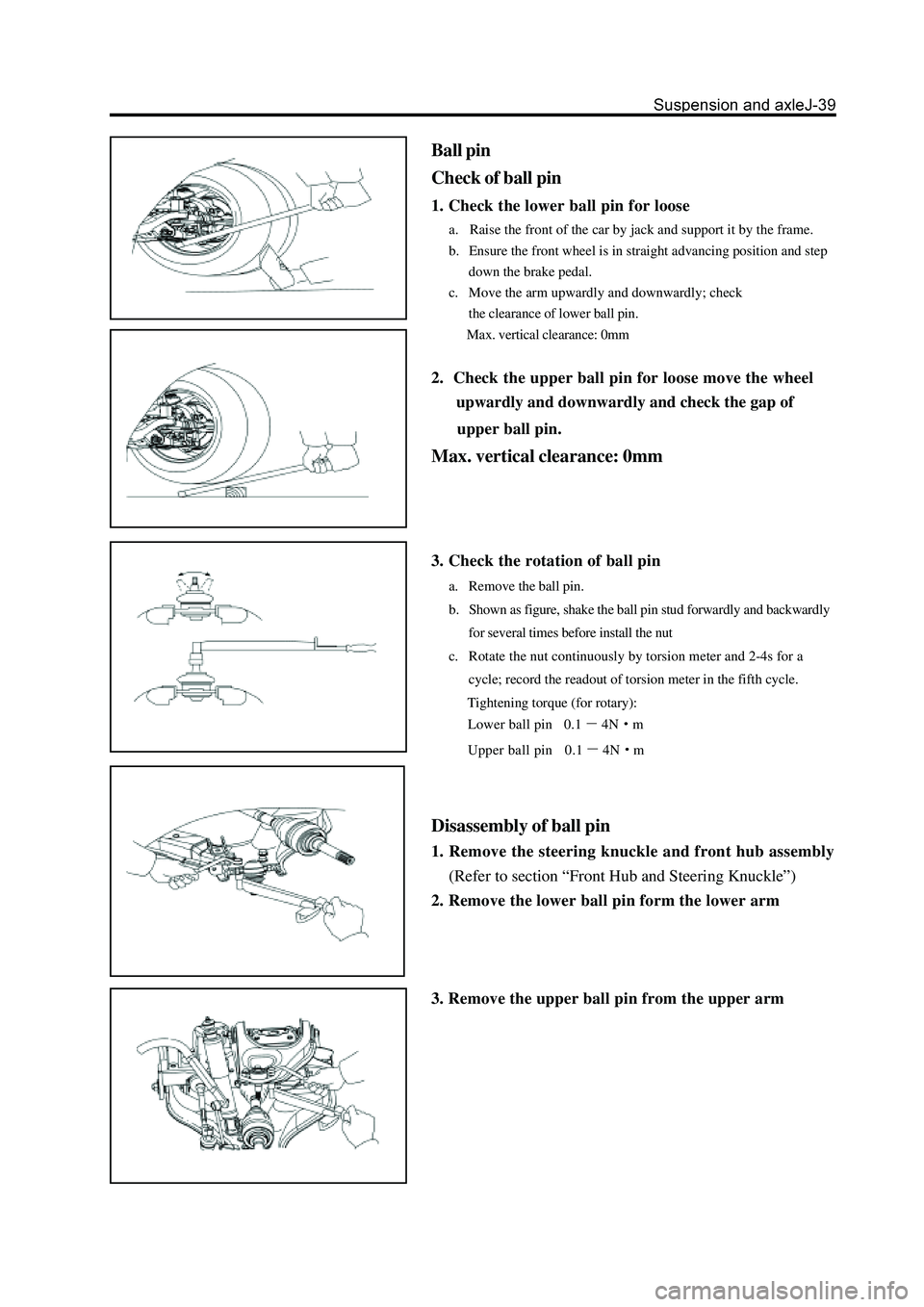
1. Check the lower ball pin for loose
a. Raise the front of the car by jack and support it by the frame.
b. Ensure the front wheel is in straight advancing position and step
down the brake pedal.
c. Move the arm upwardly and downwardly; check
the clearance of lower ball pin.
Max. vertical clearance: 0mm
2. Check the upper ball pin for loose move the wheel
upwardly and downwardly and check the gap of
upper ball pin.
Max. vertical clearance: 0mm
3. Check the rotation of ball pin
a. Remove the ball pin.
b. Shown as figure, shake the ball pin stud forwardly and backwardly
for several times before install the nut
c. Rotate the nut continuously by torsion meter and 2-4s for a
cycle; record the readout of torsion meter in the fifth cycle.
Tightening torque (for rotary):
Lower ball pin 0.1
4Nm
Upper ball pin 0.1
4Nm
Disassembly of ball pin
1. Remove the steering knuckle and front hub assembly
(Refer to section “Front Hub and Steering Knuckle”)
2. Remove the lower ball pin form the lower arm
3. Remove the upper ball pin from the upper arm
Page 219 of 425
Upper suspension arm
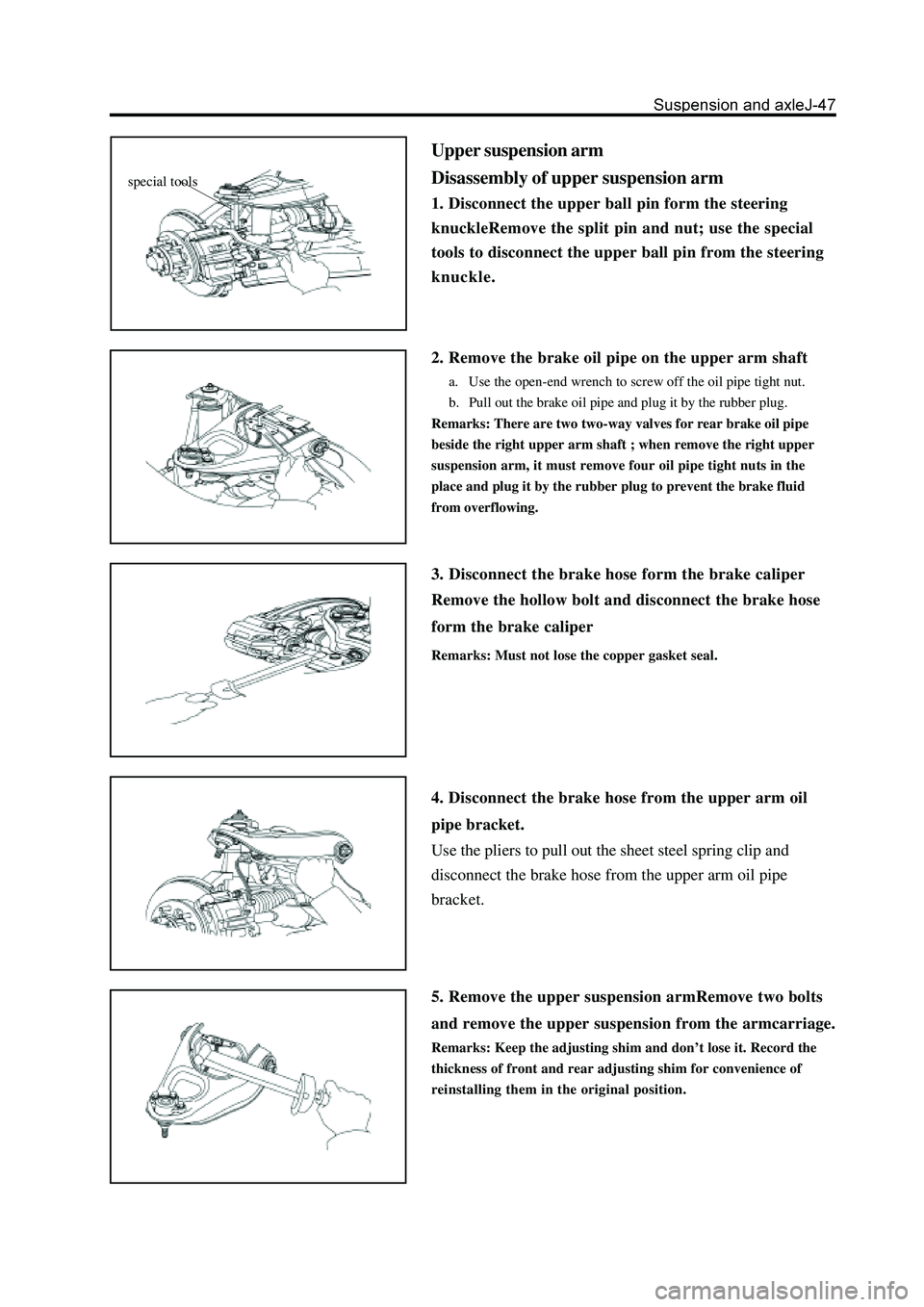
Disassembly of upper suspension arm
1. Disconnect the upper ball pin form the steering
knuckleRemove the split pin and nut; use the special
tools to disconnect the upper ball pin from the steering
knuckle.
2. Remove the brake oil pipe on the upper arm shaft
a. Use the open-end wrench to screw off the oil pipe tight nut.
b. Pull out the brake oil pipe and plug it by the rubber plug.
Remarks: There are two two-way valves for rear brake oil pipe
beside the right upper arm shaft ; when remove the right upper
suspension arm, it must remove four oil pipe tight nuts in the
place and plug it by the rubber plug to prevent the brake fluid
from overflowing.
3. Disconnect the brake hose form the brake caliper
Remove the hollow bolt and disconnect the brake hose
form the brake caliper
Remarks: Must not lose the copper gasket seal.
4. Disconnect the brake hose from the upper arm oil
pipe bracket.
Use the pliers to pull out the sheet steel spring clip and
disconnect the brake hose from the upper arm oil pipe
bracket.
5. Remove the upper suspension armRemove two bolts
and remove the upper suspension from the armcarriage.
Remarks: Keep the adjusting shim and don’t lose it. Record the
thickness of front and rear adjusting shim for convenience of
reinstalling them in the original position.
special tools
Page 221 of 425
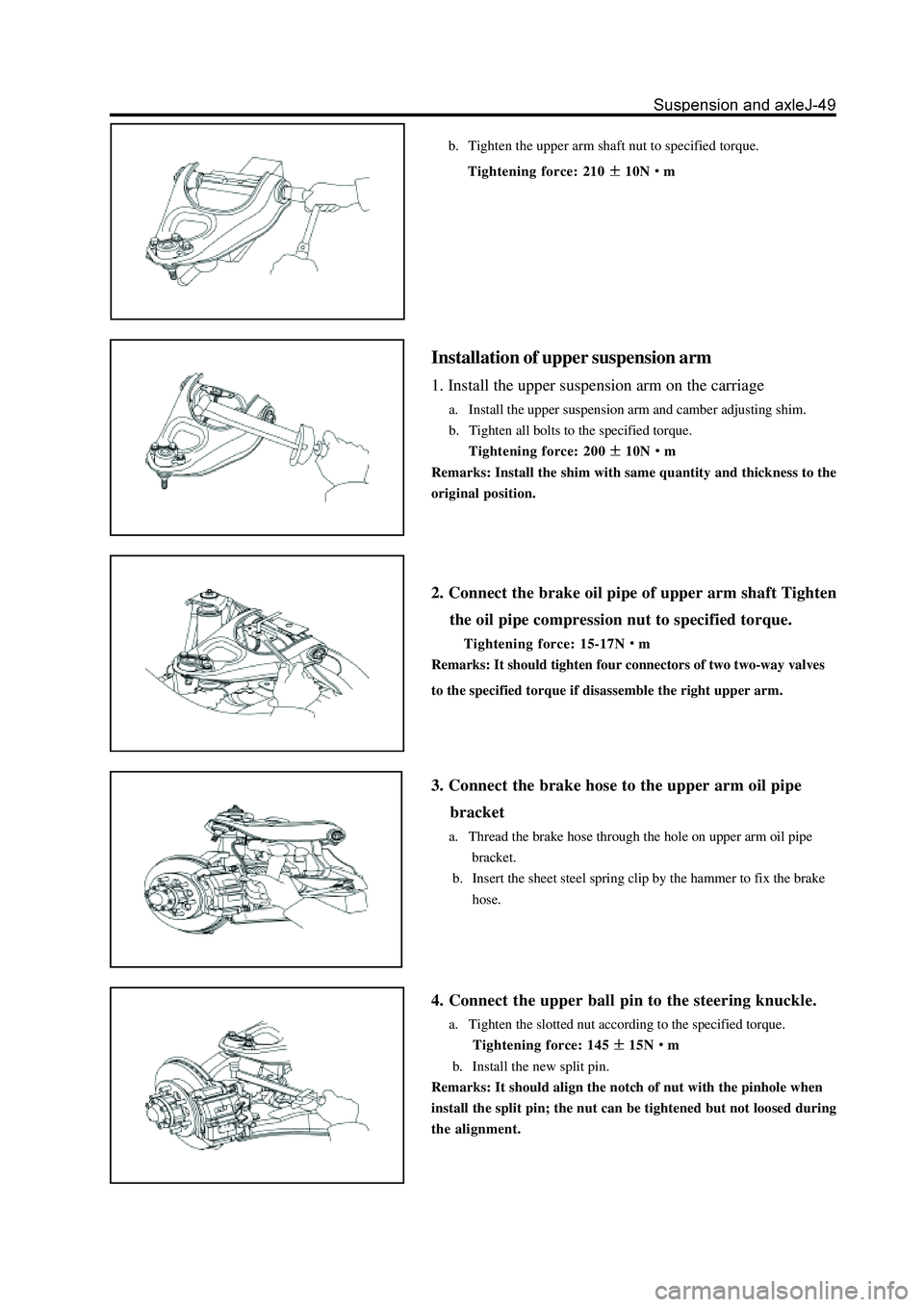
b. Tighten the upper arm shaft nut to specified torque.
Tightening force: 210
10Nm
Installation of upper suspension arm
1. Install the upper suspension arm on the carriage
a. Install the upper suspension arm and camber adjusting shim.
b. Tighten all bolts to the specified torque.
Tightening force: 200
10Nm
Remarks: Install the shim with same quantity and thickness to the
original position.
2. Connect the brake oil pipe of upper arm shaft Tighten
the oil pipe compression nut to specified torque.
Tightening force: 15-17Nm
Remarks: It should tighten four connectors of two two-way valves
to the specified torque if disassemble the right upper arm.
3. Connect the brake hose to the upper arm oil pipe
bracket
a. Thread the brake hose through the hole on upper arm oil pipe
bracket.
b. Insert the sheet steel spring clip by the hammer to fix the brake
hose.
4. Connect the upper ball pin to the steering knuckle.
a. Tighten the slotted nut according to the specified torque.
Tightening force: 145
15Nm
b. Install the new split pin.
Remarks: It should align the notch of nut with the pinhole when
install the split pin; the nut can be tightened but not loosed during
the alignment.
Page 222 of 425
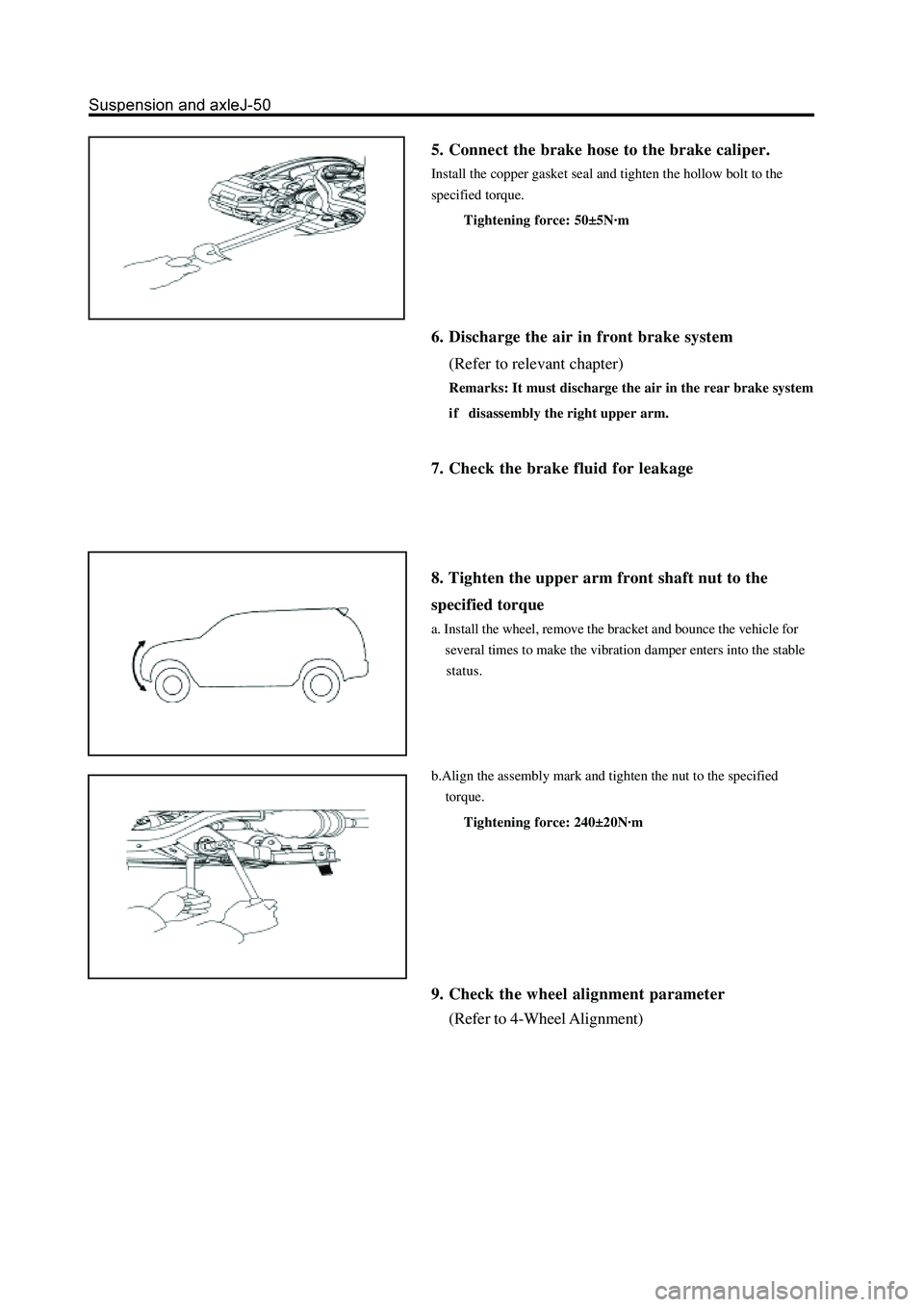
5. Connect the brake hose to the brake caliper.
Install the copper gasket seal and tighten the hollow bolt to the
specified torque.
Tightening force: 50±5N·m
6. Discharge the air in front brake system
(Refer to relevant chapter)
Remarks: It must discharge the air in the rear brake system
i f disassembly the right upper arm.
7. Check the brake fluid for leakage
8. Tighten the upper arm front shaft nut to the
specified torque
a. Install the wheel, remove the bracket and bounce the vehicle for
several times to make the vibration damper enters into the stable
status.
b.Align the assembly mark and tighten the nut to the specified
torque.
Tightening force: 240±20N·m
9. Check the wheel alignment parameter
(Refer to 4-Wheel Alignment)
Page 268 of 425
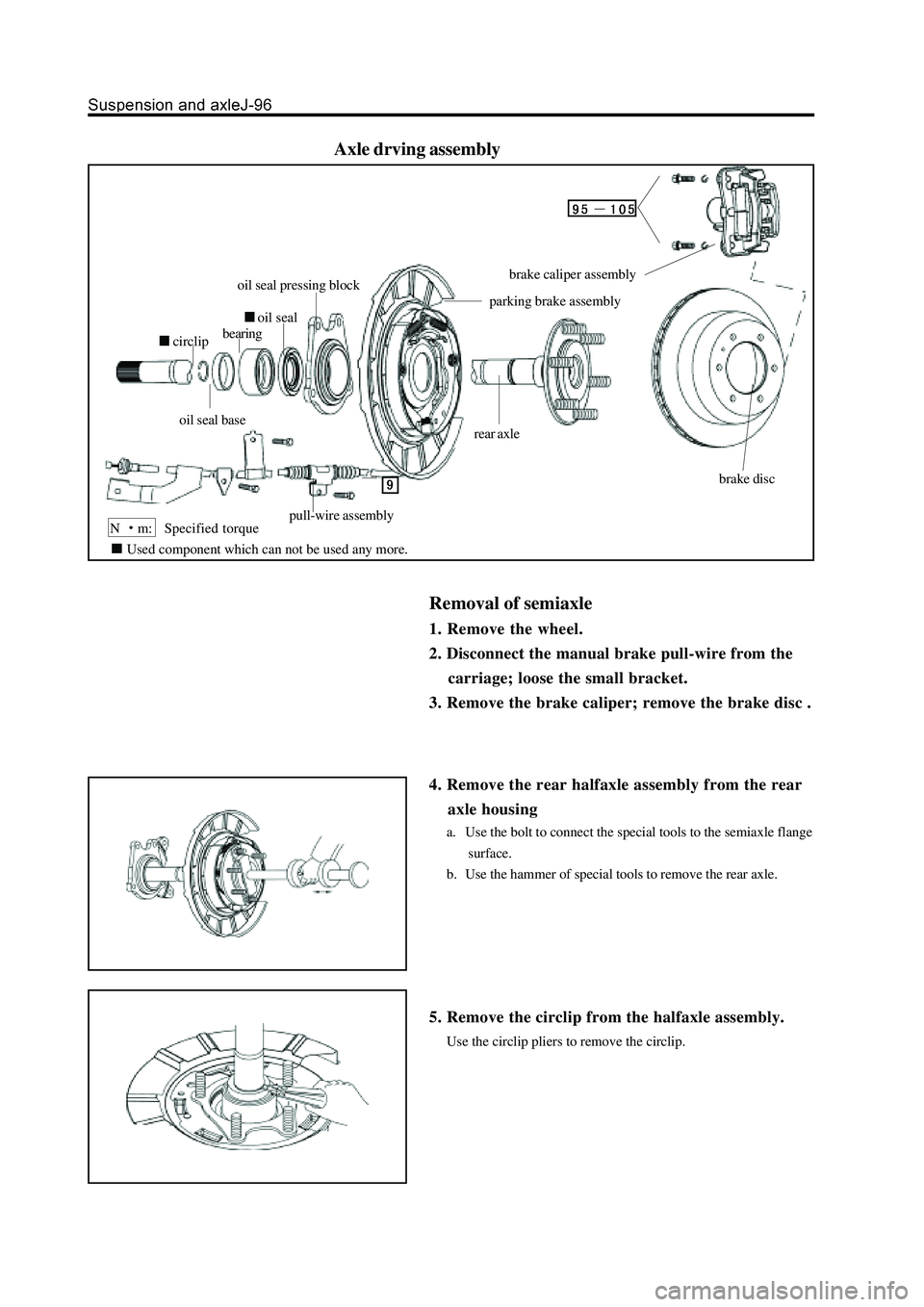
Axle drving assembly
Removal of semiaxle
1. Remove the wheel.
2. Disconnect the manual brake pull-wire from the
carriage; loose the small bracket.
3. Remove the brake caliper; remove the brake disc .
4. Remove the rear halfaxle assembly from the rear
axle housing
a. Use the bolt to connect the special tools to the semiaxle flange
surface.
b. Use the hammer of special tools to remove the rear axle.
brake caliper assembly
brake disc
circlip
oil seal base
bearing
oil seal
oil seal pressing block
parking brake assembly
rear axle
N
m: Specified torque
Used component which can not be used any more.
pull-wire assembly
5. Remove the circlip from the halfaxle assembly.
Use the circlip pliers to remove the circlip.
Page 269 of 425
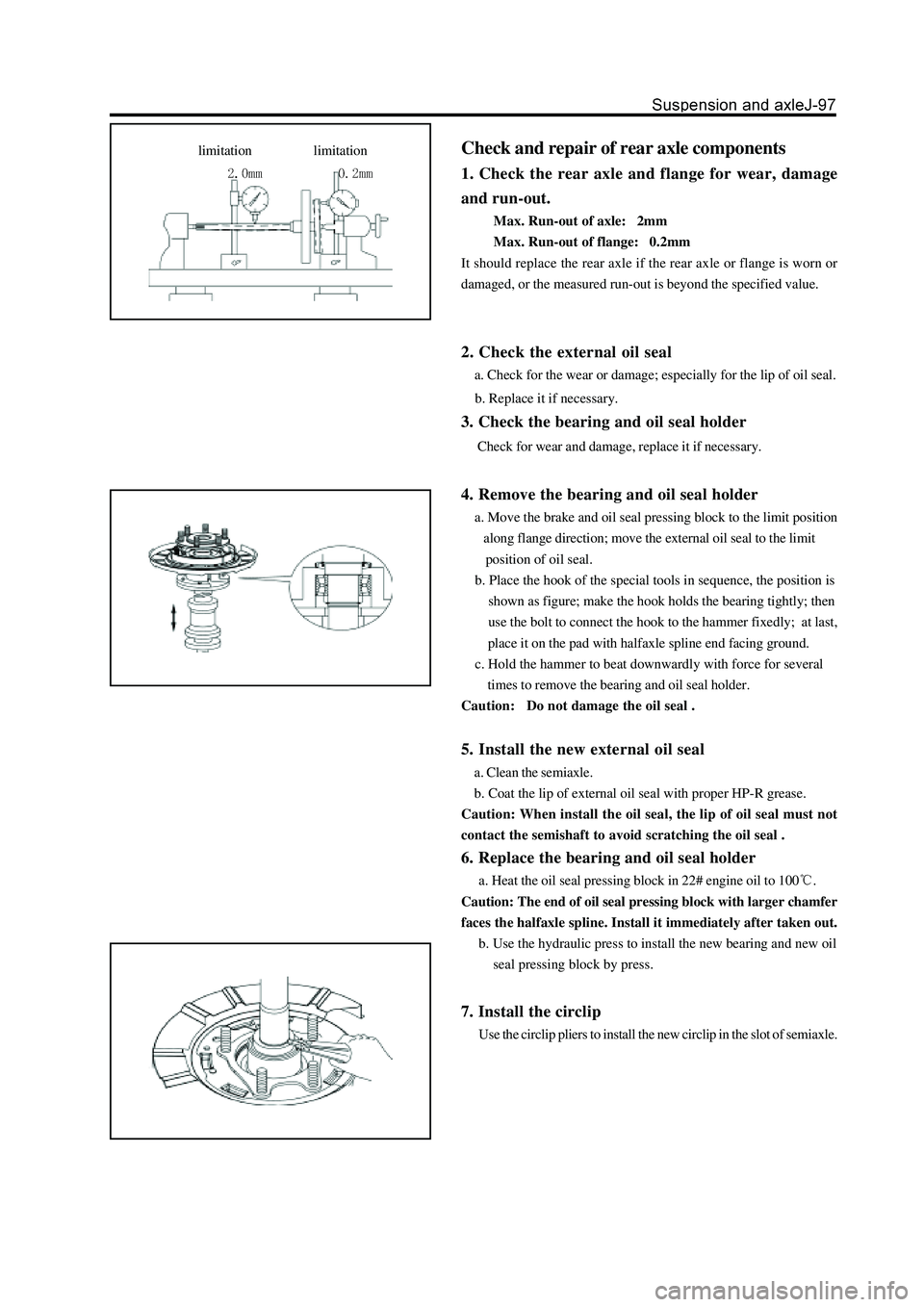
limitationlimitationCheck and repair of rear axle components
1. Check the rear axle and flange for wear, damage
and run-out.
Max. Run-out of axle: 2mm
Max. Run-out of flange: 0.2mm
It should replace the rear axle if the rear axle or flange is worn or
damaged, or the measured run-out is beyond the specified value.
2. Check the external oil seal
a. Check for the wear or damage; especially for the lip of oil seal.
b. Replace it if necessary.
3. Check the bearing and oil seal holder
Check for wear and damage, replace it if necessary.
4. Remove the bearing and oil seal holder
a. Move the brake and oil seal pressing block to the limit position
along flange direction; move the external oil seal to the limit
position of oil seal.
b. Place the hook of the special tools in sequence, the position is
shown as figure; make the hook holds the bearing tightly; then
use the bolt to connect the hook to the hammer fixedly; at last,
place it on the pad with halfaxle spline end facing ground.
c. Hold the hammer to beat downwardly with force for several
times to remove the bearing and oil seal holder.
Caution: Do not damage the oil seal .
5. Install the new external oil seal
a. Clean the semiaxle.
b. Coat the lip of external oil seal with proper HP-R grease.
Caution: When install the oil seal, the lip of oil seal must not
contact the semishaft to avoid scratching the oil seal .
6. Replace the bearing and oil seal holder
a. Heat the oil seal pressing block in 22# engine oil to 100.
Caution: The end of oil seal pressing block with larger chamfer
faces the halfaxle spline. Install it immediately after taken out.
b. Use the hydraulic press to install the new bearing and new oil
seal pressing block by press.
7. Install the circlip
Use the circlip pliers to install the new circlip in the slot of semiaxle.
Page 270 of 425
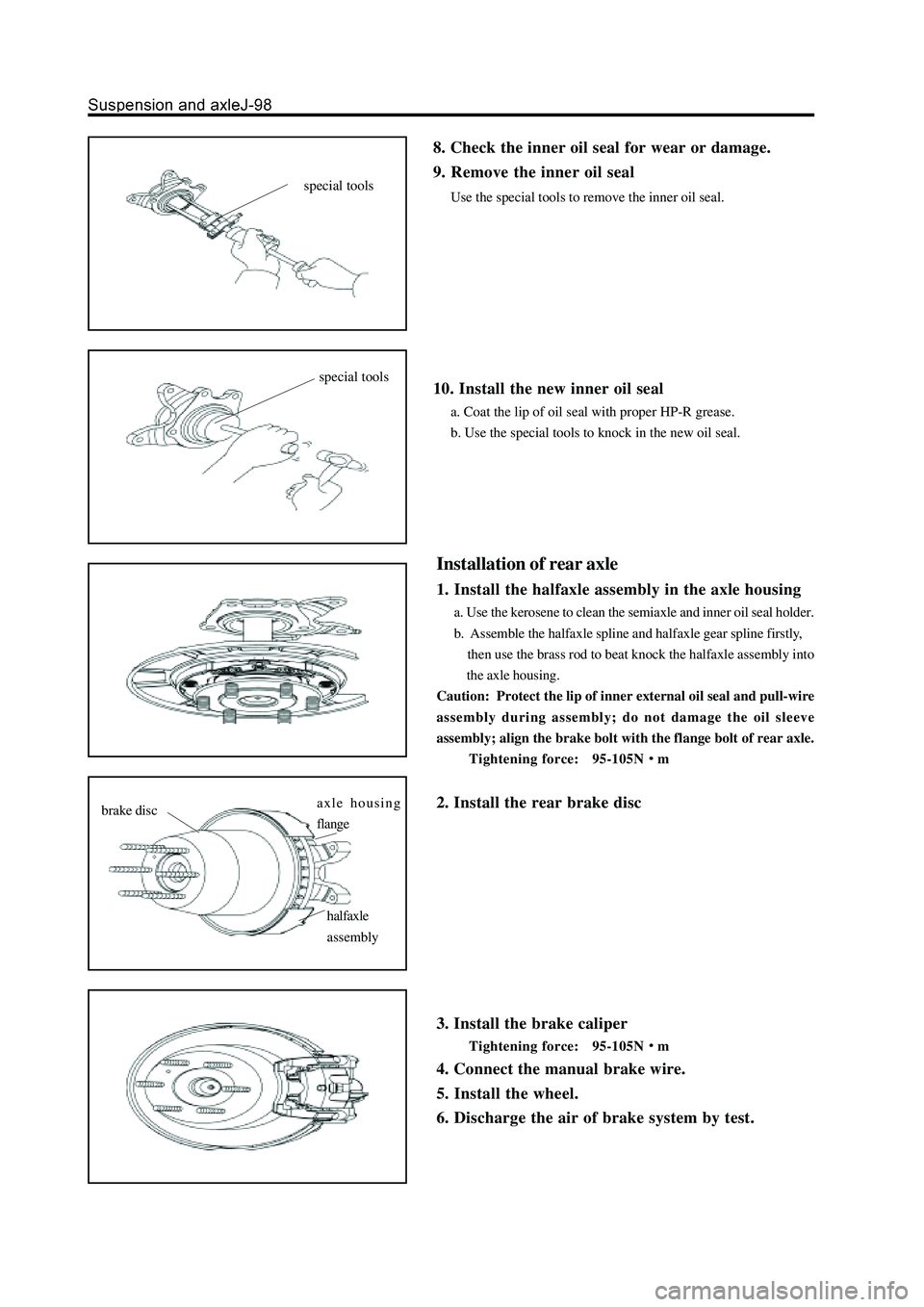
8. Check the inner oil seal for wear or damage.
9. Remove the inner oil seal
Use the special tools to remove the inner oil seal.
10. Install the new inner oil seal
a. Coat the lip of oil seal with proper HP-R grease.
b. Use the special tools to knock in the new oil seal.
Installation of rear axle
1. Install the halfaxle assembly in the axle housing
a. Use the kerosene to clean the semiaxle and inner oil seal holder.
b. Assemble the halfaxle spline and halfaxle gear spline firstly,
then use the brass rod to beat knock the halfaxle assembly into
the axle housing.
Caution: Protect the lip of inner external oil seal and pull-wire
assembly during assembly; do not damage the oil sleeve
assembly; align the brake bolt with the flange bolt of rear axle.
Tightening force: 95-105N
m
2. Install the rear brake disc
3. Install the brake caliper
Tightening force: 95-105Nm
4. Connect the manual brake wire.
5. Install the wheel.
6. Discharge the air of brake system by test.
special tools
special tools
brake discaxle housing
flange
halfaxle
assembly
Page 287 of 425

Brake-1
Chapter 8
Brake
Cautions...................................................................................... 2
Troubleshooting............................................................................2
Check and adjustment..................................................................5
Brake pedal..................................................................................7
Parking brake...............................................................................8
Front brake...................................................................................9
Rear brake...................................................................................16
Rear parking brake......................................................................22
Sensor load proportional valve.....................................................29
Antilock Braking System (ABS)..................................................31
Page 288 of 425
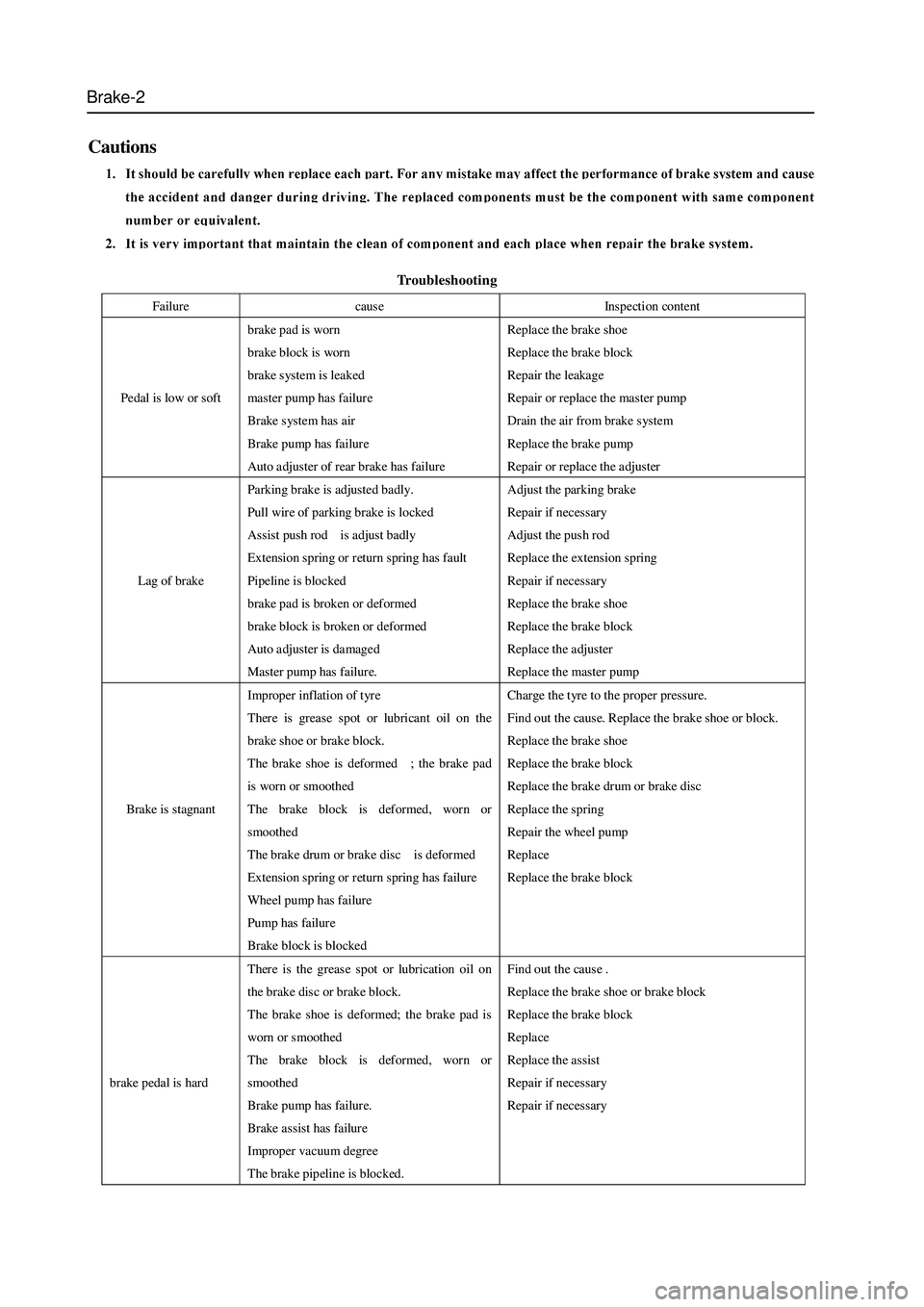
Brake-2
Troubleshooting
Cautions
Failure cause Inspection content
Pedal is low or soft brake pad is worn
brake block is worn
brake system is leaked
master pump has failure
Brake system has air
Brake pump has failure
Auto adjuster of rear brake has failure Replace the brake shoe
Replace the brake block
Repair the leakage
Repair or replace the master pump
Drain the air from brake system
Replace the brake pump
Repair or replace the adjuster
Lag of brake Parking brake is adjusted badly.
Pull wire of parking brake is locked
Assist push rod is adjust badly
Extension spring or return spring has fault
Pipeline is blocked
brake pad is broken or deformed
brake block is broken or deformed
Auto adjuster is damaged
Master pump has failure. Adjust the parking brake
Repair if necessary
Adjust the push rod
Repla ce the extension spring
Repair if necessary
Replace the brake shoe
Replace the brake block
Repla ce the a djuster
Repla ce the master pump
Brake is stagnant Improper inflation of tyre
There is grease spot or lubricant oil on the
brake shoe or brake block.
The brake shoe is deformed ; the brake pad
is worn or smoothed
The brake block is deformed, worn or
smoothed
The brake drum or brake disc is deformed
Extension spring or return spring has failure
Wheel pump has failure
Pump has failure
Brake block is blocked Charge the tyre to the proper pressure.
Find out the cause. Replace the brake shoe or block.
Replace the brake shoe
Replace the brake block
Replace the brake drum or brake disc
Repla ce the spring
Repair the wheel pump
Replace
Replace the brake block
brake pedal is hard There is the grease spot or lubrication oil on
the brake disc or brake block.
The brake shoe is deformed; the brake pad is
worn or s moothed
The brake block is deformed, worn or
smoothed
Brake pump has failure.
Brake assist has failure
Improper vacuum degree
The brake pipeline is blocked. Find out the caus e .
Replace the brake shoe or brake block
Replace the brake block
Replace
Replace the assist
Repair if necessary
Repair if necessary