oil pressure HONDA ACCORD HYBRID 2019 Owners Manual
[x] Cancel search | Manufacturer: HONDA, Model Year: 2019, Model line: ACCORD HYBRID, Model: HONDA ACCORD HYBRID 2019Pages: 727, PDF Size: 24.78 MB
Page 29 of 727
27
Quick Reference Guide
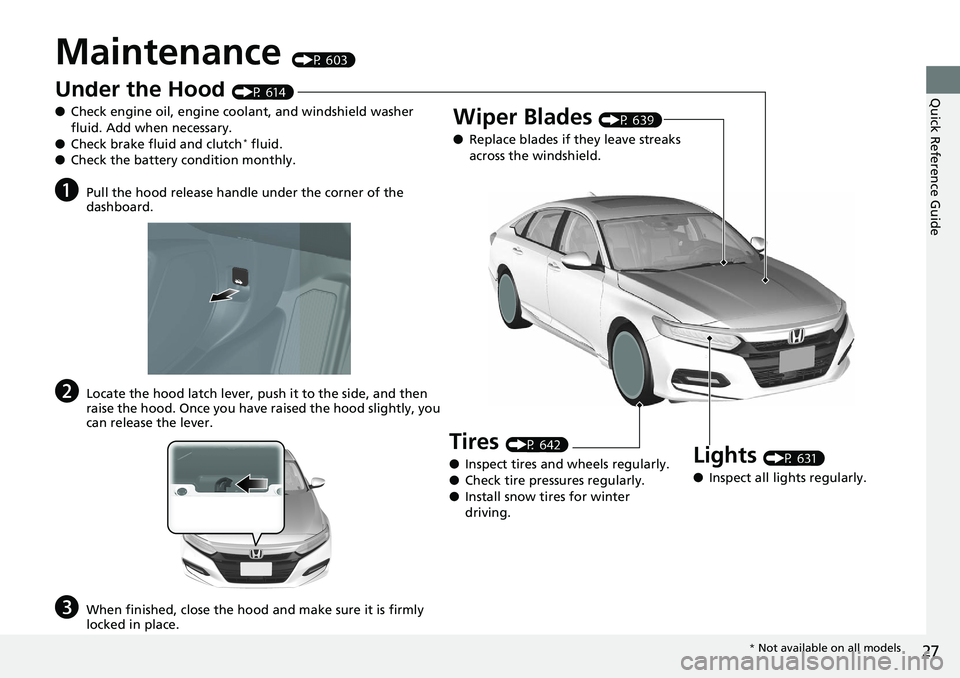
Maintenance (P 603)
Under the Hood (P 614)
● Check engine oil, engine coolant, and windshield washer
fluid. Add when necessary.
● Check brake fluid and clutch *
fluid.
● Check the battery condition monthly.
a Pull the hood release handle under the corner of the
dashboard.
b Locate the hood latch lever, push it to the side, and then
raise the hood. Once you have raised the hood slightly, you
can release the lever.
c When finished, close the hood and make sure it is firmly
locked in place. Lights (P 631)
● Inspect all lights regularly.Wiper Blades (P 639)
● Replace blades if they leave streaks
across the windshield.
Tires (P 642)
● Inspect tires and wheels regularly.
● Check tire pressures regularly.
● Install snow tires for winter
driving.
* Not available on all models
Page 108 of 727
106 uu Indicators u Driver Information Interface Wa rning and Information Messages
Instrument Panel Message Condition Explanation
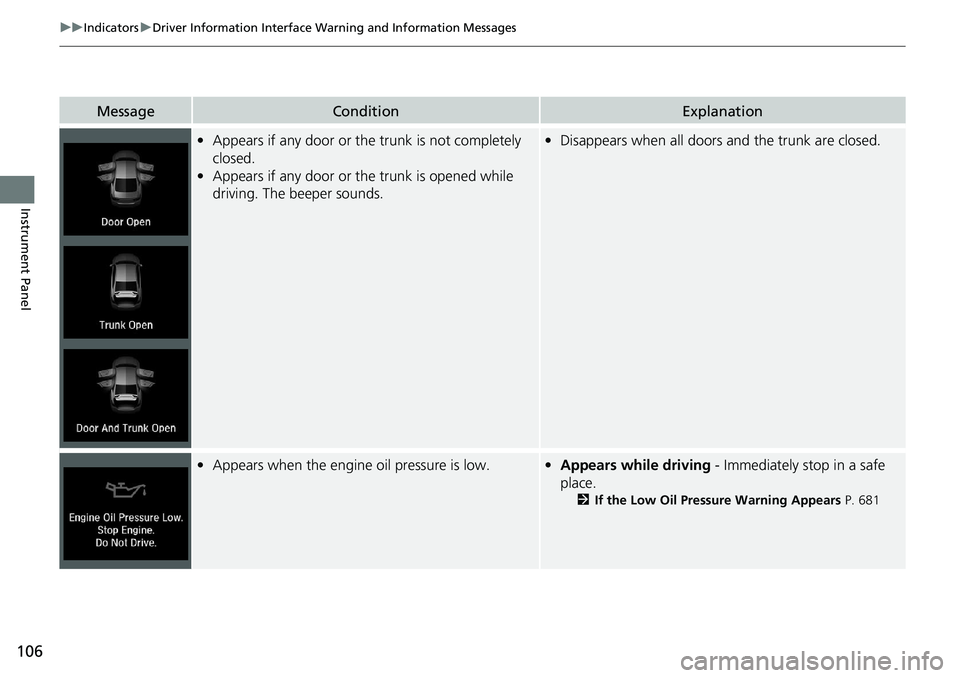
• Appears if any door or the trunk is not completely
closed.
• Appears if any door or the trunk is opened while
driving. The beeper sounds. • Disappears when all doors and the trunk are closed.
• Appears when the engine oil pressure is low. • Appears while driving - Immediately stop in a safe
place. 2 If the Low Oil Pressure Warning Appears P. 681
Page 472 of 727
uu When Driving u Starting the Engine
470
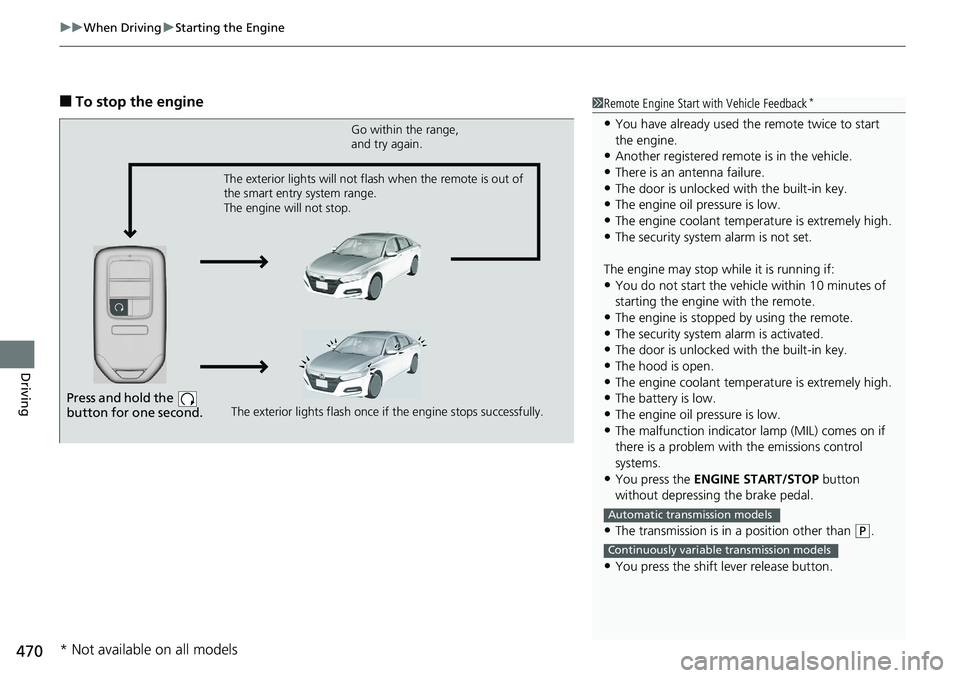
Driving ■ To stop the engine 1 Remote Engine Start with Vehicle Feedback *
• You have already used the remote twice to start
the engine.
• Another registered remo te is in the vehicle.
• There is an antenna failure.
• The door is unlocked with the built-in key.
• The engine oil pressure is low.
• The engine coolant temper ature is extremely high.
• The security system alarm is not set.
The engine may stop whil e it is running if:
• You do not start the vehicl e within 10 minutes of
starting the engine with the remote.
• The engine is stopped by using the remote.
• The security system alarm is activated.
• The door is unlocked with the built-in key.
• The hood is open.
• The engine coolant temper ature is extremely high.
• The battery is low.
• The engine oil pressure is low.
• The malfunction indicator lamp (MIL) comes on if
there is a problem with the emissions control
systems.
• You press the ENGINE START/STOP button
without depressing the brake pedal.
• The transmission is in a position other than ( P
.
• You press the shift lever release button. Automatic transmission models
Continuously variable transmission modelsPress and hold the
button for one second. Go within the range,
and try again.
The exterior lights flash once if the engine stops successfully.The exterior lights will not flash when the remote is out of
the smart entry system range.
The engine will not stop.
* Not available on all models
Page 602 of 727
600
Driving Fuel Economy and CO 2
EmissionsImproving Fuel Economy and Reducing CO 2
EmissionsAchieving fuel economy and reducing CO 2
emissions is dependent on several
factors, including driving conditions, load weight, idling time, driving habits, and
vehicle condition. Depending on these and other factors, you may not achieve the
rated fuel economy of this vehicle.
You can optimize your fuel economy with proper maintenance of your vehicle.
Always maintain your vehicle in accordance with the messages displayed on the
driver information interface.
• Use the recommended viscosity engine oil, displaying the API Certification Seal.
• Maintain the specified tire pressure.
• Do not load the vehicl e with excess cargo.
• Keep your vehicle clean. A buildup of snow or mud on your vehicle’s underside
adds weight and increases wind resistance.■ Maintenance and Fuel Economy 1 Improving Fuel Economy and Reducing CO 2
Emissions
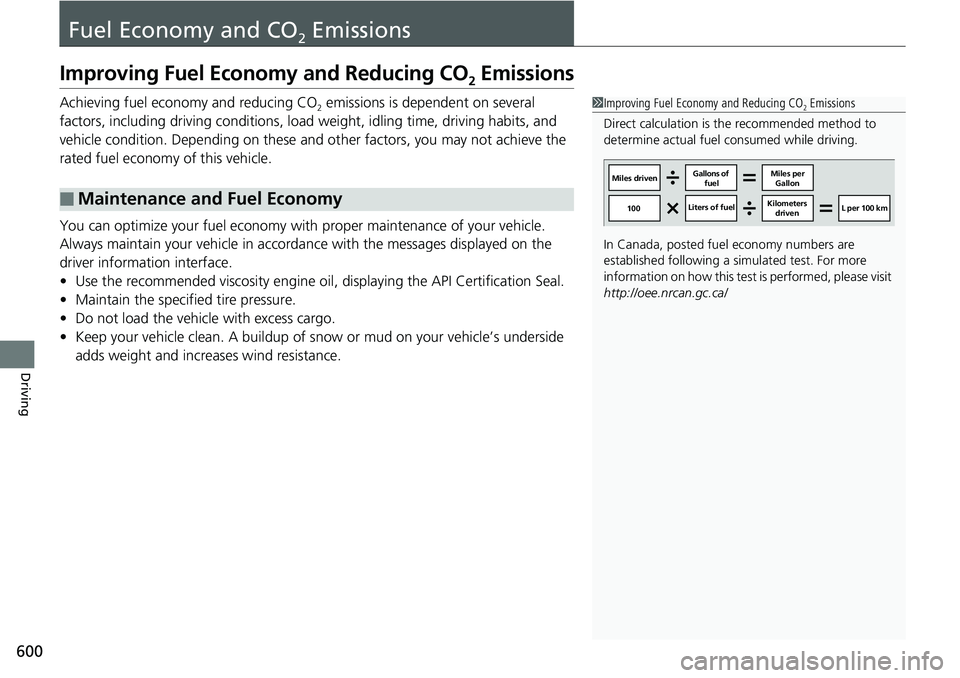
Direct calculation is the recommended method to
determine actual fuel consumed while driving.
In Canada, posted fuel economy numbers are
established following a simulated test. For more
information on how this test is performed, please visit
http://oee.nrcan.gc.ca/ Miles driven Gallons of
fuel Miles per
Gallon
100 Liters of fuel Kilometers
driven L per 100 km
Page 603 of 727
601
Driving
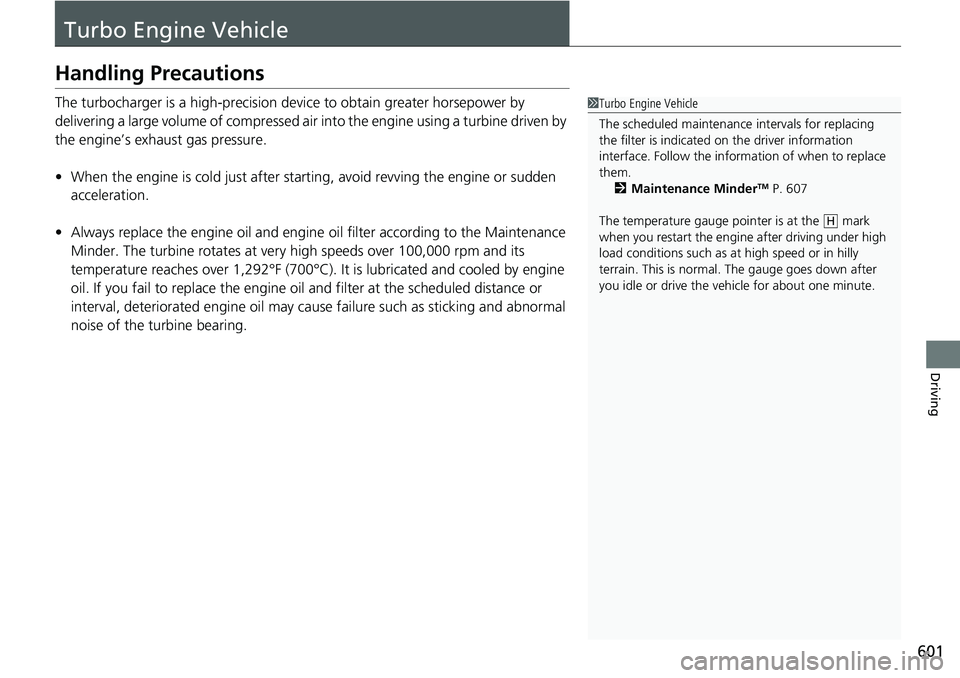
Turbo Engine VehicleHandling Precautions The turbocharger is a high-precision devi ce to obtain greater horsepower by
delivering a large volume of compressed air into the engine using a turbine driven by
the engine’s exhaust gas pressure.
• When the engine is cold just after sta rting, avoid revving the engine or sudden
acceleration.
• Always replace the engine oil and engine oil filter according to the Maintenance
Minder. The turbine rotates at very high speeds over 100,000 rpm and its
temperature reaches over 1,29 2°F (700°C). It is lubricat ed and cooled by engine
oil. If you fail to replace the engine oil and filter at the scheduled distance or
interval, deteriorated engine oil may caus e failure such as st icking and abnormal
noise of the turbine bearing. 1 Turbo Engine Vehicle
The scheduled maintenance intervals for replacing
the filter is indicated on the driver information
interface. Follow the information of when to replace
them.
2 Maintenance Minder TM
P. 607
The temperature gauge pointer is at the mark
when you restart the engi ne after driv ing under high
load conditions such as at high speed or in hilly
terrain. This is normal. The gauge goes down after
you idle or drive the vehi cle for about one minute. H
Page 606 of 727
604
Maintenance Before Performing MaintenanceInspection and Maintenance For your safety, perform all listed inspecti ons and maintenance to keep your vehicle
in good condition. If you become aware of any abnormality (noise, smell, insufficient
brake fluid, oil residue on the ground, etc.), have your vehicle inspected by a dealer.
(Note, however, that service at a dealer is not mandatory to keep your warranties in
effect.)
■ Daily inspections
Perform inspections before long distance trips, when washing the vehicle, or when
refueling.
■ Periodic inspections
• Check the brake fluid level monthly. 2 Brake/Clutch *
Fluid P. 629
• Check the tire pressure monthly. Examin e the tread for wear and foreign objects.2 Checking and Maintaining Tires P. 642
• Check the operation of the exterior lights monthly.2 Replacing Light Bulbs P. 631
• Check the condition of the wiper bl ades at least every six months.2 Checking and Maintaining Wiper Blades P. 639■ Types of Inspection and Maintenance 1 Inspection and Maintenance
Maintenance, replacement, or repair of
emissions control devices and systems may be
done by any automotive repair establishment or
individuals using parts that are “certified” to
EPA standards.
According to state and fede ral regulations, failure to
perform maintenance on the maintenance main
items marked with # will not void your emissions
warranties. However, all ma intenance services should
be performed in accordan ce with the intervals
indicated by the driver information interface.
2 Maintenance Service Items P. 611
If you want to perform complex maintenance tasks
that require more skills a nd tools, you can purchase a
subscription to the Service Express website at
www.techinfo.honda.com .
2 Authorized Manuals P. 711
If you want to perform ma intenance yourself, make
sure that you have the necessary tools and skills first.
After performing ma intenance, update the records in
the separate maintenance booklet. U.S. models
* Not available on all models
Page 626 of 727
uu Maintenance Under the Hood u Changing the Engine Oil and Oil Filter
624
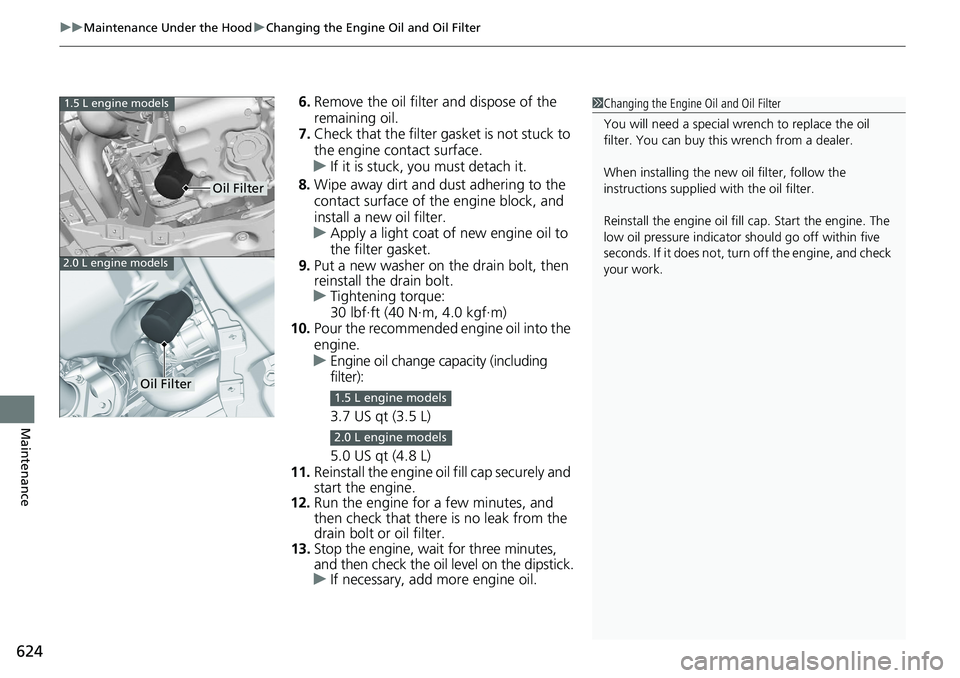
Maintenance 6. Remove the oil filter and dispose of the
remaining oil.
7. Check that the filter ga sket is not stuck to
the engine contact surface.
u If it is stuck, you must detach it.
8. Wipe away dirt and dust adhering to the
contact surface of the engine block, and
install a new oil filter.
u Apply a light coat of new engine oil to
the filter gasket.
9. Put a new washer on the drain bolt, then
reinstall the drain bolt.
u Tightening torque:
30 lbf∙ft (40 N∙m, 4.0 kgf∙m)
10. Pour the recommended engine oil into the
engine.
u Engine oil change capacity (including
filter):
3.7 US qt (3.5 L)
5.0 US qt (4.8 L)
11. Reinstall the engine oil fill cap securely and
start the engine.
12. Run the engine for a few minutes, and
then check that there is no leak from the
drain bolt or oil filter.
13. Stop the engine, wait for three minutes,
and then check the oil level on the dipstick.
u If necessary, add more engine oil. 1 Changing the Engine Oil and Oil Filter
You will need a special wrench to replace the oil
filter. You can buy this wrench from a dealer.
When installing the new oil filter, follow the
instructions supplied with the oil filter.
Reinstall the engine oil fill cap. Start the engine. The
low oil pressure indicator should go off within five
seconds. If it does not, turn off the engine, and check
your work.1.5 L engine models
2.0 L engine models Oil Filter
Oil Filter 1.5 L engine models
2.0 L engine models
Page 665 of 727
663Handling the Unexpected This chapter explains how to handle unexpected troubles.
Tools
Types of Tools .................................. 664
If a Tire Goes Flat
Changing a Flat Tire ......................... 665
Engine Does Not Start
Checking the Engine ........................ 671
If the Remote Battery is Weak ....... 672
Emergency Engine Stop ................... 673
Jump Starting .................................... 674
Shift Lever Does Not Move .............. 677
Overheating
How to Handle Overheating ............. 679 Indicator, Coming On/Blinking
If the Low Oil Pressure Warning Appears ... 681
If the Charging System Indicator Comes
On ................................................. 681
If the Malfunction Indicator Lamp Comes
On or Blinks ................................... 682
If the Brake System Indicator (Red) Comes
On or Blinks ................................... 683
If the Brake System Indicator (Red) Comes On
or Blinks at the Same Time When the Brake
System Indicator (Amber) Comes On.... 684
If the Electric Power Steering (EPS) System
Indicator Comes On ....................... 685 If the Low Tire Pressure/TPMS Indicator
Comes On or Blinks ....................... 686
If the Transmission I ndicator Blinks along
with the Warning Message ............ 687
Fuses
Fuse Locations ................................. 688
Inspecting and Changing Fuses ........ 692
Emergency Towing ........................... 693
When You Cannot Unlock the Fuel Fill
Door ................................................. 694
When You Cannot Open the Trunk ... 695
Refueling ........................................... 697
Page 683 of 727
681
Handling the Unexpected
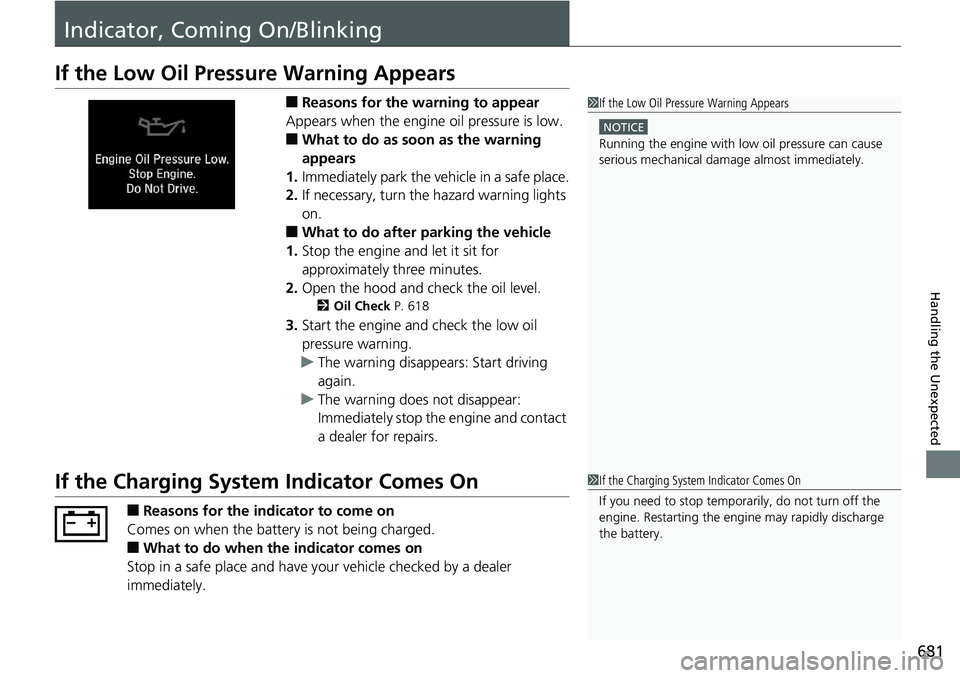
Indicator, Coming On/BlinkingIf the Low Oil Pressu re Warning Appears ■ Reasons for the warning to appear
Appears when the engine oil pressure is low.
■ What to do as soon as the warning
appears
1. Immediately park the vehicle in a safe place.
2. If necessary, turn the hazard warning lights
on.
■ What to do after parking the vehicle
1. Stop the engine and let it sit for
approximately three minutes.
2. Open the hood and ch eck the oil level.2 Oil Check P. 618
3. Start the engine and check the low oil
pressure warning.
u The warning disappears: Start driving
again.
u The warning does not disappear:
Immediately stop the engine and contact
a dealer for repairs.
If the Charging System Indicator Comes On■ Reasons for the indicator to come on
Comes on when the battery is not being charged.
■ What to do when th e indicator comes on
Stop in a safe place and have y our vehicle checked by a dealer
immediately. 1 If the Low Oil Pressure Warning Appears NOTICE
Running the engine with low oil pressure can cause
serious mechanical damage almost immediately.
1 If the Charging System Indicator Comes On
If you need to stop temporarily, do not turn off the
engine. Restarting the engi ne may rapidly discharge
the battery.
Page 703 of 727
701 uu Specifications u
Continued
Information
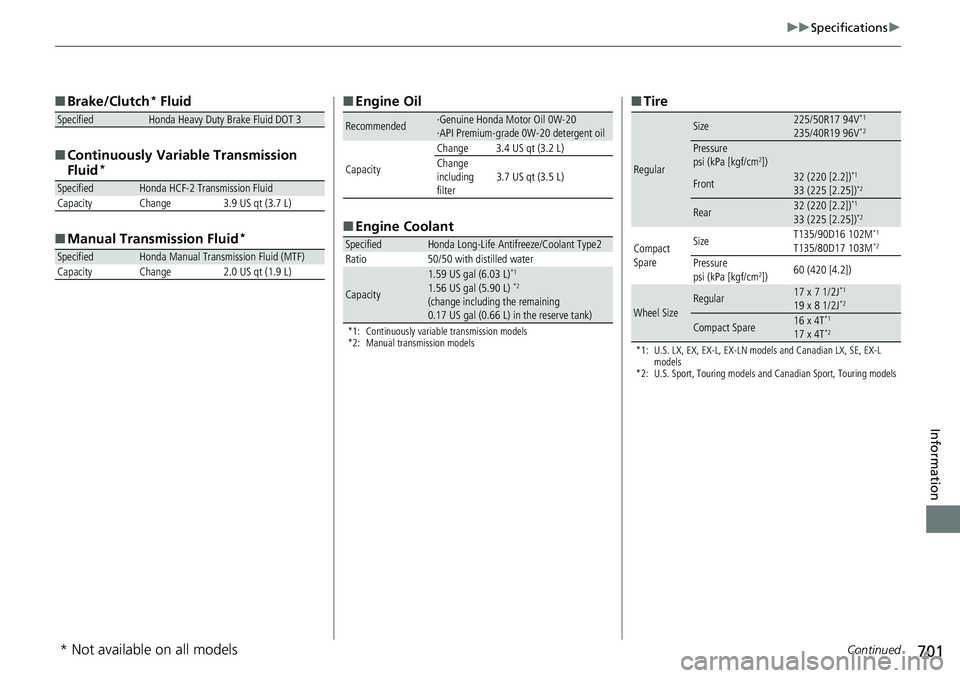
■ Brake/Clutch *
Fluid
■ Continuously Variable Transmission
Fluid *
■ Manual Transmission Fluid *Specified Honda Heavy Duty Brake Fluid DOT 3
Specified Honda HCF-2 Transmission Fluid
Capacity Change 3.9 US qt (3.7 L)
Specified Honda Manual Transmission Fluid (MTF)
Capacity Change 2.0 US qt (1.9 L) ■ Engine Oil
■ Engine Coolant *1: Continuously variable transmission models
*2: Manual transmission modelsRecommended ·Genuine Honda Motor Oil 0W-20
·API Premium-grade 0W-20 detergent oil
Capacity Change 3.4 US qt (3.2 L)
Change
including
filter 3.7 US qt (3.5 L)
Specified Honda Long-Life Antifreeze/Coolant Type2
Ratio 50/50 with distilled water
Capacity 1.59 US gal (6.03 L) *1
1.56 US gal (5.90 L) *2
(change including the remaining
0.17 US gal (0.66 L) in the reserve tank) ■ Tire
*1: U.S. LX, EX, EX-L, EX-LN models and Canadian LX, SE, EX-L
models
*2: U.S. Sport, Touring models and Canadian Sport, Touring modelsRegular Size 225/50R17 94V *1
235/40R19 96V *2
Pressure
psi (kPa [kgf/cm 2
])
Front 32 (220 [2.2]) *1
33 (225 [2.25]) *2
Rear 32 (220 [2.2]) *1
33 (225 [2.25]) *2
Compact
Spare Size T135/90D16 102M *1
T135/80D17 103M *2
Pressure
psi (kPa [kgf/cm 2
]) 60 (420 [4.2])
Wheel Size Regular 17 x 7 1/2J *1
19 x 8 1/2J *2
Compact Spare 16 x 4T *1
17 x 4T *2
* Not available on all models