steering HONDA ACCORD HYBRID 2019 Owners Manual
[x] Cancel search | Manufacturer: HONDA, Model Year: 2019, Model line: ACCORD HYBRID, Model: HONDA ACCORD HYBRID 2019Pages: 727, PDF Size: 24.78 MB
Page 5 of 727
ContentsChild Safety P. 61 Exhaust Gas Hazard P. 75 Safety Labels P. 76
Opening and Closing the Trunk P. 180 Security System P. 183 Opening and Closing the Windows P. 186
Operating the Switches Around the Steering Wheel P. 190 Adjusting the Mirrors P. 208
Interior Lights/Interior Convenience It ems P. 221 Climate Control System P. 239
Audio Error Messages P. 343 General Information on the Audio System P. 348
Bluetooth ® HandsFreeLink ® P. 403, 427 Refuel Recommend P. 452
When Driving P. 465 Braking P. 571 Parking Your Vehicle P. 583
Fuel Economy and CO 2
Emissions P. 600 Turbo Engine Vehicle P. 601
Maintenance Under the Hood P. 614 Replacing Light Bulbs P. 631
Checking and Maintaining Tires P. 642 Battery P. 651 Remote Transmitter Care P. 653
Cleaning P. 655 Accessories and Modifications P. 660
Engine Does Not Start P. 671 Jump Starti ng P. 674 Shift Lever Does Not Move P. 677
Fuses P. 688 Emergency Towing P. 693 When You Cannot Unlock the Fuel Fill Door P. 694
Refueling P. 697
Devices that Emit Radio Waves P. 705 Reporting Safety Defects P. 706
Authorized Manuals P. 711 Customer Service Information P. 712 Quick Reference Guide
P. 4 Safe Driving
P. 33 Instrument Panel
P. 77 Controls
P. 163 Features
P. 243 Driving
P. 453 Maintenance
P. 603 Handling the Unexpected
P. 663
Information
P. 699
Index
P. 713
Page 7 of 727
5
Quick Reference Guide
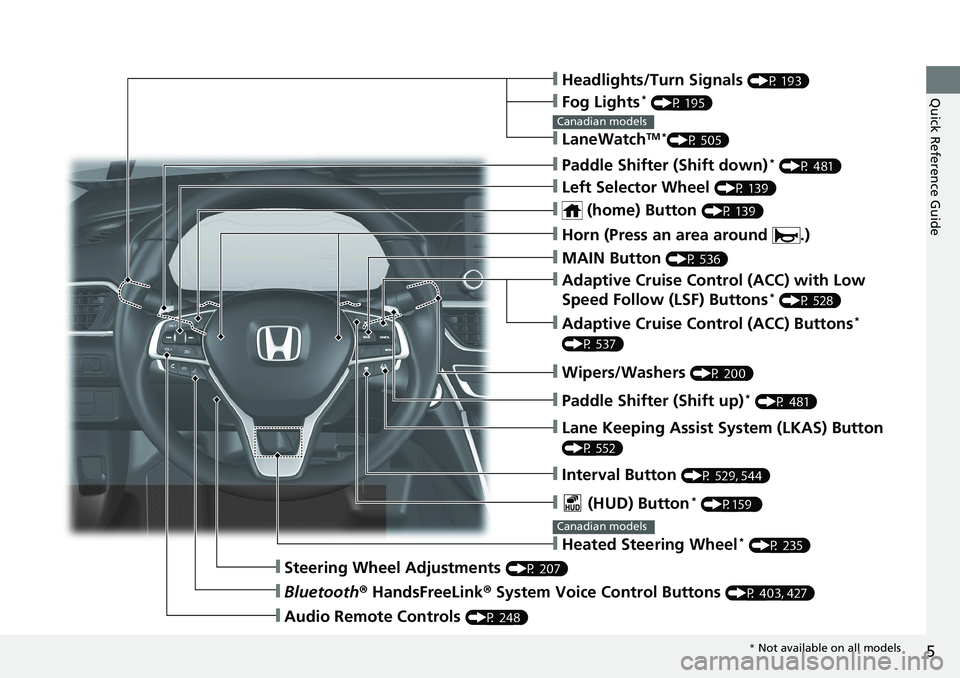
❙ Headlights/Turn Signals (P 193)
❙ Fog Lights *
(P 195)
❙ LaneWatch TM *
(P 505)Canadian models
❙ Paddle Shifter (Shift down) *
(P 481)
❙ Left Selector Wheel (P 139)
❙ (home) Button (P 139)
❙ MAIN Button (P 536)
❙ Adaptive Cruise Control (ACC) with Low
Speed Follow (LSF) Buttons *
(P 528)
❙ Adaptive Cruise Control (ACC) Buttons *
(P 537)
❙ Wipers/Washers (P 200)
❙ Paddle Shifter (Shift up) *
(P 481)
❙ Lane Keeping Assist System (LKAS) Button (P 552)
❙ Interval Button (P 529, 544)
❙ Steering Wheel Adjustments (P 207)
❙ Bluetooth ® HandsFreeLink ® System Voice Control Buttons (P 403, 427)
❙ Audio Remote Controls (P 248)❙ Horn (Press an area around .)
❙ (HUD) Button *
(P159 )
❙ Heated Steering Wheel *
(P 235)Canadian models
* Not available on all models
Page 12 of 727
10
Quick Reference Guide Safe Driving (P 33)
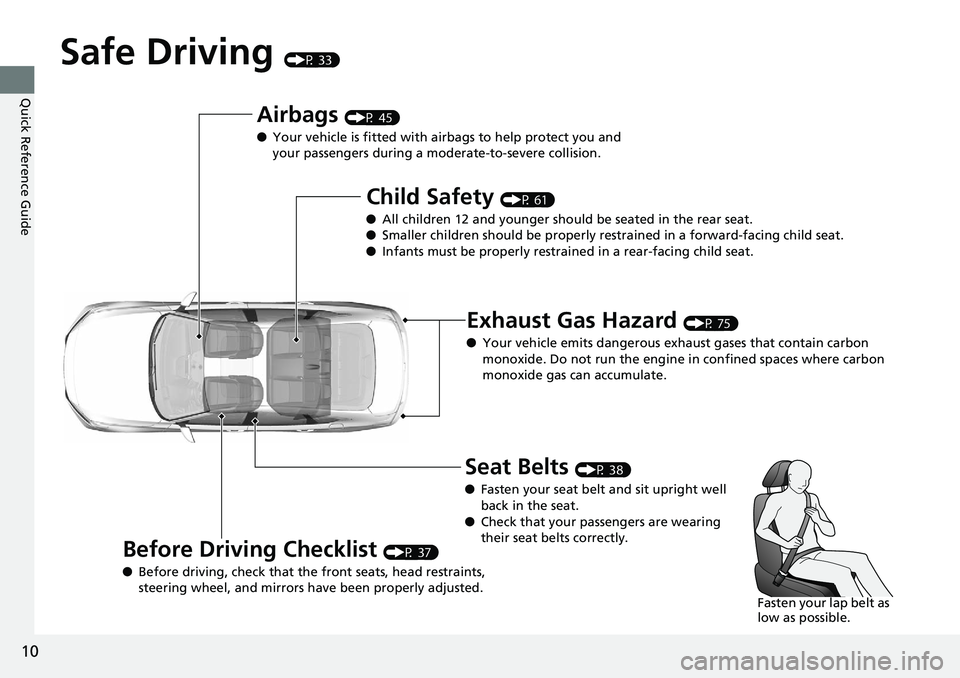
Airbags (P 45)
● Your vehicle is fitted with ai rbags to help protect you and
your passengers during a moderate-to-severe collision.
Child Safety (P 61)
● All children 12 and younger should be seated in the rear seat.
● Smaller children should be properly restra ined in a forward-facing child seat.
● Infants must be properly restraine d in a rear-facing child seat.
Exhaust Gas Hazard (P 75)
● Your vehicle emits dangerous exhaust gases that contain carbon
monoxide. Do not run the engine in confined spaces where carbon
monoxide gas can accumulate.
Before Driving Checklist (P 37)
● Before driving, check that the front seats, head restraints,
steering wheel, and mirrors have been properly adjusted. Seat Belts (P 38)
● Fasten your seat belt and sit upright well
back in the seat.
● Check that your passengers are wearing
their seat belts correctly.
Fasten your lap belt as
low as possible.
Page 15 of 727
13
Quick Reference Guide
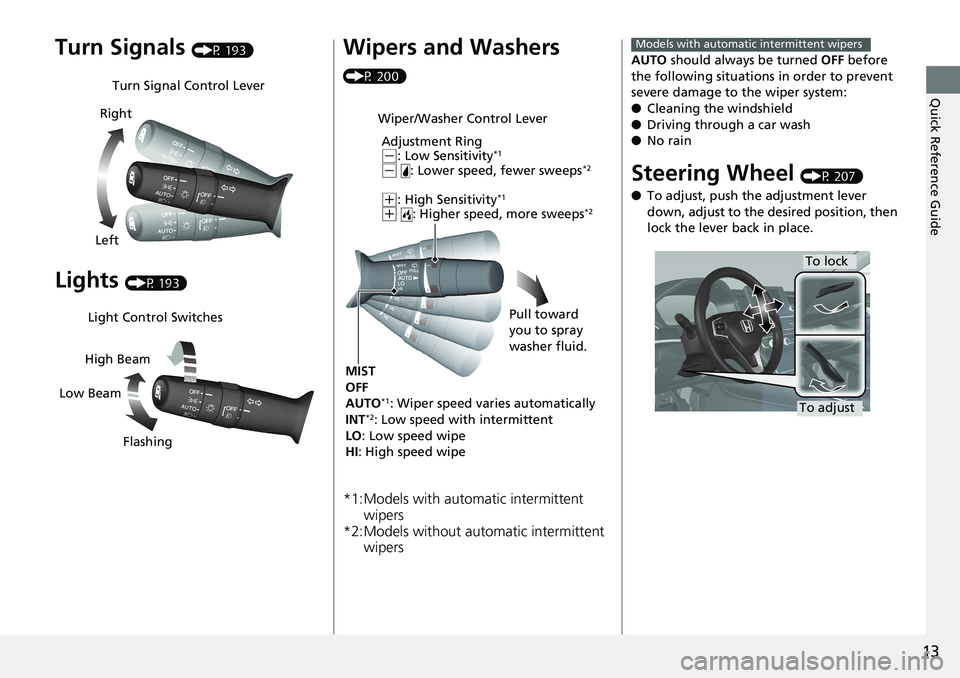
Turn Signals (P 193)
Lights (P 193)Turn Signal Control Lever
Right
Left
Light Control Switches
Low Beam High Beam
Flashing Wipers and Washers (P 200)
*1:Models with automatic intermittent
wipers
*2:Models without automatic intermittent
wipers Wiper/Washer Control Lever
Adjustment Ring ( -
: Low Sensitivity *1
( -
: Lower speed, fewer sweeps *2
( +
: High Sensitivity *1
( +
: Higher speed, more sweeps *2
MIST
OFF
AUTO *1
: Wiper speed varies automatically
INT *2
: Low speed with intermittent
LO : Low speed wipe
HI : High speed wipe Pull toward
you to spray
washer fluid. AUTO should always be turned OFF before
the following situations in order to prevent
severe damage to the wiper system:
● Cleaning the windshield
● Driving through a car wash
● No rain
Steering Wheel (P 207)
● To adjust, push the adjustment lever
down, adjust to the de sired position, then
lock the lever back in place. Models with automatic intermittent wipers
To lock
To adjust
Page 25 of 727
23
Quick Reference Guide
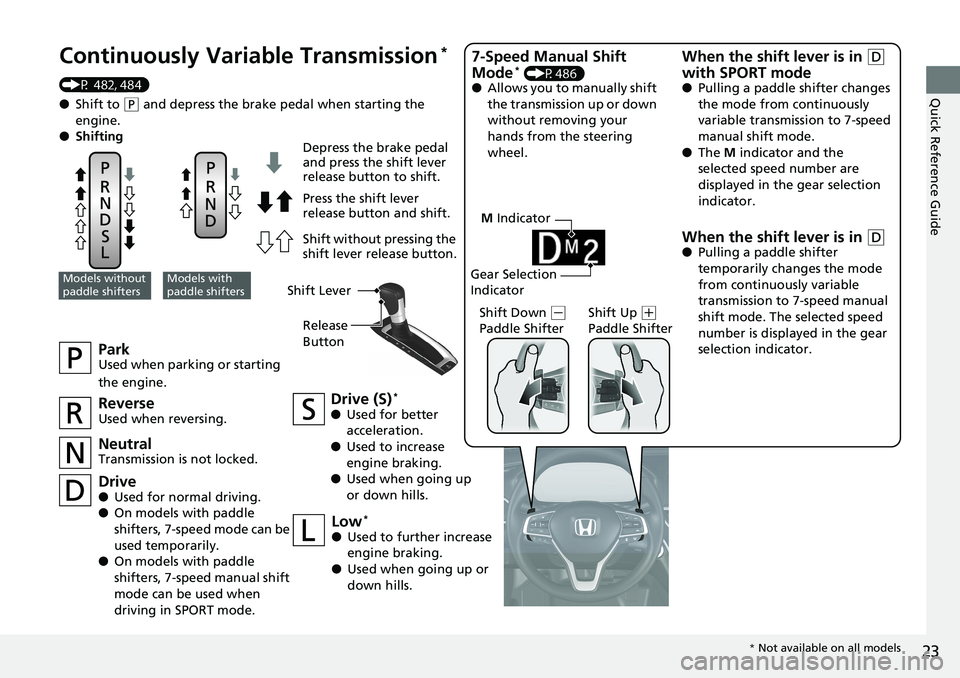
M Indicator
Gear Selection
Indicator
Continuously Variable Transmission *
(P 482, 484)
● Shift to ( P
and depress the brake pedal when starting the
engine.
● Shifting
Park Used when parking or starting
the engine.
Neutral Transmission is not locked. Drive (S) *
● Used for better
acceleration.
● Used to increase
engine braking.
● Used when going up
or down hills.Models without
paddle shifters Models with
paddle shifters Depress the brake pedal
and press the shift lever
release button to shift.
Press the shift lever
release button and shift.
Shift without pressing the
shift lever release button.
Reverse Used when reversing.
Drive ● Used for normal driving.
● On models with paddle
shifters, 7-speed mode can be
used temporarily.
● On models with paddle
shifters, 7-speed manual shift
mode can be used when
driving in SPORT mode. Low *
● Used to further increase
engine braking.
● Used when going up or
down hills. Shift Down ( -
Paddle Shifter Shift Up ( +
Paddle Shifter7-Speed Manual Shift
Mode *
(P486)
● Allows you to manually shift
the transmission up or down
without removing your
hands from the steering
wheel.
When the shift lever is in ( D
with SPORT mode ● Pulling a paddle shifter changes
the mode from continuously
variable transmission to 7-speed
manual shift mode.
● The M indicator and the
selected speed number are
displayed in the gear selection
indicator.
When the shift lever is in ( D● Pulling a paddle shifter
temporarily changes the mode
from continuously variable
transmission to 7-speed manual
shift mode. The selected speed
number is displayed in the gear
selection indicator.Shift Lever
Release
Button
* Not available on all models
Page 27 of 727
25
Quick Reference Guide
Honda Sensing ® (P 507)
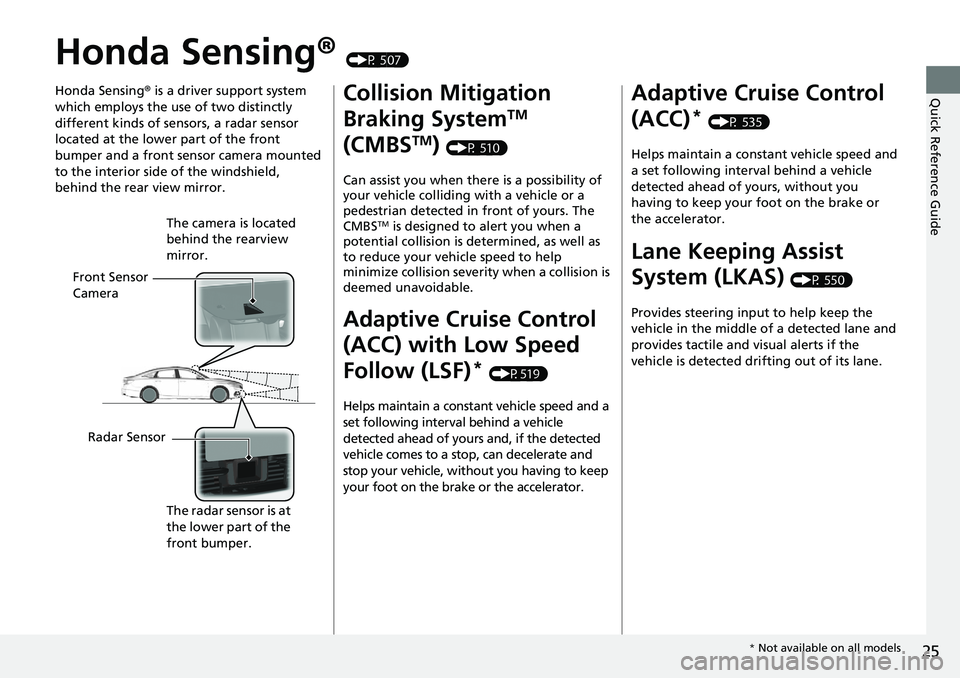
Honda Sensing ® is a driver support system
which employs the use of two distinctly
different kinds of sensors, a radar sensor
located at the lower part of the front
bumper and a front sensor camera mounted
to the interior side of the windshield,
behind the rear view mirror.
Front Sensor
Camera The camera is located
behind the rearview
mirror.
Radar Sensor
The radar sensor is at
the lower part of the
front bumper. Collision Mitigation
Braking System TM
(CMBS TM
) (P 510)
Can assist you when there is a possibility of
your vehicle colliding with a vehicle or a
pedestrian detected in front of yours. The
CMBS TM
is designed to alert you when a
potential collision is determined, as well as
to reduce your vehicle speed to help
minimize collision severity when a collision is
deemed unavoidable.
Adaptive Cruise Control
(ACC) with Low Speed
Follow (LSF) *
(P519)
Helps maintain a constant vehicle speed and a
set following interval behind a vehicle
detected ahead of yours and, if the detected
vehicle comes to a stop, can decelerate and
stop your vehicle, without you having to keep
your foot on the brake or the accelerator. Adaptive Cruise Control
(ACC) *
(P 535)
Helps maintain a constant vehicle speed and
a set following interval behind a vehicle
detected ahead of yours, without you
having to keep your foot on the brake or
the accelerator.
Lane Keeping Assist
System (LKAS) (P 550)
Provides steering input to help keep the
vehicle in the middle of a detected lane and
provides tactile and visual alerts if the
vehicle is detected drifting out of its lane.
* Not available on all models
Page 31 of 727
29
Quick Reference Guide
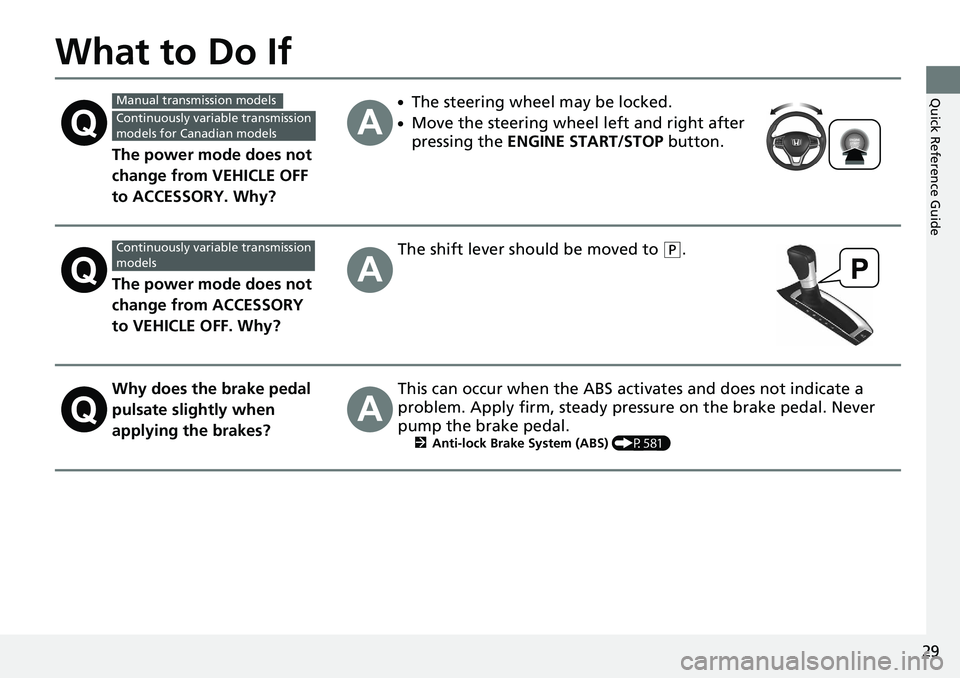
What to Do If The power mode does not
change from VEHICLE OFF
to ACCESSORY. Why? ●
The steering wheel may be locked. ●
Move the steering wheel left and right after
pressing the ENGINE START/STOP button.
The power mode does not
change from ACCESSORY
to VEHICLE OFF. Why? The shift lever should be moved to ( P
.
Why does the brake pedal
pulsate slightly when
applying the brakes? This can occur when the ABS activates and does not indicate a
problem. Apply firm, steady pressure on the brake pedal. Never
pump the brake pedal. 2 Anti-lock Brake System (ABS) (P581)Manual transmission models
Continuously variable transmission
models for Canadian models
Continuously variable transmission
models
Page 38 of 727
36 uu For Safe Driving u Your Vehicle’s Safety Features
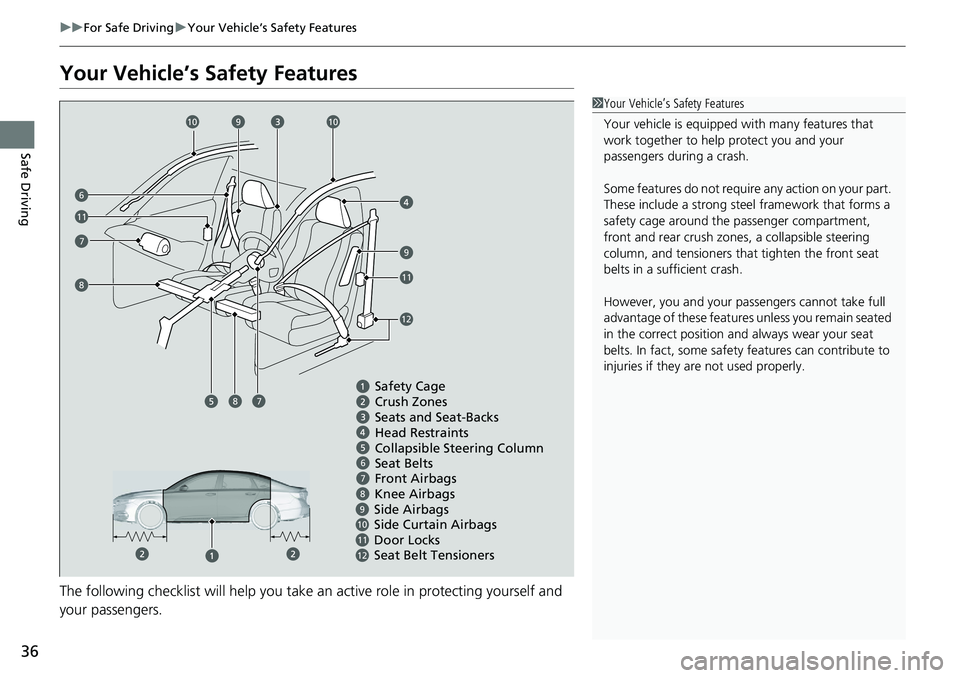
Safe Driving Your Vehicle’s Safety Features
The following checklist will he lp you take an active role in protecting yourself and
your passengers. 1 Your Vehicle’s Safety Features
Your vehicle is equipped wi th many features that
work together to help protect you and your
passengers during a crash.
Some features do not require any action on your part.
These include a strong steel framework that forms a
safety cage around the passenger compartment,
front and rear crush zone s, a collapsible steering
column, and tensioners that tighten the front seat
belts in a sufficient crash.
However, you and your passe ngers cannot take full
advantage of these features unless you remain seated
in the correct position and always wear your seat
belts. In fact, some safety features can contribute to
injuries if they are not used properly.
Crush Zones 6
7
9
10
11
12Safety Cage
Seats and Seat-Backs
Head Restraints
Collapsible Steering Column
Seat Belts
Front Airbags
Side Curtain Airbags
Door LocksSide Airbags
Seat Belt Tensioners77
99
810 10
11 6
11
12
8
Knee Airbags8
Page 48 of 727
46 uu Airbags u Airbag System Components
Safe Driving The front, front knee, front side, and side
curtain airbags are deployed according to
the direction and severity of impact. Both
side curtain airbags are deployed in a
rollover. The airbag system includes: a
Two SRS (Supplemental Restraint System)
front airbags. The driver’s airbag is stored
in the center of the steering wheel; the
front passenger’s airbag is stored in the
dashboard. Both are marked SRS
AIRBAG .b
Two knee airbags. Th e driver’s knee
airbag is stored under the steering
column; the front passenger’s knee
airbag is stored under the glove box.
Both are marked SRS AIRBAG .c
Two side airbags, one for the driver and
one for a front passenger. The airbags are
stored in the outer edges of the seat-
backs. Both are marked SIDE AIRBAG .
d
Two side curtain airbags, one for each
side of the vehicle. The airbags are stored
in the ceiling, above the side windows.
The front and rear pillars are marked
SIDE CURTAIN AIRBAG . e
An electronic control unit that, when the
power mode is in ON, continually
monitors information about the various
impact sensors, seat and buckle sensors,
rollover sensor, airbag activators, seat
belt tensioners, and other vehicle
information. During a crash event the
unit can record such information. f
Automatic front seat belt tensioners. In
addition, the driver’s and front
passenger’s seat belt buckles incorporate
sensors that detect whether or not the
belts are fastened. g
A driver’s seat position sensor. This
sensor determines the optimal force at
which the airbag will deploy in a crash. h
Weight sensors in the front passenger’s
seat. The front passenger’s airbag will be
turned off if the weight on the seat is
approximately 65 lbs (29 kg) or less (the
weight of an infant or small child). i
Impact sensors that can detect a
moderate-to-severe front or side impact. j
An indicator on the dashboard that alerts
you that the front passenger’s front
airbag has been turned off. k
An indicator on the instrument panel that
alerts you to a possible problem with your
airbag system or seat belt tensioners. l
A rollover sensor that can detect if your
vehicle is about to roll over and signal the
control unit to deploy both side curtain
airbags.
Page 49 of 727
47uu Airbags u Airbag System Components
Safe Driving
Airbags can pose serious hazards. To do their job, airbags must inflate with
tremendous force. So, while airbags help sa ve lives, they can cause burns, bruises,
and other minor injuries, sometimes even fatal ones if occupants are not wearing
their seat belts properl y and sitting correctly.
What you should do: Always wear your seat belt properly, and sit upright and as
far back from the steering wheel as possibl e while allowing full control of the
vehicle. A front passenger should move thei r seat as far back from the dashboard as
possible.
Remember, however, that no safety system ca n prevent all injuries or deaths that
can occur in a severe crash, even when s eat belts are properly worn and the airbags
deploy.
Do not place hard or sharp objects between yourself and a front airbag.
Carrying hard or sharp objects on your lap, or driving with a pipe or other sharp
object in your mouth, can result in in juries if your front airbag inflates.
Do not attach or place objects on th e front and front knee airbag covers.
Objects on the covers marked SRS AIRBAG could interfere with the proper
operation of the airbags or be propelled inside the vehicle and hurt someone if the
airbags inflate.■ Important Facts About Your Airbags 1 Important Facts About Your Airbags
Do not attempt to deactivate your airbags. Together,
airbags and seat belts pr ovide the best protection.
When driving, keep hand s and arms out of the
deployment path of the fro nt airbag by holding each
side of the steering wheel. Do not cross an arm over
the airbag cover.