trailer HONDA ACCORD HYBRID 2019 Owners Manual
[x] Cancel search | Manufacturer: HONDA, Model Year: 2019, Model line: ACCORD HYBRID, Model: HONDA ACCORD HYBRID 2019Pages: 727, PDF Size: 24.78 MB
Page 4 of 727
Contents
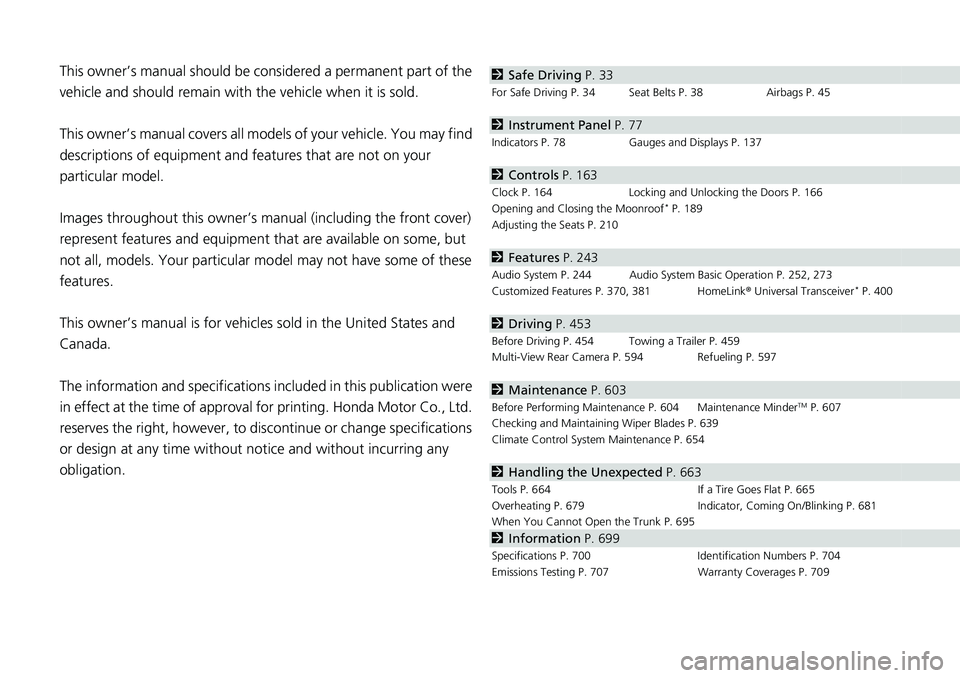
This owner’s manual should be considered a permanent part of the
vehicle and should remain with the vehicle when it is sold.
This owner’s manual covers all models of your vehicle. You may find
descriptions of equipment and features that are not on your
particular model.
Images throughout this owner’s ma nual (including the front cover)
represent features and equipment that are available on some, but
not all, models. Your particular mo del may not have some of these
features.
This owner’s manual is for vehicles sold in the United States and
Canada.
The information and specifications in cluded in this publication were
in effect at the time of approval for printing. Honda Motor Co., Ltd.
reserves the right, however, to discontinue or change specifications
or design at any time without notice and without incurring any
obligation. 2 Safe Driving P. 33For Safe Driving P. 34 Seat Belts P. 38 Airbags P. 45
2 Instrument Panel P. 77Indicators P. 78 Gauges and Displays P. 137
2 Controls P. 163 Clock P. 164 Locking and Unlocking the Doors P. 166
Opening and Closing the Moonroof *
P. 189
Adjusting the Seats P. 210
2 Features P. 243 Audio System P. 244 Audio System Basic Operation P. 252, 273
Customized Features P. 370, 381 HomeLink ® Universal Transceiver *
P. 400
2 Driving P. 453 Before Driving P. 454 Towing a Trailer P. 459
Multi-View Rear Camera P. 594 Refueling P. 597
2 Maintenance P. 603Before Performing Maintenance P. 604 Maintenance Minder TM
P. 607
Checking and Maintaining Wiper Blades P. 639
Climate Control System Maintenance P. 654
2 Handling the Unexpected P. 663Tools P. 664 If a Tire Goes Flat P. 665
Overheating P. 679 Indicator, Coming On/Blinking P. 681
When You Cannot Op en the Trunk P. 695
2 Information P. 699Specifications P. 700 Identi fication Numbers P. 704
Emissions Testing P. 707 Warranty Coverages P. 709
Page 455 of 727
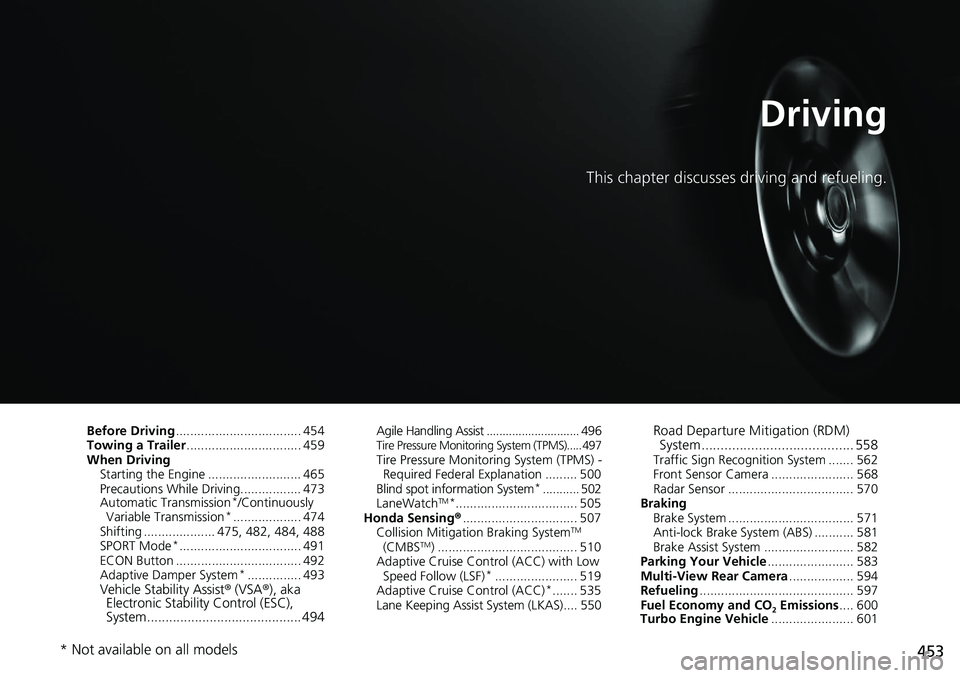
453Driving This chapter discusses driving and refueling.
Before Driving ................................... 454
Towing a Trailer ................................ 459
When Driving
Starting the Engine .......................... 465
Precautions While Driving................. 473
Automatic Transmission *
/Continuously
Variable Transmission *
................... 474
Shifting .................... 475, 482, 484, 488
SPORT Mode *
.................................. 491
ECON Button ................................... 492
Adaptive Damper System *
............... 493
Vehicle Stability Assist ® (VSA ® ), aka
Electronic Stability Control (ESC),
System.......................................... 494 Agile Handling Assist ............................. 496 Tire Pressure Monitoring System (TPMS)..... 497
Tire Pressure Monitoring System (TPMS) -
Required Federal Explanation ......... 500
Blind spot information System *
........... 502
LaneWatch TM
*
.................................. 505
Honda Sensing ® ................................ 507
Collision Mitigati on Braking System TM
(CMBS TM
) ....................................... 510
Adaptive Cruise Control (ACC) with Low
Speed Follow (LSF) *
....................... 519
Adaptive Cruise Control (ACC) *
....... 535
Lane Keeping Assist System (LKAS).... 550 Road Departure Mi tigation (RDM)
System ........................................ 558
Traffic Sign Recognition System ....... 562
Front Sensor Camera ....................... 568
Radar Sensor ................................... 570
Braking
Brake System ................................... 571
Anti-lock Brake System (ABS) ........... 581
Brake Assist System ......................... 582
Parking Your Vehicle ........................ 583
Multi-View Rear Camera .................. 594
Refueling ........................................... 597
Fuel Economy and CO 2
Emissions .... 600
Turbo Engine Vehicle ....................... 601
* Not available on all models
Page 457 of 727
Continued
455uu Before Driving u Driving Preparation
Driving
• Store or secure all items on board properly.
u Carrying too much cargo, or improperly storing it, can affect your vehicle’s
handling, stability, sto pping distance, and tires, and make it unsafe.2 Maximum Load Limit P. 457
• Do not pile items higher than the seat height.
u They can block your view and may be thrown forward in the event of sudden
braking.
• Do not place anything in the front seat footwells. Make sure to secure the floor
mat.
u An object or unsecured floor mat can in terfere with your brake and accelerator
pedal operation while driving.
• If you have any animals on board, do no t let them move around in the vehicle.
u They may interfere with driv ing and a crash could occur.
• Securely close and lock all doors and the trunk.2 Locking/Unlocking the Doors from the Inside P. 176
• Adjust your seating position properly.
u Adjust the head restraint, too.2 Adjusting the Seats P. 210
2 Adjusting the Front and Rear Outer *
Head Restraint Positions P. 216
• Adjust the mirrors and steering wh eel properly for your driving.
u Adjust them while sitting in the proper driving position. 2 Adjusting the Mirrors P. 208
2 Adjusting the Steering Wheel P. 207■ Interior Checks 1 Interior Checks
The headlight aim is set by the factory, and does not
need to be adjusted. Howeve r, if you regularly carry
heavy items in the tr unk or tow a trailer *
, have the
aiming readjusted at a de aler or by a qualified
technician.
* Not available on all models
Page 459 of 727
457uu Before Driving u Maximum Load Limit
Continued
Driving
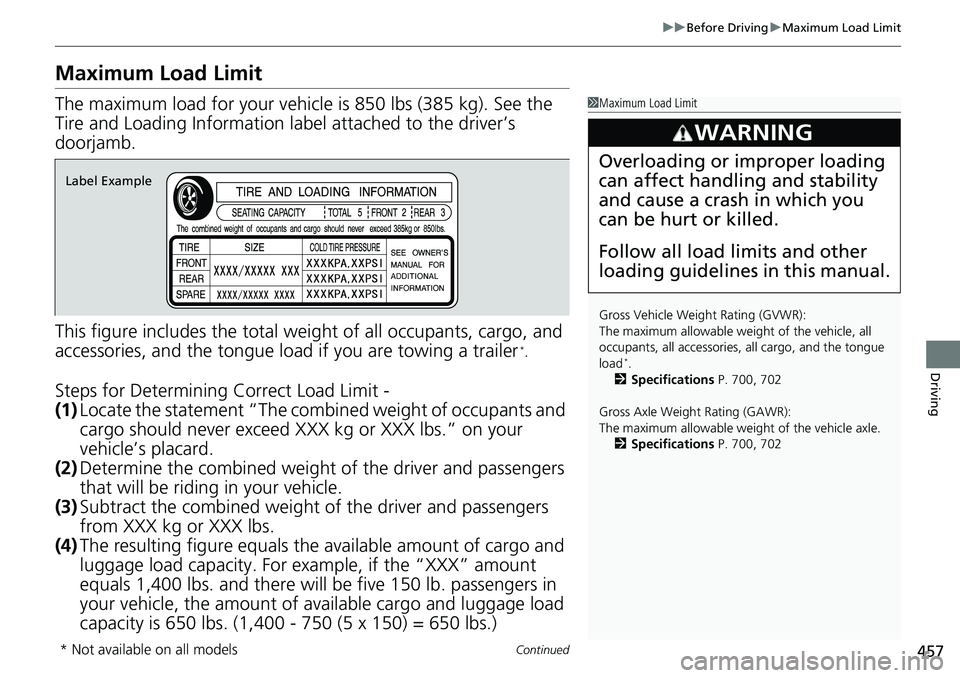
Maximum Load Limit The maximum load for your vehicl e is 850 lbs (385 kg). See the
Tire and Loading Information la bel attached to the driver’s
doorjamb.
This figure includes the total weig ht of all occupants, cargo, and
accessories, and the tongue load if you are towing a trailer *
.
Steps for Determining Correct Load Limit -
(1) Locate the statement “The comb ined weight of occupants and
cargo should never exceed XXX kg or XXX lbs.” on your
vehicle’s placard.
(2) Determine the combined weight of the driver and passengers
that will be riding in your vehicle.
(3) Subtract the combined weight of the driver and passengers
from XXX kg or XXX lbs.
(4) The resulting figure equals the available amount of cargo and
luggage load capaci ty. For example, if the “XXX” amount
equals 1,400 lbs. and there will be five 150 lb. passengers in
your vehicle, the am ount of available cargo and luggage load
capacity is 650 lbs. (1,400 - 750 (5 x 150) = 650 lbs.) 1 Maximum Load Limit
Gross Vehicle Weight Rating (GVWR):
The maximum allowable wei ght of the vehicle, all
occupants, all a ccessories, all cargo, and the tongue
load *
.
2 Specifications P. 700, 702
Gross Axle Weight Rating (GAWR):
The maximum allowable wei ght of the vehicle axle.
2 Specifications P. 700, 7023
WARNING Overloading or improper loading
can affect handling and stability
and cause a crash in which you
can be hurt or killed.
Follow all load limits and other
loading guidelines in this manual.Label Example
* Not available on all models
Page 460 of 727
uu Before Driving u Maximum Load Limit
458
Driving (5) Determine the combined weight of luggage and cargo being
loaded on the vehicle. That we ight may not safely exceed the
available cargo and luggage load capacity calculated in step 4.
(6) If your vehicle will be towing a tra iler, load from your trailer will
be transferred to your vehicl e. Consult this manual to
determine how this reduces th e available cargo and luggage
load capacity of your vehicle.
In addition, the total weight of the vehicle, all occupants,
accessories, cargo, and trailer tongue load must not exceed the
Gross Vehicle Weight Rating (GVW R) or the Gross Axle Weight
Rating (GAWR). Both are on a label on the driver’s doorjamb. 1 Maximum Load Limit
Towing a Trailer:
See Towing a Trailer to determine whether your
vehicle is designed to tow a tailer.
2 Towing a Trailer P. 459
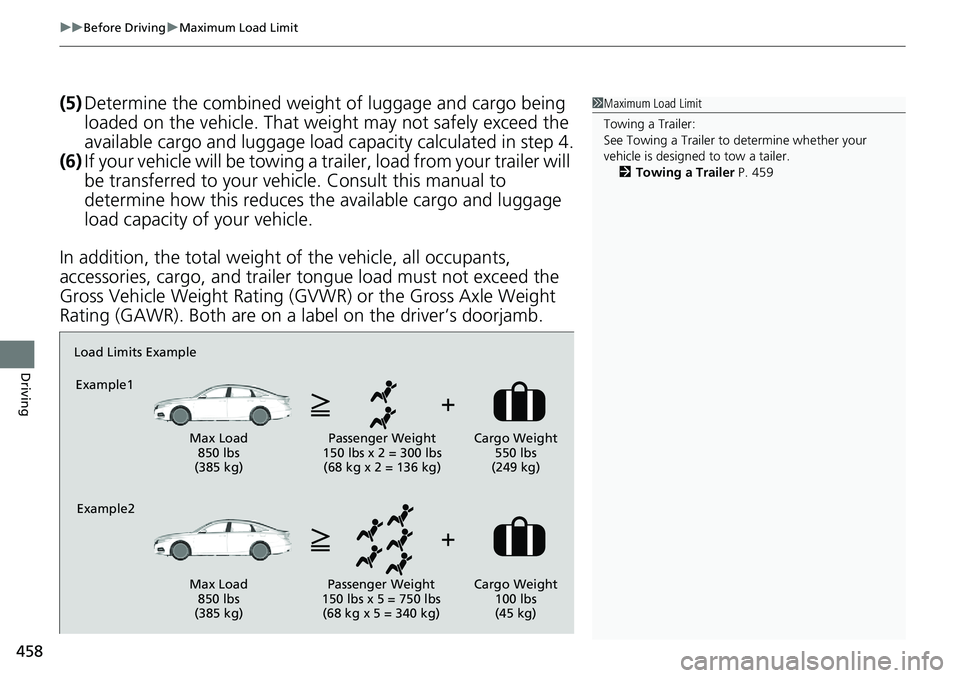
Load Limits Example
Example1
Max Load
850 lbs
(385 kg) Passenger Weight
150 lbs x 2 = 300 lbs
(68 kg x 2 = 136 kg) Cargo Weight
550 lbs
(249 kg)
Example2
Max Load
850 lbs
(385 kg) Passenger Weight
150 lbs x 5 = 750 lbs
(68 kg x 5 = 340 kg) Cargo Weight
100 lbs
(45 kg)
Page 461 of 727
459Continued
Driving
Towing a Trailer Your vehicle is not designed to tow a trailer. Attempting to do so can void your
warranties.
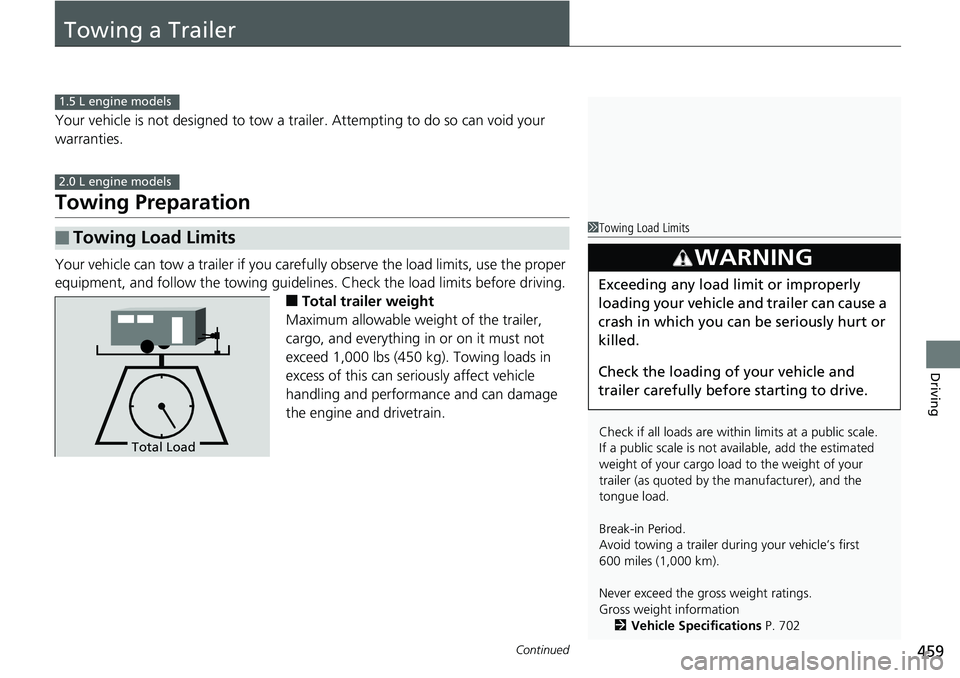
Towing Preparation Your vehicle can tow a trailer if you carefully observe the load limits, use the proper
equipment, and follow the towing guidelin es. Check the load limits before driving.
■ Total trailer weight
Maximum allowable weight of the trailer,
cargo, and everything in or on it must not
exceed 1,000 lbs (450 kg). Towing loads in
excess of this can seriously affect vehicle
handling and performance and can damage
the engine and drivetrain.■ Towing Load Limits 1.5 L engine models
2.0 L engine models
1 Towing Load Limits
Check if all loads are within limits at a public scale.
If a public scale is not available, add the estimated
weight of your cargo load to the weight of your
trailer (as quoted by th e manufacturer), and the
tongue load.
Break-in Period.
Avoid towing a trailer dur ing your vehicle’s first
600 miles (1,000 km).
Never exceed the gross weight ratings.
Gross weight information
2 Vehicle Specifications P. 7023
WARNING Exceeding any load limit or improperly
loading your vehicle and trailer can cause a
crash in which you can be seriously hurt or
killed.
Check the loading of your vehicle and
trailer carefully before starting to drive.
Total Load
Page 462 of 727
460 uu Towing a Trailer u Towing Preparation
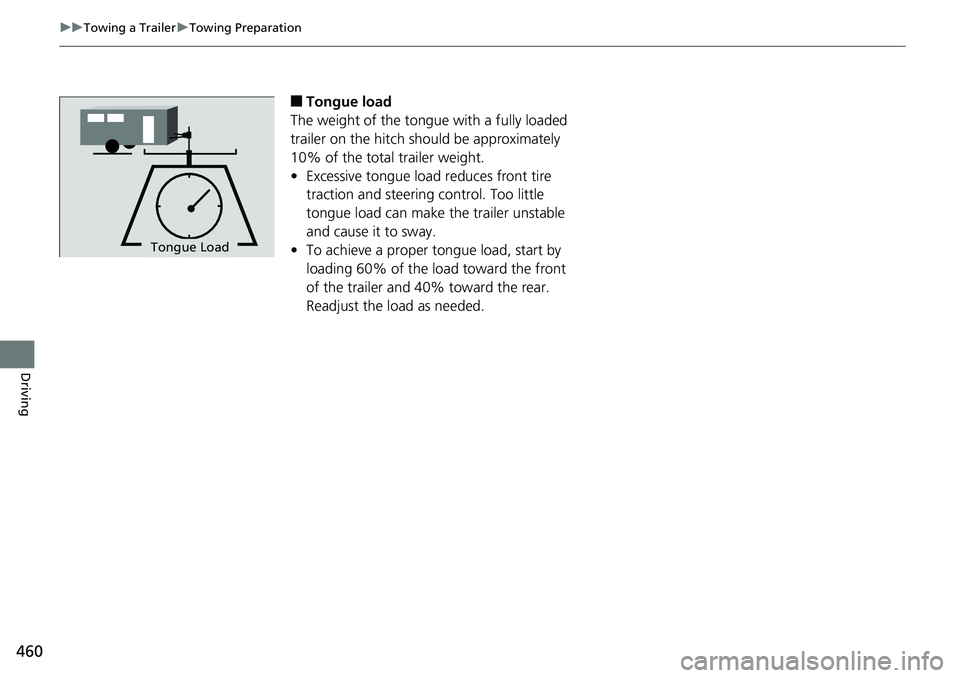
Driving ■ Tongue load
The weight of the tongue with a fully loaded
trailer on the hitch should be approximately
10% of the total trailer weight.
• Excessive tongue load reduces front tire
traction and steering control. Too little
tongue load can make the trailer unstable
and cause it to sway.
• To achieve a proper tongue load, start by
loading 60% of the load toward the front
of the trailer and 40% toward the rear.
Readjust the load as needed.Tongue Load Tongue Load
Page 463 of 727
461uu Towing a Trailer u Towing Preparation
Driving
Towing equipment varies by th e size of your trailer, how much load you are towing,
and where you are towing.
■ Hitches
The hitch must be of an approved type and properly bolted to the underbody.
■ Safety chains
Always use safety chains when you tow a trailer. Leave enough slack to allow the
trailer to turn corners easily, but do not allow the chains to drag on the ground.
■ Trailer brakes
There are two common types of trailer bra kes: surge and electric. Surge brakes are
common for boat trailers, since the brakes will get wet. If you choose electric brakes,
be sure they are electronically actuated. Do not attempt to attach trailer brakes to
your vehicle’s hydraulic system, as it wi ll lower braking effectiveness and create a
potential hazard.
■ Additional towing equipment
Many states and provinces/territories requ ire special outside mirrors when towing a
trailer. Even if mirrors are not required in your locale, you should install special
mirrors if visibility is restricted in any way.
■ Trailer light
Trailer lights and equipment must comply with federal, state, province/territory, and
local regulations. Check with your local trailer sales or rent al agency for the
requirements in the area where you plan to tow.■ Towing Equipment and Accessories 1 Towing Equipment and Accessories
Make sure that all equipment is properly installed and
maintained, and that it meets federal, state, province/
territory, and lo cal regulations.
Consult your trai ler maker for prope r installation and
setup of the equipment.
Improper installation and setup can affect the
handling, stability, and br aking performance of your
vehicle.
Consult your traile r sales or rental agency if any other
items are recommended or required for your towing
situation.
The lighting and wiring of tra ilers can vary by type
and brand. If a connector is required, it should only
be installed by a qua lified technician.
Page 464 of 727
462 uu Towing a Trailer u Driving Safely with a Trailer
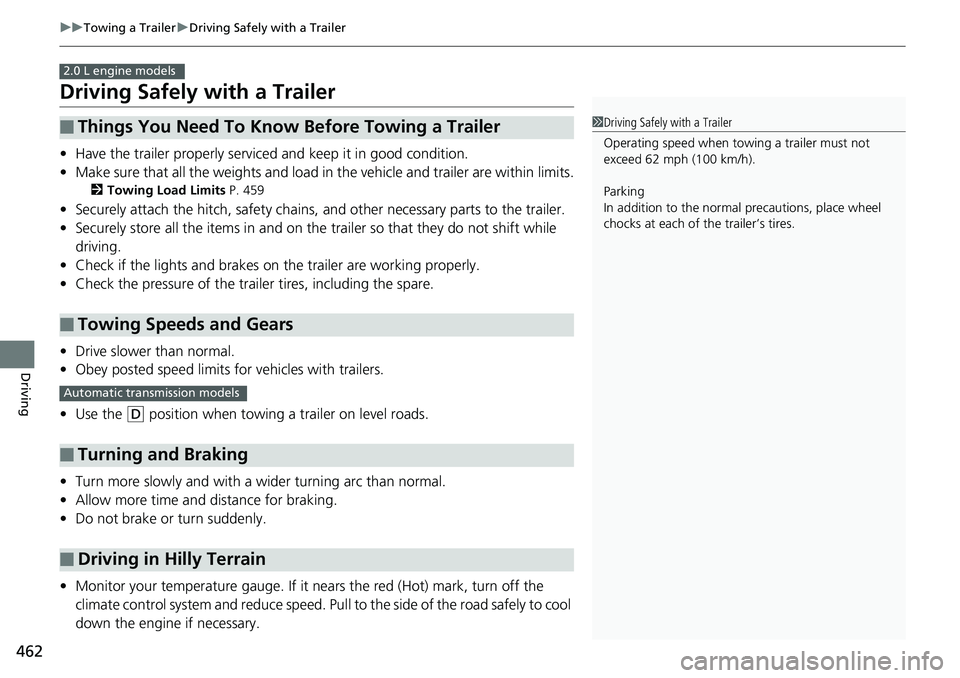
Driving Driving Safely with a Trailer • Have the trailer properly serviced and keep it in good condition.
• Make sure that all the weights and load in the vehicle and trailer are within limits.2 Towing Load Limits P. 459
• Securely attach the hitch, safety chains, and other necessary parts to the trailer.
• Securely store all the items in and on the tr ailer so that they do not shift while
driving.
• Check if the lights and brakes on the trailer are working properly.
• Check the pressure of the traile r tires, including the spare.
• Drive slower than normal.
• Obey posted speed limits for vehicles with trailers.
• Use the ( D
position when towing a trailer on level roads.
• Turn more slowly and with a wider turning arc than normal.
• Allow more time and distance for braking.
• Do not brake or turn suddenly.
• Monitor your temperature gauge. If it nears the red (Hot) mark, turn off the
climate control system and reduc e speed. Pull to the side of the road safely to cool
down the engine if necessary.■ Things You Need To Know Before Towing a Trailer
■ Towing Speeds and Gears
■ Turning and Braking
■ Driving in Hilly Terrain 2.0 L engine models
1 Driving Safely with a Trailer
Operating speed when towing a trailer must not
exceed 62 mph (100 km/h).
Parking
In addition to the normal precautions, place wheel
chocks at each of the trailer’s tires.
Automatic transmission models
Page 465 of 727
463uu Towing a Trailer u Towing Your Vehicle
Continued
Driving
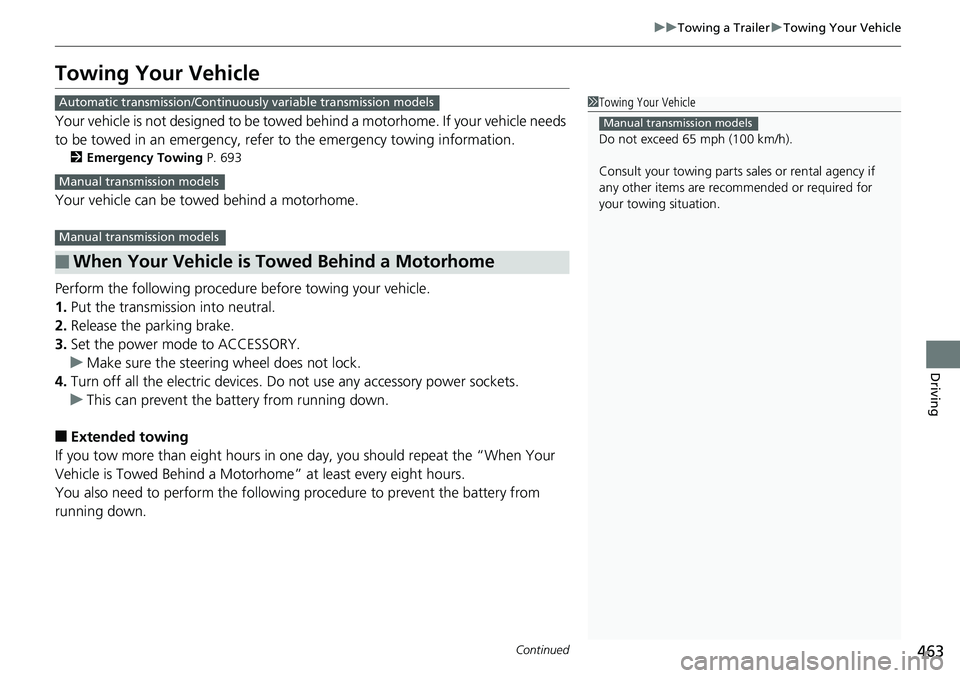
Towing Your Vehicle Your vehicle is not designed to be towed behind a motorhome. If your vehicle needs
to be towed in an emergency, refer to the emergency to wing information.2 Emergency Towing P. 693
Your vehicle can be towed behind a motorhome.
Perform the following procedure before towing your vehicle.
1. Put the transmission into neutral.
2. Release the parking brake.
3. Set the power mode to ACCESSORY.
u Make sure the steering wheel does not lock.
4. Turn off all the electric devices. Do not use any accessory power sockets.
u This can prevent the battery from running down.
■ Extended towing
If you tow more than eight hours in one day, you should repeat the “When Your
Vehicle is Towed Behind a Motor home” at least every eight hours.
You also need to perform the following procedure to prevent the battery from
running down.■ When Your Vehicle is Towed Behind a Motorhome 1 Towing Your Vehicle
Do not exceed 65 mph (100 km/h).
Consult your towing parts sales or rental agency if
any other items are recommended or required for
your towing situation. Manual transmission models
Automatic transmission/Continuousl y variable transmission models
Manual transmission models
Manual transmission models