air condition HONDA CIVIC 1991 User Guide
[x] Cancel search | Manufacturer: HONDA, Model Year: 1991, Model line: CIVIC, Model: HONDA CIVIC 1991Pages: 136, PDF Size: 1.33 MB
Page 61 of 136
Engine Exhaust Gas Warning
A properly maintained car is your best protection against exhaust
gas entering the passenger compartment.
The exhaust system should be thoroughly inspected by a compe-
tent mechanic whenever:
The car is raised for oil change.You notice a change in the sound of the exhaust. The exhaust system or the rear or underside of the car is
damaged.
Avoid breathing exhaust gases. They contain carbon monoxide,
which is a colorless, odorless gas that can cause loss of con-
sciousness and eventual death. If you suspect that exhaust gas is entering the passenger compartment, have the cause deter-mined and corrected as soon as possible. If you must driveunder these conditions, drive only with all windows fully open. Do not drive with the hatch/trunk lid open. An open hatch/trunk
may draw exhaust gases into the passenger compartment. If
you must drive with the hatch/trunk open, drive only with all the
windows wide open. Do not run the engine in confined areas, such as garages, any
longer than necessary to move the car in or out.
If you must sit in a parked car with the engine running for more
than a short time, adjust the heating/ventilation system as
follows:
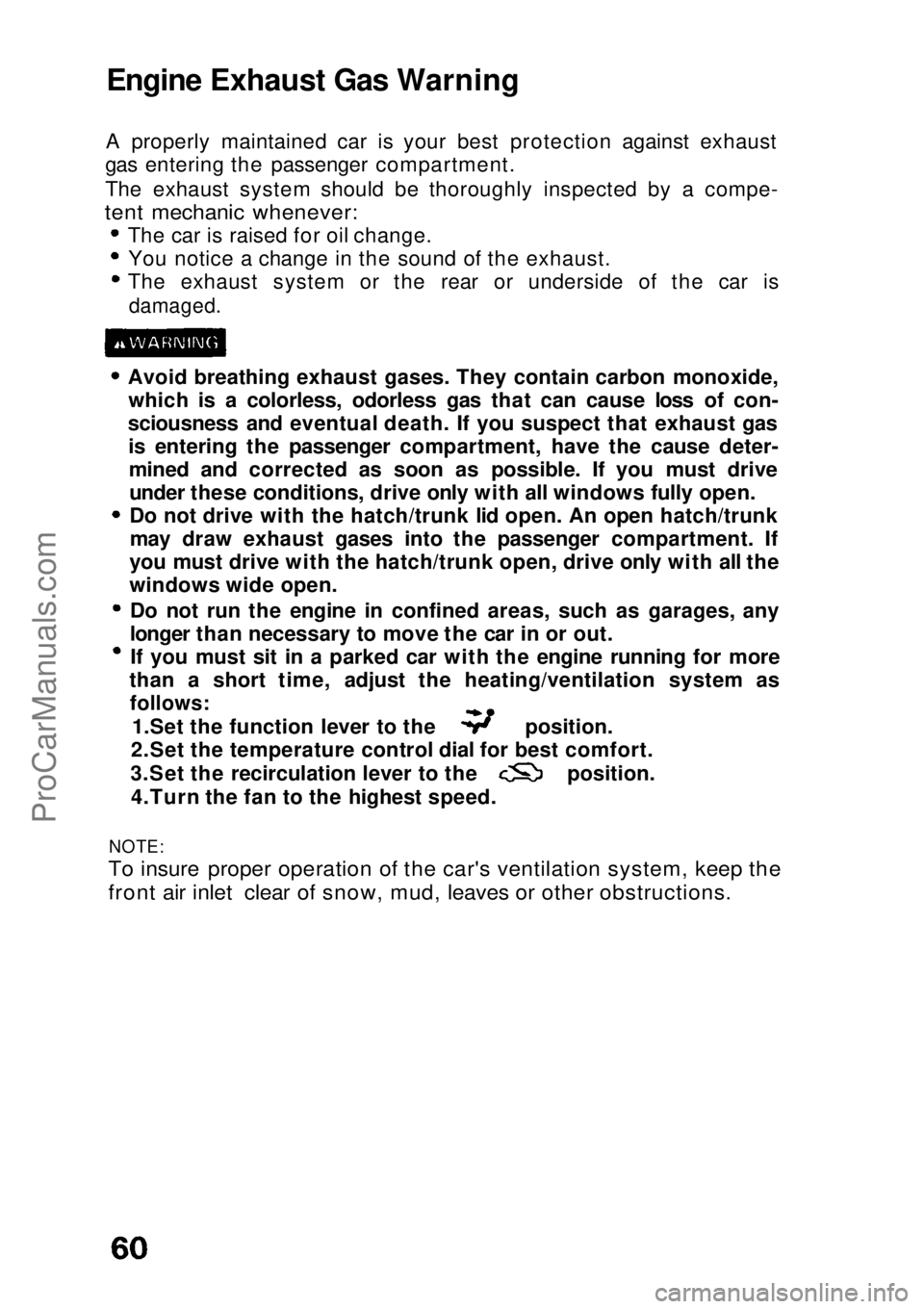
1.Set the function lever to the position.
2.Set the temperature control dial for best comfort. 3.Set the recirculation lever to the position.
4.Turn the fan to the highest speed.
NOTE:
To insure proper operation of the car's ventilation system, keep the
front air inlet clear of snow, mud, leaves or other obstructions.ProCarManuals.comMain Menu s t
Page 68 of 136
Your Honda automobile must be properly maintained to ensure that
it is in peak operating condition and the emission levels are within
the standards set by the Federal Clean Air Act. The following instructions and maintenance procedures are basedon the assumption that your car will be used exclusively for thepurpose for which it was designed:
1.To carry passengers and cargo within the load limits shown on the label in the glove box.
2. To be driven on reasonable road surfaces within legal limits.
3. To generally be driven daily over a distance of several miles.
4. Use gasoline from pumps labeled unleaded, with a pump octane number of 86 or higher. The pump octane number is an average of
the Research (R) octane and Motor (M) octane numbers.
NOTE: Failures which occur due to a lack of maintenance will not be
covered under warranty.
The Required Maintenance Schedule* specifies all maintenance
required to keep your car in peak operating condition. Work should
be done by a Honda dealer but may be done by any qualified service
facility or individual who is competent in this type of work.
Maintenance, replacement, or repair of emission control devices
and systems may be done by any automotive repair establishment
or individual using parts that are "certified" to EPA standards.
After the maintenance has been done, be sure to complete theMaintenance Records on pages 71 — 73. All required maintenance is
considered normal owner operating cost and you will be charged for it by your dealer.
* For vehicles sold in California, maintenance operations indicated by *3 on page 70 are recommended by the manufacturer. Othermaintenance operations are required by California regulations and
condition the emission warranty.
Maintenance Schedule and RecordsProCarManuals.comMain Menu s t
Page 72 of 136
Maintenance Schedule and Records (cont'd)
Severe Driving Conditions
CAUTION:
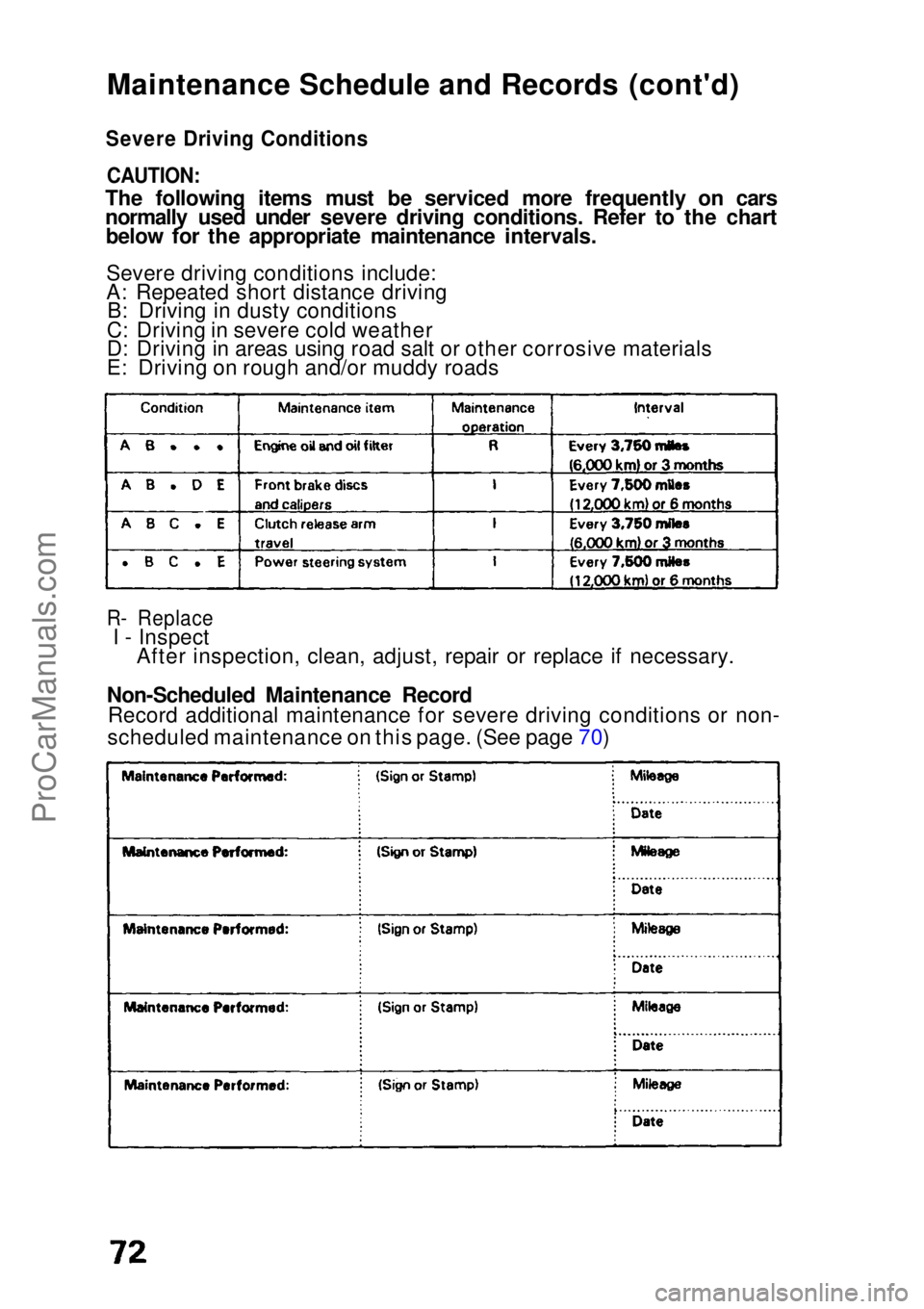
The following items must be serviced more frequently on cars
normally used under severe driving conditions. Refer to the chart below for the appropriate maintenance intervals.
Severe driving conditions include:
A: Repeated short distance driving B: Driving in dusty conditions
C: Driving in severe cold weather
D: Driving in areas using road salt or other corrosive materials
E: Driving on rough and/or muddy roads
R- Replace
I - Inspect After inspection, clean, adjust, repair or replace if necessary.
Non-Scheduled Maintenance Record Record additional maintenance for severe driving conditions or non-
scheduled maintenance on this page. (See page 70)ProCarManuals.comMain Menu s t
Page 86 of 136
Air and Fuel Filters
Air Filter Replace the air filter every 24 months or 30,000 miles (48,000 km),
whichever comes first (more often in extremely dusty conditions).
Replacement
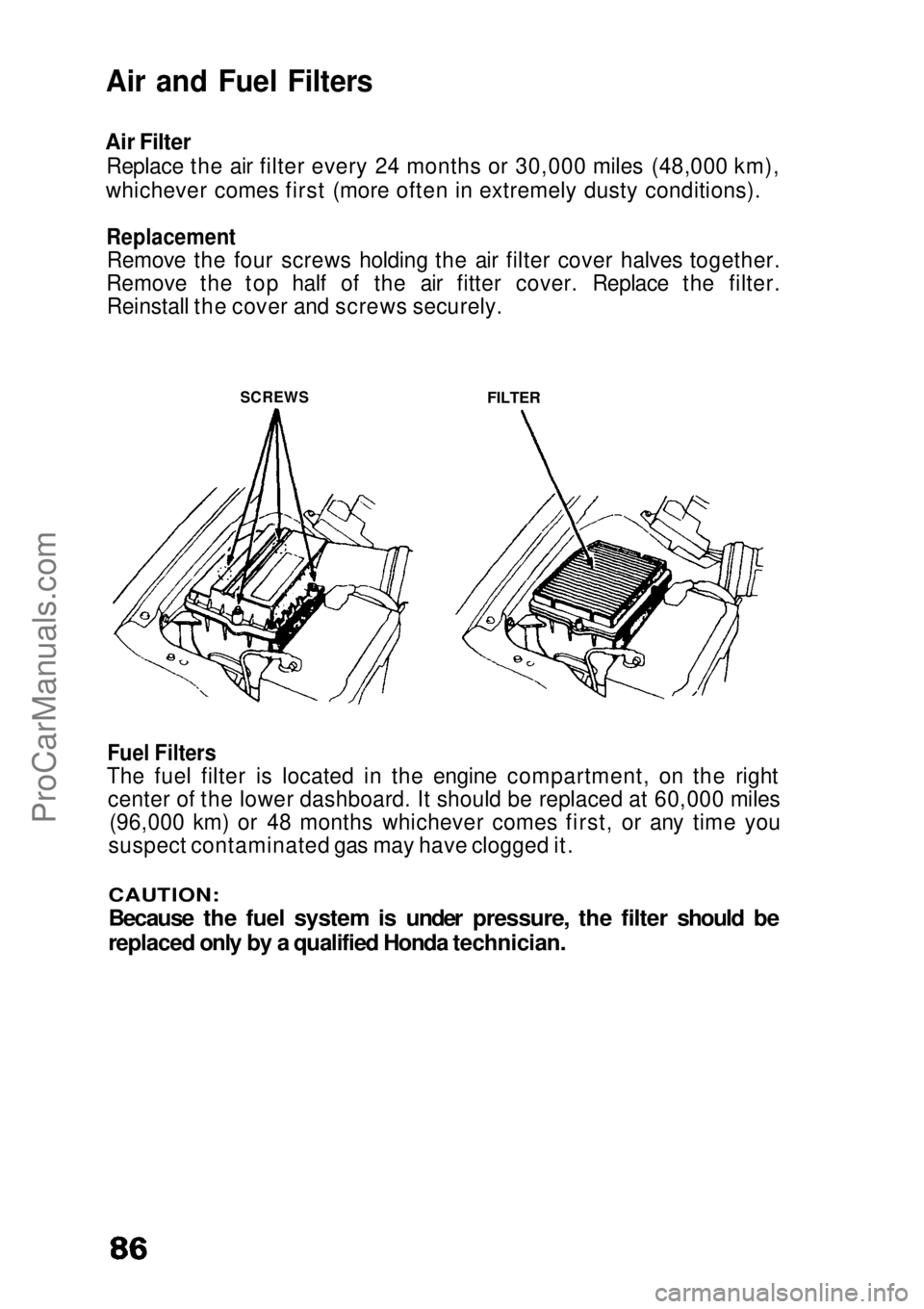
Remove the four screws holding the air filter cover halves together.
Remove the top half of the air fitter cover. Replace the filter. Reinstall the cover and screws securely.
SCREWS
FILTER
Fuel Filters
The fuel filter is located in the engine compartment, on the right center of the lower dashboard. It should be replaced at 60,000 miles (96,000 km) or 48 months whichever comes first, or any time you
suspect contaminated gas may have clogged it.
CAUTION:
Because the fuel system is under pressure, the filter should be
replaced only by a qualified Honda technician.ProCarManuals.comMain Menu s t
Page 98 of 136
Air Conditioner Care
Condenser and Radiator
Check the engine radiator and the air conditioner condenser (in front
of the radiator) for accumulated dirt, insects or leaves. Carefully brush or hose them off to assure maximum cooling performance.
CAUTION:
Radiator and condenser fins are very thin and easily damaged; do
not bend them with the high water pressure or brush.
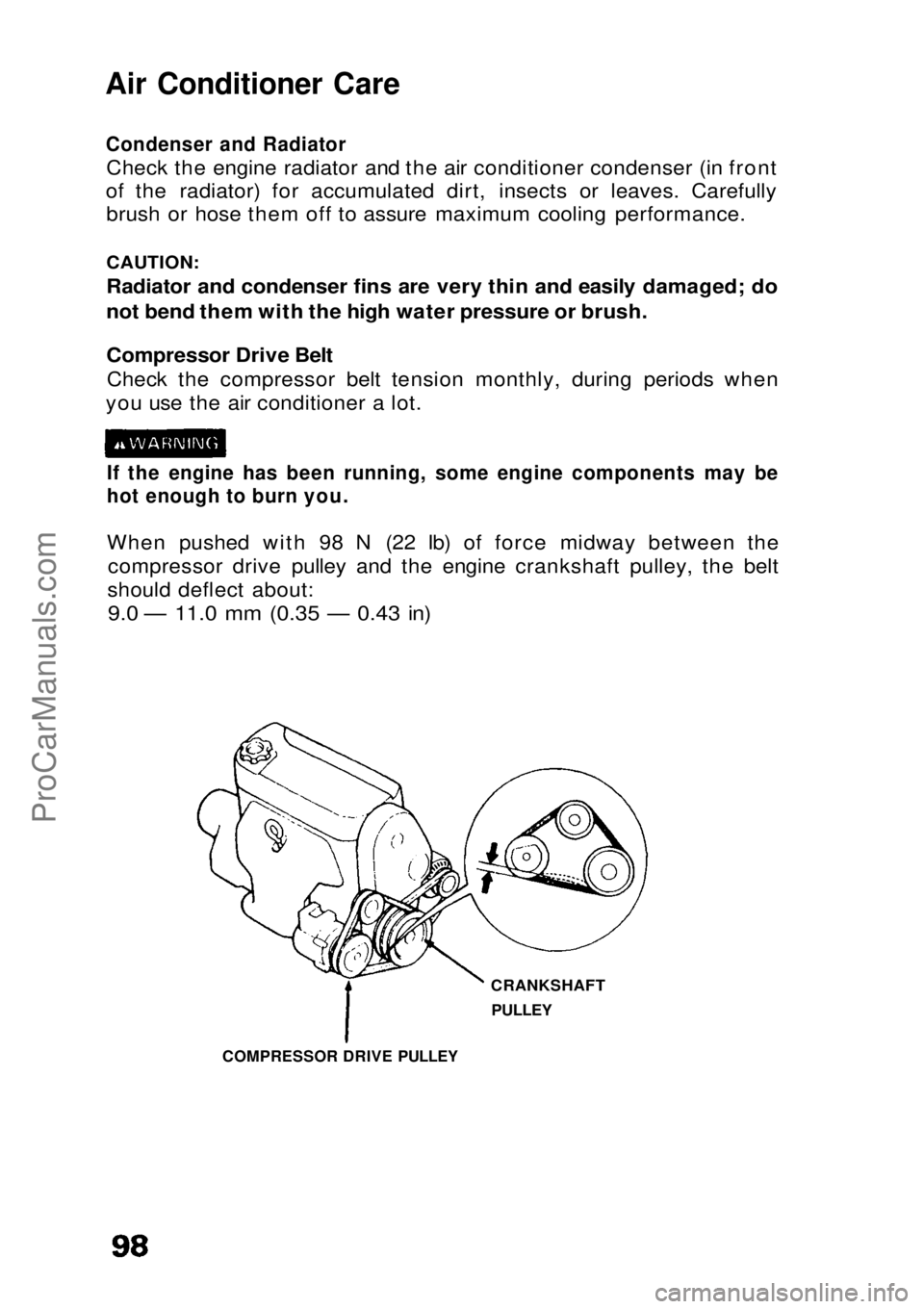
Compressor Drive Belt
Check the compressor belt tension monthly, during periods when
you use the air conditioner a lot.
If the engine has been running, some engine components may be
hot enough to burn you.
When pushed with 98 N (22 Ib) of force midway between thecompressor drive pulley and the engine crankshaft pulley, the belt
should deflect about:
9.0 — 11.0 mm (0.35 — 0.43 in)
CRANKSHAFTPULLEY
COMPRESSOR DRIVE PULLEYProCarManuals.comMain Menu s t
Page 99 of 136

System Maintenance
Run your air conditioner at least once a week for about ten minutes,
even during the off season, to lubricate the seals and the inside of
the compressor and, to verify that the system is functional.
If the air conditioner is not cooling properly, it may indicate an
undercharged system. Have your dealer check the system for leaks,
then evacuate and charge the system with refrigerant 12. Charging quantity:
850 — 950 g (30.1 — 33.6 oz)
CAUTION:
Prolonged use of an undercharged system may damage the
compressor.ProCarManuals.comMain Menu s t
Page 103 of 136
Replacement Body and Fender Parts
If your vehicle incurs body damage and requires replacement parts,
we encourage you to use only Genuine Honda sheet metal body and
fender parts. Many insurance companies are specifying imitation sheet metal parts for collision repairs in an effort to reduce claim
costs; however, if imitation parts are used the following conditions
may apply:
There is no assurance that imitation parts will equal the fit and
finish of Genuine Honda sheet metal parts; and in our experience
they often do not.
There is no assurance that imitation parts will resist corrosion aswell as Genuine Honda sheet metal parts.Imitation sheet metal parts are not covered by the Honda Limited
Warranty.
To ensure your continued satisfaction with your Honda vehicle in the event of an accident, contact your insurance adjuster and insist
on Genuine Honda parts in the repair of your vehicle. Body RepairProCarManuals.comMain Menu s t
Page 104 of 136
Spare Tire
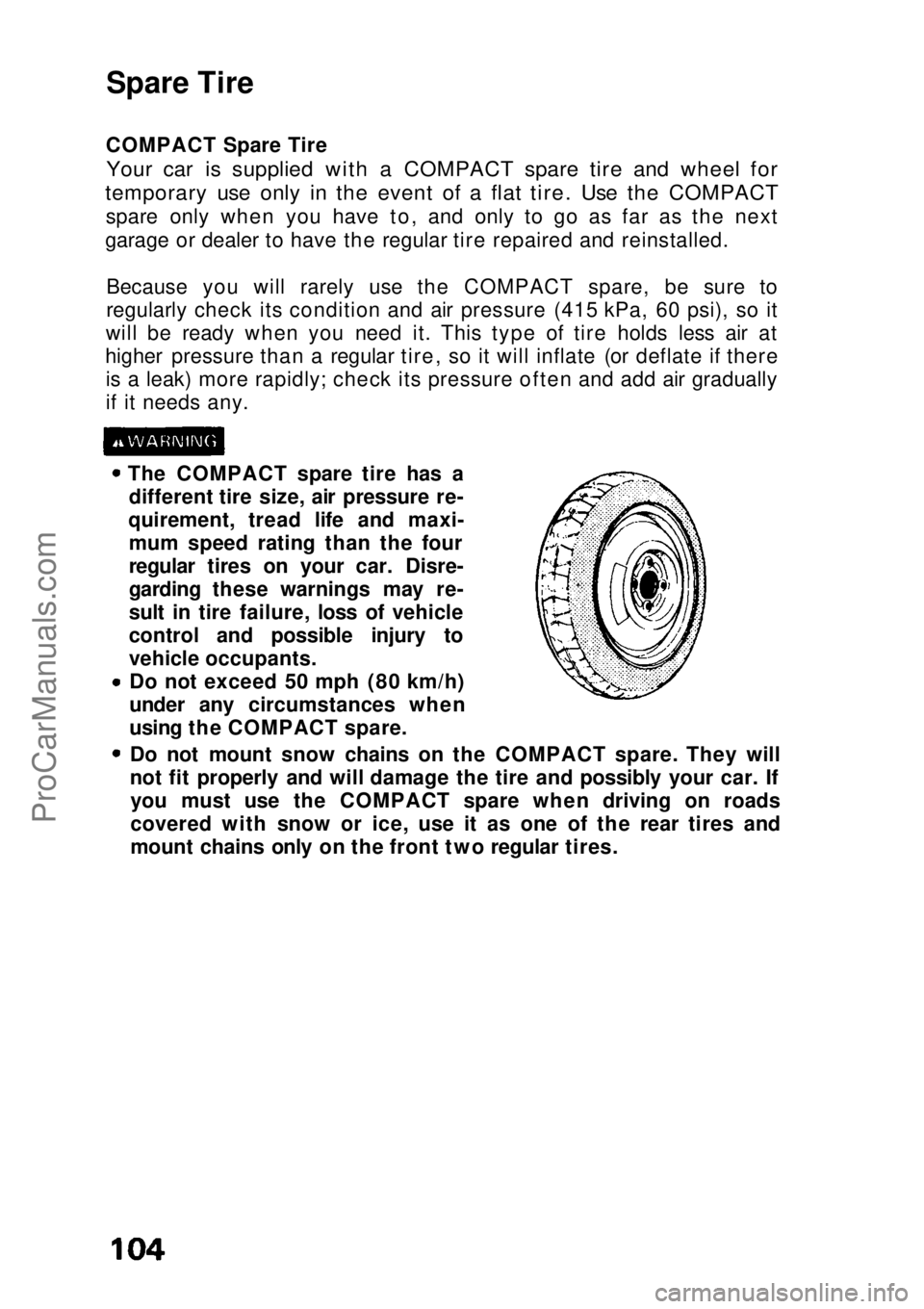
COMPACT Spare Tire
Your car is supplied with a COMPACT spare tire and wheel for
temporary use only in the event of a flat tire. Use the COMPACT
spare only when you have to, and only to go as far as the next
garage or dealer to have the regular tire repaired and reinstalled.
Because you will rarely use the COMPACT spare, be sure to
regularly check its condition and air pressure (415 kPa, 60 psi), so it
will be ready when you need it. This type of tire holds less air at
higher pressure than a regular tire, so it will inflate (or deflate if there is a leak) more rapidly; check its pressure often and add air gradually
if it needs any.
The COMPACT spare tire has adifferent tire size, air pressure re-
quirement, tread life and maxi- mum speed rating than the four
regular tires on your car. Disre-
garding these warnings may re-
sult in tire failure, loss of vehicle
control and possible injury to
vehicle occupants.Do not exceed 50 mph (80 km/h)
under any circumstances when
using the COMPACT spare.
Do not mount snow chains on the COMPACT spare. They will
not fit properly and will damage the tire and possibly your car. Ifyou must use the COMPACT spare when driving on roads
covered with snow or ice, use it as one of the rear tires and
mount chains only on the front two regular tires.ProCarManuals.comMain Menu s t
Page 124 of 136

Emission Controls
Sources of Emissions
The combustion process produces carbon monoxide, oxides of nitrogen and hydrocarbons. The evaporation of fuel in the fuel tank
also produces hydrocarbons. Control of oxides of nitrogen andhydrocarbons is very important since, under certain conditions,
when subjected to sunlight, they react to form photochemical smog. Carbon monoxide does not react to form smog, but it is toxic.Honda Motor Co., Ltd. has developed a number of systems which
are highly effective in reducing carbon monoxide, oxides of nitrogen
and hydrocarbons.
The Clean Air Act The Clean Air Act requires all vehicle manufacturers to explain in
writing, the operation and maintenance of their emission control
systems.
Maintenance instructions are included on pages 68 — 73 ; the
operation of each system is explained on the following.
Replacement Parts
The emission control systems on your new Honda were designed, built and certified to conform with the Federal regulations
implementing the Clean Air Act. Honda recommends only the use of
new, genuine Honda parts or their equivalent. The use of otherreplacement parts which are not of equivalent quality may impair
the effectiveness of your car's emission control systems.
Crankcase Emission Control System
To prevent crankcase emissions, your car is equipped with a Positive Crankcase Ventilation (PCV) System which routes blowby
gases from the crankcase, through the PCV valve and intakemanifold, into the combustion chamber.ProCarManuals.comMain Menu s t
Page 125 of 136

Evaporative Emission Control System
The Evaporative Emission Control System is designed to prevent
fuel vapors from escaping into the atmosphere. Fuel vapors from the fuel tank are directed into the charcoal
canister where they are adsorbed and stored while the engine is stopped or idling. When the coolant temperature rises to a certain
value, the vapors are drawn into the engine through the throttlebody and the intake manifold during normal engine operation.
Engine Exhaust Emission Controls
The engine exhaust emission control systems are designed to control combustion during idle, acceleration, cruise, and deceleration.
These systems are entirely separate from the crankcase and evaporative emission control systems described previously.
HONDA PGM-FI System
The PGM-FI system consists of three independent sub-systems; Air Intake, Electronic Control and Fuel Control, thus allowing moreaccurate control of air/fuel ratios under all operating conditions.
The Electronic Control Unit (ECU) detects the amount of air
drawn into the cylinders and determines the amount of fuel to be injected to provide the optimum air/fuel ratio for all engine needs.
Ignition Timing Control System
This system automatically controls the ignition timing to reduce
the amount of HC and NOx.
Catalytic Converter
Three Way Catalyst
The catalyst is used to convert hydrocarbons (HC), carbon monoxide (CO) and oxides of nitrogen (NOx) in the exhaust gas,
to carbon dioxide (CO 2
), dinitrogen (N 2
) and water vapor.
Exhaust Gas Recirculation (EGR) (California automatic models except EX Sedan)
The EGR system is designed to control the formation of oxides of nitrogen (NOx) caused when fuel mixture burns at high
temperature. It works by recirculating exhaust gas through the EGR valve and intake manifold into the combustion chambers
where it reduces peak temperature by diluting the air/fuel mixture.ProCarManuals.comMain Menu s t