wheel HONDA CIVIC 1991 User Guide
[x] Cancel search | Manufacturer: HONDA, Model Year: 1991, Model line: CIVIC, Model: HONDA CIVIC 1991Pages: 136, PDF Size: 1.33 MB
Page 84 of 136
Brakes (cont'd)
Front Brake Wear Indicators
Your car is equipped with audible front brake wear indicators. When
the brake pads wear to point that they should be replaced, they will make a "screeching" sound when the wheels are rolling and when
the brakes are applied.
NOTE:
Due to some driving habits or climates, brakes may "squeal" when
you first apply them or when you have them partially applied; this is normal, and does not indicate excessive wear. The wear indicator
makes a "screeching" sound while the brakes are applied.
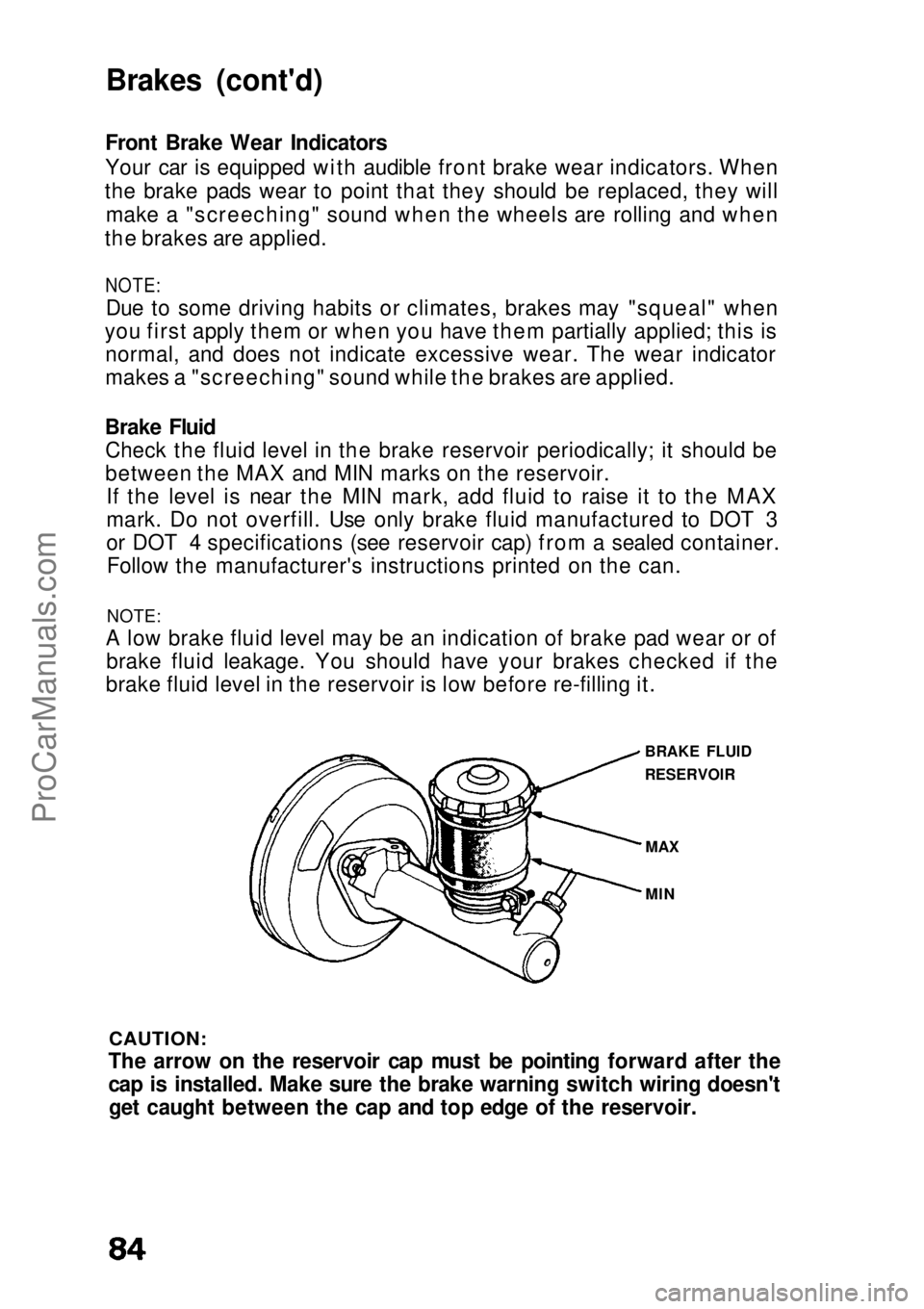
Brake Fluid Check the fluid level in the brake reservoir periodically; it should be
between the MAX and MIN marks on the reservoir. If the level is near the MIN mark, add fluid to raise it to the MAX
mark. Do not overfill. Use only brake fluid manufactured to DOT 3
or DOT 4 specifications (see reservoir cap) from a sealed container.Follow the manufacturer's instructions printed on the can.
NOTE:
A low brake fluid level may be an indication of brake pad wear or of brake fluid leakage. You should have your brakes checked if the
brake fluid level in the reservoir is low before re-filling it.
BRAKE FLUID
RESERVOIR
CAUTION:
The arrow on the reservoir cap must be pointing forward after the
cap is installed. Make sure the brake warning switch wiring doesn't get caught between the cap and top edge of the reservoir. MAX
MINProCarManuals.comMain Menu s t
Page 85 of 136
Power Steering
The Sedan (except DX with manual transmission) and DX Hatch- back with automatic transmission are equipped with power steering.
The power steering on your car provides easy handling while parking and maneuvering in traffic, without loss of road "feel" at
highway speeds. An engine-driven hydraulic pump provides full
power assist at low speeds and decreasing assist as the car goes
faster.
CAUTION:
If the power steering system should fail, or if the engine should
stall, the car can still be steered. However, much greater effort
will be required, particularly in sharp turns at low speed.
NOTE:
You may feel a slight clunk or knock when turning the wheel with
the engine off. This is a normal condition due to the design of the
system.
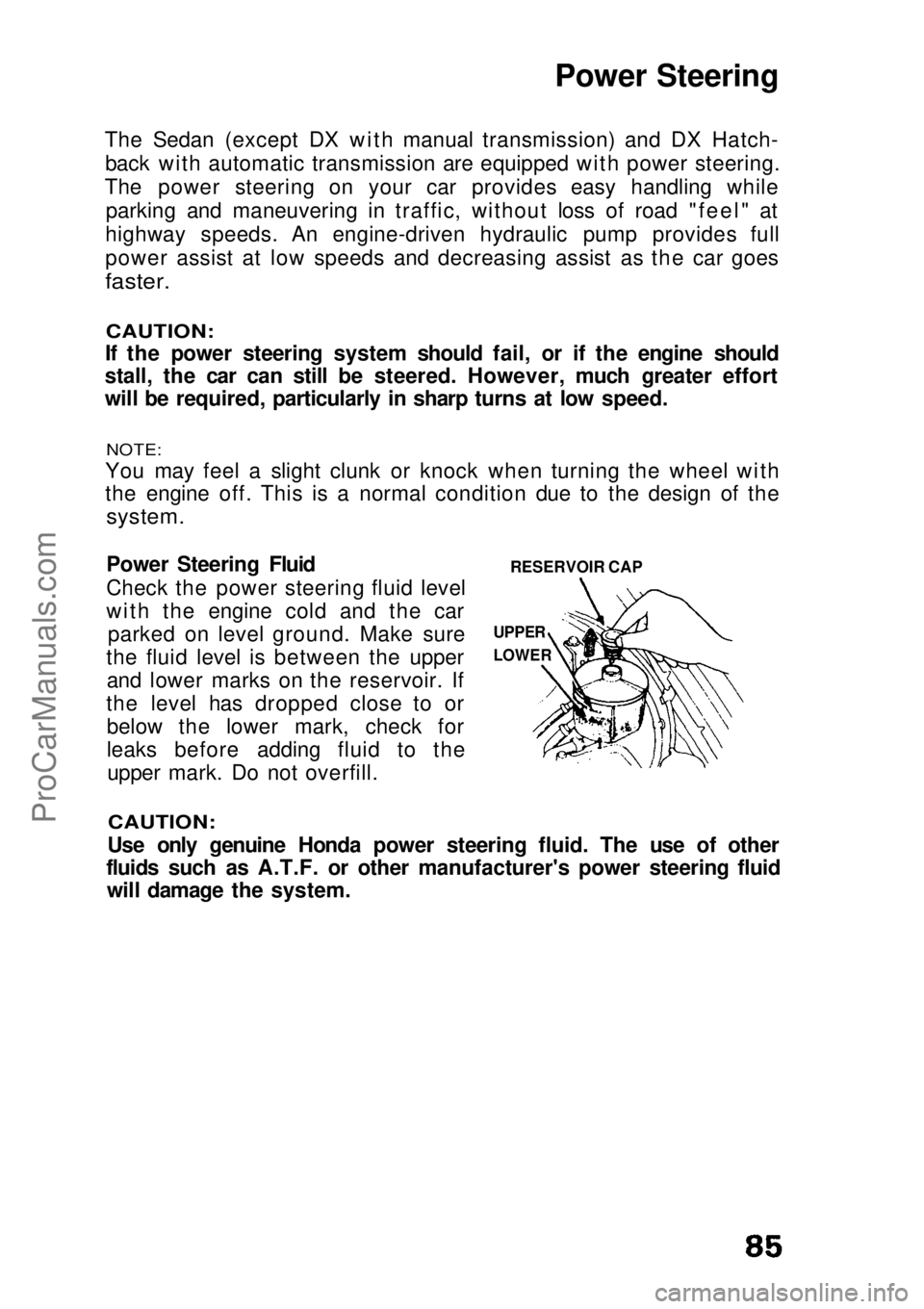
RESERVOIR CAP
UPPER
LOWER
Power Steering Fluid
Check the power steering fluid level
with the engine cold and the car
parked on level ground. Make sure
the fluid level is between the upper and lower marks on the reservoir. If
the level has dropped close to or below the lower mark, check for
leaks before adding fluid to theupper mark. Do not overfill.
CAUTION:
Use only genuine Honda power steering fluid. The use of other
fluids such as A.T.F. or other manufacturer's power steering fluid will damage the system.ProCarManuals.comMain Menu s t
Page 95 of 136

CAUTION:
Check tire pressure when the tires are cold.(After the car has been parked for more than 3 hours or driven
less than 1 mile/1.6 km.)
Tire pressure may increase as much as 41 kPa (6 psi) when the
tire is hot, so NEVER ADJUST tire pressure when the tires are hot.
Never inflate load range B tires to more than 220 kPa (32 psi)
cold.
Cars with luggage racks or cartop carriers DO NOT have greater
load limits than those on the label.
Winter Driving Tires marked "M + S" or "all season" have an all-weather treaddesign and should be suitable for most driving conditions. However,
snow tires and tire chains may be required under some conditions. Ifyour tires do not have these markings, they may not be suitable forwinter driving conditions. We recommend snow tires or tire chainsfor snow and icy conditions.
Snow TiresIf you use snow tires, they should be of the same size, construction
and load capacity as the original tires on your car. Snow tires must
be installed in sets of four, or they may cause poor handling. Driving
with snow tires on dry roads can reduce your car's performance
during acceleration, turning and stopping.
If you need further information on snow tires, please contact your
Honda dealer.
Tire Chains
Use chains only when you have to. Check with local authorities or
Provinces for requirements prior to installing tire chains. Make sure
the chains are the right size for your tires. Install them only on the
drive wheels of your car, and do so as tightly as possible, following
the manufacturer's instructions. If metal chains are used, they must
be SAE Class "S." Cable type traction devices can also be used.
Drive slowly with chains installed. If you hear the chains contacting
your car's body or chassis, stop and tighten them.
(cont'd)ProCarManuals.comMain Menu s t
Page 96 of 136
Tires (cont'd)
CAUTION:
If the contact continues, slow down until it stops or your car can
be damaged. Chains that are the wrong size or improperly installed can
damage your car's brake lines, suspension, body, and wheels.
If you need further information on tire chains, please see your
Honda dealer.
Remove the chains as soon as the road is clear of ice and snow.
Tire Replacement Honda recommends that you replace tires in sets of four, or in pairs,
front or rear. If you need to replace only one tire, mount the new
tire opposite the tire showing the least amount of wear. For instance, if the left front tire shows the least amount of wear,
mount the new tire on the front right side.
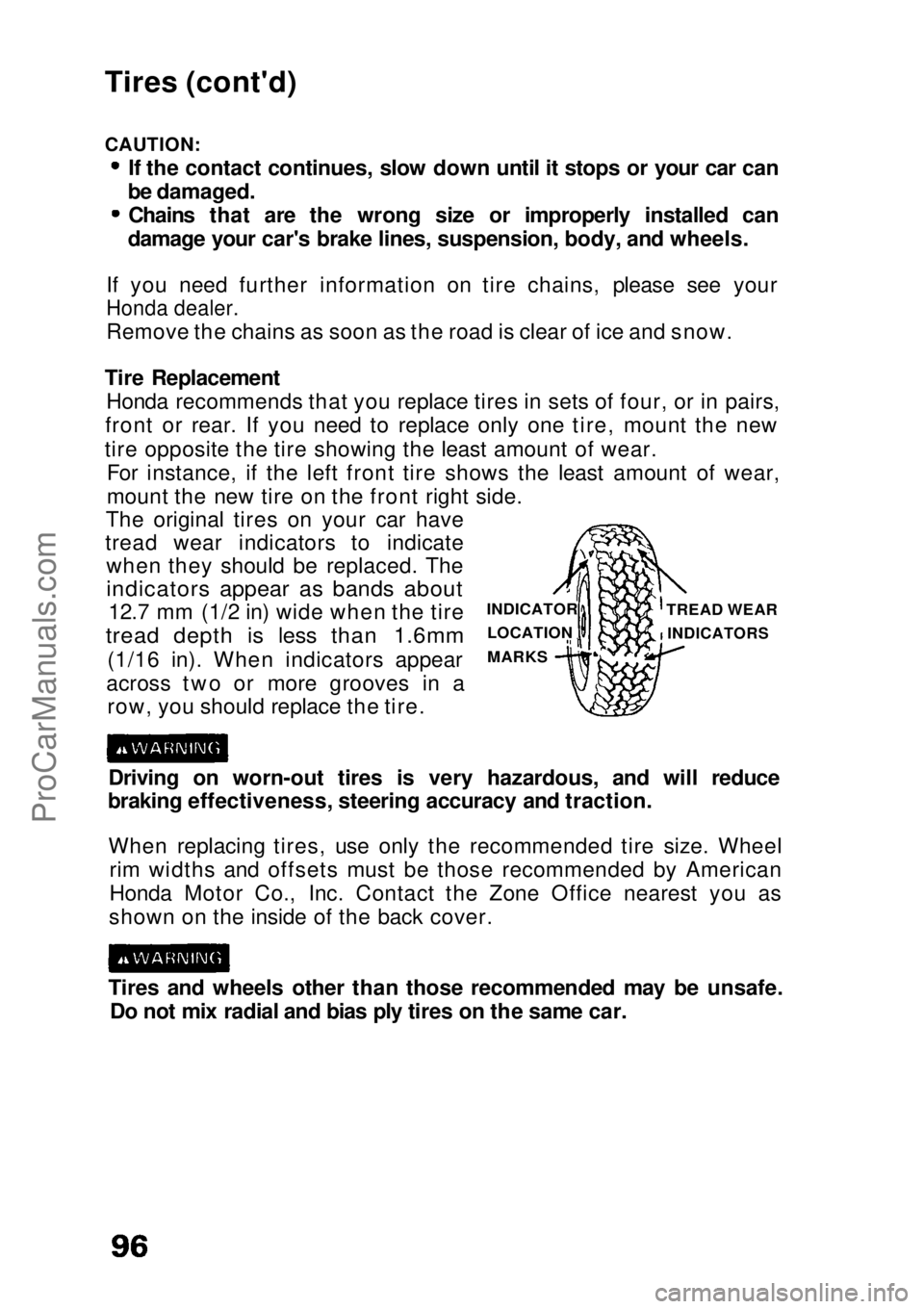
The original tires on your car have
tread wear indicators to indicate when they should be replaced. The
indicators appear as bands about
12.7 mm (1/2 in) wide when the tire
tread depth is less than 1.6mm
(1/16 in). When indicators appear
across two or more grooves in a row, you should replace the tire.
Driving on worn-out tires is very hazardous, and will reduce
braking effectiveness, steering accuracy and traction.
When replacing tires, use only the recommended tire size. Wheel rim widths and offsets must be those recommended by American
Honda Motor Co., Inc. Contact the Zone Office nearest you as
shown on the inside of the back cover.
Tires and wheels other than those recommended may be unsafe. Do not mix radial and bias ply tires on the same car. INDICATOR
LOCATION
MARKS TREAD WEAR
INDICATORSProCarManuals.comMain Menu s t
Page 97 of 136
Tire Balancing
Unbalanced tires may affect handling and tire wear. A tire should
always be rebalanced after it has been dismounted from the wheel.
Your original tires were properly balanced before the car left the
factory, but may need rebalancing at some time during the life of the
tire. Tire balancing for the COMPACT spare is not necessary.
Tire Rotation
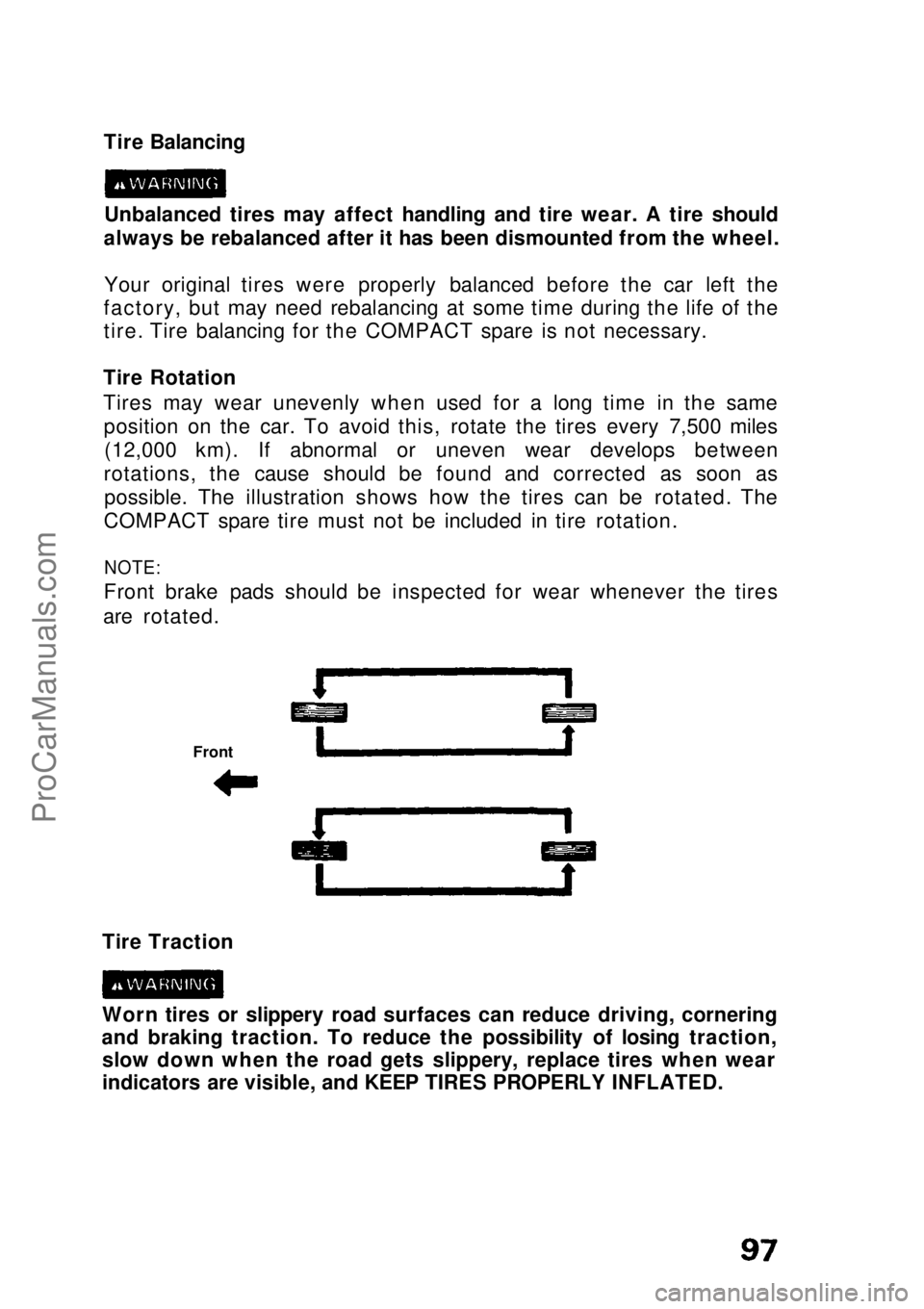
Tires may wear unevenly when used for a long time in the same position on the car. To avoid this, rotate the tires every 7,500 miles(12,000 km). If abnormal or uneven wear develops between
rotations, the cause should be found and corrected as soon as possible. The illustration shows how the tires can be rotated. The
COMPACT spare tire must not be included in tire rotation.
NOTE:
Front brake pads should be inspected for wear whenever the tires
are rotated.
Tire Traction
Worn tires or slippery road surfaces can reduce driving, cornering
and braking traction. To reduce the possibility of losing traction, slow down when the road gets slippery, replace tires when wear
indicators are visible, and KEEP TIRES PROPERLY INFLATED. FrontProCarManuals.comMain Menu s t
Page 102 of 136
Appearance Care (cont'd)
Preventive Service
Check all drain holes in the doors and body panels for clogging and
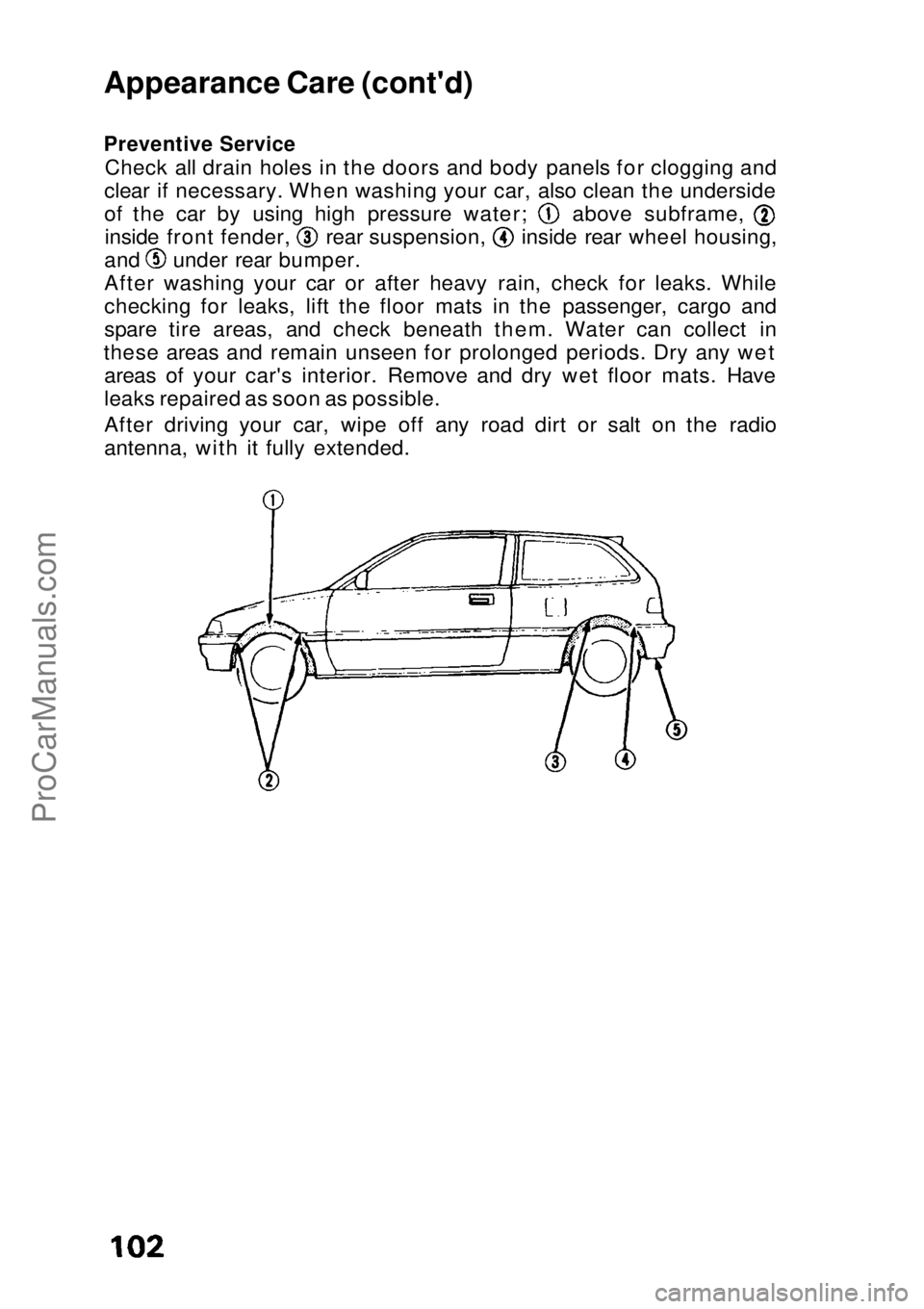
clear if necessary. When washing your car, also clean the underside of the car by using high pressure water; above subframe,
inside front fender, rear suspension, inside rear wheel housing,
and under rear bumper.
After washing your car or after heavy rain, check for leaks. While
checking for leaks, lift the floor mats in the passenger, cargo and
spare tire areas, and check beneath them. Water can collect in
these areas and remain unseen for prolonged periods. Dry any wet areas of your car's interior. Remove and dry wet floor mats. Have
leaks repaired as soon as possible.
After driving your car, wipe off any road dirt or salt on the radio
antenna, with it fully extended.ProCarManuals.comMain Menu s t
Page 104 of 136
Spare Tire
COMPACT Spare Tire
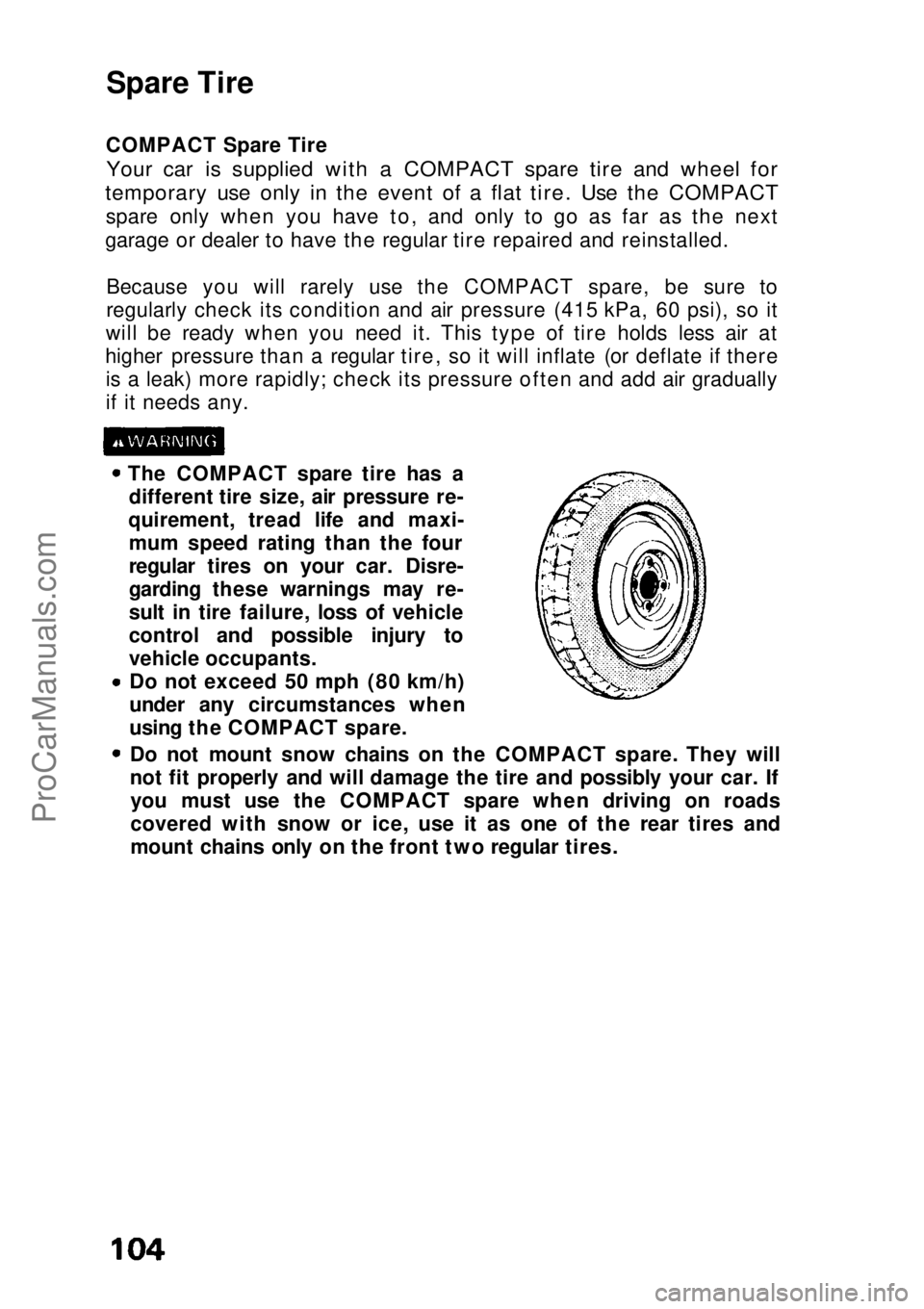
Your car is supplied with a COMPACT spare tire and wheel for
temporary use only in the event of a flat tire. Use the COMPACT
spare only when you have to, and only to go as far as the next
garage or dealer to have the regular tire repaired and reinstalled.
Because you will rarely use the COMPACT spare, be sure to
regularly check its condition and air pressure (415 kPa, 60 psi), so it
will be ready when you need it. This type of tire holds less air at
higher pressure than a regular tire, so it will inflate (or deflate if there is a leak) more rapidly; check its pressure often and add air gradually
if it needs any.
The COMPACT spare tire has adifferent tire size, air pressure re-
quirement, tread life and maxi- mum speed rating than the four
regular tires on your car. Disre-
garding these warnings may re-
sult in tire failure, loss of vehicle
control and possible injury to
vehicle occupants.Do not exceed 50 mph (80 km/h)
under any circumstances when
using the COMPACT spare.
Do not mount snow chains on the COMPACT spare. They will
not fit properly and will damage the tire and possibly your car. Ifyou must use the COMPACT spare when driving on roads
covered with snow or ice, use it as one of the rear tires and
mount chains only on the front two regular tires.ProCarManuals.comMain Menu s t
Page 105 of 136
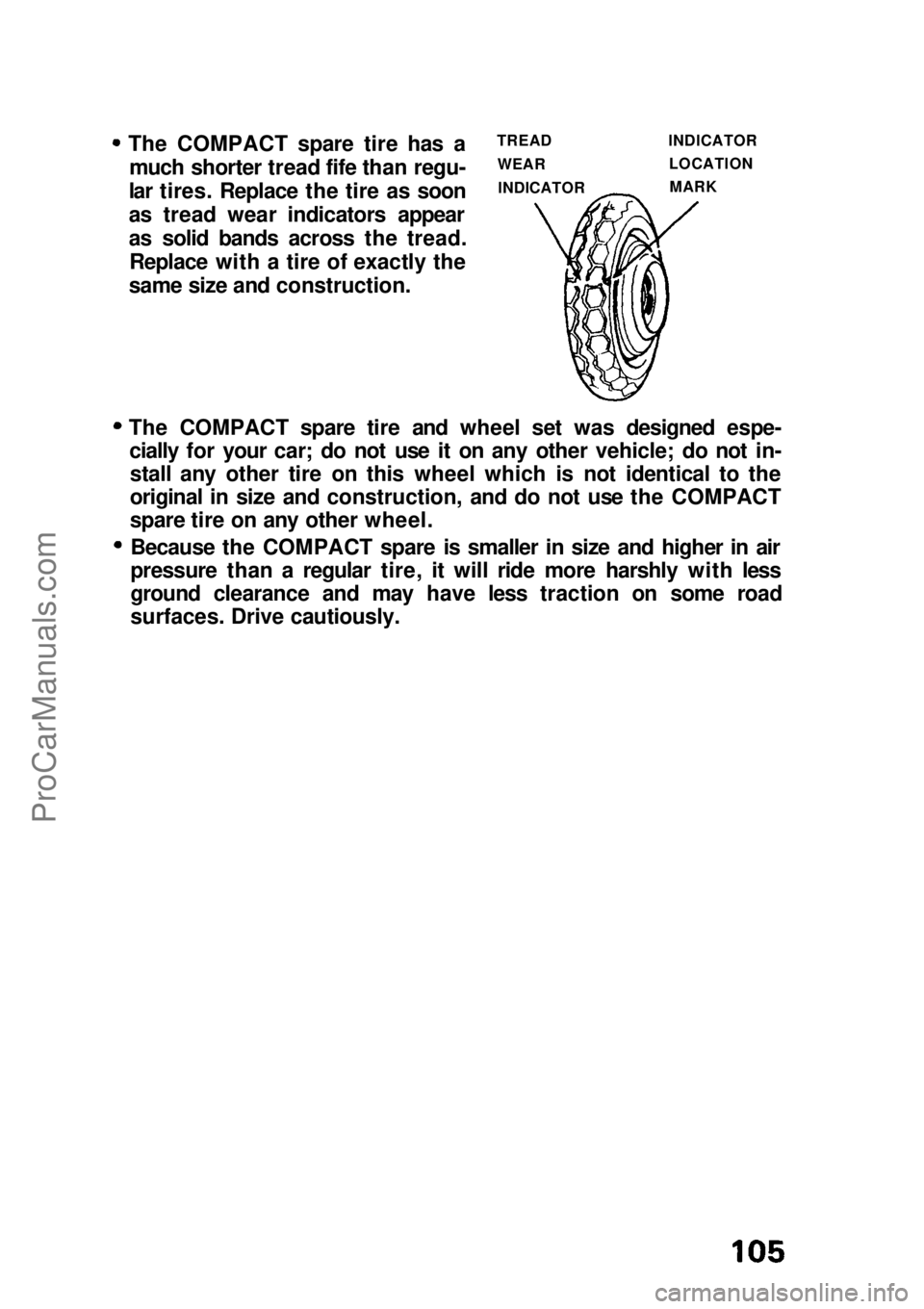
The COMPACT spare tire has a
much shorter tread fife than regu-
lar tires. Replace the tire as soon
as tread wear indicators appear
as solid bands across the tread. Replace with a tire of exactly the
same size and construction. TREAD
WEARINDICATOR INDICATOR
LOCATIONMARK
The COMPACT spare tire and wheel set was designed espe- cially for your car; do not use it on any other vehicle; do not in-stall any other tire on this wheel which is not identical to the
original in size and construction, and do not use the COMPACT
spare tire on any other wheel.
Because the COMPACT spare is smaller in size and higher in air
pressure than a regular tire, it will ride more harshly with less
ground clearance and may have less traction on some road
surfaces. Drive cautiously.ProCarManuals.comMain Menu s t
Page 106 of 136
Changing a Flat Tire
Do not attempt to change a tire unless the car is on firm, level
ground and well out of the flow of traffic.
Park the car on a firm, level surface, apply the parking brake, turn
on the hazard warning switch and put the transmission in gear (Park
for automatic).
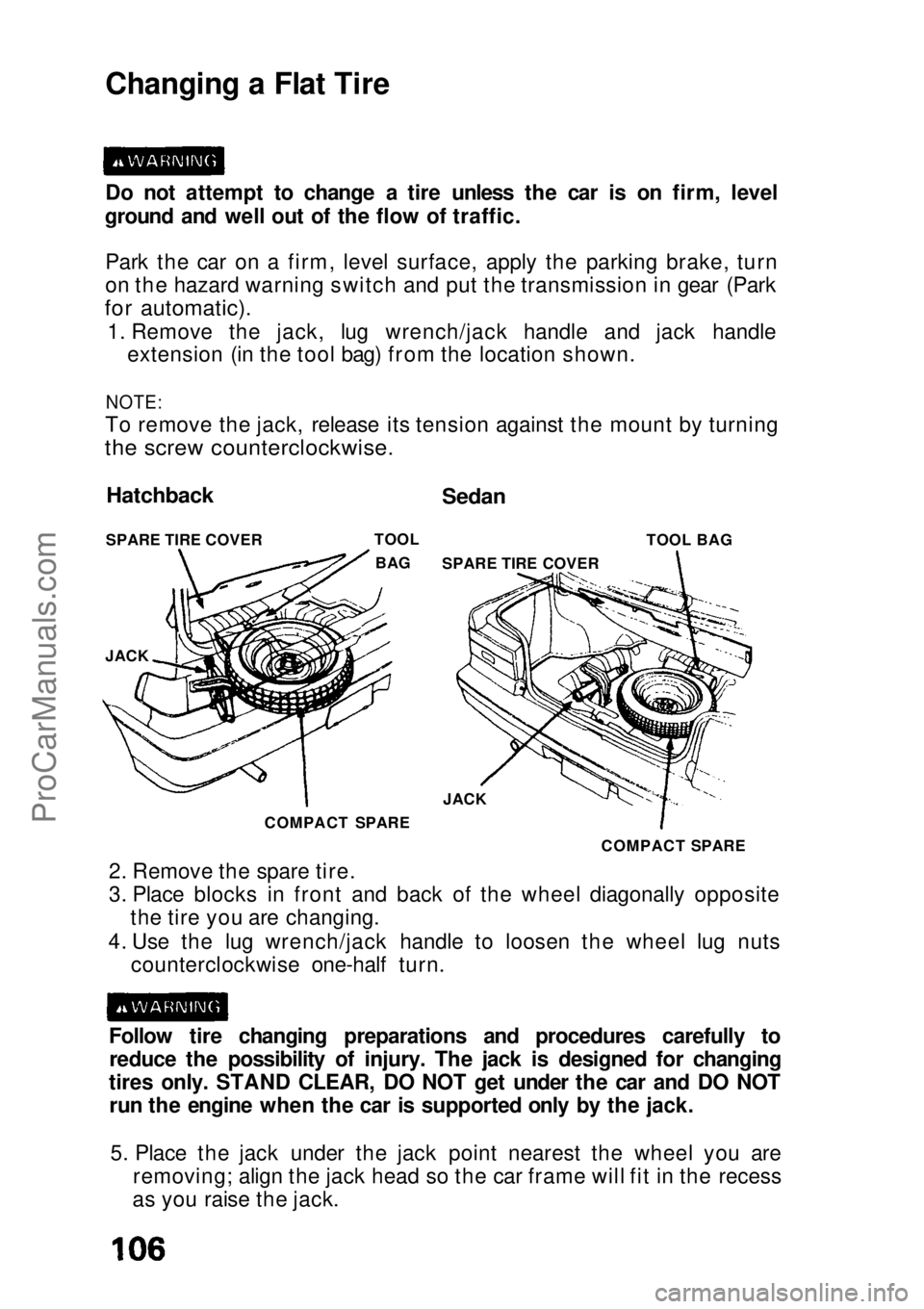
1. Remove the jack, lug wrench/jack handle and jack handle extension (in the tool bag) from the location shown.
NOTE:
To remove the jack, release its tension against the mount by turning
the screw counterclockwise.
JACK TOOL BAG
Follow tire changing preparations and procedures carefully to reduce the possibility of injury. The jack is designed for changing
tires only. STAND CLEAR, DO NOT get under the car and DO NOT run the engine when the car is supported only by the jack.
5. Place the jack under the jack point nearest the wheel you are removing; align the jack head so the car frame will fit in the recess
as you raise the jack.
Hatchback
SPARE TIRE COVER
Sedan
TOOL BAG SPARE TIRE COVER
JACK
COMPACT SPARE COMPACT SPARE
2. Remove the spare tire.
3. Place blocks in front and back of the wheel diagonally opposite the tire you are changing.
4. Use the lug wrench/jack handle to loosen the wheel lug nuts counterclockwise one-half turn.ProCarManuals.comMain Menu s t
Page 107 of 136
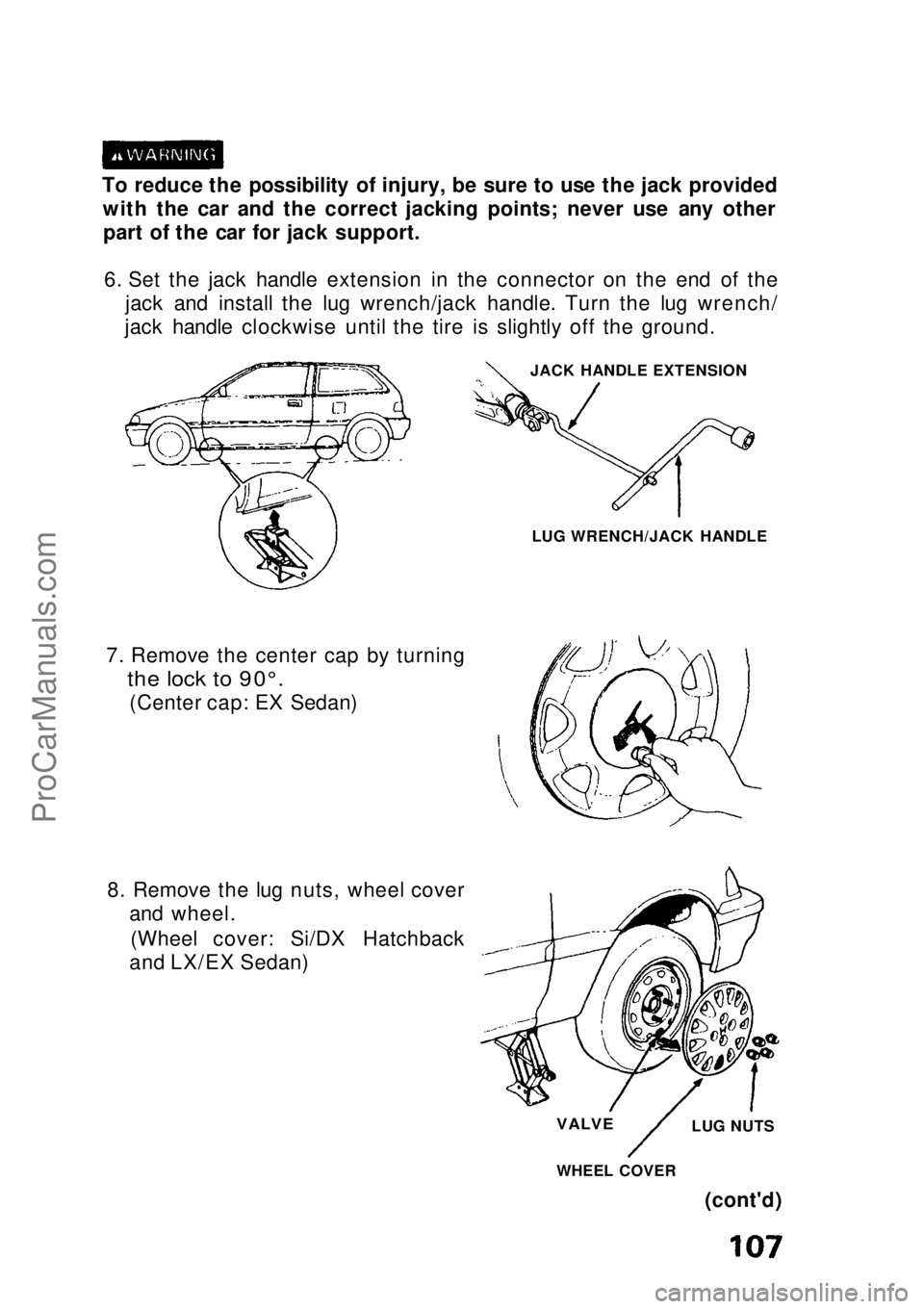
To reduce the possibility of injury, be sure to use the jack provided
with the car and the correct jacking points; never use any otherpart of the car for jack support.
6. Set the jack handle extension in the connector on the end of the jack and install the lug wrench/jack handle. Turn the lug wrench/
jack handle clockwise until the tire is slightly off the ground.
JACK HANDLE EXTENSION
LUG WRENCH/JACK HANDLE
7. Remove the center cap by turning
the lock to 90°.
(Center cap: EX Sedan)
8. Remove the lug nuts, wheel cover and wheel.
(Wheel cover: Si/DX Hatchback
and LX/EX Sedan)
(cont'd)
VALVE
LUG NUTS
WHEEL COVERProCarManuals.comMain Menu s t