wheel HONDA CIVIC 1991 Owner's Manual
[x] Cancel search | Manufacturer: HONDA, Model Year: 1991, Model line: CIVIC, Model: HONDA CIVIC 1991Pages: 136, PDF Size: 1.33 MB
Page 108 of 136
Changing a Flat Tire (cont'd)
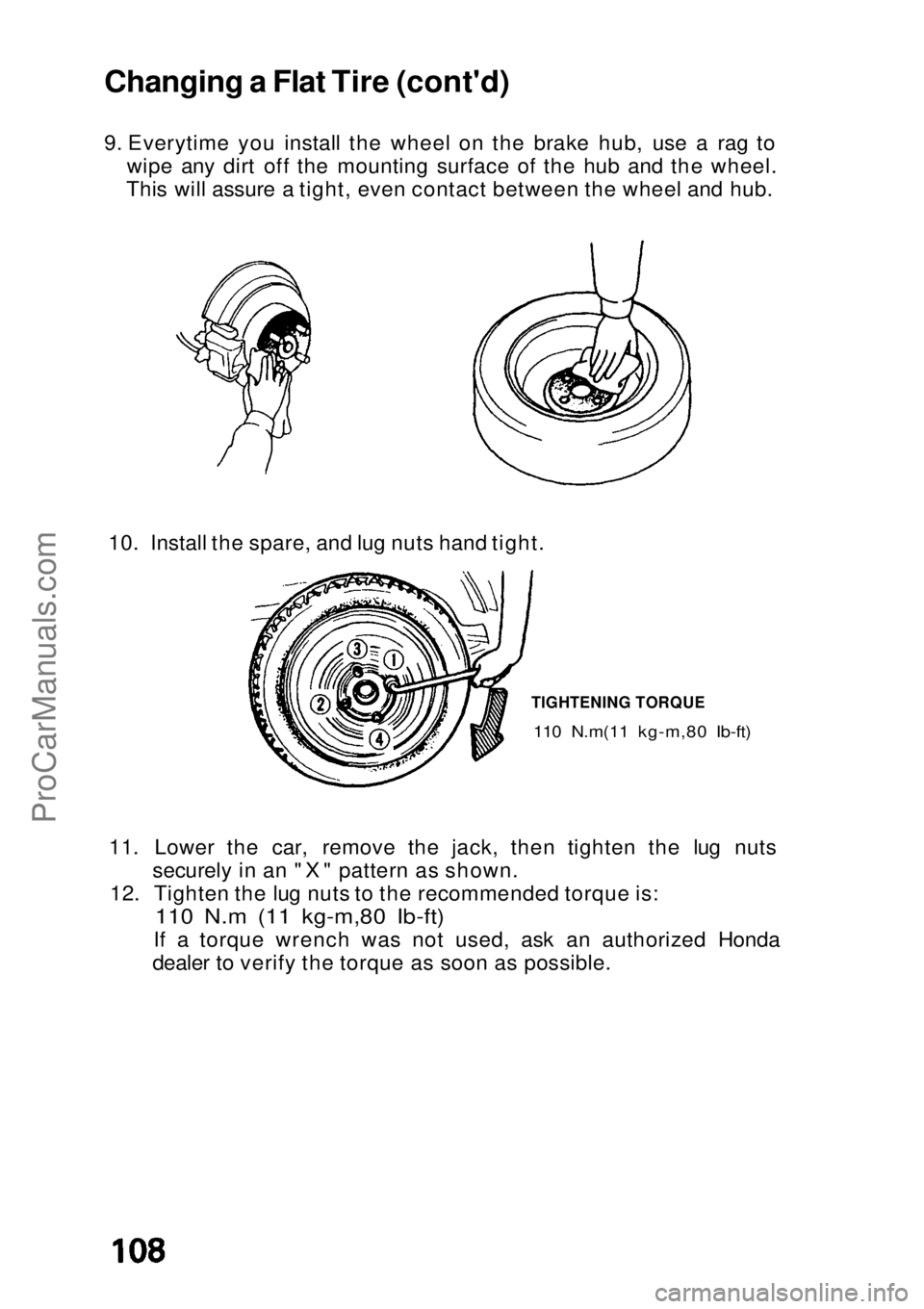
9. Everytime you install the wheel on the brake hub, use a rag to
wipe any dirt off the mounting surface of the hub and the wheel.
This will assure a tight, even contact between the wheel and hub.
10. Install the spare, and lug nuts hand tight.
TIGHTENING TORQUE
110 N.m(11 kg-m,80 Ib-ft)
11. Lower the car, remove the jack, then tighten the lug nuts securely in an "X" pattern as shown.
12. Tighten the lug nuts to the recommended torque is:
110 N.m (11 kg-m,80 Ib-ft)
If a torque wrench was not used, ask an authorized Honda
dealer to verify the torque as soon as possible.
ProCarManuals.comMain Menu s t
Page 111 of 136

If towing is necessary, contact a professional towing service. Your
authorized Honda dealer can assist you with detailed towing
instructions.
Never use tow chains or rope to tow a car; your ability to safely
control the car may be adversely affected.
We recommend the following: Flat Bed Equipment —Entire car is winched on a flat bed vehicle.
This is the best way of transporting your Honda.
Wheel Lift Type—Tow with the front wheels off the ground.
If the car can only be towed with the front wheels on the ground:
make sure the transmission is full of fluid (see pages 78 — 79) and
tow with the transmission in neutral (N) and the ignition key in the 1
position.
CAUTION:
To avoid serious damage on automatic transmission cars, first
start the engine and shift to D4, then to N and shut the engine off. If the engine does not run or the transmission cannot be shifted
while the engine is running, the car must be transported on flat
bed equipment.
Check local regulations for towing.
CAUTION:
Do not exceed 35 mph (55 km/h) or tow for distances of more
than 50 miles (80 km).
If a sling type tow is used, the tow truck driver should position
wood spacer blocks between your car's frame and the chains
and lift straps to avoid damaging the bumper and the body. Do not use the bumpers to lift the car or to support the car's
weight while towing. TowingProCarManuals.comMain Menu s t
Page 112 of 136

If Your Car Gets Stuck
If your car gets stuck in sand, mud, or snow, call a professional
towing service for assistance in getting your car out.
CAUTION: Do not rev up the engine and allow the wheels to spin freely at
high speed. Severe transmission damage may result if the wheels are allowed to spin for more than a few seconds.DO NOT try to free a car with automatic transmission from
snow, etc. by rocking the car alternately between forward and
reverse gears. Severe transmission damage may result from
shifting into gear with the wheels moving.ProCarManuals.comMain Menu s t
Page 122 of 136
DOT Tire Quality Grades
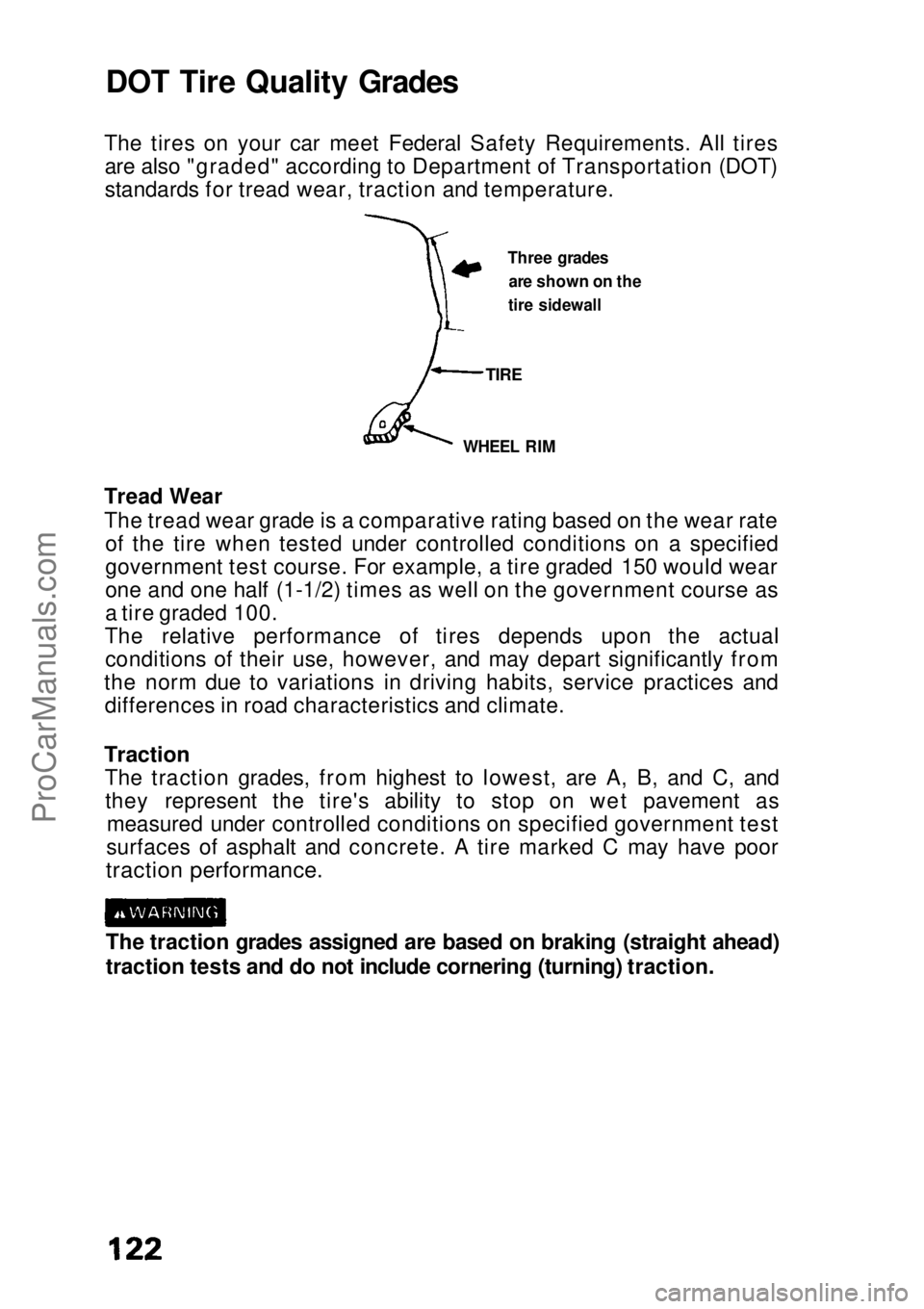
The tires on your car meet Federal Safety Requirements. All tires are also "graded" according to Department of Transportation (DOT)
standards for tread wear, traction and temperature.
Tread Wear
The tread wear grade is a comparative rating based on the wear rate of the tire when tested under controlled conditions on a specified
government test course. For example, a tire graded 150 would wear
one and one half (1-1/2) times as well on the government course as
a tire graded 100.
The relative performance of tires depends upon the actual conditions of their use, however, and may depart significantly from
the norm due to variations in driving habits, service practices and differences in road characteristics and climate.
Traction
The traction grades, from highest to lowest, are A, B, and C, andthey represent the tire's ability to stop on wet pavement as measured under controlled conditions on specified government test
surfaces of asphalt and concrete. A tire marked C may have poor
traction performance.
The traction grades assigned are based on braking (straight ahead)
traction tests and do not include cornering (turning) traction. Three grades
are shown on the
tire sidewall
TIRE
WHEEL RIMProCarManuals.comMain Menu s t
Page 123 of 136

Temperature
The temperature grades are A (the highest), B and C representing
the tire's resistance to the generation of heat and its ability to
dissipate heat when tested under controlled conditions on a
specified indoor laboratory test wheel. Sustained high temperaturecan cause the material of the tire to degenerate and reduce tire life,
and excessive temperature can lead to sudden tire failure. The grade C corresponds to a level of performance which all passenger car
tires must meet under the Federal Motor Vehicle Safety Standard No. 109. Grades B and A represent higher levels of performance on
the laboratory test wheel than the minimum required by law.
The tire temperature grade is established for a tire that is properly inflated and not overloaded. Excessive speed, underinflation, or
excessive loading, either separately or in combination, can cause
heat buildup and possible tire failure.ProCarManuals.comMain Menu s t