light HONDA CIVIC 1991 Owner's Manual
[x] Cancel search | Manufacturer: HONDA, Model Year: 1991, Model line: CIVIC, Model: HONDA CIVIC 1991Pages: 136, PDF Size: 1.33 MB
Page 42 of 136
Hood
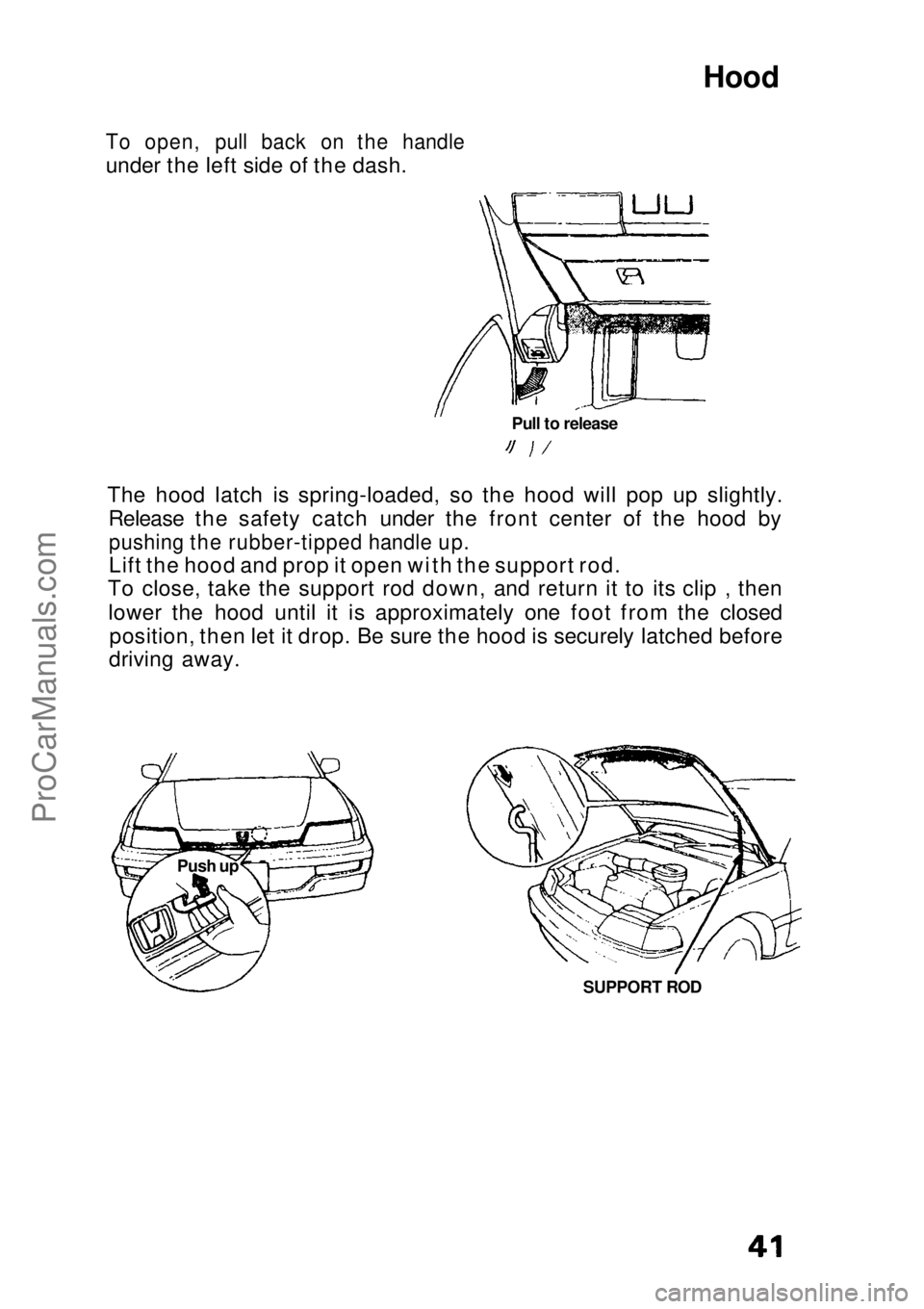
To open, pull back on the handle
under the left side of the dash.
The hood latch is spring-loaded, so the hood will pop up slightly.Release the safety catch under the front center of the hood by
pushing the rubber-tipped handle up.
Lift the hood and prop it open with the support rod.
To close, take the support rod down, and return it to its clip , then
lower the hood until it is approximately one foot from the closed position, then let it drop. Be sure the hood is securely latched before
driving away.
Pull to release
SUPPORT ROD
Push upProCarManuals.comMain Menu s t
Page 43 of 136
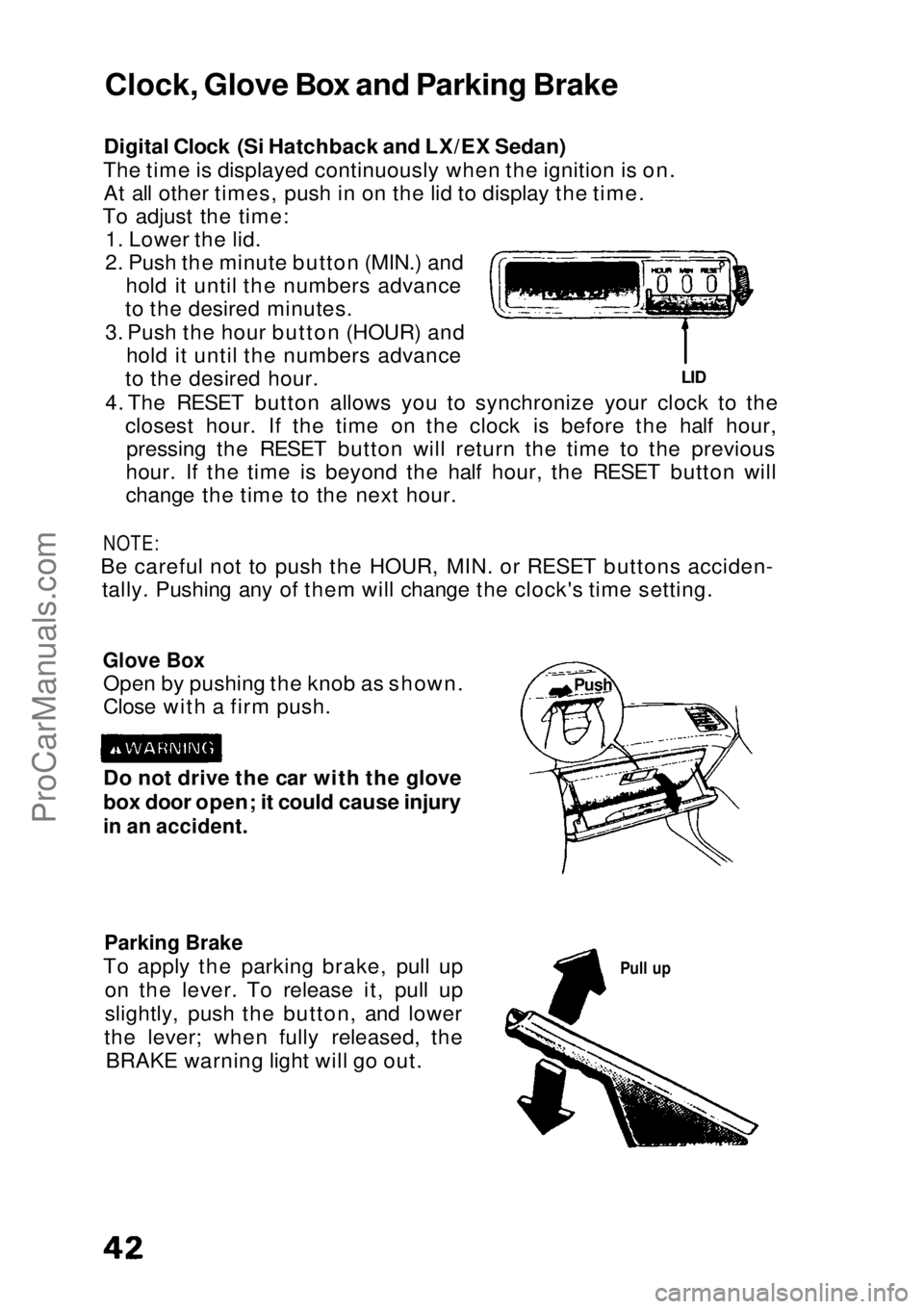
Digital Clock (Si Hatchback and LX/EX Sedan)
The time is displayed continuously when the ignition is on. At all other times, push in on the lid to display the time.
To adjust the time: 1. Lower the lid.
2. Push the minute button (MIN.) and hold it until the numbers advance
to the desired minutes.
3. Push the hour button (HOUR) and hold it until the numbers advance
to the desired hour.
4. The RESET button allows you to synchronize your clock to the closest hour. If the time on the clock is before the half hour,pressing the RESET button will return the time to the previous
hour. If the time is beyond the half hour, the RESET button will
change the time to the next hour.
NOTE:
Be careful not to push the HOUR, MIN. or RESET buttons acciden- tally. Pushing any of them will change the clock's time setting.
Glove Box
Open by pushing the knob as shown.
Close with a firm push.
Parking Brake
To apply the parking brake, pull up on the lever. To release it, pull up
slightly, push the button, and lower
the lever; when fully released, the BRAKE warning light will go out.
Pull up
Do not drive the car with the glove
box door open; it could cause injury
in an accident.
LID
Clock, Glove Box and Parking Brake
PushProCarManuals.comMain Menu s t
Page 45 of 136
Cigarette Lighter and Ashtrays
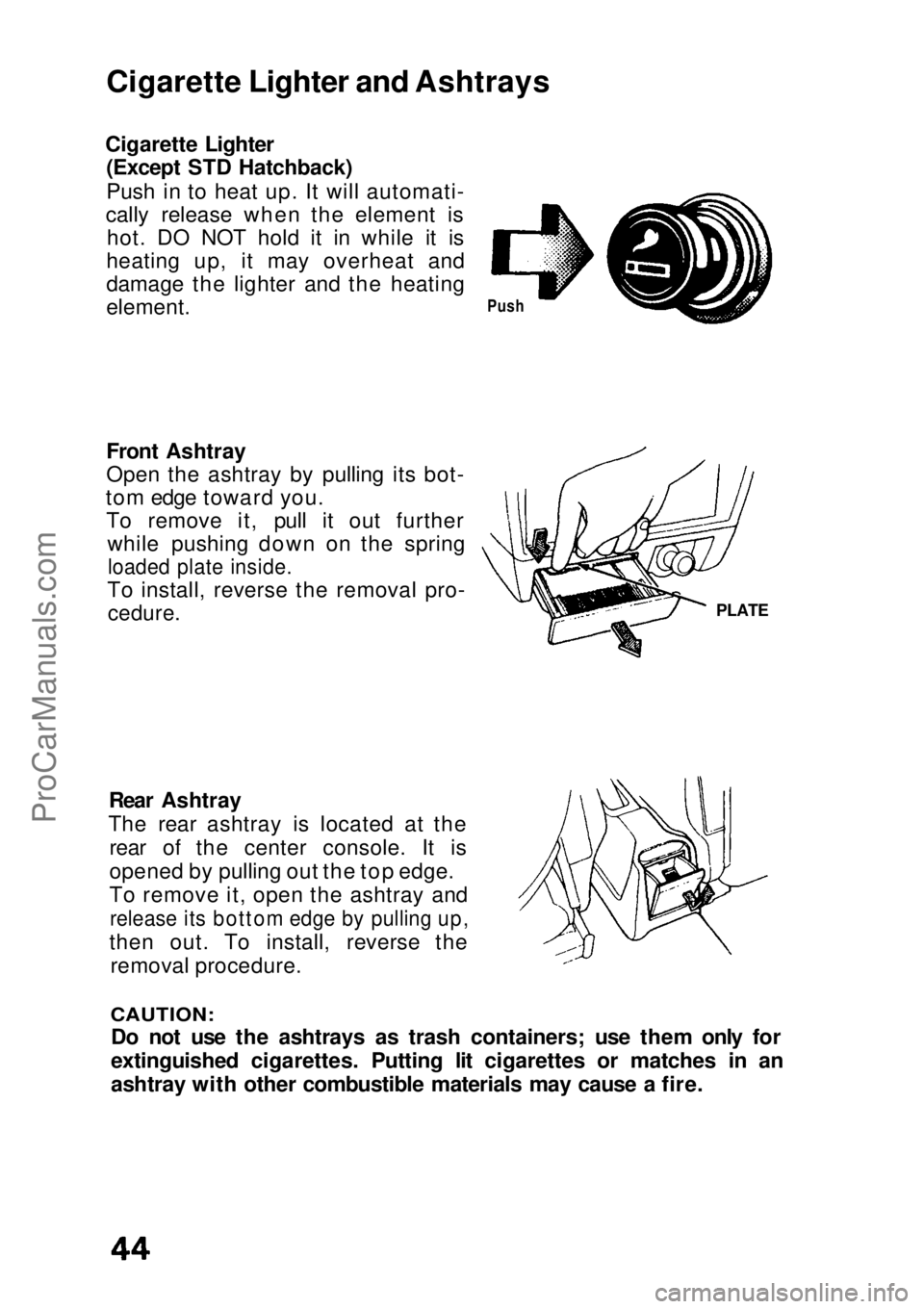
Cigarette Lighter (Except STD Hatchback)
Push in to heat up. It will automati-
cally release when the element is hot. DO NOT hold it in while it is
heating up, it may overheat and
damage the lighter and the heating
element.
Front Ashtray
Open the ashtray by pulling its bot-
tom edge toward you. To remove it, pull it out further while pushing down on the spring
loaded plate inside.
To install, reverse the removal pro-
cedure.
Rear Ashtray
The rear ashtray is located at the rear of the center console. It is
opened by pulling out the top edge.
To remove it, open the ashtray and
release its bottom edge by pulling up,
then out. To install, reverse the removal procedure.
CAUTION:
Do not use the ashtrays as trash containers; use them only for
extinguished cigarettes. Putting lit cigarettes or matches in an
ashtray with other combustible materials may cause a fire.
Push
PLATEProCarManuals.comMain Menu s t
Page 48 of 136
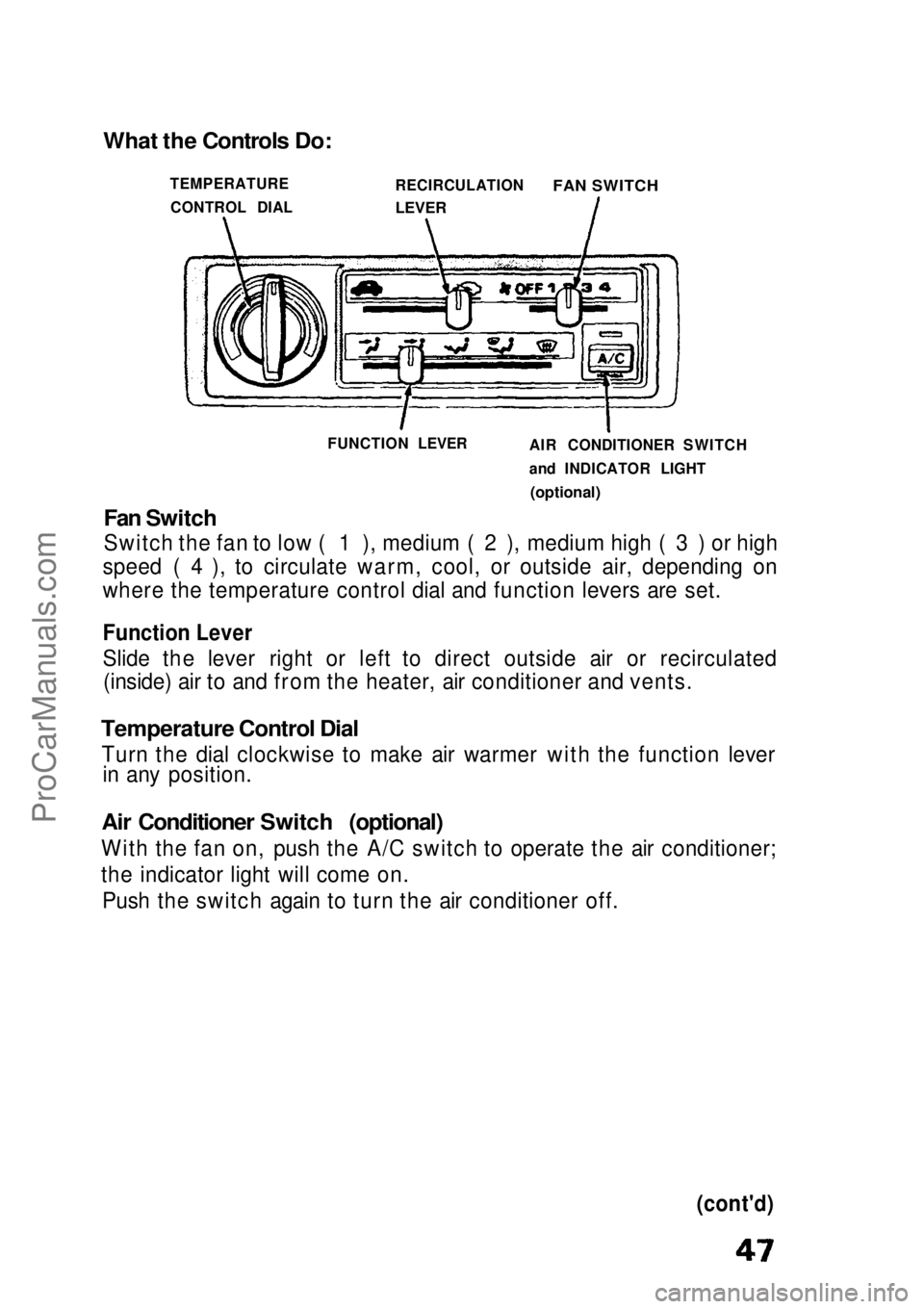
Fan Switch
Switch the fan to low ( 1 ), medium ( 2 ), medium high ( 3 ) or high
speed ( 4 ), to circulate warm, cool, or outside air, depending on
where the temperature control dial and function levers are set.
Function Lever
Slide the lever right or left to direct outside air or recirculated (inside) air to and from the heater, air conditioner and vents.
Temperature Control Dial
Turn the dial clockwise to make air warmer with the function lever in any position.
Air Conditioner Switch (optional)
With the fan on, push the A/C switch to operate the air conditioner;
the indicator light will come on. Push the switch again to turn the air conditioner off.
(cont'd)
What the Controls Do:
TEMPERATURECONTROL DIAL RECIRCULATION
LEVER
FAN SWITCH
FUNCTION LEVER AIR CONDITIONER SWITCH
and INDICATOR LIGHT
(optional)ProCarManuals.comMain Menu s t
Page 53 of 136
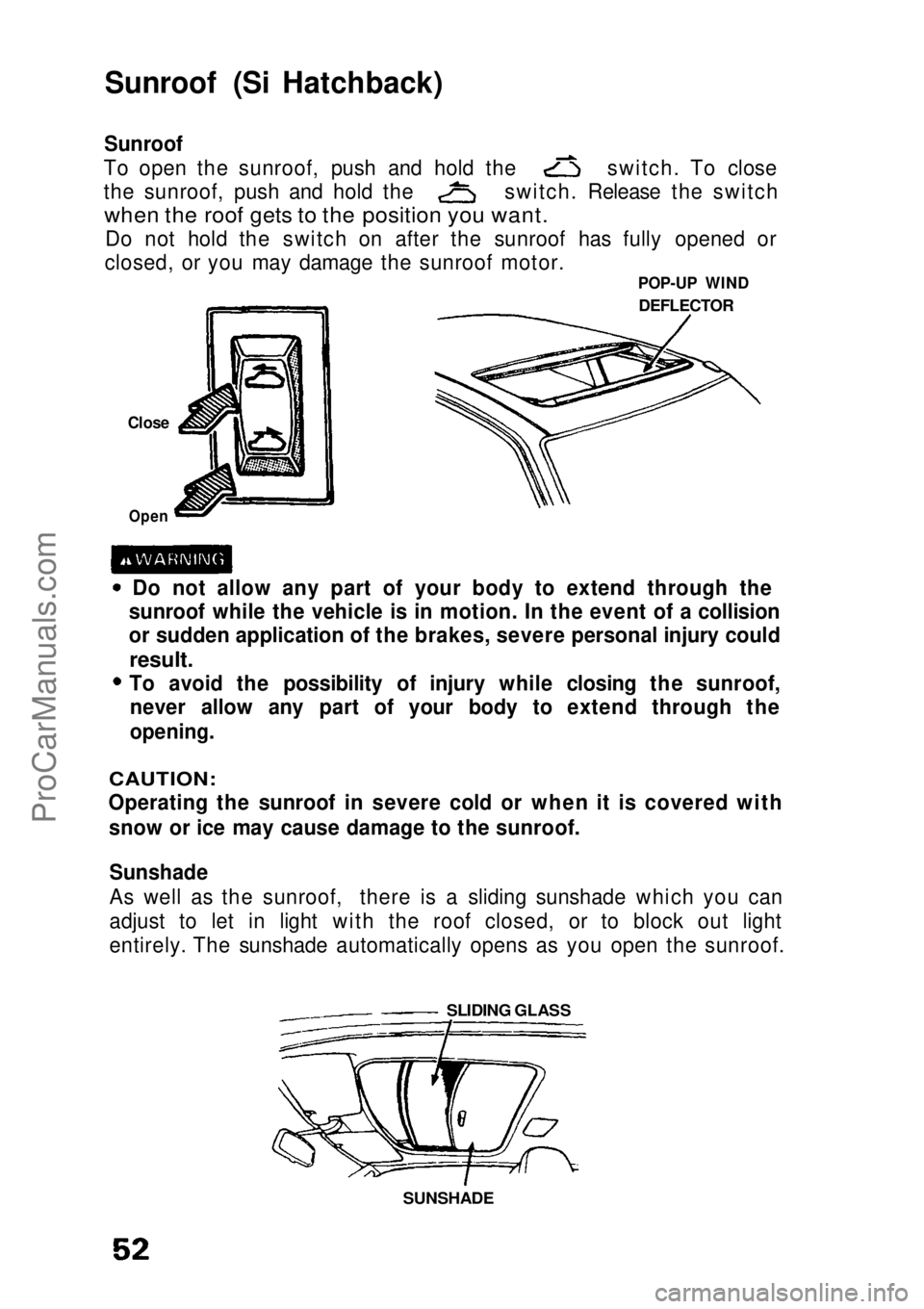
Sunroof (Si Hatchback)
Sunroof
To open the sunroof, push and hold the switch. To close
the sunroof, push and hold the switch. Release the switch
when the roof gets to the position you want.
Do not hold the switch on after the sunroof has fully opened or
closed, or you may damage the sunroof motor.
Do not allow any part of your body to extend through the
sunroof while the vehicle is in motion. In the event of a collision
or sudden application of the brakes, severe personal injury could
result.
To avoid the possibility of injury while closing the sunroof,
never allow any part of your body to extend through the
opening.
CAUTION:
Operating the sunroof in severe cold or when it is covered with
snow or ice may cause damage to the sunroof.
Sunshade
As well as the sunroof, there is a sliding sunshade which you can
adjust to let in light with the roof closed, or to block out light
entirely. The sunshade automatically opens as you open the sunroof. POP-UP WIND
DEFLECTOR
Close
Open
SLIDING GLASS
SUNSHADE
ProCarManuals.comMain Menu s t
Page 55 of 136

For proper operation of your car's emission controls, your engine is
designed to use unleaded fuel only.
CAUTION:
Using leaded or even low-lead gasoline could damage some of your
emission controls, and also void their coverage under the emission
controls warranty.
Use gasoline from pumps labeled unleaded, with a pump octane
number of 86 or higher. The pump octane number is an average of
the Research (R) octane and Motor (M) octane numbers. Use of a lower octane gasoline can cause persistent, heavy "spark knock" (ametallic rapping noise), which can lead to engine damage if severe.
CAUTION:
If you notice steady spark knock while holding a steady speed on a
level road, try changing brands of gasoline. If the spark knock persists, consult your Honda dealer. Failure to do so is considered
misuse, and misuse is not covered under the New Car Warranty.
Occasionally you may notice light spark knock while accelerating or
driving up hills. This is no cause for concern, it simply means your
engine is running at its most economical.
Gasoline Containing AlcoholIf you decide to use a gasoline containing alcohol ("gasohol"), be
sure its octane rating is at least as high as that recommended for
unleaded gasoline. There are two types of "gasohol": that
containing ethanol, and that containing methanol. Do not use
gasohol that contains more than 10% ethanol. Do not use gasoline
containing methanol (methyl or wood alcohol) that does not also contain cosolvents and corrosion inhibitors for methanol. Never use
gasoline containing more than 5% methanol, even if it has cosolvents and corrosion inhibitors.
NOTE.
Fuel system damage or vehicle performance problems resulting
from the use of such fuels is not covered under the new car warranties. Honda cannot endorse the use of fuels containing methanol since evidence of their suitability is as yet incomplete. Before purchasing fuel from an unfamiliar station, try to confirm
whether the fuel contains alcohol, of what kind, and how much. If
you notice any undesirable operating symptoms after using a
gasoline that contains alcohol; or one that you think contains alcohol, switch to an unleaded gasoline, as recommended above.
GasolineProCarManuals.comMain Menu s t
Page 58 of 136
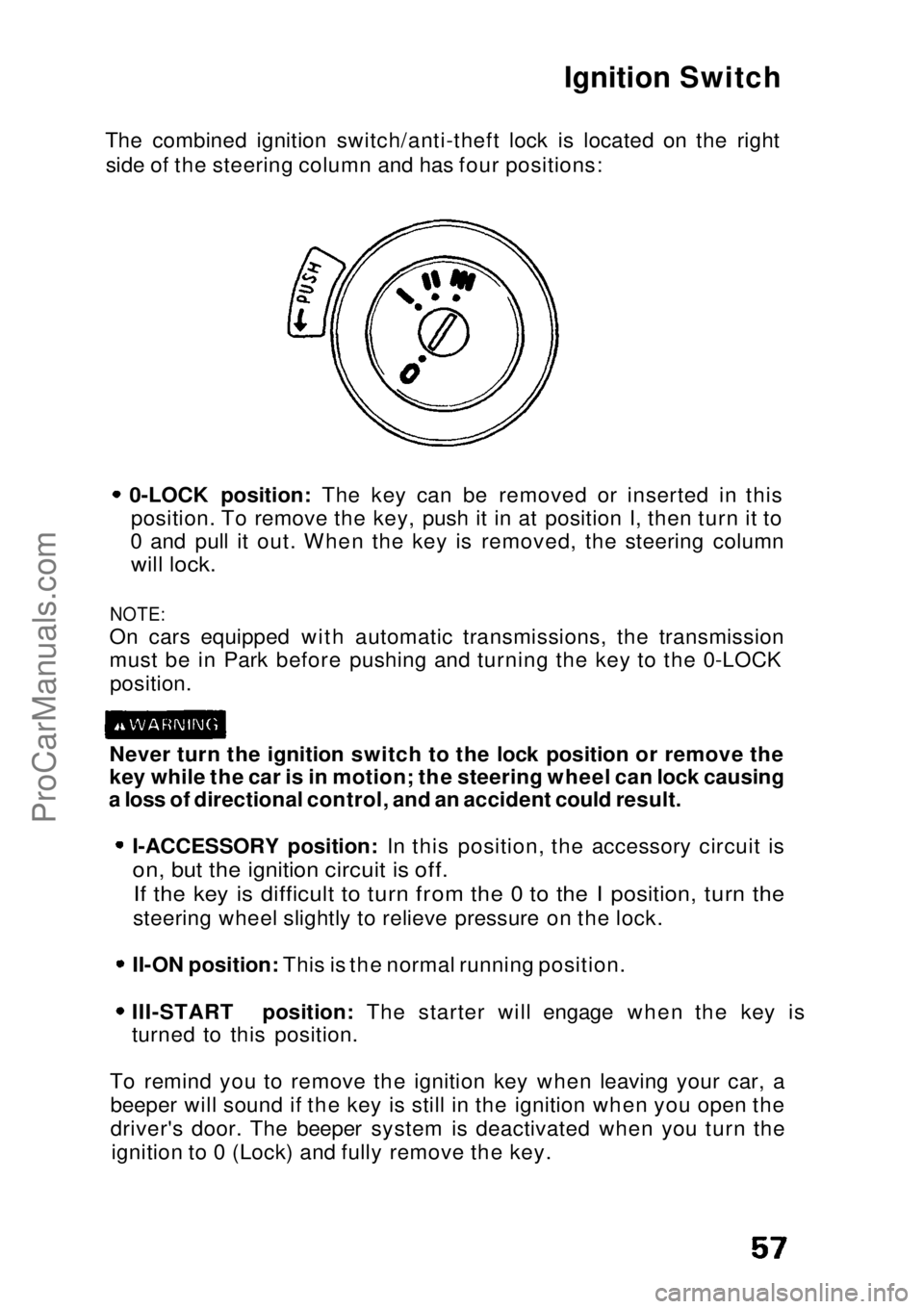
Ignition Switch
The combined ignition switch/anti-theft lock is located on the right side of the steering column and has four positions: 0-LOCK position: The key can be removed or inserted in this
position. To remove the key, push it in at position I, then turn it to
0 and pull it out. When the key is removed, the steering column
will lock.
NOTE:
On cars equipped with automatic transmissions, the transmission
must be in Park before pushing and turning the key to the 0-LOCK
position.
Never turn the ignition switch to the lock position or remove the
key while the car is in motion; the steering wheel can lock causing
a loss of directional control, and an accident could result. I-ACCESSORY position: In this position, the accessory circuit is
on, but the ignition circuit is off.
If the key is difficult to turn from the 0 to the I position, turn the
steering wheel slightly to relieve pressure on the lock. II-ON position: This is the normal running position.
III-START position: The starter will engage when the key is
turned to this position.
To remind you to remove the ignition key when leaving your car, a beeper will sound if the key is still in the ignition when you open the
driver's door. The beeper system is deactivated when you turn the ignition to 0 (Lock) and fully remove the key.ProCarManuals.comMain Menu s t
Page 59 of 136

Starting the Engine
Before Starting
Manual Transmission:
1. Apply the parking brake.
2. Push the clutch pedal all the way in (see NOTE below). 3. Shift the transmission to neutral.
NOTE:
On cars equipped with manual transmissions, the engine will not
crank unless the clutch pedal is fully depressed.
Automatic Transmission:
1. Make sure the shift lever is in Park (P).
2. Apply the parking brake and the foot brake.
NOTE:
When starting in cold weather, keep all unnecessary electrical
circuits off (lights, defogger, etc.) for the best battery output.
Do not crank the engine for more than 15 seconds at a time. Wait
10 seconds before going to the next step.
Starting the Engine 1. With your foot off the accelerator start the engine by turning the key to the III position.
2. If the engine won't start within 15 seconds or starts but fails to continue to run, push the accelerator pedal halfway, and hold it
there while cranking the engine. Once the engine starts, release
the accelerator gradually as the engine speeds up.
3. If it doesn't start within 15 seconds, push the accelerator pedal down to the floor and hold it there while cranking in order to clearflooding. Try step 2 again.
Cold Weather at High Altitude Starting 1. When starting in cold weather at high altitude (above 8,000 feet), push the accelerator pedal about halfway and hold it there while
cranking the engine. Once the engine starts, release the accelerator gradually as the engine speeds up.
2. If it doesn't start within 15 seconds, push the accelerator pedal down to the floor and hold it there while cranking in order to clearflooding. Try step 1 again.
NOTE:
If the outside temperature is below freezing, or if your car has not
been driven for several days, warm up the engine for a few minutes
before driving.ProCarManuals.comMain Menu s t
Page 60 of 136

Safety Items
Before driving away, check that: The doors are closed properly.
The mirrors are properly adjusted, and the windows clean.
The driver and passengers are wearing properly adjusted seat
belts.
The head restraints are properly adjusted.
The warning and indicator lights are operating properly. The brake pedal feels normal.
All luggage and cargo is secured.
Nothing is interfering with the driver's feet or blocking vision to
the rear.
While driving remember to: Always drive defensively; expect the unexpected.Reduce your speed during night hours and bad weather.Follow at a safe distance; don't tailgate. Get off the highway when you are tired; stop and take a rest.
When stopping for repairs: Park the car well off the road.
Turn on the hazard warning flasher. Use flares or other warning devices to warn other motorists.
After parking your car: Apply the parking brake and shift to first gear if equipped with
manual transmission, or PARK on automatic transmission equip-ped cars.
Make sure the sunroof and windows are closed and the doors are
locked.
If parked on a hill:
1. Turn the front wheels away from the curb if facing uphill.
2. Turn the front wheels toward the curb if facing downhill.
Never leave children unattended in a parked car. Take your keys.ProCarManuals.comMain Menu s t
Page 69 of 136

Check the following items at each fuel stop:
1. Engine oil level.
2. Radiator coolant level.
Check the following items periodically: 1. Brakes: for braking efficiency, brake pedal travel and hydraulic
fluid level.
2. Lights: for operation of headlights, taillights, side marker lights, stoplights, turn signals and back-up lights.
3. Tires: for correct pressures (including spare); inspect for cuts and uneven or excessive wear. Rotate every 7,500 miles (12,000 km)
in the pattern shown on page 97.
4. Steering: for excessive play or vibration while driving. 5. Exhaust system: for leaks or loose mounts.
6. Wipers: for operation of windshield wipers and washer, and condition of wiper blades.
7. Seat belts: for condition of fabric and buckles, and operation of the restraint mechanism.
8. Battery condition.
9. Clutch adjustment (clutch pedal free travel).
(cont'd)ProCarManuals.comMain Menu s t