Hazard HONDA CIVIC 1991 Owners Manual
[x] Cancel search | Manufacturer: HONDA, Model Year: 1991, Model line: CIVIC, Model: HONDA CIVIC 1991Pages: 136, PDF Size: 1.33 MB
Page 3 of 136
Introduction
This manual contains important information about the safe operation and maintenance of your car.
We urge you to read it carefully, become familiar with the controls itdescribes, and follow its recommendations, to help make your
driving trouble-free and enjoyable.
Statements or labels on the product preceded by the following
words are of special significance:
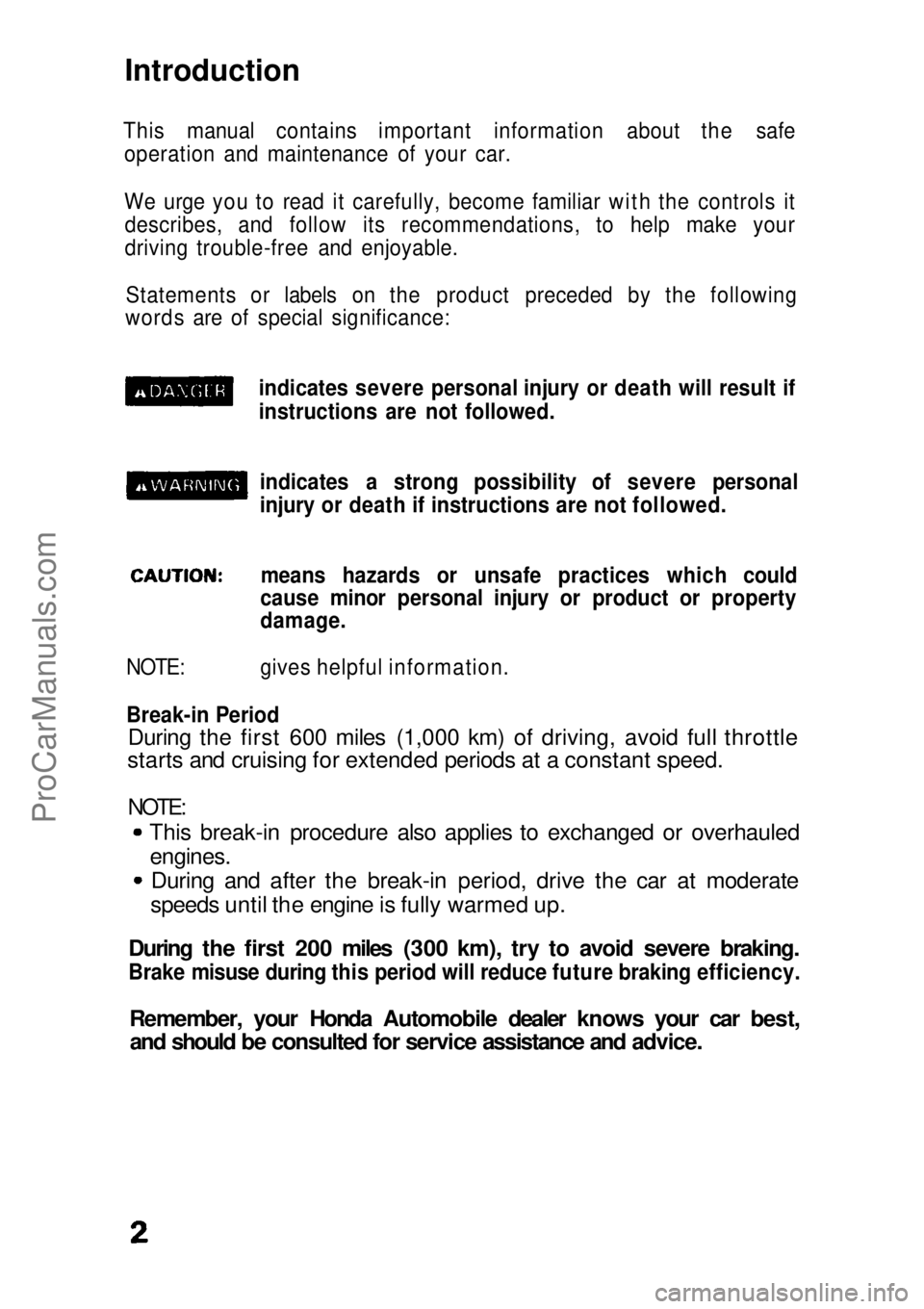
indicates severe personal injury or death will result if
instructions are not followed.indicates a strong possibility of severe personal
injury or death if instructions are not followed.means hazards or unsafe practices which could
cause minor personal injury or product or property
damage.
NOTE: gives helpful information.
Break-in Period
During the first 600 miles (1,000 km) of driving, avoid full throttle
starts and cruising for extended periods at a constant speed.
NOTE:
This break-in procedure also applies to exchanged or overhauled
engines.
During and after the break-in period, drive the car at moderate
speeds until the engine is fully warmed up.
During the first 200 miles (300 km), try to avoid severe braking.
Brake misuse during this period will reduce future braking efficiency.
Remember, your Honda Automobile dealer knows your car best,and should be consulted for service assistance and advice.ProCarManuals.comMain Menu s t
Page 27 of 136
Instrument Panel
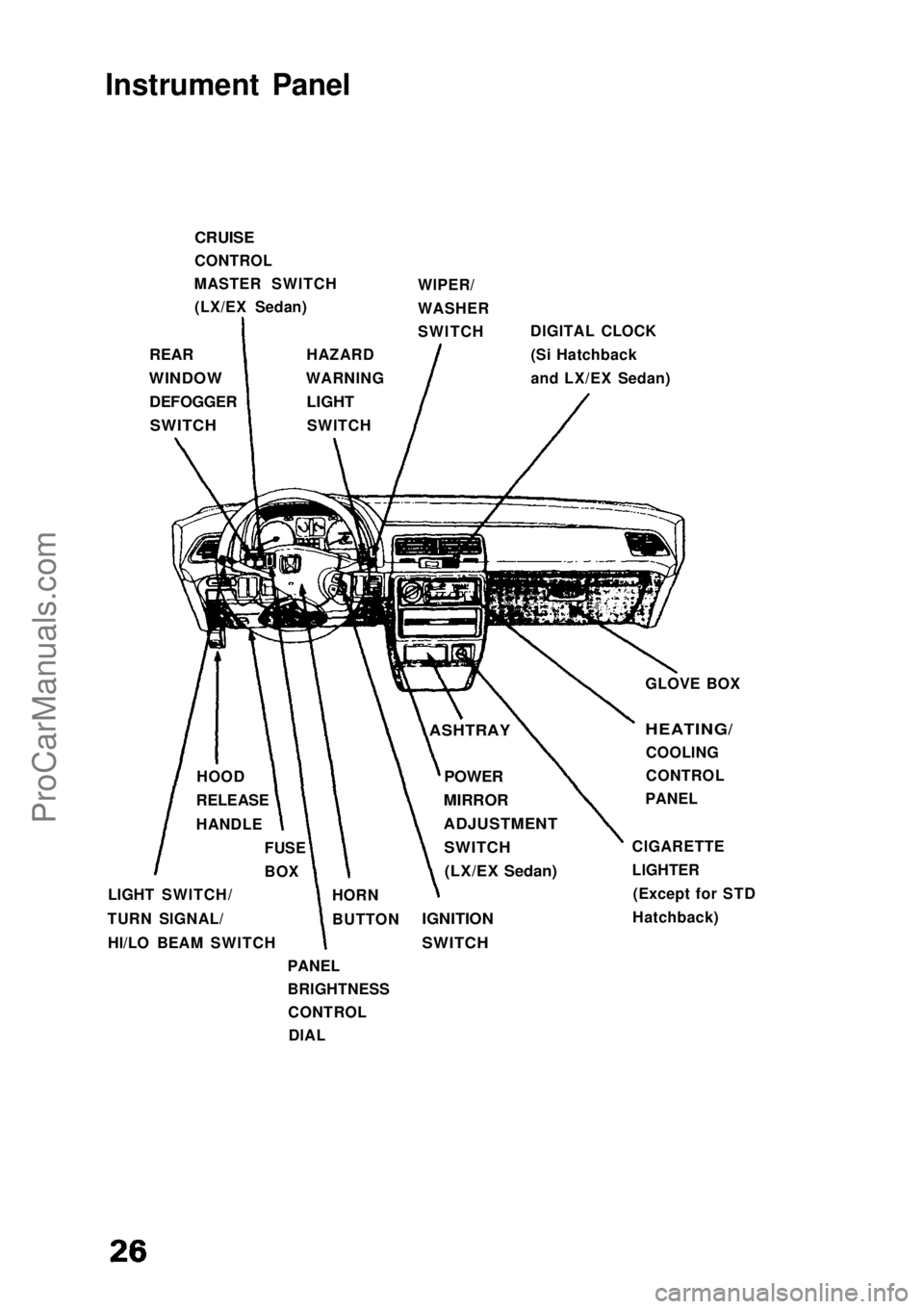
CRUISE
CONTROL
MASTER SWITCH (LX/EX Sedan) WIPER/
WASHER
SWITCH
DIGITAL CLOCK
(Si Hatchback
and LX/EX Sedan)
REAR
WINDOW
DEFOGGER
SWITCH
HAZARD
WARNING
LIGHT
SWITCH
GLOVE BOX
ASHTRAY
HEATING/
COOLING
CONTROL
PANEL
CIGARETTE
LIGHTER (Except for STD
Hatchback)
POWER
MIRROR
ADJUSTMENT
SWITCH
(LX/EX Sedan)
IGNITION
SWITCH
HORN
BUTTON
PANEL
BRIGHTNESS CONTROLDIAL
LIGHT SWITCH/
TURN SIGNAL/ HI/LO BEAM SWITCH FUSE
BOX
HOOD
RELEASE
HANDLEProCarManuals.comMain Menu s t
Page 30 of 136
Warning and Indicator Lights
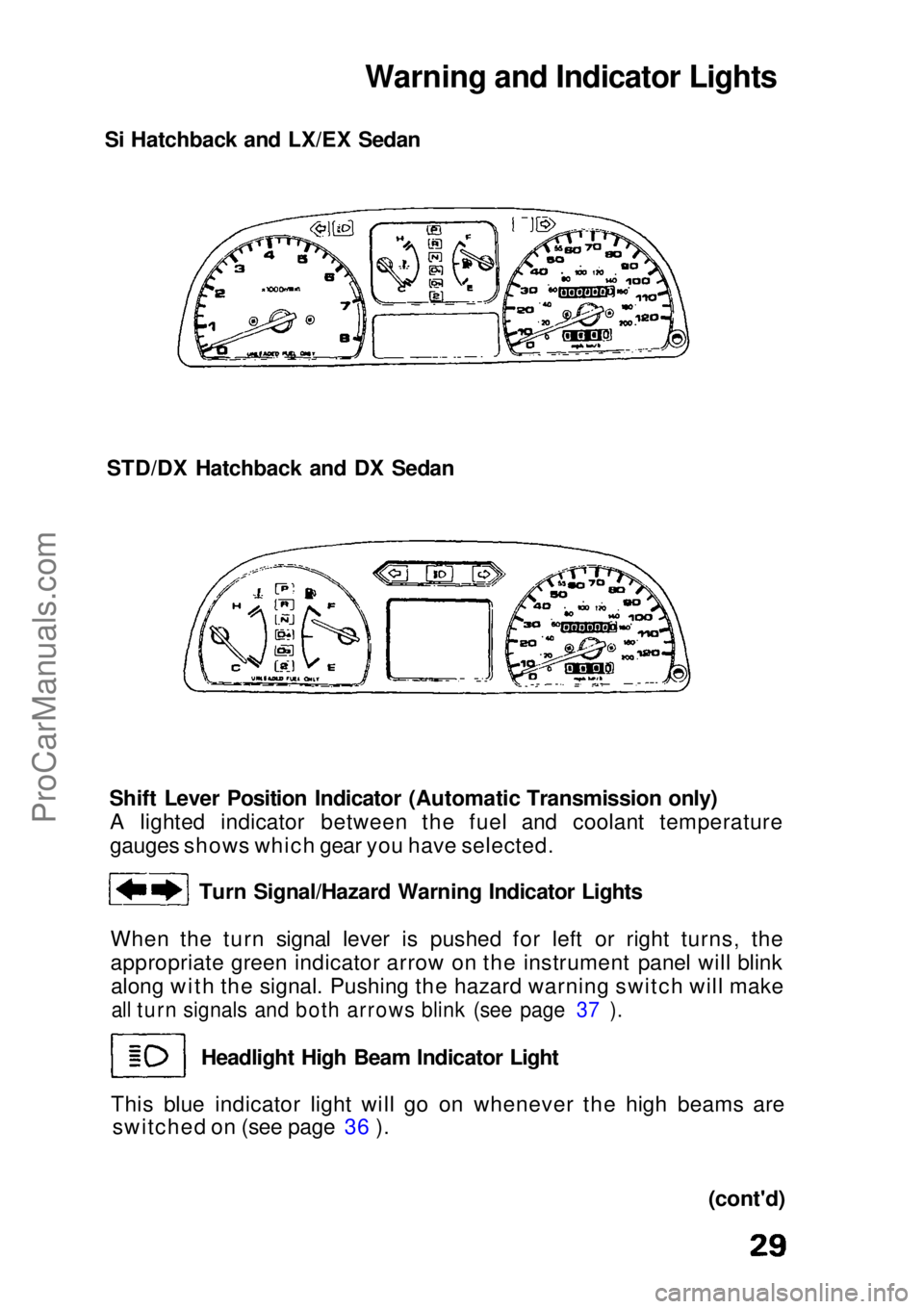
Si Hatchback and LX/EX Sedan
STD/DX Hatchback and DX Sedan
Shift Lever Position Indicator (Automatic Transmission only)A lighted indicator between the fuel and coolant temperature
gauges shows which gear you have selected.
Turn Signal/Hazard Warning Indicator Lights
When the turn signal lever is pushed for left or right turns, the
appropriate green indicator arrow on the instrument panel will blink along with the signal. Pushing the hazard warning switch will make
all turn signals and both arrows blink (see page 37 ).
Headlight High Beam Indicator Light
This blue indicator light will go on whenever the high beams are switched on (see page 36 ).
(cont'd)ProCarManuals.comMain Menu s t
Page 38 of 136
Hazard Warning System
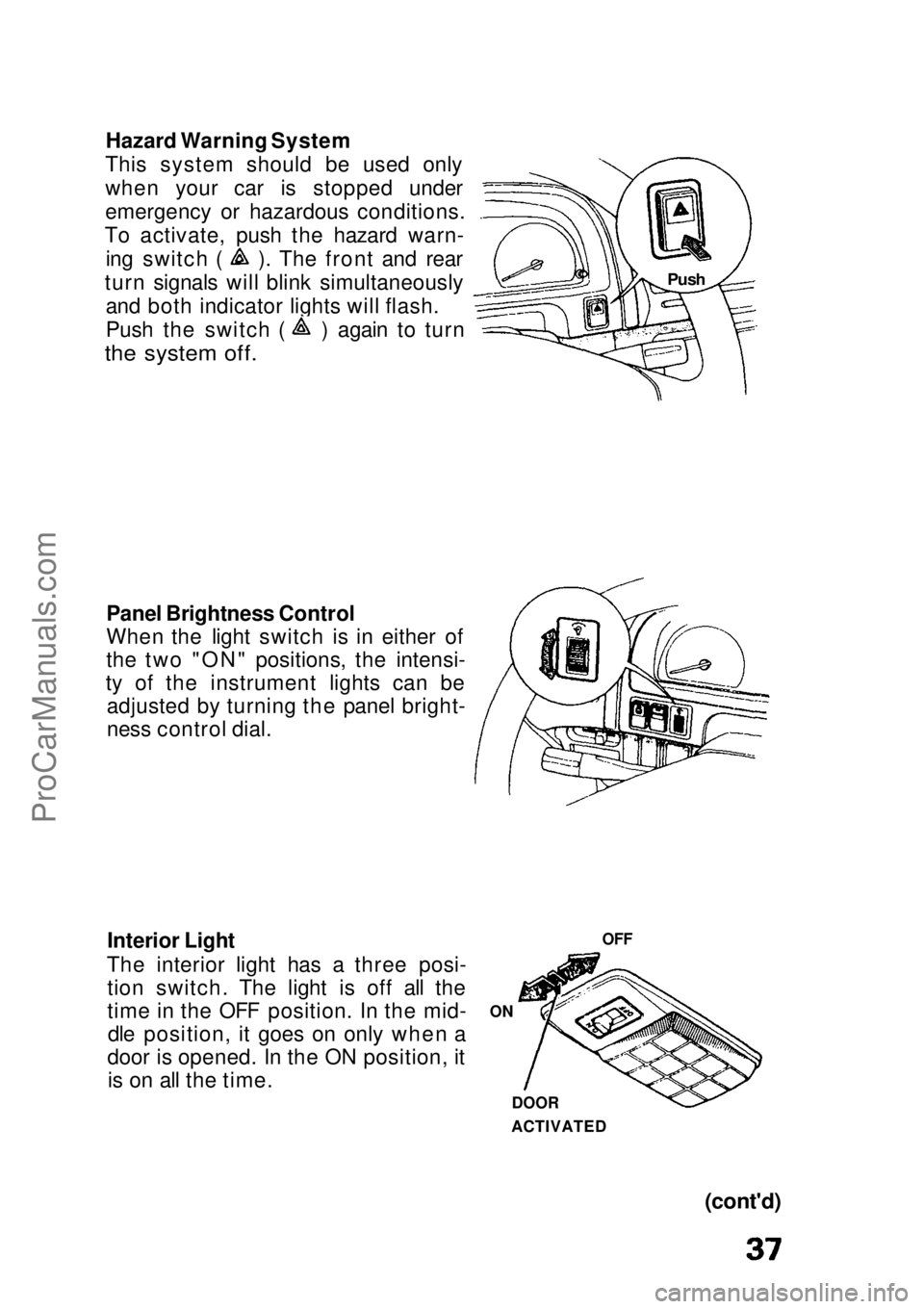
This system should be used only
when your car is stopped under
emergency or hazardous conditions.
To activate, push the hazard warn- ing switch ( ). The front and rear
turn signals will blink simultaneously and both indicator lights will flash. Push the switch ( ) again to turn
the system off.
Panel Brightness Control
When the light switch is in either of
the two "ON" positions, the intensi-
ty of the instrument lights can be adjusted by turning the panel bright-
ness control dial.
Interior Light
The interior light has a three posi- tion switch. The light is off all the
time in the OFF position. In the mid-dle position, it goes on only when a
door is opened. In the ON position, it is on all the time.
(cont'd)
OFF
ON
DOOR
ACTIVATED
PushProCarManuals.comMain Menu s t
Page 57 of 136

Gasoline (cont'd)
Fuel vapor is extremely hazardous under certain conditions.
Always stop the engine before refueling, and never refuel near
sparks or open flames. CAUTION:
When reinstalling the fuel cap, be sure both tabs on the cap are
engaged in the slots of the filler neck and turn the cap until it stops. If you replace the cap, use only a genuine Honda replacement part
or its equivalent. Failure to use the proper part could cause serious
fuel system problems.
How to Improve Your Gas Mileage: Drive at a smooth, steady pace to avoid unnecessary decele-
rations and stops — accelerating back to speed uses more fuel.Plan trips to avoid rush hour traffic if possible. Make sure the parking brake is completely released.
Consolidate trips whenever possible.
Keep vehicle weight to a minimum by removing unnecessary
items from the luggage area.
Whenever possible, use fresh air from the dash vents to keep
cool when driving; open windows, or use of the optional air
conditioning both affect fuel economy.
Keep the tires adjusted to the recommended pressure.
Tire Pressure (measured cold): STD Hatchback front 240 kPa (35 psi)
rear 220 kPa (32 psi)
DX Hatchback front 220 kPa (32 psi)
rear 220 kPa (32 psi)
Si Hatchback front 195 kPa (28 psi)
rear 195 kPa (28 psi)
DX Sedan front 220 kPa (32 psi)
rear 220 kPa (32 psi)
LX Sedan front 180 kPa (26 psi)
rear 180 kPa (26 psi)
EX Sedan front 180 kPa (26 psi)
rear 180 kPa (26 psi)
Condition of Your Car You can only get maximum fuel economy if your car is in toprunning condition. Have all required maintenance done at the proper
intervals. Check tire pressures and tire wear frequently. If tire wear is uneven, have the alignment checked by your Honda dealer.
Proper alignment saves gasoline and prolongs tire life.ProCarManuals.comMain Menu s t
Page 60 of 136

Safety Items
Before driving away, check that: The doors are closed properly.
The mirrors are properly adjusted, and the windows clean.
The driver and passengers are wearing properly adjusted seat
belts.
The head restraints are properly adjusted.
The warning and indicator lights are operating properly. The brake pedal feels normal.
All luggage and cargo is secured.
Nothing is interfering with the driver's feet or blocking vision to
the rear.
While driving remember to: Always drive defensively; expect the unexpected.Reduce your speed during night hours and bad weather.Follow at a safe distance; don't tailgate. Get off the highway when you are tired; stop and take a rest.
When stopping for repairs: Park the car well off the road.
Turn on the hazard warning flasher. Use flares or other warning devices to warn other motorists.
After parking your car: Apply the parking brake and shift to first gear if equipped with
manual transmission, or PARK on automatic transmission equip-ped cars.
Make sure the sunroof and windows are closed and the doors are
locked.
If parked on a hill:
1. Turn the front wheels away from the curb if facing uphill.
2. Turn the front wheels toward the curb if facing downhill.
Never leave children unattended in a parked car. Take your keys.ProCarManuals.comMain Menu s t
Page 94 of 136
The factory installed tires on your car were selected to match the
car's performance capabilities and to provide the best combination
of handling, ride comfort and tread wear.
We recommend that you get the same size, type, and grade of tires when replacement is necessary. If your tires have an all-season
tread design, the model name will be followed by the marking: "M + S" (mud and snow) or "all-season".
If you decide not to get the same brand of tires as those originally
installed, you should make sure that the replacements are the radial
type, of the same size, load range and speed rating as the original
tires.
If you have any questions about your car's tires, please contact
your Honda dealer.
Inflation Pressures
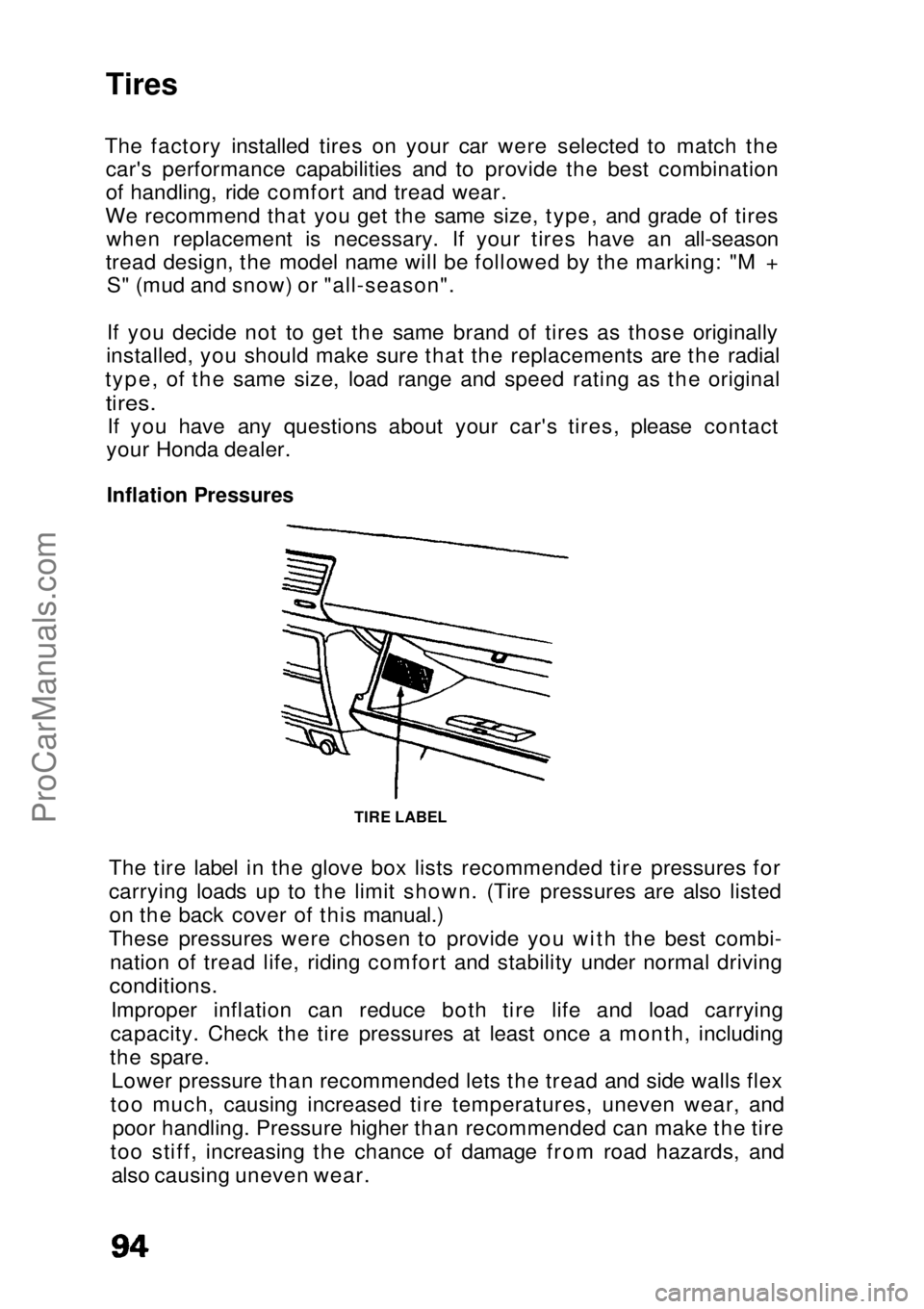
The tire label in the glove box lists recommended tire pressures for
carrying loads up to the limit shown. (Tire pressures are also listedon the back cover of this manual.)
These pressures were chosen to provide you with the best combi- nation of tread life, riding comfort and stability under normal driving
conditions.
Improper inflation can reduce both tire life and load carrying
capacity. Check the tire pressures at least once a month, including
the spare. Lower pressure than recommended lets the tread and side walls flex
too much, causing increased tire temperatures, uneven wear, and poor handling. Pressure higher than recommended can make the tire
too stiff, increasing the chance of damage from road hazards, and also causing uneven wear.
Tires
TIRE LABELProCarManuals.comMain Menu s t
Page 96 of 136
Tires (cont'd)
CAUTION:
If the contact continues, slow down until it stops or your car can
be damaged. Chains that are the wrong size or improperly installed can
damage your car's brake lines, suspension, body, and wheels.
If you need further information on tire chains, please see your
Honda dealer.
Remove the chains as soon as the road is clear of ice and snow.
Tire Replacement Honda recommends that you replace tires in sets of four, or in pairs,
front or rear. If you need to replace only one tire, mount the new
tire opposite the tire showing the least amount of wear. For instance, if the left front tire shows the least amount of wear,
mount the new tire on the front right side.
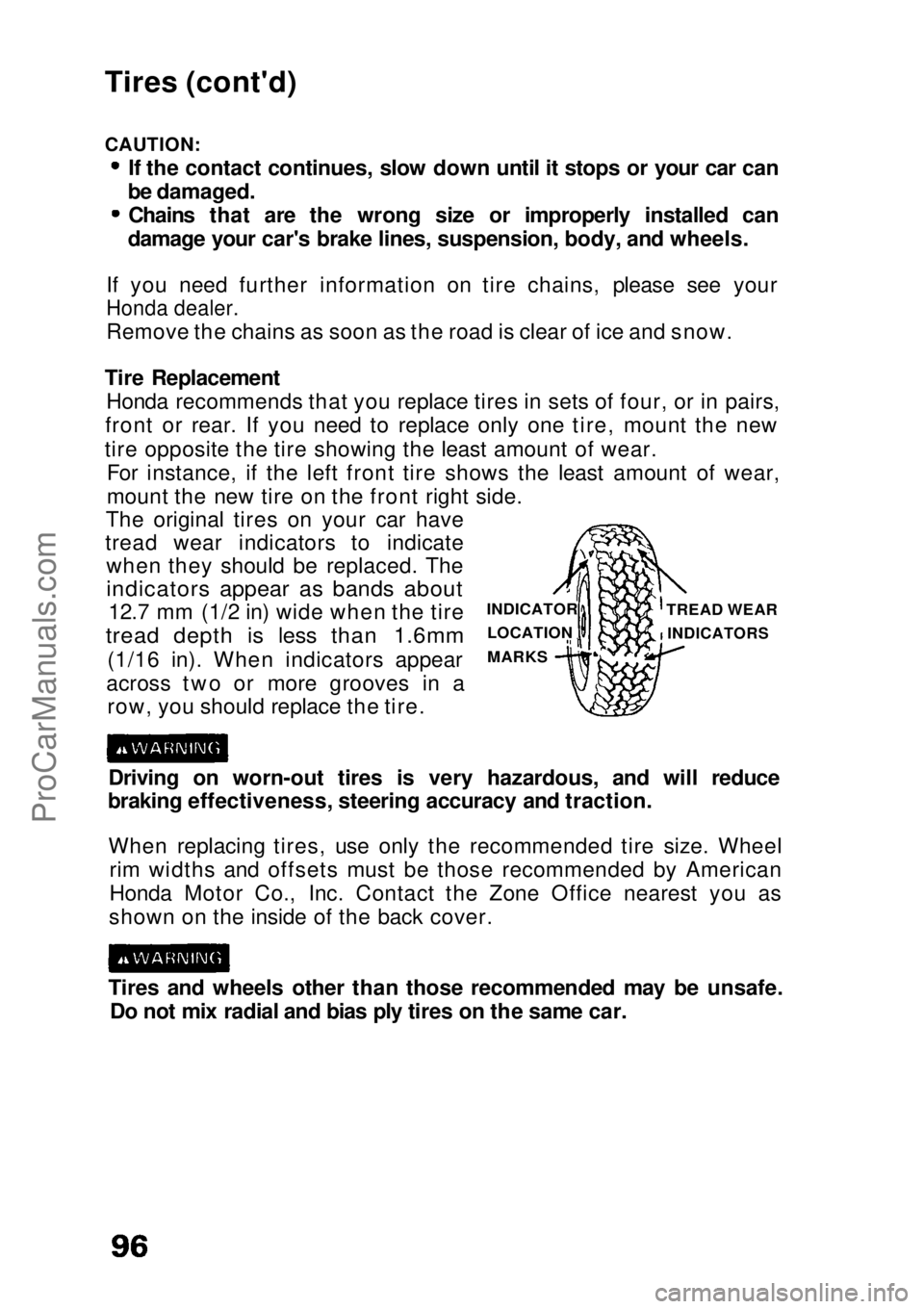
The original tires on your car have
tread wear indicators to indicate when they should be replaced. The
indicators appear as bands about
12.7 mm (1/2 in) wide when the tire
tread depth is less than 1.6mm
(1/16 in). When indicators appear
across two or more grooves in a row, you should replace the tire.
Driving on worn-out tires is very hazardous, and will reduce
braking effectiveness, steering accuracy and traction.
When replacing tires, use only the recommended tire size. Wheel rim widths and offsets must be those recommended by American
Honda Motor Co., Inc. Contact the Zone Office nearest you as
shown on the inside of the back cover.
Tires and wheels other than those recommended may be unsafe. Do not mix radial and bias ply tires on the same car. INDICATOR
LOCATION
MARKS TREAD WEAR
INDICATORSProCarManuals.comMain Menu s t
Page 100 of 136

Appearance Care
Interior Trim
Remove dust and loose dirt with a vacuum cleaner.
Wipe the vinyl with a clean, damp cloth or sponge. Stains can be removed with a commercially available vinyl cleaner.
CAUTION:
Do not use thinner, gasoline, kerosene, naphtha or other solvents
on the interior. They are toxic, flammable and hazardous and could
damage the material you're cleaning.
Windows
A 10 to 1 mix of water and white vinegar, or a commercially
available glass cleaner may be used to clean windows and to remove
the dust film sometimes caused by the ingredients used in interior vinyls and plastics.
NOTE:
Do not put this solution in the windshield washer reservoir, it will
damage the windshield washer pump.
Be careful not to scratch or damage the defogger wires when clean-
ing the inside of the rear window; wipe the window horizontally
along the wires, not up and down.
Dry the windows with a lint-free cloth or paper towel. Keep all the
windows clean for maximum visibility.
Exterior Care
Washing
Rinse all loose dirt off the car by spraying it with lukewarm or cold
water. Do not use hot water.
Wash using a soft-bristle brush, sponge or cloth with water containing a mild detergent such as a liquid dishwashing detergent. Remove oil, tar, tree sap, etc., with tar remover or turpentine.
Remove road salt, insects, etc., with mild detergent and lukewarm
water. Any of these substances may damage the finish if left on
painted surfaces.
Rinse the car well. Promptly wipe with a chamois or soft towel toprevent water-spotting. Do not let water or soap air-dry on painted
surfaces. During wiping, inspect the surface for stone chips and scratches;
paint them with touch-up paint so they won't rust (touch-up paint
is available through your Honda dealer).
For further instructions on corrosion protection, refer to the Rust
Prevention section on following page.ProCarManuals.comMain Menu s t
Page 106 of 136
Changing a Flat Tire
Do not attempt to change a tire unless the car is on firm, level
ground and well out of the flow of traffic.
Park the car on a firm, level surface, apply the parking brake, turn
on the hazard warning switch and put the transmission in gear (Park
for automatic).
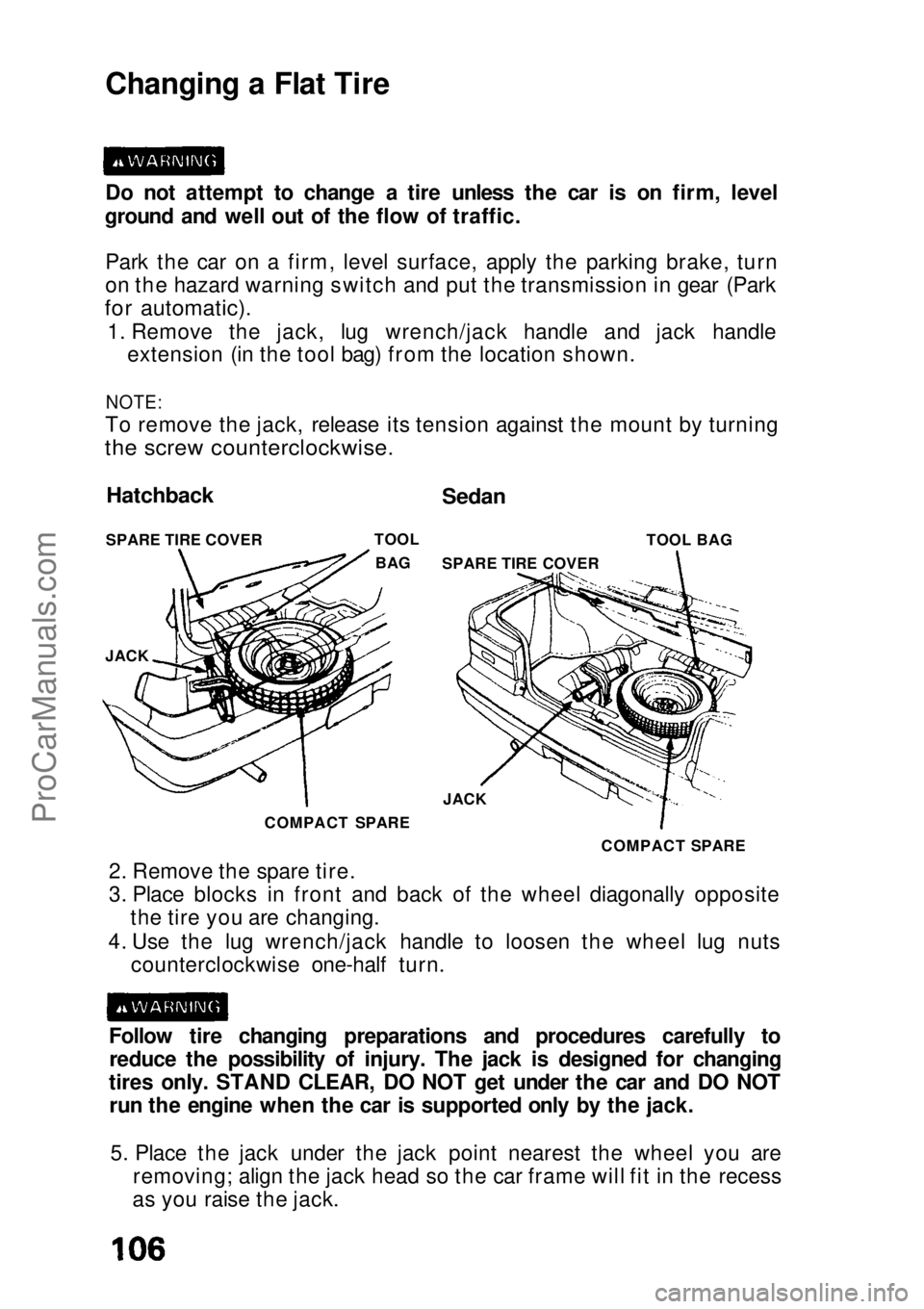
1. Remove the jack, lug wrench/jack handle and jack handle extension (in the tool bag) from the location shown.
NOTE:
To remove the jack, release its tension against the mount by turning
the screw counterclockwise.
JACK TOOL BAG
Follow tire changing preparations and procedures carefully to reduce the possibility of injury. The jack is designed for changing
tires only. STAND CLEAR, DO NOT get under the car and DO NOT run the engine when the car is supported only by the jack.
5. Place the jack under the jack point nearest the wheel you are removing; align the jack head so the car frame will fit in the recess
as you raise the jack.
Hatchback
SPARE TIRE COVER
Sedan
TOOL BAG SPARE TIRE COVER
JACK
COMPACT SPARE COMPACT SPARE
2. Remove the spare tire.
3. Place blocks in front and back of the wheel diagonally opposite the tire you are changing.
4. Use the lug wrench/jack handle to loosen the wheel lug nuts counterclockwise one-half turn.ProCarManuals.comMain Menu s t