Motor HONDA CIVIC 2002 7.G User Guide
[x] Cancel search | Manufacturer: HONDA, Model Year: 2002, Model line: CIVIC, Model: HONDA CIVIC 2002 7.GPages: 1139, PDF Size: 28.19 MB
Page 191 of 1139
Engine Cooling
Cooling System
Component Location Index ......................................... 10-2
Radiator Cap Test ..................... .......... 10-3
RadiatorTest ............. 10-3
Fan Motor Test .......... l0-4
Thermostat Test ...................... ........... 10-4
Water Pump Inspection ..................... 10-5
Water Pump Replacement ................. 10-5
Coolant Check .............. ....................... 10-6
Coolant Replacement ......................... 10-6
Thermostat Replacement .................. 10-8
Water Passage Installation ................ 10-9
Water Outlet Installation .................... 10-9
Radiator and Fan Replacement ................................... 10-10
Fan Controls
Component Location Index ......................................... 10-11
Symptom Troubleshooting Index ............................... 10-12
Circuit Diagram ......... 10-13
Radiator Fan CircuitTroubleshooting ........................ 10-14
Radiator Fan Switch Circuit Troubleshooting
(Open) ............ ........ 10-16
Radiator Fan Switch Circuit Troubleshooting
(Short) ............ ........ 10-16
Radiator Fan Switch Test ................... 10-17
Radiator Fan Switch Reolacement .............................. 10-17
Page 192 of 1139

Cooling System
Component Location Index
WATER PUMPInspection, page 10-5Replacement. page 10-5
RESERVETANK
RADIATORCAP
RAOIATOR FAN SWITCHTest, page 10-17Replacement, page 10'17
\
WATER OUTLET,Installation, page'10-g
\f
CONNECTING PIPE
WATER PASSAGEInstallation, page 10-9
THERMOSTATTest, page 10 4Replacement, page 10 8
RADIATORReplacement, page 10-'l0
RADIATOR FANASSEMgLYReplacement, page 10-10Fan MotorTest, page 10 4A/C CONDENSERFAN ASSEMBLYReplacement, page 10 10Fan Motor Test, page '10-4
10-2
\J
Page 194 of 1139
Cooling System
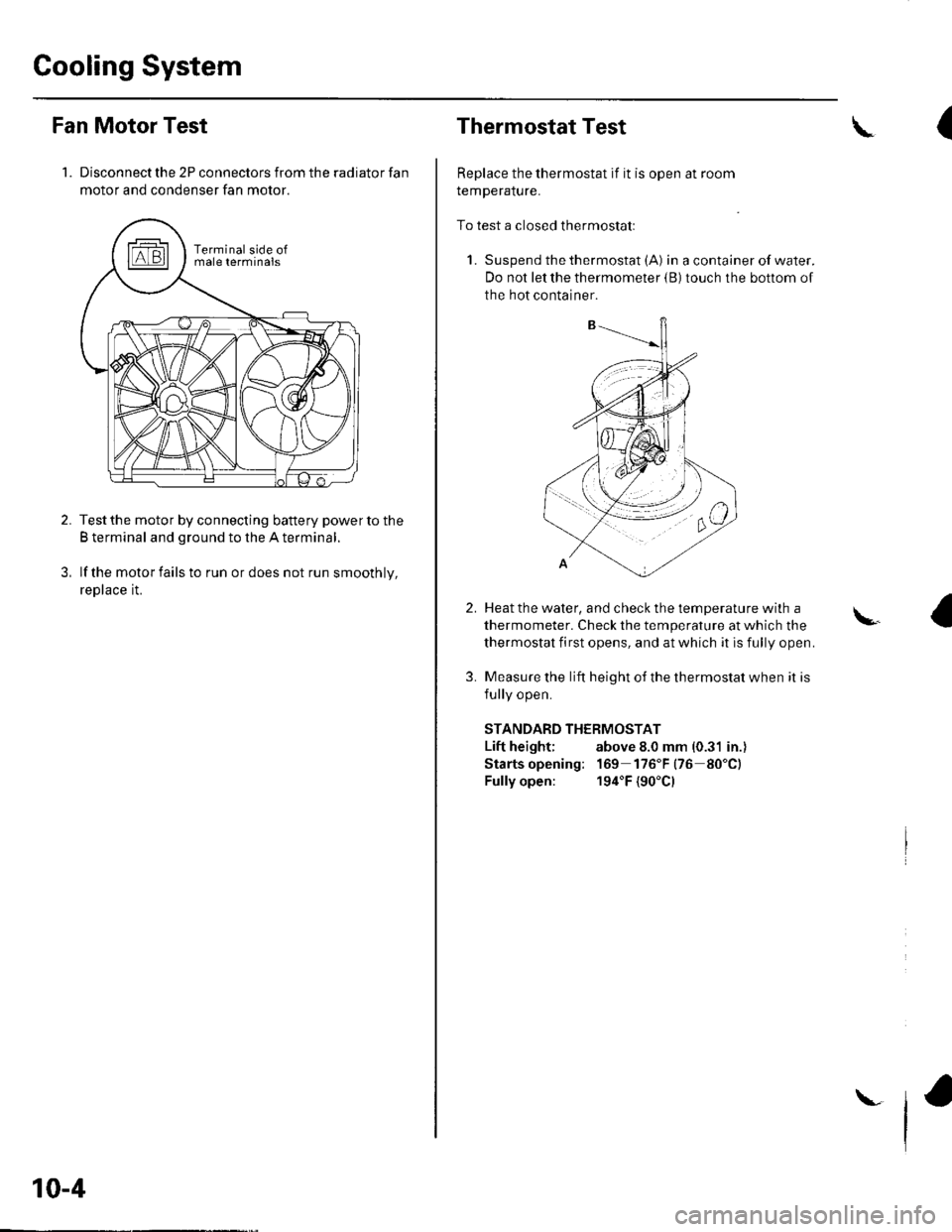
Fan Motor Test
1. Disconnect the 2P connectors from the radiator fan
motor and condenser fan motor.
Test the motor by connecting battery power to the
B terminal and ground to the A terminal.
lf the motor fails to run or does not run smoothly,
reptace rL
10-4
\
Thermostat Test
Replace the thermostat if it is open at room
remperalure.
To test a closed thermostatl
1. Suspend the thermostat (A) in a container of water.
Do not let the thermometer {B) touch the bottom of
the hot container.
(\
2.
3.
Heat the water, and check the temDerature with a
thermometer. Check the temperature at which the
thermostat first opens, and at which it is fully open.
Measure the lift height of the thermostat when it is
fullv ooen.
STANDARD THERMOSTAT
Lift height; above 8.0 mm (0.31 in.)
Starts opening: 169 176"F(76 80"C)
Fully open: 194"F {90'Cl
\.
Page 200 of 1139
Cooling System
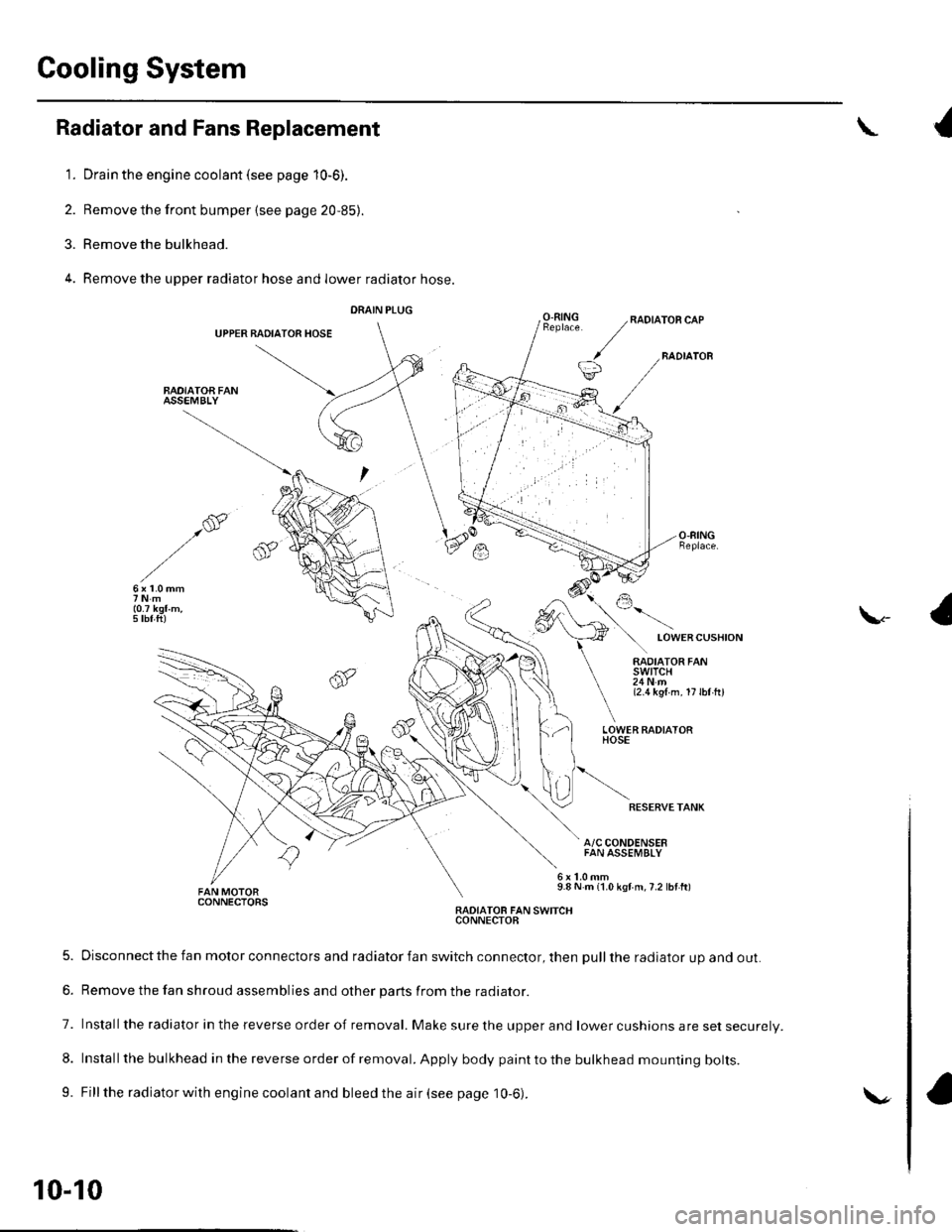
Radiator and Fans Replacement
1. Drain the engine coolant (see page 10-6).
2. Remove the front bumper {see page 20,85).
3. Remove the bulkhead.
4. Remove the upper radiator hose and lower radiator hose.
DRAIN PLUG
UPPER BADIATOR HOSE
BAOIATOA FANASSEMBLY
{
O.RINGRADIATOR CAP
BADIATOB
LOWERCUSHION
\-
RADIATOR FANswtTcH24Nm{2.1t kgl m. 17lbl hl
LOWER FADIATORHOSE
RESERVETANK
A/C CONDENSERFAN ASSEMBLY
9.8 N m {1.0 kgf m,7.2 lbf ft)CONNECTORSRADIATOB FAN SWITCHCONNECTOB
5. Disconnect the fan motor connectors and radiator fan switch connector, then pull the radiator up and out.
6. Remove the fan shroud assemblies and other parts from the radiator.
7. Installthe radiator in the reverse order of removal. Make sure the upper and lower cushions are set securelV.
8. Install the bulkhead in the reverse order of removal. Apply body paint to the bulkhead mounting bolts.
9. Fill the radiator with engine coolant and bleed the air (see page 10-6).
10-10
\.
Page 201 of 1139
Fan Controls
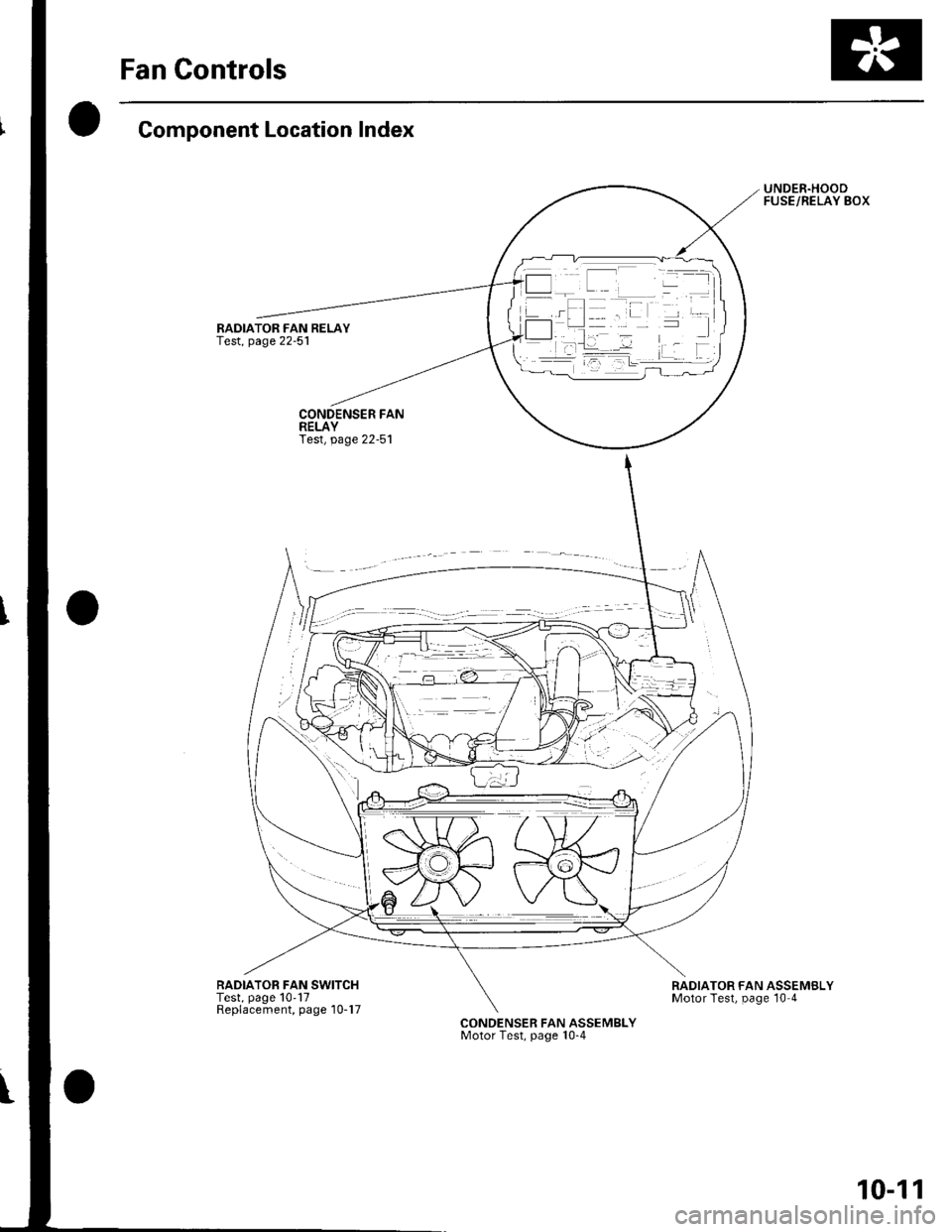
Component Location Index
RADIATOR FAN RELAY
RADIATOB FAN SWITCHTest, page 10'17Replacement, page'10-17
UNDER.HOODFUSE/RELAY BOX
RADIATOR FAN ASSEMBLYMotor Test, page 10 4
CONDENSER FAN ASSEMBLYMotor Test, page 10-4
10-11
Page 205 of 1139
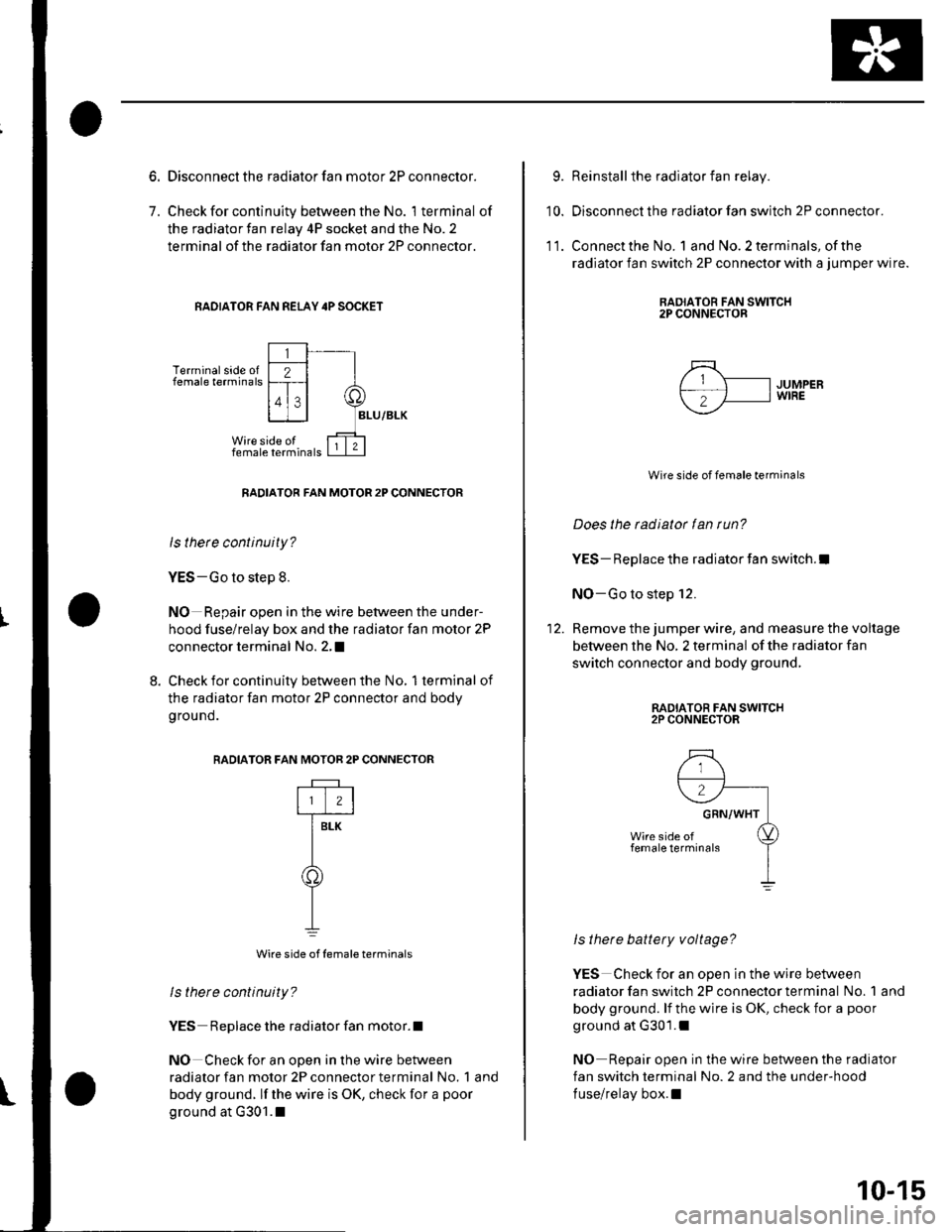
7.
Disconnect the radiator fan motor 2P connector.
Check for continuity between the No. 1 terminal of
the radiator fan relay 4P socket and the No. 2
terminal of the radiator fan motor 2P connector.
RAOIATOR FAN REI-AY 4P SOCKET
Terminal side offemale terminals
RADIATOR FAN MOTOR 2P CONNECTOR
ls thete continuity?
YES-Go to step 8.
NO Repair open in the wire between the under-
hood fuse/relay box and the radiator fan motor 2P
connector terminal No. 2,I
8. Check for continuity between the No, 1terminal of
the radiator fan motor 2P connector and bodv
g rou nd.
RADIATOR F
Wire side of female terminals
ls there continuity?
YES Replace the radiator fan motor.l
NO Check for an open in the wire between
radiator fan motor 2P connector terminal No. 1 and
body ground. lf the wire is OK, check for a poor
ground at G301.1
AN MOTOR 2P CONNECTOR
rftr
T-
Y
9.
10.
Reinstall the radiator fan relay.
Disconnect the radiator fan switch 2P connector.
Connect the No. 1 and No. 2 terminals, of the
radiator fan switch 2P connector with a jumper wire.
RAOIATOR FAN SWITCH2P CONNECTOR
11.
5\- IJUMPERf-; 'fl I wrRE
--
Wire side of female terminals
Does the radiator fan run?
YES- Replace the radiator fan switch.l
NO-Go to step 12.
Remove the jumper wire, and measure the voltage
between the No, 2 terminal of the radiator fan
switch connector and body ground,
RADIATOR FAN SWITCH2P CONNECTOR
ls there battery voltage?
YES Check for an open in the wire between
radiator fan switch 2P connector terminal No. 1 and
body ground. lf the wire is OK, check for a poor
ground at G301.1
NO Repair open in the wire between the radiator
fan switch terminal No. 2 and the under-hood
fuse/relay box.l
10-15
Page 413 of 1139
Transmission Fluid Inspection and
Replacement
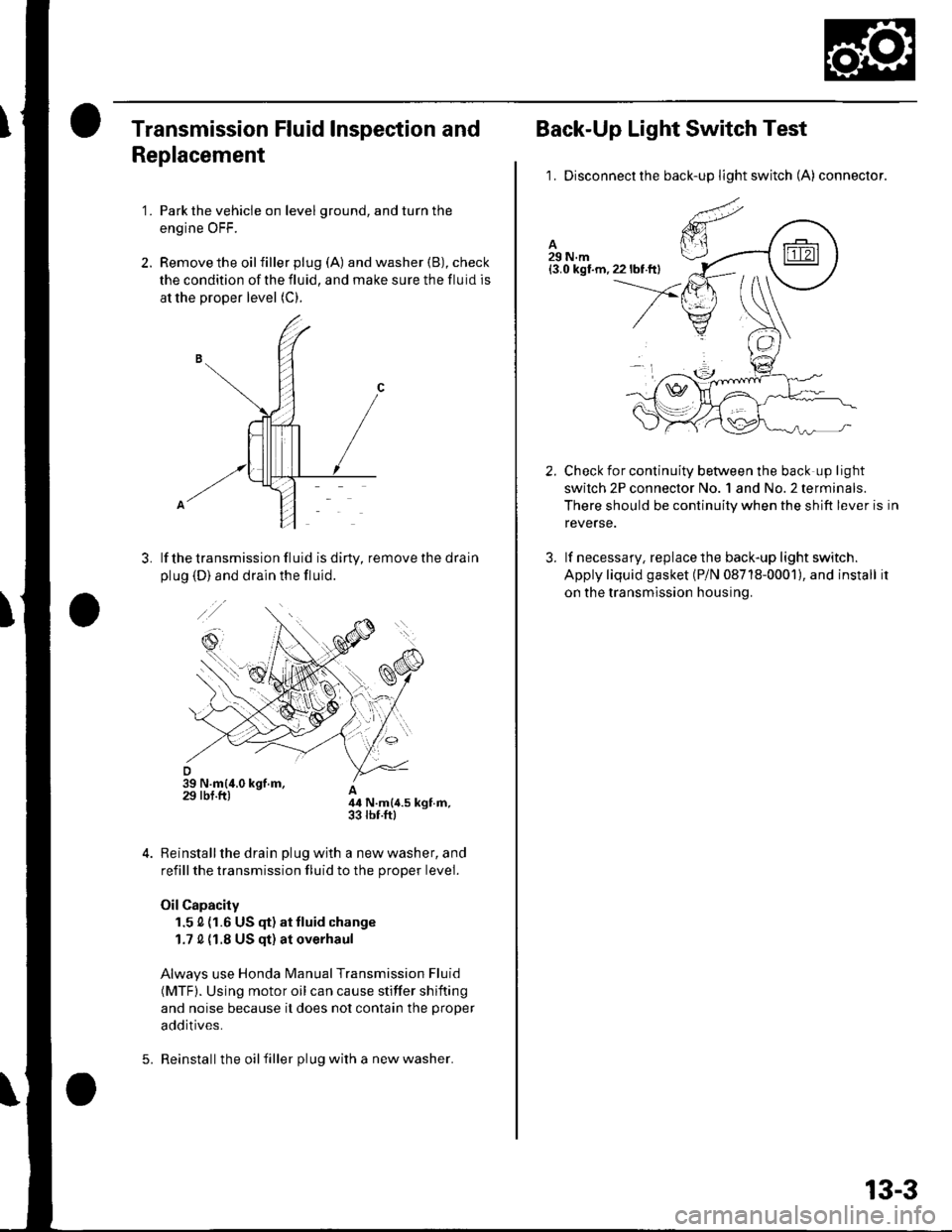
'1. Park the vehicle on level ground, and turn the
engine OFF.
2. Remove the oilfiller plug (A) and washer (B), check
the condition of the fluid, and make sure the fluid is
at the proper level (C).
lf the transmission fluid is diny, remove the drain
plug (D) and drain the fluid.
A44 N.m{4.5 kgt.m,33 rbr.ftl
Reinstall the drain plug with a new washer, and
refill the transmission fluid to the proper level.
Oil Capacity
1.5 0 (1.6 US (F) at tluid change
1.7 0 {1.8 US qt) at overhaul
Always use Honda Manual Transmission Fluid
(MTF). Using motor oil can cause stiffer shifting
and noise because it does not contain the proper
additives.
Reinstall the oil filler plug with a new washer.5.
13-3
Back-Up Light Switch Test
1. Disconnectthe back-up light switch (A) connector.
Check for continuity between the back up light
swilch 2P connector No. 1 and No.2 terminals.
There should be continuity when the shift lever is in
reverse.
lf necessary, replace the back-up light switch.
Apply liquid gasket (P/N 08718-0001), and install it
on the transmission housing.
2.
3.
Page 506 of 1139
Electrical Power Steering (EPSI
SpecialTools ............. 17 -16
Component Location Index ......................................... 17-17
General Troubleshooting Information ....................... 17-18
DTC Troubleshooting Index .............. 17-22
Symptom Troubleshooting Index ............................... 17 -23
System Description ................. ........... 17-24
Circuit Diagram ......... 17-26
DTC Troubleshooting ............... .......... 17-28
EPS lndicator Circuit Troubleshooting ....................... 17-47
Motor Removal/lnstallation ............... 17-49
Steering Gearbox Removal ............... 17-51
Steering Gearbox Overhaul ............... 17-55
Steering Gearbox Installation ........... 17-63
EPS Control Unit Remova l/lnsta llation ....................... 17-67
Tie-rod Ball Joint Boot Replacement .......................... 17-67
Page 508 of 1139
![HONDA CIVIC 2002 7.G User Guide Component Location Index
UNDER.HOODFUSE/RELAY BOX
EPS CONTROL UNITEPS Control Unit Removal/lnstallation,page 17 -67
UNDER.DASH FUSE/RELAY BOX
-,/.,....
.,i,
X ]
DATA LINK CONNECTOR I16P)
TOROUE SENS](/img/13/5744/w960_5744-507.png "HONDA CIVIC 2002 7.G User Guide Component Location Index
UNDER.HOODFUSE/RELAY BOX
EPS CONTROL UNITEPS Control Unit Removal/lnstallation,page 17 -67
UNDER.DASH FUSE/RELAY BOX
-,/.,....
.,i,
X ]
DATA LINK CONNECTOR I16P)
TOROUE SENS")
Component Location Index
UNDER.HOODFUSE/RELAY BOX
EPS CONTROL UNITEPS Control Unit Removal/lnstallation,page 17 -67
UNDER.DASH FUSE/RELAY BOX
-,'/.,....
'.,i,
X ]
DATA LINK CONNECTOR I16P)
TOROUE SENSOR
STEERING GEARBOXSteering Gearbox Removal, page 17-51Steering Gearbox Overhaul, page 17-55Steering Gearbox Installation, page 17-63
Removal/lnstallation,page l7-49
GAUGE ASSEMBLY
MOTOR
17-17
Page 509 of 1139
EPS Components
aGeneral Troubleshooting Information
EPS Indicator
Under normal conditions, the EPS indicator comes on when
the ignitlon switch is turned to the ON (ll) position, then goes
off after the engine is started. This indicates that the bulb and
its circuit are operating correctly.
lf there is any trouble in the system after the engine is started,
the EPS indicator will stay on, and the power assist is turned
off.
When EPS indicator light comes on, the control unit
memorizes the DTC. In this case, the control unit will not
activate the EPS system after the engine starts again, but it
keeps the EPS indicator on.
When DTC 12, 16, 17, 18 or 67 is stored in the control unit, the
EPS indicator will stay on until the DTC is erased. When a
problem is detected and the EPS indicator comes on, there are
cases when the indicator stays on untilthe ignition switch is
turned 0FF, and cases when the indicator goes off
automatically when the system returns to normal. Even though
the system is operating normally, the EPS indicator will come
on under the following conditions:
Condition '1:
. The vehicle was traveling at least 12.4 mph (20 km/h), then. A rapid change in vehicle speed was detected, then. The vehicle (or the vehicle speed sensor signal) stopped for
at least 5 seconds. The engine speed was still 'l,640rpmorhigherforatleastS
seconds
Condition 2:
After the vehicle (or the vehicle speed sensor signal) has
stopped for at least 10 seconds, yet the engine speed was still
1,640 rpm or higherfor at least 20 seconds.
Condition 3:
When the engine speed is 280 rpm or less, and the vehicle is traveling at
a speed of 6,2 mph (10 km/h) or more for 3 seconds.
To determine the actual cause ofthe problem, question the
customer about the conditions during which the problem
occured, taking the above conditions into consideration.
Diagnostic Trouble Code (DTCI
. lf the CPU cannot be activated, or itfails,the EPS indicator
comes on, but the DTC is not memorized.. The memory can hold any number of DTCS. However, when
the same DTC is detected more than once, the most recent
DTC is written over the prior DTC, therefore only one
occurrence is memorized.. The DTCS are indicated repeatedly untilthe ignition switch is
turned OFF.. lf the DTC is not memorized,the EPS indicator blinks.
. The DTCS are memorized in the EEPRO| (non-volatile
memory) therefore the memorized DTCS cannot be erased
by disconnecting the battery. Perform the specified
procedures to clear DTCS.
Self-diagnosis
Self-diagnosis can be classified into two categories:.Initial diagnosis: performed right after the engine
starts and until the EPS indicator goes off.. Regular diagnosis: performed right after the initial
diagnosis until the ignition switch is turned OFF.
The EPS control unit performs the following functions
when a problem is detected by self-diagnosis;
'1. Turns on the EPS indicator.
2. Memorizes the DTC.
3. Stops power assist and manual steering operation
begrns.
NOTE:. When DTC 23 (a problem with the circuit for
engine speed signal) is detected, the power
assist will return to normal when the vehicle
speed is 0.62 mph (1 km/h) or above.. Fot DfCs 22,23, 64, or 66 the EPS indicator goes
off automatically when the system relurns to
normal. For all other codes, the EPS indicator
goes off when the system is OK after the ignition
switch is turned from OFF to ON (ll).
Restriction on Power Assist Operation
Repeated extreme steering force. such as turning the
steering wheel continuously back-and-forth with the
vehicle stopped, causes an increase of power
consumption in the EPS motor. The increase of electric
current causes the motor to heat up. Because this heat
adversely affects the system, the control unit monitors
the electric current of the motor.
When the control unit detects heat build-up in the motor,
it reduces the electric current to the motor gradually to
protect the system, and it restricts the power assist
operation. The EPS indicator does not come on during
this function.
When steering torque is not applied to the steering
wheel, or when the ignition is turned off, and the motor
cools, the control unit will restore the power assist
gradually until it's fully restored (after approximately 15
minutes maximum).
17-18