starter HONDA CIVIC 2003 7.G User Guide
[x] Cancel search | Manufacturer: HONDA, Model Year: 2003, Model line: CIVIC, Model: HONDA CIVIC 2003 7.GPages: 1139, PDF Size: 28.19 MB
Page 45 of 1139
* -#\"\"Jli")
Starting System
Starter Overhaul
Disassembly/Reassembly
f
@
@
,-- ----_2<-
; ,/ 1(-\
rw.h
\:!@a
-
@-A
q -z\hsc6
b-.- ,"OVERRUNNINGCLUTCH ASSEMBLY
G
SOLENOID LEVER
o*"lu*.
V*rN*
\#. A*@
c^)* -#""Jli[X:""
S#o
7:- o
a<-4 t^ fr/ / ffiA-v
9\:-/ ffitr,.. D lWEND COVER t/ '!4/
STARTER SOLENOID
4-10
BRUSH HOLDER
Page 46 of 1139
.
2. Disassemble the starter as shown atthe beginning
of this procedure.
3. Inspect the armature for wear or damage from
contact")
\
?.-
Armature Inspection and Test
1. Remove the starter (see page 4-9).
2. Disassemble the starter as shown atthe beginning
of this procedure.
3. Inspect the armature for wear or damage from
contact with the permanent magnet. lf there is wear
or damage, replace the armature.
Check the commutator (A) surface. lf the surface is
dirty or burnt, resurface with emery cloth or a lathe
within the specifications in step 5, or recondition
with # 500 or # 600 sandpaper (B).
6.
5. Check the commutator diameter. lf the diameter is
below the service limit, replace the armature.
Commutator Diameter
Standard (Newl: 28.0 mm (1.10 in.l
Service Limit: 27.0 mm (1.06 in.)
Measure the commutator (A) runout.
. lf the commutator runout is within the service
limit, check the commutator for carbon dust or
brass chips between the segments.. lf the commutator runout is not within the service
limit, reolace the armature.
Commutator Runout
Standard lNew): 0.02 mm 10.001 in.) max.
Service Limit: 0.05 mm (0.002 in.)
(cont'd)
4-11
Page 47 of 1139
Starting System
Starter Overhaul (cont'dl
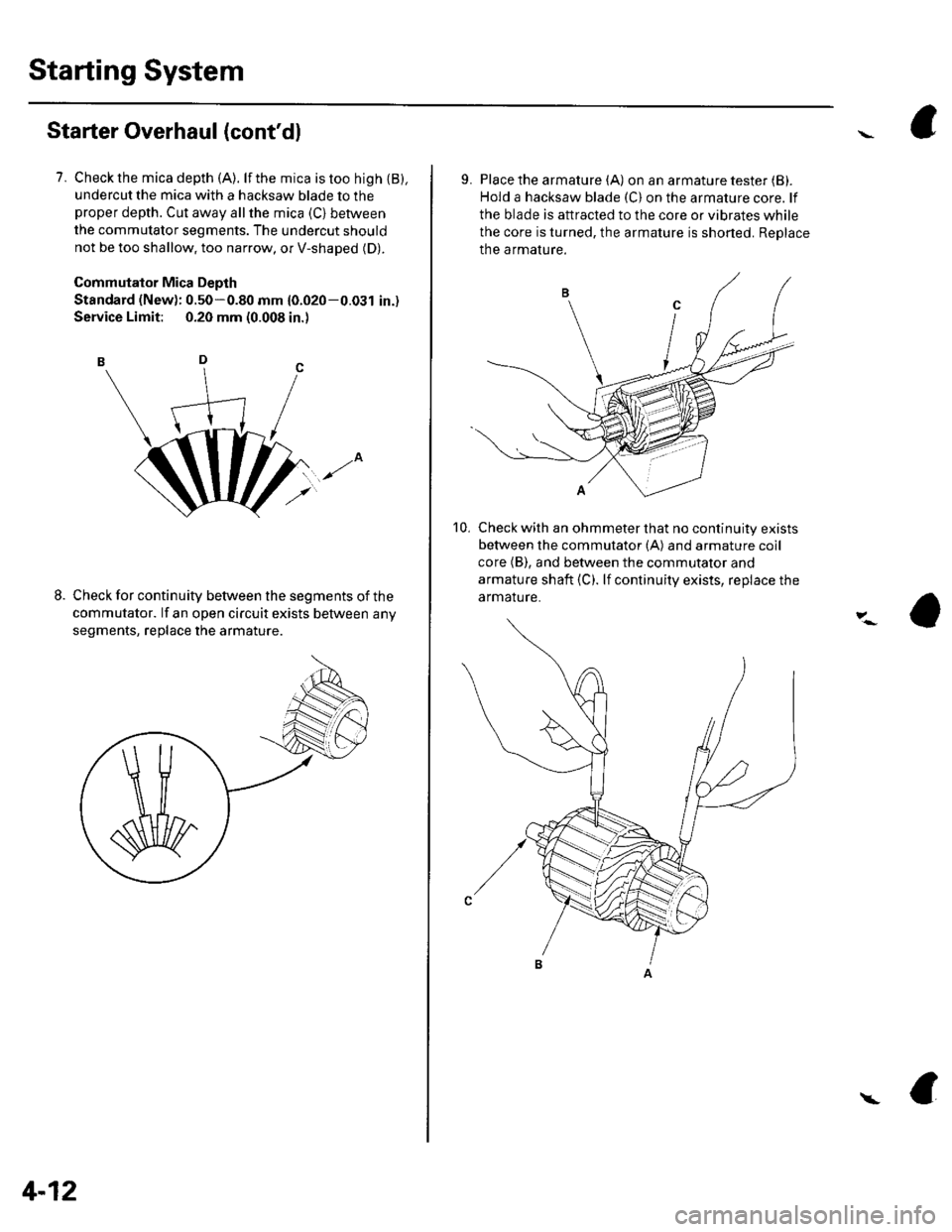
7. Check the mica depth (A). lf the mica is too high {B),undercut the mica with a hacksaw blade to theproper depth. Cut away allthe mica (C) between
the commutator segments. The undercut should
not be too shallow, too narrow, or V-shaped (D).
Commutator Mica Depth
Standard (New): 0.50-0.80 mm {0.020-0.031 in.)
Service Limit: 0.20 mm (0.008 in.)
Check for continuity between the segments of the
commutator. lf an open circuit exists between any
segments, replace the armature.
M
4-12
\
9. Place the armature (A) on an armature tester (B).
Hold a hacksaw blade (C) on the armature core. lf
the blade is attracted to the core or vibrates while
the core is turned, the armature is shoned. Replace
the armature.
Check with an ohmmeter that no continuity exists
between the commutator (A) and armature coll
core (B), and between the commutator and
armature shaft (C). lf continuity exists, replace the
armature.
10,
Page 48 of 1139
Starter Brush Inspection
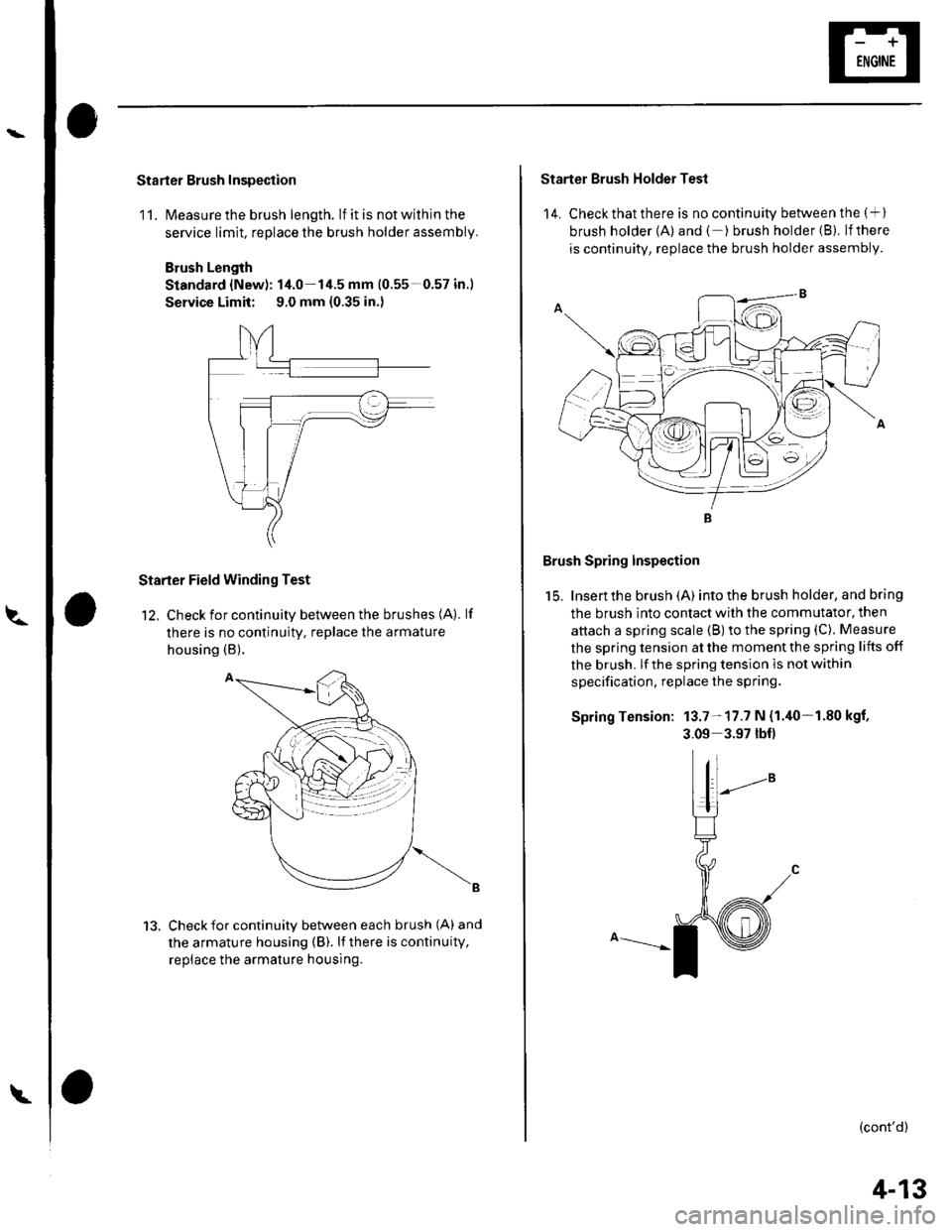
11. lvleasure the brush length. lf it is not within the
service limit, replace the brush holder assembly.
Brush Length
Standard {New): 14.0-14.5 mm (0.55-0.57 in.)
Service Limit: 9.0 mm {0.35 in.)
Starter Field Winding Test
12. Check for continuity between the brushes (A). lf
there is no continuity. replace the armature
housing (B).
Check for continuity between each brush (A) and
the armature housing (B). li there is continuity,
replace the armature housing.
13.
Starter Brush Holder Test
14, Check that there is no continuity between the (+ )
brush holder {A) and ( ) brush holder (B}. lfthere
is continuity, replace the brush holder assembly.
Brush Spring Inspection
15. Insen the brush (A) into the brush holder, and bring
the brush into contact with the commutator, then
attach a spring scale (B) to the spring (C). Measure
the spring tension at the moment the spring lifts off
the brush. lf the spring tension is not within
specification, replace the spring.
Spring Tension: 13.7-17.7 N {1.40-1.80 kgf,
3.09 3.97 lbf)
(cont'd)
4-13
Page 49 of 1139
Starting System
Starter Overhaul (cont'dl
Planetary Gear Inspection
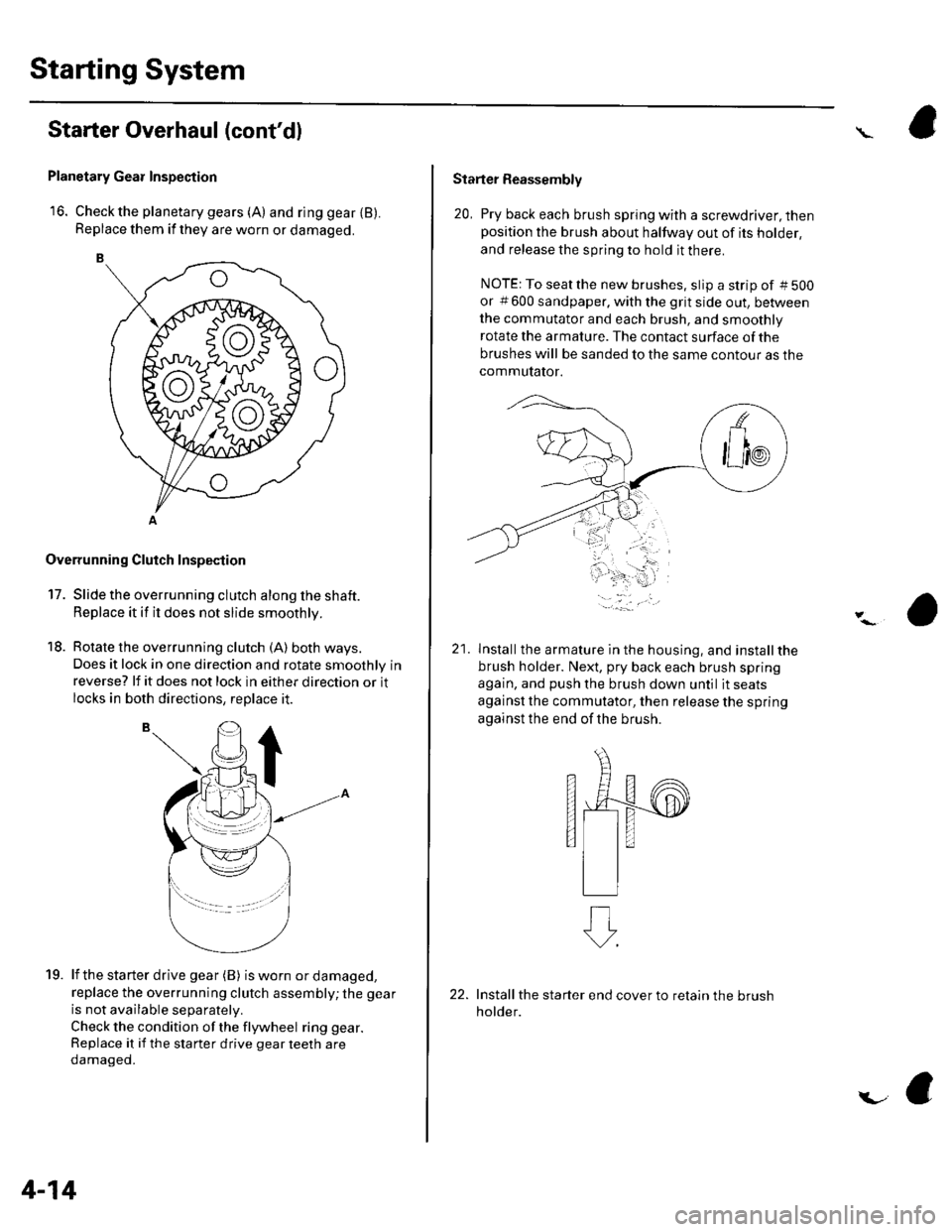
16. Check the planetary gears (A) and ring gear {B).Replace them if they are worn or damaged.
Overrunning Cluich Inspection
17. Slide the overrunning clutch along the shaft.
Replace it if it does not slide smoothly.
18. Rotate the overrunning clutch (A) both ways.
Does it lock in one direction and rotate smoothly inreverse? lf it does not lock in either direction or it
locks in both directions, replace it.
lf the starter drive gear (B) is worn or damaged,
replace the overrunning clutch assembly; the gear
is not available separately.
Check the condition of the flywheel ring gear.
Replace it if the starter drive gear teeth are
oamageo.
19.
4-14
i.-
Starter Reassembly
20, Pry back each brush spring with a screwdriver, thenposition the brush about halfway out of its holder,
and release the spring to hold it there.
NOTE: To seatthe new brushes. slip a strip of #5OO
or # 600 sandpaper. with the grit side out, be&veen
the commutator and each brush, and smoothly
rotate the armature. The contact surface of the
brushes will be sanded to the same contour as the
commutator.
21lnstallthe armature in the housing, and installthe
brush holder. Next, pry back each brush spring
again, and push the brush down until it seats
against the commutator, then release the spring
against the end of the brush.
s
Install the starter end cover to retain the brush
holder.
Page 57 of 1139
Gharging System
Charging Circuit Troubleshooting
lf the charging system indicator does not come on or
does not go off, or the battery is dead or low, test these
items in the order listed below:
Battery (see page 22-50)
Charging system indicator
Alternator and regulator circuit
Alternator control system
Charging System Indicator Test
1. Turn the ignition switch ON {ll).
Does the chatging system indicator come on?
YES Go to step 2.
NO Go to step 3.
2. Start the engine.
Does the charging system indicator go off?
YES-Charging system indicator circuit is OK. Go
to the Alternator and Regulator circuit Test. t
NO-Go to step 3.
3. Turn the ignition switch OFF.
4. Troubleshoot the multiplex control system (see
page 22 172).
ls the multiplex control system OK?
YES Go to step 5.
NO Check the multiplex control system as
indicated by the diagnostic trouble code (DTC) (see
step 8 on page 22-172).1
5. Disconnect the engine wire harness 6P connector
from the starter sub harness 6P connector.
4-22
\"4
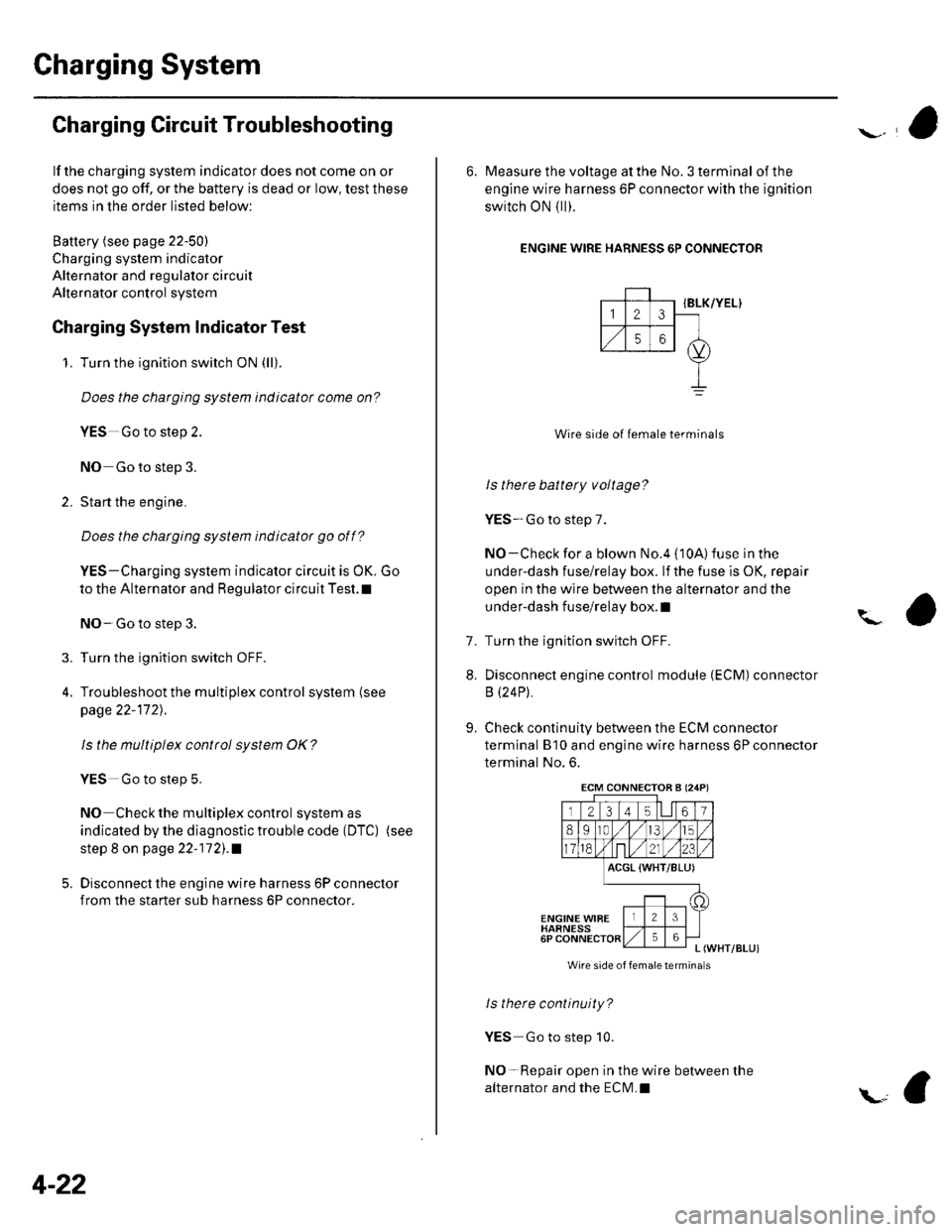
6. Measure the voltage at the No. 3 terminal of the
engine wire harness 6P connector with the ignition
switch ON { ll).
ENGINE WIRE HARNESS 6P CONNECTOR
IBLK/YEL}
Wire side of female terminals
ls there battery voltage?
YES-Go to step 7.
NO-Check for a blown No.4 {10A) fuse in the
under-dash fuse/relay box. lf the fuse is OK, repair
open in the wire between the alternator and the
under-dash fuse/relay box. I
Turn the ignition switch OFF.
Disconnect engine control module (ECM) connector
B (24P).
Check continuity between the ECM connector
terminal B'10 and engine wire harness 6P connector
terminal No. 6.
?
7.
8.
9.
ACGL {WHT/BLU)
ENGINE WIBEHARNESS6PL (WHT/BLUI
Wire side of femaletermina s
ls there continuity?
YES Go to step 10.
NO-Repair open in the wire between the
alternator and the ECN4.I
ECM CONNECTOB A (24P)
Page 58 of 1139
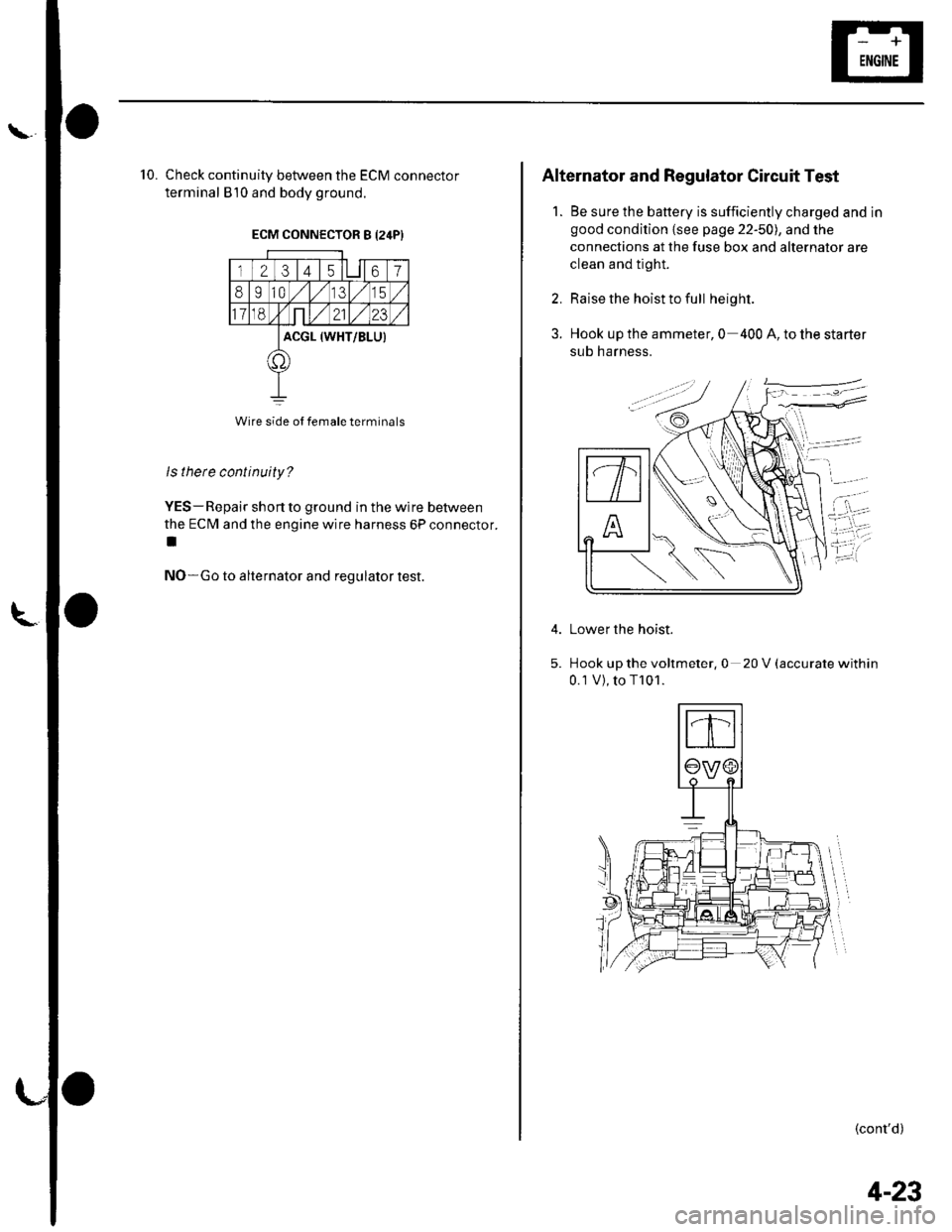
'10. Check continuity between the ECM connector
terminal 810 and body ground.
ECM CONNECTOR S I24PI
23 t4 t567
8I10,/1,/315
118,Nnt,/2123
ACGL (WHT/BLUI
t1'
Wire side ol female terminals
ls there continuity?
YES- Repair short to ground in the wire between
the ECM and the engine wire harness 6P connector.
t
NO-Go to alternator and regulator test.
Alternator and Regulator Circuit Test
1. Be sure the battery is sufficiently charged and in
good condition {see page 22-50), and the
connections at the fuse box and alternator are
clean and tight.
2. Raise the hoist to full height.
3. Hook up the ammeter, 0 400 A, to the starter
sub harness.
Lower the hoist.
Hook up the voltmeter, 0 20 V (accurate within
0.1V),toT101.
(cont'd)
4-23
Page 59 of 1139
Gharging System
Charging Circuit Troubleshooting (cont'd)
6. Start the engine. Hold the engine at 3,000 rpm with
no load (in Neutral) until the radiator fan comes on,
then let it idle.
7. Raise the engine speed to 2,000 rpm, and hold it
there.
8. Turn the headlights (high beam) on, and measure
voltage at the under-hood fuse/relay box terminal.
ls the voltage between 13.9 and 15.1 v?
YES-Go to step 9.
NO Repair or replace the alternator components
(see page 4-30).1
9. Read the amperage at '13.5 V.
NOTE: Adjust the voltage by turning the blower
motor, rear window defogger, brake lights. etc. ON.
ls the amperage 604 ot morc?
YES-Alternator/regulator operation is OK. I
NO Repair or replace the alternator components(see page 4-30).1
4-24
\,
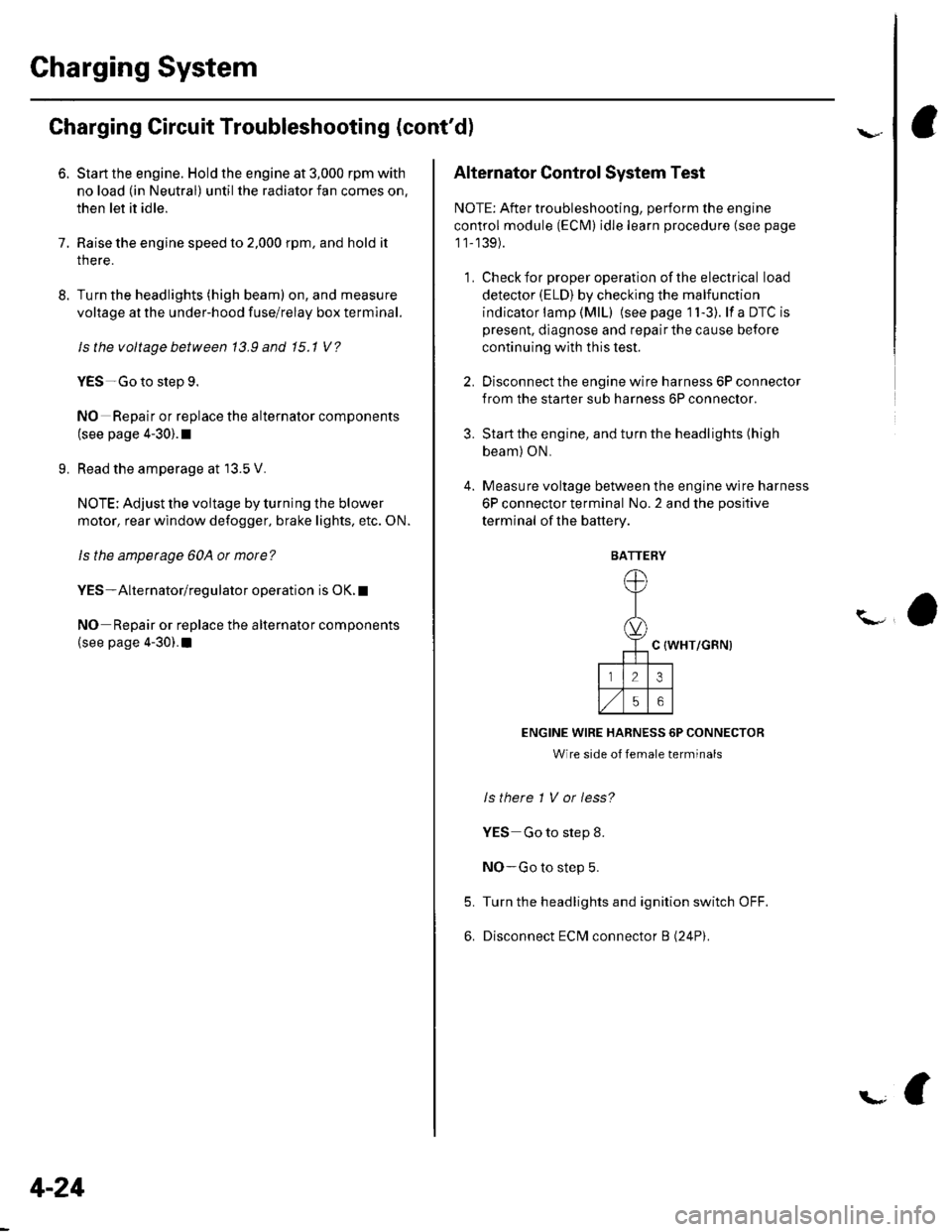
Alternator Control System Test
NOTE: After troubleshooting, perform the engine
control module (ECM) idle learn procedure (see page
11-139).
1 . Check for proper operation of the electrical load
detector (ELD) by checking the malfunction
indicator lamp (MlL) (see page 1 l-3). lf a DTC is
present, diagnose and repair the cause before
continuing with this test.
2. Disconnect the engine wire harness 6P connector
from the starter sub harness 6P connector.
3. Start the engine, and turn the headlights (high
beam) ON,
4. Measure voltage between the engine wire harness
6P connector terminal No. 2 and the positive
terminal of lhe battery.
C {WHT/GRN)
ENGINE WIRE HARNESS 6P CONNECTOR
Wire side of female terminals
ls there 1 V or less?
YES Go to step 8.
NO-Go to step 5.
Turn the headlights and ignition switch OFF.
Disconnect ECM connector B (24P).
5.
6.
BATTERY
Page 60 of 1139

\
L
7, Check for continuity between ECM connector
terminal 818 and body ground.
ECM CONNECTOR B {24PI
123 t4 t561
8910,/1,/35
11ont,/2123
ACGC {WHT/GRN}
o
Wire side ot female terminals
9.
ls there continuity?
YES-Repair short to ground in the wire between
the alternator and the ECM.I
NO-Check that the terminals are firmly seated at
the ECM connector B. lf OK, substitute a known-
good ECM, and recheck (see page 11-6).
lf prescribed voltage is now available. replace the
original ECM,I
Turn the headlights and ignition switch OFF.
Disconnect ECM connector B (24P).
10. Check for continuity between ECM connector
terminal 818 and engine wire harness 6P connector
terminal No.2.
ACGC (WHT/GRN)
ECM CONNECTOR B l2,lPI
12314l5lll67
8910t.)15
11on2123
oC (WHT/GRN)
23
56
ENGINE WIRE HARNESS 6P CONNECTOR
Wire side oI lemale terminals
ls therc continuity?
YES Repair or replace the starter subharness or
the alternator (see page 4-30).I
NO Repair open in the wire between the
alternator and the ECM.I
4-25
Page 95 of 1139
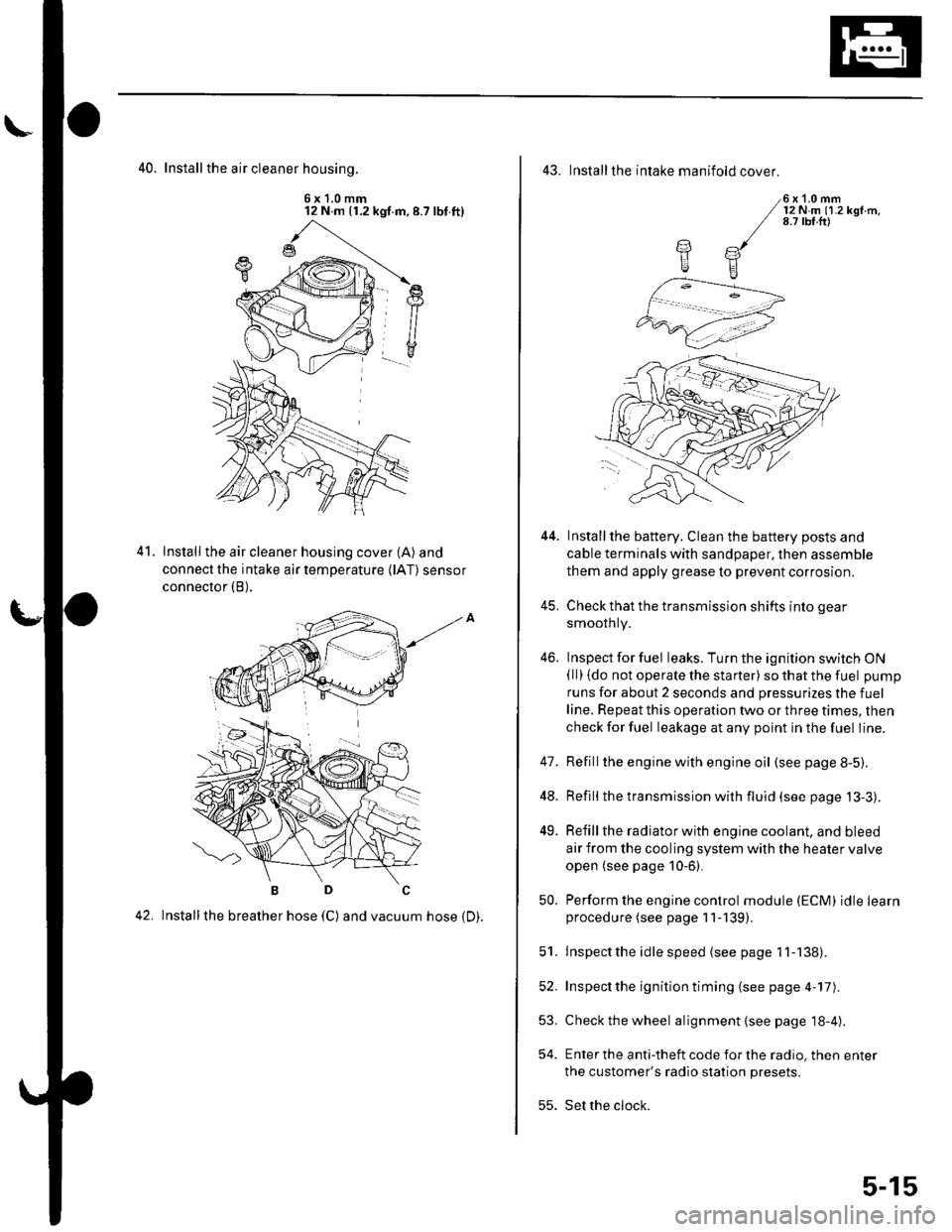
40. Install the air cleaner housinq.
6x1.0mm12 N m (1.2 kgf.m,8.7 lbt.ft)
Install the air cleaner housing cover (A) and
connect the intake air temperature (lAT) sensor
connector (B),
42. Installthe breather hose (C) and vacuum hose 1D).
41.
43. Installthe intake manifold cover.
6x1.0mm12Nm11.2kgf.m.8.7 tbf.ft)
Installthe battery. Clean the battery posts and
cable terminals with sandpaper, then assemble
them and apply grease to prevent corrosion.
Check that the transmission shifts into gear
smoothly.
Inspect for fuel leaks. Turn the ignition switch ON(ll) {do not operate the starter) so that the fuel pump
runs for about 2 seconds and pressurizes the fuel
line. Repeat this operation two or three times, then
check for fuel leakage at any point in the fuel line.
Refillthe engine with engine oil (see page 8-5).
Refill the transmission with fluid (see page 13-3).
Refill the radiator with engine coolant, and bleed
air from the cooling system with the heater valve
open (see page 10-6).
Perform the engine control module (ECM) idle learnprocedure (see page 11-139).
Inspect the idle speed (see page 1 1-138).
Inspect the ignition timing (see page 4-17).
Check the wheel alignment {see page 18-4).
Enter the anti-theft code for the radio, then enter
the customer's radio station presets.
Set the clock.
YE
44.
41.
]tE
46.
48.
49.
52.
53.
54.
50.
51.
55.
5-15