radio HONDA CIVIC COUPE 1998 User Guide
[x] Cancel search | Manufacturer: HONDA, Model Year: 1998, Model line: CIVIC COUPE, Model: HONDA CIVIC COUPE 1998Pages: 251, PDF Size: 2.04 MB
Page 116 of 251
Accessories and Modifications
Modifying your vehicle, or installingsome non-Honda accessories, can
make your vehicle unsafe. Before
you make any modifications or add
any accessories, be sure to read the
following information.
Accessories
Your dealer has Genuine Honda accessories that allow you to
personalize your vehicle. These accessories have been designed and
approved for your vehicle, and are
covered by warranty.
Non-Honda accessories are usually
designed for universal applications.
Although aftermarket accessories may fit on your vehicle, they may not
meet factory specifications, and
could adversely affect your vehicle's
handling and stability. (See "Modifications" on page 115 for
additional information.) When properly installed, car phones,
alarms, two-way radios, and low-
powered audio systems should not
interfere with your vehicle's
computer-controlled systems, such as the SRS and anti-lock brake
system.
However, if electronic accessories
are improperly installed, or exceed
your vehicle's electrical system capacity, they can interfere with the operation of your vehicle, or even
cause the airbags to deploy.
Before installing any accessory:
Make sure the accessory does notobscure any lights, or interfere
with proper vehicle operation or performance.
Be sure electronic accessories do
not overload electrical circuits (see page 225). Have the installer contact your
Honda dealer for assistance before
installing any electronic accessory.
If possible, have your dealer inspect
the final installation.
Before Driving
Improper accessories or
modifications can affect your
vehicle's handling, stability and performance, and cause a
crash in which you can be hurt
or killed.
Follow all instructions in this
owner's manual regarding
accessories and modifications.Main Menu Table of Contents s t
Page 218 of 251
Charging System Indicator
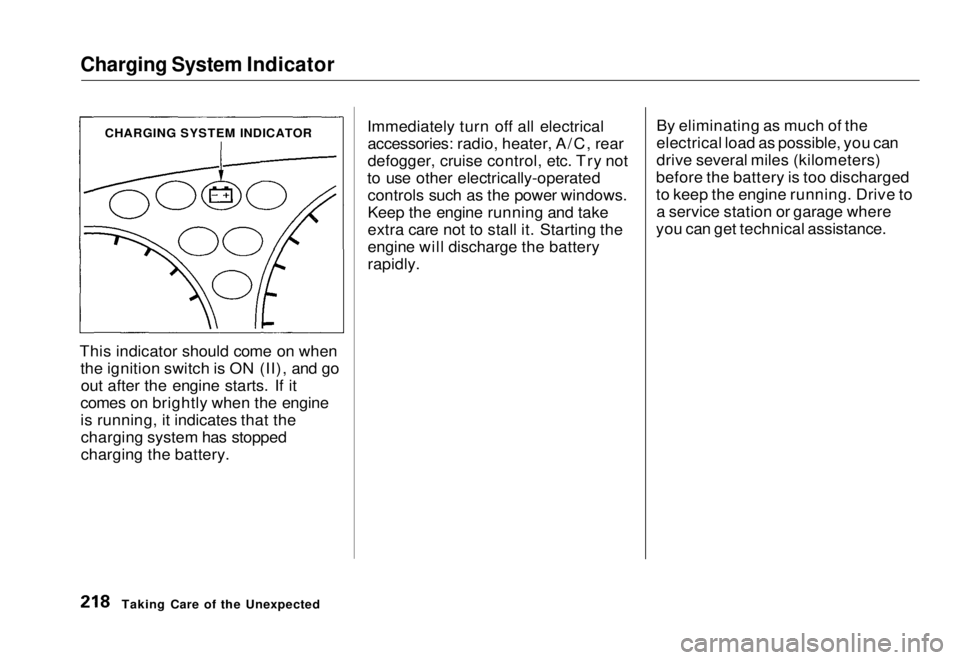
This indicator should come on when the ignition switch is ON (II), and goout after the engine starts. If it
comes on brightly when the engine
is running, it indicates that the charging system has stopped
charging the battery. Immediately turn off all electrical
accessories: radio, heater, A/C, rear
defogger, cruise control, etc. Try not
to use other electrically-operated controls such as the power windows.
Keep the engine running and take
extra care not to stall it. Starting the
engine will discharge the battery
rapidly. By eliminating as much of the
electrical load as possible, you can
drive several miles (kilometers)
before the battery is too discharged
to keep the engine running. Drive to a service station or garage where
you can get technical assistance.
Taking Care of the Unexpected
CHARGING SYSTEM INDICATORMain Menu Table of Contents s t
Page 224 of 251
Fuses
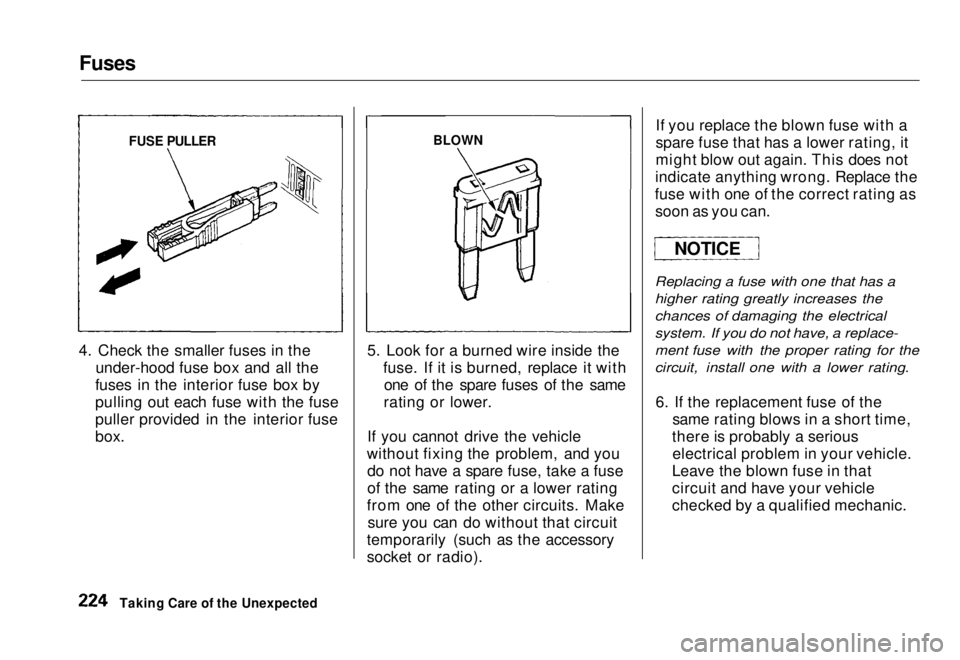
4. Check the smaller fuses in the under-hood fuse box and all the
fuses in the interior fuse box by
pulling out each fuse with the fuse
puller provided in the interior fuse
box. 5. Look for a burned wire inside the
fuse. If it is burned, replace it withone of the spare fuses of the same
rating or lower.
If you cannot drive the vehicle
without fixing the problem, and you do not have a spare fuse, take a fuse
of the same rating or a lower rating
from one of the other circuits. Make sure you can do without that circuit
temporarily (such as the accessory
socket or radio). If you replace the blown fuse with a
spare fuse that has a lower rating, it
might blow out again. This does not
indicate anything wrong. Replace the
fuse with one of the correct rating as soon as you can.
Replacing a fuse with one that has a
higher rating greatly increases the
chances of damaging the electrical
system. If you do not have, a replace-
ment fuse with the proper rating for the
circuit, install one with a lower rating.
6. If the replacement fuse of the same rating blows in a short time,
there is probably a serious electrical problem in your vehicle.
Leave the blown fuse in that
circuit and have your vehicle
checked by a qualified mechanic.
Taking Care of the Unexpected FUSE PULLER
BLOWN
NOTICEMain Menu Table of Contents s t
Page 227 of 251
Emergency Towing
If your vehicle needs to be towed,
call a professional towing service or,
if you belong to one, an organization
that provides roadside assistance.
Never tow your vehicle behind another vehicle with just a rope or
chain. It is very dangerous.
There are three popular types of
professional towing equipment.Flat-bed Equipment - The operatorloads your vehicle on the back of a
truck. This is the best way to transport your Honda.
Wheel-Lift Equipment - The tow
truck uses two pivoting arms that go under the tires (front or rear) and lift
them off the ground. The other two
tires remain on the ground.This is an acceptable way to tow
your Honda.
Sling-type Equipment - The tow
truck uses metal cables with hookson the ends. These hooks go around parts of the frame or suspension and
the cables lift that end of the vehicle off the ground. Your vehicle's
suspension and body can be seriously
damaged. This method of towing is
unacceptable.
If your Honda cannot be transported
by flat-bed, it should be towed by
wheel-lift equipment with the front
wheels off the ground. If, due to damage, your vehicle must be towed
with the front wheels on the ground, do the following.
5-speed Manual Transmission
Release the parking brake.Shift the transmission to Neutral.
Automatic Transmission Release the parking brake.Start the engine.
Shift to D4, then to N.
Turn off the engine.
Improper towing preparation will
damage the transmission. Follow
the above procedure exactly. If you
cannot shift the transmission or
start the engine (automatic
transmission), your vehicle must be
transported with the front wheels
off the ground.
With the front wheels on the
ground, it is best to tow the vehicle
no farther than 50 miles (80 km), and keep the speed below 35 mph
(55 km/h).
If you decide to tow your vehicle
with all four wheels on the ground,
make sure you use a properly-
designed and attached tow bar.
Prepare the vehicle for towing as
described above, and leave theignition switch in Accessory (I) so
the steering wheel does not lock.
Make sure the radio and any items
Taking Care of the Unexpected
NOTICEMain Menu Table of Contents s t
Page 250 of 251
Index
Ethanol in Gasoline ....................... 238
Evaporative Emissions Controls.. 240
Exhaust Fumes................................ 47
Expectant Mothers, Use of Seat
Belts by.........................................17
Exterior, Cleaning the................... 200
Fabric, Cleaning............................. 202
Fan, Interior...................................... 86
Features, Comfort and Convenience................................. 85
Filling the Fuel Tank..................... 109
Filters
Air................................................169
Oil................................................ 157
5-speed Manual Transmission
Checking Fluid Level................ 166
Shifting the................................. 122
Flashers, Hazard Warning.............. 62
Flat Tire, Changing a.................... 207
Fluids
Automatic Transmission........... 164
Brake...........................................167
Clutch..........................................167
Manual Transmission............... 166
Power Steering........................... 168
Windshield Washer................... 164
FM Stereo Radio
Reception...................................... 94
Folding Rear Seat............................ 76
Foreign Countries, Driving in...... 239
Four-way Flashers........................... 62
Front End, Towing by
Emergency Wrecker................. 227
Fuel..................................................108
Fill Door and Cap....................... 109
Gauge............................................ 56
Octane Requirement................. 108
Oxygenated................................ 238
Reserve Indicator......................... 54
Tank, Filling the......................... 109
Fuses, Checking the...................... 222
Gas Mileage, Improving................ 113
Gasohol........................................... 238
Gasoline.......................................... 108
Fuel Reserve Indicator................ 54
Gauge............................................ 56
Octane Requirement................. 108
Tank, Filling the......................... 109
Gas Station Procedures................. 109
Gauges
Engine Coolant Temperature .... 56
Fuel................................................ 56
Gearshift Lever Positions Automatic Transmission........... 1255-speed Manual Transmission.......................... 122
Glass Cleaning............................... 203
Glove Box......................................... 8 1
Haloge n Headligh t
Bulbs.............. 189
Hazard Warning Flashers............... 62
Headlights
Aiming......................................... 188
Daytime Running Lights............. 59
High Beam Indicator................... 54
High Beams, Turning on............ 59
Low Beams, Turning on............. 59 Reminder Beeper......................... 59
Replacing Halogen Bulbs ......... 189
Turning on....................................
59Main Menu s t