head HONDA CIVIC COUPE 1999 User Guide
[x] Cancel search | Manufacturer: HONDA, Model Year: 1999, Model line: CIVIC COUPE, Model: HONDA CIVIC COUPE 1999Pages: 269, PDF Size: 2.42 MB
Page 28 of 269
Protecting Children
Placing a Child Seat
This page briefly summarizes Honda's recommendations on where
to place rear-facing and forward-
facing child seats in your car.
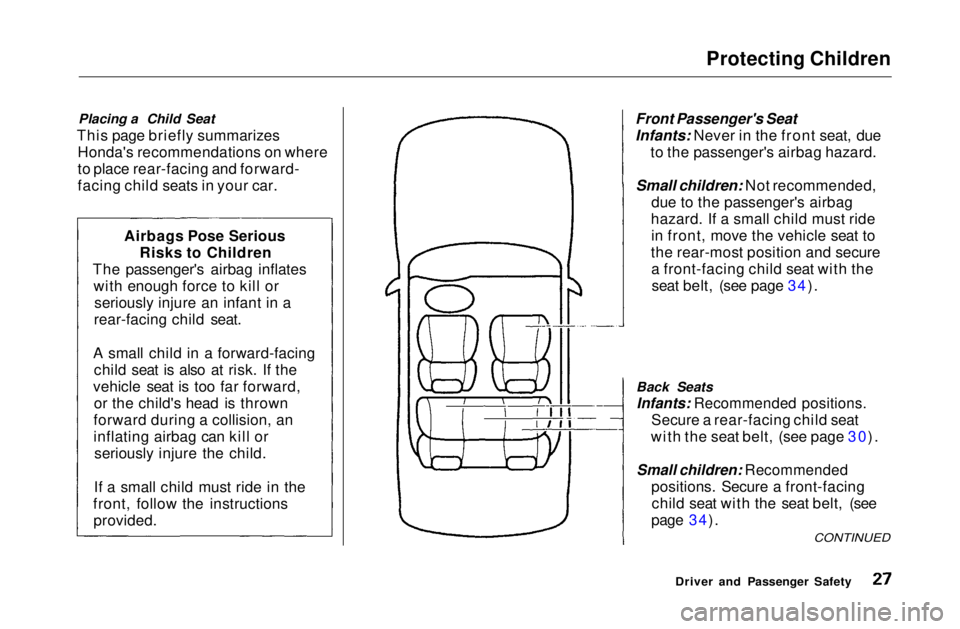
Front Passenger's Seat
Infants: Never in the front seat, due
to the passenger's airbag hazard.
Small children: Not recommended,
due to the passenger's airbag
hazard. If a small child must ride in front, move the vehicle seat to
the rear-most position and secure a front-facing child seat with theseat belt, (see page 34).
Back Seats
Infants: Recommended positions.
Secure a rear-facing child seat
with the seat belt, (see page 30).
Small children: Recommended
positions. Secure a front-facingchild seat with the seat belt, (see
page 34).
Driver and Passenger Safety
Airbags Pose Serious
Risks to Children
The passenger's airbag inflates with enough force to kill orseriously injure an infant in a
rear-facing child seat.
A small child in a forward-facing child seat is also at risk. If the
vehicle seat is too far forward, or the child's head is thrown
forward during a collision, an
inflating airbag can kill or seriously injure the child.
If a small child must ride in the
front, follow the instructions provided.
CONTINUEDMain Menu Table of Contents s t
Page 30 of 269
Protecting Children
Protecting Infants
Child Seat Type
Only a rear-facing child seat provides
proper support for a baby's head, neck, and back. Infants up to about
one year of age must be restrained in
a rear-facing child seat.
Two types of seats may be used: a seat designed exclusively for infants,
or a convertible seat used in the rear-
facing, reclining mode. We recommend that an infant be
restrained in a rear-facing child seat
until the infant reaches the seat
maker's weight or height limit and isable to sit up without support.
Rear-Facing Child Seat Placement
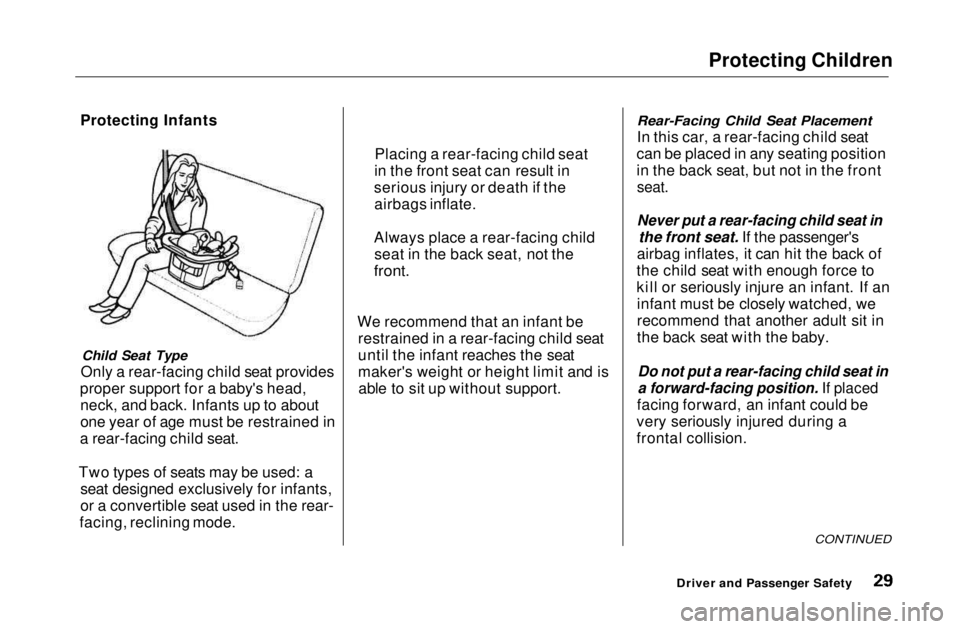
In this car, a rear-facing child seat
can be placed in any seating position
in the back seat, but not in the front
seat.
Never put a rear-facing child seat in
the front seat. If the passenger's
airbag inflates, it can hit the back of
the child seat with enough force to
kill or seriously injure an infant. If an infant must be closely watched, we
recommend that another adult sit in
the back seat with the baby.
Do not put a rear-facing child seat in
a forward-facing position. If placed
facing forward, an infant could be
very seriously injured during a
frontal collision.
CONTINUED
Driver and Passenger Safety
Placing a rear-facing child seat
in the front seat can result in
serious injury or death if the airbags inflate.
Always place a rear-facing child seat in the back seat, not the
front.Main Menu Table of Contents s t
Page 34 of 269
Protecting Children
Additional Precautions for Infants Never hold an infant on your lap.
If you are not wearing a seat belt
in a crash, you could be thrown
forward into the dashboard and crush the infant.
If you are wearing a seat belt, the
infant can be torn from your arms.For example, if your car crashes
into a parked vehicle at 30 mph (48 km/h), a 20-lb (9 kg) infant
will become a 600-lb (275 kg) force, and you will not be able to hold on.
Never put a seat belt over yourself
and an infant. During a crash, the
belt could press deep into the infant and cause very serious
injuries. Protecting Small Children
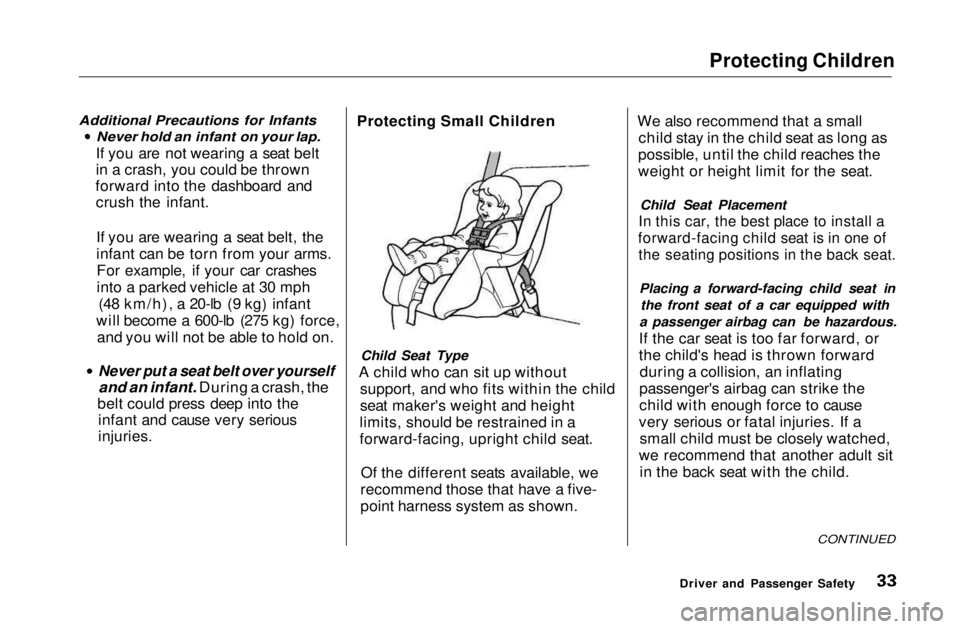
Child Seat Type
A child who can sit up without support, and who fits within the child
seat maker's weight and height
limits, should be restrained in a
forward-facing, upright child seat.
Of the different seats available, we
recommend those that have a five-
point harness system as shown. We also recommend that a small
child stay in the child seat as long as
possible, until the child reaches the
weight or height limit for the seat.
Child Seat Placement
In this car, the best place to install a
forward-facing child seat is in one of
the seating positions in the back seat.
Placing a forward-facing child seat in the front seat of a car equipped with
a passenger airbag can be hazardous.
If the car seat is too far forward, or
the child's head is thrown forward during a collision, an inflating
passenger's airbag can strike the
child with enough force to cause
very serious or fatal injuries. If a small child must be closely watched,
we recommend that another adult sit in the back seat with the child.
CONTINUED
Driver and Passenger SafetyMain Menu Table of Contents s t
Page 40 of 269
Protecting Children
Using a Booster Seat
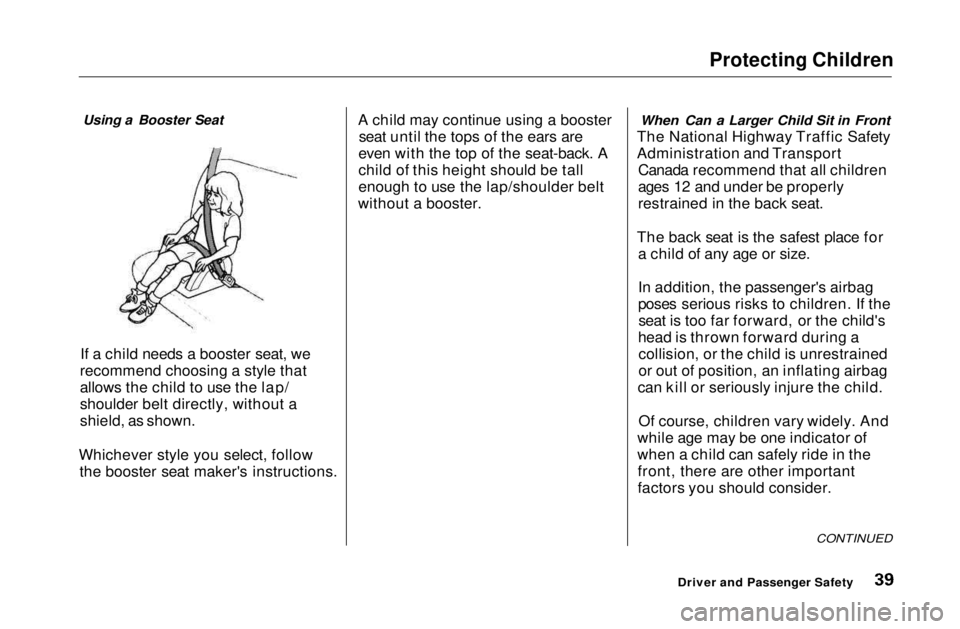
If a child needs a booster seat, we
recommend choosing a style that
allows the child to use the lap/
shoulder belt directly, without a
shield, as shown.
Whichever style you select, follow the booster seat maker's instructions. A child may continue using a booster
seat until the tops of the ears are
even with the top of the seat-back. A
child of this height should be tall
enough to use the lap/shoulder belt
without a booster.
When Can a Larger Child Sit in Front
The National Highway Traffic Safety
Administration and Transport Canada recommend that all children
ages 12 and under be properly
restrained in the back seat.
The back seat is the safest place for a child of any age or size.
In addition, the passenger's airbag
poses serious risks to children. If theseat is too far forward, or the child's
head is thrown forward during a collision, or the child is unrestrained
or out of position, an inflating airbag
can kill or seriously injure the child.
Of course, children vary widely. And
while age may be one indicator of
when a child can safely ride in the front, there are other important
factors you should consider.
CONTINUED
Driver and Passenger SafetyMain Menu Table of Contents s t
Page 46 of 269
Additional Information About Your SRS
SRS Components
Your Supplemental Restraint System (SRS) includes: Two front airbags. The driver's
airbag is stored in the center of
the steering wheel; the front
passenger's airbag is stored in the dashboard. Both are marked "SRS
AIRBAG." Sensors that can detect a
moderate to severe frontal
collision. A sophisticated electronic system
that continually monitors thesensors, control unit, the airbag
activators, and all related wiring
when the ignition is ON (II). An indicator light on the
instrument panel that alerts you to
a possible problem with thesystem (see page 47). Emergency backup power in case
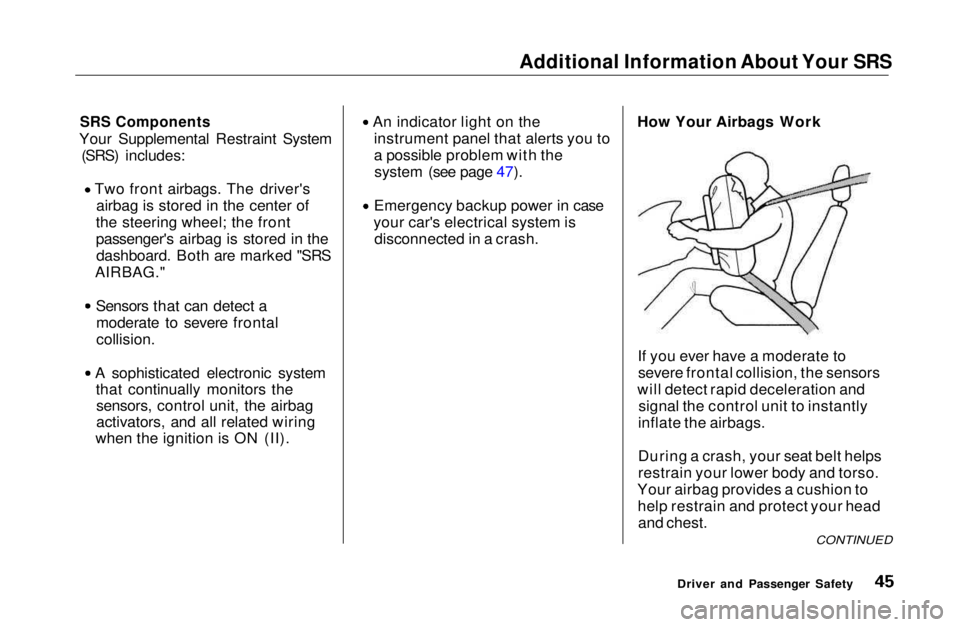
your car's electrical system is disconnected in a crash. How Your Airbags Work
If you ever have a moderate tosevere frontal collision, the sensors
will detect rapid deceleration and signal the control unit to instantly
inflate the airbags.
During a crash, your seat belt helps
restrain your lower body and torso.
Your airbag provides a cushion to help restrain and protect your headand chest.
Driver and Passenger Safety
CONTINUEDMain Menu Table of Contents s t
Page 52 of 269
Instruments and Controls
This section gives information about
the controls and displays thatcontribute to the daily operation of
your Honda. All the essential
controls are within easy reach.
Control Locations............................ 52
Indicator Lights................................ 53
Gauges.............................................. 57
Speedometer................................ 57
Tachometer.................................. 57
Odometer...................................... 57
Trip Meter.................................... 57
Fuel Gauge................................... 58
Temperature Gauge.................... 58
Maintenance Required
Indicator.................................... 59
Controls Near the Steering Wheel........................................ 60
Headlights.................................... 61
Daytime Running Lights............. 61
Instrument Panel Brightness..... 62
Turn Signals................................. 62
Windshield Wipers...................... 63
Windshield Washers................... 63
Hazard Warning........................... 64
Rear Window Defogger.............. 64
Steering Wheel Adjustment....... 65
Steering Wheel Controls ................ 66 Cruise Control.............................. 66
Keys and Locks................................ 69
Keys.............................................. 69
Ignition Switch............................. 69
Door Locks................................... 70
Power Door Locks....................... 71
Remote Transmitter.................... 72
Trunk............................................ 75
Seat Adjustments............................. 76
Front Seat Adjustments.............. 76
Rear Seat Access......................... 77
Head Restraints........................... 77
Folding Rear Seat............................ 78
Power Windows............................... 79
Moonroof.......................................... 81
Mirrors.............................................. 81
Adjusting the Power Mirrors..... 82
Parking Brake.................................. 83 Glove Box......................................... 83
Beverage Holder.............................. 84
Accessory Power Socket................ 85
Ashtrays............................................ 85
Interior Light.................................... 86
Instruments and ControlsMain Menu s t
Page 56 of 269
Indicator Lights
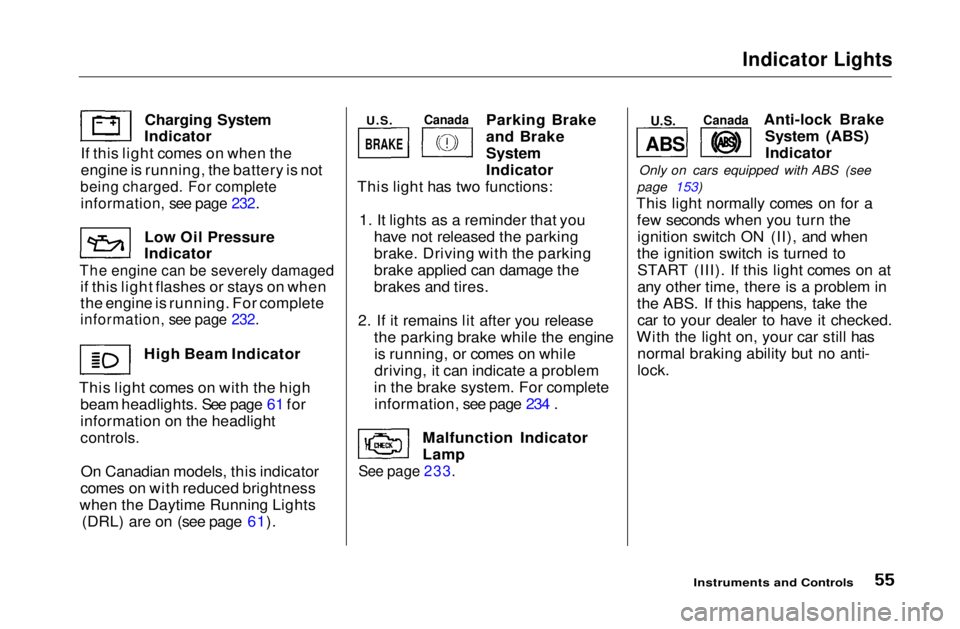
Charging System
Indicator
If this light comes on when the
engine is running, the battery is not
being charged. For complete
information, see page 232.
Low Oil Pressure
Indicator
The engine can be severely damaged
if this light flashes or stays on when
the engine is running. For complete
information, see page 232.
High Beam Indicator
This light comes on with the high beam headlights. See page 61 for
information on the headlight
controls.
On Canadian models, this indicator
comes on with reduced brightness
when the Daytime Running Lights (DRL) are on (see page 61). Parking Brake
and Brake
System
Indicator
This light has two functions:
1. It lights as a reminder that you have not released the parking
brake. Driving with the parking
brake applied can damage the
brakes and tires.
2. If it remains lit after you release the parking brake while the engineis running, or comes on while
driving, it can indicate a problem
in the brake system. For complete information, see page 234 .
Malfunction Indicator
Lamp
See page 233.
Anti-lock Brake
System (ABS)Indicator
Only on cars equipped with ABS (see
page 153)
This light normally comes on for a few seconds when you turn theignition switch ON (II), and when
the ignition switch is turned to START (III). If this light comes on at
any other time, there is a problem in
the ABS. If this happens, take the car to your dealer to have it checked.
With the light on, your car still has normal braking ability but no anti-
lock.
Instruments and Controls
U.S.
Canada
BRAKE
ABS
U.S.
CanadaMain Menu Table of Contents s t
Page 61 of 269
Controls Near the Steering Wheel
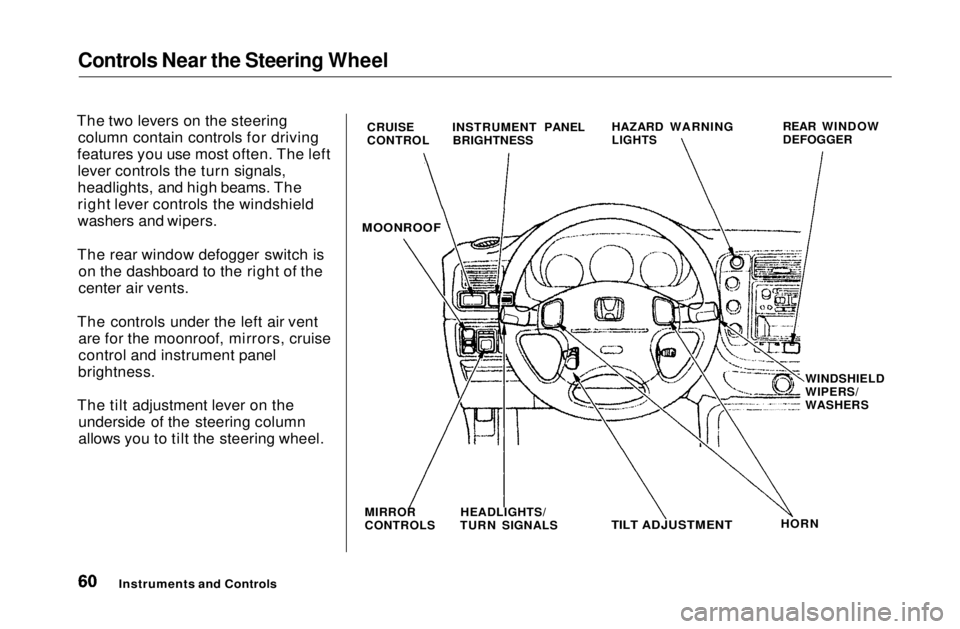
The two levers on the steering column contain controls for driving
features you use most often. The left lever controls the turn signals,
headlights, and high beams. The
right lever controls the windshield
washers and wipers.
The rear window defogger switch is on the dashboard to the right of the
center air vents.
The controls under the left air vent are for the moonroof, mirrors, cruise
control and instrument panel
brightness.
The tilt adjustment lever on the underside of the steering column
allows you to tilt the steering wheel.
Instruments and Controls
CRUISE
CONTROL
INSTRUMENT PANEL
BRIGHTNESS HAZARD WARNING
LIGHTS
REAR WINDOW
DEFOGGER
MOONROOF
MIRROR
CONTROLS HEADLIGHTS/
TURN SIGNALS
TILT ADJUSTMENT
HORNWINDSHIELD
WIPERS/
WASHERSMain Menu Table of Contents s t
Page 62 of 269
Controls Near the Steering Wheel
Headlights
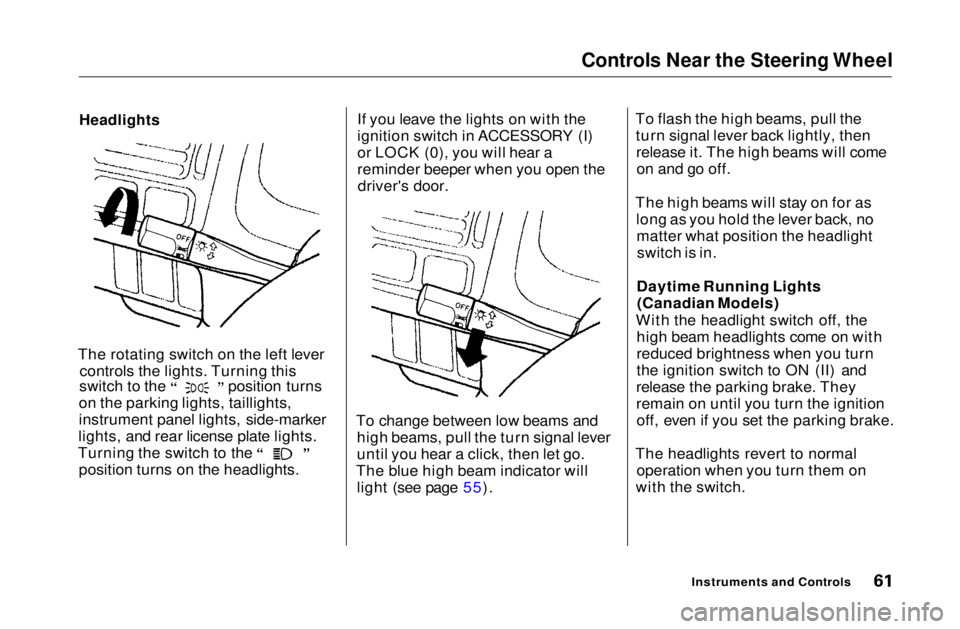
The rotating switch on the left lever controls the lights. Turning this switch to the position turns
on the parking lights, taillights,
instrument panel lights, side-marker
lights, and rear license plate lights. Turning the switch to the
position turns on the headlights. If you leave the lights on with the
ignition switch in ACCESSORY (I)
or LOCK (0), you will hear a
reminder beeper when you open the
driver's door.
To change between low beams and high beams, pull the turn signal lever
until you hear a click, then let go.
The blue high beam indicator will light (see page 55). To flash the high beams, pull the
turn signal lever back lightly, thenrelease it. The high beams will comeon and go off.
The high beams will stay on for as long as you hold the lever back, nomatter what position the headlightswitch is in.
Daytime Running Lights (Canadian Models)
With the headlight switch off, the high beam headlights come on with
reduced brightness when you turn
the ignition switch to ON (II) and
release the parking brake. They
remain on until you turn the ignition off, even if you set the parking brake.
The headlights revert to normal operation when you turn them on
with the switch.
Instruments and ControlsMain Menu Table of Contents s t
Page 78 of 269
Seat Adjustments
Rear Seat Access
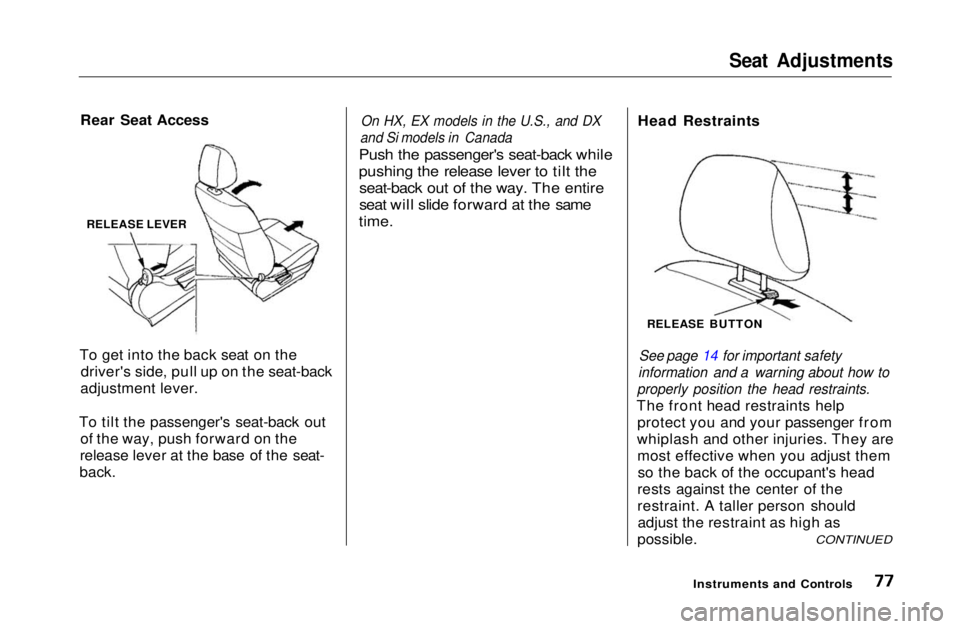
To get into the back seat on the driver's side, pull up on the seat-back
adjustment lever.
To tilt the passenger's seat-back out of the way, push forward on the
release lever at the base of the seat-
back.
On HX, EX models in the U.S., and DX
and Si models in Canada
Push the passenger's seat-back while
pushing the release lever to tilt the seat-back out of the way. The entire
seat will slide forward at the same
time.
Head Restraints
See page 14 for important safety
information and a warning about how to
properly position the head restraints.
The front head restraints help protect you and your passenger from
whiplash and other injuries. They are most effective when you adjust themso the back of the occupant's head
rests against the center of the
restraint. A taller person should adjust the restraint as high as
possible.
Instruments and Controls
CONTINUED
RELEASE LEVER
RELEASE BUTTONMain Menu Table of Contents s t